How to walk in place for calorie burn
What if I told you that you could burn calories, boost your metabolism, and get fit without ever leaving your living room—or even changing out of your pajamas? I know it sounds too simple to work.
When I first started walking in place during commercial breaks five years ago, I thought I was just staying slightly less sedentary.
Then I tracked my heart rate and realized I was burning nearly 200 calories in just 30 minutes. No gym membership. No expensive equipment. No intimidating fitness classes: just me, a small space, and the proven power of walking in place.
Here’s what most fitness content won’t tell you: the exercise industry profits from making you believe that results require complexity.
But research consistently shows that consistent, moderate-intensity movement beats sporadic intense workouts for sustainable fat loss and cardiovascular health.
Walking in place delivers exactly that—a low-barrier, high-consistency solution that works whether you’re a busy professional squeezing in movement between meetings, a stay-at-home parent working out during naptime, or a beginner who wants to start a fitness journey without the gym intimidation factor.
In this guide, you’ll discover exactly how many calories you can burn walking in place (with specific numbers based on your weight and intensity), proper form techniques to maximize every minute, creative variations to keep challenging your body, and how to build a sustainable routine that fits your actual life.
No hype. No impossible promises. Just the realistic, science-backed approach that transformed my own fitness and has worked for hundreds of clients I’ve coached.
Why Walking in Place Is a Powerful Calorie-Burning Solution

The Science Behind the Burn
Let’s talk numbers. Walking in place burns between 150-300 calories per hour depending on your body weight and intensity level. A 155-pound person walking at a moderate pace burns approximately 185 calories per hour, while that same person doing high knees or power walking in place can burn up to 300 calories in the same timeframe.
How does this compare to other cardio? Traditional outdoor walking burns roughly 200-250 calories per hour for the same person, meaning walking in place is nearly as effective—and sometimes more effective when you increase intensity. Running burns more (around 450-600 calories per hour), but it also carries significantly higher injury risk and isn’t sustainable for most people long-term.
The real magic happens with something called excess post-exercise oxygen consumption (EPOC). When you walk at a moderate to high intensity, your body continues burning calories for up to 2 hours after you stop moving. This metabolic boost is why consistent daily walking can create a calorie deficit of 1,000-1,500 calories per week—enough to lose a pound every 2-3 weeks without changing your diet.
Perfect for Real Life, Real Schedules
Here’s what changed everything for me: eliminating the commute to the gym gave me back 40 minutes per day. That’s 40 minutes I could actually spend exercising instead of sitting in traffic or searching for parking. The average person spends 15-30 minutes getting to and from the gym. Walking in place removes that friction entirely.
It’s also completely weather-proof. I live in the Midwest, where winter temperatures regularly drop below zero. During those months, outdoor walking becomes dangerous and unpleasant. Walking in place means your fitness routine never gets derailed by weather, darkness, or unsafe conditions.
The multi-tasking potential is real. I’ve walked in place during conference calls (camera off), while watching my kids play, during TV shows, and while listening to audiobooks. This isn’t about being busy for the sake of busy—it’s about removing the false choice between movement and other priorities. Research from the American Council on Exercise shows that people who integrate movement into existing activities maintain their routines 3 times longer than those who carve out separate “workout time.”
Low-Impact, High-Results Approach
This matters more than most people realize. Running and high-impact exercises create ground reaction forces of 2-3 times your body weight with every step. For a 180-pound person, that’s 360-540 pounds of force on your knees, ankles, and hips thousands of times per workout. Walking in place generates approximately 1-1.5 times your body weight—significantly gentler on your joints while still providing cardiovascular and calorie-burning benefits.
I’ve worked with clients in their 60s who couldn’t run anymore but could walk in place for 45 minutes. I’ve coached people with previous knee injuries who needed low-impact options. The joint-friendly nature of walking in place makes it sustainable for decades, not just months.
The sustainability factor extends beyond physical stress. High-intensity workouts trigger higher levels of cortisol and require more recovery time. Walking in place can be done daily without overtraining, making it ideal for building the consistency that actually creates results. You’re not looking for the workout that destroys you once a week—you’re looking for the movement you can do 5-6 days per week for the next year.
Mastering Proper Form to Maximize Calorie Burn

The Foundation: Basic Walking in Place Technique
Proper posture starts with your alignment. Stand with your shoulders pulled back and down—not up toward your ears. Imagine a string pulling the top of your head toward the ceiling, lengthening your spine. Your chin should be parallel to the floor, not jutting forward or dropped down. Engage your core by pulling your belly button toward your spine without holding your breath. This creates a stable base that protects your lower back and increases calorie burn by recruiting more muscle fibers.
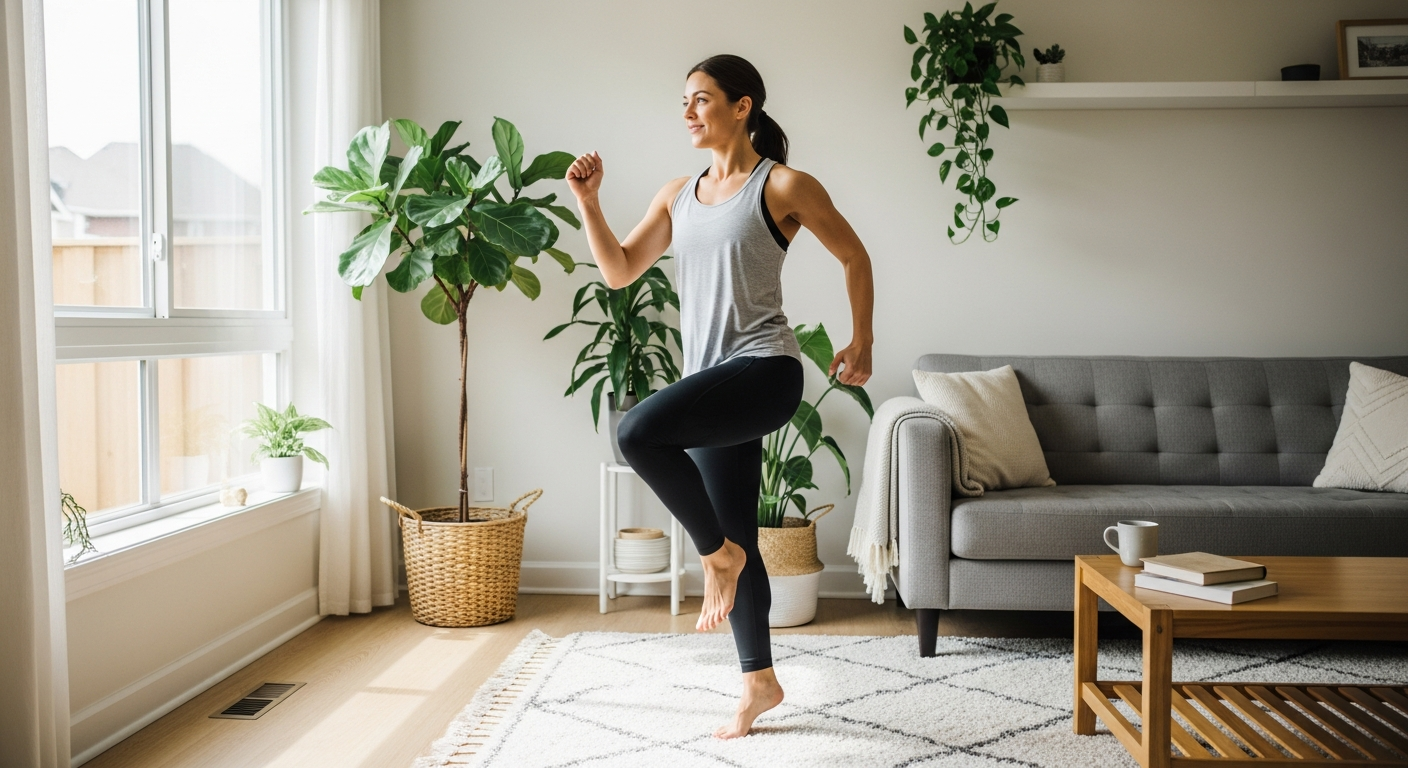
Foot placement matters more than you think. When lifting your knee, your foot should clear the ground by at least 4-6 inches. Land on your midfoot, not your heel or toes exclusively. Your weight should transfer smoothly from one foot to the other without heavy pounding. If you’re making loud stomping sounds, you’re landing too hard and need to soften your steps.
Arm swing mechanics can increase your calorie expenditure by 5-10%—that’s an extra 10-20 calories per hour. Bend your elbows at approximately 90 degrees. Swing your arms naturally with each step, keeping them close to your body rather than swinging wide. Your hands should reach roughly chest height in front and hip height behind. The opposite arm and leg move together—right arm forward when left leg lifts, and vice versa.
Breathing Patterns That Boost Performance
Most people hold their breath or breathe shallowly during exercise without realizing it. Rhythmic breathing enhances oxygen delivery to your muscles, which directly impacts fat burning efficiency. Try a 3-3 pattern: inhale for three steps, exhale for three steps. If you’re working harder, switch to a 2-2 pattern.
Your breathing rate tells you if you’re working at the right intensity. You should be able to speak in short sentences but not carry on a full conversation comfortably. This “talk test” indicates you’re in the moderate-intensity zone where fat burning is optimized. If you can only gasp single words, you’re working too hard for sustainable calorie burn. If you can sing, you need to increase your intensity.
Proper oxygen flow does more than just fuel your muscles—it also helps your body access fat stores for energy. During moderate-intensity exercise with adequate oxygen, your body uses a mix of carbohydrates and fat for fuel, with fat contributing 40-60% of the energy. When you’re gasping and oxygen-deprived, you rely almost entirely on carbohydrates, which is less efficient for fat loss.
Common Mistakes That Sabotage Your Results
The biggest mistake I see is minimal knee lift—basically shuffling your feet with tiny movements. This barely elevates your heart rate and burns minimal calories. Your knee should lift high enough that your thigh is roughly parallel to the floor at the top of the movement, or at minimum, your foot should be 6-8 inches off the ground. The higher the knee lift, the more muscle activation and calorie burn you create.
Looking down at your phone destroys your posture and reduces calorie burn by up to 20%. When your head drops forward, your shoulders round, your core disengages, and your breathing becomes shallow. If you want to watch something, position your device at eye level. I mounted a tablet holder on my wall specifically for this purpose.
Inconsistent pace is another silent sabotage. Starting strong and then gradually slowing down means you spend most of your workout at a lower intensity than you think. Set a timer and commit to maintaining your pace for the entire interval. If you can’t maintain intensity for 20 minutes, do 10-minute intervals with 2-minute rest periods instead of one long, progressively slower session.
Proven Variations to Sculpt and Tone While You Walk

High Knees for Maximum Calorie Burn
High knees transform basic walking into a calorie-burning powerhouse. The technique requires lifting your knees to hip height or higher with each step, driving them up quickly and powerfully. Your pace increases naturally, and you engage your hip flexors, quadriceps, and core significantly more than basic walking.
The calorie burn increase is substantial—up to 50% more than basic walking in place. A 155-pound person burning 185 calories per hour with basic walking can burn 270-300 calories doing high knees at the same duration. The key is maintaining good form: keep your core tight, land softly, and use your arms to drive the movement.
For interval integration, I recommend starting with 30-second high knee bursts followed by 90 seconds of regular-pace walking in place. As you build endurance, progress to 45 seconds of high knees with 60 seconds of recovery, then eventually 60 seconds of high knees with 30 seconds of recovery. A 20-minute workout might include 8-10 high knee intervals, significantly boosting your total calorie burn.
Power Walking in Place with Arm Movements
Adding intentional upper body engagement transforms walking in place into a full-body workout. Instead of letting your arms swing naturally, incorporate deliberate movements: overhead reaches, lateral raises, front punches, or arm circles. Each variation recruits different muscle groups—shoulders, back, chest, and arms—increasing your total muscle activation and calorie expenditure.
Arm circles are particularly effective. As you walk, extend your arms out to the sides at shoulder height and make small circles forward for 30 seconds, then backward for 30 seconds. This engages your deltoids and upper back while maintaining your lower body movement. Front punches engage your chest and triceps—alternate punching forward with each step, keeping your core tight to prevent twisting.
How much difference does this make? Adding upper body movements can increase your calorie burn by 100+ calories per hour. That 185-calorie baseline becomes 285-300 calories with consistent arm engagement. The compound effect of moving more muscle mass simultaneously requires more energy, plain and simple.
Side Steps and Twist Variations
Side-stepping while staying in place engages your outer thighs, glutes, and obliques—muscles barely activated during forward walking. Step your right foot out to the side, bring your left foot to meet it, then step left foot out to the side and bring your right foot in. Maintain the stepping rhythm continuously, keeping your knees slightly bent and your weight in your heels.
Adding twists targets your obliques and core even more directly. As you lift your right knee, rotate your torso to bring your left elbow toward your right knee. Alternate sides with each step. This creates a dynamic ab workout while maintaining your cardio intensity. The rotational movement also improves spinal mobility and functional fitness.
Creating a dynamic routine means cycling through variations every 2-3 minutes. Start with 2 minutes of basic walking to warm up, then 2 minutes of high knees, 2 minutes of power walking with arm circles, 2 minutes of side steps, 2 minutes of twist variations, and repeat. This circuit-style approach prevents boredom, challenges multiple muscle groups, and maintains high calorie burn throughout your entire workout.
How Many Calories Can You Actually Burn? (The Numbers)

Calorie Burn by Body Weight and Intensity
Let’s get specific because vague estimates don’t help you plan. A 125-pound person walking in place at a light to moderate intensity (feeling like you’re moving but not breathing hard) burns approximately 150-240 calories per hour. At higher intensity with knee lifts and arm movements, that increases to 220-280 calories per hour.
A 155-pound person—roughly the average weight used in most calorie studies—burns 185-300 calories per hour depending on intensity. Light walking in place burns around 185 calories, moderate intensity with good form burns 220-250 calories, and high-intensity variations like high knees or power walking burn 270-300 calories.
A 185-pound person burns 220-360 calories per hour. The heavier you are, the more energy your body requires to move, which is why larger individuals burn more calories doing the same exercise. Light intensity burns about 220 calories, moderate burns 260-300 calories, and high intensity can reach 340-360 calories per hour.
Factors that influence your personal calorie expenditure include your fitness level (fitter people burn slightly fewer calories doing the same exercise because their bodies become more efficient), your muscle mass (more muscle burns more calories), your age (metabolism decreases about 2% per decade after age 30), and your consistency with form and intensity throughout the workout.
Boosting Your Burn: Intensity Multipliers
Resistance bands add genuine challenge and calorie burn. Loop a resistance band around your thighs just above your knees while walking in place. This forces your hip abductors to work harder with every step, increasing calorie burn by an estimated 20-40 calories per hour while simultaneously sculpting your outer thighs and glutes. The constant tension creates metabolic demand even during “easier” portions of your workout.
Light hand weights (1-3 pounds) increase calorie expenditure by 30-50 calories per hour when used properly. Hold them while doing arm movements—punches, overhead presses, lateral raises—as you walk. Don’t just let them hang at your sides; that won’t increase burn meaningfully. The key is active movement. Heavier isn’t always better here; if weights force you to slow down or compromise form, they’re counterproductive.
Increasing speed and knee height can double your calorie burn—literally. Moving from a leisurely 2 mph pace to a vigorous 4 mph pace with high knee lifts can take you from 180 calories per hour to 360 calories per hour. This is the most accessible intensity multiplier because it requires no equipment, just effort and consistency.
Realistic Expectations and Timeline for Results
Here’s what 30 minutes of daily walking in place can achieve in one month. A 155-pound person burning 220 calories per session (moderate intensity) completes 6,600 calories of exercise in 30 days. Since one pound of fat equals approximately 3,500 calories, that’s 1.9 pounds of potential fat loss from exercise alone—without changing your diet.
Combining with nutrition creates better results. If you also reduce your calorie intake by 250 calories per day (eliminating one snack or dessert), you create a total deficit of 470 calories per day. Over 30 days, that’s 14,100 calories or 4 pounds of fat loss. This is sustainable, healthy weight loss that you can maintain.
Why consistency beats intensity for long-term transformation: I’ve watched countless people start aggressive workout programs, burn out within 3 weeks, and quit entirely. Compare that to walking in place for 20-30 minutes daily. It’s not sexy. It doesn’t make for dramatic before-and-after photos after one week. But it’s something you can do today, tomorrow, and every day for the next year. That consistency creates body composition changes that last because they’re built on sustainable habits, not unsustainable suffering.
Building Your Effective Walking in Place Routine

Beginner-Friendly Starting Point (Weeks 1-2)
Start with 10-15 minute sessions, 3-4 times per week. This feels almost too easy, and that’s exactly the point. You’re building a habit, not proving your toughness. Focus entirely on form: proper posture, controlled breathing, consistent pace, and good knee lift. Set a timer and commit to moving for the entire duration without stopping.
Your only goal during these first two weeks is showing up consistently. Don’t worry about calories burned or weight lost. Track your workouts on a calendar—every time you complete a session, mark it with an X. Your streak of X’s becomes its own motivation.
Simple progression markers: By the end of week 2, you should be able to maintain a conversation while walking (the talk test), your breathing should feel rhythmic rather than gasping, and you should finish your 15-minute session feeling energized rather than exhausted. If you’re struggling, that’s feedback to slow down or reduce duration, not to quit.
Intermediate Progression (Weeks 3-6)
Increase to 20-30 minute sessions, 4-5 times per week. You’ve built the habit; now you’re building fitness capacity. Introduce interval training by alternating intensity levels: 2 minutes at a comfortable pace, then 1 minute at a challenging pace with higher knees and faster movement. Repeat this pattern throughout your workout.
Adding variations prevents the dreaded plateau where your body adapts and results slow. Every workout should include at least two different movement patterns. Try 5 minutes of basic walking, 5 minutes with arm circles, 5 minutes of high knees, 5 minutes of side steps, and 5 minutes of twist variations. This circuit-style approach keeps your body guessing and your mind engaged.
You should notice tangible improvements by week 6: your resting heart rate may drop by 5-10 beats per minute (a sign of improved cardiovascular fitness), you’ll recover faster between intervals, and activities like climbing stairs or carrying groceries will feel easier. These functional improvements matter more than the number on the scale.
Advanced Routines for Maximum Results
Progress to 30-45 minute sessions with structured intervals. A sample advanced workout: 5-minute warm-up at an easy pace, then 10 rounds of 2 minutes high intensity (high knees, power walking with arm movements) followed by 1 minute active recovery (slow, controlled walking). Finish with a 5-minute cool-down. This pattern creates significant calorie burn and cardiovascular adaptation.
Combining multiple variations in circuit-style workouts maximizes both calorie burn and muscle engagement.