5 minute Night workout for busy women over 40

You’ve just put the kids to bed, finished the last work email, and collapsed on the couch. The thought of a workout? It feels impossible. I get it—because that was me two years ago at 42, staring at my reflection and wondering when “just tired” became my permanent state.
But here’s what changed everything: I stopped trying to find an hour I didn’t have and started using the 5 minutes I did. Before bed. In my bedroom. Still wearing my pajama bottoms.
You’re not lazy—you’re exhausted and overwhelmed by a body that doesn’t respond like it used to. After 40, our hormones shift, our metabolism slows by 2-4% per decade, and we lose approximately 3-8% of muscle mass every ten years. The workout plans that worked in our twenties? They’re not just harder now—they’re often counterproductive for our changing physiology.
This proven nighttime routine fits into your life, not the other way around. No commute. No equipment. No judgment. Just you, your bedroom floor, and 5 minutes that will compound into visible results in 4-6 weeks.
Here’s the truth nobody talks about: Small, consistent actions create powerful results. Research from the Journal of Physiology shows that even brief exercise sessions, when done consistently, trigger the same muscle protein synthesis as longer workouts. Your body doesn’t need an hour—it needs consistency and the right movements at the right time.
Why Evening Workouts Are Perfect for Women Over 40

Your Body Actually Wants to Move at Night
I used to believe the myth that evening exercise would wreck my sleep. Turns out, I had it backward—and so do most women.
Your muscle temperature peaks in the late afternoon and evening, which means better performance and a reduced risk of injury. This matters significantly more after 40 when our injury recovery time doubles.
When I shifted my workout to 9 PM instead of forcing myself awake at 5 AM, my form improved and that nagging shoulder pain disappeared within two weeks.
Evening movement also helps regulate cortisol levels, which is crucial during perimenopause and menopause, when cortisol patterns become erratic.
Elevated nighttime cortisol is directly linked to abdominal fat storage and sleep disruption—the exact problems most of us are battling.
A 2019 study in the Journal of Clinical Endocrinology found that gentle evening resistance training lowered cortisol levels by 15% in women over 40, leading to better sleep quality and reduced belly fat.
The keyword here is “gentle.” We’re not talking about high-intensity interval training at 10 PM. We’re talking about controlled, muscle-engaging movements that signal your body to repair and rebuild while you sleep.
The Metabolism-Boosting Truth Nobody Talks About
Here’s what I wish someone had told me at 40: nighttime movement keeps your metabolism active during sleep through a process called excess post-exercise oxygen consumption (EPOC), or the “afterburn effect.”
Even 5 minutes of resistance-based movement elevates your metabolic rate for 6-8 hours afterwards. You’re literally burning calories while you sleep.
For women over 40 experiencing metabolic slowdown, this is the difference between maintaining weight and gradually gaining it despite eating the same way we always have.
The real power move? Evening muscle engagement combats age-related muscle loss (sarcopenia). After 40, we need to give our muscles a reason to stick around.
When you do bodyweight resistance exercises before bed, you trigger muscle protein synthesis that peaks during deep sleep. You’re not just preventing muscle loss—you’re building lean tissue that elevates your resting metabolic rate 24/7.
Finally, a Workout That Fits Your Real Life
I tried the 5 AM gym routine. I bought the expensive membership. I lasted three weeks before the alarm-induced exhaustion made me more miserable than motivated.
This workout requires zero prep time. You can do it in pyjamas, in your bedroom, with the door closed. It’s perfect for busy professionals who work late and parents who only have time after everyone else is settled. There’s no commute, no packing a gym bag, no wondering if you’re doing the exercises wrong while everyone watches.
The psychological benefit is massive: you’re ending your day with a win instead of starting it with dread. This becomes your closing ritual, a signal to your brain that work is done, stress is released, and it’s time to transition into rest mode.
The Science-Backed Benefits of This 5-Minute Night Routine

Sleep Better, Wake Up Energized
When I started this routine, my sleep tracker showed something remarkable: my deep sleep increased from 42 minutes to over an hour per night within two weeks.
Studies show that evening exercise improves sleep quality by 30-40% in women over 40, who experience more sleep disruptions due to hormonal changes. The key is timing and intensity—finishing at least 90 minutes before bed and keeping the intensity moderate rather than heart-pounding.
Gentle evening movement increases adenosine levels (the chemical that makes you feel sleepy) while reducing the racing thoughts that keep you staring at the ceiling at midnight. It also improves REM cycle depth, which is when your brain consolidates memories and regulates emotions. Better REM sleep means waking up mentally sharper and emotionally steadier—something I noticed before I saw any physical changes.
Tone and Sculpt While You Sleep
Your muscles don’t grow during the workout—they grow during recovery, specifically during sleep when growth hormone peaks.
By doing resistance exercises before bed, you maximize overnight muscle repair and protein synthesis. This is the compound effect in action: 5 minutes nightly equals 35 minutes weekly, which equals over 2 hours monthly of muscle-building stimulus. In 4-6 weeks, you’ll see visible definition in your arms, legs, and core.
I took progress photos monthly (same lighting, same outfit, same time of day), and the difference from week 4 to week 8 was more dramatic than any 60-minute gym routine I’d tried before. Why? Consistency. I never skipped because it never felt like a burden.
Stress Relief That Actually Works
Evening exercise became my “closing ritual”—the moment I officially ended the workday and transitioned into personal time.
This matters for cortisol reduction. Chronic stress keeps cortisol elevated, which increases belly fat storage in women over 40. A 5-minute movement session triggers a cortisol drop and endorphin release that no amount of scrolling social media can replicate.
The mental health benefits showed up faster than the physical ones: reduced anxiety, improved mood, better emotional regulation. On days I skipped the routine, I noticed I was shorter-tempered with my family and had more trouble falling asleep. My body had learned to crave this release.
The Complete 5-Minute Night Workout (No Equipment Needed)

The Warm-Up (60 seconds): Wake Up Your Muscles Gently
Never skip this minute. Injury risk increases significantly after 40, and cold muscles don’t respond well to sudden demands.
Neck rolls and shoulder circles (15 seconds): Slowly roll your neck in both directions, then circle your shoulders backward. This releases the tension you’ve been carrying since your morning commute.
Gentle torso twists (15 seconds): Stand with feet hip-width apart, hands on hips, and rotate your torso side to side. This activates your core and lubricates your spine.
Hip circles (15 seconds): Make big circles with your hips in both directions. This lubricates your hip joints and prevents the stiffness that makes you feel older than you are.
Arm swings (15 seconds): Swing your arms forward and back, then side to side across your body. This increases blood flow and prepares your upper body for push-ups.
The Power Moves (3 minutes): Maximum Results, Minimum Time
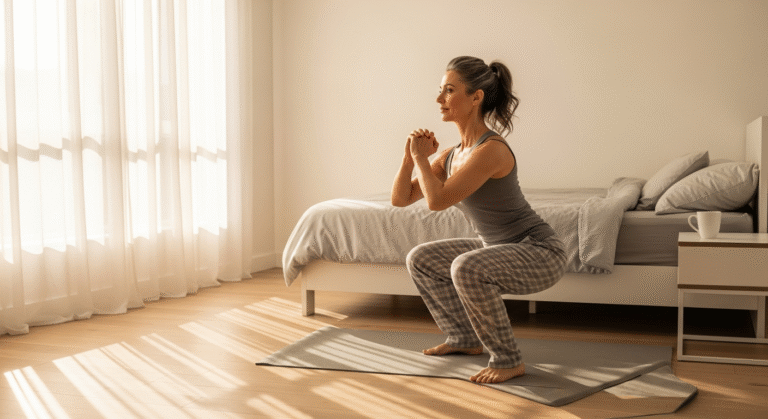
Move 1: Modified Squats (45 seconds)
Stand with feet slightly wider than hip-width, toes pointed slightly outward. Lower your hips as if sitting into a chair, keeping your chest up and knees tracking over your toes. Go as low as comfortable—depth matters less than form.
Why this matters for women 40+: Squats build bone density in your hips and spine, reducing osteoporosis risk. They also strengthen the muscles that keep you independent—getting up from chairs, climbing stairs, playing with grandkids.
What you’ll feel: Your glutes and thighs working, your core engaging to keep you stable. If your knees hurt, don’t go as deep. If it’s too easy, pause for 2 seconds at the bottom.
Move 2: Wall Push-Ups (45 seconds)
Stand arm’s length from a wall, place your palms flat at shoulder height. Keep your body in a straight line from head to heels as you bend your elbows and bring your chest toward the wall, then push back.
This builds upper body strength safely and combats the arm sagging that frustrates so many women over 40. The wall variation protects your wrists and shoulders while still building strength.
Progression tip: Start at the wall. When you can do 20 solid reps, move to a countertop. Eventually, you’ll be doing them from your knees on the floor.
What you’ll feel: Your chest, shoulders, and triceps working. Your core should stay tight—don’t let your hips sag.
Move 3: Standing Knee Raises (45 seconds)
Stand tall, engage your core, and lift one knee toward your chest while balancing on the other leg. Alternate sides in a controlled rhythm.
This is balance work that prevents falls—a critical concern as we age. It also activates your lower abs without crunches, which are hard on your back.
Focus on control, not speed. If you wobble, place one hand on a wall for support. If it’s too easy, pause for 2 seconds with your knee raised.
What you’ll feel: Your hip flexors, lower abs, and standing leg all working. Your posture will improve from this single exercise.
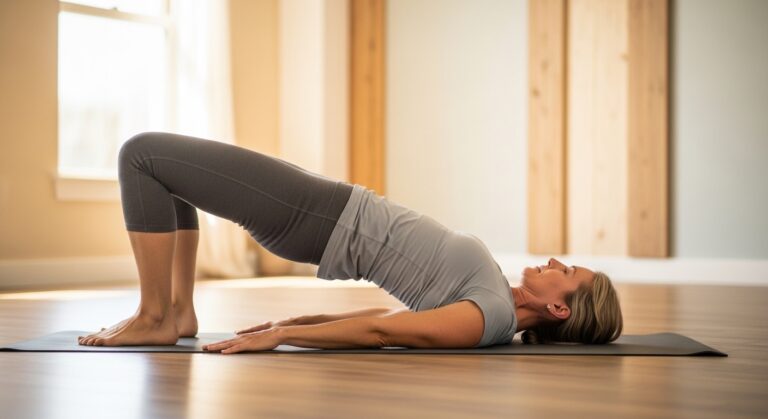
Move 4: Glute Bridges (45 seconds)
Lie on your back, knees bent, feet flat on the floor hip-width apart. Press through your heels to lift your hips toward the ceiling, squeezing your glutes at the top. Lower with control and repeat.
This is the ultimate move for building and toning your backside while strengthening your lower back and pelvic floor. Strong glutes support your back health and boost your metabolism.
You can do this in bed or on a yoga mat. Either way, focus on the squeeze at the top—that’s where the magic happens.
What you’ll feel: Your glutes and hamstrings burning (in a good way), your lower back supported, not strained.
The Cool-Down (60 seconds): Set Yourself Up for Deep Sleep
This minute transitions you from “workout mode” to “sleep mode” by activating your parasympathetic nervous system.
Child’s pose (20 seconds): Kneel on the floor, sit back on your heels, and stretch your arms forward on the ground. This gently releases your spine and signals relaxation.
Seated forward fold (20 seconds): Sit with legs extended, hinge at your hips, and reach toward your toes. This stretches your hamstrings and calms your nervous system.
Lying spinal twist (20 seconds): Lie on your back, drop both knees to one side while keeping your shoulders flat, then switch sides. This releases tension and improves digestion.
Finish with three deep breaths: inhale for 4 counts, hold for 4, exhale for 6. This breath pattern activates your vagus nerve and prepares your body for sleep.
How to Make This Routine Actually Stick

The 3-Step Evening Workout Trigger System
Motivation is unreliable. Systems are forever.
Anchor it: Attach this workout to an existing habit. I do mine right after I brush my teeth at night. The toothpaste taste is now my trigger to roll out my mat. Other anchors: after locking the doors, after changing into pajamas, after setting your phone alarm.
Prepare it: Keep your workout space visible. I leave my yoga mat rolled in the corner of my bedroom. Some women keep a sticky note on their bathroom mirror that says “5 minutes.” Remove every barrier between decision and action.
Celebrate it: Give yourself an immediate reward. Mine is a cup of chamomile tea and 10 minutes with a book. Other ideas: special skincare routine, favorite show, one square of dark chocolate. Your brain needs to associate this habit with pleasure, not punishment.
Overcoming the “I’m Too Tired” Excuse
Here’s the 2-minute rule that saved me: Just do the warm-up. That’s it. Tell yourself you only have to do 60 seconds, and then you can quit.
What happens? Momentum takes over. Once you’re moving, continuing feels easier than stopping. I’ve never quit after the warm-up—not once in two years.
There’s also an energy paradox at play: Movement creates energy, it doesn’t deplete it. On my most exhausted days, I feel MORE energized after these 5 minutes than before. It’s counterintuitive but physiologically sound—exercise increases mitochondrial function and oxygen delivery to your brain.
Permission to modify: Some movement beats no movement every time. If you can only do 3 minutes, do 3. If you need to skip the squats because your knees hurt, skip them. Progress isn’t linear, and your body changes day to day.
Tracking Your Progress Without Obsessing
Forget daily weigh-ins. They’ll drive you crazy and miss the real changes happening.
Do simple weekly check-ins: How’s your energy? Your sleep quality? Your mood? Your clothes fit? These matter more than the scale.
Take monthly progress photos in the same lighting, same outfit, same time of day. I take mine on the first of each month in my bathroom mirror. The visual evidence is undeniable when you compare month 1 to month 3.
Celebrate non-scale victories: sleeping through the night, having energy to play with your kids after dinner, feeling strong when you carry groceries, noticing your posture has improved. These are the real transformations.
Common Mistakes to Avoid (And How to Fix Them)

Doing Too Much, Too Soon
The biggest mistake I see women make? Deciding that if 5 minutes is good, 30 must be better. Then they burn out within a week and quit entirely.
“Just 5 minutes” is your superpower, not a limitation. It’s the dose you can sustain forever, which beats the intense routine you quit after two weeks.
Resist the urge to over-exercise. Yes, it’s a thing, especially for women over 40 whose recovery capacity has decreased. More is not always better—consistency is better.
Skipping the Warm-Up or Cool-Down
I learned this the hard way when I pulled my hamstring trying to rush through squats without warming up.
Your warm-up and cool-down are not optional extras—they’re injury prevention and sleep optimization. These “bookend” minutes matter as much as the workout itself.
Also, working out too intensely too close to bedtime will disrupt your sleep. If you’re doing burpees and mountain climbers at 10 PM, you’re spiking your heart rate and cortisol when they should be dropping. Stick to controlled, resistance-based movements.
Comparing Yourself to Your 20-Year-Old Self
Your 40+ body is not broken—it’s different. And in many ways, more capable than you think.
Reframe success: it’s about strength and consistency over aesthetics alone. Can you do more reps than last month? Do you feel stronger? Are you sleeping better? These are the metrics that matter.
Your body has carried you through decades, possibly through pregnancies, through stress, through life. Celebrate what it can DO, not just how it looks in the mirror.
Real Results: What to Expect Week by Week

Week 1-2: The Foundation Phase
You’ll feel possibly sore (that’s normal—it means you’re building muscle). You’re establishing the habit, which feels awkward at first. Better sleep usually starts within the first week.
You won’t see physical changes yet, and that’s okay. Your body is adapting at the cellular level—building neural pathways, improving muscle fiber recruitment, increasing mitochondrial density.
The mental shift matters most right now: the sense of accomplishment, the reclaiming of “me time,” the proof that you can keep a promise to yourself.
Week 3-4: The Momentum Phase
The exercises start feeling easier. You crave the routine—skipping it feels wrong. Your energy noticeably improves, especially in the afternoon when you used to crash.
You’ll see slight muscle definition, improved posture, clothes fitting better around your shoulders and thighs. These are subtle changes that you notice more than others do.
The confidence boost changes everything. You start making other healthy choices because you feel like someone who takes care of herself.
Week 5+: The Transformation Phase
Visible muscle tone appears in your arms, legs, and core. Your sleep quality is measurably better. You handle stress differently—more resilient, less reactive.
Your metabolism has increased from the added lean muscle mass. You might notice you can eat slightly more without gaining weight, or that weight loss becomes easier if that’s your goal.
The compound effect reveals itself: 5 minutes became your non-negotiable self-care, the foundation that supports everything else in your life.
The Power of Showing Up for Yourself
Two years ago, I couldn’t imagine having the energy or discipline for a consistent workout routine. Now, I can’t imagine going to bed without these 5 minutes.
This isn’t about transforming into someone else—it’s about becoming the strongest, most energized version of yourself. It’s about proving that you don’t need an hour you don’t have. You just need 5 minutes you’re willing to protect.
Your body is capable of remarkable things, even after 40. Especially after 40. Every squat is an investment in staying independent. Every push-up is resistance against age-related muscle loss. Every bridge is strengthening the foundation that carries you through life.
Start tonight. Just the warm-up if that’s all you can manage. Tomorrow, add one exercise. By next week, you’ll have the full routine down. By next month, you’ll wonder how you ever lived without it.
Your 5 minutes start now. Roll out your mat, set a timer, and show yourself what consistency looks like.