5 minute morning workout for busy women over 40

What if I told you that the most powerful thing you can do for your body doesn’t require a gym membership, fancy equipment, or even getting out of your pajamas?
I know what you’re thinking because I’ve been there. You’re juggling a demanding career, family responsibilities, maybe aging parents, and somewhere in the chaos of your morning—between packing lunches and answering emails before you’ve even brushed your teeth—your fitness has become that thing you’ll “get back to eventually.”
You’ve probably tried the 6 AM boot camp classes, downloaded the workout apps that promised transformation in 30 days, or committed to hour-long YouTube routines that lasted exactly three days before life got in the way.
Here’s what most fitness content won’t tell you: Women over 40 face a unique physiological challenge. Your metabolism has naturally slowed by roughly 5% per decade after 30.
Hormonal changes are redistributing fat storage, and muscle mass is declining at a rate of 3-8% per decade without resistance training.
This isn’t a failure on your part—it’s biology. And it makes the “just work harder” advice from 25-year-old fitness influencers not just unhelpful, but scientifically tone-deaf.
But here’s the myth-buster that changed everything for me: You don’t need hour-long workouts to see real, measurable results. Research published in the Journal of Physiology demonstrates that short bursts of high-intensity movement trigger metabolic responses that continue burning calories for hours after you’ve finished—something called excess post-exercise oxygen consumption (EPOC). Translation: Five focused minutes can be more effective than 30 minutes of half-hearted treadmill walking.
This proven 5-minute routine will help you burn calories, build functional strength, and boost energy levels—before your coffee is even ready. No equipment.
No commute. No excuses that actually hold up. You’ll get a science-backed, no-nonsense routine designed specifically for your body’s current reality and your schedule’s actual constraints.
Here’s the empowering truth that took me years to accept: Consistency beats intensity every single time. Five minutes daily transforms more than sporadic hour-long sessions ever will.
I’m not promising you’ll look like a fitness model by next month. I’m promising something better—a sustainable habit that makes you stronger, more energized, and more capable in your actual life.
Why 5 Minutes Is All You Need (And Why It Actually Works)

The Science Behind Short, Effective Workouts
Let me address the skepticism head-on, because I had it too. When my trainer first suggested five-minute workouts, I laughed. I’d spent years believing that real results required suffering through 60-minute sessions. I was wrong, and the research proves it.
A landmark study from McMaster University found that one minute of intense exercise produced metabolic changes comparable to 45 minutes of moderate exercise. The key isn’t duration—it’s intensity and consistency. When you perform compound movements (exercises that work multiple muscle groups simultaneously) in short bursts, you activate fast-twitch muscle fibers, spike your heart rate, and trigger hormonal responses that support fat burning and muscle building.
The metabolic boost from high-intensity interval training (HIIT) continues for 12-24 hours post-workout. Your body literally keeps burning extra calories while you’re sitting in meetings or driving carpool. This is the EPOC effect I mentioned earlier, and it’s why strategic, intense movement beats long, moderate sessions.
What Happens to Your Body After 40
Let’s talk about what you’re actually working with. Starting around age 30, basal metabolic rate decreases by approximately 1-2% per year. By 40, you’re burning roughly 100-150 fewer calories per day than you did at 25—just existing. Add in perimenopause or menopause, and estrogen decline shifts fat storage from hips and thighs to the midsection.
Muscle mass loss accelerates without intervention. This matters because muscle tissue burns more calories at rest than fat tissue. Less muscle means slower metabolism, which compounds the problem. Bone density also decreases, increasing fracture risk unless you’re doing weight-bearing exercise.
But here’s what most articles skip: This makes strategic, consistent movement even MORE important, not less. You can’t out-exercise a slowing metabolism with occasional intense efforts. You need regular metabolic signaling—daily reminders to your body that it needs to maintain muscle, support bone density, and keep your metabolic rate elevated.
The Realistic Advantage
The biggest obstacle to fitness after 40 isn’t time—it’s the “all or nothing” mentality that sabotages progress before you even start. You tell yourself that unless you can do a full hour, it’s not worth doing. So you do nothing. Days turn into weeks. Weeks into months.
Five minutes removes every excuse. You have five minutes. I know you do, because you’re scrolling social media for longer than that while your coffee brews. The power isn’t in the five minutes themselves—it’s in proving to yourself that you can keep a commitment. That builds trust with yourself, which is the foundation of every sustainable change.
No gym intimidation. No special clothes required. No “I’ll start when I have more time.” Just results, built one five-minute morning at a time.
The Complete 5-Minute Morning Routine (Step-by-Step)

Set a timer for five minutes. You’ll perform each exercise for 60 seconds, moving from one to the next without rest. Focus on controlled movement over speed—quality matters more than quantity.
Exercise 1: Modified Burpees (60 seconds)
How to perform: 1. Stand with feet hip-width apart 2. Place hands on the floor in front of you (bend knees as needed) 3. Step or jump feet back to plank position 4. Hold plank for one second, engaging your core 5. Step or jump feet back toward hands 6. Stand up fully (no jump required)
Beginner modification: Step back one foot at a time instead of jumping. Skip the plank hold if needed.
Advanced option: Add a push-up in the plank position and a small jump at the top.
Why it works: This full-body movement combines cardiovascular conditioning with strength training. You’re working legs, core, chest, and shoulders while elevating your heart rate—maximum efficiency.
Common mistake: Letting your hips sag during the plank. Keep your core tight, as if someone might punch your stomach. If you can’t maintain a straight line from shoulders to heels, drop to your knees.
Exercise 2: Plank to Downward Dog (60 seconds)
How to perform: 1. Start in a forearm plank (elbows under shoulders, body in a straight line) 2. Hold for 3 seconds, breathing steadily 3. Press through your forearms and lift hips toward ceiling 4. Straighten legs as much as comfortable (slight knee bend is fine) 5. Hold downward dog position for 3 seconds 6. Lower back to plank 7. Repeat this flow for the full minute
Wrist-sensitive modification: Stay on forearms for both positions instead of moving to hands.
Benefits: This combination builds core stability, shoulder strength, and improves flexibility through the hamstrings and calves. The dynamic movement keeps your heart rate elevated while giving you brief active recovery moments.
Breathing cue: Inhale in plank, exhale as you lift to downward dog. This rhythmic breathing prevents you from holding your breath and supports core engagement.
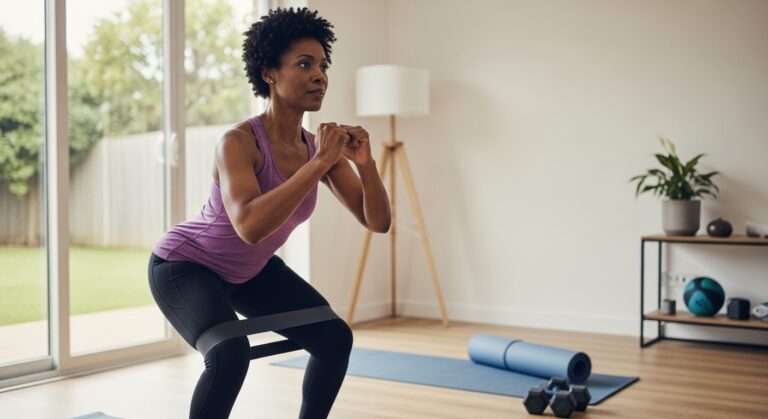
Exercise 3: Bodyweight Squats (60 seconds)
Proper form checklist: 1. Feet shoulder-width apart, toes slightly turned out 2. Weight in your heels (you should be able to wiggle your toes) 3. Lower hips back and down as if sitting in a chair 4. Knees track over toes, don’t cave inward 5. Chest stays lifted, core engaged 6. Lower until thighs are parallel to floor (or as low as comfortable) 7. Press through heels to stand 8. Squeeze glutes at the top
Knee protection: If you have knee issues, limit your range of motion. Quarter squats still provide benefit. Place a chair behind you and tap it with your glutes before standing—this ensures you’re sitting back properly.
Why squats are essential: After 40, maintaining lower body strength directly impacts your quality of life. Squats strengthen the muscles that help you get up from chairs, climb stairs, and maintain balance. They’re also one of the best exercises for bone density in your hips and spine.
Progression: Once you can complete 20 controlled squats in 60 seconds, slow down your tempo. Take 3 seconds to lower, pause at the bottom for 2 seconds, then stand. This increases time under tension and builds more strength.
Exercise 4: Push-Ups (Modified or Traditional) (60 seconds)
Choose your variation: – Wall push-ups: Hands on wall, body at 45-degree angle – Incline push-ups: Hands on counter, couch, or sturdy chair – Knee push-ups: Knees on floor, body straight from knees to shoulders – Full push-ups: Toes on floor, body in straight plank position
Form checklist regardless of variation: 1. Hands slightly wider than shoulders 2. Elbows track back at 45 degrees, not straight out to sides 3. Lower until chest nearly touches surface 4. Core engaged—no sagging hips or lifted butt 5. Press back up to starting position 6. Full range of motion beats high reps with partial movement
Upper body sculpting benefits: Push-ups target chest, shoulders, triceps, and core simultaneously. For women over 40, maintaining upper body strength prevents the arm jiggle we all complain about and supports better posture as we age.
Building strength gradually: Start where you can complete 8-10 quality reps in 60 seconds. When that becomes easy, move to a more challenging variation. I spent six weeks on knee push-ups before attempting full ones—there’s no shame in meeting yourself where you are.
Exercise 5: Mountain Climbers (60 seconds)
How to perform: 1. Start in high plank position (hands under shoulders) 2. Engage core as if bracing for impact 3. Drive right knee toward chest 4. Return right foot to starting position 5. Immediately drive left knee toward chest 6. Continue alternating in a running motion
Slow and controlled option: Take 2 seconds per leg if you’re building core strength. Focus on keeping hips level—no rotating side to side.
Fast-paced option: If you’re more advanced, increase speed while maintaining form. Aim for 40-50 reps in 60 seconds.
Core engagement cue: Imagine you’re trying to create a shelf on your lower back that could hold a glass of water. If your hips pike up or sag down, that glass would spill. This visualization helps maintain proper position.
Cardio burst: This final exercise spikes your heart rate one more time, maximizing the calorie burn and metabolic boost from your five minutes. You’re also building hip flexor strength and core stability that translates to better running, walking, and daily movement.
Cool-down note: Immediately drop into child’s pose for 30 seconds. Sit back on your heels, extend arms forward, rest your forehead on the floor. Breathe deeply. This brief stretch signals to your nervous system that the intense work is done and helps prevent dizziness from stopping abruptly.
How to Make This Routine Work for YOUR Body

Listening to Your Body (Not Ignoring It)
There’s a crucial difference between productive discomfort and pain that signals injury. Productive discomfort feels like muscle fatigue, elevated breathing, and the burn of effort. Your muscles might shake, you might feel challenged, but nothing feels sharp, pinching, or wrong.
Pain that signals injury is sharp, localized, and often accompanied by a feeling of instability or something “not right.” If you feel this, stop immediately and modify. After 40, your joints have accumulated decades of use. Ignoring pain signals doesn’t make you tough—it makes you injured.
I learned this the hard way when I pushed through shoulder pain during push-ups, thinking I was just being weak. Three weeks later, I couldn’t lift my arm above my head. Respect your body’s signals.
When to modify: Joint discomfort, sharp pain, dizziness, or form breakdown all indicate you need an easier variation. There’s zero shame in this. I still do knee push-ups on days when my shoulders feel cranky.
When to push: Muscle fatigue, elevated heart rate, and the mental resistance that says “I don’t want to” (when you’re physically capable) are all signs to keep going. The magic happens when you do it anyway.
Adapting Based on Fitness Level
Complete Beginner (haven’t exercised in 6+ months): – Perform each exercise for 30 seconds instead of 60 – Rest 15 seconds between exercises – Focus exclusively on form, not speed – Expect this to feel very challenging—that’s normal – Take 2-3 rest days per week initially
Returning to Fitness (exercised somewhat recently): – Follow the standard 60-second format – Use modified versions of exercises as needed – No rest between exercises, but pause if you need to – Aim for 5-6 days per week – Increase intensity before duration
Already Active (regular exerciser): – Complete the five-minute circuit – Rest 60 seconds – Repeat for a second round (total: 11 minutes) – Use advanced variations of each exercise – Consider adding light dumbbells to squats
Progressive overload simplified: Your body adapts to stress by getting stronger, but only if you gradually increase the challenge. This doesn’t mean adding time. It means better form, more reps, slower tempo, or more challenging variations. Change one variable every 2-3 weeks.
Working Around Common Limitations
Knee issues: Skip jumping movements entirely. For burpees, step back to plank. For mountain climbers, slow the pace and reduce range of motion. Consider doing these exercises with hands elevated on a chair to reduce knee loading.
Shoulder problems: Replace downward dog with cat-cow stretches. Modify push-ups to wall or incline versions. If shoulders bother you in plank, drop to forearms or knees.
Back sensitivity: Avoid any movement that causes pain. For burpees, step back carefully and maintain core engagement. For mountain climbers, reduce speed and ensure hips don’t sag. Consider substituting standing knee drives (marching in place with high knees).
Balance concerns: Keep one hand on a wall or chair during squats. For plank-based movements, widen your stance for more stability. Never sacrifice safety for completing an exercise exactly as described.
Common Mistakes That Sabotage Your Success

The “All or Nothing” Trap
You overslept. You have back-to-back meetings. Your kid is home sick. So you skip your workout because you “only” have five minutes, and five minutes “isn’t enough to matter.”
This is the lie that keeps you stuck. Five minutes always matters. The compound effect of 365 five-minute workouts is 30+ hours of movement. That’s more than most people who make ambitious January gym commitments actually complete.
Perfectionism is the enemy of progress. I’ve had mornings where I did this routine in my bathroom while my coffee brewed, still in my pajamas, hair unbrushed, definitely not Instagram-worthy. Those mornings count just as much as the ones where I felt motivated and energized.
Building trust with yourself: Every time you keep your five-minute commitment, you’re depositing into your self-trust bank account. Every time you skip it because it’s “not enough,” you’re making a withdrawal. Which direction do you want that account to trend?
Doing the Movements Without Intention
Speed doesn’t equal effectiveness. I’ve watched women rush through 30 sloppy squats in 60 seconds, barely bending their knees, thinking more reps means better results. They would get significantly more benefit from 12 controlled squats with full range of motion and intentional muscle engagement.
Mind-muscle connection: This is the practice of consciously focusing on the muscle you’re working. During squats, think about your glutes and quads doing the work. During push-ups, feel your chest and triceps. This conscious attention increases muscle fiber recruitment by up to 20%, according to research from the European Journal of Applied Physiology.
How rushing reduces effectiveness: Poor form means you’re either not working the intended muscles or you’re compensating with other muscle groups. Half-range squats work your quads but miss the glutes entirely. Sagging push-ups shift work from your chest to your shoulders and potentially strain your lower back. You’re spending the same five minutes but getting 50% of the results.
Slow down. Feel the work. Count to three on the way down, pause, count to two on the way up. Quality over quantity, always.
Not Giving Your Body Time to Adapt
Week one, you’ll feel sore and tired. Week two, you might feel frustrated that you don’t see changes in the mirror. Week three, you’ll probably think “this isn’t working.”
This is exactly when most people quit. Right before the adaptation phase kicks in.
Realistic timeline: – Weeks 1-2: Neurological adaptation (your brain learns the movement patterns, exercises feel slightly easier even though muscles aren’t stronger yet) – Weeks 3-4: Energy improvements, better sleep quality, mood elevation from consistent endorphin release – Weeks 6-8: Measurable strength gains (you can do more reps or harder variations), subtle muscle definition, clothes fit differently – Week 12+: Visible transformation, habit is automatic, sustainable lifestyle change
Your body is adapting from day one. You just can’t see it yet. Trust the process. I didn’t see visible changes until week 10, but I felt different by week 3. That was enough to keep me going.
Real Talk: What to Realistically Expect

The Honest Timeline for Visible Results
I’m going to tell you what the transformation photos won’t: This five-minute routine alone will not give you six-pack abs or dramatically change your body composition. Let me explain what it WILL do, because it’s actually more valuable.
Weeks 1-2: You’ll notice you have more energy throughout the day. The afternoon slump might be less severe. You’ll sleep better because you’ve moved your body. Your mood will improve—exercise releases endorphins and reduces cortisol, the stress hormone that increases with age.
Weeks 3-4: Movements that felt impossible become manageable. You can hold plank longer. Squats don’t make you breathe as hard. This is real strength building, even if you can’t see it yet. Your posture might improve because you’re strengthening core and back muscles.
Weeks 6-8: Your clothes fit differently, especially around your arms and legs. Muscle takes up less space than fat, so even without weight loss, you might notice your pants are looser or your arms look more defined. You can see the beginning of muscle tone when you flex.