30-Day Pilates Workout Plan for Women Over 40
You’ve noticed it—the way your core doesn’t engage like it used to, how your lower back aches after a full day, the stiffness that greets you every morning.
The workout plans designed for 25-year-olds don’t fit anymore. You don’t have two hours for the gym, you can’t afford another expensive membership, and you’re done feeling intimidated by fitness spaces that weren’t designed with you in mind.
This 30 day Pilates workout plan gives you structured, realistic progression that works with your body’s specific needs. You’ll build proven core strength, address the underlying weakness causing your back pain, and create a sustainable practice in just 20 minutes per day from your living room. No equipment required, no complicated choreography—just effective movement that respects where your body is right now.
Why Pilates Works for Women Over 40

Your body after 40 is physiologically different in ways that make traditional cardio and heavy lifting feel wrong. Your pelvic floor muscles have weakened from decades of sitting and hormonal shifts.
Your core’s deep stabilizing muscles (the transverse abdominis) have become dormant. Your bone density is declining, especially if you’re approaching menopause. Your joints have less cartilage cushioning them.
Pilates addresses all of this because it was designed around controlled movement, breath work, and deep core engagement—not speed or impact. Unlike running or high-intensity training, Pilates works within your current range of motion, gradually expanding it.
The focus on breathing (inhale to prepare, exhale to engage) activates your parasympathetic nervous system, lowering cortisol while you build strength.
The emphasis on neutral spine and pelvic alignment directly counteracts the forward-rounded posture most women develop from years of desk work.
Research consistently shows that controlled, low-impact strength training improves bone density in postmenopausal women without the joint stress of high-impact exercise.
Pilates specifically targets the stabilizing muscles around your spine—the ones your back pain is actually asking for. The pelvic floor engagement cues strengthen rather than strain this critical area, making daily activities like coughing, sneezing, or lifting feel manageable again.
Most fitness plans marketed to women over 40 fall into two traps: they’re either watered-down versions of younger-person workouts, or they’re so cautious they don’t build strength.
This plan avoids both by building progressive difficulty week by week while respecting your body’s actual constraints. Week 1 focuses on foundational form and breath work because your nervous system needs to relearn how to engage your deep core.
Weeks 2-3 add repetitions and complexity as your neuromuscular control improves. Week 4 integrates everything into flowing sequences that prepare you for long-term practice beyond 30 days.
Realistic Expectations for 30 Days
By day 30, your lower back pain will diminish because your core is finally supporting your spine. Your posture will improve noticeably—you’ll catch yourself standing taller without thinking about it.
You’ll move through daily life with less creaking, less morning stiffness, and better body awareness. You’ll be able to engage your core on command, which means you can protect your back during heavy lifting or gardening.
What won’t happen: you won’t look dramatically different. You won’t lose significant weight. You won’t have visible abs. This isn’t vanity work; it’s functional work.
The value shows up in how you move, not how you photograph. If you’re looking for rapid aesthetic transformation, Pilates isn’t your tool. If you’re looking to feel better, move better, and build sustainable strength that protects your body, you’re in the right place.
Most people feel a difference in their lower back and posture by day 10-14. By day 21, you’ll notice you can hold positions longer without shaking.
By day 30, movements that felt impossible on day 1 feel manageable. This is real progress, even if it’s not Instagram-visible.
Your 30 Day Pilates Challenge Structure

Week 1: Foundation and Form (Days 1-7)
Your job this week is learning, not pushing. You’re teaching your nervous system how to activate your deep core, how to breathe properly, and how to maintain neutral spine alignment.
Each session lasts 18-20 minutes. You’ll repeat the same six foundational exercises daily because repetition builds motor memory. Your muscles might not feel “worked”—that’s fine. You’re building the neural pathway that makes every future workout more effective.
The exercises this week: breathing practice (2 minutes), pelvic tilts, modified Hundred, bridge holds, single leg stretches, side-lying leg lifts, and stretching.
You’ll do 8-12 repetitions of each movement, focusing on form over speed. Rest 30 seconds between exercises. If something causes sharp pain (not muscle fatigue, but actual pain), skip it and consult a healthcare provider.
Week 2-3: Building Endurance and Complexity (Days 8-21)
Now that your form is solid, you’re increasing reps and adding variations. The same six exercises now include 15-20 repetitions. You’ll add small progressions: bridge holds longer, single leg stretches add arm movement, side-lying series includes pulses.
Sessions are 20-25 minutes. You’ll feel actual muscle fatigue—that’s the signal you’re building strength. You should be able to complete most exercises without modification by day 15.
Week 2 feels harder than week 1 because you’re actually fatiguing your muscles. That’s intentional. Push through it—this is where adaptation happens. If you need to repeat a day or take an extra rest day, that’s fine. Consistency matters more than perfection.
Week 4: Full Sequences and Integration (Days 22-30)
You’re now ready for flowing sequences that combine multiple exercises into longer chains. Instead of doing Bridge, rest, then Single Leg Stretch, you’ll do Bridge, flow directly into Single Leg Stretch, then side-lying work—all without stopping.
This builds cardiovascular endurance alongside strength. Sessions are 25-30 minutes. You’ll repeat 2-3 flowing sequences, resting only 60 seconds between sequences.
By day 30, you’ll have moved through an entire challenge that progressed logically from foundational to integrated. You’ll know your body better and understand which movements serve you and which need modification. You’ll have built a practice you can sustain beyond this month.
Pilates Workout Plan 30 Day: Essential Exercises Explained

The Hundred (Modified for Beginners)
Lie on your back, knees bent, feet flat on the floor. Place your hands beside your hips, palms down. Exhale as you lift your head and shoulders slightly off the mat—just enough that you feel your abs engage.
Your gaze should stay on your thighs. Now pulse your arms up and down in small 6-inch movements while breathing: inhale for 5 pulses, exhale for 5 pulses. Complete 10 cycles (100 pulses total).
What you should feel: Your lower abs pulling in and up, not your hip flexors gripping. If your neck hurts, you’re lifting your head too high—keep it down until your core is stronger. If you can’t complete 100 pulses, do 50 and build from there. The goal isn’t the number; it’s maintaining core engagement throughout.
Bridge with Pelvic Engagement
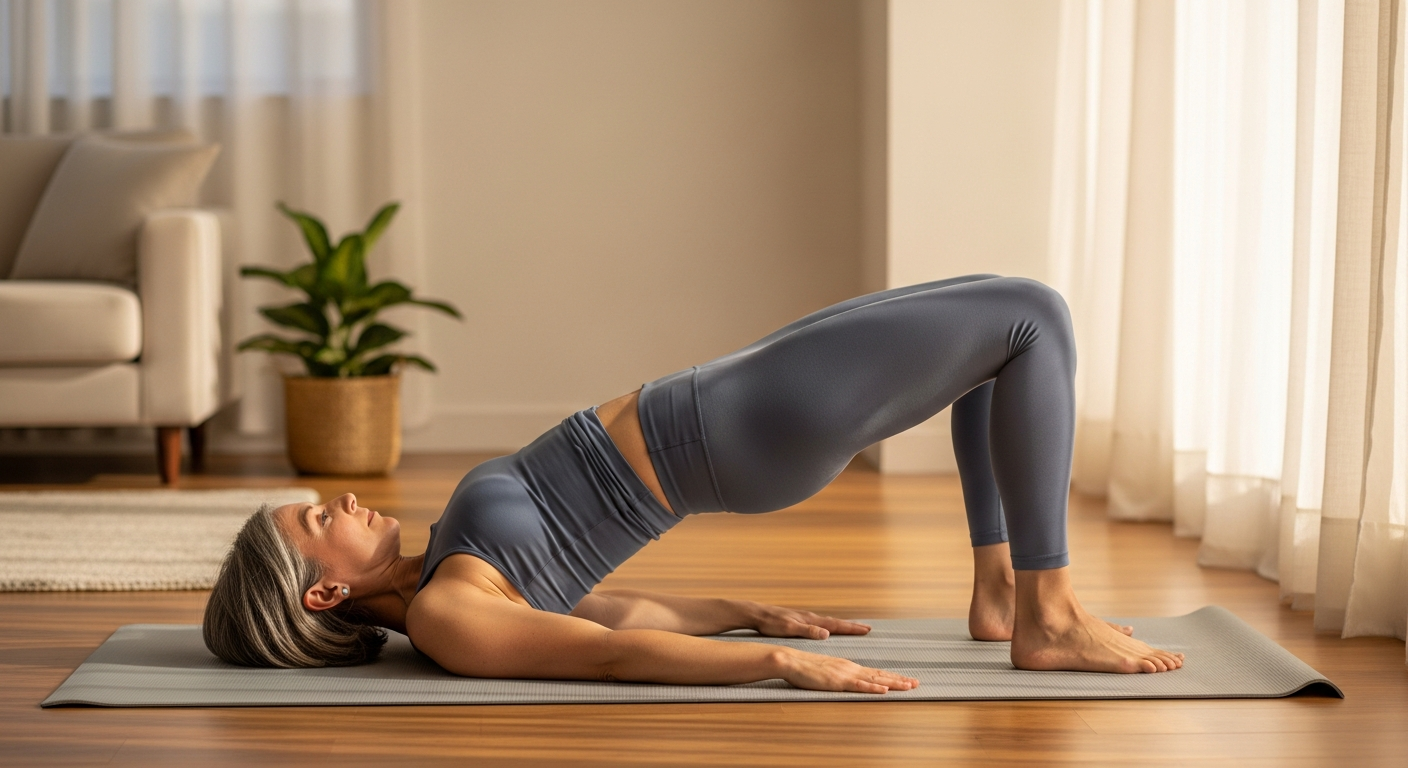
Lie on your back, knees bent, feet hip-width apart and parallel. Arms at your sides, palms down. Exhale as you press your feet into the floor and lift your hips toward the ceiling, creating a straight line from your knees through your hips to your shoulders. Squeeze your glutes at the top. Hold for 3-5 seconds, then inhale as you lower down with control. Repeat 12-15 times.
Critical cue: Your knees should stay directly over your ankles—not caving inward. If your lower back arches excessively at the top, you’re using your back muscles instead of your glutes. Reduce your range slightly and focus on glute engagement. This is a glute and pelvic floor strengthener, not a back exercise.
Roll-Up (or Dead Bug Alternative)
Traditional Roll-Up: Lie flat on your back, arms extended overhead. Slowly peel your spine off the mat one vertebra at a time, reaching your hands toward your toes, then roll back down with control.
Critical modification: If this causes neck strain, substitute Dead Bug—lie on your back, extend opposite arm and leg while keeping your low back pressed to the mat, alternating sides. Hold each position for 2 seconds. Do 10-12 repetitions per side. This builds the same core control without spinal flexion stress.
Single Leg Stretch
Lie on your back, lift your head and shoulders slightly. Bring one knee toward your chest, holding it with your hands just below the knee. Extend the opposite leg long and low (hovering 2-3 inches above the floor). Switch legs with a controlled pulse, alternating sides. Complete 10-12 switches per side. Keep your lower back pressed to the mat throughout—if it lifts, lower your extended leg higher off the ground.
Side-Lying Leg Lift Series
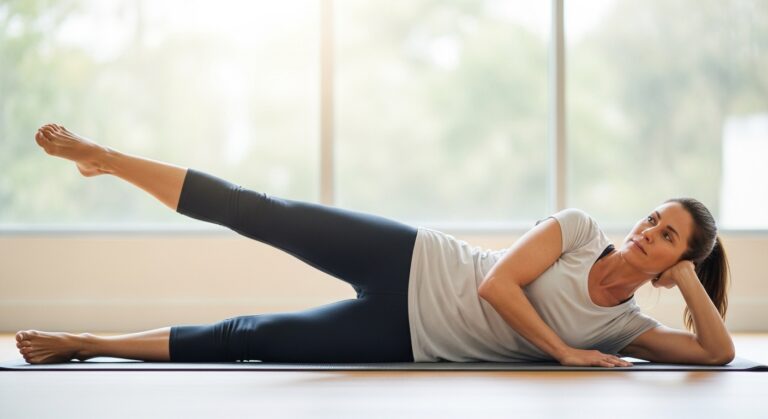
Lie on your right side, head resting on your right arm. Stack your hips and shoulders. Lift your left leg to hip height (about 12 inches), keeping it in line with your body. Do 12-15 small pulses up and down, then hold at the top for 5 seconds. Lower and rest. Repeat on the other side. What you should feel: The outer hip and glute working, not your lower back. If your back feels strained, reduce your leg height—the range matters less than the quality of engagement.
Plank to Forearm Hold
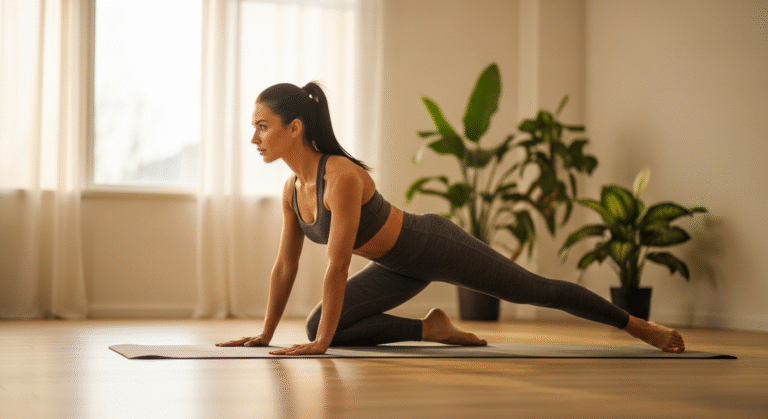
Start on your hands and knees. Step your feet back one at a time until your body forms a straight line from head to heels (high plank). Hold for 15-20 seconds, keeping your core engaged and your hips level. Lower to your forearms and hold for 15-20 seconds (forearm plank). Return to high plank. Repeat 3-4 times. Critical form check: Your hips should not sag (which means your core isn’t engaged) and should not pike up (which means you’re overworking your shoulders). If you can’t maintain a straight line, drop to your knees and hold from that position until you build strength.
Beginner Pilates at Home: What You Actually Need

Required: A yoga mat or thick towel for cushioning your spine. That’s it. Your body weight against gravity is all the resistance you need to build real strength. Don’t wait to buy a mat—a folded blanket or towel works fine for week 1.
Optional by week 3: A small Pilates ball (9-inch, typically $12-15) for added resistance and pelvic floor activation cues. A resistance band (loop or long band, $8-12) for arm exercises and added leg resistance. A folded towel for neck support during abdominal work. A timer (your phone works) to track hold times and rest periods.
You don’t need a reformer, ankle weights, or specialized equipment to build proven results. Your own body weight provides sufficient resistance for functional strength. A single quality mat ($40-60) is the only equipment worth buying once you’re committed to continuing past 30 days.
You need 6 feet by 3 feet of clear floor space—roughly the size of a yoga mat. Your living room, bedroom, garage, or covered patio works. You don’t need a gym or studio. Most people succeed when they practice at the same time daily—6 AM before the day starts, or 8 PM after dinner. Pick a time that’s already in your routine and attach your Pilates practice to it. Consistency matters more than timing.
Take 1-2 rest days per week, ideally non-consecutive. Rest days are when your muscles actually adapt and build strength—the work happens in recovery, not during the workout. If you feel joint pain (sharp, specific discomfort) rather than muscle fatigue, take an extra rest day. Your body is telling you something needs recovery time. If you’re new to exercise, don’t push through fatigue. You’re building a sustainable practice for life, not proving something in 30 days.
Home Pilates Workout for Beginners: Your Week 1 Blueprint

Day 1 Exact Sequence (Start Here)
Total time: 18 minutes. What to expect: You’ll feel this in your lower abs and glutes. If your neck hurts, you’re lifting your head too high—keep it down until your core is stronger. Set a timer and work through this sequence exactly as written.
- Breathing practice (2 minutes): Lie on your back, knees bent, feet flat. Inhale through your nose for 4 counts, exhale through your mouth for 4 counts. This activates your parasympathetic nervous system and teaches proper breathing for all future exercises.
- Pelvic tilts (1 minute, 12 reps): Lie on your back, knees bent. Exhale as you tilt your pelvis, pressing your lower back into the mat. Inhale as you return to neutral. This wakes up your core.
- Modified Hundred (2 minutes, 50-100 pulses): Follow the instructions above. Rest 30 seconds after.
- Bridge (2 minutes, 12 reps): Follow the instructions above. Rest 30 seconds after.
- Single Leg Stretch (2 minutes, 10 per side): Follow the instructions above. Rest 30 seconds after.
- Side-Lying Leg Lifts (4 minutes, 12 per side): Follow the instructions above. Rest 30 seconds between sides.
- Stretching (5 minutes): Hug one knee to your chest for 30 seconds per side. Gentle spinal twist: lie on your back, drop both knees to one side, hold 30 seconds, repeat other side. End lying flat, relaxing for 1 minute.
That’s it. That’s day 1. Do this exact sequence every day for week 1. Your body will adapt faster with repetition than with variety.
Days 2-3: Same sequence, same timing. By day 3, movements should feel slightly less awkward. Days 4-5: Same sequence, but increase reps: 15 bridge repetitions instead of 12, 12 single leg stretches per side instead of 10, 15 side-lying leg lifts instead of 12. Days 6-7: Same sequence and reps as days 4-5. By day 7, you should feel noticeably less stiff in the morning. Your lower back should ache less.
Form, Safety, and Troubleshooting Your Practice

Common Mistakes That Undermine Results
Holding your breath: This spikes blood pressure and prevents core engagement. If you can’t breathe steadily through a movement, you’re working too hard—scale back. Exhale on exertion (when you’re lifting or contracting), inhale on the return. If you forget the breathing pattern, slow down until you can coordinate breath with movement.
Forcing range of motion: Your hamstrings are tight from years of sitting; don’t force your legs straight. Work within your current range, and it will expand naturally over weeks. Forcing creates micro-tears and inflammation. Patience creates adaptation.
Neck strain during ab work: You’re leading with your head instead of your abs. Keep your gaze on your thighs, tuck your chin slightly, and imagine a tennis ball between your chin and chest. Or simply keep your head down—you’ll still sculpt core strength without neck strain. Your head weighs about 12 pounds; letting gravity pull it up exhausts your neck muscles instead of your abs.
Hips sagging in plank: Your core isn’t engaged. Tighten your abs before you hold the position, not during. If you can’t maintain a straight line, drop to your knees. A proper modified plank is better than a sloppy full plank.
When to Modify or Skip Exercises
If you have osteoporosis: Avoid deep spinal flexion (roll-ups, full hundreds with head lifted). Substitute exercises that maintain neutral spine. Bridges, side-lying work, and modified planks build core support without spinal stress. Check with your doctor before starting any new exercise program if you have bone density concerns.
If you have disc issues: Skip movements that cause sharp back pain and focus on bridges, side-lying work, and modified planks that build core support without spinal stress. Your deep core muscles are actually the best protection for a compromised disc. If you’re unsure which movements are safe, consult a physical therapist who understands Pilates.
If you have pelvic floor dysfunction: Work with a pelvic floor physical therapist first; some Pilates cues can worsen prolapse if done incorrectly. Not all Pilates teachers understand pelvic floor issues. A PT can teach you which exercises are safe and which to avoid or modify.
Red flag pain: Sharp, shooting, or radiating pain means stop immediately. Dull muscle burn means you’re working—learn the difference. Muscle fatigue is good. Joint pain or nerve pain is a stop sign. If you experience sharp pain, skip that exercise and consult a doctor or physical therapist before continuing.
How to Measure Progress Without a Scale
By day 15, notice: Can you stand taller without thinking about it? Does your lower back hurt less? Can you get out of a chair with less effort? By day 30, you should be able to hold a plank for 30+ seconds, complete all exercises without modification, and feel noticeably stronger in daily movement.
Track these functional markers instead of weight: How many bridge repetitions can you complete? How long can you hold a plank? Can you touch your toes further than day 1? Do you catch yourself with better posture? Does your back feel better at the end of a long day? Write them down on days 1, 15, and 30. You’ll be surprised by the progress.
CONCLUSION

Your body after 40 needs a different approach—one that respects your joint health, addresses core weakness and pelvic floor concerns, and builds proven strength through low-impact, controlled movement. This 30 day Pilates workout plan delivers exactly that. No gym required, no equipment necessary, just 20 minutes of focused practice that actually works with your life instead of demanding you restructure it.
The structure is designed for real life: Week 1 teaches you the foundational six exercises with modifications for stiff bodies. Weeks 2-3 build endurance and add complexity as your neuromuscular control improves. Week 4 integrates everything into flowing sequences that prepare you for sustainable long-term practice. You’ll take 1-2 rest days per week because recovery is when results actually happen—not during the workout itself.
Start with Day 1’s exact sequence today: breathing practice, pelvic tilts, modified hundred, bridges, single leg stretches, side-lying leg lifts, and final stretching. Eighteen minutes. You have everything you need to begin right now. No more research, no more “I’ll start Monday.” Roll out your mat or grab a towel, set a timer, and begin.
Progress is functional, not aesthetic. By day 30, you’ll move through daily life with less pain, better posture, and core strength you can engage on command. You’ll have built a practice that fits your schedule, respects your body’s limitations, and delivers results you can feel in how you move. After 30 days, repeat the full cycle with added resistance (bands, Pilates ball), explore online classes that build on these foundations, or maintain your practice 3-4 days per week as sustainable movement for life.
The goal isn’t to finish the 30 days—it’s to build a practice that serves your body for the next 40 years. Your Pilates challenge for beginners starts now.