5-Move Core Reset in 10 Minutes
Your core feels disconnected, weak, or simply “switched off” after months of sitting at a desk or just not knowing where to start with fitness.
You’ve scrolled past countless “insane ab shredding” workouts that demand 45 minutes and a full gym. What if you could rebuild foundational core strength in just 10 minutes, right in your living room, with zero equipment and zero intimidation?
This isn’t hype. A 5-move core reset designed for real bodies and real schedules actually works better than sporadic long sessions because consistency beats intensity every time.
You’ll feel more stable and connected to your core after just one session. The best part? You can do this tomorrow morning before your coffee cools.
Why a Daily Core Workout Changes Everything
Your core isn’t just your abs. It includes your deep transverse abdominis (the muscle that wraps around your torso like a corset), your obliques, your lower back muscles, and even your pelvic floor.
These muscles work together as one integrated system to stabilize your spine, support your posture, and power nearly every movement you make—from picking up groceries to playing with kids to simply sitting upright at your desk.
A strong core stability foundation reduces back pain, improves balance, and makes everyday activities easier. Research consistently shows that short, consistent workouts build strength more effectively than sporadic long sessions.
Ten minutes is the magic number—long enough to challenge your muscles, short enough to fit before your morning coffee cools or during your lunch break.
What makes this a “reset” instead of just another workout is the emphasis on reconnection and control. This routine focuses on proper breathing, deliberate movement, and form over speed.
It’s perfect for postpartum bodies (after medical clearance), desk workers with nagging back pain, or anyone restarting their fitness journey. You’re training for function, stability, and the ability to move without compensation patterns that lead to injury.
Exercise for Core Strength: The 5-Move Breakdown

Move 1: Dead Bug (Target: Deep Core + Coordination)
How to do it: Lie on your back, arms extended toward the ceiling, knees bent at 90 degrees. Slowly lower your right arm overhead while extending your left leg, hovering it 2–3 inches off the ground. Return to start. Alternate sides in a controlled rhythm.
Form cues: Press your lower back into the mat throughout the entire movement. Exhale as you extend your limbs. Move slowly—this isn’t a race. If your lower back arches off the mat, your core has checked out.
Modifications: Keep your extended leg higher off the ground, or practice just arm movements without the legs until you build control.
Why it works: The dead bug trains anti-extension strength, which means your core learns to resist the arch in your lower back. This is essential for a stable, injury-resistant core. Most people never train this pattern, which is why their backs hurt when they sit or stand for long periods.
Move 2: Bird Dog (Target: Lower Back + Glutes + Balance)
How to do it: Start on hands and knees. Extend your right arm forward and left leg back simultaneously, forming a straight line from fingertips to heel. Hold for 2–3 seconds. Return and switch sides. Move with intention, not speed.
Form cues: Keep your hips level—don’t let them rotate or dip. Draw your shoulder blades down, away from your ears. Look at the floor to keep your neck neutral.
Modifications: Practice just lifting one arm or one leg at a time before combining movements.
Why it works: This move builds core stability while strengthening your posterior chain—your back, glutes, and hamstrings—that supports your spine. It teaches your core to stabilize while your limbs move, which is exactly what happens during real life.
Move 3: Modified Plank Hold (Target: Full Core Endurance)
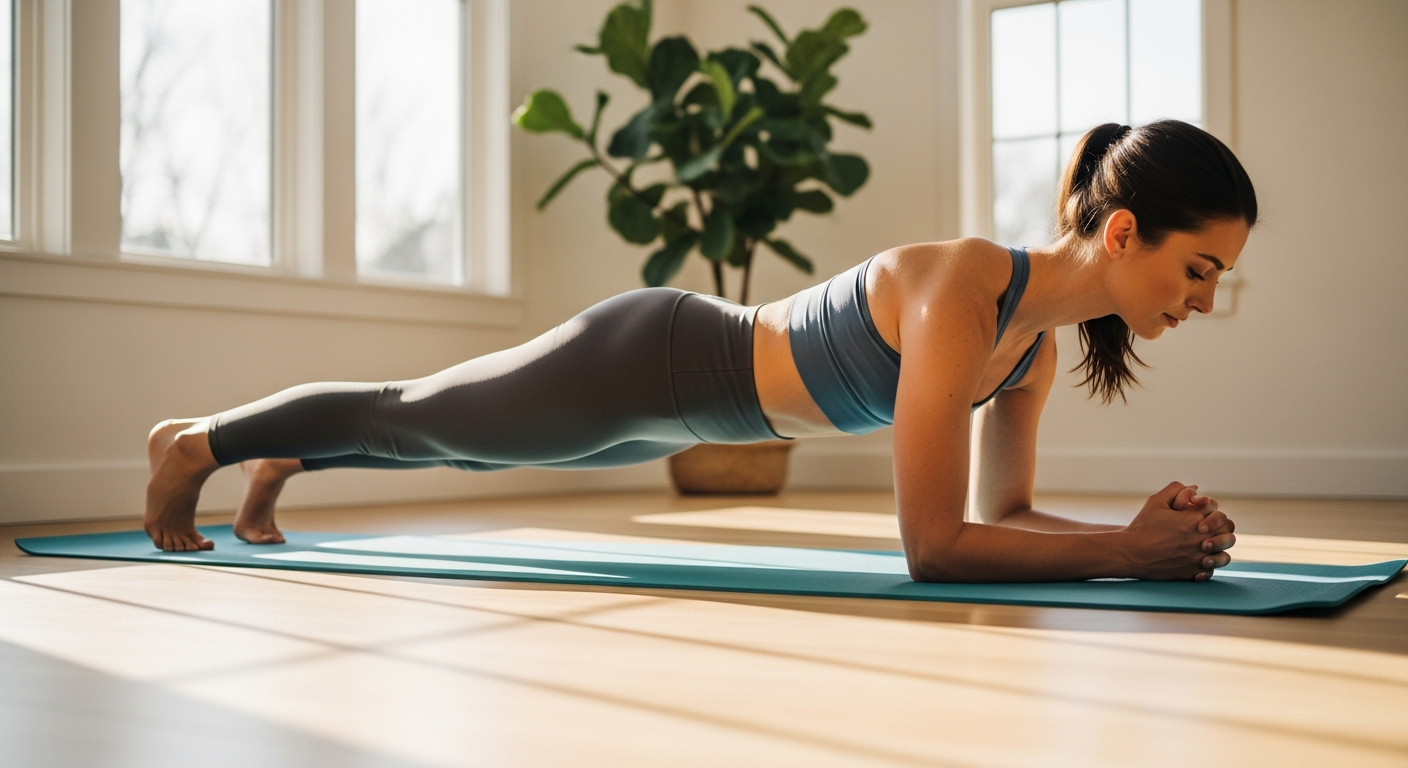
How to do it: Start in a forearm plank position on your knees or toes, depending on your level. Keep your body in a straight line from head to knees or heels. Hold for 20–30 seconds without sagging.
Form cues: Don’t let your hips sag or pike upward. Keep your neck neutral by looking at the floor about 6 inches in front of your hands. Squeeze your glutes and brace your abs. Breathe steadily—don’t hold your breath.
Modifications: Drop to your knees. Even a knee plank builds powerful core endurance when done with proper form.
Why it works: Isometric holds teach your core to stabilize under tension, which is exactly what it does during daily activities. This move trains endurance, not just strength.
Move 4: Glute Bridge with Core Engagement (Target: Glutes + Lower Core + Pelvic Floor)
How to do it: Lie on your back, knees bent, feet flat on the floor hip-width apart. Press through your heels to lift your hips toward the ceiling. Squeeze your glutes at the top and gently engage your lower abs. Lower with control.
Form cues: Don’t overarch your lower back at the top—think about tucking your pelvis slightly. Exhale as you lift. Keep your ribs from flaring outward.
Modifications: Hold the top position for 5 seconds for an extra burn. Slow your tempo to 3 seconds up, 3 seconds down.
Why it works: This strengthens the often-neglected posterior core and helps correct anterior pelvic tilt, a common postural issue in people who sit all day. Strong glutes also reduce strain on your lower back.
Move 5: Bicycle Crunch (Target: Obliques + Rectus Abdominis)
How to do it: Lie on your back, hands gently supporting your head (not pulling on your neck). Lift your shoulders off the mat and bring your right elbow toward your left knee while extending your right leg. Alternate in a controlled, pedaling motion.
Form cues: Twist from your torso, not just your elbows. Keep your lower back pressed to the mat. Exhale with each twist. Move deliberately. Speed kills form.
Modifications: Keep both feet on the ground and practice just the upper-body twist. Or slow your tempo to 3 seconds per side.
Why it works: This trains rotational strength and sculpts the obliques, which are critical for functional movements like reaching, twisting, and lifting.
How to Structure Your 5 Minute Core Workout

The Exact Time Breakdown
Warm-up (2 minutes): 30 seconds of cat-cow stretches, 30 seconds of hip circles, 1 minute of gentle marching in place to increase blood flow and activate your nervous system.
Work rounds (8 minutes): Perform each of the 5 moves for 40 seconds, with 20 seconds of rest between moves. Complete 2 full rounds.
Optional cool-down (1–2 minutes): Child’s pose (30 seconds), gentle spinal twists (30 seconds total), deep breathing (30 seconds). This signals to your nervous system that the work is done and helps you recover.
Rest and Breathing Strategy
Rest periods are part of the workout. Don’t skip them. Your muscles need brief recovery to maintain good form in the next round. Focus on exhaling during the hardest part of each movement and inhaling during the easier phase. Proper breathing activates your deep core muscles and prevents you from holding your breath, which spikes blood pressure and makes exercises feel harder than they need to be.
Frequency and Progression
- Beginners: Start with 3 sessions per week, with at least one rest day between workouts.
- Intermediate: This routine can be done daily as a maintenance 5 minute core workout to keep your foundation strong.
- When it feels easy: Increase hold times to 50 seconds, reduce rest to 15 seconds, or add a third round. Progress gradually.
Core Stability: Common Mistakes That Sabotage Results

Mistake #1: Rushing Through Reps
Speed kills results in core training. When you race through movements, momentum takes over and your muscles don’t actually work. You’re just going through the motions.
Fix: Count to 3 on the way down or out, count to 3 on the way up or in. Controlled tempo forces your muscles to work harder and builds real strength.
Mistake #2: Letting Your Lower Back Arch
This is the most common form breakdown, especially in dead bugs and planks. Arching disengages your deep core and puts stress on your spine. You’ll feel this in your back instead of your abs—that’s your cue that something’s wrong.
Fix: Imagine pressing your belly button toward your spine. Keep your ribs “down” and avoid flaring them toward the ceiling. If you can’t keep your lower back flat, use an easier modification.
Mistake #3: Holding Your Breath
Breath-holding creates internal pressure but actually prevents your core from working properly. It also makes exercises feel harder than they need to be and can spike blood pressure.
Fix: Exhale on effort (the hard part), inhale on the return. Steady breathing is a sign of proper pacing.
Mistake #4: Neglecting Modifications
Trying to do the “advanced” version before you’re ready leads to poor form and potential injury. There’s zero shame in knee planks, slower tempos, or shorter hold times. Build your foundation first.
Building a Strong Core: Who This Workout Is For (and Who Should Modify)

Perfect For
- Beginners who feel lost starting a fitness routine and need a clear starting point
- Busy professionals and parents who need effective workouts in minimal time
- Postpartum individuals (after getting medical clearance from a doctor or pelvic floor physical therapist)
- Desk workers experiencing lower back discomfort or poor posture
- Anyone intimidated by gym environments or complicated equipment
- People recovering from injury who need foundational exercise for core strength
Modify or Consult a Professional If
- You have diastasis recti (abdominal separation)—skip bicycle crunches and get guidance from a pelvic floor physical therapist
- You’re experiencing acute back pain or have a history of hernias
- You’re in your first trimester of pregnancy or haven’t been cleared for exercise postpartum
- You have pelvic floor dysfunction (leaking, heaviness, pain)—work with a specialist first
What You’ll Need
A yoga mat or soft surface (carpet works fine). Comfortable clothing that allows full range of motion. Optional: a small pillow or folded towel for knee support during planks. That’s it. No weights, no machines, no excuses.
Your Next Steps: Making This Core Reset a Habit

Track Your Progress Without Obsessing
Keep a simple note on your phone: date, how each move felt (easy/moderate/challenging), any form breakthroughs. Notice functional improvements first—does your back feel better after sitting all day? Can you pick up your toddler without bracing? Can you stand for longer without lower back fatigue? Physical changes typically appear after 4–6 weeks of consistent training. Patience here pays off.
When You’re Ready to Level Up
Add a third round to extend the workout to 12–15 minutes. Incorporate resistance: hold a light weight during glute bridges, wear ankle weights for dead bugs. Explore Pilates moves that build on these foundations. Try compound movements that challenge core stability (squats, lunges, push-ups). Progress gradually. Jumping ahead leads to frustration and injury.
Pair This With Other Healthy Habits
Core strength is one piece of overall fitness. Add 2–3 days of walking, light cardio, or full-body strength training. Prioritize protein and hydration to support muscle recovery. Sleep is non-negotiable for results: aim for 7–9 hours per night. These aren’t optional add-ons—they’re the foundation that makes your daily core workout actually work.
CONCLUSION

A strong core is the foundation for everything—from pain-free daily movement to more advanced fitness goals. This 5-move, 10-minute reset is designed for real life: no equipment, no intimidation, just proven exercises that work. Consistency beats intensity every time. Three 10-minute sessions per week will build more core stability than one brutal hour-long workout you can’t sustain.
You don’t need to transform overnight. Small, steady progress compounds into powerful results over weeks and months. Start tomorrow morning. Set a 10-minute reminder on your phone, roll out a mat, and complete one round of these five moves. That’s all you need to do. Notice how you feel after—steadier, more connected, stronger. Then do it again in two days. Do that three times a week for the next month, and you’ll be amazed at what your body can do when you give it consistent, intelligent training.
Consistency beats intensity. Ten minutes three times a week builds more real strength than sporadic long sessions you can’t sustain.
Your next move: Bookmark this page. Set a calendar reminder for tomorrow morning at a time when you actually have 10 minutes—before work, during lunch, after kids’ bedtime, whenever fits your real life. Do one round of these five moves focusing on form over speed. That’s your commitment. Not perfection. Just showing up and moving with intention. Everything else follows from there.