Lifting Weights After 50 women
The weight that used to come off with a week of salads now seems permanently attached. Your doctor mentioned bone density at your last checkup.
You’re tired of feeling winded carrying groceries from the car. The gym feels designed for people half your age who already know what they’re doing.
Here’s what’s actually true: your body responds to strength training differently after 50, but it responds. Women who lift weights in their 50s, 60s, and beyond build muscle, protect their bones, boost their metabolism, and regain the physical confidence that makes daily life easier.
You don’t need a gym membership, Instagram-worthy form, or decades of experience. You need a proven protocol, realistic expectations, and permission to start exactly where you are.
This guide gives you the step-by-step blueprint: specific weights, exact exercises, a realistic timeline for results, and the science behind why weight lifting becomes more powerful—not less—as you age. By the end, you’ll have a complete 4-week protocol you can start this week.
Why Strength Training Changes Everything for Over 50 Fitness
Starting around age 30, women lose approximately 3% to 8% of their muscle mass per decade. After 60, that rate accelerates. This process is called sarcopenia. It’s not just about fitting into your jeans—it affects everything. Muscle is metabolically active tissue. Lose muscle, and your resting metabolism drops. Your body burns fewer calories at rest, which means weight creeps on even when you’re eating the same way you always have.
But the real cost is functional. Muscle loss means climbing stairs gets harder. Picking up your grandchild becomes risky. A small slip becomes a fracture because there’s less muscle to stabilize your joints and protect your bones. Walking, cycling, and running preserve some muscle but don’t build it back. You need external resistance—weights—to trigger the muscle-building signal your body still absolutely responds to. Research consistently shows that women who start resistance training in their 50s gain measurable muscle within 8-12 weeks, even if they’ve never lifted before.
Women reach peak bone mass around age 30. After menopause, bone loss accelerates dramatically—sometimes 2-3% per year for the first 5-10 years post-menopause. This is why osteoporosis disproportionately affects women over 50. Resistance training creates the stimulus that builds bone density. When you lift weights, the stress on your bones triggers them to adapt by becoming denser and stronger. This is measurable on a DEXA scan within 6-12 months of consistent training. Your bones are living tissue, and they respond to demand.
Estrogen plays a role in muscle maintenance that most women don’t realize. As estrogen drops during perimenopause and menopause, your body becomes less efficient at building and keeping muscle. This isn’t an excuse—it’s a reason to train smarter. Your body needs progressive overload (gradually increasing weight or reps) more than ever. The good news: strength training becomes a more powerful metabolic tool after 50. Because you’re starting from a place of muscle loss, the gains you make—even modest ones—create a larger percentage improvement in your metabolism and body composition.
Weight Lifting for Women Over 50: What’s Actually Different
Your joints have decades of wear. Your rotator cuff—the small muscles that stabilize your shoulder—is more vulnerable. Your lower back has absorbed years of sitting, carrying, and bending. This doesn’t mean you can’t lift. It means you lift differently: with more attention to movement quality, more conservative starting weights, and smarter exercise selection.
Recovery also changes. At 25, you could hammer your legs on Monday and hit them again on Wednesday. After 50, your body benefits from 48-72 hours between sessions targeting the same muscle groups. Your nervous system takes longer to adapt to a new stimulus, and your muscles need more time between sessions to fully repair and grow. This is why a weight lifting schedule for women over 50 typically looks like 2-3 full-body sessions per week, not 6 days of split training.
Form becomes non-negotiable. At 30, you could get away with sloppy form and momentum. After 50, poor form accelerates joint wear and increases injury risk. When you nail your form, the results come faster because every rep counts. You’re not wasting energy. You’re building strength efficiently.
Most women over 50 who’ve never lifted should start with dumbbells in the 5-15 pound range. That’s not “light”—it’s appropriate. A 10-pound dumbbell creates real stimulus when you’re doing 10-12 controlled repetitions. The common mistake is lifting too light because you’re afraid of getting hurt or looking foolish. Lifting weights that feel too easy won’t trigger adaptation. Your body adapts to demand. No demand, no change.
Here’s how to know if your weight is right: the last 2-3 reps of a set should feel challenging but doable with good form. If you could do 10 more reps, the weight is too light. If you can’t complete all your reps with solid form, it’s too heavy. That sweet spot is where progress happens.
Strength gains appear fast initially. In the first 4-6 weeks, most of your strength improvement comes from your nervous system learning to recruit muscle fibers more efficiently. Around week 8-12, visible muscle growth starts. By 12-16 weeks of consistent training, friends notice. This timeline is realistic. Not overnight, but measurable within a season.
If you have an osteoporosis diagnosis, recent joint replacement, uncontrolled high blood pressure, or significant joint pain, talk to your doctor before starting a strength program. Come prepared with specifics. Don’t ask, “Can I exercise?” Ask, “I want to do resistance training 2-3 times per week with dumbbells, focusing on compound movements like squats, rows, and presses. Are there any movements I should avoid or modify?” This conversation takes five minutes and gives you clarity.
Weight Lifting Schedule: Your First 4-Week Protocol
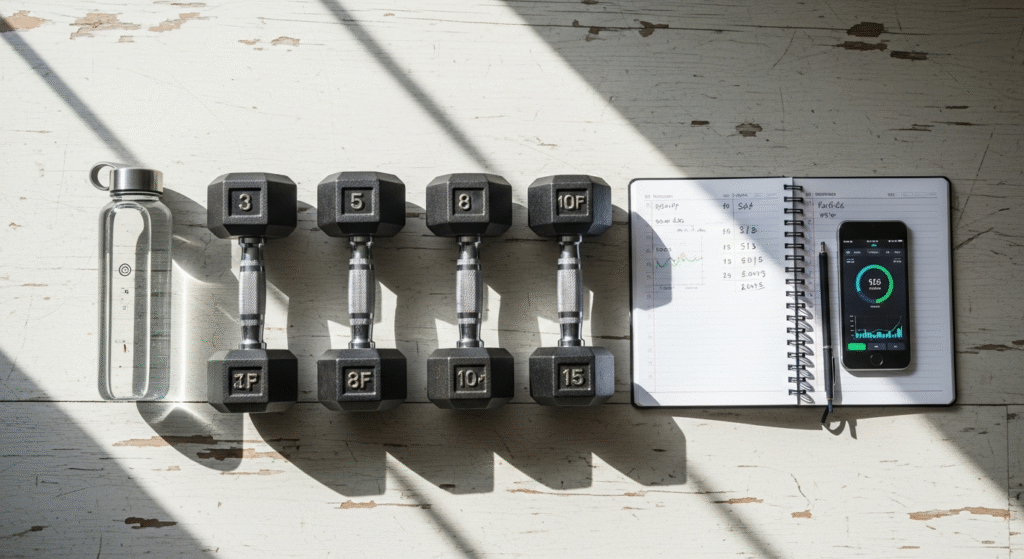
Two to three days per week is the minimum for proven results. More than that, and recovery becomes the limiting factor for women over 50. Less than that, and you don’t create enough stimulus for adaptation. The ideal weight lifting schedule is three non-consecutive days: Monday, Wednesday, Friday. Or Tuesday, Thursday, and Saturday. Space them out. Your muscles grow on rest days, not during the workout.
Each session should last 35-45 minutes, including a 5-minute warm-up. You’re being efficient: warm up, hit 5-6 exercises with intention, and leave.
Weeks 1-2: Movement Learning Phase. Your job is to nail movement patterns with lighter weights. You’re teaching your nervous system and building motor memory for proper form. Expect to feel slightly sore 24-48 hours after your first sessions. This is normal—it’s called delayed-onset muscle soreness (DOMS) and it decreases after the first 1-2 weeks as your body adapts.
Sample Week 1-2 Session (repeat 3x per week):
- 5-minute warm-up: arm circles, leg swings, bodyweight squats, cat-cow stretches
- Goblet squats: 3 sets of 10 reps with 10-pound dumbbell
- Bent-over dumbbell rows: 3 sets of 8 reps with 8-pound dumbbells
- Dumbbell chest press (lying on floor): 3 sets of 8 reps with 8-pound dumbbells
- Dumbbell reverse lunges: 3 sets of 8 reps per leg with 5-pound dumbbells
- Dead bugs: 3 sets of 10 reps per side
Weeks 3-4: Progressive Overload Introduction. Now you add weight or reps. If you completed all sets with good form and felt like you had 2-3 reps left in the tank, increase the weight by 2-5 pounds on that exercise. If you hit all reps but they felt hard, add 1-2 reps per set instead of increasing weight.
Sample Week 3-4 Session (repeat 3x per week):
- 5-minute warm-up (same as above)
- Goblet squats: 3 sets of 12 reps with 12-pound dumbbell
- Bent-over dumbbell rows: 3 sets of 10 reps with 10-pound dumbbells
- Dumbbell chest press: 3 sets of 10 reps with 10-pound dumbbells
- Dumbbell reverse lunges: 3 sets of 10 reps per leg with 8-pound dumbbells
- Dead bugs: 3 sets of 12 reps per side
- Pallof press: 2 sets of 10 reps per side with 8-pound dumbbell
The 5-Minute Warm-Up You Can’t Skip: After 50, a proper warm-up isn’t optional. Your joints need lubrication and your nervous system needs activation. Five minutes is enough.
- Arm circles: 10 forward, 10 backward (wakes up shoulders)
- Leg swings: 10 forward-back each leg, 10 side-to-side each leg (mobilizes hips)
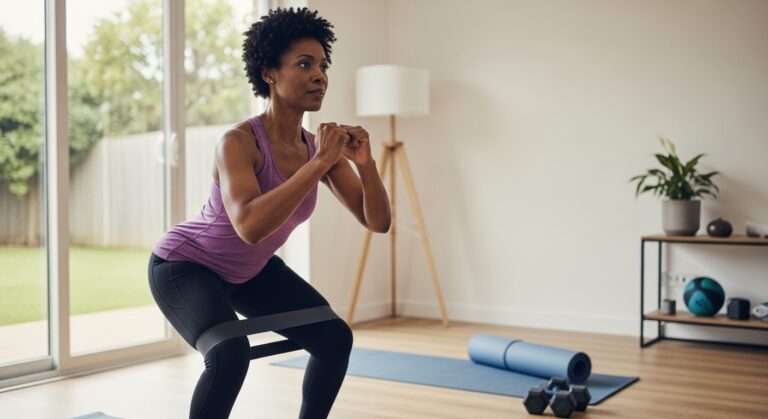
- Bodyweight squats: 10 reps, slow and controlled (primes legs and core)
- Cat-cow stretches: 10 reps (mobilizes spine)
- Glute bridges: 15 reps (activates glutes, which stabilize everything)
Essential Weight Lifting Exercises (With Safer Modifications)
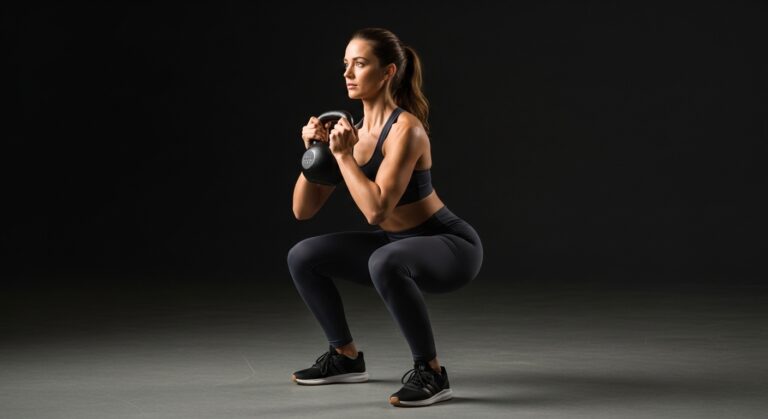
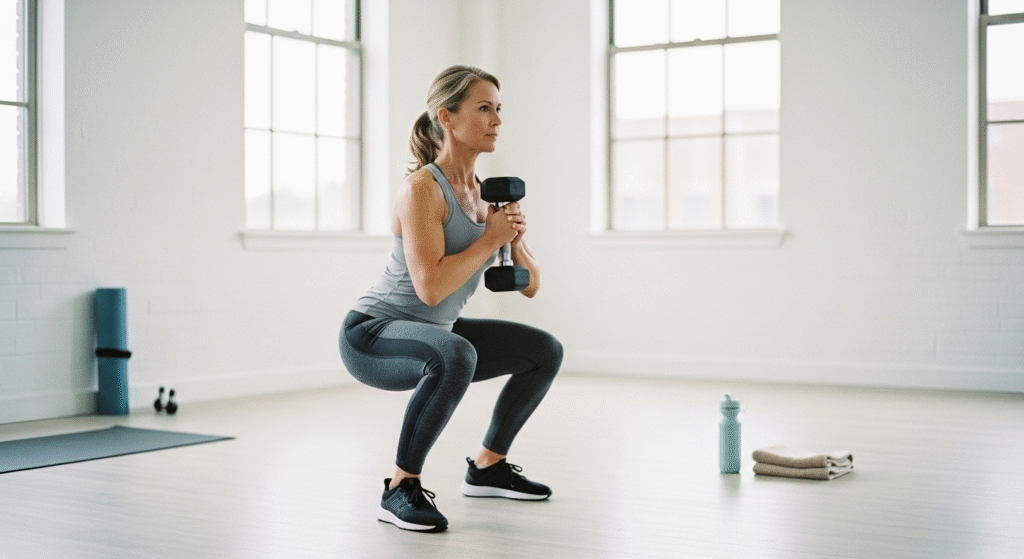
Goblet Squats are the safest entry point for weights for women over 50. Hold a single dumbbell vertically against your chest, elbows pointing down. Squat by pushing your hips back and down, keeping your chest upright and knees tracking over your toes. Descend until your thighs are parallel to the floor, then drive through your heels to stand. The dumbbell in front keeps you balanced and prevents your torso from folding forward, which protects your lower back. Modification for knee pain: Do box squats instead. Lower yourself to a chair or bench, lightly touch it with your glutes, and stand. This reduces the range of motion and takes stress off the knees while building the same strength.
Dumbbell Deadlifts (Romanian Style) build posterior chain strength—your hamstrings, glutes, and lower back—which is critical for daily function and bone density. Stand holding a dumbbell in each hand at your sides. Keep a slight bend in your knees and hinge at your hips, lowering the dumbbells down your legs until you feel a stretch in your hamstrings. Drive your hips forward to stand. Keep your spine neutral throughout—don’t round your back. Modification for lower back sensitivity: Start with lighter weights and reduce range of motion. Lower the dumbbells only to mid-shin instead of the floor.
Dumbbell Reverse Lunges build single-leg strength and balance, which directly reduces fall risk. Step backward with one leg, lowering your body until your back knee nearly touches the floor. Your front knee stays directly over your ankle. Push through your front heel to return to standing. Do all reps on one leg, then switch.
Bent-Over Dumbbell Rows build back strength and improve posture, which deteriorates after 50. Hinge at your hips, keeping your spine neutral and your chest nearly parallel to the floor. Let the dumbbells hang at arm’s length. Pull the dumbbells toward your ribs, squeezing your shoulder blades together. Lower with control. Modification for lower back strain: Do supported single-arm rows. Place one knee on a bench or chair, row one dumbbell at a time. This reduces spinal load while building the same strength.
Dumbbell Chest Press (Floor Version) is safer than a bench press for women over 50 because it limits range of motion and protects your shoulders. Lie on your back with knees bent and feet flat on the floor. Hold dumbbells at chest height, elbows bent to 90 degrees. Press the dumbbells up and slightly toward each other, stopping just short of locking your elbows. Lower with control. Your feet on the floor keep your lower back safe.
Dumbbell Overhead Press builds shoulder and core strength. Stand holding dumbbells at shoulder height, feet hip-width apart. Press the dumbbells overhead, stopping just short of full elbow lockout. Lower to shoulder height. This is demanding but powerful for functional strength. Start light and focus on controlled movement.
Dead Bugs are superior to crunches for core strength after 50. Lie on your back with arms extended toward the ceiling and knees bent to 90 degrees. Slowly lower your right arm overhead while straightening your left leg, hovering it just above the floor. Return to start. Alternate sides. This builds deep core stability without spinal compression.
Pallof Press trains anti-rotation strength, which stabilizes your spine during real life. Stand perpendicular to a cable machine or holding a dumbbell at chest height. Press the weight away from your body, resisting the urge to rotate. Hold for a breath, return. Do all reps on one side, then turn and repeat. This prevents low back pain.
Plank Progressions build endurance in your core muscles. Start on your forearms and knees, maintaining a straight line from head to knees. Hold for 20-30 seconds, rest, repeat for 3 sets. As this becomes easier, progress to full plank (on hands instead of forearms), then add movement like tapping shoulders or raising one leg slightly.
Weights for Women Over 50: How Much, How Often, How Heavy
Progressive overload is the single most important concept in strength training. It means gradually increasing the demand on your muscles over time. Without it, your body adapts to the current stimulus and stops improving. You could do the same 5-pound dumbbell squats for a year and see no progress because there’s no new demand.
Progressive overload happens in three ways: increase weight, increase reps, or increase sets. The most practical approach for women over 50 is to increase weight every 1-2 weeks once you can complete all sets with good form and 2+ reps “left in the tank.” When you hit 3 sets of 12 reps with solid form, bump the weight up by 2-5 pounds and drop back to 8-10 reps. This keeps the challenge consistent while allowing for recovery.
For muscle building, the sweet spot is 8-12 reps per set. This range creates enough mechanical tension and metabolic stress to trigger growth without being so heavy that form breaks down. For pure strength, 6-8 reps with heavier weights works, but only after you’ve built a base of movement quality.
Sets per exercise depend on experience. Beginners do 2-3 sets per exercise. After 4 weeks, progress to 3-4 sets on compound movements (squats, rows, presses). This creates enough volume for adaptation without overloading recovery capacity. Rest 60-90 seconds between sets on compound movements, 45-60 seconds on isolation work. This timing lets your nervous system recover enough for quality reps while keeping your heart rate elevated.
When and How to Increase Weight: Use the “last two reps test”: if the last 2 reps of your final set felt challenging but doable, you’re at the right weight. If they felt easy, increase weight next session. If you couldn’t complete all reps with good form, drop back 2-5 pounds.
- Completed 3×12 with good form and 2 reps left: increase weight by 2-5 lbs next session
- Completed 3×10 but last 2 reps were hard: stay at this weight, try for 3×12 next session
- Couldn’t finish all reps: drop weight by 2-5 lbs, rebuild volume, then progress
- Exercises feel stale after 4-6 weeks: swap for a variation (dumbbell rows become single-arm rows)
Plateaus are normal. You’ll hit a point where you can’t add weight or reps for 2-3 weeks. This is your body adapting. Take a deload week: reduce weight by 20%, do 2 sets instead of 3, and focus on movement quality. The following week, return to your previous weight and you’ll often break through.
Nutrition and Recovery: Fueling Muscle After 50
Women over 50 need more protein than younger women to build and maintain muscle. Research suggests 1.2-1.6 grams of protein per kilogram of body weight daily. For a 150-pound woman, that’s roughly 82-109 grams per day. If you’re training hard and trying to build muscle, aim for the higher end.
Timing matters slightly. Consume 20-30 grams of protein within 2 hours after your workout to support muscle repair. This doesn’t have to be a shake—it could be Greek yogurt, a chicken breast, eggs, or cottage cheese. Spread protein across your meals rather than loading it all at dinner. Your body can only synthesize about 30-40 grams of protein per meal, so three meals with 25-35 grams each is more efficient than one meal with 100 grams.
Easy protein sources: Greek yogurt (20g per 7oz), eggs (6g per egg), chicken breast (31g per 3oz), cottage cheese (14g per half cup), canned tuna (20g per can), protein powder (20-30g per scoop), and beans (15g per cooked cup). You don’t need expensive supplements—whole foods work perfectly.
Dehydration kills strength performance after 50. Your thirst mechanism becomes less reliable with age, so drink water proactively. A practical target: half your body weight in ounces of water daily. A 150-pound woman should drink 75 ounces (about 2.2 liters). More on training days. You’ll know you’re hydrated if your urine is pale yellow.
Sleep is where muscle is actually built. During deep sleep, your body releases growth hormone and repairs muscle tissue damaged during training. Aim for 7-9 hours nightly. This isn’t luxury—it’s biology. Women over 50 who sleep less than 6 hours have accelerated muscle loss. Prioritize sleep like you prioritize workouts. Consistent bedtime, cool dark room, no screens 30 minutes before bed.
What to Watch Out For: Injury Prevention Red Flags. Good soreness appears 24-48 hours after training as a dull, widespread muscle fatigue. You can still move and function. Bad pain is sharp, joint-focused, or immediate during the exercise. If you feel sharp pain during a movement, stop immediately. Sharp pain = stop. Dull soreness 24 hours later = normal adaptation.
Common mistakes that lead to injury: skipping warm-ups, progressing weight too fast (add 2-5 lbs, not 20), and continuing to train through pain that changes your movement pattern. If a movement causes pain that makes you limp or compensate, replace that exercise with a modification or variation for a week, then try again.
Persistent fatigue, irritability, or stalled progress for 3+ weeks often signals under-recovery. This means you need more sleep, more food, or fewer training days. Listen to your body. Pushing through genuine under-recovery leads to injury.
CONCLUSION
Strength training after 50 isn’t about transforming into someone else. It’s about building a powerful, resilient body that lets you live fully without fear of fractures, falls, or fatigue. The research is consistent: women who lift weights in their 50s, 60s, and beyond build muscle, protect their bones, stabilize their metabolism, and regain the physical confidence that makes daily life easier.
The proven protocol is straightforward. Train 2-3 days per week on non-consecutive days. Use moderate weights—5-15 pounds to start. Master 6-8 foundational exercises with perfect form. Add weight every 1-2 weeks when you can complete all sets with 2+ reps left. Eat enough protein, sleep 7-9 hours, and stay patient. Expect to feel stronger in 4-6 weeks, see visible muscle tone in 8-12 weeks, and experience measurable bone density improvements within 6-12 months of consistent training.
Your next move: This week, get medical clearance if needed (takes a 5-minute conversation with your doctor). Purchase one set each of 5-pound, 8-pound, and 12-pound dumbbells—neoprene or rubber-coated ones give you better grip. Then complete the 4-week beginner protocol above, filming yourself on squats and rows so you can check your form. In week 5, increase weights on exercises where you’re finishing with 2+ reps in reserve. Add a third training day if recovery feels solid. Track everything in a simple notebook: exercise, weight, reps, sets. Reassess every 4 weeks.
Remember: every woman who lifts weights after 50 started exactly where you are now, wondering if her body would respond. It will. You just have to start.