Functional Fitness for Women Over 50 | Strength Training Guide
You’re standing at the luggage carousel, and someone next to you lifts their carry-on into the overhead bin with ease. You hesitate. Your shoulder pulls back.
You use both hands, and even then, it feels precarious. That moment—the quiet realization that something you used to do without thinking now requires strategy—is what brings most women to functional fitness.
This isn’t about vanity. It’s not about fitting into old clothes or looking a certain way. Functional fitness for women over 50 is about reclaiming the ability to do the things that matter: carrying groceries in one trip, getting up from the floor to play with grandchildren, traveling without pain, living with autonomy and confidence.
The frustration is real. Most fitness advice is written for 25-year-olds. Your body has shifted. Hormones have changed. Recovery works differently. Joints need respect.
And traditional gym programs ignore all of this. They promise results designed for a body you no longer have, using timelines that don’t match your physiology.
Here’s what actually works: a framework built specifically for how your body adapts after 50. Not less effective than younger-focused training—just smarter. This guide gives you the science, the movements, and a proven routine you can start this week, at home, with minimal equipment.
What Functional Fitness Means for Women Over 50

Functional fitness is training for life, not for Instagram. It’s the difference between training your muscles to look a certain way and training them to do things that matter.
When you perform a squat in a functional fitness framework, you’re not squatting for aesthetics. You’re training the exact movement pattern your body uses to stand up from a chair, pick something off a low shelf, or get down to garden. When you do a deadlift variation, you’re practicing the mechanics of lifting a suitcase, a laundry basket, or a bag of groceries. The exercise and the real-world task are the same thing.
This matters because functional strength transfers directly to independence. Research consistently shows that women who maintain strength in the six foundational movement patterns—squat, hinge, push, pull, carry, and rotate—are significantly more likely to avoid falls, maintain bone density, and stay active well into their 70s and beyond. You’re not training for a number on the scale. You’re training to keep living the life you want.
Real-World Movement vs. Gym Performance
Bodybuilding focuses on muscle size and symmetry. Cardio-only training focuses on heart rate and endurance. Functional fitness focuses on movement quality and real-world strength. You might be weaker in absolute terms than a bodybuilder, but you’ll be stronger where it counts: in the movements that keep you independent.
The six foundational patterns form the blueprint for virtually every daily task. A squat is getting up from a chair or the toilet. A hinge is picking something up off the ground. A push is putting something on a high shelf or getting up from the floor. A pull is opening a heavy door or carrying bags. A carry is bringing in groceries. A rotate is reaching behind you or twisting safely to look over your shoulder. Train these patterns, and you train for life.
Why This Approach Transforms Your Independence
The most powerful thing about functional fitness is that progress is visible immediately in daily life. Week three, you notice you can carry both grocery bags from the car in one trip without fatigue. Week five, you get off the floor without using your hands. Week eight, stairs feel easier. These aren’t small wins—they’re the difference between depending on others and taking care of yourself.
This is why women over 50 respond so powerfully to functional training. The results aren’t theoretical. They’re lived.
Strength Training for Women Over 50: Why Your Body Needs Different Programming

Here’s the difficult truth: after menopause, your body changes in ways that matter for training. This isn’t weakness or failure. It’s biology. And understanding it is what makes your program effective instead of frustrating.
The Hormonal Reality After Menopause
Estrogen plays a massive role in muscle protein synthesis and bone density. When estrogen levels drop during and after menopause, two things accelerate: muscle loss and bone loss. Without intervention, women lose approximately 1 to 2 percent of muscle mass per year after age 50. Over a decade, that’s 10 to 20 percent of your strength gone. Bone density can drop up to 20 percent in the 5 to 7 years immediately following menopause.
This isn’t a defect to fear—it’s a reality to train around. Strength training is one of the most powerful tools to slow and even reverse these losses. Research shows that consistent resistance work preserves muscle mass, increases bone density, and maintains metabolic health. This is why strength training for women over 50 isn’t optional. It’s essential.
Recovery and Adaptation Differences
A 25-year-old’s muscles recover in 24 to 48 hours. Your muscles typically need 48 to 72 hours. This doesn’t mean you’re weaker or slower. It means your programming needs to respect this timeline. Train too frequently without adequate recovery, and you’ll feel perpetually fatigued and won’t see progress. Train with the right frequency—typically 2 to 3 sessions per week—and you’ll adapt beautifully.
This longer recovery window is actually strategic. It means fewer sessions per week, which fits real life better. It also means that when you do train, the stimulus is more powerful because your body has fully recovered. This is smarter programming, not weaker programming.
Joint Health Considerations
Joint health becomes more important after 50, and this shapes how you perform every exercise. Perfect form matters more now than ever. A sloppy squat at 25 might not cause problems. A sloppy squat at 55 can aggravate your knees for weeks. This isn’t a limitation—it’s a reason to focus on movement quality. And honestly, perfect form builds strength faster anyway.
The good news: every exercise has modifications that make it joint-friendly while maintaining the training stimulus. You’ll learn these in the next section.
Exercise for Women Over 50 Workouts: The 6 Essential Movement Patterns

These six patterns form the foundation of functional fitness. Master these, and you’ve trained for virtually every real-world task your body performs.
Squat Pattern—From Chair to Car
The squat pattern is how your body gets up from a seated position, picks something off a low shelf, or gets into a car. For beginners, start with a chair-assisted squat: stand facing a sturdy chair with feet hip-width apart, lower yourself until your hips lightly touch the seat, then stand back up. The chair is your safety net, not a crutch. As you get stronger, barely touch the seat. Eventually, you’ll squat without it.
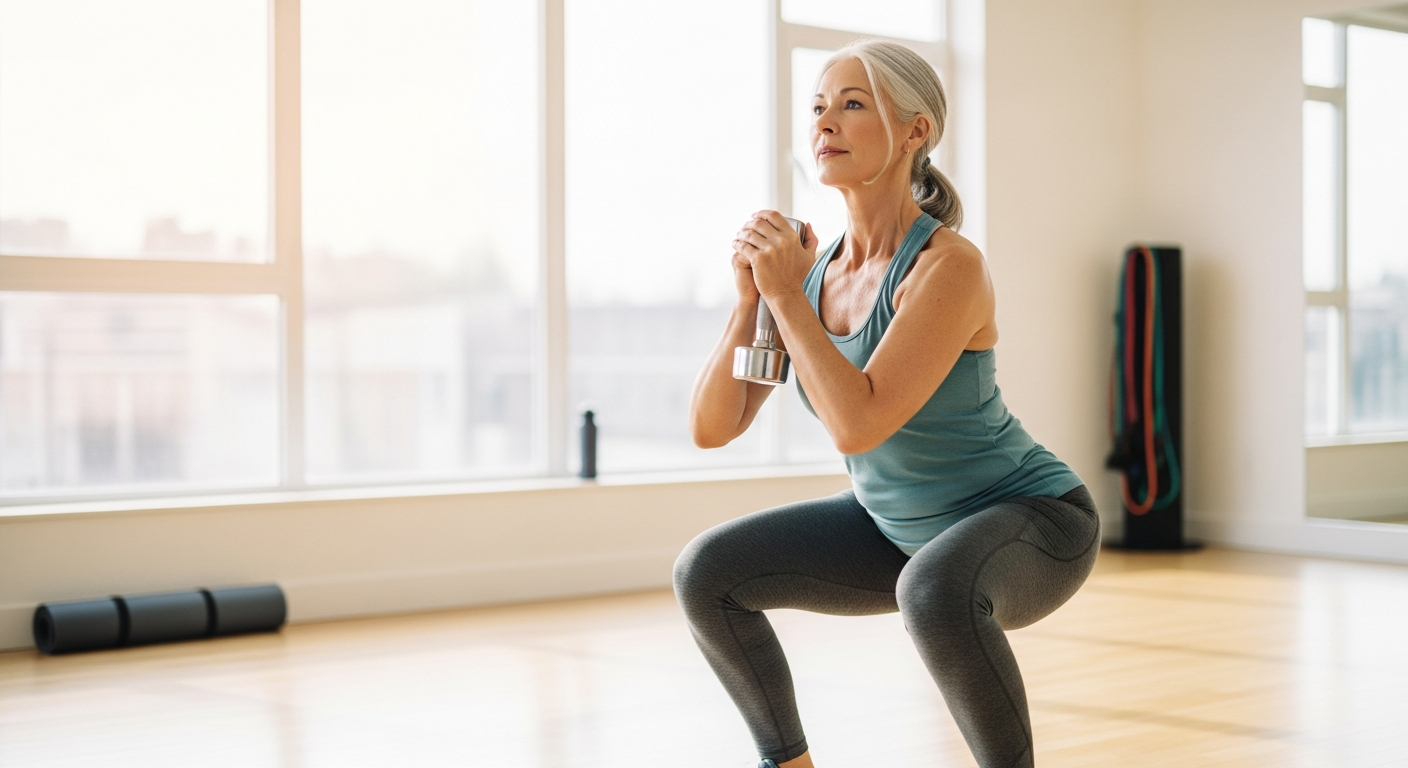
A more advanced option is the goblet squat: hold a light dumbbell or kettlebell at chest height, feet hip-width apart, and squat down as if sitting into a chair. Keep your chest up, weight in your heels, and knees tracking over your toes. The weight in front of you acts as a counterbalance and helps with form.
Form cues: chest up, weight in heels, knees don’t cave inward, depth is only as far as comfortable. If your knees hurt, you’re either going too deep or your form is off. Stop, reset, and try again with less depth.
Hinge Pattern—The Grocery Bag Lift
The hinge is how you pick things up. It’s the foundation of deadlifts, and it’s one of the most important patterns for daily strength. The key is keeping your spine neutral (not rounding forward) while you bend at the hips.
Start with a Romanian deadlift with light dumbbells: hold a light dumbbell in each hand, feet hip-width apart, and hinge forward at the hips as if reaching for something on a low shelf. Your back stays straight, your knees stay slightly bent, and you feel a stretch in your hamstrings. Stand back up by squeezing your glutes. This movement is the exact pattern you use to pick up a grocery bag or laundry basket.
Critical safety cue: your spine stays neutral throughout. If you feel rounding in your lower back, reduce the depth or weight immediately. The hinge is powerful, but only if form is perfect.
Push and Pull Patterns—Upper Body Functionality
Push patterns train your ability to put things on high shelves and push yourself up from the ground. Pull patterns train your ability to open heavy doors and carry bags. Both are essential for upper body strength.
For push, start with wall push-ups: place your hands on a wall at shoulder height, step back, and lower your body toward the wall by bending your elbows. Push back to start. As you get stronger, move to an incline push-up with your hands on a bench or sturdy table. Eventually, you’ll progress to floor push-ups. The form is the same: body straight, elbows at a 45-degree angle to your body, controlled descent and explosive push-up.
For pull, use resistance band rows: anchor a resistance band at chest height, grab both ends, and pull the band toward you by squeezing your shoulder blades together. This trains the exact muscles you use to open a heavy door or carry bags. Bands are joint-friendly and highly effective for this population.
Carry and Rotate—Forgotten but Essential
Carries are simple and powerful: hold a weight (dumbbell, kettlebell, or even a grocery bag) and walk. This trains grip strength, core stability, and the exact movement of bringing groceries inside. A farmer’s carry is the simplest version: hold a dumbbell in each hand and walk for 30 to 60 seconds. Your core stays tight, your posture stays upright, and you’re building real-world strength.
Rotation trains safe spinal movement for tasks like reaching behind you or twisting to look over your shoulder. A Pallof press is excellent: stand perpendicular to a resistance band anchored at chest height, hold the band at your chest, and press forward. This resists rotation, building core stability. Do 8 reps per side.
Over 50 Workouts for Women: Your Beginner-Friendly Starting Routine

This is the routine you can start this week. It requires minimal equipment, takes 30 to 40 minutes including warm-up, and is designed specifically for recovery and progression at this stage of life.
The Twice-Weekly Framework
Two sessions per week is the sweet spot for women over 50. It’s enough to build strength and muscle, respects your recovery needs, and fits into real life. You’ll do one lower-body-focused session and one upper-body-focused session, with at least two days between them. A sample schedule: Monday and Thursday, or Tuesday and Friday. This gives your body 48 to 72 hours to recover between sessions.
Each session includes a 5-minute warm-up (light movement to elevate heart rate), the main workout (5 exercises), and a 5-minute cool-down (stretching). Total time: 35 to 40 minutes.
Workout A: Lower Body and Core Focus
Perform these exercises in order. Rest 60 to 90 seconds between sets.
- Goblet squats: 2 sets of 8 to 10 reps. Hold a light dumbbell (5 to 15 pounds, depending on your strength) at chest height. Squat down as if sitting into a chair. Pause briefly at the bottom, then stand up. If you don’t have a dumbbell, use a chair for balance and do chair-assisted squats.
- Romanian deadlifts (light): 2 sets of 8 to 10 reps. Hold light dumbbells (3 to 10 pounds) at your sides. Hinge forward at the hips, keeping your spine neutral. Feel the stretch in your hamstrings. Stand back up by squeezing your glutes.
- Step-ups or reverse lunges: 2 sets of 6 to 8 reps per leg. For step-ups, step up onto a sturdy low step or bench, then step down. For reverse lunges, step backward, lower your hips, and step forward. Choose whichever feels more stable.
- Farmer’s carries: 2 sets of 30 seconds. Hold a dumbbell in each hand (or one in each hand if that’s all you have) and walk. Keep your posture upright and core tight.
- Dead bugs: 2 sets of 8 reps per side. Lie on your back, knees bent, feet on the floor. Lift one arm overhead while straightening the opposite leg. Return to start and repeat on the other side. This trains core stability safely.
Workout B: Upper Body and Balance
Perform these exercises in order. Rest 60 to 90 seconds between sets.
- Wall or incline push-ups: 2 sets of 8 to 10 reps. Place hands on a wall (easier) or on an incline like a bench or sturdy table (harder). Lower yourself with control, then push back to start. Full floor push-ups come later as you build strength.
- Resistance band rows: 2 sets of 10 to 12 reps. Anchor a resistance band at chest height or hold it in your hands. Pull the band toward you by squeezing your shoulder blades. This trains your back and the muscles you use to carry heavy things.
- Overhead press (light weights): 2 sets of 8 to 10 reps. Hold light dumbbells at shoulder height (2 to 8 pounds). Press overhead, then lower with control. If overhead movement bothers your shoulders, reduce range of motion—press only to eye level instead of full overhead.
- Single-leg stands or heel-to-toe walks: 2 sets of 30 seconds per side. Stand on one leg and hold for 30 seconds. If that’s unstable, practice heel-to-toe walks: walk in a straight line, placing your heel directly in front of your toe with each step. This trains balance, which prevents falls.
- Pallof press or woodchops: 2 sets of 8 reps per side. Anchor a resistance band at chest height. Hold the band with both hands at your chest and press forward, resisting rotation. This trains core stability and safe rotation for daily tasks.
Strength Training Workouts for Women Over 50: Modifications for Common Concerns

Real life includes joint pain, balance concerns, and osteoporosis precautions. Here’s how to modify for each.
Working Around Joint Pain
Knee pain during squats? Use a wider stance, reduce depth, or use a chair for support. The goal is to find the range of motion where you feel muscle work but no sharp pain. Muscle fatigue (burning sensation) is fine. Sharp, shooting pain is a signal to stop and modify.
Shoulder pain during overhead work? Reduce range of motion. Instead of pressing overhead, press only to eye level. Or use resistance bands instead of dumbbells—they provide less stress on the joint. As you get stronger, range of motion often improves naturally.
The critical distinction: muscle fatigue versus joint pain. Muscle fatigue is productive—it’s the signal that you’re building strength. Joint pain is a warning. If an exercise causes sharp pain, modify or replace it. There’s always an alternative that trains the same pattern.
Balance and Osteoporosis Precautions
If you have osteoporosis or poor balance, avoid high-impact movements and forward spinal flexion (bending forward aggressively). This means no jumping, no heavy forward bending, and no exercises that round your spine under load.
Instead, focus on controlled movements, stable positions, and using walls or chairs for balance during balance exercises. As your balance improves, gradually reduce reliance on support. Single-leg stands are powerful for balance, but start by holding onto a counter with one hand. Progress to fingertip contact. Eventually, you’ll stand without support.
For osteoporosis, strength training is actually protective. The impact of muscle pulling on bone stimulates bone growth. Just ensure movements are controlled and form is perfect.
Equipment Alternatives and Minimal Investment
You don’t need a gym or expensive equipment. Bodyweight progressions work beautifully. Wall push-ups require nothing. Chair-assisted squats require only a sturdy chair. Single-leg stands require only a wall or counter.
If you want to invest minimally, resistance bands are the best value. A quality set costs $15 to $30 and gives you dozens of exercise options. They’re joint-friendly, portable, and durable. For carries and goblet squats, a single adjustable dumbbell ($30 to $50) covers most beginners’ needs.
Household items work too: water bottles as light weights, a backpack filled with books for carries, a sturdy chair for support and step-ups. The equipment matters far less than consistency and form. Start with what you have.
Workouts for Over 50: Progressive Overload Without Injury

Progress is how you build strength. But progression for women over 50 looks different than for 25-year-olds. The principle is the same—gradually increase difficulty. The timeline is slower, and the method is smarter.
How to Increase Difficulty Safely
Never increase weight and reps simultaneously. The safest progression: add reps first. When you can complete all sets and reps with perfect form and feel recovered the next day, add one more rep per set. Once you reach 12 reps per set, then increase weight and drop back to 8 reps. This keeps joints safe while building strength steadily.
Another powerful progression: tempo. Slow down the lowering phase of any exercise. A goblet squat with a 3-second descent is harder than one with a 1-second descent, even with the same weight. Tempo builds strength without increasing load on joints.
Reducing support is also progression. Chair-assisted squats to barely touching the chair to no support. Using a wall for balance to fingertip contact to no contact. These progressions are powerful and safe because they’re based on movement quality, not arbitrary weight increases.
The rule: never increase more than 10 percent per week. If you’re lifting 10 pounds, the next weight is 11 pounds. This seems small, but compounded over weeks and months, it builds substantial strength without injury risk.
Tracking Progress Beyond the Scale
The scale is nearly useless for tracking functional fitness progress. Muscle weighs more than fat, and you might build muscle while losing fat—net weight stays the same, but your body has transformed.
Instead, track functional wins. Can you carry both grocery bags in one trip now? Can you get off the floor without using your hands? Do stairs feel easier? Can you play with grandchildren longer without fatigue? These are the metrics that matter. Write them down weekly. You’ll be amazed at how quickly they improve.
Also track strength markers: more reps with the same weight, heavier weight for the same reps, better form (less reliance on support), faster recovery (less sore the next day). These are objective measures of progress that matter.
When to Progress Your Program
After 4 to 6 weeks at the beginner routine, you’ll be ready to progress. Signs you’re ready: exercises feel significantly easier, you complete all reps with perfect form and energy to spare, and recovery is quick (no soreness or fatigue the next day).
Progression doesn’t mean harder. It means smarter. Add an extra set to each exercise. Increase reps from 8 to 10 to 12. Progress to less supported variations (less reliance on chair, wall, or band). Add one new exercise per workout to train slightly different angles. The goal is gradual challenge, not dramatic overhaul.
Expect results in 3 to 4 weeks (you’ll feel stronger), visible functional improvements by 6 to 8 weeks, and substantial strength gains by 12 weeks. This timeline is realistic and sustainable. Faster isn’t better—consistent is better.
CONCLUSION: Your Next Steps to Build Powerful, Functional Strength

Functional fitness for women over 50 is the most powerful investment you can make in your independence and quality of life. It’s not about looking younger or fitting into old clothes. It’s about being able to lift your grandchild, carry your luggage, get off the floor, and live without fear of injury or limitation.
Your body has changed since you were 25. That’s not a deficit—it’s a reason to train smarter. Longer recovery, respect for joints, focus on movement quality over ego, and patience with progression. This isn’t weakness. This is wisdom.
Here’s what to do this week: Pick two days to train (Monday and Thursday, or Tuesday and Friday). Put them in your calendar now. Gather whatever equipment you have—a chair, resistance bands, light dumbbells, or nothing at all. Start with Workout A. Focus entirely on perfect form. Don’t worry about weight or reps. Just move well.
Track one functional win each week. Did you carry more groceries? Get up easier? Feel stronger? Write it down. This compounds. In four weeks, you’ll have four functional wins. In twelve weeks, you’ll have transformed how your body moves through the world.
The bottom line: Functional fitness works because it trains you for real life, and real life is the best motivation. You’re not training for a number on a scale or a photo. You’re training to stay independent, capable, and strong. That’s powerful. Start this week.