8 minute workout for busy seniors
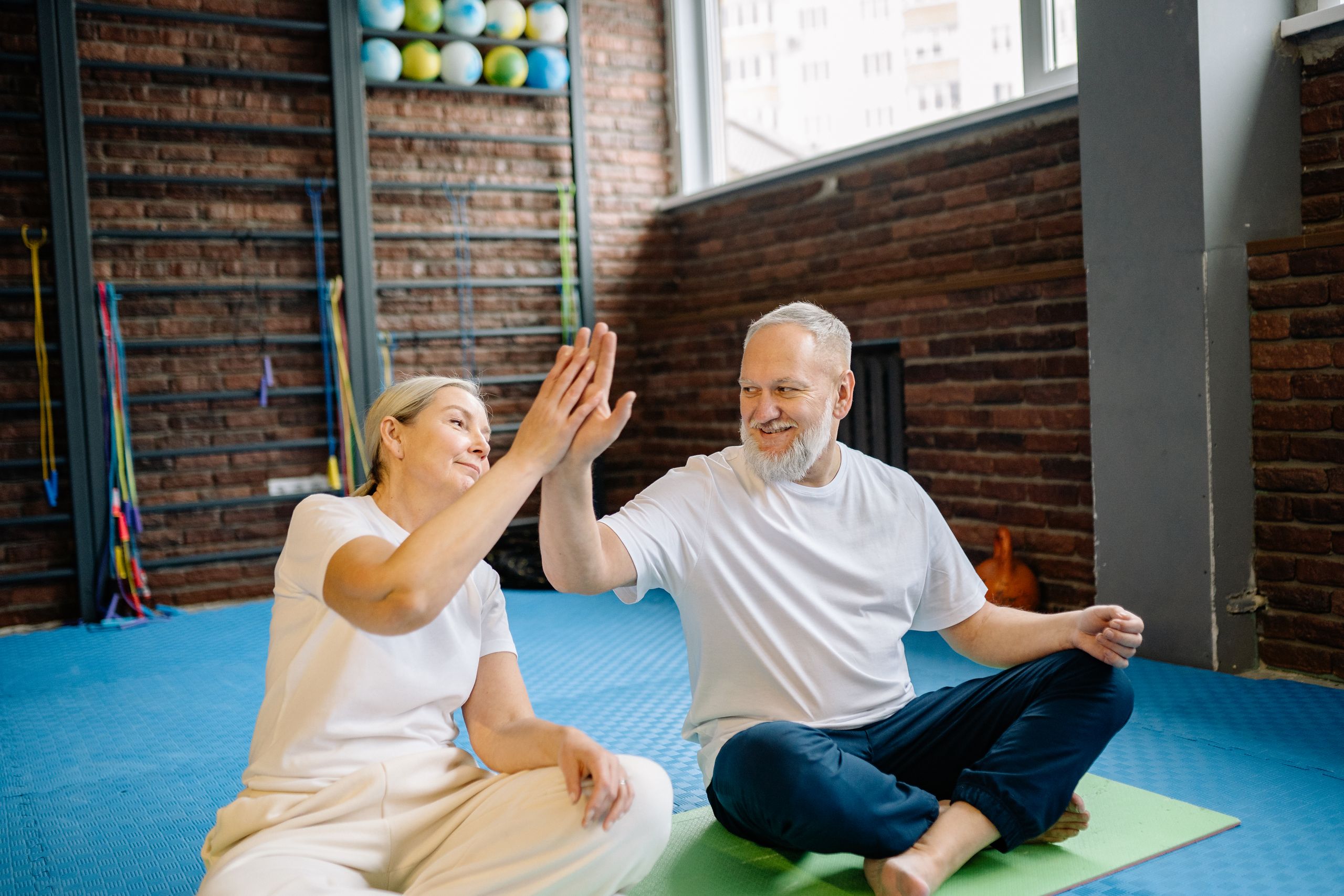
Most seniors hear “you need to exercise” and picture an hour at the gym—something that feels impossible when you’re managing a full life, joint pain, or simply don’t have the energy you used to.
But here’s what research actually shows: eight minutes of intentional movement, done consistently, produces measurable improvements in strength, balance, and independence. You don’t need more time. You need the right eight minutes.
This guide gives you a complete, chair-based routine designed specifically for senior bodies—no equipment, no complicated transitions, no excuses about time.
You’ll learn exactly which exercises matter most for preventing falls, maintaining muscle, and keeping your body functional for the activities you actually care about. By the end, you’ll have a routine you can do tomorrow morning, and a clear path to progressing when you’re ready.
Why 8 Minutes Actually Works for Senior Fitness

Let’s be direct: you’ve probably heard that you need 30 minutes of exercise daily. That’s true for building cardiovascular endurance, but it’s also why many seniors skip workouts altogether. Life is full—doctor’s appointments, grandkids, managing medications.
An 8-minute workout removes the biggest barrier to consistency, which is far more valuable than one perfect 30-minute session you never actually do.
The science here is solid. Research on “exercise snacking”—short bursts of movement throughout the day—shows that seniors who do multiple brief sessions maintain strength and mobility better than those waiting for the “perfect time” to exercise. Your muscles don’t know if you’re working for 8 minutes or 30; they respond to the stimulus you give them. What matters is that you’re moving regularly, with intention.
Here’s what makes 8 minutes realistic for seniors specifically: it fits between breakfast and your morning routine. It’s short enough that joint pain or fatigue won’t derail you mid-session.
And critically, it’s sustainable. The best workout is the one you actually do, not the ambitious plan gathering dust on your nightstand.
An 8-minute session also sidesteps the recovery trap. Seniors often need more recovery time between intense workouts, which can stretch a “quick workout” into a day-long ordeal of soreness.
These shorter sessions build strength and balance without leaving you exhausted or sore the next day—meaning you’re more likely to do it again tomorrow.
The real win? Consistency compounds. Eight minutes, five days a week, adds up to 40 minutes—more than enough for meaningful strength gains, better balance, and improved daily function.
You’ll notice it first in small ways: climbing stairs without gripping the rail, standing up from a chair without pushing, or simply feeling steadier on your feet. Those aren’t small victories. That’s independence.
Chair Exercises: The Complete 8-Minute Seated Routine
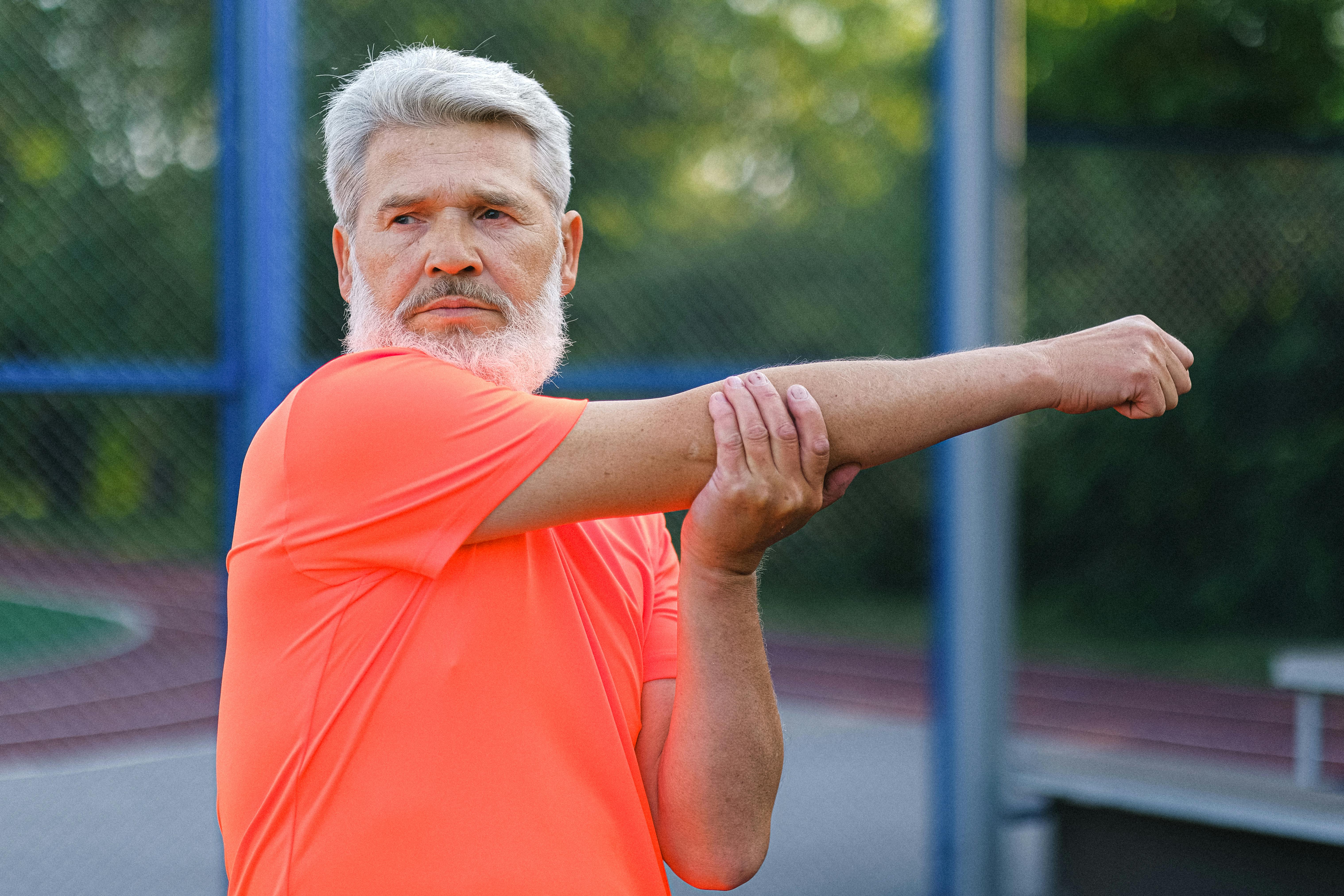
Here’s the routine that works. You’ll do five exercises, spending roughly 90 seconds on each (including transitions). The chair itself becomes your gym—no equipment needed, no excuses about balance or mobility getting in the way.
Minute 0–1:30 | Seated Marching
Sit upright with feet flat. Lift one knee up toward your chest, then the other, in a controlled marching rhythm. Aim for 20–30 total lifts. This wakes up your hip flexors and core without any impact. Most people rush this; slow it down. Quality over speed means your muscles actually work.
Minute 1:30–3:00 | Seated Torso Twists
Cross your arms over your chest or place hands behind your head. Rotate your torso left and right, keeping your hips stable in the chair. Do 10–12 twists per side. You’re mobilizing the spine and engaging the obliques—muscles that stabilize you during daily movement like reaching for groceries or turning to look behind you while walking.
Minute 3:00–4:30 | Seated Leg Lifts
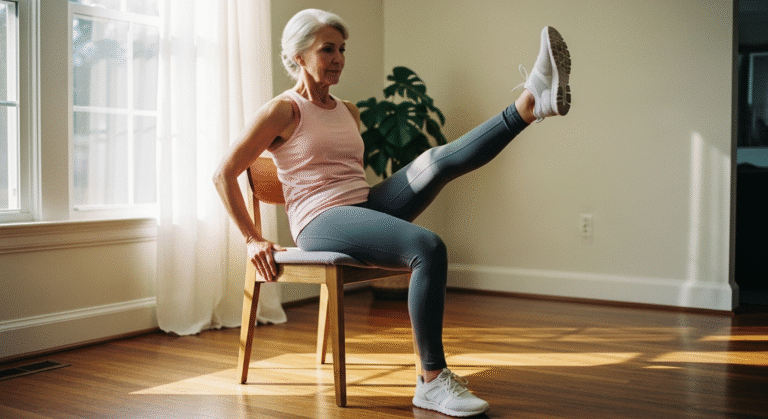
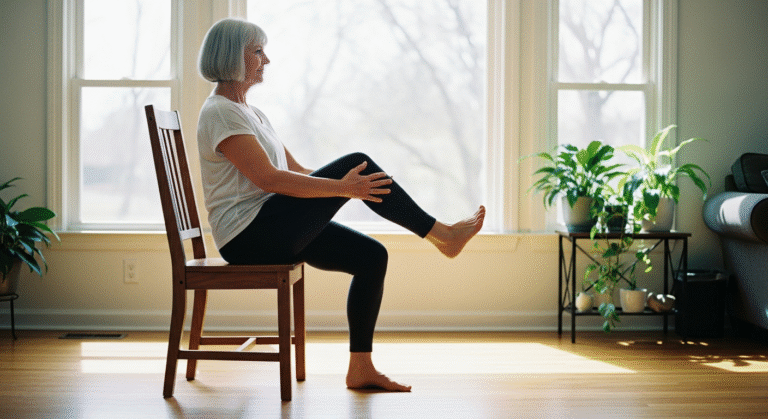
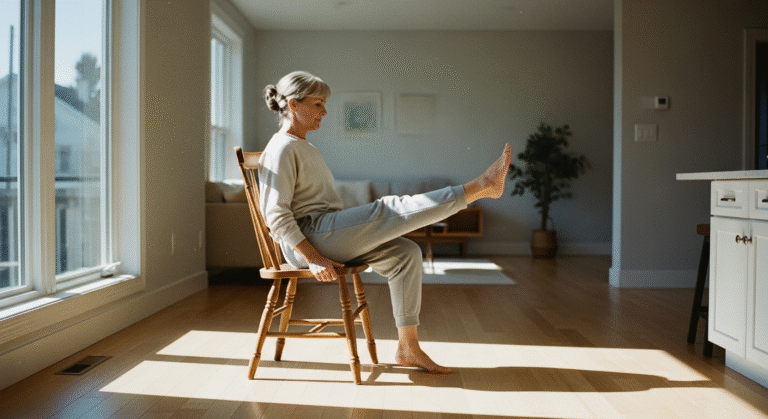
Straighten one leg out in front of you, hold for a second, then lower. Alternate legs for 10–12 reps each. This targets the quadriceps, the muscle group that directly supports knee health and stair climbing. The seated position removes fall risk while building genuine strength.
Minute 4:30–6:00 | Seated Shoulder Rolls and Arm Circles
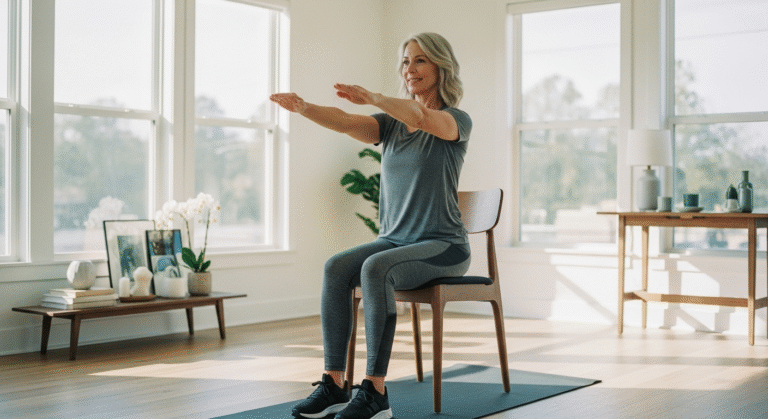
Roll your shoulders backward 10 times, then forward 10 times. Follow with small arm circles forward and backward. Shoulder mobility declines with age, and this combats it. You’ll notice reaching for high shelves or putting on a jacket becomes easier within weeks.
Minute 6:00–7:30 | Seated Glute Squeezes
Tighten your glute muscles as hard as you can for 2 seconds, then release. Repeat 12–15 times. The glutes are your powerhouse for standing, walking, and climbing stairs. They’re also the first muscle group to weaken with inactivity, so this matters more than it sounds.
Minute 7:30–8:00 | Cool Down Breathing
Sit quietly, breathe deeply for 3–4 counts in, 4–5 counts out. Let your heart rate settle. This isn’t wasted time—it signals your nervous system that the work is done.
That’s it. Eight minutes. Five moves. Zero excuses.
Senior Exercises: Safety Basics Before You Start
Before you do a single rep, let’s talk about the non-negotiable safety rules. This isn’t fear-mongering—it’s the difference between sustainable progress and a setback that derails your momentum for months. The good news: these rules are straightforward, and once they’re habit, you won’t think about them.
First, get medical clearance. If you’ve been sedentary, have joint issues, heart concerns, or take medications that affect balance or blood pressure, talk to your doctor before starting. This takes 10 minutes and removes the guesswork. Your doctor might even suggest modifications specific to your situation—information that’s worth gold.
Wear stable footwear. This is the single most common mistake I see. Socks alone, slippers, or worn-out shoes dramatically increase fall risk, especially during balance work. Lace-up shoes or supportive slip-ons with good grip are non-negotiable. Your feet are your foundation—treat them that way.
Set up your space properly. Clear clutter, ensure good lighting, and position a sturdy chair or counter within arm’s reach for balance support. You’re not being overly cautious—you’re being smart. Falls in seniors often result from tripping over a pet, a throw rug, or poor visibility, not from the exercise itself.
Warm up for 60 seconds. Gentle arm circles, marching in place, or slow shoulder rolls prepare your joints and nervous system. Your muscles and connective tissue need this transition, especially in the morning when synovial fluid hasn’t fully mobilized your joints yet.
Know the difference between discomfort and pain. Muscle fatigue—that “working” feeling—is normal and good. Sharp pain, joint pain, dizziness, or chest discomfort means stop immediately. Pushing through real pain isn’t dedication; it’s how injuries happen. Listen to your body without letting fear stop you from trying.
Stay hydrated. Have water nearby and sip before, during, and after. Dehydration impairs balance and cognitive function—two things you absolutely need during exercise.
These aren’t obstacles to your workout. They’re the infrastructure that lets you train safely for years to come.
Exercises for Seniors: What Each Move Does for You

Understanding what each exercise actually accomplishes in your body changes how you approach the workout. You’re not just moving for the sake of movement—every repetition is building something specific. Let’s break down the chair-based routine so you know exactly why you’re doing it.
Seated marches wake up your hip flexors and quadriceps while elevating your heart rate safely. This matters because hip flexor strength directly supports your ability to walk without shuffling and climb stairs without holding the railing. You’ll feel this in your thighs—that’s the signal that the muscle fibers are engaging. Do 20–30 lifts per leg, keeping your posture upright against the chair back.
Seated torso twists target your obliques and rotational core stability. This isn’t vanity work; rotational strength prevents falls by letting you turn safely without losing balance. The key mistake here is twisting from your neck instead of your spine. Keep your head still and rotate from your ribcage. Perform 10–15 twists each direction, moving deliberately rather than fast.
Seated arm circles and overhead presses rebuild shoulder mobility and upper-body strength. Many seniors lose overhead strength gradually, which makes everyday tasks—reaching for cabinet items, adjusting a ceiling fan—feel impossible. These moves restore that capability. Use light resistance (1–2 pound dumbbells or water bottles) and complete 10–12 repetitions with controlled movement.
Seated leg lifts isolate your quadriceps and hip extensors. Strong quads are non-negotiable for knee stability and walking endurance. Research shows that quad strength correlates directly with fall prevention in older adults. Lift each leg straight out, hold for one second at the top, and lower slowly. This eccentric (lowering) phase builds the most strength. Aim for 12–15 lifts per leg.
The beauty of this routine is that every single exercise serves a functional purpose. You’re not training to look a certain way—you’re training to live independently. That distinction matters for motivation. When you understand that stronger legs mean you can play with grandkids or travel without fatigue, the 8 minutes becomes an investment, not a chore.
Improve Balance Exercises: Progressing Beyond 8 Minutes

Eight minutes is a starting point, not a ceiling. Once you’ve built consistency with the seated routine—and consistency matters more than intensity at this stage—your body adapts. You’ll notice movements feel less shaky, transitions feel smoother, and you’re breathing easier. That’s your signal that progression is possible and, frankly, necessary. Without it, your nervous system stops improving balance because it’s no longer being challenged in new ways.
The progression isn’t about doing more of the same thing faster. It’s about adding instability in controlled doses. Start by performing familiar moves while standing instead of seated—same chair exercises, different position. Your core and stabilizer muscles suddenly work harder because they’re not supported. A simple chair stand becomes a balance challenge when you add a 2-second pause at the top, eyes closed. Research on proprioception shows that removing visual input forces your vestibular system and muscles to work together more intensely, which is exactly what prevents falls in real life.
Here’s a realistic progression timeline: spend 2–3 weeks with the 8-minute seated routine. Then add 5 minutes of standing variations 3–4 times per week. By week 6–8, you’ll likely be ready for tandem stance holds (standing with one foot slightly in front of the other) or single-leg balance work at the counter. This isn’t fast. It’s deliberate. And it works because your balance system needs time to rewire neural pathways—that takes weeks, not days.
The common mistake is jumping to advanced balance work too quickly and either falling or getting discouraged. Always keep one hand near a sturdy surface. The goal isn’t to prove you don’t need support; it’s to gradually reduce your dependency on it while staying safe. If you feel unsteady, that’s information—step back to the previous level for another week. This isn’t failure; it’s respecting how your body actually learns.
Senior Exercises Workouts: Making the 8-Minute Habit Stick

Here’s the uncomfortable truth: an 8-minute workout only works if you actually do it. And consistency—not intensity—is what changes your body and your life. Research on habit formation shows that people who exercise regularly gain more strength, balance, and independence than those who do occasional intense sessions. The difference isn’t dramatic week-to-week, but over 12 weeks, it’s undeniable. The catch is showing up.
The biggest mistake I see is treating the 8-minute routine like a chore you check off, rather than a non-negotiable part of your day—like brushing your teeth. Instead of “I’ll do it when I have time,” anchor it to an existing routine. Do it right after breakfast, or immediately after your morning coffee while the pot cools. Pair it with something you already do every single day. This is called habit stacking, and it removes the decision-making friction that kills consistency.
Track it visually. Use a calendar on your fridge and put an X on every day you complete your routine. This sounds simple because it is—but seeing that chain of X’s grow creates psychological momentum. You won’t want to break it. Studies on goal-setting show that people who track progress are 2–3 times more likely to stick with a behavior than those who don’t.
Set a realistic expectation: results take 4–6 weeks to feel noticeable, and 8–12 weeks to see measurable changes in strength or balance. If you’re expecting transformation in two weeks, you’ll quit. If you know it takes time and you commit anyway, you’ve already won the mental game.
Finally, give yourself permission to modify the routine on hard days. If your knee is sore or you’re exhausted, do a gentler version—5 minutes instead of 8, or just the upper-body moves.
Something is always better than nothing, and protecting your motivation matters more than perfect execution on day 47. The goal isn’t perfection. It’s becoming someone who moves, consistently, for the rest of their life.
Your Next Move

Eight minutes is not a shortcut—it’s a legitimate training stimulus when you’re consistent and intentional. The science is clear: frequency and adherence matter more than duration. A senior who does this routine five times a week will see measurable improvements in strength, balance, and mobility within 4–6 weeks. That’s not hype; that’s physiology. You’re creating a stimulus your muscles and nervous system respond to, and you’re doing it in a timeframe that actually fits your life. The barrier to fitness for most seniors isn’t knowing what to do—it’s doing it regularly. Eight minutes removes the excuse.
What you’ve learned here is a foundation: why seated work is effective, how to move safely without compensating, what each exercise targets, and how to progress when you’re ready. You know that chair exercises aren’t “less than” standing workouts—they’re strategic, sustainable, and genuinely challenging when performed with control. You understand that balance doesn’t improve from one session; it improves from repeated, deliberate practice. And you have a framework for making this a habit that sticks, not another thing you tried once.
Here’s your next step: Pick one day this week—tomorrow, ideally—and do the full 8-minute routine once. Not perfectly. Just do it. Move through each exercise with the form cues in mind, rest when you need to, and notice how you feel afterward. That single session is not about results; it’s about proving to yourself that you can do this and that it fits into your day. Then commit to three sessions next week, same time if possible. Your brain needs consistency to build the habit; your body needs repetition to build the strength. Both happen in parallel, and both take time.
You don’t need a gym membership, expensive equipment, or an hour you don’t have. You need a chair, eight minutes, and the decision to show up. That’s within reach. Start tomorrow.