pilates reformer spring tension Guide
You’ve finally decided to invest in a pilates reformer for your home, or you’ve walked into a pilates studio for the first time, and you’re staring at a confusing array of colored springs, wondering if you’re about to make a costly mistake. Should you use the red spring or the blue one?
How many springs equal “beginner-friendly”? And why does your instructor make it look so effortless when you can barely move the carriage?
Here’s what nobody tells you upfront: spring tension is the single most important variable in your pilates reformer workout, and getting it wrong doesn’t just limit your results—it can turn an effective, joint-friendly exercise into a frustrating struggle or set you up for injury.
The reformer’s spring system is what makes pilates fundamentally different from every other workout you’ve tried, but most beginners spend weeks guessing at settings instead of understanding the simple principles that unlock real progress.
This guide breaks down exactly how pilates reformer spring tension works, which settings to use for every major exercise category, and how to adjust springs as you progress from complete beginner to advanced practitioner.
You’ll learn the counterintuitive truth about lighter springs often creating harder workouts, decode the color-coded system that changes between reformer brands, and discover the specific spring combinations that target fat loss, muscle building, or rehabilitation.
Understanding Pilates Reformer Spring Tension Basics

The pilates reformer spring system is built on a principle that most gym equipment ignores: continuous variable resistance throughout the entire range of motion.
Unlike dumbbells or weight machines that rely on gravity, reformer springs create tension that changes dynamically as you move.
When you push the carriage away, the springs stretch and resistance increases. When you return, the springs want to pull you back, forcing your muscles to control the eccentric phase.
This matters because research on muscle development consistently shows that eccentric control (the lengthening phase of movement) builds strength and prevents injury more effectively than concentric work alone.
The reformer’s spring tension gives you both phases in one smooth motion, which is why pilates builds that characteristic long, lean muscle without the bulk that comes from traditional weightlifting.
What Makes Pilates Reformer Springs Different from Traditional Weights
Reformer springs create horizontal resistance that increases as the spring stretches, meaning the hardest part of the movement is often at full extension, not at the start.
This variable resistance pattern does three powerful things: it protects joints by reducing load at vulnerable positions, trains your stabilizer muscles harder because you’re controlling movement in both directions, and allows you to work strength and flexibility simultaneously.
The practical advantage? You can get a complete strength workout in 30 minutes because every exercise works multiple muscle groups through full ranges of motion. No need to isolate biceps, then triceps, then shoulders. The reformer’s spring tension system integrates everything.
Decoding the Color-Coded Spring System
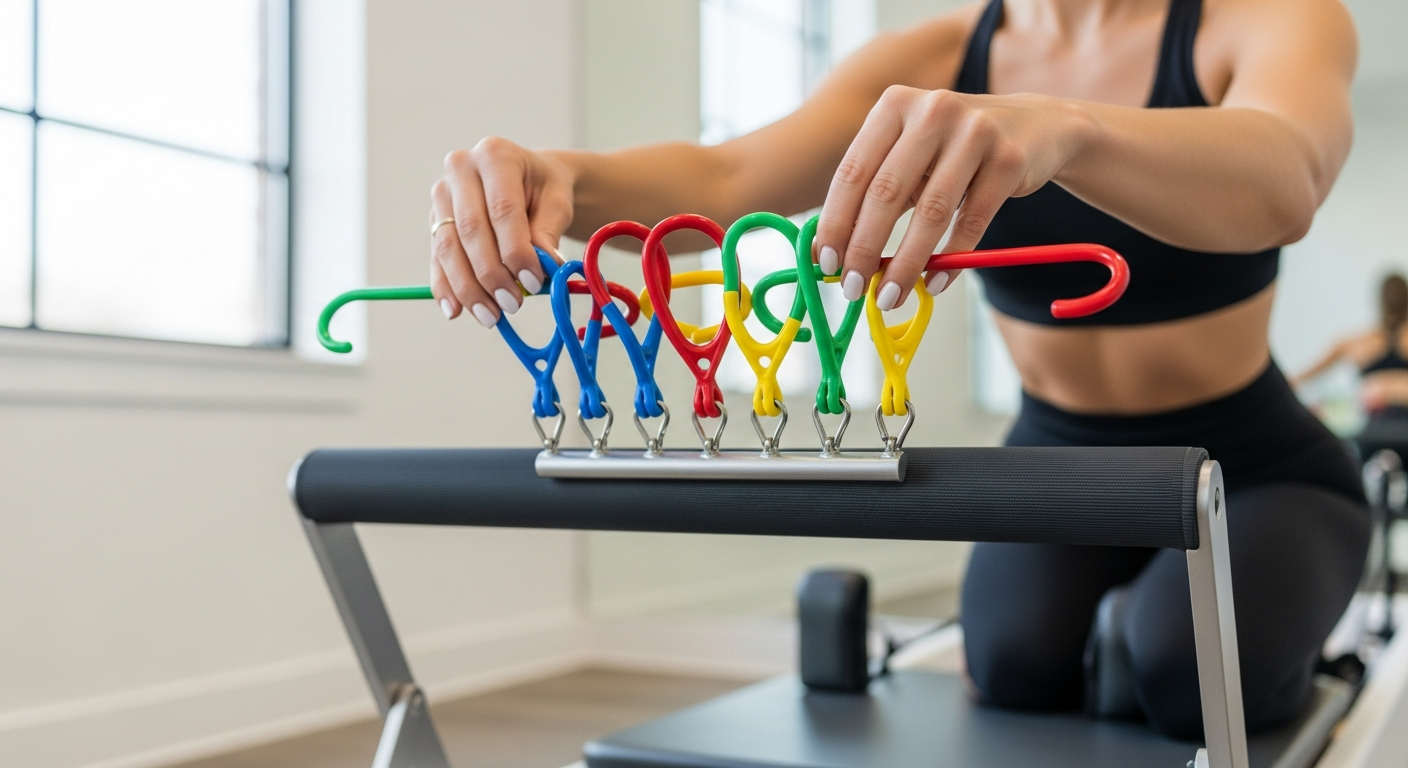
Most pilates reformers use a color-coded spring system, but here’s the frustrating truth: there is no universal standard. The most common configuration follows this pattern: red springs are heavy, blue springs are also heavy (slightly less than red), yellow or green springs are medium, and green or yellow springs are light. Some reformers add a fifth spring in purple or white for extra-light resistance.
Balanced Body reformers typically use red and blue as heavy springs, yellow as medium, and green as light. Stott Pilates reformers often use blue as the heaviest, red as medium-heavy, yellow as medium, and green as light.
Peak Pilates and other brands may flip these assignments entirely. Before you start any workout on an unfamiliar reformer, test each spring individually.
Push the carriage out with one spring attached and feel the resistance. This 30-second check prevents the common mistake of assuming your home reformer matches the studio setup.
How Spring Tension Affects Your Workout Intensity
Here’s the counterintuitive principle that confuses every beginner: lighter springs often make exercises harder, not easier.
When you reduce spring tension, your body has to provide more of the control and stability to move the carriage smoothly.
For pilates reformer exercises that focus on core stability and precise control, like abdominal work or single-leg movements, lighter springs force your deep stabilizer muscles to fire harder.
Conversely, heavier springs are better for building pure strength and for exercises where you want assistance rather than resistance.
Footwork typically uses heavier spring combinations because you’re pushing significant resistance to build leg strength.
Jumping on the reformer requires heavy springs to provide the rebound that protects your joints while still delivering a powerful cardio and plyometric training effect.
Real progression in pilates reformer spring tension often means strategically reducing springs while maintaining perfect form and control. That’s when transformation happens.
Pilates Reformer Spring Tension Settings for Every Exercise

Every category of pilates reformer exercises has a proven spring tension range that maximizes effectiveness while protecting your joints.
These aren’t arbitrary numbers—they’re based on biomechanical principles about how your body generates force in different positions and planes of movement.
Upper Body Pilates Reformer Exercises and Spring Selection
For arm work and chest expansion exercises, start with one heavy spring. This provides enough resistance to feel the work in your deltoids and triceps without allowing your shoulders to hunch.
As you build strength over 4-6 weeks, add a second heavy spring to increase resistance for pure strength building, or reduce to one medium spring to challenge your stability and control.
Rowing variations typically use two heavy springs for beginners, progressing to one heavy spring for intermediate practitioners.
Too little resistance and you’ll struggle to feel the work in your lats and rhomboids. Too much resistance and you’ll compensate by rounding your back or using momentum instead of controlled muscle contraction.
Push-up progressions on the reformer start with two to three heavy springs to provide significant assistance as you learn the movement pattern.
Advanced practitioners can perform reformer push-ups with one medium spring or even one light spring, which transforms the exercise into an intense core and shoulder stability challenge.
Lower Body and Glute-Focused Spring Configurations
Footwork is the foundation of most pilates reformer workouts, and it’s where you’ll use the heaviest spring combinations.
Start with three to four heavy springs. This might seem like a lot, but footwork involves pushing your entire body weight plus spring resistance through your legs.
The heavy spring load builds serious leg strength and burns calories effectively. If you can perform 20 reps of footwork without feeling fatigue in your quads, glutes, and hamstrings, add another spring.
For leg circles, splits, and inner thigh work, reduce the spring tension significantly. Use one medium spring or one light spring. The lighter tension allows you to move through full hip circumduction while still providing enough resistance to engage your glutes and hip stabilizers throughout the entire circle.
Jumping exercises on the reformer require two to three heavy springs minimum. The springs provide the elastic rebound that makes reformer jumping joint-friendly and effective.
The heavy springs absorb impact, return energy for the next jump, and create a plyometric training effect that builds explosive power while protecting your knees and ankles.
Core-Focused Exercises and Optimal Spring Tension
Core work on the pilates reformer is where the “lighter is harder” principle becomes most obvious. Abdominal exercises like short spine, coordination, and knee stretches typically use one or two light springs.
With minimal spring resistance, your core has to work maximally to control the carriage movement, prevent arching in your lower back, and maintain the neutral spine position that protects your vertebrae while targeting your deep abdominal muscles.
Many pilates instructors will tell you that the hardest core challenge on the reformer is performing certain exercises with zero springs attached.
The carriage becomes completely unstable, and every micro-movement requires intense core activation to prevent the carriage from sliding uncontrollably.
Oblique exercises that sculpt your waistline use one medium spring or one light spring. The moderate tension provides enough resistance to feel the work in your side body without pulling you out of alignment.
Full-body integration moves like long stretch or elephant typically use two to three medium springs. The goal is continuous tension through your entire kinetic chain, which maximizes calorie burn and builds functional strength.
Pilates Reformer Spring Guide: Choosing the Right Tension for Your Level

Your fitness level determines your starting spring settings, but progression isn’t linear. You’ll follow a nuanced path where some exercises get lighter springs as you advance (to increase the stability challenge) while others get heavier springs (to build more strength).
Beginner Spring Settings (Weeks 1-8)
If you’re new to pilates reformer exercises, your primary goal for the first two months is learning movement patterns and building baseline strength without injury. Start with these proven spring combinations: three to four heavy springs for footwork, two heavy springs for upper body work, two medium springs for core exercises, and one medium spring for single-leg movements.
You’re ready to progress when you can complete 10-12 repetitions of an exercise with perfect form and controlled tempo, feeling muscular fatigue (not joint pain) by the final rep. This typically happens around week 6-8. Common beginner mistakes to avoid: using heavy springs for core work (this lets your hip flexors dominate instead of your deep abs), using light springs for footwork (this reduces the strength-building stimulus), and changing springs mid-exercise because it feels too hard.
Intermediate Progressions (Months 3-6)
By month three, you’ve built foundational strength and your body understands the basic movement vocabulary of the reformer. For footwork, you might increase to four heavy springs or add ankle weights while maintaining three heavy springs. For core work, this is the phase where you start reducing springs. Move from two medium springs to one medium spring or even one light spring for exercises like coordination or knee stretches. This counterintuitive reduction dramatically increases the difficulty because your core has to work harder to stabilize the carriage.
Upper body work progresses differently depending on your goal. If you’re focused on building strength and muscle definition, increase to two or three heavy springs for rowing and arm work. If you’re more interested in the long, lean pilates aesthetic and improved shoulder stability, reduce to one heavy spring or one medium spring and focus on perfect form with slower tempo.
Advanced Spring Strategies for Experienced Practitioners
After six months of consistent practice, you’re ready for advanced spring work that challenges even experienced athletes. Single-spring exercises become your testing ground. Performing long stretch, elephant, or knee stretches on one light spring requires extraordinary core control and full-body integration. The carriage wants to slide away from you with the slightest loss of tension, so you’re forced to maintain continuous muscle activation from your toes to your fingertips.
Advanced practitioners also experiment with asymmetrical spring loading, attaching springs to only one side of the carriage to create rotational challenges that target the obliques and deep stabilizers. For building explosive power, advanced spring strategies include plyometric progressions with varied resistance. Start a jumping series with three heavy springs for maximum rebound, then drop to two heavy springs mid-set to increase the muscular demand, then finish with three springs again for a final power burst.
What Your Pilates Instructor Wants You to Know About Springs

Professional pilates instructors spend years studying movement mechanics and spring dynamics. The insights in this section represent the knowledge that separates people who dabble in reformer work from those who get transformative results.
Professional Tips from Certified Pilates Instructors
The number one spring adjustment mistake that limits your results is keeping the same spring setting for too long because it feels comfortable. Your body adapts to resistance training stimulus within 4-6 weeks. If you’re still using the same spring configuration you started with three months ago, you’re maintaining fitness, not building it. Effective progression means changing at least one variable (spring tension, tempo, or range of motion) every 4-6 weeks.
Pilates instructors often recommend different springs than you expect because they’re watching your movement quality, not just your ability to complete reps. If your pilates instructor tells you to add a spring when the exercise feels hard, it’s because they see your form breaking down. The additional resistance will actually make the movement easier to control and safer for your joints.
Listening to Your Body: When to Adjust Spring Tension Mid-Workout
Signs you need more resistance: the carriage is moving too fast to control smoothly, you’re using momentum instead of muscle strength, your form is breaking down because you’re unstable, or the exercise feels too easy to create any muscle engagement. Add one spring and reassess.
Signs you need less resistance: you can’t complete the full range of motion, you’re compensating by hiking your shoulders or arching your back, you feel joint pain (especially in knees or shoulders), or you can only complete 3-4 reps before your muscles give out completely. Remove one spring and focus on perfect form through the full range of movement.
Your body isn’t a machine that performs identically every day. On high-energy days, use your standard or slightly heavier spring settings and push for strength gains. On low-energy days, reduce springs by one level and focus on precision, control, and the mind-body connection. Both types of workouts build fitness.
Spring Maintenance and Safety Checks
Before every workout, spend 30 seconds inspecting your springs. Look for rust, kinks, or stretched coils that indicate wear. A damaged spring can snap under tension, which creates injury risk and damages your reformer. Most pilates reformer springs should be replaced every 2-3 years with regular use (3-5 times per week), or every 4-5 years with occasional use.
Always attach springs with the carriage in the closed position (pushed all the way in toward the footbar). This prevents the spring from snapping back and hitting you if it slips during attachment. Hook the spring onto the eyebolt securely, then tug it gently to confirm it’s seated properly before loading your body weight onto the system.
Pilates Reformer Springs: Adapting Tension for Different Goals

Not everyone comes to the pilates reformer with the same goal. The beauty of the spring system is that you can optimize it for any outcome by adjusting tension, tempo, and exercise selection.
Spring Settings for Weight Loss and Fat Burning
Fat loss comes from creating a calorie deficit, and the most effective way to burn calories on the pilates reformer is through higher-rep, moderate-tension combinations that keep your heart rate elevated. Use two to three medium springs for most exercises and structure your workout as a circuit with minimal rest between movements. Perform 15-20 reps of footwork, immediately transition to 15-20 reps of arm work, then move into core exercises without stopping.
A proven 20-minute fat-shredding session: Start with 3 minutes of footwork on three heavy springs (60-80 reps total), transition to 3 minutes of upper body work on two medium springs (40-50 reps), move into 4 minutes of core work on one light spring (30-40 reps), add 4 minutes of single-leg exercises on one medium spring (20-25 reps per leg), finish with 3 minutes of jumping on three heavy springs (40-60 jumps), and close with 3 minutes of stretching. This burns 200-300 calories depending on your body weight.
Building Muscle and Sculpting Definition
Building visible muscle definition on the reformer requires heavier spring progressions combined with slower tempos and lower rep ranges. Instead of 15-20 reps, you’ll perform 8-12 reps with 3-4 seconds on the eccentric phase and 2-3 seconds on the concentric phase. This time under tension is what stimulates muscle growth.
For leg and glute development, use four heavy springs for footwork and perform 3-4 sets of 10-12 reps with 60-90 seconds rest between sets. For upper body sculpting, use two to three heavy springs for rowing and arm work, again focusing on 8-12 reps with controlled tempo. The key difference from fat-loss training is the longer rest periods and heavier resistance.
Rehabilitation and Injury Prevention Spring Protocols
If you’re recovering from injury or managing chronic pain, the pilates reformer’s spring system offers something most rehabilitation equipment can’t: the ability to provide both assistance and resistance in the same movement. For someone with knee pain, for example, footwork on heavy springs provides assistance that reduces the load on the knee joint while still allowing you to maintain leg strength during recovery.
Gentle spring settings for rehabilitation typically start with one to two heavy springs for lower body work and one medium spring for upper body and core work. The goal isn’t to challenge your muscles maximally—it’s to restore movement patterns, rebuild neuromuscular control, and gradually increase load tolerance without triggering pain or inflammation.
Pilates Spring Tension Myths Debunked

The internet is full of conflicting advice about pilates reformer spring tension, and much of it is flat-out wrong. Let’s address the three most common misconceptions that prevent people from getting optimal results.
“More Springs Always Means a Harder Workout”
This is the single most damaging myth about pilates reformer spring tension because it’s exactly backwards for many exercises. More springs often make exercises easier by providing more assistance and stability. When you’re performing core work like short spine or knee stretches, adding springs gives you more resistance to pull against, which actually makes it easier to move the carriage and reduces the stability demand on your powerhouse.
Research on muscle activation during pilates exercises shows that EMG readings in the deep abdominal muscles are often higher with lighter spring loads because the body has to generate more internal stability. Long stretch becomes exponentially harder as you reduce from three springs to two springs to one spring. With three springs, the resistance helps pull you back to the starting position. With one spring, your core has to do almost all the work.
“You Should Use the Same Springs as Everyone Else in Class”
Your body is unique. Your limb length, body weight, current fitness level, injury history, and even your energy level that specific day all affect what spring tension will be optimal for you. Following your neighbor’s spring settings instead of listening to your body is a recipe for either inadequate stimulus or injury risk.
Someone who weighs 180 pounds needs different spring settings than someone who weighs 130 pounds for the same exercise to create equivalent muscular challenge. Someone with longer legs will experience different leverage and resistance curves than someone with shorter legs. Individualization isn’t optional—it’s required for effectiveness and safety.
“Spring Tension Doesn’t Matter If Your Form Is Good”
Form and spring tension are inseparable. Improper spring selection sabotages even perfect form by creating compensatory movement patterns that override your conscious control.
If springs are too heavy, your body will recruit larger, more superficial muscles (hip flexors, traps, quads) instead of the deeper stabilizers that pilates is designed to target.
If springs are too light before you have sufficient stability, you’ll wobble, jerk, and use momentum instead of controlled muscle contraction.
Finding your “Goldilocks zone” for maximum effectiveness and injury prevention means experimenting with spring settings and paying attention to how your body responds.
The right tension feels challenging but controlled. You can complete 10-12 reps with perfect form, feeling the work in the target muscles, without pain or excessive fatigue.
Your Roadmap to Pilates Reformer Spring Mastery

Understanding pilates reformer spring tension transforms the reformer from an intimidating piece of equipment into a precision tool that adapts perfectly to your body, your goals, and your current fitness level.
The single most important takeaway is this: spring tension is not a one-size-fits-all variable but a dynamic tool you adjust based on the exercise, your strength level, and what you’re trying to achieve.
More springs don’t always mean harder workouts. Lighter springs often create more challenge by demanding greater control and stability from your deep core muscles.
Start with moderate spring settings and adjust based on how your body responds, not what you think you “should” use or what the person next to you is doing.
For beginners, that means three to four heavy springs for footwork, two heavy springs for upper body work, and one to two medium springs for core exercises.
As you build strength over weeks and months, you’ll strategically reduce springs for stability-focused movements while potentially increasing springs for pure strength work. This isn’t contradictory. It’s sophisticated training that addresses different aspects of fitness simultaneously.
Your spring settings will and should change based on the exercise category, your energy level that day, and your evolving strength.
This variability isn’t a bug in the system. It’s a feature that makes the pilates reformer uniquely effective for building long, lean muscle, improving flexibility, and creating the kind of functional strength that makes everyday movement easier and more graceful.
There’s no shame in using different springs than the person next to you. Customization is your superpower, not a weakness.
Your action plan starts now. Before your next workout, test each spring on your reformer individually to understand its resistance level.
Choose one exercise you’ve been doing and experiment with one spring variation lighter and one heavier than your usual setting.
Notice the difference in how your muscles engage, where you feel the work, and which setting allows you to maintain the best form through 10-12 controlled repetitions.
That feedback is more valuable than any generic spring chart because it’s teaching you to read your own body’s signals.
Track your spring progressions in a simple notebook or phone app. Write down the date, the exercise, and the spring setting that felt appropriately challenging. Review this log every four weeks and adjust at least one variable to prevent plateaus.
Celebrate the milestones: the first time you complete long stretch on one spring, the day you add a fourth spring to footwork, the moment when core work on zero springs feels controlled instead of impossible.
These victories are evidence of real strength gains and neuromuscular adaptation that extends far beyond the reformer into every physical activity in your life.
The reformer’s spring system gives you infinite progression potential. You’ll never outgrow it because there’s always a way to make any exercise more challenging through spring adjustment, tempo manipulation, or range of motion expansion.
That’s why professional dancers, elite athletes, and rehabilitation patients all use the same piece of equipment with equally transformative results.
The springs adapt to serve whatever goal you bring to the practice, which makes this investment in understanding spring tension one of the highest-return fitness education decisions you can make.