pilates daily workout challenge for women over 40
You’ve noticed it: the lower back stiffness that wasn’t there five years ago, the extra effort it takes to get up from the floor, the stubborn weight that ignores the same strategies that used to work. Your body isn’t broken—it’s just operating under new rules that most fitness programs refuse to acknowledge.
Generic fitness routines designed for 25-year-olds ignore what actually changes after 40. Joint sensitivity increases. Hormonal shifts affect muscle recovery and fat distribution.
Your pelvic floor needs attention that standard ab workouts skip entirely. And you definitely don’t have 90 minutes daily for a gym routine that leaves you sore for three days.
This is where a 28-day Pilates challenge specifically designed for women over 40 becomes the game-changer. Not because Pilates is magic, but because it’s the rare workout system that actually accounts for how your body works right now.
Controlled, breath-centred movement builds core strength without the joint impact of high-intensity training. Progressive resistance through form refinement keeps your knees, wrists, and lower back safe. And 15-20 minutes daily beats sporadic hour-long sessions every time.
What follows is a structured, printable plan with daily assignments that remove decision fatigue. Six foundation exercises. Progressive modifications for every common 40+ concern.
Exact form cues prevent the mistakes that sideline people. And honest timelines for results—because you’re done with hype.
Why Pilates Delivers Effective Results After 40

The Physiological Match Between Pilates and 40+ Bodies
After 40, your body experiences measurable physiological changes that most workouts don’t address. Bone density declines approximately 1% per year post-menopause—a reality that makes weight-bearing exercise non-negotiable, not optional.
The controlled resistance and weight-bearing positions in Pilates directly stimulate bone remodeling without the impact trauma of running or jumping.
Simultaneously, you’re losing 3–8% of muscle mass per decade after age 30. This isn’t vanity; it’s functional capacity. Pilates builds lean muscle through precise, repetitive movements against gravity and light resistance—exactly what prevents the strength decline that makes simple tasks harder. The low-impact nature protects joints while still providing the muscle engagement needed to counteract this loss.
The core stabilization emphasis in Pilates directly addresses postural changes and lower back vulnerability that intensify with hormonal shifts.
Your deep abdominal muscles (the transversus abdominis) function as a corset for your spine. Pilates trains this muscle group with precision—far more effectively than crunches, which only work the superficial rectus abdominis and often reinforce poor posture.
What Makes This Different From High-Impact Programs
High-intensity interval training and plyometrics have their place. For women over 40 managing joint sensitivity, hormonal fluctuations, and pelvic floor concerns, they’re often counterproductive.
Breath-centered Pilates movement reduces cortisol response—critical when stress hormones already affect weight distribution and recovery after 40. You’re not fighting your physiology; you’re working with it.
Controlled, precise movements build strength without the injury risk that comes with explosive transitions. Every exercise in a proper Pilates routine integrates pelvic floor engagement—something most fitness programs ignore entirely.
This integration prevents the leaking, heaviness, or dysfunction that affects up to 40% of women over 50. It’s not a side benefit; it’s foundational.
The neuromuscular patterning that develops through consistent Pilates improves balance and coordination, directly reducing fall risk—which increases significantly after 50 and becomes a major health threat. You’re not just building muscle; you’re building resilience.
The Proven Power of Consistency Over Intensity
Daily 15-20 minute sessions produce better adherence and measurable results than sporadic hour-long workouts. This isn’t motivational speak—it’s a pattern that shows up consistently across fitness research. Shorter sessions fit into real life. You’re more likely to do them. Consistency compounds in ways that intensity cannot.
Progressive overload in Pilates happens through form refinement rather than added weight—sustainable for bodies managing joint sensitivity.
You don’t need to lift heavier; you refine your positioning, extend your hold times, reduce your rest periods, or master a more advanced variation. This approach keeps you engaged without the injury risk of constantly chasing heavier loads.
Your 28-Day Pilates Challenge Structure

How the Four-Week Progression Works
This 28-day Pilates challenge is organized into four distinct phases, each building on the foundation before it. The progression is deliberate—designed to prevent plateaus while giving your body time to adapt without overwhelming your joints or nervous system.
Week 1 (Foundation): Six fundamental exercises, 2 sets each, focused entirely on breath coordination and neutral spine alignment. You’re learning the language of Pilates—how to exhale on exertion, how to maintain a neutral pelvis, how to engage your deep core. This week takes 12–15 minutes daily. Don’t rush it. Perfecting form now prevents injury later.
Week 2 (Stability): Single-leg variations and longer holds enter the mix. You’ll introduce a resistance band as an optional tool to deepen engagement. This week is where you notice your first strength gains—a subtle shift in how stable you feel during everyday movements. 15–18 minutes daily.
Week 3 (Strength): Repetitions increase, transitional movements link exercises together, and the side-lying series is introduced. Your cardiovascular demand rises slightly, but you’re still moving in controlled, low-impact patterns. 18–20 minutes daily. By week 3, you’ll feel noticeably stronger in your core and more aware of your posture throughout the day.
Week 4 (Integration): Full sequences link exercises with minimal rest. Challenge variations are offered for those ready to progress further. This week prepares you for a sustainable maintenance routine beyond day 28. 20–22 minutes daily.
Rest Day Protocol
Two designated rest days per week (suggested: Wednesday and Sunday) are non-negotiable. This isn’t laziness; it’s when your muscles actually adapt and strengthen. Skipping rest days accumulates cortisol, incomplete muscle repair, and central nervous system fatigue—all of which undermine your results and increase injury risk.
Active recovery options on rest days: gentle stretching, a leisurely 20-minute walk, or 5 minutes of breath work. Not additional Pilates. Not a different workout. Genuine rest. Your 40+ body recovers differently than it did at 25, and respecting that difference is what keeps you consistent long-term.
What You’ll Track Beyond the Scale
The scale is a terrible progress marker for this challenge. Track what actually matters: plank hold duration (a direct measure of functional core strength), single-leg balance time with eyes closed (proprioception and stability), and your ability to execute a full Roll-Up with articulated spine movement and zero momentum.
Also track subjective markers that matter more than any number: lower back stiffness upon waking, ease of getting up from the floor, posture awareness throughout the day, and how your clothes fit. By week 3, most people report standing taller without conscious effort. That’s the nervous system rewiring itself.
Home Pilates Workout Plan: Essential Exercises and Setup

The Six Foundation Exercises
Your home Pilates workout plan rests on six core movements. Master these, and you have the foundation for everything that follows. Each exercise has a specific purpose in training your body’s core stabilization system.
The Hundred (Modified): Supine position, knees bent or in tabletop, head lifted or supported on a pillow, 50–100 arm pulses coordinated with your breath. This exercise builds core endurance without the neck strain of traditional crunches. Your deep abdominals stay engaged the entire time. If your neck is sensitive, keep your head on the mat and focus entirely on the arm pulse and breath coordination.
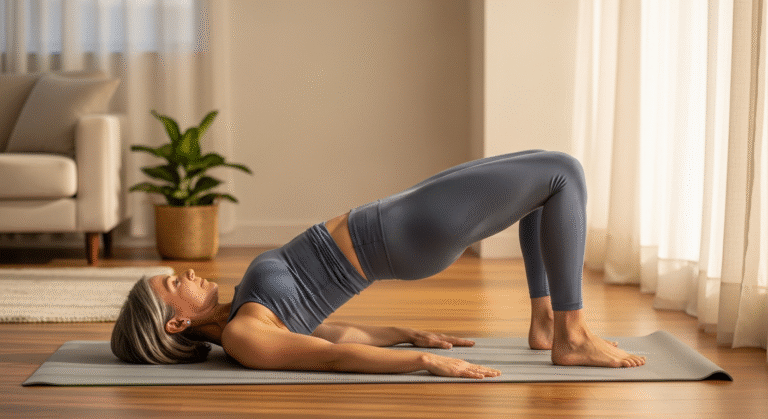
Pelvic Curl: Bridge position with articulated spine movement—meaning you peel your spine off the mat vertebra by vertebra, not in one rigid lift. This targets your glutes and hamstrings while strengthening your lower back. It’s the antidote to hip flexor tightness and lower back weakness. Feet stay hip-width apart and parallel throughout.
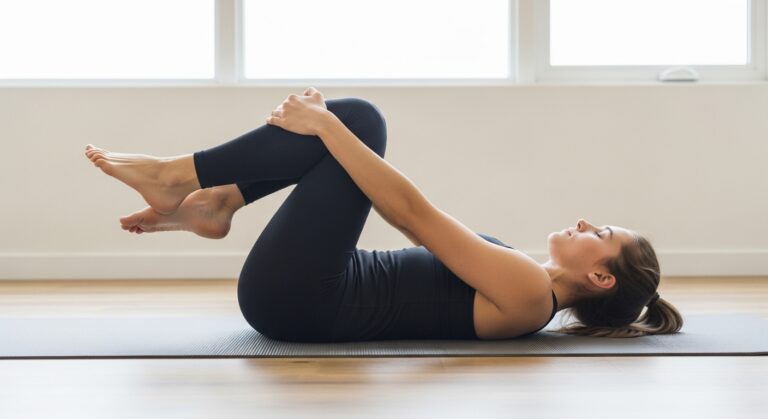
Single Leg Stretch: Supine core stabilization with alternating leg extensions. Your extended leg stays at 45 degrees minimum to maintain deep abdominal engagement. Your hands rest on your shins, not your ankles—this prevents you from pulling your neck forward. This exercise trains your pelvic floor coordination with core activation in a way that prevents leaking during exertion.
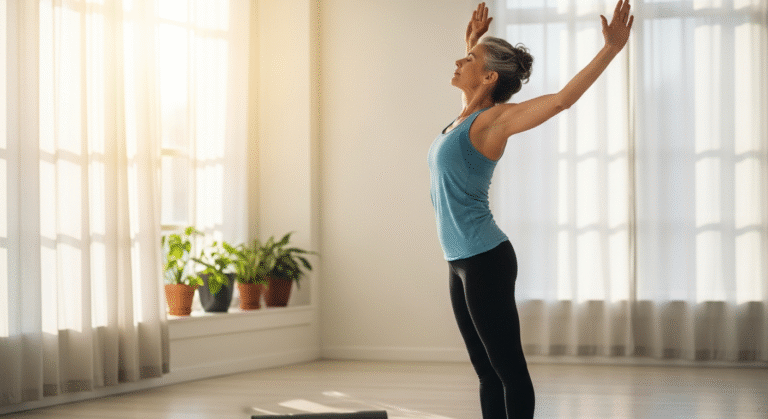
Spine Stretch Forward: Seated flexion with deliberate breath emphasis. You’re rounding your spine forward, opening tight hamstrings, and counteracting the rounded posture that develops from desk work. This isn’t a ballistic hamstring stretch; it’s a controlled spinal articulation that mobilizes your entire posterior chain.
Side-Lying Leg Lift Series: Hip abductor and adductor strengthening in side-lying position. This is critical for pelvic stability and knee health. Most women neglect hip strength, which leads to knee pain and hip dysfunction. This series fixes that imbalance. You’ll feel this in your hip, not your lower back—if your lower back is working, adjust your alignment.
Modified Plank to Child’s Pose: Core integration with shoulder stability. Start on your forearms (not straight arms if your wrists are weak) with hips level and spine neutral. Hold for 10–15 seconds, then sink back into child’s pose for a 5-second rest. Repeat. This builds endurance without the shoulder stress of full planks, and the built-in rest position prevents you from compensating with poor form.
Proper Setup for Each Exercise
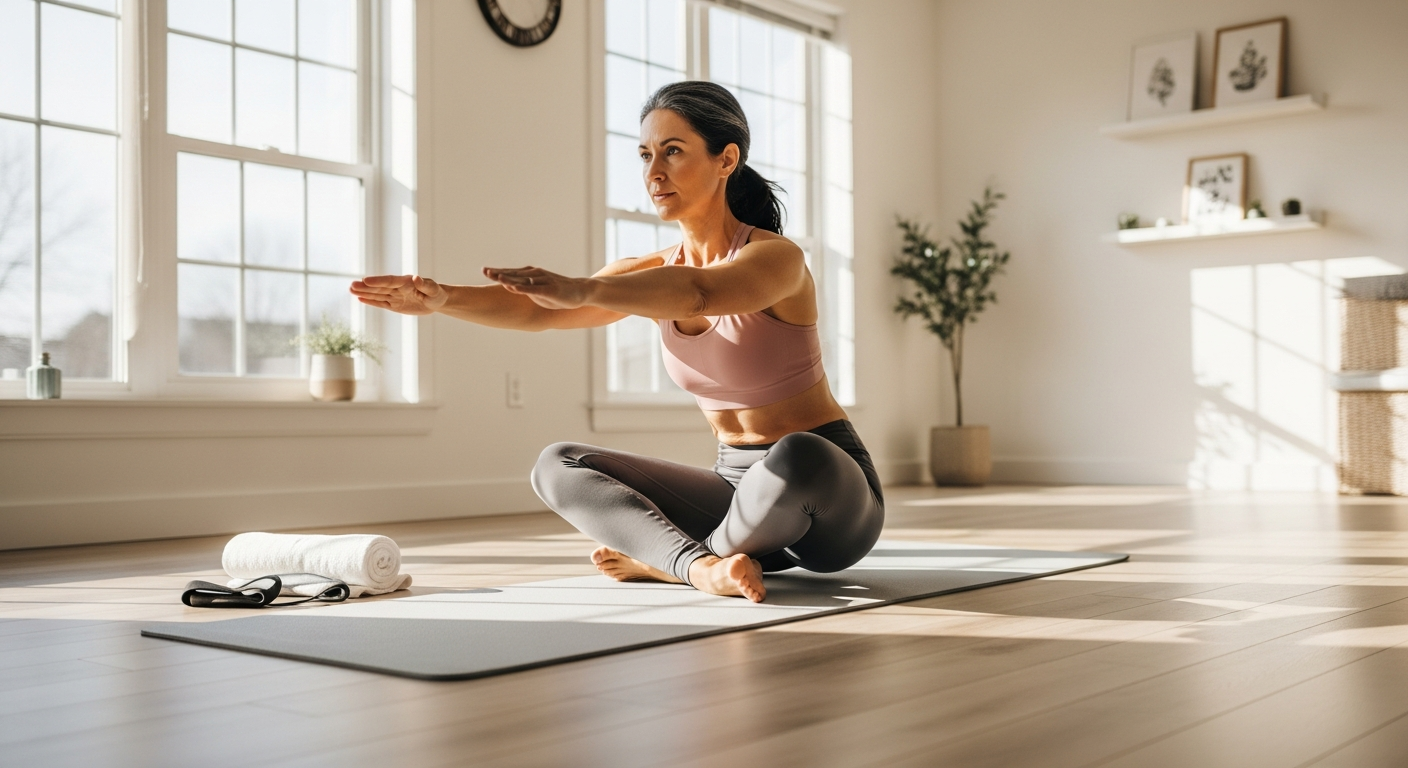
Alignment makes everything. Use a 6mm or thicker mat for adequate spinal cushioning. If your neck is sensitive, keep a small pillow available for head support. A resistance band (medium tension, 15–25 lbs) is optional but useful in weeks 2 and beyond.
Breath pattern integration is non-negotiable. Inhale to prepare. Exhale on exertion (lifting, extending, contracting). Inhale to hold or return. Never hold your breath during effort—this spikes cortisol and defeats the nervous system calming that makes Pilates effective. Exhale forcefully; it triggers deep abdominal engagement automatically.
Common Mistakes and Concrete Fixes
Mistake: Gripping your hip flexors during Single Leg Stretch. Fix: Keep your extended leg higher (45-degree angle minimum), hands on shins not ankles, and exhale forcefully to engage your deep abdominals instead of relying on your hip flexors. If your leg is dropping below 45 degrees, you’re not ready for that range yet—keep it higher.
Mistake: Losing neutral spine in Plank. Fix: Modify to elevated plank (hands on a chair or wall), hold only 10–15 seconds with perfect form rather than 30+ seconds with sagging hips. Sagging hips teach your body the wrong pattern. Ten seconds of perfect form beats 30 seconds of compensation every time.
Mistake: Holding tension in your shoulders during the Hundred. Fix: Lower your head to the mat, reduce arm pulse range, and focus entirely on the rib-to-hip connection with coordinated breath. Your shoulders should feel relaxed, not engaged. If they’re tight, you’re working too hard.
Pilates Workout Plan 30-Day Modifications for 40+ Concerns

Pelvic Floor Dysfunction and Diastasis Recti Adaptations
If you experience leaking during exercise, reduce range of motion in leg extensions, avoid both legs extended simultaneously until your pelvic floor strengthens, and exhale during effort—never hold your breath. Breath holding increases intra-abdominal pressure and exacerbates leaking. Forceful exhalation does the opposite.
If you have diastasis recti (abdominal separation), skip full Roll-Ups and deep twisting movements initially. Use a hands-on-ribs cue to draw your abdominals inward rather than pushing outward. Some doming (bulging) is normal, but avoid exercises where your belly visibly domes or protrudes. Modify to bent-knee variations and smaller ranges of motion.
Progressive pelvic floor integration: Begin every exercise with 30% pelvic floor engagement (imagine stopping urine flow without clenching your glutes—subtle, not extreme), and maintain that engagement throughout the movement. This trains your pelvic floor to work with your core, not against it. By week 3, this becomes automatic, and you’ll notice improvements in daily continence and core stability.
Joint-Specific Modifications
Sensitive knees: Use a folded towel under your kneecap during kneeling positions. Reduce range in leg circles. Keep the bent-knee option in all single-leg work until your knees feel stable. Avoid locking your knees at any point—always maintain a micro-bend.
Wrist weakness: Use forearm plank instead of straight-arm plank. Make fists instead of flat palms if flat palms cause discomfort. Or elevate your hands on yoga blocks to reduce the angle of wrist extension. Your wrists should never hurt during Pilates; if they do, modify immediately.
Lower back history: Maintain bent knees in all supine exercises until your core strength builds. Use a small towel roll under your lumbar curve for support if needed. Skip spinal extensions (Swan, Swimming) in the first two weeks. Start with flexion-based movements (forward bends, curls) before progressing to extension.
Osteoporosis and Bone Density Precautions
If you have diagnosed osteoporosis or a history of compression fractures, consult your physician before starting this program. Some exercises may be contraindicated. In general, avoid deep spinal flexion (forward rounding), loaded twisting, and high-impact transitions. Emphasize weight-bearing on hands and feet (plank variations), resistance band exercises for upper body, and standing balance work instead. These build bone density safely.
28-Day Pilates Challenge Printable Tracker and Accountability

What to Measure Weekly
Track performance metrics: plank hold time, number of Hundreds completed without rest, ability to complete a full Roll-Up without using your hands, single-leg balance duration with eyes closed. These are objective, measurable markers of progress that the scale will never capture.
Body measurements are optional but more relevant than scale weight. Measure your waist at the narrowest point and your hips at the widest point once weekly, on the same day, at the same time. You’ll likely see 1–2 inches lost in the waist and slight recomposition in the hips by week 4, even if the scale doesn’t move. This is the body composition shift you’re actually after.
Qualitative markers matter equally: Rate your energy level on a 1–10 scale daily. Track lower back stiffness upon waking. Note your posture awareness during daily activities. Log sleep quality. These subjective measures often shift before objective measurements do, and they’re the first signal that the workout is working.
The Printable 28-Day Calendar
Your 28-day Pilates challenge printable tracker uses a simple daily checkbox format: exercise name, sets and reps completed, modifications used, time spent, and notes on form or energy level. Print it and post it where you’ll see it—on your bathroom mirror, your fridge, your desk. Visual accountability is powerful.
Weekly review prompts appear at the bottom of each week: What felt stronger this week? Which exercise needs form attention? Any pain or discomfort to address? These questions force you to reflect, not just check boxes. Reflection deepens learning and prevents you from mindlessly repeating poor form.
Optional progress photos: Take photos on Days 1, 14, and 28 in the same position, lighting, and fitted clothing. Front, side, and back views. You’ll see postural changes in your photos long before the scale or your clothes shift. Posture changes are real changes—they signal that your nervous system is rewiring itself.
Accountability Strategies That Actually Work
Time-block your Pilates session as a non-negotiable appointment. Schedule it the same time daily—morning before obligations or evening wind-down, whichever you’ll actually do. This removes the decision of “when should I work out?” Decision fatigue kills consistency. One decision, made once, protects you.
Set up your environment the night before. Keep your mat rolled in a visible location. Lay out workout clothes. Remove friction. When it’s time to work out, everything is ready—no excuses about finding your mat or figuring out what to wear.
Use if-then planning for missed sessions: “If I miss my morning session, then I complete it during lunch break or before dinner.” This specific contingency removes the all-or-nothing thinking that derails most people. You’re not “off the wagon” if you miss once; you’re just moving the session to a backup time.
Palaties Workout Routines: Sample Week-by-Week Breakdown

Week 1 Daily Assignments (Foundation Phase)
This week, you’re establishing the foundation. Every day follows the same sequence, with emphasis on breath coordination and neutral spine alignment. Expect 12–15 minutes daily.
Monday through Saturday: The Hundred (modified, 50 pulses), Pelvic Curl (10 reps), Single Leg Stretch (8 each side), Spine Stretch Forward (6 reps), Side-Lying Leg Lifts (10 each side), Modified Plank to Child’s Pose (3 rounds of 10–15 second holds). Rest 30 seconds between exercises. Focus on matching your arm pulses to your breath in the Hundred—inhale for 5 counts, exhale for 5 counts.
Wednesday and Sunday: Rest days. Gentle stretching or a 10-minute walk only. Your body adapts during rest, not during the workout.
By Saturday, you should be able to complete the Hundred with 75 pulses and hold the plank for 20 seconds. If you’re not there, that’s fine—continue at your pace. Quality over speed always.
Week 2-3 Progression Examples
Week 2 additions: Resistance band for Spine Stretch (hold the band with arms extended, creating light tension). Single Leg Stretch with extended leg lowered to 30 degrees (instead of 45). Side Plank on your knee for 10-second holds. Total time: 15–18 minutes daily. You’ll feel muscular fatigue (shaking) by your final reps—that’s the signal that your muscles are being challenged appropriately.
Week 3 integration: Link exercises without full rest between them. Move directly from Pelvic Curl into Single Leg Stretch. Add Rolling Like a Ball (6 reps)—a gentle spinal massage that mobilizes your back. Increase all plank holds by 5 seconds. Time increases to 18–20 minutes daily. This week is where the real strength gains become visible. You’ll stand taller. Getting up from the floor will feel easier.
Throughout weeks 2 and 3, if joints hurt (not muscle fatigue, but joint pain), reduce range of motion or modify the exercise. Muscle fatigue is the goal. Joint pain is a signal to adjust.
Week 4: Building Your Maintenance Routine
Week 4 is your full-sequence integration week. All exercises link together with minimal rest—one continuous 20-22 minute flow. Challenge variations are offered for those ready to progress: straight-leg Hundred instead of bent-knee, full Roll-Up attempt without hand support, extended plank holds (30+ seconds), side plank on your feet instead of your knee.
This week prepares you for your post-challenge maintenance routine. After day 28, you have two options: 4x weekly full routine (20 minutes), or 6x weekly express version (10 minutes with 3 core exercises, 3 sets each). Both maintain strength and prevent regression. Choose whichever fits your life.
CONCLUSION

This 28-day Pilates challenge is not a transformation program. It’s a foundation-building, habit-creating, nervous-system-rewiring commitment that addresses exactly what changes after 40—joint sensitivity, pelvic floor health, bone density, and realistic time constraints. Daily 15-20 minute sessions built on six foundation exercises with progressive modifications deliver measurable improvements in core strength, posture, and functional movement without gym equipment or prior experience.
The single most important takeaway: consistency over intensity. Four weeks of daily practice beats sporadic intense sessions. Your body doesn’t care how hard you worked; it cares about what you did yesterday, today, and what you’ll do tomorrow.
Your next action: Download the printable 28-day calendar tonight. Set up your mat and workout space. Block your calendar for your chosen daily time tomorrow morning. Complete Day 1—all six foundation exercises, 12–15 minutes, focus entirely on breath coordination and neutral spine alignment. Don’t worry about speed or difficulty. Focus on form. The strength comes after the pattern is established.
Results become visible in weeks 3-4, not days 3-4. Expect subtle shifts first: lower back stiffness decreasing upon waking, easier movement getting up from the floor, posture awareness throughout the day. Body composition changes follow. Stick with the full 28 days before evaluating results. After completion, transition to your chosen maintenance routine and continue building strength. This isn’t a 28-day sprint followed by stopping; it’s the beginning of a sustainable practice that grows stronger with you.