15 minutes pilates workout routine
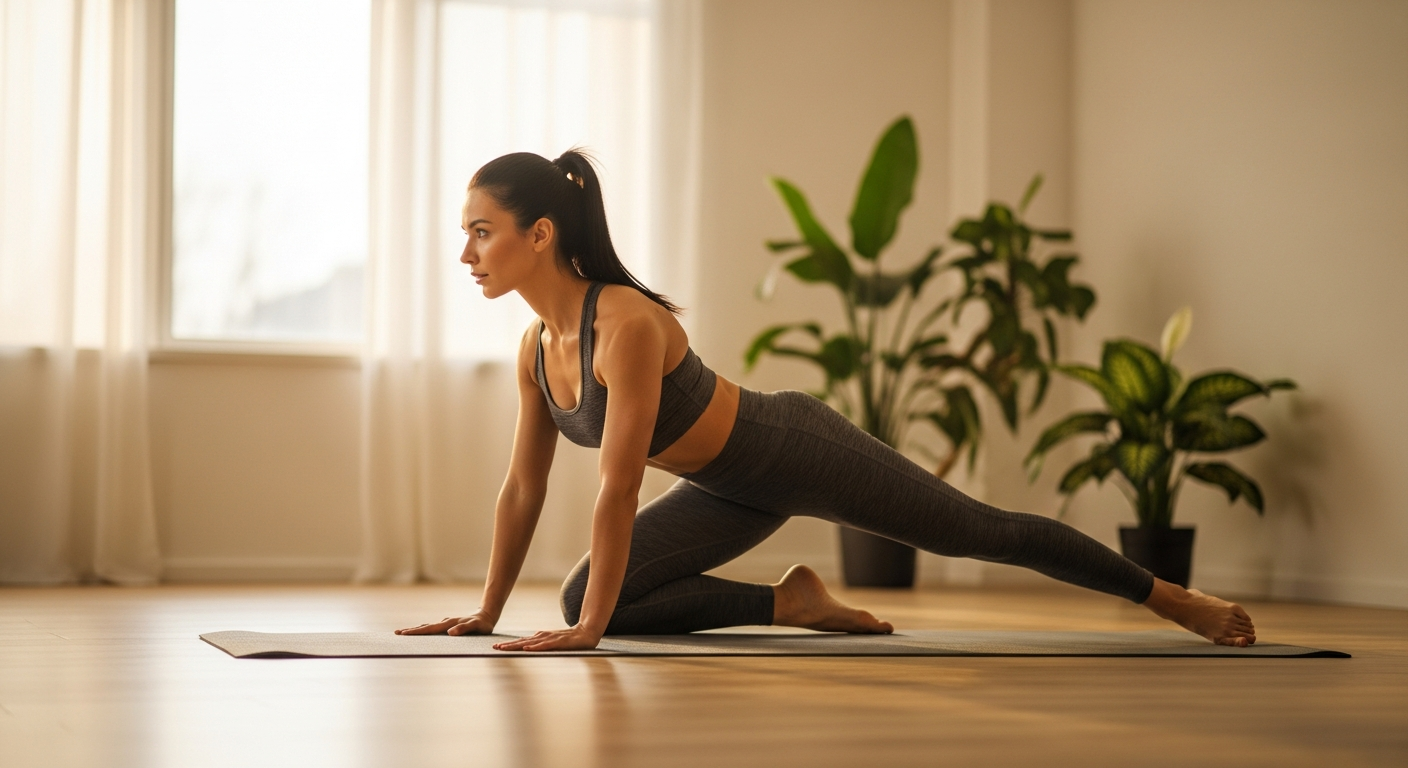
You don’t need an hour, expensive equipment, or a studio membership to feel the powerful benefits of Pilates. What if you could build a stronger core, improve your posture, and feel more energized with just 15 minutes a day—right in your living room?
Between work deadlines, family obligations, and everything else on your plate, finding time for fitness feels impossible. The gym intimidates you, and those hour-long workout videos?
They’re gathering digital dust in your saved folder. This proven 15-minute Pilates routine is designed for real life. No fancy equipment. No complicated choreography. Just effective, results-driven movements that fit into your morning—before your coffee gets cold.
Why This 15-Minute Pilates Routine Actually Works

Consistency beats duration every single time. Research on habit formation shows that 15 minutes of daily practice builds stronger neural pathways than sporadic hour-long sessions.
Your brain doesn’t care if you’re exercising for 60 minutes once a week or 15 minutes every morning—it cares about the repetition.
When you commit to a short window, you remove decision fatigue. You’re not negotiating whether you have “enough time” or “energy.” It’s done before your brain can talk you out of it.
What pilates does in just a quarter of an hour is remarkable. Core activation and deep muscle engagement happen in minutes, not hours.
The breath-to-movement connection that defines Pilates resets your nervous system faster than you’d expect. Your transverse abdominis (the deepest core muscle) engages within the first two minutes of proper breathing cues.
Progressive muscle fatigue—the kind that builds strength—starts around the 12-minute mark. That’s perfect timing for a 15-minute sequence. You’re hitting the window where your body is primed to adapt without overtraining.
The “before your shower” advantage is real. Morning Pilates, even in pyjamas, sets your posture for the rest of the day. You stand taller.
Your shoulders relax back. Your core feels engaged during your commute, your desk work, your errands. Compound this over 365 days: 15 minutes × 365 days equals 91 hours of strength training. That’s not cheating with a shorter routine—that’s being strategic.
Basic Pilates Workout Setup: What You Actually Need

Your space requirements are minimal. You need a yoga mat or towel on carpet—roughly 6 feet by 3 feet of clear floor space.
That’s it—no fancy studio. No mirrors. Bonus props (but not required) include a resistance band, small pillow, or rolled towel for modifications.
The kitchen timer trick works better than any app: set it for 15 minutes and commit to not stopping. Something about the ticking changes your psychology.
What to wear matters more than you’d think. Choose fitted but comfortable clothing so you can actually check your form without fabric bunching.
Barefoot is best—socks slip during bridges and planks. Skip the shoes, heavy jewelry, or anything that restricts spinal movement. You’re not training for a photo; you’re training for results.
Safety first: pause and consult a doctor if you’re pregnant, recently postpartum, recovering from surgery, or managing herniated discs.
Modify if you have wrist pain, knee issues, or osteoporosis—we’ll show you exactly how below. Listen to your body with precision.
Discomfort in the muscle is good; sharp pain in joints means stop immediately. This routine is scalable. Beginners pilates workout modifications exist for every single move.
At Home Pilates Workout For Beginners: The Complete 15-Minute Sequence

Warm-Up: Breath & Spinal Mobility (2 minutes)
Pelvic Curls (60 seconds): Lie on your back, knees bent, feet hip-width apart. Inhale to prepare. Exhale as you curl your tailbone up, peeling your spine off the mat vertebra by vertebra. Inhale at the top. Exhale to roll back down with control. Do 6 to 8 slow curls.
The cue: imagine zipping up a tight pair of jeans from your pubic bone to your belly button. This activates your transverse abdominis immediately.
Cat-Cow on All Fours (60 seconds): Hands under shoulders, knees under hips. Inhale and arch your back, lifting your chest (Cow).
Exhale and round your spine, tucking your chin (Cat). Flow through 8 to 10 repetitions. The cue: move from your tailbone, not just your neck. This wakes up spinal mobility before the intense core work begins.
The Core Sequence (10 minutes)
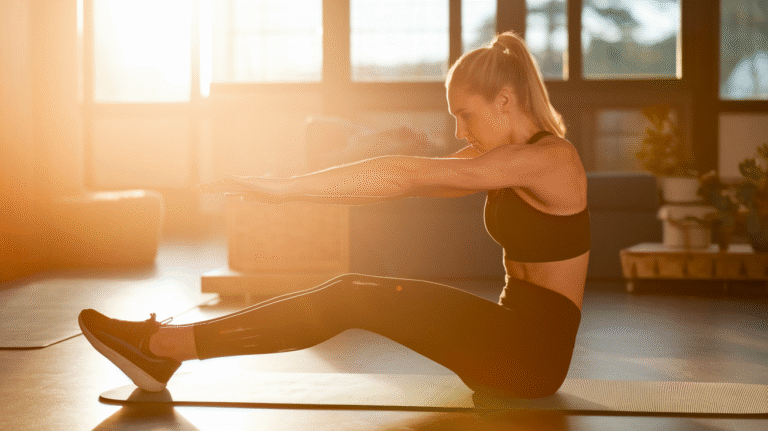
The Hundred (90 seconds): Lie on your back, knees bent in tabletop position (shins parallel to the floor). Lift your head and shoulders, extend your arms by your sides.
Pump your arms up and down in a controlled rhythm: inhale for 5 counts, exhale for 5 counts. Complete 5 breath cycles (50 pumps total).
Beginner modification: keep your feet on the floor instead of tabletop. You’ll feel deep burn in your upper abs and shoulders engaged.
Roll-Up (90 seconds): Lie flat, arms extended overhead. Exhale and slowly roll up, reaching for your toes, letting your spine curve forward naturally. Inhale and hold the stretch. Exhale and roll back down with control, vertebra by vertebra. Do 5 to 6 slow roll-ups.
Beginner modification: bend your knees and only roll halfway down. The cue: lead with your head, let each vertebra touch down sequentially. This teaches spinal articulation, a core Pilates principle.
Single Leg Stretch (90 seconds): From tabletop position with head and shoulders lifted, extend your right leg long while pulling your left knee toward your chest.
Switch legs in a controlled rhythm. Complete 16 total repetitions (8 per side). Breathing: exhale for two switches, inhale for two. Common mistake: don’t let your lower back arch off the mat. Keep it pressed down throughout.
Criss-Cross (Oblique Twists) (90 seconds): From tabletop, hands behind your head. Rotate your right shoulder toward your left knee as you extend your right leg. Switch sides with control.
Do 12 total repetitions (6 per side). The cue: twist from your ribs, not your neck. You’ll feel your obliques burning and your waistline engaged. This is where the sculpting happens.
Spine Stretch Forward (60 seconds): Sit tall, legs extended in a wide V. Inhale to lengthen your spine. Exhale and round forward, reaching your arms past your feet. Inhale to return to tall seated position. Do 5 to 6 stretches. Modification: bend your knees slightly if hamstrings are tight. This is active recovery—you’re stretching the spine while maintaining engagement.
Swan (Back Extension) (90 seconds): Lie on your stomach, hands under your shoulders. Inhale and press up, lifting your chest while keeping your hips down. Exhale and lower with control. Do 6 to 8 extensions. Beginner modification: keep your forearms on the mat (Sphinx pose). The cue: lengthen your spine, don’t just push up with your arms. This balances all the forward flexion and strengthens your posterior chain.
Side-Lying Leg Lifts (2 minutes total, 60 seconds per side): Lie on your right side, legs stacked, head resting on your arm. Exhale and lift your top leg to hip height. Inhale and lower with control. Do 10 to 12 repetitions per side. Progression: add small pulses at the top once you’ve mastered the basic lift. You’ll feel outer hip and glute activation immediately.
Plank Hold (60 seconds): Forearms on mat, body in a straight line from head to heels. Hold and breathe: 30 to 45 seconds. Beginner modification: drop to your knees while keeping your hips aligned. The cue: pull your belly button to your spine. Don’t let your hips sag. This isometric hold trains core stability under tension—essential for real-world strength.
Cool-Down & Stretch (3 minutes)
Child’s Pose (60 seconds): Knees wide, big toes touching, sit your hips back to your heels. Arms extended forward, forehead on mat. Breathe deeply and let your back release. This is where your nervous system downshifts.
Supine Spinal Twist (60 seconds per side): Lie on your back, hug your right knee to your chest, extend your left leg. Drop your right knee across your body to the left, right arm extended. Hold 30 seconds, then switch sides. This releases your lower back and wrings out the spine after all that core work.
Final Relaxation (60 seconds): Lie flat, legs extended, arms by your sides. Close your eyes. Let your body absorb the work. This isn’t wasted time—this is where adaptation happens.
Common Beginner Mistakes and How to Fix Them
The most common mistake beginners make is holding their breath. Pilates is built on breath. Exhale on exertion (when you’re doing the hard work), inhale on the easier phase. If you hold your breath, you tense your neck and shoulders instead of engaging your core. You also spike your blood pressure unnecessarily. Fix this by counting out loud during the first few sessions. It forces you to breathe.
The second mistake is rushing through repetitions. Pilates isn’t about speed. One controlled roll-up is worth ten sloppy ones. Slow down. Feel each vertebra. If you’re moving so fast you can’t feel the muscle working, you’re doing it wrong. Quality over quantity is the Pilates mantra for a reason.
The third mistake is gripping your neck during upper-body work. Your neck should be neutral. Your head should feel heavy. If you’re pulling on the back of your head during Criss-Cross or The Hundred, you’re recruiting the wrong muscles. Keep your hands light, just for light support. Let your core do the work.
How to Progress Beyond the Basics
After two weeks of daily practice, you’re ready to add challenge. Progression doesn’t mean doing more reps—it means increasing resistance or range of motion. Add a resistance band to Leg Circles. Hold the Plank for 60 seconds instead of 45. Extend your legs fully in Single Leg Stretch instead of keeping knees bent. These small changes force your muscles to adapt, which is how strength builds.
After four weeks, consider moving to a 20 or 30-minute routine. You’ve built the foundation. Your body understands the movement patterns. You’re ready for more volume. But don’t skip the 15-minute version entirely. It’s your maintenance baseline. Even experienced Pilates practitioners return to short, focused sessions when life gets busy.
Track how you feel, not just what you do. Better posture at your desk. Less lower back pain. Easier to stand for long periods. Clothes fitting differently. These changes happen before the mirror shows dramatic visual results. Trust the process. Pilates builds lean, functional strength that translates to real life.
Your Next Move
The single most important takeaway: consistency matters infinitely more than perfection. A 15-minute pilates workout for beginners done daily beats a perfect 60-minute session done once a month. Your nervous system, your postural muscles, and your core strength all respond to regular, moderate stimulus far better than occasional intense effort.
Roll out your mat tomorrow morning. Set your timer for 15 minutes. Do the warm-up, the core sequence, and the cool-down. Don’t worry about being “good” at Pilates yet. You’re building a habit. You’re teaching your body what strong feels like. After two weeks, you’ll notice your clothes fit differently. After a month, you’ll feel taller. After three months, this routine will feel so automatic that skipping it feels wrong. That’s when you know it’s stuck. That’s when real transformation starts—not because one workout is magic, but because you finally stopped stopping.