Somatic Yoga For Stored Trauma Relief

Have you ever felt tension in your shoulders that won’t budge, no matter how many stretches you do? Or experienced unexplained tightness in your hips that seems to have no physical cause? Your body might be holding onto something deeper than muscle tension—it could be storing trauma.
I remember standing in my kitchen three years ago, unable to turn my neck more than a few degrees to the right. I’d tried everything: massage therapy, traditional yoga classes, even expensive chiropractor visits.
Nothing worked. A friend mentioned somatic yoga, and I dismissed it as another wellness trend. But desperation made me curious. Within two weeks of daily practice, something shifted.
During a simple hip circle exercise, I felt an unexpected wave of emotion, followed by the first real relief I’d experienced in months. My neck wasn’t just tight—it was holding onto stress patterns my body had never fully processed.
You don’t need expensive therapy sessions or hours at the gym to address this. Somatic yoga offers a powerful, science-backed approach to releasing stored trauma right from your living room.
This ancient practice meets modern neuroscience to help you finally let go of what’s been weighing you down—both physically and emotionally.
In this comprehensive guide, you’ll discover exactly what somatic yoga is, how it works to release trauma from your body, and proven exercises you can start today. Whether you’re a complete beginner or someone who’s tried everything else without results, this accessible practice can transform how you feel in your body.
No intimidating gym required, no expensive equipment needed—just you, your mat, and a willingness to reconnect with your body.
What Is Somatic Yoga? Understanding the Mind-Body Connection

The Science Behind Somatic Movement
The word “soma” comes from Greek, meaning the body as experienced from within—not how it looks in a mirror, but how it feels from the inside out. This distinction is crucial. Traditional yoga often focuses on achieving external shapes: getting your hands to the floor in a forward fold or holding a perfect warrior pose. Somatic yoga flips this entirely. The question isn’t “Am I doing this right?” but rather “What am I feeling right now?”
Research from the Trauma Research Foundation shows that traumatic experiences create lasting changes in the body’s fascia, muscles, and nervous system. When you experience something overwhelming—whether it’s a single traumatic event or chronic stress—your body initiates a fight, flight, or freeze response. Here’s what most people don’t realize: if that stress cycle doesn’t complete, the activation stays trapped in your tissues. Your nervous system remains on high alert, even when the danger has passed.
Dr. Peter Levine’s work on Somatic Experiencing demonstrates that trauma isn’t stored in our thoughts or memories alone—it lives in our physical body. MRI studies reveal that people with unresolved trauma show different activation patterns in brain regions responsible for body awareness and emotional regulation. Somatic yoga works directly with these patterns, using slow, mindful movement to complete those unfinished stress cycles.
Why Your Body Holds Onto Trauma
Your nervous system is designed to protect you. When you face a threat, your body floods with stress hormones, muscles tense for action, and your breathing becomes shallow. In an ideal scenario, you’d fight or flee, then shake off the excess energy—watch any animal after escaping danger, and you’ll see them literally trembling to discharge that activation.
But humans rarely complete this cycle. We freeze during difficult experiences, suppress our natural responses to stay professional at work, or push through without processing. That incomplete activation has to go somewhere, and it typically lodges in specific areas: the hips (where the psoas muscle, your primary fight-or-flight muscle, lives), the shoulders (from carrying burdens and bracing against stress), the jaw (from words left unsaid), and the neck (from hypervigilance and looking for danger).
Common physical symptoms of stored trauma include chronic tension that doesn’t respond to massage, unexplained pain that doctors can’t diagnose, persistent fatigue despite adequate sleep, and feeling disconnected or numb in certain body regions. You might notice you can’t take a full breath, or that your shoulders live somewhere near your ears no matter how many times you tell yourself to relax.
How Somatic Yoga Creates Lasting Change
Unlike high-intensity workouts that can sometimes reinforce stress patterns by keeping your nervous system activated, somatic yoga works by slowing everything down. You’re not trying to achieve anything or push through discomfort. Instead, you’re creating conditions for your parasympathetic nervous system—your rest-and-digest mode—to come online.
Through gentle, repetitive movements performed with full attention, you build what neuroscientists call “interoceptive awareness”—the ability to sense what’s happening inside your body. This awareness is the foundation of healing. You can’t release what you can’t feel.
Each time you practice, you’re literally creating new neural pathways. Your brain learns that it’s safe to feel sensations, that movement doesn’t have to be threatening, and that you can return to calm after activation. This neuroplasticity—your brain’s ability to rewire itself—is why somatic yoga works when other methods haven’t. You’re not just stretching tight muscles; you’re teaching your entire nervous system a new way of being.
Signs You’re Carrying Stored Trauma in Your Body

Physical Red Flags That Point to Deeper Issues
Your body speaks in symptoms before it screams in pain. Persistent muscle tension that doesn’t respond to traditional stretching or massage is often the first indicator. You might notice your shoulders constantly creeping toward your ears, a tight band around your chest that makes deep breathing difficult, or hip flexors so tense they pull your pelvis out of alignment.
Unexplained pain without clear physical injury is another telltale sign. Your doctor runs tests, finds nothing structurally wrong, yet you’re still hurting. This isn’t imaginary—it’s your nervous system creating real physical sensations based on unprocessed stress. Research from the Journal of Bodywork and Movement Therapies found that 60-80% of chronic pain cases have a significant mind-body component.
Feeling disconnected or numb in specific areas is particularly significant. You might struggle to feel your feet on the ground, experience a “floating” sensation, or notice certain body parts feel like they don’t quite belong to you. This dissociation is a protective mechanism—your nervous system’s way of not feeling overwhelming sensations.
Emotional and Mental Symptoms
Difficulty relaxing even during downtime is a hallmark of stored trauma. You sit down to watch a show, but your mind races. You lie in bed exhausted but can’t fall asleep. Your body doesn’t trust that it’s truly safe to let down its guard.
Feeling “on edge” or hypervigilant without clear cause means your nervous system is stuck in threat-detection mode. You might startle easily, constantly scan your environment, or feel anxious in situations that logically shouldn’t trigger fear. This isn’t weakness or overreaction—it’s your body trying to protect you from dangers it experienced before.
Emotional reactions that seem disproportionate to situations often indicate unprocessed trauma surfacing. A minor criticism triggers intense shame. A small disappointment brings overwhelming sadness. These aren’t character flaws—they’re old wounds being touched.
Why Traditional Workouts Don’t Address This
Here’s what the fitness industry often misses: high-intensity exercise can be incredibly beneficial for overall health, but it doesn’t necessarily help with trauma release. In fact, pushing through pain, ignoring your body’s signals, and maintaining constant intensity can reinforce the very patterns you’re trying to break.
Traditional workouts focus on external goals: building muscle, burning calories, improving cardiovascular fitness. These are valuable, but they don’t directly address nervous system regulation. You can be physically fit and still carry unresolved trauma. You can have visible abs and still feel disconnected from your body.
The missing piece in most fitness routines is the internal awareness component. Somatic yoga fills this gap by making sensation, not achievement, the primary focus. This is why slowing down is actually more effective for trauma release than speeding up.
The Proven Benefits of Somatic Yoga for Trauma Relief
Physical Transformation You Can Measure
The physical changes from consistent somatic practice are both measurable and meaningful. A 2019 study in the Journal of Clinical Psychology found that participants practicing somatic-based interventions experienced a 32% reduction in chronic pain symptoms after eight weeks. This isn’t placebo—it’s your nervous system learning to release chronic bracing patterns.
Improved flexibility and range of motion happen differently than in traditional stretching. Instead of forcing muscles to lengthen, you’re teaching your nervous system that it’s safe to let go. The result is sustainable flexibility that doesn’t disappear when you stop practicing daily.
Better posture emerges naturally as you release compensatory tension patterns. Your body stops working so hard to protect itself, allowing your skeleton to support you efficiently. Enhanced sleep quality follows because your nervous system can finally downregulate at night instead of maintaining vigilant watch.
Mental and Emotional Healing
Research from Harvard Medical School shows that body-based practices like somatic yoga can reduce cortisol levels by up to 25% after just four weeks of consistent practice. Lower cortisol means less chronic stress activation, which cascades into improved mood, clearer thinking, and better emotional regulation.
Improved emotional resilience doesn’t mean you won’t feel difficult emotions—it means you’ll be able to feel them without becoming overwhelmed. You develop what trauma therapists call “window of tolerance”—the ability to experience intensity without shutting down or spinning out.
Greater sense of safety and groundedness in your body is perhaps the most profound benefit. Many people spend years feeling like they’re living in their heads, disconnected from physical sensations. Somatic yoga rebuilds that connection, helping you feel at home in your own skin again.
Long-Term Wellness Impact
The tools you learn through somatic yoga become yours for life. Unlike external interventions you depend on—medications, therapist appointments, gym memberships—this practice lives inside you. You can access it anywhere, anytime, without special equipment.
Building a sustainable self-care practice that fits your schedule is realistic because somatic yoga doesn’t require hour-long sessions. Even 10-15 minutes daily creates measurable change. This isn’t about adding another overwhelming obligation to your to-do list—it’s about creating small moments of reconnection throughout your day.
You’re empowering yourself to heal without expensive interventions. While professional support has its place (and I’m never suggesting somatic yoga replaces trauma therapy when needed), this practice gives you agency in your own healing process. You’re not waiting for someone else to fix you—you’re learning to facilitate your own nervous system regulation.
7 Powerful Somatic Yoga Exercises to Release Stored Trauma
Exercise 1: Somatic Hip Circles for Emotional Release
Stand with feet hip-width apart, knees slightly bent. Place your hands on your hips. Begin making slow, small circles with your pelvis—imagine you’re stirring honey with your hips. This isn’t about how large you can make the circles; it’s about how much sensation you can feel.
Breathe naturally, letting your breath deepen on its own. Make 10 circles in one direction, then reverse. The hips store emotions we haven’t fully expressed—grief, fear, suppressed anger. Don’t be surprised if you feel emotional during this exercise. That’s not a problem; it’s the point.
What to expect: You might feel trembling, warmth, or tingling in your pelvis. Some people experience spontaneous yawning or sighing. These are signs your nervous system is releasing. Practice for 2-3 minutes daily.
Beginner modification: Sit on the edge of a chair and make smaller circles with your pelvis. The principle remains the same—internal awareness over external performance.
Exercise 2: Shoulder Pendulum for Tension Relief
Stand with feet hip-width apart. Let your right arm hang completely loose at your side—truly dead weight. Begin swinging your arm gently forward and back, like a pendulum. The movement comes from your torso slightly shifting, not from muscular effort in your arm.
This exercise addresses the chronic shoulder tension so many of us carry from metaphorically “shouldering” burdens. As you swing, notice any tendency to control or direct the movement. Can you let your arm be completely passive?
Common mistake: Using muscle to swing your arm. The correction: imagine your arm is a rope with a weight at the end. Let gravity and momentum do all the work.
Practice: 1-2 minutes per arm. You’re doing it correctly when your arm feels heavy and warm, and the movement becomes almost hypnotic.
Exercise 3: Jaw Release Technique for Suppressed Expression
Sit comfortably. Place your fingertips gently on your jaw joints (just in front of your ears). Let your jaw hang open slightly—no tension in your face. Begin making tiny circles with your jaw, massaging the joint.
The jaw-trauma connection is significant: this is where we clench words we don’t say, emotions we swallow, and needs we suppress. TMJ issues are often more about stored emotion than dental problems.
Breathing integration: Breathe in through your nose, then exhale with a gentle “ahh” sound, letting your jaw soften further. Repeat for 2-3 minutes.
Signs of release: You might yawn repeatedly, feel emotional, or notice tension you didn’t know you were holding. All normal and healthy.
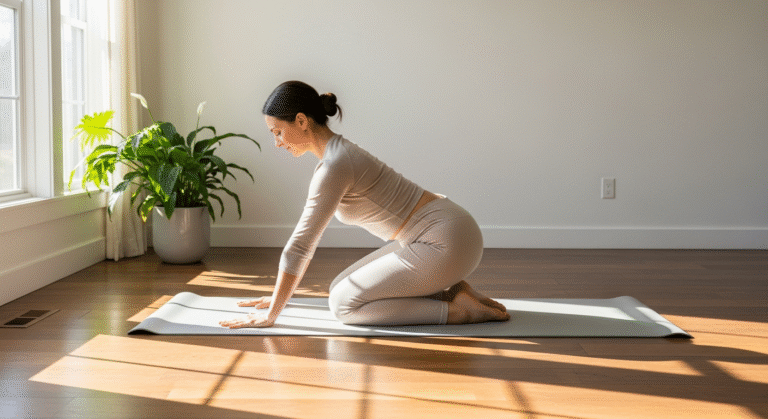
Exercise 4: Somatic Cat-Cow for Spinal Awareness
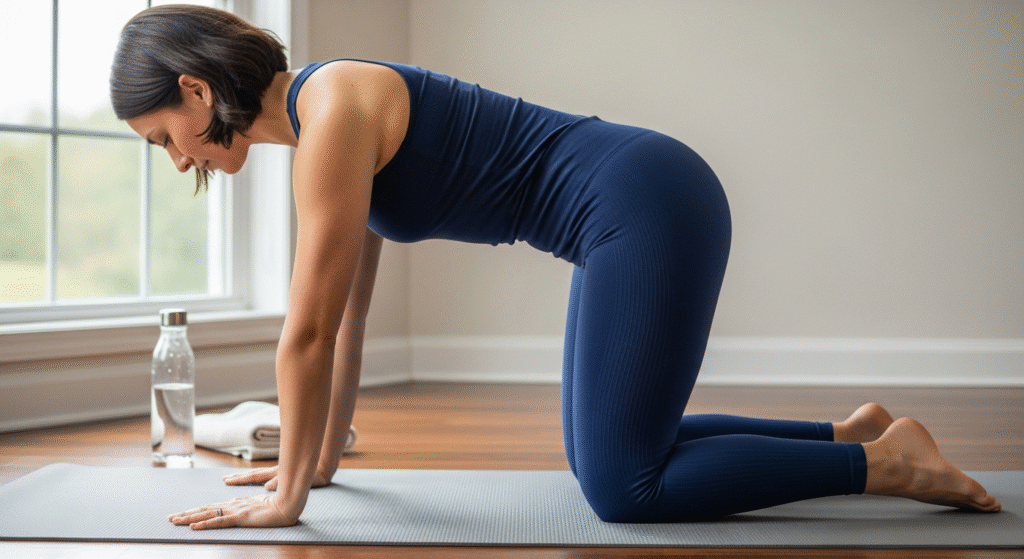
Come to hands and knees. Unlike traditional cat-cow where you move through the full range, somatic cat-cow is about micro-movements. Arch your back just an inch, then round it just an inch. Move so slowly you can feel each vertebra.
The difference here is crucial: you’re not performing a shape. You’re exploring sensation. Where does the movement start? Where does it feel sticky or stuck? Can you breathe into those areas?
Nervous system focus: Notice if you’re holding your breath or bracing. This exercise teaches you to move while staying relaxed—a skill that transfers to everyday life.
Duration: 3-5 minutes, moving as slowly as possible. This isn’t about repetitions; it’s about quality of attention.
Exercise 5: Psoas Release for Deep-Seated Fear
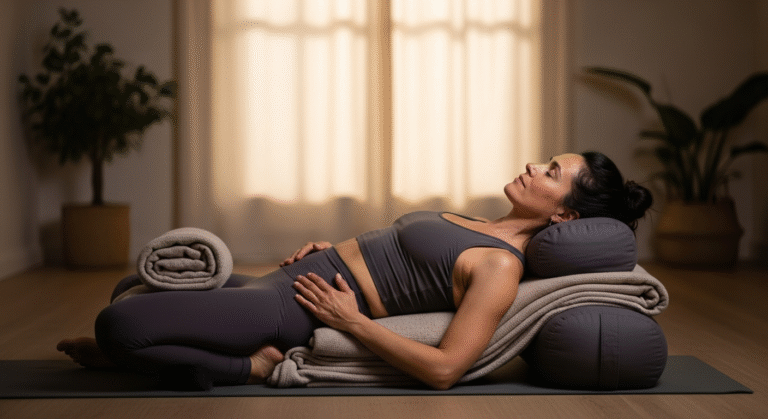
Lie on your back with knees bent, feet flat on the floor. Place a small rolled towel or yoga block under your sacrum (the flat bone at the base of your spine). Let your knees fall open into a gentle butterfly position, soles of feet together.
The psoas muscle connects your spine to your legs and contracts during fight-or-flight responses. Chronic psoas tension keeps your nervous system in a state of readiness for danger.
What emotions might surface: Fear, anxiety, or a sense of vulnerability are common. The psoas holds our deepest survival responses. If you feel overwhelmed, bring your knees back together and take a break.
Beginner timeline: Start with just 2 minutes. Work up to 5-10 minutes as your nervous system learns this is safe. Never force or push through intense discomfort.
Exercise 6: Somatic Twist for Letting Go
Lie on your back, knees bent. Let both knees fall slowly to the right while turning your head to the left. The key word is slowly—take 30 seconds to make this transition. Feel every moment of the movement.
This isn’t about how deep you can twist. It’s about the metaphorical act of letting go, releasing what no longer serves you. As you breathe, imagine each exhale releasing tension you’ve been carrying.
Visualization enhancement: Picture yourself releasing old stories, outdated beliefs, or patterns that keep you stuck. The physical twist mirrors the psychological release.
Building into routine: Hold each side for 2-3 minutes, breathing deeply. This is excellent before bed for processing the day’s stress.
Exercise 7: Grounding Meditation in Child’s Pose
Kneel on the floor, then sit back on your heels. Fold forward, letting your forehead rest on the floor (or on stacked fists if that’s more comfortable). Arms can extend forward or rest alongside your body.
This position activates your parasympathetic nervous system—your body’s natural calming mechanism. The gentle pressure on your forehead stimulates the vagus nerve, which signals safety to your brain.
Breathwork technique: Breathe in for a count of 4, hold for 4, exhale for 6. The longer exhale activates your relaxation response. Practice for 3-5 minutes.