21 day chair yoga challenge women over 40
# Your 21-Day Chair Yoga Challenge: The Proven Path to Reclaiming Your Body After 40
Remember when you could touch your toes without wincing? When getting up from the couch didn’t require a strategic plan involving momentum and possibly a hand on the armrest? If you’re nodding along, you’re not alone—and here’s the good news: it’s not too late to transform how your body feels every single day.
I’ll be honest with you. When I first attempted yoga at 42, I walked into a studio, looked around at people folding themselves into pretzel shapes, and walked right back out.
The intimidation was real. But here’s what I learned after years of working with women over 40: you don’t need to become a contortionist.
You need movement that meets you exactly where you are, builds strength without breaking you down, and fits into the life you’re actually living—not some fantasy version where you have two hours for self-care daily.
This 21-day chair yoga challenge is designed specifically for women over 40 who are tired of feeling stiff, achy, and left behind by fitness programs that ignore what our bodies actually need.
No gym membership required. No feeling intimidated. No complicated equipment. Just you, a sturdy chair, and 15-20 minutes a day.
Let me set realistic expectations right now: This isn’t about Instagram-worthy poses or dramatic before-and-after photos.
This is about reclaiming comfort in your own body—reaching for something on a high shelf without wincing, playing with your grandkids without your back protesting, and moving through your day with the ease you remember from a decade ago.
Why Chair Yoga Is a Game-Changer for Women Over 40

The Reality of Fitness After 40
Let’s address the elephant in the room: bodies change after 40, and pretending they don’t is setting yourself up for frustration and potential injury.
Research consistently shows that women experience decreased muscle mass (sarcopenia) starting in our 30s, losing approximately 3-8% per decade.
Add hormonal fluctuations during perimenopause and menopause, decreased bone density, and joints that don’t bounce back like they used to, and you’ve got a perfect storm that makes traditional high-impact exercise genuinely challenging.
The gym environment feels intimidating when you’re starting from scratch or returning after years away. You’re not imagining it—that feeling of being watched or judged is a real barrier that keeps countless women from even trying.
Previous workout plans failed not because you lacked willpower, but because they weren’t designed for your body’s current needs. A 25-year-old’s workout plan simply doesn’t account for the physiological realities of being over 40.
What Makes Chair Yoga Different (and Powerful)
Chair yoga is low-impact yet remarkably effective for building the three pillars of functional fitness: strength, flexibility, and balance.
The chair serves as both support and resistance tool, eliminating the fear of falling that keeps many women from attempting balance work.
This matters more than you might think—according to the CDC, falls are the leading cause of injury among older adults, and balance training is one of the most powerful preventive measures we have.
But here’s what most articles won’t tell you: chair yoga works because it leverages isometric contractions and controlled eccentric movements that build strength without joint stress.
When you hold a seated twist or perform a controlled leg lift, you’re creating time under tension—the actual mechanism that builds muscle and bone density.
The science backs this up: a study in the Journal of Physical Therapy Science found that chair yoga significantly improved lower body strength and flexibility in older adults after just 8 weeks.
The chair adapts to YOUR fitness level, not the other way around. Need more support? Use it for balance. Getting stronger? Use it for resistance.
This scalability is what makes chair yoga sustainable long-term, unlike programs that start too hard and leave you sore, discouraged, and likely to quit.
The Magic of 21 Days
Why 21 days specifically? While the popular myth claims it takes 21 days to form a habit (actually, research by Phillippa Lally shows it’s closer to 66 days), three weeks is the sweet spot for building momentum without overwhelming yourself.
It’s long enough to experience real physical results—improved flexibility, reduced stiffness, better sleep—and short enough that the finish line stays visible and motivating.
More importantly, 21 days allows for neuroplastic changes in your brain. You’re not just building physical flexibility; you’re rewiring neural pathways that control movement patterns, balance, and body awareness.
Consistency matters infinitely more than intensity for lasting transformation. I’d rather see you do 15 minutes daily for 21 days than one hour-long session per week.
Incredible Benefits You’ll Experience
Physical Transformation That Actually Matters
Forget the fitness magazine promises of “sculpted abs” and “toned arms.” Let’s talk about benefits that change your actual life. Chair yoga will tone and strengthen your muscles without the joint stress and high impact that causes flare-ups in conditions like arthritis or past injuries. You’ll build functional strength—the kind that helps you carry groceries, lift a suitcase into an overhead bin, or get down on the floor to play with kids without dreading the getting-back-up part.
Flexibility improvements happen faster than you’d expect, especially in problem areas like hips, shoulders, and spine. Within the first week, most women notice they can reach further, turn their neck more completely to check blind spots while driving, and bend forward without that tight pulling sensation in the hamstrings.
This isn’t magic—it’s consistent, gentle lengthening of tissues that have been chronically shortened from sitting, stress, and simply not moving through full ranges of motion.
Core stability is where chair yoga truly shines. Every pose requires core engagement to maintain proper alignment, which means you’re building the deep stabilizing muscles that protect your back and improve posture.
This translates directly to reduced lower back pain—one of the most common complaints I hear from women over 40. You’ll also burn calories more efficiently than you’d think.
While chair yoga isn’t primarily a weight-loss tool, the combination of muscle building (which increases resting metabolic rate) and improved insulin sensitivity creates a metabolic environment that supports healthy weight management.
Mental and Emotional Results You Can Feel
The mind-body connection in yoga isn’t just wellness buzzword fluff—it’s backed by solid neuroscience. Chair yoga reduces stress and anxiety through activation of the parasympathetic nervous system, your body’s “rest and digest” mode.
The deep breathing techniques alone lower cortisol levels, the stress hormone that contributes to belly fat storage, poor sleep, and inflammation.
You’ll build genuine confidence as you accomplish something designed specifically for your needs. This isn’t about keeping up with a 30-year-old instructor or comparing yourself to anyone else.
It’s about showing up for yourself, day after day, and experiencing tangible progress. That feeling of capability spreads into other areas of life—I’ve watched it happen countless times.
Improved sleep quality typically shows up around day 10-14. The combination of gentle physical activity, stress reduction, and the ritualistic nature of daily practice helps regulate circadian rhythms. You’ll fall asleep faster and wake feeling more rested.
Practical Life Improvements
Here’s what really matters: moving through daily activities with less pain and more ease. Bending to load the dishwasher.
Reaching to change a lightbulb. Getting in and out of the car without that stiff, creaky feeling. These aren’t small things—they’re the quality-of-life markers that determine how independent and active you remain as you age.
Many women reduce their reliance on pain medications for chronic discomfort. I’m not suggesting you stop any prescribed medication without medical guidance, but the anti-inflammatory effects of regular movement and the pain-gate theory (where movement signals can override pain signals) mean many women find they need less ibuprofen for daily aches.
You’ll feel empowered knowing you can exercise anywhere, anytime. Hotel room? Living room? Office break room? Your practice travels with you. This removes the “I don’t have access to a gym” excuse completely.
Your 21-Day Challenge Roadmap
Week 1: Foundation and Awareness (Days 1-7)
The first week is about learning basic poses, establishing the habit, and tuning into your body’s current state without judgment. This is crucial—skip this foundation, and you’ll struggle later.
Days 1-3 focus on seated warm-ups and breathing. Start every session with Seated Mountain Pose: sit toward the front edge of your chair, feet flat and hip-width apart, spine lengthened, shoulders relaxed. Place your hands on your thighs.
This is your home base—return here anytime you need to reset. Spend 2 minutes here, focusing on deep belly breathing. Inhale for 4 counts, exhale for 6 counts. This longer exhale activates that parasympathetic nervous system I mentioned.
Add gentle neck rolls (5 in each direction, moving slowly) and shoulder shrugs (lift shoulders to ears on inhale, drop them down on exhale, 8 times).
These release the tension most of us carry from computer work and stress. Then practice seated cat-cow: hands on thighs, inhale as you arch your back and look slightly up, exhale as you round your spine and tuck your chin. Repeat 10 times, moving with your breath. This mobilizes every segment of your spine.
Days 4-7 introduce upper body work. Add Seated Forward Fold: from Mountain Pose, inhale and lengthen your spine, then exhale and hinge forward from your hips (not your waist), letting your hands slide down your legs. Go only as far as comfortable—maybe your hands reach your knees, maybe your shins. Hold for 5 breaths, feeling the stretch along your entire back body. This is excellent for hamstring flexibility and calming your nervous system.
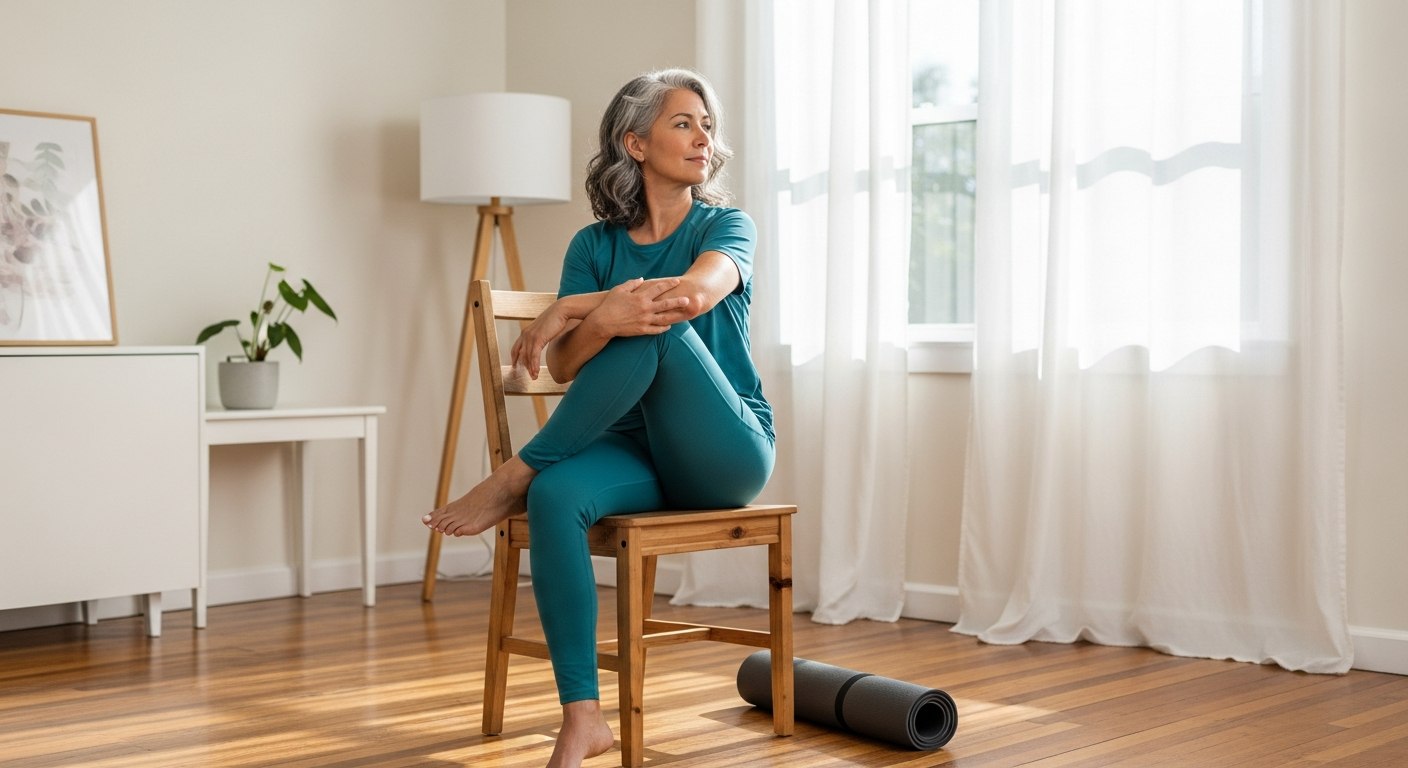
Include chair-supported arm raises: hold the sides of your chair seat, press down to lift your chest, and slowly raise both arms overhead on an inhale, lower on an exhale. Repeat 10 times. This builds shoulder strength and improves posture. Practice Seated Spinal Twist: sit sideways on your chair, feet flat, knees together. Hold the back of the chair with both hands and gently twist toward the chair back, using your hands for light resistance, not to wrench yourself around. Hold for 5 breaths each side. This improves spinal mobility and aids digestion.
End with Eagle Arms: extend arms forward, cross right arm over left (or as close as you can), bend elbows, and try to press palms together. Lift elbows slightly and hold for 5 breaths. Switch sides. This releases incredible tension in the upper back and shoulders.
Week 2: Building Strength and Confidence (Days 8-14)
Week two adds challenge and introduces standing poses with chair support. You should feel noticeably less stiff by now.
Days 8-11 activate your core. Seated Leg Lifts: sit tall in Mountain Pose, hands gripping the sides of your chair seat. Engage your core and slowly lift one foot 2-3 inches off the floor. Hold for 5 seconds, lower with control. Alternate legs, 10 times each. This builds deep core strength and hip flexor strength crucial for walking and stair climbing.
Progress to Chair Boat Pose: same starting position, but lift both feet off the floor simultaneously, knees bent, shins parallel to the floor. Hold for 5-10 seconds, rest, repeat 5 times. This is powerful core work. If it’s too challenging, stick with single-leg lifts—there’s no prize for pushing too hard too fast.
Side Bends tone obliques: sit tall, left hand on the seat beside your hip, right arm overhead. Inhale to lengthen, exhale to bend gently to the left, creating a C-curve with your body. Hold for 3 breaths, return to center, switch sides. Repeat 5 times each side. Seated Bicycle: lean back slightly (supported by your core), lift feet off the floor, and perform a slow bicycle motion with your legs. Do 20 total (10 each side).
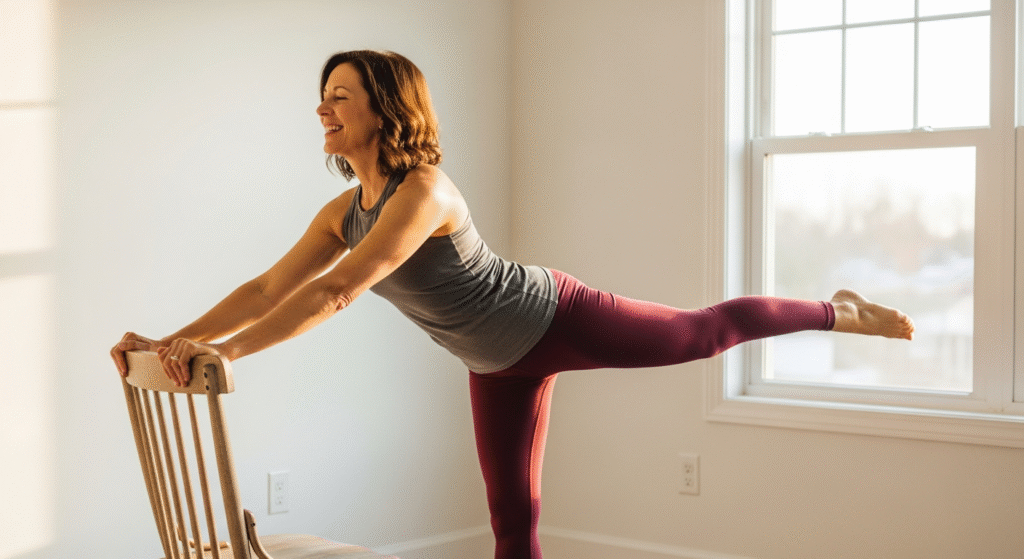
Days 12-14 introduce standing balance work. This is where many women feel nervous—honor that, and use your chair fully for support. Chair-Supported Standing Mountain: stand behind your chair, hands lightly on the chair back. Find your balance with feet hip-width apart, weight evenly distributed. Focus on one point in front of you. Hold for 30 seconds, building to 1 minute. This simple pose builds incredible ankle stability and proprioception.
Standing Calf Raises: same position, rise onto the balls of your feet, hold for 2 seconds, lower with control. Repeat 15 times. These strengthen your lower legs and improve balance. Modified Warrior II: stand beside your chair, left hand on the chair back. Step your right foot back, turn it out slightly, bend your left knee over your ankle. Extend your right arm forward. Hold for 5 breaths, feeling the powerful stretch in your inner thighs and the strengthening in your legs. Switch sides. Tree Pose with support: stand beside your chair, right hand on the chair back. Shift weight to your right foot, place your left foot on your right ankle (not knee), inner ankle or calf. Focus on one point. Hold for 5 breaths, switch sides. This dramatically improves balance.
Week 3: Integration and Transformation (Days 15-21)
The final week is about flowing sequences and celebrating how far you’ve come. By now, poses that felt impossible on day one should feel accessible.
Days 15-18 combine poses into smooth transitions. Create a simple flow: Seated Mountain → Neck Rolls → Shoulder Shrugs → Cat-Cow → Forward Fold → Seated Twist (both sides) → Return to Mountain. Move through this sequence twice, focusing on smooth transitions and synchronizing movement with breath. This builds stamina and teaches your body to move efficiently.
Try a chair-supported Sun Salutation: Standing Mountain behind chair → Forward Fold with hands on chair seat → Step back to a modified plank (hands on seat, body in a straight line) → Lower to chair seat → Press back up → Step forward → Rise to standing. Move slowly and with control. This full-body sequence builds strength, flexibility, and cardiovascular endurance.
Increase hold times in poses you’ve been practicing. If you held Warrior II for 5 breaths in week two, aim for 8-10 breaths now. This progressive overload is how you build strength.
Days 19-21 are about making this practice yours. Choose 5-7 favorite poses from the challenge and create your personalized sequence. Some days you’ll need gentle stretching; other days you’ll crave strength work. Listen to your body—this intuitive approach is a skill you’ve been developing all along.
On day 21, repeat the exact sequence you did on day 1. You’ll be amazed at the difference in how poses feel, how much further you can reach, how much stronger you are. Celebrate this tangible progress, then set intentions for continuing. The challenge doesn’t end here—it’s just the beginning of a sustainable practice.
Essential Form Cues and Common Mistakes
The biggest mistake I see is rushing through poses without proper alignment. In chair yoga, quality crushes quantity every single time. Seated Mountain Pose should feel active, not passive—you’re not just sitting, you’re engaging your core, lengthening your spine, and grounding through your feet. If your lower back aches in this pose, you’re likely arching too much. Think about drawing your lower ribs toward your hips to engage your core.
In Seated Forward Fold, never round from your waist. The hinge happens at your hip joints. If you can’t reach very far forward, that’s completely fine—the stretch happens in the attempt, not the achievement. Forcing it risks lower back strain.
For Seated Twist, the twist comes from your thoracic spine (mid-back), not your lower back. Think about lengthening your spine before you twist, and never use your arms to wrench yourself around. The arms guide; the core does the work.
In standing poses, if you feel wobbly, use your chair more. There’s no shame in support—it’s literally what the chair is there for. As your balance improves over the 21 days, you can lighten your touch, but never feel pressured to let go completely.
Watch for these red flags: sharp pain (different from the discomfort of stretching), dizziness, or joint pain that persists after practice. These mean you need to modify or consult a healthcare provider. Chair yoga should never hurt.
Beyond the Mat: Supporting Your Transformation
Hydration matters more than most people realize for flexibility and joint health. Dehydrated tissues don’t stretch well. Aim for half your body weight in ounces of water daily. If you practice in the morning, drink 8-12 ounces of water 30 minutes before. If you practice in the evening, stay hydrated throughout the day.
For pre-practice fuel, if you need something, keep it light: a small banana, a few almonds, or a tablespoon of nut butter. You don’t want a full stomach, but you also don’t want low blood sugar affecting your balance and focus.
Post-practice, prioritize protein within an hour. Women over 40 need approximately 1.2-1.6 grams of protein per kilogram of body weight daily to maintain and build muscle mass. This isn’t about protein shakes and gym culture—it’s about eggs, Greek yogurt, chicken, fish, beans, and lentils. Muscle recovery depends on adequate protein.
Sleep is non-negotiable for results. Your body repairs and adapts during sleep. If you’re practicing daily but only sleeping 5-6 hours, you’re undermining your progress. Aim for 7-9 hours. Your evening chair yoga practice can actually improve sleep quality, but avoid vigorous practice right before bed—stick to gentle stretching in the evening.
The most important support for your transformation? Self-compassion. Some days will feel easier than others. Some days you’ll skip practice. Some days a pose that felt great yesterday will feel impossible today. This is all normal. Progress isn’t linear. What matters is that you keep coming back.
The 21-day challenge isn’t about perfection—it’s about showing up for yourself, day after day, and reclaiming the comfort and capability in your body that you thought was gone forever. It’s not gone. It’s just been waiting for you to give it the right kind of attention.
Your next step is simple: grab a chair, commit to day one, and see how different your body can feel in just three weeks. You’ve got this.