strength training for women over 40 beginners

You’ve noticed it, haven’t you? The jeans that fit perfectly last year now feel snug. The energy that used to carry you through the day fades by noon.
Your arms feel softer, your back aches more often, and those “young person” exercises seem impossibly intimidating. Here’s the truth no one talks about: after 40, your body doesn’t play by the same rules—but that doesn’t mean you can’t transform it.
I’m going to be direct with you. The changes happening in your body right now aren’t random bad luck. They’re predictable, biological shifts that affect every woman after 40.
Your metabolism is slowing down. Your muscle mass is declining. Your bone density is decreasing. These aren’t scare tactics—they’re facts backed by decades of research.
But here’s the powerful part: you can reverse these changes. Not with endless cardio sessions or restrictive diets, but with something proven to work: strength training.
The women who feel strongest, most energized, and most confident in their 40s, 50s, and beyond aren’t doing anything magical. They’re lifting weights, building muscle, and taking control of their body composition. And you’re about to learn exactly how to join them.
Why Strength Training Is Non-Negotiable for Women Over 40

The Metabolic Shift That Changes Everything
Your metabolism isn’t just slowing down because you’re “getting older.” It’s slowing down because you’re losing muscle mass. Research shows that after age 30, women lose 3-8% of their muscle mass per decade, and this loss accelerates after 40. This process, called sarcopenia, directly impacts how many calories your body burns at rest.
Here’s the reality: muscle tissue burns significantly more calories than fat tissue, even when you’re sitting on the couch. When you lose muscle, your metabolic rate drops, making it easier to gain weight while eating the same amount of food you’ve always eaten. That’s why the scale keeps creeping up despite your best efforts.
Cardio alone won’t solve this problem. While running, cycling, or aerobics classes burn calories during the workout, they don’t build the metabolic engine that keeps burning calories 24/7. Strength training does. When you build muscle through resistance training, you’re literally increasing your body’s calorie-burning capacity. Studies demonstrate that women who engage in regular strength training maintain higher metabolic rates and find it easier to manage their weight compared to those who only do cardio.
The proven connection between muscle mass and metabolism isn’t theoretical—it’s the foundation of sustainable body transformation after 40.
Bone Density and the Silent Threat of Osteoporosis
One in two women over 50 will break a bone due to osteoporosis. That statistic should make you pause. After menopause, women can lose up to 20% of their bone density in just five to seven years. This silent disease doesn’t hurt until you fracture a hip, break a wrist, or compress a vertebra.
Weight-bearing strength training is the most effective non-pharmaceutical intervention for building bone density. When you lift weights, you create stress on your bones (the good kind). Your body responds by making those bones stronger and denser. Research published in the Journal of Bone and Mineral Research found that women who performed strength training exercises twice a week increased their bone density significantly, while those who didn’t continued to lose bone mass.
No calcium supplement can replicate what happens when you perform a deadlift or squat. The mechanical load on your bones triggers biological processes that literally make them stronger. This isn’t about vanity—it’s about maintaining your independence, preventing fractures, and ensuring you can play with your grandchildren without fear.
The Hormone Factor You Can’t Ignore
Perimenopause and menopause bring hormonal chaos: declining estrogen, fluctuating progesterone, and changes in cortisol and insulin sensitivity. These shifts directly affect where you store fat (hello, belly fat), how easily you build muscle, and how you feel day-to-day.
Strength training acts as a powerful regulator for these hormonal changes. When you lift weights, you improve insulin sensitivity, which helps your body manage blood sugar more effectively and reduces fat storage. You also optimize cortisol levels—the stress hormone that, when chronically elevated, promotes abdominal fat storage and muscle breakdown.
But the benefits extend beyond body composition. Women who strength train report better sleep quality, improved mood, reduced anxiety, and more stable energy levels throughout the day. This happens because resistance training positively affects neurotransmitters like serotonin and dopamine, while also helping regulate the hormonal fluctuations that cause those frustrating symptoms.
Your hormones are changing—that’s non-negotiable. But strength training gives you a proven tool to work with those changes instead of fighting against them.
Busting the Myths That Keep You From Starting
“I’ll Get Bulky and Look Masculine”
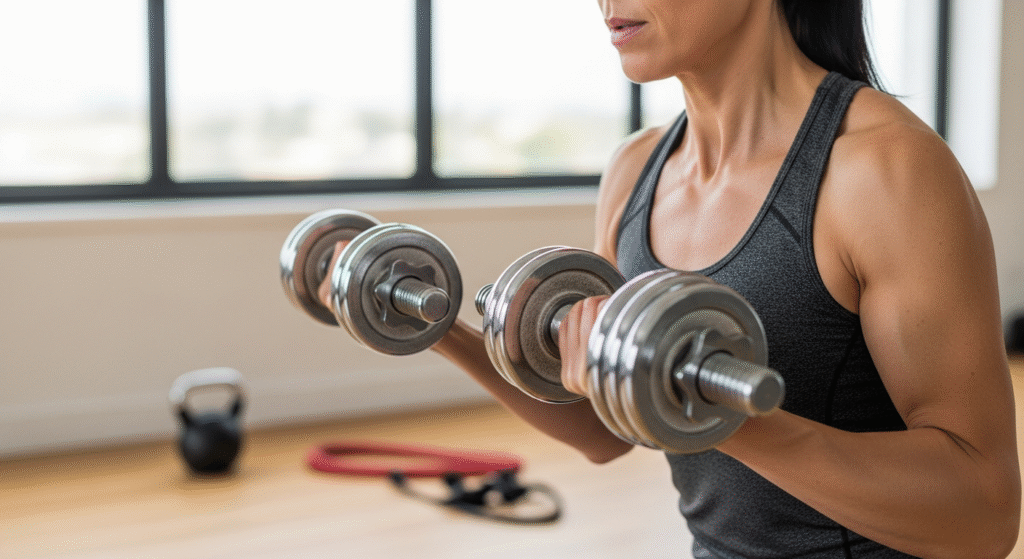
Let’s end this myth right now. Women lack the testosterone levels required to build large, bulky muscles naturally. Men have 15-20 times more testosterone than women, which is why they can build substantial muscle mass more easily. When you see female bodybuilders with extreme muscularity, they’ve spent years training with specific protocols, eating in precise ways, and often using performance-enhancing substances.
What you call “toned” is actually muscle definition—which requires building muscle and losing fat. Those sculpted arms, defined shoulders, and firm legs you admire? They come from lifting weights heavy enough to challenge your muscles. You cannot achieve that look with 2-pound dumbbells and endless repetitions.
Real women who lift weights develop strong, feminine physiques. They have curves, defined muscles, and confidence that radiates. The transformation photos you see of women in their 40s and 50s who look incredible? They’re lifting heavy weights 2-4 times per week. They’re not bulky—they’re powerful, and there’s a significant difference.
“I’m Too Old to Start Now”
Research consistently shows that women in their 40s, 50s, 60s, and even 70s can build muscle and gain strength. A study in the Journal of Applied Physiology found that women aged 60-75 who began strength training gained as much relative strength as younger women. Your muscles don’t have an expiration date.
I’ve worked with women who started lifting at 47 and deadlifted over 100 pounds within six months. I’ve seen 52-year-olds complete their first pull-up. I know women who began strength training at 60 and transformed their body composition completely. These aren’t genetic outliers—they’re regular women who decided to start.
The “use it or lose it” principle applies directly to muscle and bone. Every year you wait, you lose more muscle mass and bone density. Starting today means you’ll be stronger next year than if you wait. The best time to start was 20 years ago. The second best time is right now.
“I Need Expensive Equipment and a Gym Membership”
You can build serious strength at home with minimal investment. Bodyweight exercises like push-ups, squats, lunges, and planks provide significant resistance, especially when you’re starting. As you progress, a set of adjustable dumbbells (ranging from 5-25 pounds) and a set of resistance bands cost less than two months of gym membership and provide everything you need for a complete strength training program.
Want to level up? Add a kettlebell (around $30-50) for swings, goblet squats, and rows. Get a stability ball (under $20) for additional core work. That’s it. You don’t need a home gym that looks like a commercial fitness center.
The most effective workout is the one you’ll actually do. If a gym membership motivates you, great. If working out at home in your living room fits your schedule better, that’s equally powerful. Your muscles don’t know the difference between a $3,000 machine and a $15 resistance band—they only know tension and resistance.
What Your Body Needs: The Beginner’s Framework
How Often Should You Train?
Start with two to three strength training sessions per week. This frequency allows adequate recovery while providing enough stimulus to build strength and muscle. More isn’t always better, especially when you’re beginning. Your muscles need 48 hours to recover and adapt after a challenging workout.
Rest days aren’t lazy days—they’re when the actual transformation happens. During your workout, you create microscopic tears in your muscle fibers. During rest, your body repairs those tears, making the muscles stronger and more resilient. Skip recovery, and you’ll feel perpetually exhausted, increase injury risk, and sabotage your results.
Progressive overload is the principle that drives results. This means gradually increasing the challenge over time—adding more weight, performing more repetitions, or reducing rest periods. You don’t need to progress every single workout, but you should aim to do slightly more than you did last month.
Balance strength training with activities you enjoy. Walk, swim, do yoga, or dance on your non-lifting days. Movement supports recovery, maintains cardiovascular health, and keeps you energized.
The Essential Movement Patterns to Master
Your body moves in specific patterns, and effective strength training targets all of them. Master these five fundamental movements, and you’ll build balanced strength throughout your entire body:
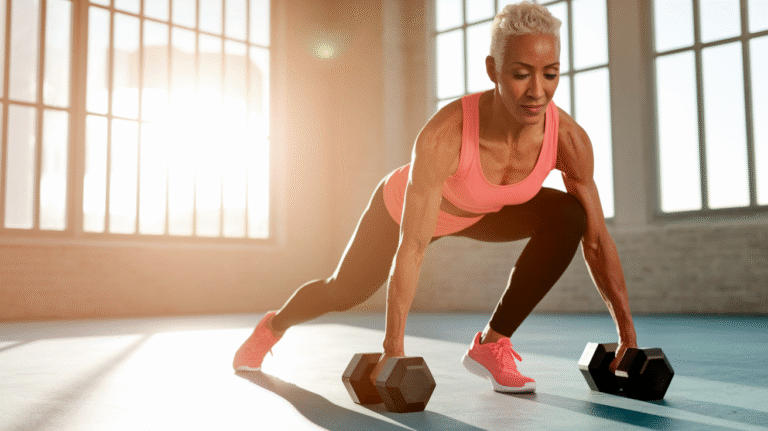
Push movements work your chest, shoulders, and triceps. These include push-ups, chest presses, and overhead presses. They build upper body strength for everyday activities like pushing a heavy door or lifting items overhead.
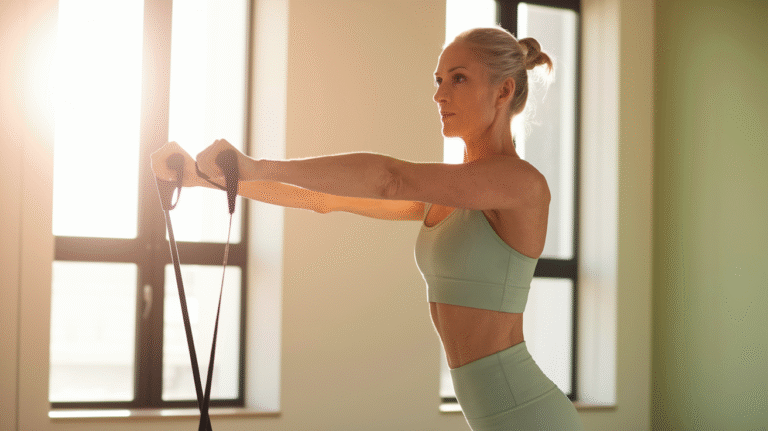
Pull movements target your back, rear shoulders, and biceps. Rows, pull-downs, and reverse flies strengthen your posterior chain, improve posture, and counterbalance all the forward-facing activities we do daily.
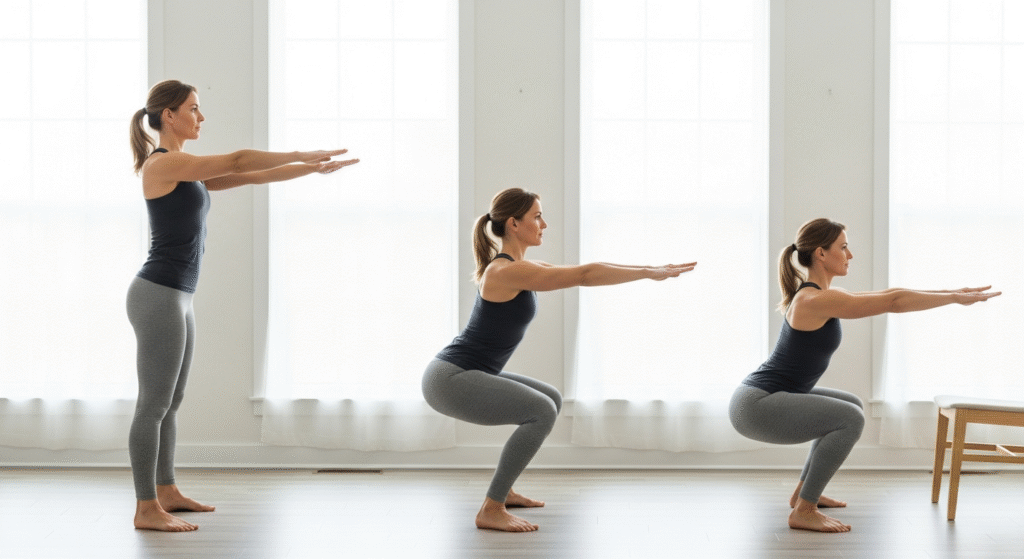
Squat movements engage your quads, glutes, and core. Bodyweight squats, goblet squats, and chair squats build lower body strength essential for standing up from a chair, climbing stairs, and maintaining mobility.
Hinge movements focus on your glutes, hamstrings, and lower back. Deadlifts, hip thrusts, and good mornings develop powerful posterior chain muscles that protect your spine and generate force.
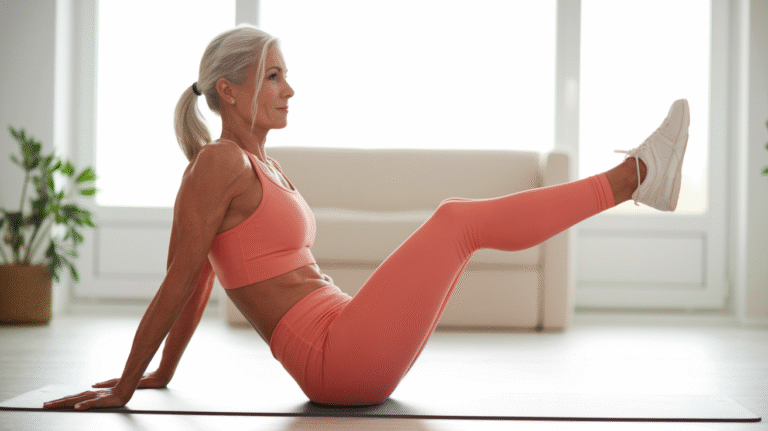
Core stability exercises like planks, bird dogs, and dead bugs strengthen the muscles that stabilize your spine and transfer force between your upper and lower body.
Full-body workouts that include all these patterns are ideal for beginners. You’ll build balanced strength, burn more calories, and train efficiently without spending hours in the gym.
Reps, Sets, and Weight: Decoding the Confusion
Start with 2-3 sets of 8-12 repetitions for each exercise. This rep range effectively builds both strength and muscle for beginners. The weight you choose should make the last two repetitions of each set challenging but not impossible. If you can easily complete 12 reps, the weight is too light. If you can’t reach 8 reps with good form, it’s too heavy.
Here’s a practical test: after your set, you should feel like you could do 1-2 more reps if absolutely necessary, but you’re glad you don’t have to. That’s the sweet spot.
Progress your weights when you can complete all your sets and reps with good form and the last few reps no longer feel challenging. For most beginners, this happens every 2-4 weeks. Increase by the smallest increment available—usually 2.5 to 5 pounds for upper body exercises and 5 to 10 pounds for lower body movements.
Understanding training styles helps you make informed choices. Strength training (lower reps, heavier weight) builds maximum force production. Hypertrophy training (moderate reps, moderate weight) maximizes muscle growth. Endurance training (higher reps, lighter weight) improves muscular stamina. As a beginner, the 8-12 rep range gives you benefits from all three approaches.
Your First 4-Week Beginner Strength Training Program
Week 1-2: Building the Foundation
Your first two weeks focus on learning proper form and establishing the habit. Perform this full-body workout twice per week with at least one day of rest between sessions:
Workout A:
- Bodyweight or goblet squats: 2 sets of 10 reps
- Push-ups (wall, incline, or knee): 2 sets of 8-10 reps
- Dumbbell rows: 2 sets of 10 reps per arm
- Glute bridges: 2 sets of 12 reps
- Plank holds: 2 sets of 20-30 seconds
- Standing or seated shoulder presses: 2 sets of 10 reps
Form cues matter more than weight right now. For squats, keep your chest up, push your knees out, and sit back like you’re aiming for a chair. For push-ups, maintain a straight line from head to heels—no sagging hips or lifted butts. For rows, pull your elbow back toward your hip, squeezing your shoulder blade. For glute bridges, squeeze your glutes at the top and keep your core tight.
Expect muscle soreness 24-48 hours after your first few workouts. This is called delayed onset muscle soreness (DOMS), and it’s completely normal. It’s not injury—it’s adaptation. The soreness will decrease significantly by week three as your body adapts.
Early wins to celebrate: completing the workout, feeling muscles you forgot you had, and the post-workout energy boost that lasts for hours.
Week 3-4: Adding Challenge and Confidence
You’ve built the foundation—now it’s time to progress. Increase your sets from 2 to 3 for each exercise. If the weights feel manageable, increase by 2.5-5 pounds. If bodyweight exercises feel easier, slow down the movement (take 3 seconds to lower, 1 second to lift) to increase difficulty.
Consider adding a third workout day if your schedule and recovery allow. This accelerates results without overwhelming your system. If you add a third day, ensure you still have at least one full rest day between sessions.
Track your progress effectively. Keep a simple workout journal noting the date, exercises, weights used, sets, and reps completed. Add notes about how you felt and any form improvements you noticed. This data becomes incredibly motivating as you see your numbers increase over weeks and months.
Progress indicators beyond the scale: lifting heavier weights, completing more reps, exercises that felt impossible now feel manageable, improved energy throughout the day, better sleep quality, and clothes fitting differently (even if the scale hasn’t moved).
Essential Exercises Broken Down
Squats are the foundation of lower body strength. Stand with feet shoulder-width apart, toes slightly pointed out. Initiate the movement by pushing your hips back, then bending your knees. Keep your chest up and core engaged. Lower until your thighs are parallel to the ground (or as low as comfortable), then drive through your heels to stand. Common mistakes: knees caving inward, heels lifting, or leaning too far forward. Beginner modification: squat to a chair, sitting down completely before standing up.
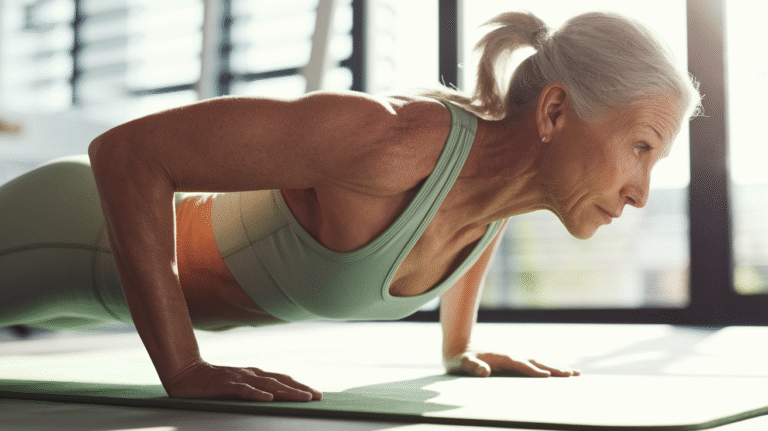
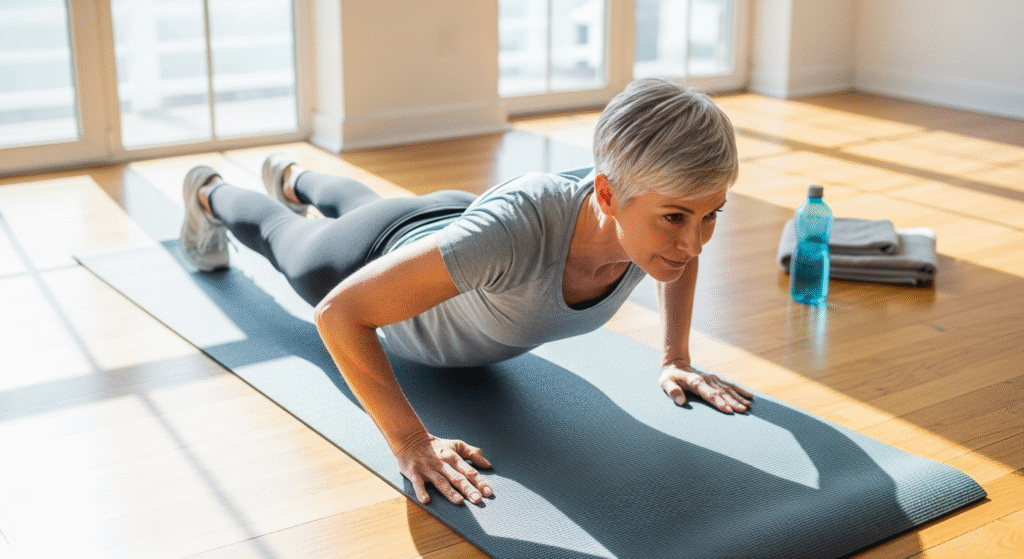
Push-ups build upper body pressing strength. Start with wall push-ups if needed—hands on a wall, body at an angle, performing the pressing motion. Progress to incline push-ups (hands on a counter or bench), then knee push-ups, and finally full push-ups. Keep your body in a straight line, lower until your chest nearly touches the ground, and push back up. You should feel this in your chest, shoulders, and triceps.
Dumbbell rows strengthen your back and improve posture. Place one knee and hand on a bench (or sturdy chair). Hold a dumbbell in your opposite hand, arm hanging straight down. Pull the dumbbell up toward your hip, leading with your elbow and squeezing your shoulder blade. Lower with control. You should feel this in your back, not your bicep. If your arm is doing all the work, lighten the weight and focus on pulling with your back muscles.
Glute bridges are the underrated powerhouse for women over 40. Lie on your back, knees bent, feet flat on the floor hip-width apart. Push through your heels, squeeze your glutes, and lift your hips until your body forms a straight line from shoulders to knees. Hold for one second at the top, then lower with control. This exercise strengthens your glutes, protects your lower back, and improves hip mobility—all critical for women over 40.
Planks build core stability without crunches. Start on your forearms and toes (or knees for modification), body in a straight line. Engage your core by pulling your belly button toward your spine. Don’t let your hips sag or pike up. Hold for 20-30 seconds initially, building to 60 seconds over time. Quality beats duration—perfect form for 20 seconds is better than sloppy form for 60.
Avoiding the Mistakes That Derail Beginners

Doing Too Much, Too Soon
Your enthusiasm is admirable, but it can backfire. Starting with five-day-per-week training, two-hour sessions, or advanced programs designed for experienced lifters leads to burnout, injury, and quitting within weeks. Your body needs time to adapt to new demands.
Gradual progression is the secret to sustainable results. The women who transform their bodies and maintain those changes for years didn’t rush the process. They started with manageable workouts, progressed slowly, and built habits that lasted.
Learn to recognize the difference between productive muscle soreness and pain that signals injury. Good soreness is symmetrical (both legs or both arms), feels like a dull ache, improves with movement, and disappears within 48-72 hours.
Bad pain is sharp, localized to one side, worsens with movement, or persists beyond a few days. If you experience the latter, stop and consult a healthcare professional.
Building sustainable habits trumps chasing quick results every single time. Consistency over months and years creates transformation. Intensity that you can’t maintain creates frustration.
Ignoring Form for Heavier Weights
Ego lifting—using weights that are too heavy to maintain proper form—is the fastest path to injury and plateaus. When you sacrifice form to lift heavier, you shift stress from the target muscles to your joints and connective tissues. This doesn’t build muscle effectively and significantly increases injury risk.
Effective lifting means controlling the weight through the entire range of motion with proper form. You should be able to pause at any point in the movement. If you’re using momentum, swinging the weight, or contorting your body to complete a rep, the weight is too heavy.
Record yourself performing exercises or ask someone knowledgeable to watch your form. What feels right often looks different than you imagine. Video feedback provides invaluable information about your movement patterns.
Master the basics before attempting advanced variations. Perfect your bodyweight squat before loading it with weight. Nail your push-up form before trying challenging variations. The foundation you build with basic movements carries over to everything else you’ll do.
Neglecting Recovery and Nutrition
You can’t out-train a poor diet. Your body needs adequate protein to repair and build muscle tissue. Women over 40 should aim for 0.7-1 gram of protein per pound of goal body weight. If you weigh 160 pounds and want to weigh 140, eat 98-140 grams of protein daily. This supports muscle maintenance and growth while managing hunger.
Sleep is when your body does the actual work of recovery and adaptation. Aim for 7-9 hours per night. Poor sleep elevates cortisol, reduces growth hormone production, and makes it nearly impossible to see results from your training. Prioritize sleep as seriously as you prioritize your workouts.
Hydration affects everything from performance to recovery to how you feel. Drink half your body weight in ounces of water daily—more if you’re training intensely or in hot weather.
Stress management and the bigger picture matter too. Chronic stress elevates cortisol, which promotes muscle breakdown and fat storage. Your strength training program is part of a holistic approach to health that includes nutrition, sleep, stress management, and recovery. Address all these factors for optimal results.
Your Stronger Future Starts Now

Strength training after 40 isn’t optional—it’s essential for maintaining your metabolism, building bone density, and managing the hormonal changes your body is experiencing. The science is clear, the benefits are proven, and the results speak for themselves.
You don’t need a gym membership, expensive equipment, or hours of free time. Two to three full-body workouts per week, 30-45 minutes each, will transform your body when you’re consistent. A set of dumbbells and your own bodyweight provide everything you need to build serious strength.
The biggest barrier isn’t your age, your current fitness level, or your busy schedule. It’s waiting for the “perfect” time that never comes. There will always be a reason to delay—work stress, family obligations, feeling out of shape, or thinking you need to “get in shape” before starting strength training. Every one of those reasons will still exist next month and next year.
Every woman over 40 deserves to feel strong, capable, and confident in her body. You deserve to climb stairs without getting winded, carry groceries without struggling, and play with your kids or grandkids without worrying about injury. You deserve to look in the mirror and see a powerful, vibrant woman who’s taking control of her health.
The women who feel their best in their 40s, 50s, and beyond didn’t wait for motivation to strike or circumstances to be perfect. They started where they were, with what they had, and built momentum through consistent action.
Choose one exercise from this guide and do it today. Not tomorrow, not next Monday, not after you buy equipment or join a gym. Right now. Do ten bodyweight squats. Hold a plank for twenty seconds. Complete five wall push-ups. Take that first small action, and you’ve already begun your transformation.
Your stronger future is waiting. Start building it today.