7 Stress Release Exercises for Better Sleep Over 40
If you’re lying awake at 2 AM with your mind racing through tomorrow’s to-do list, you’re not alone. After 40, stress and sleep seem to become increasingly incompatible roommates—and your body is paying the price.
Here’s what’s really happening: As we age, our bodies handle stress differently. Cortisol levels stay elevated longer, muscle tension builds up faster, and that blissful sleep we once took for granted becomes frustratingly elusive.
You’ve probably tried everything from counting sheep to expensive supplements, listening to sleep podcasts, and even investing in blackout curtains. But the secret to better sleep might be simpler than you think.
The good news? You don’t need a gym membership, expensive equipment, or hours of free time. These seven proven stress release exercises take just minutes before bed and can transform your sleep quality starting tonight.
They work specifically with your body’s natural rhythms after 40, helping you release the day’s tension and signal your nervous system that it’s safe to rest.
In this complete guide, you’ll discover simple, effective techniques that address the unique sleep challenges we face after 40—from progressive muscle relaxation to gentle stretches you can do in bed.
Each exercise is designed to calm your overactive mind, release physical tension, and prepare your body for the deep, restorative sleep you deserve.
No complicated routines or difficult positions. Just straightforward practices that work with your changing body, not against it.
Why Stress Sabotages Sleep After 40 (And What’s Different Now)
The Cortisol-Sleep Connection in Midlife
Your body’s relationship with stress hormones fundamentally changes after 40. While cortisol—your primary stress hormone—naturally peaks in the morning and declines throughout the day, this rhythm becomes less efficient as we age. Research shows that cortisol levels stay elevated 23% longer in adults over 40 compared to younger adults, meaning that stressful meeting at 3 PM is still affecting your body at 11 PM.
This creates a vicious cycle that’s hard to break. Poor sleep increases cortisol production, which further disrupts sleep quality, which raises cortisol even more. Your body’s natural stress recovery system, which once bounced back quickly, now needs more time and intentional support to reset. This is why you can’t just “power through” sleep deprivation like you could in your twenties—your physiology has changed.
What this means for bedtime is crucial: You need a deliberate transition period to help your body shift from “alert mode” to “rest mode.” Your nervous system won’t make this switch automatically anymore.
Physical Tension Builds Differently
Notice how your shoulders creep up toward your ears during the day? That muscle tension accumulates differently now. Your muscles hold stress longer and release it more slowly, partly due to reduced blood flow and decreased flexibility that naturally occurs with aging.
The hours you spend hunched over screens create forward head posture—a condition where your head juts forward from your shoulders. This seemingly small shift forces your neck and shoulder muscles to work overtime, creating tension that radiates down your spine. This physical stress doesn’t just disappear when you lie down. Instead, it keeps your body in a state of subtle alertness that prevents deep sleep.
Those aches and pains you ignore during your busy day? They become impossible to ignore at 2 AM when you’re trying to find a comfortable sleeping position. Your body is literally too tense to relax into restorative sleep.
Your Changing Sleep Architecture
Sleep patterns naturally shift after 40 in ways that make you more vulnerable to stress. You spend less time in deep sleep and more time in lighter sleep stages, meaning you wake up more easily throughout the night. While a younger person might sleep through minor disturbances, your brain is now more sensitive to both external disruptions and internal stress signals.
This is why stress has a bigger impact on sleep quality now than it did in your younger years. A mildly stressful day that wouldn’t have affected your sleep at 30 can keep you tossing and turning at 45. Your sleep system has less resilience and requires more support.
The essential takeaway? A proper wind-down routine isn’t optional anymore—it’s necessary for quality sleep. Your body needs clear, consistent signals that it’s time to shift into rest mode.
Exercise #1 – The 4-7-8 Breathing Technique (Your Ultimate Nervous System Reset)

Why This Simple Breathing Exercise Works
The 4-7-8 breathing technique is like a manual override switch for your nervous system. When you control your breath in this specific pattern, you activate your parasympathetic nervous system—your body’s built-in “calm down” signal. This is the opposite of the fight-or-flight response that stress triggers.
The science behind the 4-7-8 ratio is fascinating. The extended hold (7 counts) allows oxygen to fully saturate your bloodstream, while the long exhale (8 counts) removes more carbon dioxide than normal breathing. This combination slows your heart rate, lowers blood pressure, and signals your brain that there’s no danger present. It’s particularly effective for racing thoughts and anxiety-driven insomnia because it gives your mind something specific to focus on besides your worries.
Dr. Andrew Weil, who popularized this technique, calls it a “natural tranquilizer for the nervous system.” Unlike actual tranquilizers, it gets more powerful with practice and has zero side effects.
Easy Step-by-Step Instructions
Here’s exactly how to practice the 4-7-8 breathing technique:
Inhale quietly through your nose for 4 counts. Keep your mouth closed and breathe deeply enough that your belly expands, not just your chest.
Hold your breath for 7 counts. This is the most important part—resist the urge to rush it.
Exhale completely through your mouth for 8 counts, making a gentle whooshing sound. Empty your lungs completely.
Repeat this cycle for 4 complete rounds. The entire practice takes less than 2 minutes.
The best position is sitting up in bed with your back supported against your headboard or pillows. This keeps your airways open and makes breathing easier. Once you finish the four cycles, you can slide down into your sleeping position.
Quick Tips for Maximum Effectiveness
Timing matters. Practice this right before turning off the lights, when you’re already in bed and ready for sleep. This creates a strong mental association between the exercise and sleep time.
Common mistakes to avoid: Don’t breathe too deeply—you’re not trying to hyperventilate. Keep the breath comfortable and controlled. Don’t rush the counts; use a slow, steady pace. If holding your breath for 7 counts feels uncomfortable at first, start with a 4-5-6 ratio and gradually work up to 4-7-8.
What to expect: Most people feel noticeably calmer by the second round. Your heart rate slows, your shoulders drop, and your mind quiets. Some people fall asleep before completing all four cycles—that’s perfectly fine. The exercise did its job.
Exercise #2 – Progressive Muscle Relaxation (Release Tension You Didn’t Know You Had)
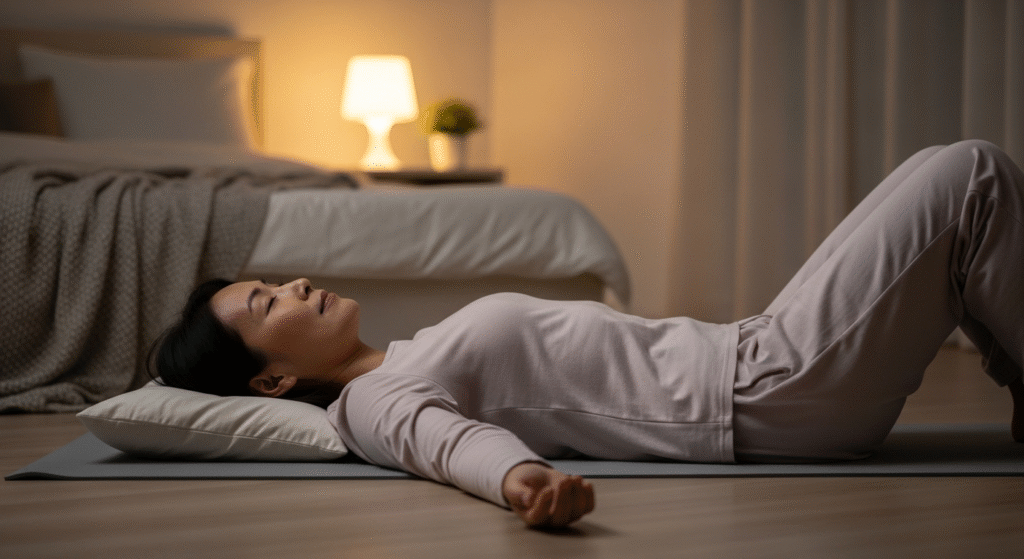
The Proven Power of PMR for Sleep
Progressive Muscle Relaxation (PMR) works on a counterintuitive principle: tensing your muscles before relaxing them creates deeper relaxation than just “trying to relax.” When you deliberately tighten a muscle group and then release it, you become acutely aware of the difference between tension and relaxation. This awareness helps you identify where you’re holding stress throughout the day—often in places you didn’t even realize.
The results are remarkable. Studies show that people who practice PMR experience up to 70% improvement in sleep onset time—meaning they fall asleep significantly faster. It’s particularly effective for people who carry physical tension from stress, which includes most of us over 40.
PMR also interrupts the worry cycle. When you’re focused on systematically tensing and relaxing muscle groups, your mind can’t simultaneously ruminate about tomorrow’s problems. It’s a gentle form of forced mindfulness.
The Complete Body Scan Sequence
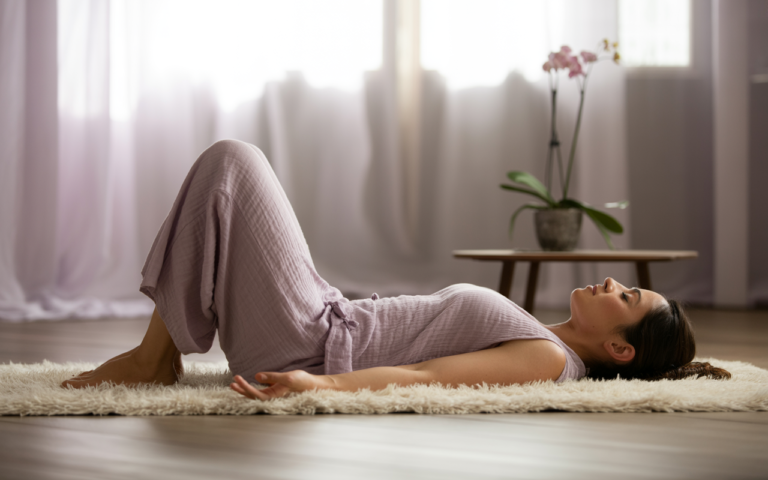
Start by lying flat on your back in bed with your arms at your sides, palms facing up. Take three deep breaths to settle in.
Feet and calves: Curl your toes downward tightly, hold for 5 seconds, then release completely. Notice the difference.
Thighs and buttocks: Squeeze these muscles together, hold for 5 seconds, release and feel them sink into the mattress.
Stomach: Pull your belly button toward your spine, tighten your abs, hold for 5 seconds, then let your stomach soften completely.
Hands and forearms: Make tight fists, hold for 5 seconds, then release and spread your fingers wide.
Upper arms and shoulders: Shrug your shoulders up toward your ears, hold for 5 seconds, then let them drop heavily.
Neck: Gently press your head back into the pillow, hold for 5 seconds, then release.
Face: Scrunch all your facial muscles toward the center of your face (like you’re smelling something terrible), hold for 5 seconds, then release and let your face go completely slack.
Making It Work for Your Body
If you have joint pain or limited mobility, adjust the intensity. You don’t need to create maximum tension—even 30-40% tension followed by complete release is effective. The release is where the magic actually happens, so focus your attention there.
Time investment: The full sequence takes 5-10 minutes, but you’ll likely fall asleep before completing it. That’s the goal. Pair this practice with slow, deep breathing between each muscle group. Inhale during the tension phase, exhale during the release.
Pro tip: As you release each muscle group, imagine the tension draining out of your body and into the mattress. This visualization enhances the physical relaxation effect.
Exercise #3 – Gentle Bedtime Stretches (Undo the Day’s Physical Stress)
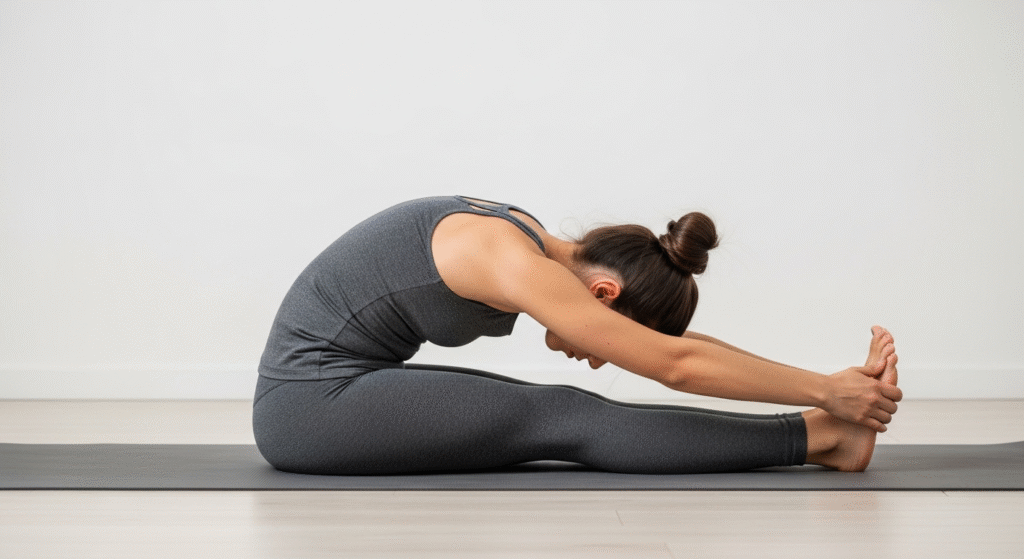
Why Stretching Before Bed Is Essential After 40
Gentle stretching before bed improves blood flow throughout your body, delivering oxygen and nutrients while carrying away metabolic waste products that accumulate during the day. This improved circulation signals relaxation to your nervous system—your body interprets increased blood flow as a sign that it’s safe to rest and repair.
The connection between physical flexibility and sleep quality is stronger than most people realize. Tight muscles create discomfort that disrupts sleep, even if you’re not consciously aware of it. Your body can’t fully relax into deep sleep when muscles are contracted and tense.
Bedtime stretching also prevents those frustrating middle-of-the-night cramps and morning stiffness that become more common after 40. When you gently lengthen muscles before sleep, you reduce the likelihood of painful spasms that jolt you awake at 3 AM.
The Perfect 5-Minute Bedtime Stretch Routine
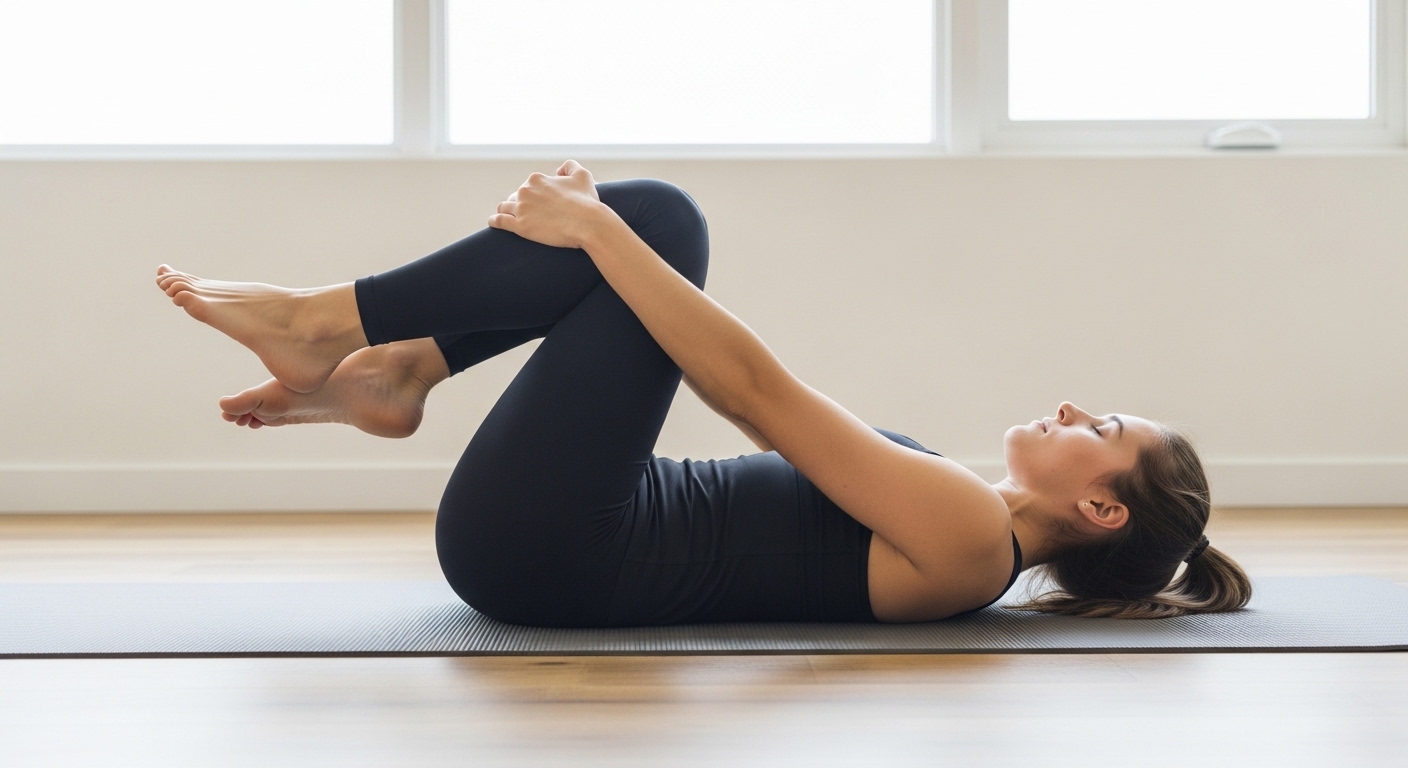
The beauty of this routine? You can do all of these stretches in bed without getting up.
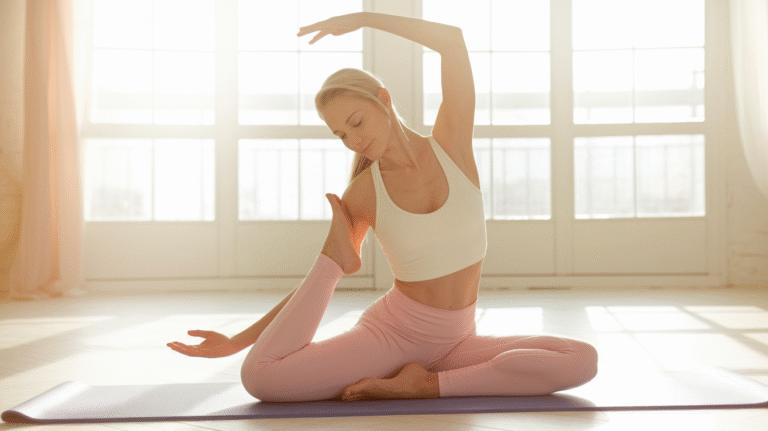
Child’s Pose (Modified): Sit back on your heels, fold forward with your arms extended in front of you, and rest your forehead on the bed. Hold for 60 seconds while breathing deeply. This opens your hips and releases lower back tension accumulated from sitting all day.
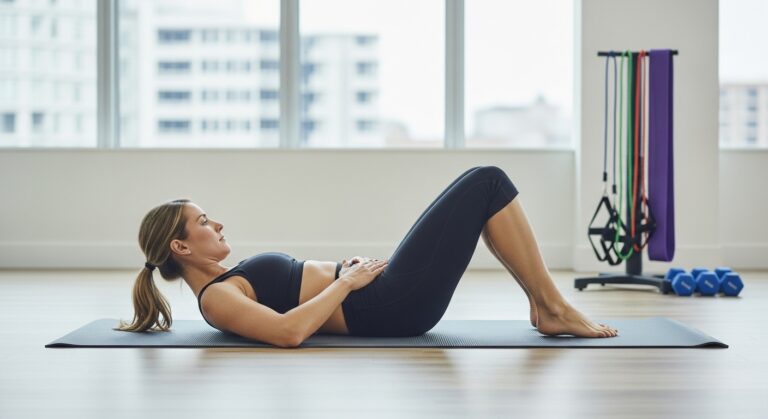
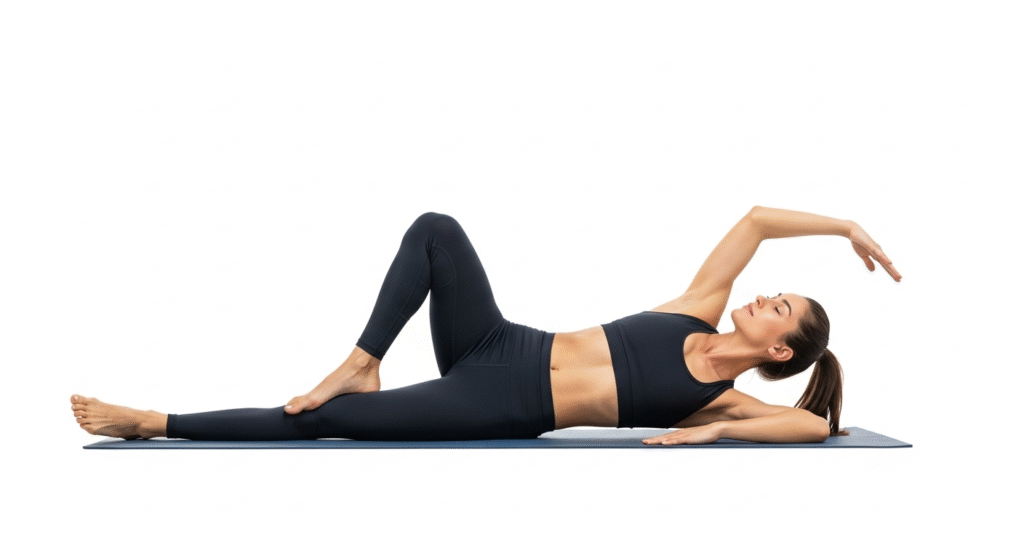
Supine Spinal Twist: Lie on your back, bend both knees, and drop them together to one side while keeping your shoulders flat on the bed. Extend your arms in a T-position. Hold for 45 seconds each side. This releases spine tension and aids digestion, which improves sleep quality.
Gentle Neck Rolls: Sitting comfortably, make slow, gentle half-circles with your head, bringing your ear toward your shoulder on each side. Avoid full circles, which can strain your neck. Do 5 slow repetitions each direction. This releases the tech neck tension and jaw tightness that many of us carry.
Legs-Up-The-Wall (Modified): Scoot your hips close to your headboard and extend your legs up against it. Rest your arms at your sides, palms up. Hold for 2-3 minutes. This reduces leg swelling, reverses the effects of gravity, and calms your nervous system remarkably quickly.
Stretching Do’s and Don’ts for Better Sleep
Keep it gentle—this isn’t your morning workout or a yoga class. You’re preparing for sleep, not building flexibility. Focus on areas where you personally hold the most tension. For most people, that’s the neck, shoulders, and lower back.
Breathe deeply through each stretch, exhaling as you move deeper into the position. Never bounce or force a stretch. What to avoid: Anything that increases your heart rate or energizes you. Skip forward bends that require you to stand up, and avoid any stretches that feel painful rather than pleasantly uncomfortable.
The goal is relaxation, not achievement. If you can only hold a stretch for 20 seconds instead of 60, that’s perfectly fine. Listen to your body.
Exercise #4 – Yoga Nidra (The Quick Path to Deep Relaxation)
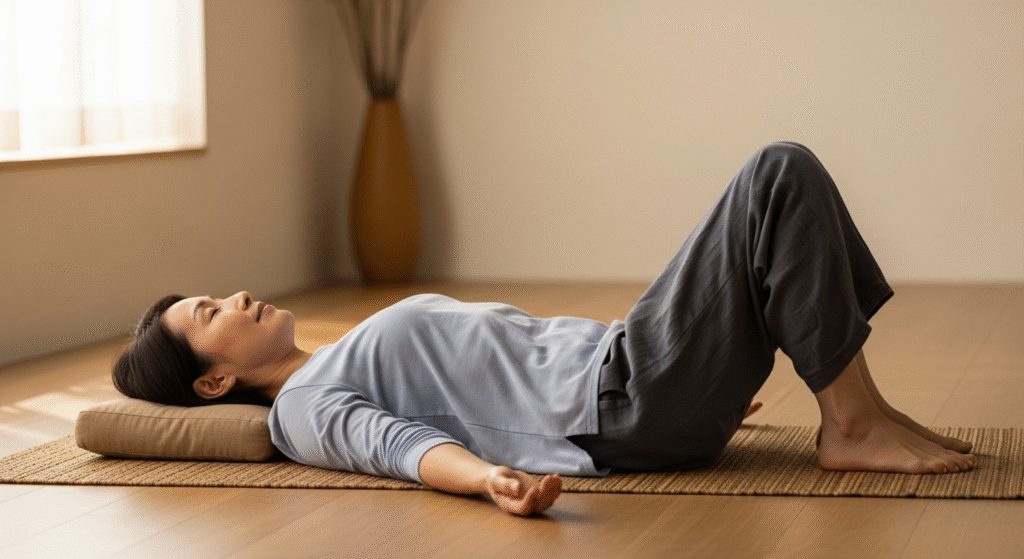
What Makes Yoga Nidra Different
Yoga Nidra translates to “yogic sleep”—it’s a guided meditation practice that leads you into the state between waking and sleeping. This borderland consciousness is where deep relaxation and restoration happen. Unlike traditional meditation, where you’re trying to stay alert and focused, Yoga Nidra encourages you to hover at the edge of sleep.
What makes this practice especially effective for overactive minds is that it gives your thoughts something to follow—a gentle guide through your body and breath—without requiring you to “clear your mind” or “stop thinking.” Those instructions never work when you’re stressed. Instead, Yoga Nidra redirects your attention systematically.
Here’s the best part: No flexibility required. This is purely mental relaxation. You don’t move at all once you’re settled. It’s perfect for people who feel intimidated by physical yoga or who have mobility limitations.
Simple Yoga Nidra Practice for Beginners
Lie flat on your back in bed with your arms slightly away from your body, palms facing up. Get completely comfortable—use pillows under your knees if needed.
Set an intention (called a Sankalpa). This is a short, positive phrase like “I am calm and rested” or “I sleep deeply and peacefully.” State it mentally three times.
Body scan awareness: Mentally move your attention through each body part without moving. Start with your right thumb, then each finger, palm, wrist, forearm, elbow, upper arm, shoulder. Continue through your entire body systematically. Don’t rush—spend 3-5 seconds on each part.
Breath awareness: Simply notice your natural breathing without trying to change it. Count backwards from 20 to 1, one number per breath.
Visualization: Imagine peaceful scenes—a calm lake, floating clouds, gentle waves. Let the images flow without forcing them.
Return to intention: Repeat your Sankalpa three more times, then gradually bring your awareness back to the room.
Making Yoga Nidra Work for You
Time needed: A full practice takes 10-20 minutes, though even 5 minutes provides benefits. Many people fall asleep before completing the practice—that’s not only okay, it’s often the goal when using Yoga Nidra for sleep.
Using guided recordings works better than self-guided practice when you’re starting out. Apps like Insight Timer and YouTube have free Yoga Nidra recordings specifically designed for sleep. The voice guides you through each step, so you don’t have to remember the sequence.
This technique is perfect for people who “can’t meditate” because there’s no right or wrong way to do it. If your mind wanders, that’s normal. If you fall asleep, you succeeded. If you stay awake through the whole thing, you still received deep relaxation benefits.
Exercise #5 – Guided Imagery (Transport Your Mind to Calm)
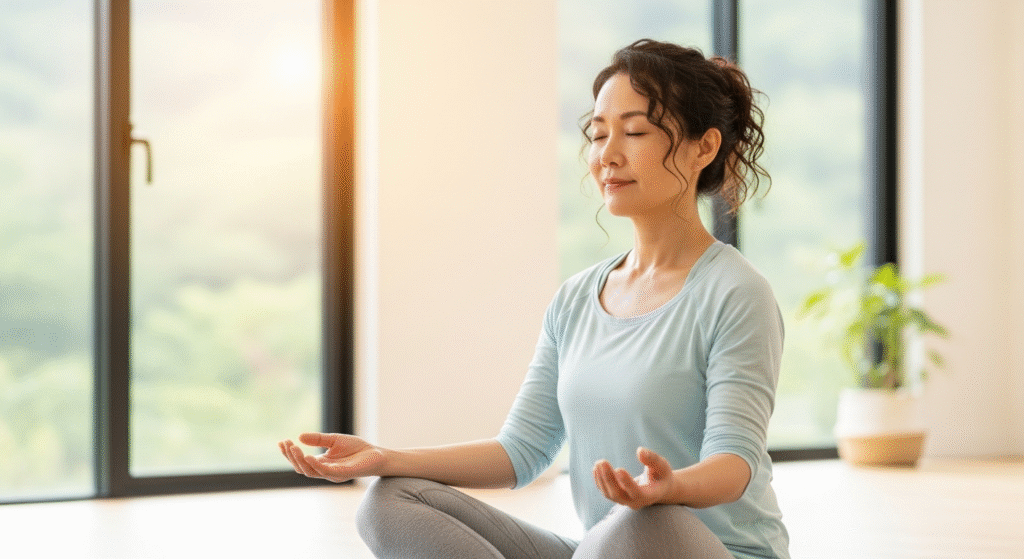
The Power of Visualization for Stress Release
Your brain doesn’t distinguish clearly between vividly imagined experiences and real ones. When you visualize yourself in a peaceful, safe place, your nervous system responds as if you’re actually there. This activates the same relaxation response as actually being on a quiet beach or in a serene forest—your heart rate slows, stress hormones decrease, and muscle tension releases.
Guided imagery works especially well for verbal and visual thinkers—people whose minds naturally create detailed mental pictures. If you’re someone who can easily imagine scenes from books you read or vividly recall past vacations, this technique will feel natural and effective.
Research confirms the connection between vivid mental imagery and reduced cortisol levels. One study found that 15 minutes of guided imagery before bed reduced cortisol by up to 25% and improved sleep quality scores by 40%.
Creating Your Perfect Sleep Sanctuary Scene
The most effective visualizations engage all your senses and include gentle movement. Here’s how to build a scene that works:
Choose your setting: Pick a place that feels inherently peaceful to you. Popular choices include a quiet beach at sunset, a forest clearing, a mountain meadow, or a cozy cabin. The specific location matters less than how calm it makes you feel.
Engage all senses: Don’t just see the scene—experience it completely. What do you hear? Ocean waves, rustling leaves, crackling fire? What do you smell? Salt air, pine trees, fresh rain? What do you feel on your skin? Warm sun, cool breeze, soft grass? The more sensory details you include, the more real it becomes to your brain.
Add gentle movement: Include elements that move slowly and rhythmically—waves rolling in and out, tree branches swaying, clouds drifting, smoke curling from a chimney. This movement is hypnotic and helps your mind settle.
Include yourself: See yourself in the scene, completely relaxed and peaceful. You’re lying on warm sand, sitting against a tree, or resting in a hammock. You’re safe, comfortable, and deeply at ease.
Stay with it: Spend 5-10 minutes building the scene in detail. Don’t rush through it. Let each element develop slowly.
Quick Tips for Effective Guided Imagery
Start with the same scene every night for at least a week. Repetition strengthens the relaxation response. Your brain will begin associating this particular imagery with sleep, making it work faster over time.
If you’re new to visualization, use a recorded guided imagery specifically designed for sleep. The narrator describes the scene for you, making it easier to maintain focus. As you become more comfortable, you can create your own silent visualizations.
Don’t worry if your mind wanders or if the images aren’t perfectly clear. Even fuzzy, incomplete visualizations provide relaxation benefits. The effort of imagining peace creates peace.
—
Ready to reclaim your sleep? Start with just one of these exercises tonight—the 4-7-8 breathing technique takes less than two minutes and works immediately for most people. As you build consistency with one practice, add another. Within a week, you’ll notice the difference. Within a month, quality sleep will become your new normal. Your body knows how to rest; these exercises simply help you remove the stress barriers that have been standing in the way. Sweet dreams are closer than you think.