Tai Chi Movements for Women Over 40 to Improve Balance
You’re standing at the top of the stairs, and for just a second, you hesitate. That confident stride you’ve always had feels a little less certain. Maybe you’ve caught yourself grabbing the railing more often, or perhaps you’ve noticed that getting up from the floor isn’t quite as easy as it used to be.
If this sounds familiar, you’re not alone. After 40, our bodies undergo significant changes that affect balance, stability, and coordination. Hormonal shifts reduce bone density, muscle mass naturally decreases, and the sensory systems that help us maintain equilibrium become less responsive. These aren’t signs of weakness—they’re normal physiological changes that every woman experiences.
Here’s the good news: You can absolutely improve your balance, rebuild your confidence, and reduce your fall risk with the right approach. Tai Chi, an ancient Chinese practice that combines gentle movement with mindful breathing, offers proven benefits specifically suited to women over 40.
In this guide, you’ll discover five effective Tai Chi movements that strengthen your legs, enhance your stability, and improve your body awareness. These aren’t complicated exercises requiring athletic ability—they’re accessible movements that anyone can master, regardless of fitness level. You’ll learn the proper technique for each movement, understand why it works, and discover how to adapt each exercise to your current abilities.
The key to success isn’t intensity—it’s consistency. Even practicing just 10 minutes daily delivers measurable improvements in balance, strength, and confidence. You’re not trying to become a Tai Chi master overnight. You’re investing in your long-term health, independence, and quality of life, one gentle movement at a time.
Why Tai Chi is the Smart Choice for Women Over 40
Understanding Your Changing Body
After 40, your body experiences a cascade of hormonal changes that directly impact your balance and stability. Declining estrogen levels accelerate bone density loss, making you more vulnerable to fractures if you fall. Research shows women can lose up to 20% of their bone density in the five to seven years following menopause.
Simultaneously, you’re losing muscle mass at a rate of 3-8% per decade after 30, with the rate accelerating after 60. This condition, called sarcopenia, particularly affects the fast-twitch muscle fibres that help you catch yourself when you stumble. Your proprioception—your body’s ability to sense its position in space—also diminishes, making it harder to react quickly to changes in terrain or unexpected obstacles.
Traditional high-impact exercises like running or aerobics can actually increase injury risk during this transition period. Your joints are handling less cushioning, your ligaments are less elastic, and your recovery time lengthens. Tai Chi offers a different approach entirely. The slow, controlled movements build strength without jarring your joints. The weight-shifting exercises train your balance systems without putting you at risk of falling.
The Proven Benefits Beyond Balance
Tai Chi delivers benefits that extend far beyond improved stability. A comprehensive review published in the British Journal of Sports Medicine analyzed 35 studies and found that Tai Chi significantly improves flexibility, particularly in the hips, knees, and ankles—the joints most critical for maintaining balance.
The practice also functions as moving meditation, reducing cortisol levels and lowering stress. Women who practice Tai Chi regularly report better sleep quality, reduced anxiety, and improved mood. The focused breathing techniques activate your parasympathetic nervous system, creating a sense of calm that extends throughout your day.
Your posture improves dramatically because Tai Chi emphasizes proper alignment and core engagement. The movements strengthen the deep stabilizing muscles around your spine, reducing back pain and creating a more confident, upright stance. This improved posture doesn’t just look better—it actually enhances your balance by keeping your center of gravity properly aligned.
Studies also show that Tai Chi practitioners develop stronger social connections and experience less isolation. Whether you practice at home or join a class, you’re part of a community that values mindful movement and mutual support.
Getting Started: What You Need to Know
One of Tai Chi’s greatest advantages is its simplicity. You don’t need special equipment, expensive gear, or a gym membership. Wear comfortable, loose-fitting clothing that allows you to move freely. Choose flat, flexible shoes or practice barefoot if you prefer—you need to feel the ground beneath your feet.
Create a practice space about 6 feet by 6 feet in your home. Clear away furniture, rugs, or obstacles that might cause tripping. If you’re just starting out, practice near a wall or sturdy chair so you have something to hold if needed. Good lighting is essential—you want to see your surroundings clearly.
Many women find that morning practice energizes them for the day ahead, while others prefer evening sessions to release accumulated tension. The best time is whenever you’ll actually do it consistently. Start with just five minutes daily. As the movements become familiar, gradually extend your practice to 10, then 15 minutes.
Movement 1: Cloud Hands (Yun Shou) – Master Your Center of Gravity
Why This Movement Works
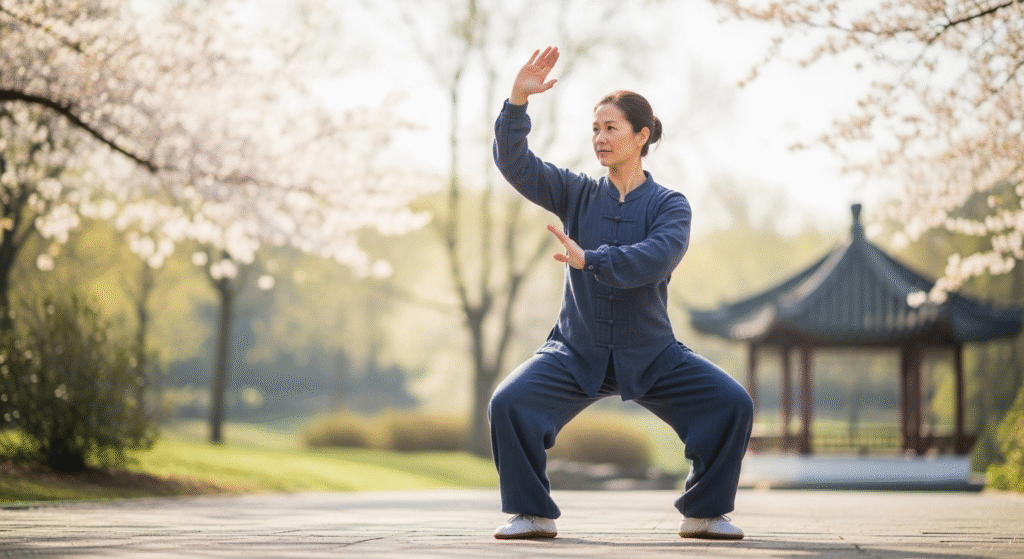
Cloud Hands is one of the most effective Tai Chi movements for developing lateral stability—the ability to maintain balance while moving side to side. This matters tremendously in daily life. When you step sideways to let someone pass, reach across your body to grab something, or shift your weight while cooking or cleaning, you’re using lateral stability.
The movement engages your core muscles throughout the entire sequence, building the deep abdominal and back muscles that stabilize your spine. Your obliques—the muscles along your sides—work constantly to control the smooth weight transfer from leg to leg. Meanwhile, your hip abductors and adductors (outer and inner thigh muscles) strengthen as they support each weight shift.
Cloud Hands also trains your body to move as an integrated unit. Your arms, torso, and legs coordinate in a flowing pattern that improves the neural pathways between your brain and muscles. This enhanced mind-body connection translates directly to better balance and quicker reactions in everyday situations.
Step-by-Step Instructions
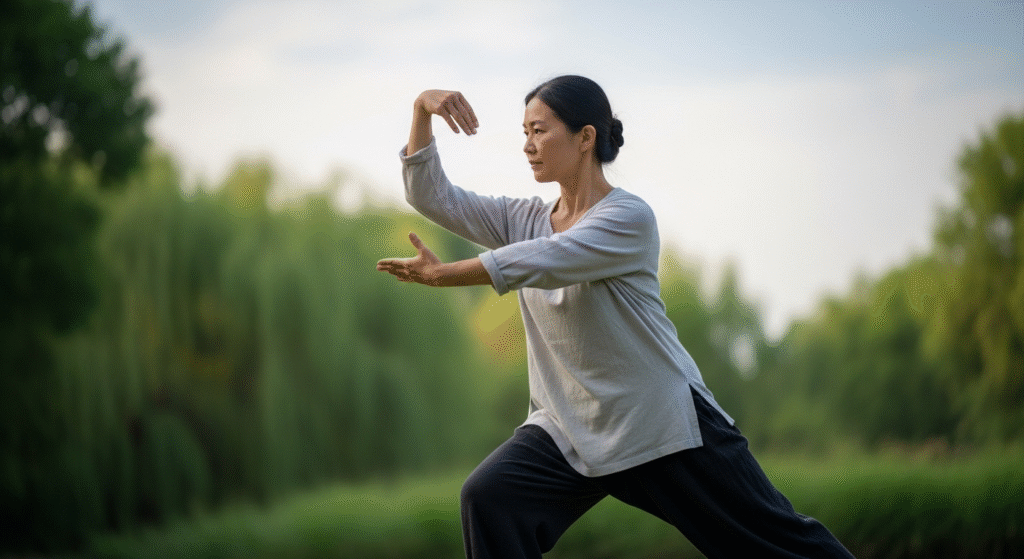
Begin by standing with your feet shoulder-width apart, toes pointing forward. Bend your knees slightly—imagine you’re sitting on a high stool. This stance, called “horse stance” in Tai Chi, creates a stable base while activating your leg muscles.
Shift your weight completely onto your right leg. Your left leg should feel light enough to lift easily, though keep your foot on the ground. Raise your right hand to shoulder height, palm facing you, as if you’re looking at your watch. Your left hand rests near your left hip, palm down.
Now begin the flowing movement: As you shift your weight to your left leg, your right hand sweeps down and across your body while your left hand rises. Imagine your hands are tracing the outline of a large sphere in front of you. Your hands pass each other at the center of your body, then continue their circular paths.
Take a small step to the left with your left foot as you complete the weight transfer. Your right foot then slides to meet it, returning you to shoulder-width stance. Repeat this pattern, moving continuously to the left for several repetitions, then reverse direction and move to the right.
Coordinate your breathing with the movement: Inhale as your weight shifts to one side, exhale as you transition to the other. The breath should feel natural and relaxed, never forced or held.
Common Mistakes and How to Avoid Them
The most common error is rushing through the movement. Cloud Hands should flow like honey pouring from a jar—slow, continuous, and smooth. If you catch yourself speeding up, pause and reset. Count slowly to four for each complete side-to-side transition.
Many beginners lock their knees straight instead of maintaining the slight bend. Straight legs actually reduce your stability and prevent your leg muscles from engaging properly. Keep checking your knees—they should always have a gentle bend, with your kneecaps pointing in the same direction as your toes.
Another frequent mistake is moving only your arms while your lower body stays rigid. Your weight must genuinely shift from leg to leg. Test this by lifting your “empty” foot slightly off the ground during each transition. If you can’t lift it easily, you haven’t transferred your weight completely.
Start with just five repetitions in each direction. As you build strength and confidence over several weeks, gradually increase to 10, then 15 repetitions. Quality always matters more than quantity.
Movement 2: Parting the Wild Horse’s Mane – Boost Dynamic Balance
The Balance-Building Power of This Move
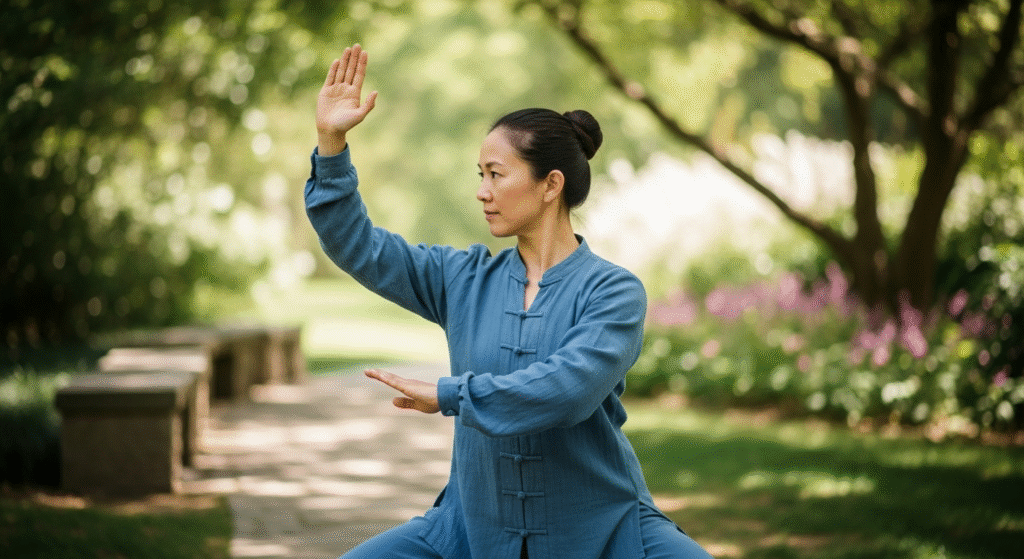
Parting the Wild Horse’s Mane challenges your balance in a completely different way than Cloud Hands. This movement requires you to step forward into a controlled lunge while maintaining stability—exactly the kind of dynamic balance you need when walking on uneven surfaces, climbing stairs, or stepping over obstacles.
The forward lunging motion strengthens your quadriceps, hamstrings, and glutes—the powerhouse muscles that prevent falls. Research shows that leg strength directly correlates with fall prevention. Women with stronger leg muscles can catch themselves more effectively if they start to stumble.
This movement also improves your hip flexibility and range of motion. Tight hips restrict your stride length and force you to take shorter, shuffling steps that actually increase fall risk. By gently stretching and strengthening your hip flexors and extensors, you develop a more confident, stable gait.
The rotational element—your torso turns as you step forward—trains your body to handle the twisting movements common in daily activities. You’re teaching your balance systems to maintain stability even when your body moves in multiple directions simultaneously.
Detailed Movement Breakdown
Start in a comfortable stance with your feet together. Hold your hands in front of your chest as if you’re holding a large beach ball, right hand on top, left hand below. This is called “holding the ball” position.
Step forward with your left foot, placing your heel down first and rolling through to your whole foot. As you step, shift 70% of your weight onto your front leg while keeping 30% on your back leg. Your back heel lifts naturally, but your toes stay grounded.
As you step forward, separate your hands: Your left hand pushes forward at shoulder height, palm facing out, as if you’re gently pushing open a door. Your right hand pulls back to rest near your right hip, palm facing down. Your torso rotates slightly to face the same direction as your left hand.
Hold this position for a moment, feeling the stretch through your hips and the engagement in your front leg. Then shift your weight back to your rear leg, bring your feet together, and return to the starting position with your hands forming the ball again.
Repeat on the opposite side, stepping forward with your right foot. Alternate sides for several repetitions, moving smoothly from one side to the other.
Modifications for Different Fitness Levels
If you’re new to Tai Chi or concerned about your balance, start with smaller steps. Instead of a full lunge, take a shorter step forward, keeping your stance higher. This reduces the challenge while still building strength and coordination.
Practice next to a chair or wall initially. Just knowing support is available increases your confidence and allows you to focus on proper form rather than worrying about falling. As your balance improves over several weeks, gradually move away from the support.
For a greater challenge once you’ve mastered the basic movement, deepen your front knee bend to create a lower stance. This increases the strength-building benefits significantly. You can also slow down the movement even more, which actually makes it harder by requiring more muscular control.
Pay attention to your back knee—it should point forward, not collapse inward. If you notice your knee turning in, take a narrower stance. Your feet should follow parallel tracks, not a tightrope line.
Movement 3: Single Whip – Enhance Rotational Stability
Why Rotation Matters for Fall Prevention
Most balance exercises focus only on forward, backward, and side-to-side movement. But think about how you actually move through your day: You turn to look behind you while backing up, twist to reach something on a shelf, rotate to get in and out of your car. These rotational movements require a different kind of balance control.
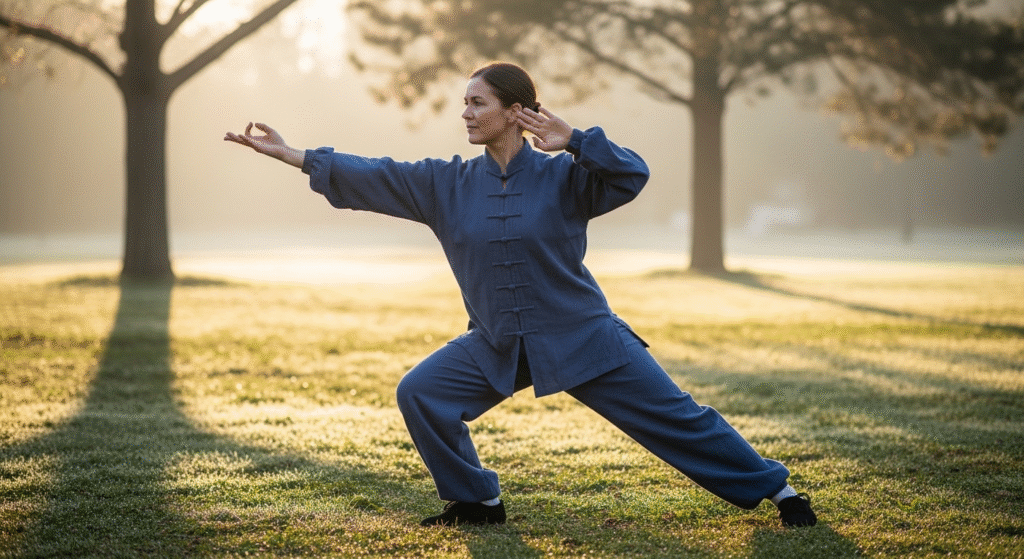
Single Whip specifically trains your ability to maintain stability while rotating your body. The movement strengthens your obliques—the muscles responsible for controlling rotation—while improving spinal mobility. Many women develop stiffness in their thoracic spine (mid-back) after 40, which limits rotation and forces compensatory movements that increase fall risk.
This exercise also enhances your spatial awareness. As you rotate, your vestibular system (inner ear balance organs) must work harder to track your position. Your eyes, muscles, and joints all send information to your brain about where you are in space. Single Whip trains these systems to work together more effectively.
The movement builds ankle stability too. As you pivot on your feet, your ankle muscles engage to control the rotation and maintain your balance. Strong, responsive ankles are your first line of defense against stumbling.
Executing the Single Whip Correctly
Begin with your feet shoulder-width apart, weight evenly distributed. Shift your weight completely onto your right leg. Form your right hand into a “beak” position: Touch your fingertips and thumb together, pointing down, with your wrist bent. Bring this beak hand across your body to the right, keeping it at shoulder height.
Your left hand sweeps down and across your body, palm facing down, as if you’re smoothing a tablecloth. As your left hand moves, pivot on your left heel to turn your body to the left. Your left foot rotates about 45 degrees.
Now step out to the left with your left foot, creating a wide stance. As you step, your left hand continues its arc upward and outward, finishing at shoulder height with your palm facing away from you. Your arm extends fully but not locked. Your right hand maintains the beak position, creating a beautiful line from one hand to the other.
Your weight shifts so that 70% rests on your left leg, 30% on your right. Your torso faces the same direction as your left hand. Your gaze follows your left hand throughout the movement.
The rotation comes from your waist and torso, not from twisting your knees. Your knees should always point in the same direction as your toes to protect your joints.
Practice Tips for Success
Start with smaller rotations—perhaps only 30 degrees instead of the full 90-degree turn. As your flexibility and balance improve, gradually increase the range of rotation. Never force the movement beyond what feels comfortable.
The key to smooth rotation is leading with your waist. Think about your navel as a headlight—wherever you point your navel, your body follows. This ensures that your spine, hips, and shoulders all rotate together as an integrated unit.
Practice in front of a mirror or record yourself on your phone. Watch for these common issues: shoulders hunching up toward your ears (keep them relaxed and down), weight shifting onto the outside edges of your feet (press through your whole foot), or your back arching excessively (engage your core to maintain neutral spine).
Move slowly and deliberately. The slower you go, the more control you develop. If you feel wobbly during the rotation, pause and check your stance. Your feet might be too close together—widen your base for more stability.
Movement 4: Grasp the Bird’s Tail – Improve Weight Distribution
The Foundation of Tai Chi Balance
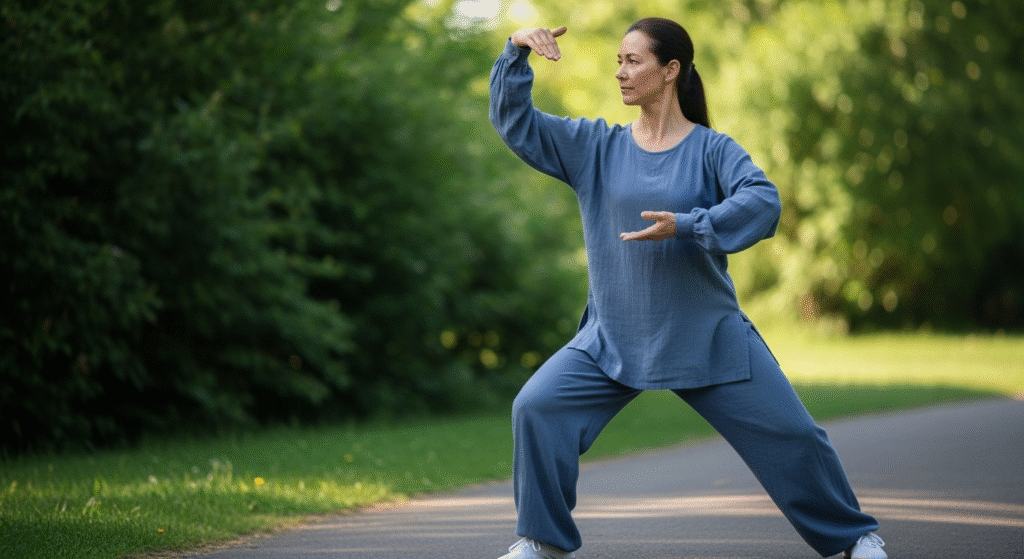
Grasp the Bird’s Tail is considered one of the fundamental Tai Chi sequences because it contains four distinct movements that together train every aspect of balance and weight transfer. You’ll move forward, backward, and in circular patterns, all while maintaining stability and control.
This sequence builds exceptional leg strength because you’re constantly shifting weight and holding semi-squatted positions. Your quadriceps, hamstrings, and calves work throughout the entire movement. The continuous weight transfers also strengthen the smaller stabilizing muscles around your ankles and knees—muscles that are crucial for preventing falls but often neglected in traditional exercise.
The circular pressing and pushing motions engage your core muscles from different angles, building the rotational strength and stability you need for everyday activities. You’re also training your body to transfer force efficiently from your legs through your torso to your arms, which improves overall coordination and body awareness.
Four-Part Movement Sequence
Ward Off: Begin with your feet together, hands in the ball-holding position. Step forward with your left foot into a forward stance (70% weight on front leg). As you step, your left arm rises and extends forward at chest height, palm facing your chest, as if you’re gently blocking something. Your right hand remains near your right hip. This upward, protective motion strengthens your shoulders and upper back while challenging your forward balance.
Roll Back: Shift your weight completely onto your right (back) leg. As you shift back, both hands move together, rotating slightly as if you’re rolling a large ball backward toward your body. Your left arm bends at the elbow, and your torso rotates slightly to the right. This backward weight shift is crucial for fall prevention—you’re training your body to move backward with control rather than falling or stumbling.
Press: Shift your weight forward again onto your left leg. Your right hand moves forward to meet your left hand, and both hands press forward together at chest height, as if you’re gently pushing open a heavy door. Your arms form a circular shape, maintaining space between your hands and your chest. This forward pressing motion builds strength in your chest, shoulders, and legs while improving your ability to move forward confidently.
Push: Pull both hands back toward your chest, then push them forward and slightly downward, as if you’re pushing something away at waist height. Your weight remains primarily on your front leg. This final pushing motion completes the cycle and prepares you to repeat the sequence.
Integration and Flow
The magic of Grasp the Bird’s Tail happens when you connect all four parts into one continuous, flowing movement. Each part transitions seamlessly into the next, like waves rolling onto shore. Practice each component separately until you understand the mechanics, then gradually link them together.
Your breathing follows a natural pattern: Inhale during Ward Off and Roll Back (the gathering, yielding movements), exhale during Press and Push (the extending, releasing movements). Don’t force your breath into a rigid pattern—let it flow naturally with the movement.
This sequence directly translates to everyday activities. The forward and backward weight shifts mirror walking up and down stairs or hills. The pressing and pushing motions strengthen the same muscles you use when getting up from a chair, pushing a shopping cart, or opening doors. You’re not just doing abstract exercises—you’re training movements that enhance your daily function and independence.
Practice Grasp the Bird’s Tail three to five times on each side. As you repeat the sequence, focus on making each transition smoother, each weight shift more complete, and each breath more relaxed.
Movement 5: Wave Hands Like Clouds – Perfect Your Fluid Motion
Cultivating Graceful Stability
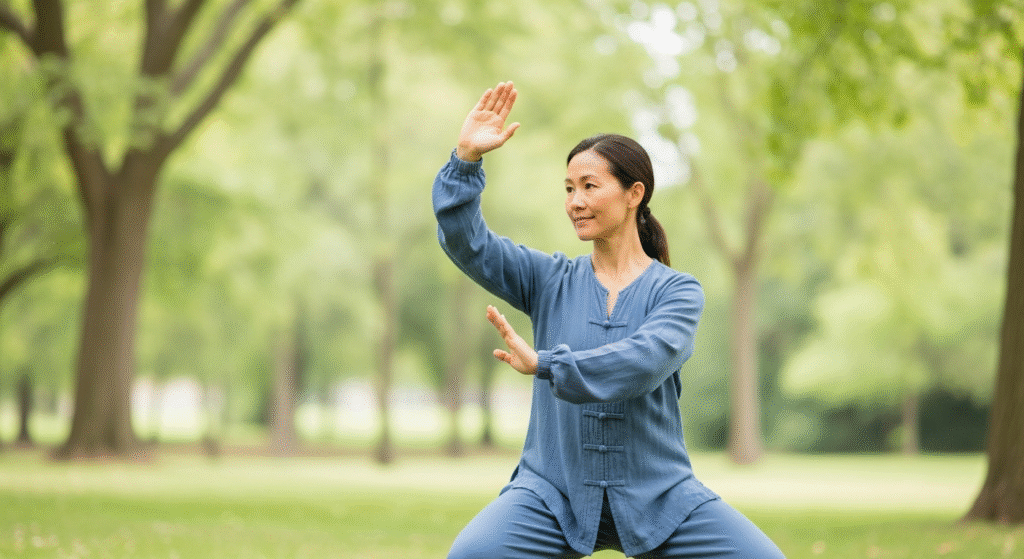
Wave Hands Like Clouds is similar to Cloud Hands but performed with a wider stance and more continuous motion. This variation provides an even greater balance challenge because you’re moving side to side while maintaining a lower center of gravity. The sustained semi-squatted position builds remarkable leg endurance and strength.
The continuous nature of this movement—there’s no pause or reset between repetitions—trains your balance systems to maintain stability through ongoing motion rather than static positions. This reflects real-world balance demands much more accurately. You rarely need to balance while standing perfectly still; you need to balance while moving, reaching, and transitioning between positions.
The flowing hand movements coordinate with your stepping pattern, creating a complex motor task that enhances brain function along with physical balance. Research shows that exercises requiring coordination between multiple body parts actually improve cognitive function and may help protect against age-related mental decline.
This movement also cultivates the meditative quality that makes Tai Chi so effective for stress reduction. The repetitive, flowing pattern quiets mental chatter and brings you into the present moment. As your mind calms, your body relaxes, and your movements become more fluid and graceful.
Complete Movement Guide
Start in a wide horse stance—feet about one and a half times shoulder-width apart, toes pointing forward, knees bent as if you’re sitting on a stool. Your weight should be evenly distributed between both legs. This wider stance provides more stability as you learn the movement.
Begin with your right hand at shoulder height in front of your chest, palm facing you. Your left hand rests near your left hip, palm down. Shift your weight completely onto your right leg.
As you shift your weight to your left leg, your hands begin their circular pattern. Your right hand sweeps down and across your body while your left hand rises. They pass each other at your centerline, then continue their arcs—right hand ending near your right hip, left hand ending at shoulder height in front of your chest.
Take a small step to the left with your left foot as you complete the weight transfer. Your right foot slides to meet it, maintaining the wide stance. Continue this pattern, moving steadily to the left for five to eight repetitions.
To reverse direction, complete one full hand circle without stepping, then begin stepping to the right. The hand pattern remains the same—the hand on the side you’re moving toward rises to shoulder height while the opposite hand descends.
Making It Your Own
Adjust your stance width based on your current strength and balance. If the wide stance feels too challenging initially, bring your feet slightly closer together. As you build strength over several weeks, gradually widen your stance to increase the difficulty.
If you feel unsteady, practice near a wall. You can even touch the wall lightly with your fingertips during the weight shifts until you develop more confidence. There’s no shame in using support—you’re building the foundation for independent balance.
Keep your head level throughout the movement. Many beginners bob up and down as they shift weight, which actually makes balance harder. Imagine balancing a book on your head—maintain that consistent height as you move side to side.
Track your progress by noting how many continuous repetitions you can complete without stopping or losing balance. When you first start, you might manage only three or four. Within a month of regular practice, you’ll likely complete 10 or more smooth, controlled repetitions. This measurable improvement provides motivation and confirms that your practice is working.
Building Your Tai Chi Practice for Lasting Results
You now have five proven movements that address every aspect of balance: lateral stability, forward and backward control, rotational strength, and fluid motion. These aren’t random exercises—they’re a complete system for rebuilding the confidence and capability that makes you feel secure in your body.
Start your practice with just two or three movements, performing each one five times. As the movements become familiar over the first week or two, add the remaining exercises and gradually increase repetitions. A complete 10-minute routine might look like this: Cloud Hands (8 repetitions each direction), Parting the Wild Horse’s Mane (5 repetitions each side), Single Whip (3 repetitions each side), Grasp the Bird’s Tail (3 complete sequences each side), and Wave Hands Like Clouds (8 repetitions each direction).
In two weeks of daily practice, you’ll notice that the movements feel more natural and your legs feel stronger. After one month, you’ll likely observe improved balance in everyday situations—greater confidence on stairs, steadier footing on uneven ground, easier transitions from sitting to standing. By three months, these improvements become significant and measurable. Many women report they no longer fear falling, they move with greater ease and grace, and they feel more capable and independent.
Consider joining a local Tai Chi class or finding online communities where you can share your progress and learn from others. While home practice is valuable, learning from an experienced instructor ensures you’re performing movements correctly and safely. Many community centers, senior centers, and fitness facilities offer Tai Chi classes specifically designed for women over 40.
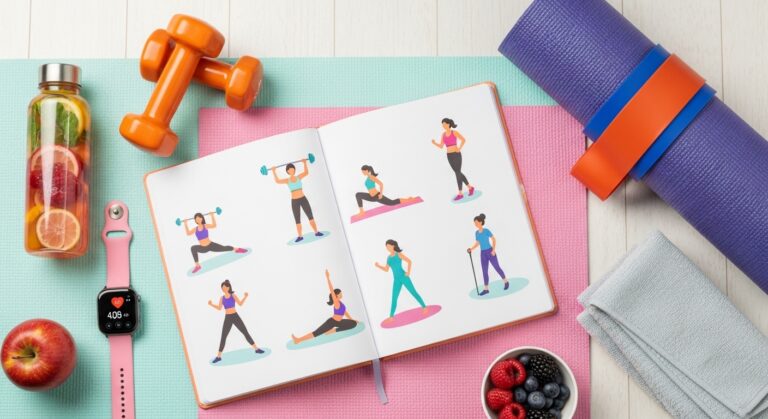
Keep a simple practice journal. Note which movements you practiced, how many repetitions you completed, and how you felt afterward. Track specific improvements: “Climbed stairs without holding railing today” or “Stood on one foot for 10 seconds.” These concrete markers of progress motivate you to maintain consistency.
Remember that consistency matters more than perfection. Five minutes of practice daily delivers better results than 30 minutes once a week. You’re building new neural pathways and strengthening muscles gradually over time. Some days your balance will feel better than others—this is completely normal. Keep practicing anyway.
You have the ability to improve your balance, strength, and well-being at any age. Your body is remarkably adaptable, capable of building new strength and coordination even after decades of inactivity. These five Tai Chi movements provide your foundation for a more confident, active life—one where you move freely, without fear or hesitation.
Start today. Choose one movement and practice it for just five minutes. That’s all it takes to begin your journey toward better balance, greater strength, and renewed confidence. You’re not just preventing falls—you’re investing in your independence, your health, and your quality of life for years to come.
Your future self will thank you for taking this step today.