Somatic Yoga Routine For Women Over 40

Your Body Is Speaking—Are You Listening?
After 40, something shifts. That yoga class that used to energize you now leaves you sore for days. Your shoulders carry tension you can’t shake. Your lower back protests movements that once felt effortless. You’re not broken—your body is just speaking a different language now.
Traditional yoga often misses this entirely. It demands flexibility you’ve lost, pushes intensity your nervous system can’t handle, and treats your 40-plus body like it should move the way it did at 25. It’s not just frustrating—it’s counterproductive.
Somatic yoga takes a radically different approach. Instead of forcing your body into poses, you’re retraining the conversation between your brain and muscles through slow, mindful movements that release decades of accumulated tension.
Research from the Journal of Bodywork and Movement Therapies shows that somatic exercises can reduce chronic pain by up to 30% in just eight weeks by addressing the root cause: your nervous system’s learned patterns of holding tension.
This isn’t about contorting into Instagram-worthy poses or sweating through another intense workout. It’s about 20 minutes of gentle movements that deliver powerful results: better sleep, reduced anxiety, less pain, and a body that finally feels like home again.
What makes this perfect for women over 40? It works *with* your hormonal changes, not against them. It addresses the chronic stress that elevates cortisol and disrupts sleep. And you can do it right now, in your living room, with zero equipment.
You don’t need expensive classes, fancy props, or years of yoga experience. You just need 20 minutes and a willingness to move slowly, breathe deeply, and actually listen to what your body is telling you.
What Is Somatic Yoga and Why It’s Perfect for Women Over 40

Understanding Somatic Movement
Somatic exercises focus on how movement feels from the inside, not how it looks from the outside. The term “somatic” comes from the Greek word “soma,” meaning the body as experienced from within. This is fundamentally different from traditional yoga, where achievement—touching your toes, holding a pose perfectly—often takes precedence over sensation.
Here’s what makes somatic yoga unique: you move at roughly 30-50% of your maximum range of motion, incredibly slowly, while maintaining complete awareness of every sensation. You’re not stretching muscles—you’re retraining the sensory-motor feedback loop in your brain that controls muscle tension.
The science behind this is called sensory motor amnesia (SMA), a concept developed by Thomas Hanna. After years of stress, injury, and repetitive movements, your brain literally forgets how to fully release certain muscles. They stay partially contracted even when you’re “relaxed.” Somatic movements wake up those neural pathways, teaching your brain to let go of chronic holding patterns.
Think of it this way: stretching tries to force a tight muscle to lengthen. Somatic movement reminds your brain that the muscle doesn’t need to be tight in the first place.
Why Your Body Needs This After 40
Perimenopause and menopause bring declining estrogen, which directly affects collagen production and joint flexibility. But here’s what most fitness advice misses: the bigger issue isn’t that your body is less flexible—it’s that decades of stress have programmed your muscles to stay contracted.
You’ve spent years hunched over computers, carrying kids on one hip, holding tension in your jaw during stressful meetings, and bracing your core during workouts. Your nervous system has learned these patterns so well that they’ve become automatic. Your shoulders creep toward your ears without you noticing. Your hip flexors stay tight even when you’re lying down.
Traditional high-intensity workouts often make this worse. When you’re already running on elevated cortisol from stress and hormonal changes, adding more intensity signals your body that you’re under threat. Your muscles tighten further. Your nervous system stays in fight-or-flight mode.
Somatic yoga does the opposite. It activates your parasympathetic nervous system—the “rest and digest” response. A study in the International Journal of Yoga Therapy found that slow, awareness-based movement reduced cortisol levels by 25% and improved sleep quality scores by 42% in women over 40.
The Mind-Body Benefits You’ll Experience
Physically, you’ll notice increased mobility without forcing flexibility. Your posture improves because you’re releasing the patterns that pull you out of alignment. Balance gets better because you’re reconnecting with your body’s natural movement intelligence. Many women report significant reduction in chronic neck, shoulder, and lower back pain within two to three weeks.
Mentally and emotionally, the benefits run deeper. Somatic movement is one of the most effective ways to process stored stress and trauma. Your body holds onto experiences—that argument from last week, the stress of juggling work and family, even old injuries create protective tension patterns. When you move slowly with awareness, you give your nervous system permission to release what it’s been holding.
Expect better sleep within the first week. Many women report feeling more grounded, less reactive to stress, and more connected to their bodies. One of my clients described it as “finally feeling like I’m living in my body instead of just operating it like a machine.”
The timeline for results is realistic: you’ll feel calmer after your first session, notice improved mobility within two weeks, and experience significant pain reduction within four to six weeks of consistent practice.
Preparing for Your Somatic Yoga Practice
What You Need (Spoiler: Not Much)
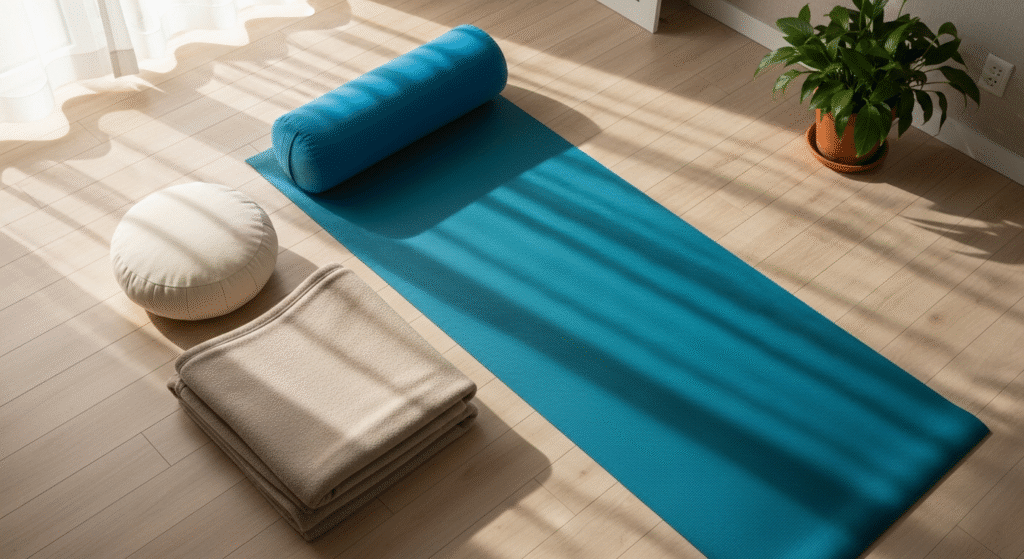
Comfortable clothing that doesn’t restrict your movement is essential—think soft leggings and a loose shirt, not compressive workout gear. You want to feel every sensation, and tight clothing can mask important feedback.
A yoga mat provides cushioning, but your bedroom carpet works perfectly fine. I’ve done this practice on hotel room floors, in my backyard on a towel, and on my living room rug. The surface matters less than your ability to lie down comfortably.
Optional support items: a pillow for under your head or knees, a blanket for warmth (your body temperature drops when you relax deeply), or a bolster if you have one. But honestly? I’ve guided hundreds of women through this routine with nothing but a mat.
No expensive equipment. No gym membership. No special props. This is intentionally accessible because the barrier to entry shouldn’t be what’s stopping you from feeling better in your body.
Creating Your Sacred Space
Find a quiet spot where you won’t be interrupted for 20 minutes. This might mean waking up before your family, practicing during lunch, or claiming space after everyone’s in bed. Put your phone on airplane mode—this isn’t Instagram content, it’s your healing time.
Lighting matters more than you’d think. Harsh overhead lights keep your nervous system alert. Dim lighting or natural light signals safety to your brain. I practice in my bedroom with just the early morning light, and it’s become a ritual my body recognizes.
Music is personal. Some women need silence to tune into subtle sensations. Others find that gentle instrumental music helps them stay present. There’s no right answer—experiment and trust what feels supportive.
The Somatic Mindset
Here’s the hardest part for most of us: you need to completely abandon “no pain, no gain” thinking. In somatic work, pain is a stop sign, not a badge of honor. You’re looking for sensation—gentle awareness of movement—not intensity.
Move at 50% of your capacity. If you can move your shoulder six inches, move it three. This feels absurdly small at first, especially if you’re used to pushing yourself. But this is precisely what allows your nervous system to feel safe enough to release chronic holding.
Focus on how movement feels, not how it looks. There are no mirrors in somatic practice. No one is watching. Your only job is to notice sensation without judgment.
There’s no wrong way to feel. If you feel emotional during hip openers, that’s normal—hips store stress and trauma. If you feel nothing during a movement, that’s also valuable information. Your body is giving you feedback. Just listen.
You have complete permission to modify or skip anything. If lying on your back bothers you, sit in a chair. If a movement doesn’t feel right, don’t do it. This is the opposite of fitness culture’s push-through mentality.
Your 20-Minute Somatic Yoga Routine
Movement 1: Somatic Breathing for Nervous System Reset (3 minutes)
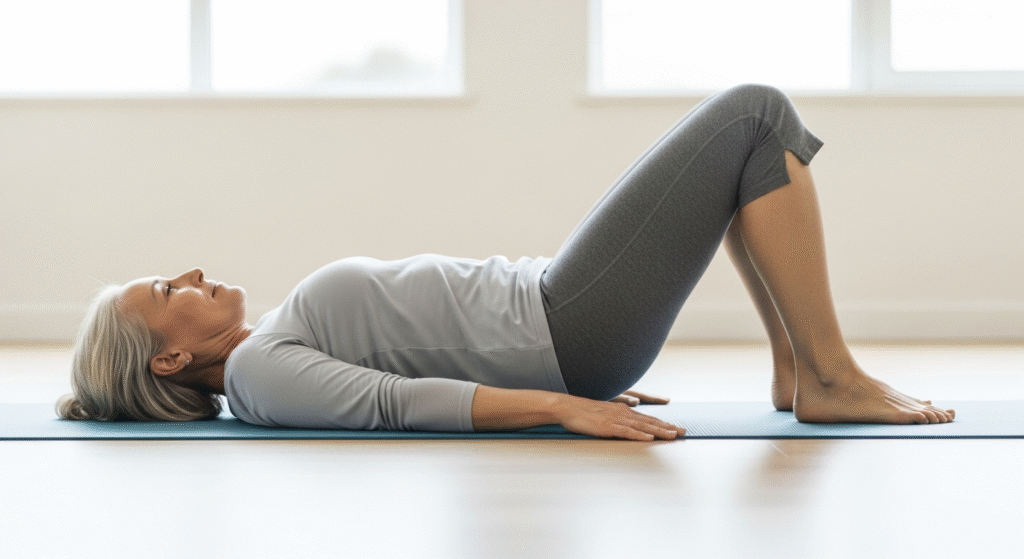
Starting position: Lie on your back with knees bent and feet flat on the floor, hip-width apart. Place one hand on your chest and one hand on your belly.
The movement: Inhale slowly through your nose for a count of four. Let your belly rise first, then your chest—like filling a glass from bottom to top. Exhale through your mouth for a count of six, feeling your belly fall first. The exhale is longer than the inhale intentionally—this activates your vagus nerve, which signals your parasympathetic nervous system.
Notice the weight of your body sinking into the floor with each exhale. You’re not trying to relax—you’re just observing what happens when you breathe this way.
What you’re targeting: This breathing pattern directly stimulates the vagus nerve, which runs from your brainstem to your abdomen and controls your relaxation response. Studies show that extended exhales reduce cortisol within minutes and shift your nervous system out of fight-or-flight mode.
Modification: If lying down causes back discomfort, sit in a chair with your feet flat on the floor and your spine supported.
Why it works: Before you can release physical tension, you need to signal your nervous system that it’s safe. This breathing pattern is that signal.
Movement 2: Pelvic Tilts for Lower Back Release (4 minutes)
Starting position: Stay on your back with knees bent and feet flat.
The movement: Inhale and gently arch your lower back, tilting your pelvis forward. This is a tiny movement—maybe your lower back lifts a quarter inch off the floor. Exhale and press your lower back into the floor, tilting your pelvis backward. Move as if you’re moving through honey—slow and smooth.
Repeat 10-15 times. The movement should feel almost invisible from the outside. You’re not doing a back exercise—you’re teaching your brain to release the chronic contraction in your lower back muscles.
What you’re targeting: Most lower back pain comes from muscles that your brain has forgotten how to fully release. Your hip flexors stay tight from sitting. Your lower back muscles compensate. This gentle rocking motion resets that pattern.
Key principle: This is called “pandiculation” in somatic education—you gently contract a muscle, then slowly release it while maintaining awareness. It’s how cats and dogs naturally release tension when they stretch.
Common mistake: Moving too quickly or making the movement too big. If you feel strain, you’re doing too much. Scale back to 30% of your range and slow down by half.
Movement 3: Shoulder Release Sequence (4 minutes)
Starting position: Still on your back, arms resting by your sides.
The movement: Lift your right shoulder toward your right ear as you inhale—just a few inches, creating gentle tension. Hold for two seconds, then slowly lower it as you exhale, letting it melt into the floor. Repeat five times, then switch to your left shoulder for five repetitions.
Next, lift both shoulders toward your ears, hold for three seconds while breathing normally, then release completely with a long exhale. Feel them drop like heavy weights. Repeat three times.
What you’re targeting: Your trapezius muscles hold chronic tension from stress, computer work, carrying bags, and the unconscious bracing we do when we’re anxious. This sequence uses the contract-release pattern to remind your brain that these muscles don’t need to stay elevated.
Visualization: Imagine warm ice cream melting off your shoulders, sliding down toward the floor.
Why this is powerful: We literally “carry stress on our shoulders.” This isn’t just a metaphor—your brain responds to emotional stress by contracting these muscles. When you consciously release them, you’re releasing both physical and emotional holding.
Movement 4: Somatic Hip Opener (4 minutes)
Starting position: On your back with knees bent and feet flat.
The movement: Let your right knee fall slowly to the right side—but only move it 30% of the way toward the floor. Pause here. Breathe. Notice any sensations without trying to change them. Slowly return your knee to center. Repeat five times on each side, moving like you’re underwater.
Then, let both knees fall gently to the right (windshield wiper style), pause for three breaths, return to center, and repeat to the left. Move slowly enough that you could stop at any point.
What you’re targeting: Hip tension is where many women store emotional stress and trauma. The psoas muscle, which connects your spine to your legs, is directly linked to your fight-or-flight response. When you’ve been in chronic stress, your psoas stays contracted.
Important note: Don’t be surprised if you feel emotional during hip work. You might suddenly feel like crying, or feel anger, or feel nothing at all. All of these responses are normal and healthy. Your body is processing stored experiences.
Modification: Place pillows under your knees for support if letting them fall feels vulnerable or uncomfortable.
Movement 5: Spinal Twist for Whole-Body Integration (3 minutes)
Starting position: On your back with arms extended out to your sides in a T-shape.
The movement: Draw your right knee to your chest, then slowly guide it across your body toward the left side. Don’t force it to the floor—let it rest wherever it naturally falls. Turn your head to the right (opposite direction from your knee). Stay here for five to eight slow breaths.
With each exhale, notice if your body wants to soften a little more. Don’t push—just observe. Slowly return to center and repeat on the other side.
What you’re targeting: Gentle spinal rotation releases tension through your entire torso, supports digestive function (twists massage your internal organs), and creates full-body integration after the more targeted movements.
Breathing tip: Your exhale is your permission slip to soften. Don’t force deeper into the twist—let your breath do the work.
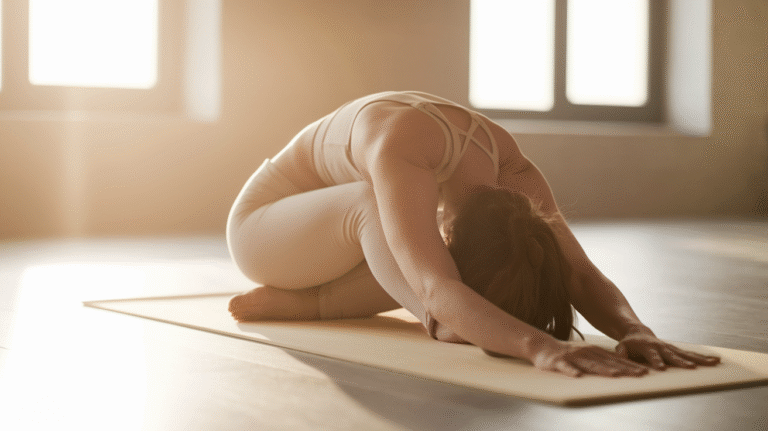
Movement 6: Child’s Pose Variation (2 minutes)
Starting position: Come to hands and knees.
The movement: Sit your hips back toward your heels, letting your arms extend forward or rest by your sides—whatever feels more nurturing. Rock gently side to side, just a few inches in each direction. Breathe into your back body, feeling your ribs expand against your thighs.
This is your complete rest pose. There’s nothing to achieve here. You’re simply being with your body.
What you’re targeting: Complete nervous system calming, back release, and grounding. This pose signals to your brain that the practice is complete and it’s safe to fully rest.
Modification: If your hips don’t reach your heels comfortably, place a pillow or folded blanket between them. If your forehead doesn’t reach the floor, rest it on stacked fists or a block.
Intention: This isn’t a stretch—it’s pure self-care. Let yourself be held by the earth.
Common Mistakes to Avoid (And How to Fix Them)

Rushing Through the Movements
The mistake: Treating this like a regular workout and moving at normal speed.
Why it matters: Somatic work requires slow movement to retrain your nervous system. When you move quickly, your brain doesn’t have time to register new information. You’re just reinforcing old patterns faster.
The fix: Set a timer for each movement. Move at literally half the speed you think you should. Count to four on every movement—if you’re lifting your shoulder, count “one-one-thousand, two-one-thousand…” as it rises.
Mantra: “Slower is more effective.” Say it out loud when you catch yourself speeding up.
Pushing for Flexibility
The mistake: Trying to stretch deeper, forcing your knee closer to the floor, or pushing into discomfort because you think more is better.
Why it matters: Forcing activates your stretch reflex—your