Somatic Yoga For Stress And Tension Relief
Your Body Keeps the Score—Here’s How to Release It
I’ll never forget the moment I realized my body was screaming at me. Sitting at my desk, shoulders hunched forward, jaw clenched tight enough to crack a walnut—and I had no idea until my physical therapist pointed out the knots in my neck felt like “steel cables.”
I was doing everything right: hitting the gym five days a week, eating clean, getting seven hours of sleep. Yet the tension remained, stubborn and relentless.
Here’s what nobody tells you about stress: your body doesn’t care how many burpees you can do. When you’re operating in constant fight-or-flight mode—juggling work deadlines, family responsibilities, financial pressure—your nervous system stores that stress in your muscles.
Your hips tighten. Your shoulders creep toward your ears. Your lower back aches for no apparent reason. You can stretch until you’re blue in the face, but forcing those muscles to release is like yelling at a frightened animal to calm down. It doesn’t work.
Somatic yoga offers a completely different approach, and the science backs it up. Research consistently shows that slow, mindful movement with internal awareness can reduce cortisol levels by up to 25% and significantly decrease symptoms of anxiety and chronic pain.
This isn’t about contorting yourself into impressive poses or sweating through an intense flow. It’s about teaching your nervous system that it’s finally safe to let go.
No gym membership required. No special equipment. Just you, your body, and 5-20 minutes of gentle, transformative movement that you can do in your living room, your bedroom, or even during your lunch break.
What Is Somatic Yoga? (And Why It’s Different From Regular Yoga)
The Science-Backed Approach to Releasing Stored Stress
The word “somatic” comes from the Greek word “soma,” meaning “the living body.” Somatic yoga focuses on internal physical perception and experience rather than achieving external shapes or forms.
While traditional yoga often emphasizes alignment, flexibility, and holding specific poses, somatic yoga asks a fundamentally different question: “What does this feel like inside my body?”
This distinction matters because of how your nervous system processes stress. When you experience chronic stress—whether from work pressure, relationship tension, or simply the relentless pace of modern life—your sympathetic nervous system (your fight-or-flight response) remains activated.
Your muscles contract and stay contracted, preparing for a threat that never fully arrives. Over time, this becomes your baseline. Your shoulders live at your ears. Your hip flexors shorten from hours of sitting. Your jaw clenches while you sleep.
Traditional stretching tries to force these muscles to lengthen, but here’s the problem: your nervous system perceives that force as another threat.
The muscle contracts harder to protect itself. This is called the stretch reflex, a protective mechanism hardwired into your biology. Somatic yoga works *with* your nervous system instead of against it.
Through slow, gentle movements performed with focused awareness, you signal to your brain that it’s safe to release the chronic contraction. You’re essentially reprogramming your nervous system’s stress response.
Why Your Body Holds Onto Tension (Even When You Try to Relax)
Your body doesn’t hold tension randomly. Specific areas accumulate stress based on how you move, work, and emotionally process your experiences.
The shoulders and neck carry the burden of “shouldering” responsibilities. The jaw tightens when you suppress what you want to say. The hips—often called the “emotional junk drawer”—store anxiety, fear, and unprocessed emotions. The lower back bears the weight of financial stress and feeling unsupported.
This isn’t New Age mysticism; it’s neurobiology. Your brain creates motor patterns—habitual ways of holding and moving your body—based on repeated experiences.
If you spend eight hours hunched over a laptop, your brain learns this position as “normal” and maintains it even when you stand up. This phenomenon, called sensory motor amnesia, explains why your body “forgets” how to fully relax certain muscle groups.
The proven benefits extend beyond just feeling less tense. Studies show that somatic practices can reduce cortisol levels, improve heart rate variability (a marker of nervous system health), decrease chronic pain intensity, and even improve immune function.
One study found that participants practicing somatic movement for just 20 minutes three times per week reported a 31% reduction in perceived stress levels after eight weeks.
Who Somatic Yoga Is Perfect For
If you’ve ever finished a workout feeling more wound up than when you started, somatic yoga is for you. If traditional yoga classes leave you frustrated because you can’t “turn off your brain,” this approach meets you where you are.
It’s ideal for busy professionals who carry their stress in their shoulders and neck, parents who have zero time for elaborate self-care routines, and beginners who find gym environments intimidating or overwhelming.
This practice shines for anyone dealing with anxiety, nervous system dysregulation, or that constant feeling of being “on edge.” You don’t need to be flexible.
You don’t need to understand anatomy. You just need to be willing to slow down and pay attention to what’s happening inside your body—which, ironically, is often harder than any advanced yoga pose.
The Powerful Benefits of Somatic Yoga for Stress Relief
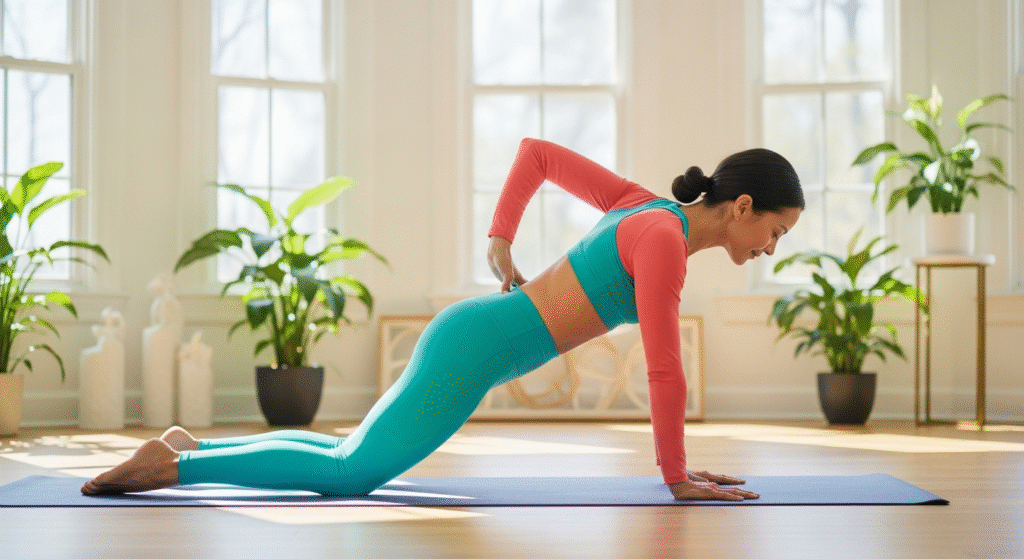
Immediate Physical Relief You Can Feel
The beauty of somatic yoga is that you feel results during your first session. Unlike traditional exercise programs that require weeks to show results, the gentle, mindful movements create immediate shifts in muscle tension and nervous system activation.
Within 5-10 minutes, you’ll notice your shoulders dropping away from your ears, your breath deepening naturally, and that tight sensation in your lower back beginning to soften.
This happens because you’re addressing the root cause—nervous system dysregulation—rather than just treating symptoms.
When you move slowly with focused internal awareness, you activate your parasympathetic nervous system (your rest-and-digest response).
Your heart rate slows. Your breathing deepens. Your muscles receive the signal that it’s safe to release their protective contraction.
The physical benefits compound quickly. Regular practice improves body awareness, which naturally corrects posture without forcing anything.
You’ll notice tension patterns earlier—before they become chronic pain. Flexibility increases as a byproduct of nervous system regulation, not through aggressive stretching.
Many practitioners report better sleep quality within the first week because they’re finally releasing the physical tension that keeps them wired at night.
Transform Your Mental and Emotional Well-Being
Here’s what surprised me most about somatic yoga: the emotional releases. During a gentle hip-opening sequence, I suddenly felt tears streaming down my face—not from pain, but from releasing something I didn’t even know I was holding. This isn’t uncommon. Research shows that emotions are stored in the body as physical tension, and when that tension releases, the emotions can surface too.
The mental health benefits are measurable and powerful. Lower cortisol levels mean reduced anxiety symptoms. The practice builds resilience to daily stressors by training your nervous system to return to baseline more quickly after stress triggers. Instead of staying activated for hours after a difficult meeting, you recover in minutes. You develop a healthier relationship with your body, learning to listen to its signals rather than override them or push through pain.
The calm you create during practice extends into your daily life. One study found that participants practicing somatic awareness techniques showed improved emotional regulation and decreased reactivity to stressors for up to 48 hours after a single 20-minute session.
Long-Term Results for Your Overall Health
The long-term benefits transform your overall approach to stress management and physical health. You strengthen the mind-body connection, developing an intuitive understanding of what your body needs on any given day. This prevents tension-related injuries and chronic pain by addressing patterns before they become problems.
Somatic yoga also supports your other fitness goals by improving recovery. When your nervous system can downregulate effectively, you sleep better, reduce inflammation, and rebuild muscle tissue more efficiently. I’ve seen my strength training improve significantly since incorporating somatic practices because my body actually recovers between sessions instead of staying chronically tense.
The sustainability factor matters. This isn’t a practice you’ll abandon after a few weeks because it requires no equipment, no gym membership, and minimal time investment. You can practice anywhere—your bedroom, office, hotel room while traveling. Five minutes is enough to make a difference, though longer sessions deepen the benefits.
9 Essential Somatic Yoga Movements to Release Tension Today
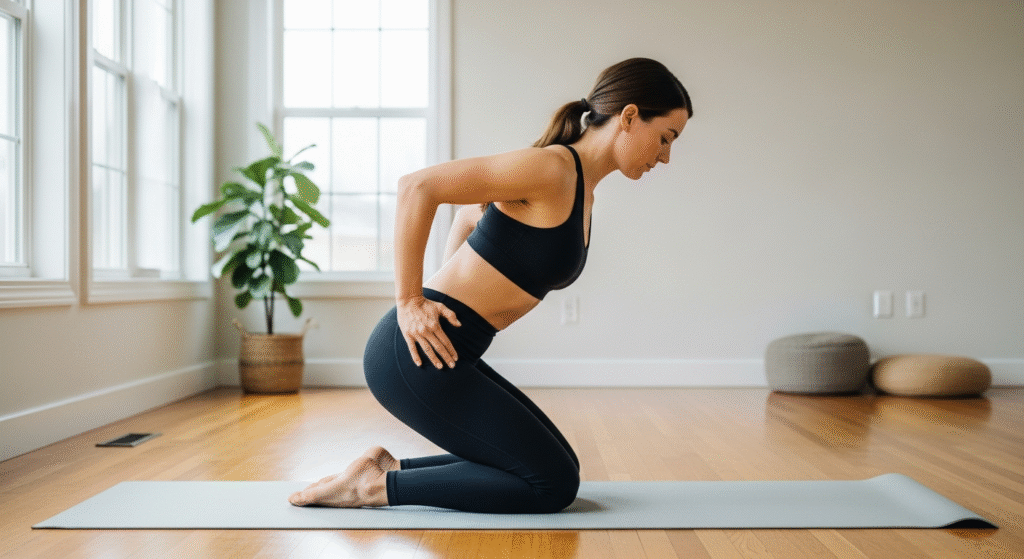
Gentle Spinal Waves (For Lower Back Tension and Stress)
Start on hands and knees with your wrists under shoulders and knees under hips. Instead of thinking “cat-cow pose,” focus entirely on internal sensation. Slowly arch your back, but only as far as feels pleasurable—this might be barely noticeable movement. Pause. Notice what you feel. Then slowly round your spine, again moving only as far as feels good.
The key difference: move at half the speed you think you should. Take 4-5 seconds for each direction. Breathe naturally—don’t force deep breaths. Your only job is to notice sensations: where do you feel movement? Where does it feel stuck? Can you soften into the stuck places?
Practice for 2-3 minutes. You should feel a gentle warmth spreading through your lower back and a sense of your spine “waking up.” Common mistake: rushing the movement or trying to maximize the stretch. This defeats the purpose. Slower is better.
Shoulder Rolls and Somatic Arm Circles (For Desk Job Tension)
Sit comfortably or stand. Slowly lift your shoulders toward your ears, but only halfway—maybe 50% of your maximum range. Pause and notice: where exactly do you feel this? Now slowly roll them back and down, taking 6-8 seconds for the complete circle. This glacial pace allows you to identify exactly where you’re holding tension.
After 3-4 slow circles backward, reverse direction. Notice if one direction feels different. For arm circles, extend your arms to the sides and make tiny circles—6 inches in diameter—moving so slowly it almost feels silly. Gradually increase the circle size only if it continues feeling good.
This is perfect for 2-minute work breaks. You should feel increased circulation in your shoulders and upper back. The difference between mechanical movement and somatic awareness is your attention: you’re not just moving, you’re exploring sensation.
Hip Circles and Pelvic Tilts (For Emotional Release and Lower Body Tension)
Stand with feet hip-width apart, knees slightly bent. Place your hands on your hips and begin making slow circles with your pelvis, as if stirring a large pot. Move so slowly that you can notice every part of the circle: front, side, back, other side. Where does it feel smooth? Where does it catch or feel restricted?
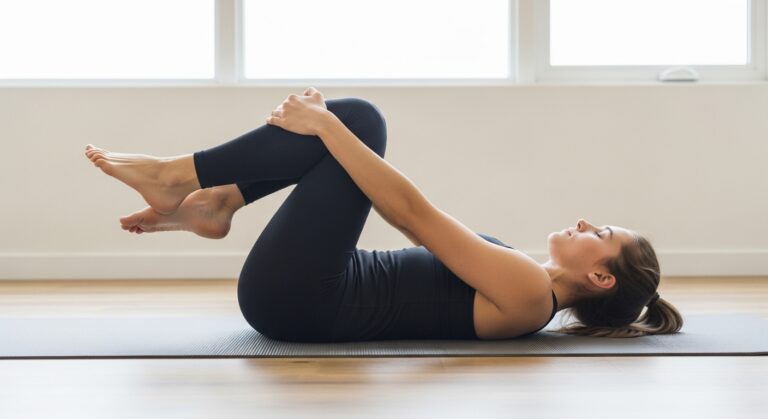
After 8-10 circles in one direction, pause completely. Notice any sensations, tingling, or warmth. Then circle the opposite direction. For floor variation, lie on your back with knees bent, feet flat. Slowly tilt your pelvis to press your lower back into the floor, then tilt to arch slightly away. Move between these positions like a gentle wave.
Your hips hold emotional stress because of the concentration of fascia and the psoas muscle’s connection to your nervous system’s threat response. You might feel unexpected emotions arise—that’s normal and healthy. Signs of release include spontaneous deep breaths, yawning, or a sense of softening through your hips and lower abdomen. Practice for 3-5 minutes.
Jaw Release and Neck Somatic Movements (For Anxiety and TMJ Relief)
Place your fingertips gently on your jaw joints (just in front of your ears). Open your mouth slowly—only halfway—and notice if one side moves differently than the other. Close slowly. Repeat 5-6 times with complete attention to sensation. Then make small circles with your jaw, as if chewing in slow motion.
For neck release, sit comfortably and slowly turn your head to look over your right shoulder—but only turn 30-40% of your full range. The goal isn’t maximum stretch. Pause. Notice what you feel. Return to center slowly. Repeat left. Then slowly tilt your head toward your right shoulder, again using only partial range. Pause. Return. Repeat left.
The connection between jaw tension and stress response is profound—your jaw clenches as part of the fight-or-flight response. You can practice this discreetly at your desk or even in bed before sleep. Pair each movement with a slow exhale. You should feel a sense of softening in your jaw and neck, possibly accompanied by yawning (a sign your nervous system is downregulating). Practice 2-3 minutes.
Somatic Child’s Pose (For Full-Body Nervous System Reset)
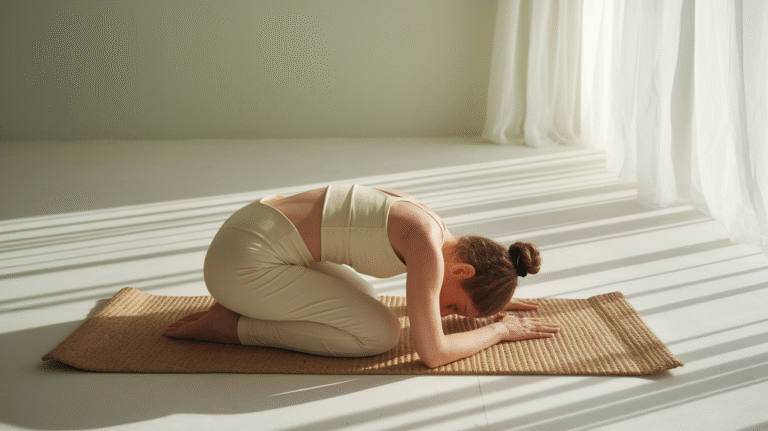
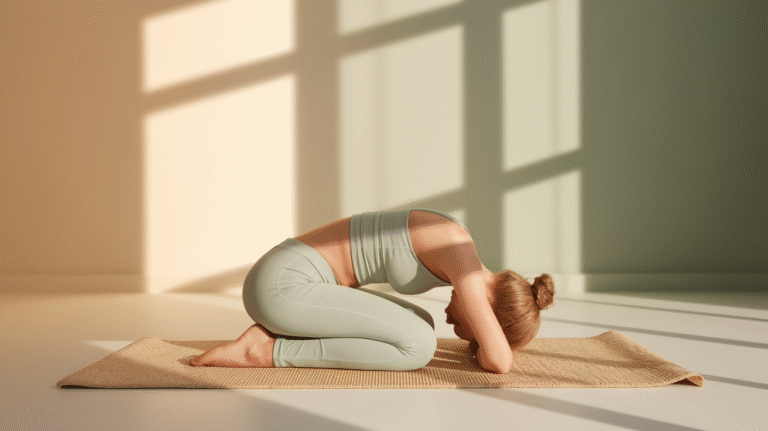
Kneel and sit back on your heels, then slowly walk your hands forward, lowering your chest toward the floor. Unlike traditional child’s pose, don’t worry about the “correct” position. Instead, adjust until you find a position that feels genuinely restful—this might mean knees wide, narrow, or somewhere in between. Place a pillow under your chest or forehead if needed.
Once settled, shift your attention entirely to internal sensation. Notice your breath moving through your body. Feel your belly expanding against your thighs. Notice any areas of contact with the floor. Stay for 3-5 minutes, making micro-adjustments whenever something stops feeling good.
What to notice as tension releases: your breath will naturally deepen and slow, you might feel warmth spreading through your back, and you may experience spontaneous muscle releases (small twitches or shifts). This position signals safety to your nervous system more effectively than almost any other. For maximum stress relief, practice this before bed.
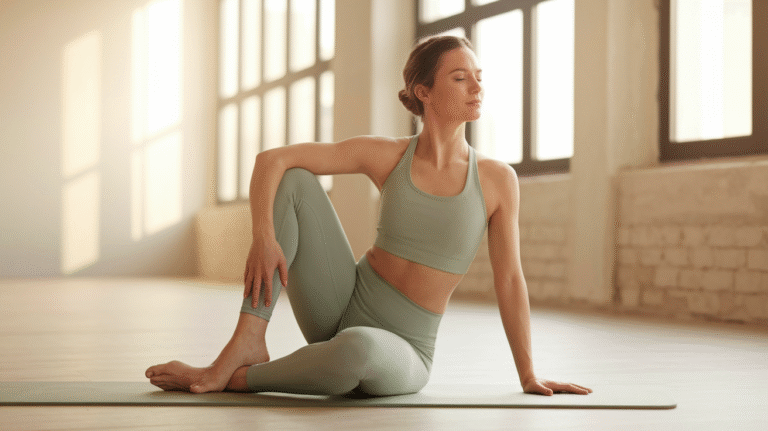
Gentle Somatic Twists (For Digestive Stress and Spine Mobility)
Lie on your back with knees bent, feet flat on the floor. Extend your arms out to the sides. Slowly let both knees fall to the right—only halfway down, not forcing them to the floor. Pause for 3-5 breaths, noticing sensations in your spine, hips, and belly. Slowly return to center. Pause. Then repeat to the left.
The connection between gut health and stress is well-established—your gut contains more neurotransmitters than your brain. Gentle twists massage your digestive organs while releasing tension in your spine. Move slowly enough that you could stop at any point. Breathe naturally into your belly.
For seated variation, sit cross-legged or in a chair. Place your right hand on your left knee and slowly turn to look over your left shoulder. Use only 40-50% of your range. Stay for 5-8 breaths, noticing if you can soften into the twist rather than forcing it. When to practice: morning for digestive support, evening for spine mobility. Practice 3-4 minutes total.
Legs Up the Wall with Somatic Awareness (For Anxiety and Fatigue)
Sit sideways next to a wall, then swing your legs up as you lie back. Scoot your hips as close to the wall as comfortable—this might be 6-12 inches away, not pressed against it. Let your arms rest at your sides or on your belly.
The somatic element: instead of just holding the position, scan through your body. Notice your legs. Feel the blood draining from your feet. Notice your lower back. Can you soften it into the floor? Notice your shoulders, jaw, eyes. Every 30-60 seconds, bring your attention to a different body part and consciously release any holding.
This restorative pose is powerful for stress relief because it reverses blood flow, activates your parasympathetic nervous system, and creates a gentle inversion. Best practiced in the evening or after work. Hold for 5-10 minutes. You should feel a sense of heaviness in your legs and overall calm. Modification: if your hamstrings are tight, move further from the wall or place a folded blanket under your hips.
Somatic Body Scan in Savasana (For Complete Nervous System Regulation)
Lie flat on your back with legs extended, arms at your sides, palms facing up. Close your eyes. Starting with your feet, bring your full attention to sensations: temperature, tingling, pressure against the floor, or even absence of sensation. Spend 20-30 seconds with your feet.
Move your awareness to your calves, then knees, thighs, hips—slowly traveling up your body. When you notice tension, don’t try to fix it. Just notice it with curiosity. Often, awareness alone triggers release. The difference between forcing relaxation and allowing release is subtle but crucial: you’re not making anything