8 Somatic workouts for difficult emotions
You know that feeling when stress sits like a rock in your chest, anxiety tightens your shoulders, or anger burns in your gut? I’ll never forget the first time a therapist asked me where I felt my anxiety.
I thought it was a trick question—anxiety was in my *head*, obviously. But when I actually paid attention, I realized my jaw was clenched so tight it ached, my shoulders were practically touching my ears, and my stomach felt like it was tied in knots. My body had been screaming at me for months, and I’d been completely ignoring it.
Here’s what most fitness advice gets wrong: you can’t always think, talk, or cardio-blast your way out of difficult emotions. Sometimes your body needs to move through them—literally.
That’s where somatic workouts come in, and no, you don’t need a gym membership, fancy equipment, or even workout clothes. These aren’t the kind of exercises that leave you drenched in sweat.
They’re gentle, intentional movements designed to help you reconnect with your body and release the emotional tension that traditional workouts completely miss.
If you’ve ever felt like your body is holding onto stress despite your best efforts to “just relax,” if you’re tired of feeling disconnected from yourself, or if you’re intimidated by high-intensity fitness culture, this approach might be exactly what you need.
By the end of this guide, you’ll have a complete toolkit of powerful somatic exercises you can use whenever difficult emotions threaten to derail your day—whether you have two minutes or twenty. No previous experience required. Just you, your body, and a willingness to listen.
What Are Somatic Workouts? (Understanding the Mind-Body Connection)

The Science Behind Somatic Movement
The word “somatic” comes from the Greek “soma,” meaning body. Somatic exercises are all about internal awareness—tuning into physical sensations, noticing where you’re holding tension, and using gentle movement to release it.
This isn’t woo-woo pseudoscience. Research consistently shows that emotions don’t just live in your brain—they manifest physically throughout your body. Anxiety creates chest tightness and shallow breathing. Anger causes jaw clenching and fist tension.
Sadness shows up as heaviness in your chest and slumped posture. Fear literally freezes your muscles and stops your breath.
Here’s the fascinating part: your nervous system doesn’t distinguish well between physical tension and emotional danger. When your shoulders are chronically tight, your brain interprets it as a signal that something’s wrong, triggering more stress hormones and creating more tension.
It’s a feedback loop that talk therapy alone often can’t break. Somatic movement interrupts this cycle by directly addressing the physical manifestation of emotional stress, helping to regulate your nervous system and reduce cortisol levels.
According to trauma research, including the groundbreaking work in “The Body Keeps the Score,” past experiences and chronic stress physically embed themselves in our tissues.
Your hips might store trauma from years ago. Your stomach might hold anxiety from this morning’s meeting. Traditional intense workouts can sometimes override these sensations temporarily, but they don’t release them.
Somatic Workouts vs. Traditional Exercise
Traditional fitness focuses on external goals: lose 10 pounds, build muscle, burn 500 calories, hit a new PR. You’re working *against* your body, pushing it harder, going faster, lifting heavier.
There’s absolutely a place for that—I still love a good strength training session—but it’s fundamentally different from somatic work.
Somatic exercises focus on internal awareness and emotional release. There are no reps and sets. No “good” or “bad” performance.
The power comes from slow, intentional movement combined with conscious attention to sensation. You’re working *with* your body, listening to what it needs, allowing tension to release naturally rather than forcing it.
The beautiful thing? These approaches complement each other perfectly. Somatic work can dramatically improve your mind-muscle connection for strength training, enhance recovery, and help you actually enjoy movement instead of treating it like punishment.
On days when high-intensity exercise feels overwhelming, somatic movement gives your nervous system the workout it actually needs.
Who Benefits Most from Somatic Workouts?
If you’re dealing with chronic stress or anxiety, somatic exercises can provide relief within minutes. People with past trauma or PTSD often find these movements helpful (though always work with a trauma-informed professional for serious issues).
If you feel disconnected from your body—like you’re just a head floating through life—this practice builds that crucial mind-body connection back.
Busy professionals who need quick, effective stress relief without changing clothes or breaking a sweat? Perfect. People intimidated by traditional gym environments?
You can do this in your bedroom, at your desk, or in your parked car. And if you’ve been exercising regularly but your body still feels “stuck” or you’re holding tension despite stretching, somatic work addresses what traditional fitness misses entirely.
How Difficult Emotions Get Trapped in Your Body

The Body Keeps the Score: Where Emotions Hide
Your body is remarkably honest about what you’re feeling, even when your mind tries to ignore it. Anxiety typically shows up as chest tightness, shallow breathing that never quite satisfies, shoulder tension that creeps up throughout the day, and stomach knots or digestive issues.
Anger manifests as jaw clenching (especially at night), fist tension, heat rising in your body, and a general feeling of being wound too tight.
Sadness creates heaviness in your chest, slumped posture that takes effort to correct, and deep fatigue that sleep doesn’t fix.
Fear causes muscles to literally freeze, held breath you don’t realize you’re holding, and digestive problems your doctor can’t explain.
I spent years with chronic neck pain before I realized it wasn’t a physical injury—it was how my body expressed the stress I wouldn’t acknowledge.
Here’s what makes this tricky: these physical sensations then feed back to your brain as evidence that something’s wrong, creating more emotional distress.
Your brain interprets physical tension as emotional danger, which triggers more stress hormones, which creates more physical tension. It’s a self-perpetuating cycle that “just thinking positive” can’t break.
The Stress-Tension Cycle
When you experience stress, your sympathetic nervous system activates the fight-or-flight response. Cortisol floods your system. Your muscles tense up, preparing for action. That’s perfect if you need to run from danger. But when the “danger” is a difficult conversation, a work deadline, or financial worry, your body stays in that activated state with nowhere for the tension to go.
Chronic stress creates chronic muscle tension. Your shoulders stay elevated. Your jaw stays clenched. Your breath stays shallow. Over time, this affects sleep quality, digestion, immune function, and overall health. Research shows that stored physical tension correlates with increased inflammation, cardiovascular issues, and mood disorders.
Why doesn’t “just relax” work? Because you can’t think your way out of a physiological state. Your body needs to complete the stress cycle through movement and release. Animals instinctively shake after stressful events—watch a dog after a vet visit. Humans have largely lost this natural response, so tension accumulates over days, weeks, years.
Signs You’re Holding Emotional Tension
You might have persistent pain that doctors can’t fully explain—nothing’s structurally wrong, but your back, neck, or shoulders constantly hurt.
You feel “wired but tired”—exhausted but unable to truly relax or sleep well. Taking a full, deep breath feels difficult or uncomfortable.
Stretching provides temporary relief, but the tightness always returns. You feel emotionally numb, disconnected from yourself, or like you’re just going through the motions. Physical exhaustion doesn’t match your actual activity level.
If any of these sound familiar, your body is likely storing emotional tension that needs release, not just rest.
The Proven Benefits of Somatic Workouts for Emotional Health

Immediate Benefits You’ll Notice
The first time I did a proper somatic breathing session, I was shocked by how quickly my heart rate dropped. Within three to five minutes of diaphragmatic breathing, anxiety that had been building all morning started to dissolve.
That’s not placebo—it’s your parasympathetic nervous system (the “rest and digest” system) activating and overriding the stress response.
You’ll notice reduced anxiety almost immediately when you practice these movements with intention. Your heart rate slows. Your breathing deepens and becomes easier. Physical tension releases, especially in common holding areas like the neck, shoulders, and hips.
Many people report improved mood and mental clarity—like a fog lifting. You’ll feel more present in your body rather than disconnected from it.
And there’s often a sensation of feeling “lighter,” both emotionally and physically, as if you’ve set down a weight you didn’t realize you were carrying.
Long-Term Transformation
Practice somatic exercises consistently for a few weeks, and the benefits compound. Your nervous system becomes better regulated—you’ll return to baseline faster after stress, and stressful situations won’t trigger as intense a physical response. This builds genuine emotional resilience over time, not just distraction from difficult feelings.
Sleep quality typically improves because you’re releasing tension before bed rather than carrying it into sleep. Chronic pain often decreases as you address the emotional component of physical holding patterns.
You’ll develop greater mindfulness in daily life, noticing tension as it arises rather than after it’s been there for hours. For trauma survivors working with professionals, somatic practices provide crucial support for the healing process.
Research from the American Congress of Rehabilitation Medicine shows that somatic approaches to trauma recovery—starting with body awareness rather than talking about emotions—can be more effective for some people than traditional top-down therapy alone.
The Bonus Physical Benefits
While emotional release is the primary goal, somatic work delivers real physical benefits too. You’ll gain increased flexibility and range of motion as chronic holding patterns are released.
Posture and body alignment improve naturally when you’re not fighting constant tension. Inflammation decreases as stress hormones regulate. Recovery from traditional workouts improves because your nervous system isn’t stuck in overdrive.
Your mind-muscle connection for strength training gets dramatically better—you’ll actually feel muscles working rather than just going through the motions.
And you’ll experience gentle toning and body awareness without the intensity that sometimes feels overwhelming. It’s not about burning calories or building visible muscle, but you’ll likely feel stronger and more capable in your body.
8 Powerful Somatic Exercises for Emotional Release
1. Diaphragmatic Breathing for Anxiety
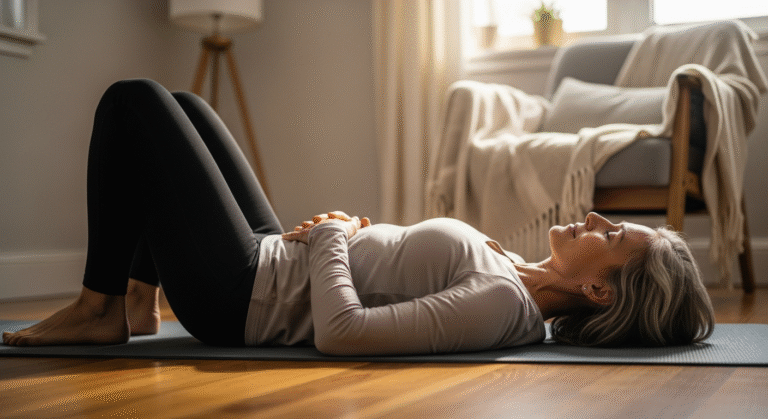
Place one hand on your chest and one on your belly. Breathe in slowly through your nose for a count of four, feeling your belly expand (your chest should barely move).
Hold for a count of four. Exhale slowly through your mouth for a count of six to eight, feeling your belly fall. The extended exhale is key—it signals safety to your nervous system and activates the parasympathetic response that counteracts anxiety.
Use this before stressful meetings, during panic or overwhelm, or at bedtime when your mind won’t stop racing. You might feel warmth spreading through your body, tingling in your hands or feet, or even emotional release (tears are normal and healthy). Three to five minutes is usually enough to notice a significant shift in your nervous system state.
2. Body Scan for Emotional Awareness
Lie down or sit comfortably. Starting with your toes, slowly bring attention to each body part, moving upward. Don’t try to change anything—just notice.
Label sensations without judgment: tight, warm, buzzy, numb, heavy, light, tingly, painful. Where do you feel tension? Where do you feel nothing at all? Numbness often indicates areas where you’ve disconnected from sensation.
Allow sensations to shift naturally as you observe them. Sometimes simply noticing tension allows it to release. This practice is incredibly effective for identifying where emotions physically live in your body—information you can use throughout your day.
Five to ten minutes provides a complete scan, but even two minutes focusing on common holding areas (jaw, shoulders, hips, stomach) helps.
3. Gentle Shaking to Release Stored Stress
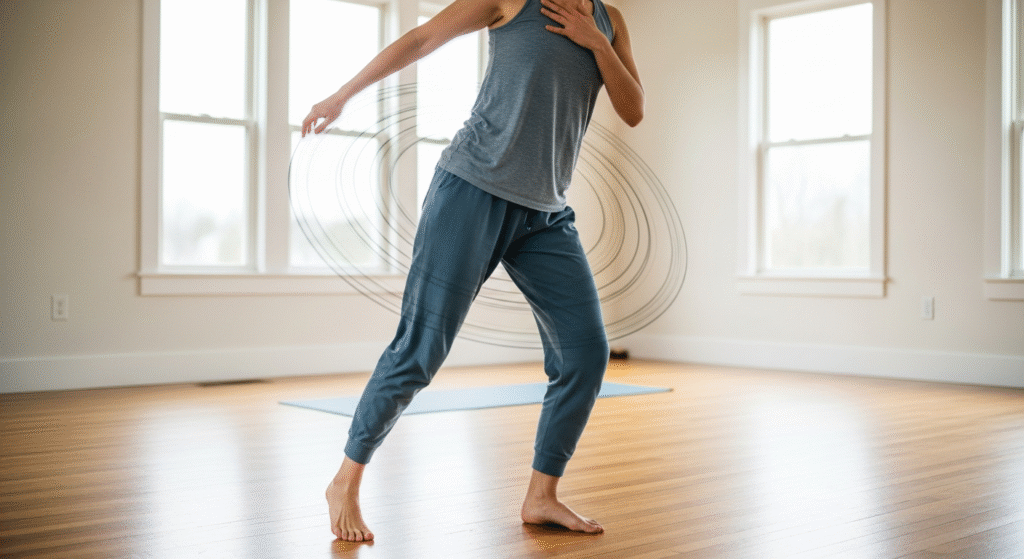
Stand with your knees slightly bent and soft. Start shaking out your hands, then your arms. Let the movement spread to your shoulders, torso, hips, and legs. This isn’t vigorous exercise—it’s gentle, allowing your body to move naturally. Animals instinctively shake after stressful events to discharge adrenaline and cortisol. Humans can do this too, but we’ve been socialized to stay still and “composed.”
This is perfect immediately after difficult conversations, stressful events, or anytime you feel wired and activated. Two to three minutes of gentle shaking can discharge significant nervous system activation. You might feel silly at first—that’s normal. Keep going.
4. Hip Circles for Emotional Holding
Stand with feet hip-width apart, hands on hips. Make slow, conscious circles with your hips in one direction, then reverse. The hips are one of the primary places we store trauma and difficult emotions—there’s a reason “hip openers” in yoga often trigger emotional release.
Move slowly enough to notice tightness, resistance, or any emotional responses that arise. Breathe deeply into any discomfort rather than pushing through it. This builds connection to your body’s center and can release tension you’ve been holding for years. Three to five minutes, moving mindfully rather than mechanically.
5. Shoulder Rolls for Tension Release
Perform slow, exaggerated shoulder movements: forward, up, back, and down. Move with full awareness of each position. Notice where you hold stress—most people carry enormous tension in their shoulders without realizing it until they actually pay attention.
Combine shoulder rolls with deep breathing: inhale as shoulders rise, exhale as they release down. This is ideal for desk workers and anyone who holds stress in their upper body (which is most of us). Two to three minutes several times throughout the day prevents tension from accumulating.
6. Grounding Exercise for Overwhelm
Stand or sit with both feet flat on the floor. Really feel your feet making contact with the ground. Press down gently and notice the support pushing back. Imagine roots growing from your feet deep into the earth, anchoring you. This brings you back to the present moment when anxiety pulls you into future worries or past regrets.
This is incredibly effective for anxiety, dissociation, or panic—and it takes only one to two minutes, making it perfect for busy days. You can do this anywhere: in a bathroom stall before a presentation, at your desk, waiting in line. No one will even know.
7. Gentle Twist for Digestive and Emotional Release
Sit or stand with a tall spine. Place your right hand on your left knee (if seated) or reach across your body. Slowly rotate your spine to the left, moving with your breath. Never force—this is about gentle, conscious movement. Hold for several breaths, then switch sides.
Your gut holds emotional tension—”gut feelings” aren’t just metaphorical. The enteric nervous system in your digestive tract directly communicates with your brain. Gentle twists support both physical and emotional digestion. Three to four minutes total, moving slowly and breathing deeply.
8. Butterfly Hug for Self-Soothing
Cross your arms over your chest with hands resting on opposite shoulders. Gently tap your shoulders in an alternating pattern: right, left, right, left. This bilateral stimulation is used in trauma therapy (similar to EMDR) and calms the nervous system while providing physical comfort.
This is perfect for moments of high emotion, distress, or when you need self-soothing. Two to five minutes can significantly reduce emotional intensity. It’s also something you can do discreetly in many situations.
Creating Your Personalized Somatic Workout Routine
For Busy Professionals (10-Minute Morning Reset)
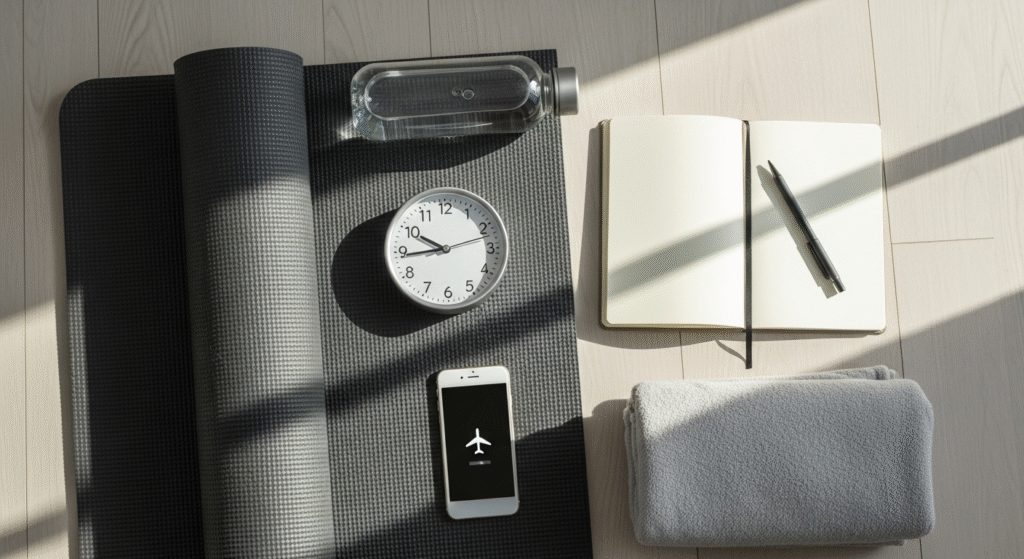
Start your day with this sequence before checking your phone or email—it sets the tone for how your nervous system will respond to stress all day.
2 minutes: Diaphragmatic breathing while still in bed 3 minutes: Body scan, noticing where you’re holding tension 2 minutes: Shoulder rolls and gentle neck releases 2 minutes: Grounding exercise standing by your bed 1 minute: Set an intention for how you want to feel today
This simple routine takes less time than scrolling social media and provides dramatically better results for your nervous system regulation.
For Stress and Anxiety Relief (15-Minute Midday Break)
When stress is building and you need to reset without leaving the office:
3 minutes: Gentle shaking (close your office door or find a private