Quick Resistance Band Glutes Workout For Women 35+
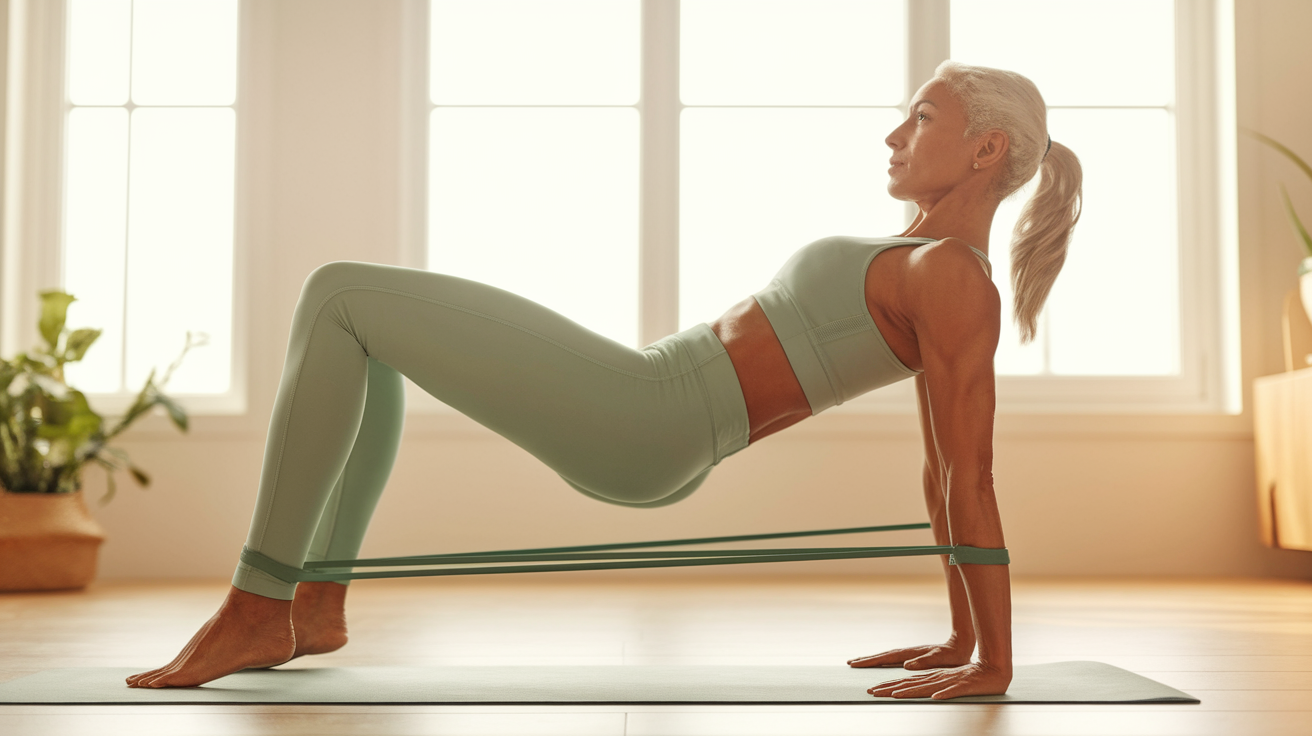
Let’s talk about something nobody warned you about turning 35: your body starts playing by different rules.
You might have noticed your favorite jeans fitting differently, or feeling winded climbing stairs that never bothered you before. Maybe you’ve realized that the workout routine that kept you toned in your twenties just isn’t delivering the same results anymore.
You’re not imagining it—after 35, women lose approximately 3-5% of muscle mass per decade, and your metabolism can drop by up to 2% each year.
Here’s the good news: you can fight back, and you don’t need a gym membership or hours of free time to do it.
This proven resistance band workout targets your glutes—the powerhouse muscles that support everything from your posture to your metabolism.
In just 20 minutes, three to four times per week, you’ll build functional strength that transforms how you move through your day. No intimidating gym equipment, no complicated routines, and absolutely no BS.
This workout delivers real benefits you’ll notice within weeks: stronger glutes mean better posture that eliminates that nagging lower back pain, improved bone density that protects you long-term, a metabolism boost that helps your body work for you instead of against you, and yes—a more sculpted, toned appearance that makes you feel confident in your own skin.
Your strongest body isn’t behind you. It’s waiting for you to build it, starting right now.
Why Resistance Bands Are Perfect for Building Stronger Glutes After 35
Understanding Your Body After 35
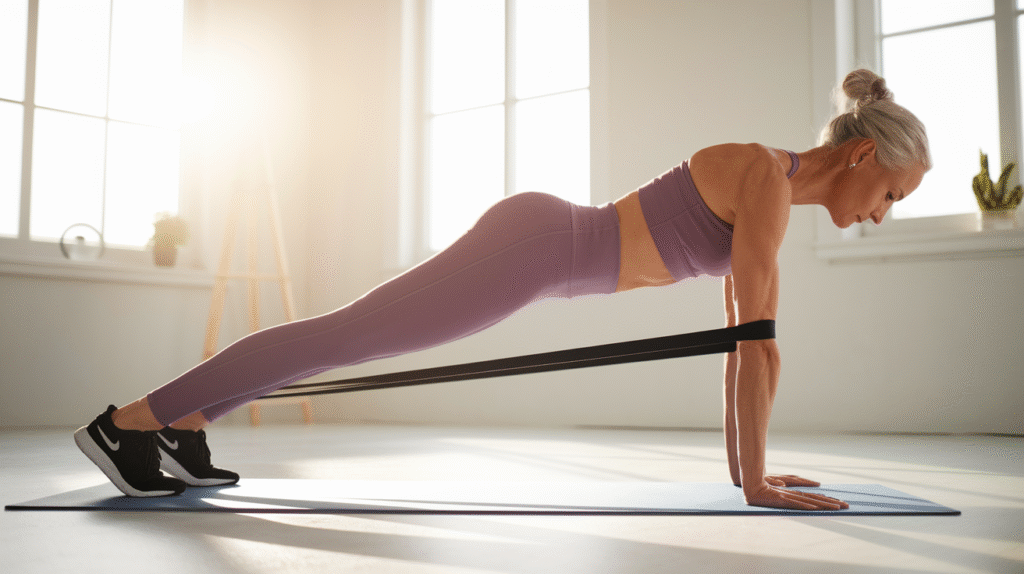
Your body after 35 operates differently than it did in your twenties, and pretending otherwise sets you up for frustration. Declining estrogen levels directly impact muscle mass and bone density—this is biological fact, not personal failure.
Your body becomes less efficient at building and maintaining muscle, which means that couch-to-marathon approach you might have used before? It doesn’t work the same way anymore.
But here’s what resistance training does: it sends powerful signals to your body that you need that muscle. When you consistently challenge your glutes with resistance, you’re telling your body to preserve and build that tissue, even when hormones are working against you.
Your glutes aren’t just about aesthetics. These muscles stabilize your pelvis, support your lower back, and power every movement from standing up from a chair to climbing stairs. Weak glutes contribute to knee pain, hip problems, and that chronic lower back ache that’s become your unwelcome companion. Strengthening them improves your quality of life in ways you’ll notice immediately.
Traditional gym workouts often feel prohibitive now—between work, family obligations, and the mental load of managing a household, who has 90 minutes to spend commuting to a gym and navigating intimidating equipment? The resistance band approach eliminates these barriers.
The Science-Backed Benefits of Resistance Band Training
Resistance bands create constant tension throughout the entire range of motion, which means your muscles work harder than they would with many traditional exercises.
When you perform a squat with a band around your thighs, your glutes fight to keep your knees aligned from start to finish—that continuous engagement builds strength more effectively than exercises where tension drops at certain points.
This matters especially after 35 because you’re working with less recovery capacity. You need efficient workouts that deliver maximum results without requiring maximum time or creating excessive joint stress.
Unlike heavy barbells or machines, resistance bands provide joint-friendly resistance that protects your knees, hips, and lower back.
The elastic resistance accommodates your natural movement patterns rather than forcing you into rigid positions that might aggravate existing issues. This approach builds strength you can sustain for decades, not just months.
The practical benefits seal the deal: resistance bands cost $10-30, fit in a drawer, and travel anywhere. You can do this workout in your living room before work, during your lunch break in your bedroom, or while watching your kids at the park.
What Makes This Workout Different
Most glute workouts online were designed for 25-year-old fitness influencers with six hours of daily gym time. This workout was created specifically for women managing real lives—careers, families, responsibilities, and bodies that need smarter training, not just harder training.
This routine targets all three glute muscles: the gluteus maximus (the largest muscle that gives shape), the gluteus medius (the side glute that stabilizes your hips), and the gluteus minimus (the deepest muscle that supports hip function). Balanced development prevents injury and creates functional strength you’ll use every single day.
You’ll notice results beyond the mirror. Carrying groceries becomes easier. Your posture improves without conscious effort.
That lower back pain that flares up after sitting at your desk? It diminishes. These functional improvements appear before visible changes, and they’re just as valuable.
Getting Started: What You Need and How to Prepare
Choosing the Right Resistance Band
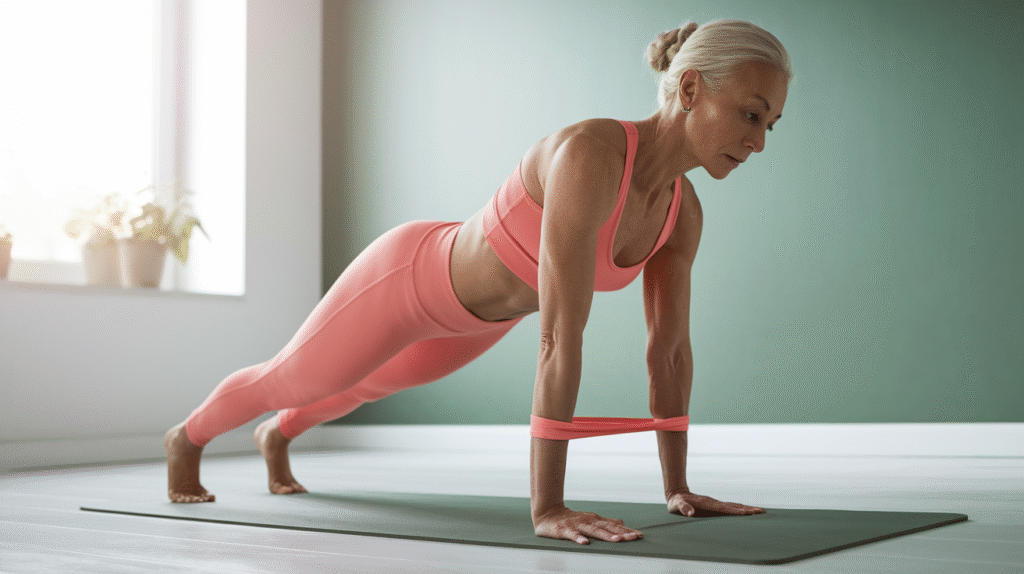
You need loop resistance bands—also called mini bands or booty bands. These circular bands create the constant tension that makes glute training effective.
Long resistance bands with handles work for some exercises, but loop bands deliver better results for glute-specific work.
Resistance levels matter. Light bands (typically 10-20 lbs of resistance) work for warm-ups but won’t challenge you enough for strength building.
Heavy bands (40+ lbs) might be too intense if you’re starting from scratch. Most women 35+ see the best results starting with medium resistance (25-35 lbs), which provides enough challenge to stimulate muscle growth without compromising form.
Buy a set of three bands in different resistances. You’ll use lighter bands for smaller muscle groups and as you fatigue, then progress to heavier bands as you get stronger.
Quality matters—cheap bands snap mid-workout, which is annoying at best and potentially dangerous. Look for fabric-covered bands rather than pure latex; they’re more durable and don’t roll or pinch your skin.
Budget-friendly options that actually work include Fit Simplify Resistance Loop Bands (around $12 for a set of five) and Te-Rich Resistance Bands ($15-20 for fabric-covered options). You don’t need expensive brands to get results—you just need bands that won’t break.
Essential Prep for Maximum Results
Never skip your warm-up. Your body after 35 needs proper preparation to perform safely and effectively. Cold muscles are injury-prone muscles, and a five-minute dynamic warm-up dramatically reduces your risk while improving your workout performance.
Start with hip circles: stand on one leg and draw large circles with your opposite knee, 10 circles each direction per leg. This lubricates your hip joints and activates the stabilizing muscles.
Follow with leg swings: hold a wall for balance and swing one leg forward and back 15 times, then side to side 15 times.
Repeat on the other leg. Finish with 10 bodyweight squats, focusing on sitting back into your hips and keeping your chest lifted.
Now here’s the game-changer: mind-muscle connection. Before each exercise, consciously think about your glutes. Place your hand on the muscle you’re targeting and squeeze it.
This mental focus increases muscle activation by up to 22% according to research—you literally get better results by thinking about the muscle you’re working.
Proper form protects your body. Keep your core engaged by drawing your belly button toward your spine—this stabilizes your lower back. Never let your knees cave inward; they should track over your toes. Move with control rather than momentum. If you feel exercises in your lower back or knees instead of your glutes, stop and adjust your form.
Setting Realistic Expectations
You’ll feel stronger within two weeks. This isn’t marketing hype—it’s how your nervous system adapts to new movements. Your first gains come from neuromuscular efficiency: your brain gets better at recruiting muscle fibers, which makes you stronger before your muscles actually grow.
Visible toning appears around weeks four to six with consistent effort. You might notice your glutes feeling firmer when you flex them, or your pants fitting differently around your hips and thighs. These changes are subtle at first, but they’re real and they’re building.
Consistency matters more than intensity at this stage. Three mediocre workouts per week deliver better results than one perfect workout followed by two weeks of nothing. Your body responds to regular stimulus, not occasional heroic efforts.
Track progress beyond the scale. Take photos from the same angles every two weeks—visual changes appear before weight changes. Notice functional improvements: can you hold a squat longer? Do stairs feel easier? Is your posture better? These victories matter just as much as aesthetic changes, and they happen first.
The Complete 20-Minute Resistance Band Glutes Workout
Circuit 1: Glute Activation (6 minutes)
Banded Glute Bridges
Place your resistance band just above your knees and lie on your back with your feet flat on the floor, hip-width apart. Your heels should be close enough to your glutes that you can graze them with your fingertips. Press through your heels and lift your hips toward the ceiling, squeezing your glutes hard at the top. Push your knees slightly outward against the band throughout the movement—this activates your gluteus medius, the often-neglected side glute that stabilizes your hips.
Hold the top position for two seconds, really squeezing your glutes. Lower with control. Don’t let your knees collapse inward—maintain that outward pressure against the band.
Perform 3 sets of 15 reps with 30 seconds rest between sets.
The burn you feel in the sides of your glutes confirms you’re hitting the gluteus medius. This muscle prevents knee pain and hip problems, making it crucial for women 35+ who want to stay active long-term.
Banded Clamshells
Lie on your side with your band around your thighs just above your knees. Stack your hips and bend your knees at 90 degrees, keeping your feet together. Engage your core to prevent your torso from rolling backward. Lift your top knee as high as you can while keeping your feet together, then lower with control.
The key: keep your hips stacked. Don’t let your top hip roll backward—that’s cheating the movement and reducing glute activation. Move slowly and feel the burn in the side of your glute.
Complete 3 sets of 12 reps per side with minimal rest.
Common mistakes include moving too quickly (use slow, controlled movements) and letting your hips rotate (stabilize your core). If you don’t feel this in your glutes, place your hand on the side of your hip and focus on that mind-muscle connection.
Circuit 2: Power Builders (8 minutes)
Banded Squats
Position your band just above your knees and stand with feet slightly wider than hip-width. Turn your toes out slightly—about 15 degrees. Before you squat, engage your core and push your knees outward against the band. This pre-tension is crucial.
Sit back into your hips like you’re sitting in a chair, keeping your chest lifted and your weight in your heels. Lower until your thighs are parallel to the floor (or as low as you can go with good form). Push through your heels to stand, maintaining that outward pressure on the band throughout the entire movement.
The band placement creates constant tension that forces your glutes to work harder than bodyweight squats alone. You should feel this primarily in your glutes and the outside of your thighs, not your quads. If you feel it mostly in your quads, sit back more and focus on pushing through your heels.
Perform 3 sets of 12-15 reps with 45 seconds rest between sets.
The burn that develops by rep 10 proves your muscles are working. This is good burn—muscle fatigue that builds strength. Push through it.
Banded Lateral Walks
Keep your band above your knees and stand with feet hip-width apart. Bend your knees slightly into a quarter-squat position and maintain this athletic stance throughout the exercise. Step sideways with your right foot, then follow with your left foot, maintaining tension on the band. Take 10 steps right, then 10 steps left—that’s one set.
Keep your chest up, your core engaged, and maintain that slight squat. Don’t let your knees cave inward or your hips rise as you step. The constant tension as you fight to keep your knees apart targets your gluteus medius with laser precision.
Complete 3 sets of 10 steps each direction with 30 seconds rest.
This exercise looks simple but delivers powerful results for hip stability. You’ll feel it burning in the sides of your glutes—that’s exactly where you want it.
Circuit 3: Glute Sculpting Finishers (6 minutes)
Banded Fire Hydrants
Position your band above your knees and get on all fours with your hands under your shoulders and knees under your hips. Keep your core tight to protect your lower back. Keeping your knee bent at 90 degrees, lift your right leg out to the side as high as you can without rotating your hips or arching your back. Lower with control.
The key is keeping your hips square to the ground. Don’t let your torso lean away from the working leg—that’s compensation, not muscle activation. Move slowly and focus on the side glute doing the work.
Perform 2 sets of 15 reps per side with minimal rest.
This exercise perfectly isolates the side glutes, creating that rounded, lifted appearance women want. The burn is intense—embrace it.
Banded Single-Leg Glute Bridges
Lie on your back with your band above your knees. Place your right foot flat on the floor and extend your left leg straight up toward the ceiling. Press through your right heel and lift your hips, squeezing your right glute hard at the top. Your body should form a straight line from your shoulders to your extended knee.
The challenge: keep your hips level. Don’t let the left hip drop—this requires serious glute and core engagement. Lower with control and repeat.
Complete 2 sets of 15 reps per leg with 30 seconds rest between sides.
This ultimate glute isolation move forces one glute to do all the work, creating intense muscle activation. To avoid arching your lower back, keep your core engaged and don’t lift your hips too high—stop when your body forms that straight line.
Maximizing Your Results: Tips for Women 35+
Recovery and Frequency
Your body needs 48 hours to recover between glute workouts. This isn’t laziness—it’s biology. Your muscles grow during recovery, not during the workout itself. Training the same muscles daily leads to breakdown, not growth.
Schedule this workout three to four times per week with at least one rest day between sessions. A sample week: Monday, Wednesday, Friday, and optionally Sunday. This frequency provides enough stimulus to build strength without overwhelming your recovery capacity.
Recovery becomes more important after 35 because your body produces less growth hormone and takes longer to repair muscle tissue. Respect this reality instead of fighting it. Quality sleep (7-9 hours), proper nutrition, and stress management directly impact your results.
Active recovery on off days keeps you moving without taxing your muscles. Walk for 20-30 minutes, do gentle yoga, or swim. These activities increase blood flow to your muscles, which speeds recovery while keeping you active.
Nutrition Basics That Support Muscle Building
You need protein to build muscle—that’s non-negotiable. Women 35+ should aim for 0.7-1 gram of protein per pound of body weight daily. For a 150-pound woman, that’s 105-150 grams of protein spread throughout the day.
You don’t need protein shakes unless you find them convenient. Real food works perfectly: Greek yogurt (20g protein per cup), chicken breast (30g per 4 oz), eggs (6g each), lentils (18g per cup), and cottage cheese (25g per cup) all deliver quality protein.
Hydration impacts muscle recovery and performance more than most people realize. Dehydrated muscles recover slower and perform worse. Drink at least half your body weight in ounces daily—a 150-pound woman needs 75 ounces minimum, more if you’re exercising or it’s hot outside.
Simple meal timing makes a difference. Eat protein within two hours after your workout to optimize muscle recovery. You don’t need to chug a shake immediately—just have a regular meal that includes quality protein within that window.
Progressive Overload Made Simple
Your muscles adapt to stress, which means you need to progressively challenge them to continue seeing results. After 3-4 weeks of consistent training, increase the difficulty.
You have three options: increase resistance by moving to a heavier band, add reps by performing 15-20 instead of 12-15, or add sets by doing four sets instead of three. Pick one variable and increase it gradually—don’t change everything at once.
Listen to your body’s signals. Good burn is muscle fatigue that fades quickly after your workout. Bad pain is sharp, localized, and doesn’t improve with rest—this signals potential injury. Stop immediately if you experience bad pain.
Progress isn’t linear. Some weeks you’ll feel stronger; others you’ll struggle with weights that felt easy before. This is normal, especially for women whose strength fluctuates with hormonal cycles. Track your overall trend over months, not days.
Combining This Workout With Your Life
The best workout schedule is the one you’ll actually follow. If mornings work for you, do this workout before your day starts—you’ll feel energized and accomplished. If you’re not a morning person, lunch breaks or evenings work just as well. Consistency matters more than timing.
This glute workout pairs beautifully with other activities. Add 20-30 minutes of walking or cycling on off days for cardiovascular health. Include upper body resistance training once or twice weekly for balanced strength. Stretch or do yoga to maintain flexibility and reduce stress.
Staying motivated when results feel slow requires shifting your focus. Celebrate every workout you complete—that’s a victory regardless of visible changes. Notice the small improvements: holding a squat longer, using a heavier band, feeling less sore after workouts. These process goals sustain motivation better than outcome goals.
Build accountability. Tell a friend about your commitment, post your workouts on social media, or join an online community of women pursuing similar goals. External accountability increases your likelihood of following through when motivation wanes.
Your Stronger Future Starts Now
You now have everything you need: a proven workout designed specifically for your body, realistic expectations about results, and practical strategies for making this sustainable.
This 20-minute resistance band routine delivers powerful benefits that extend far beyond aesthetics. Stronger glutes improve your posture, eliminating that chronic lower back pain that’s been holding you back. They boost your metabolism, helping your body work with you instead of against you. They build functional strength that makes everyday activities—carrying groceries, playing with your kids, climbing stairs—noticeably easier. And yes, they create the toned, sculpted appearance that makes you feel confident in your own skin.
Twenty minutes, three to four times per week, is genuinely enough to transform your lower body. You don’t need more time, more equipment, or more complexity. You need consistency and commitment.
Starting is the hardest part. Your first workout might feel awkward as you learn the movements. The burn might surprise you. You might wonder if you’re doing it right. Push through this initial discomfort—it fades within two weeks as the movements become familiar and your body adapts.
This workout was designed for real women with real lives—busy professionals juggling careers and families, stay-at-home parents managing households, anyone who’s looked in the mirror and thought “I want to feel strong again.” You don’t need to be fit to start. You just need to start.
Commit to trying this workout for two weeks. Notice how you feel after each session. Pay attention to the subtle changes: standing taller, moving easier, feeling more capable in your body. These small victories build momentum that carries you forward.
Your strongest, most capable body isn’t behind you—it’s ahead of you, waiting for you to build it. Every rep you complete, every workout you show up for, every time you choose strength over comfort, you’re creating that future version of yourself.
The resistance band is sitting there. The workout is mapped out. The only question left is: when will you start?
Your transformation begins with one workout. Make today that day.