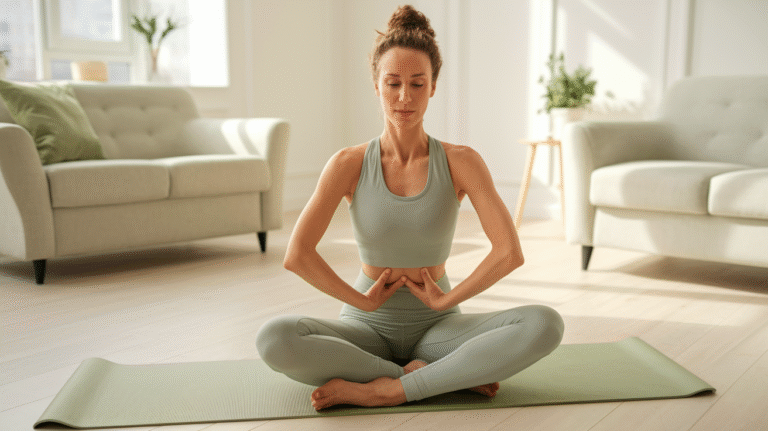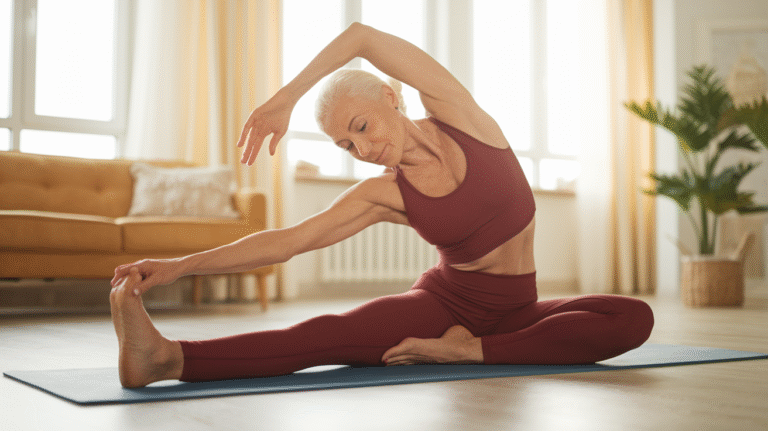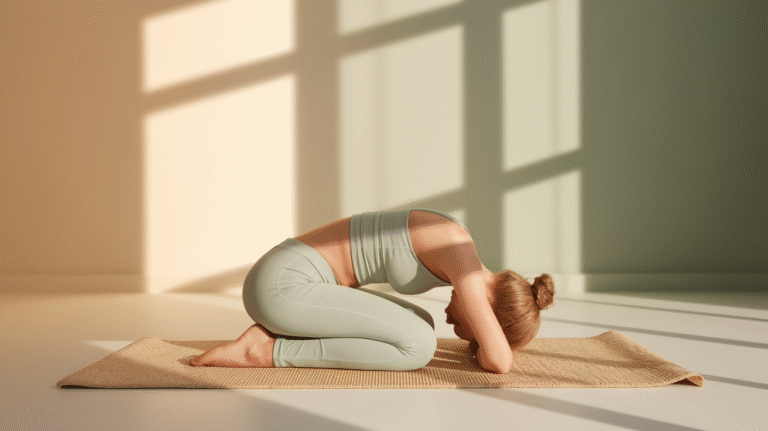
How to Start a Mindful Movement Practice: 10 Simple Exercises
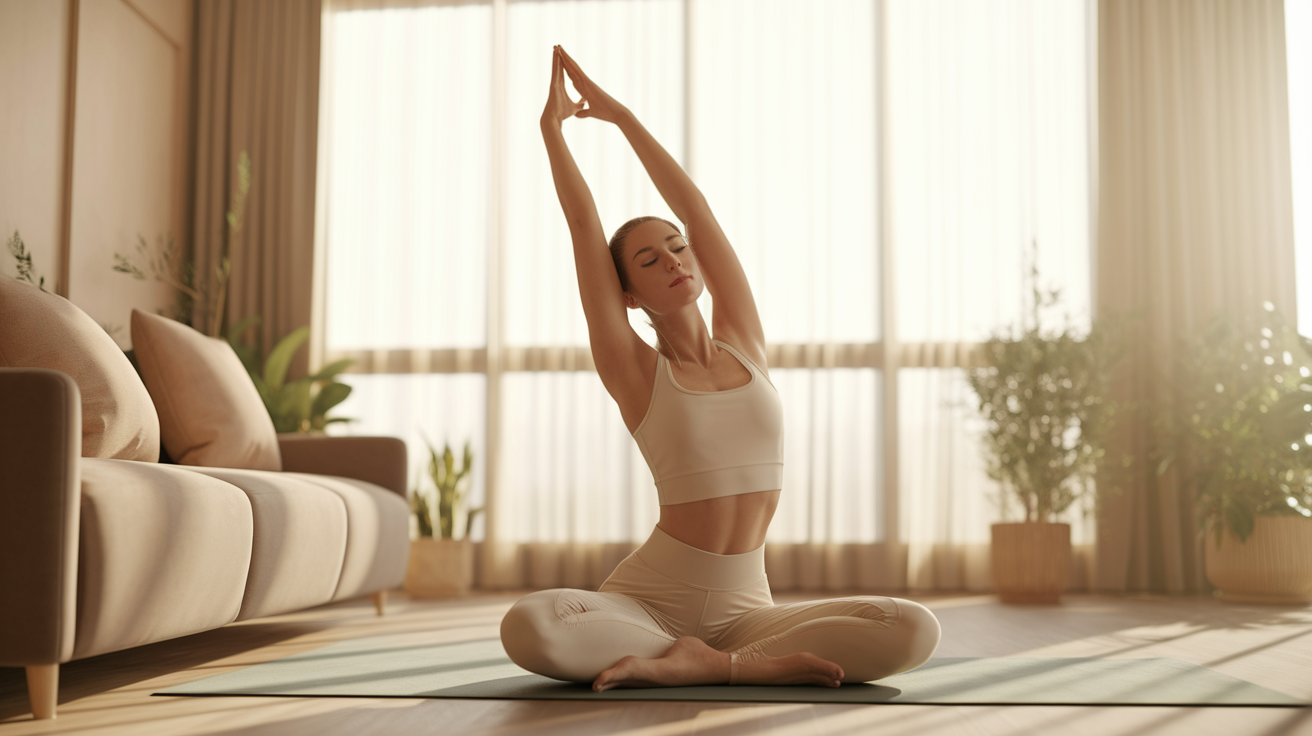
You know that feeling when you’re going through the motions of your day, but your mind is somewhere else entirely? You’re washing dishes while mentally drafting tomorrow’s to-do list, or you’re walking to your car while replaying an awkward conversation from three hours ago. We’ve all been there—living in our heads instead of our bodies.
Here’s what I’ve learned after years of studying wellness practices: mindful movement is the perfect antidote to this disconnection.
Unlike traditional exercise where you’re focused on calories burned or miles logged, mindful movement brings you back to the present moment through intentional, breath-connected physical activity.
The benefits are remarkable. Research shows that regular mindful movement practice reduces stress hormones, sharpens mental focus, and creates a deeper awareness of how your body feels and moves through space. People who practice consistently report feeling more grounded, less reactive to daily stressors, and genuinely more at peace.
The best part? You don’t need special equipment, a gym membership, or even workout clothes. These 10 simple exercises can be done anywhere—in your living room, office, or even a hotel room while traveling. We’re talking just 10 minutes a day to transform your relationship with your body and mind.
I’m going to walk you through each movement step-by-step, explain exactly what makes these exercises “mindful,” and show you how to build a sustainable daily practice that actually fits into your real life. No perfection required, no previous experience necessary. Just you, your breath, and a willingness to try something that could genuinely change how you experience your day.
Ready to start? Let’s begin with the foundation that makes everything else click.
Understanding Mindful Movement: The Essential Foundation
What Makes Movement “Mindful”
Here’s the key difference that changes everything: mindful movement isn’t about achieving a fitness goal or pushing through discomfort. It’s about paying attention—really paying attention—to what’s happening in your body right now.
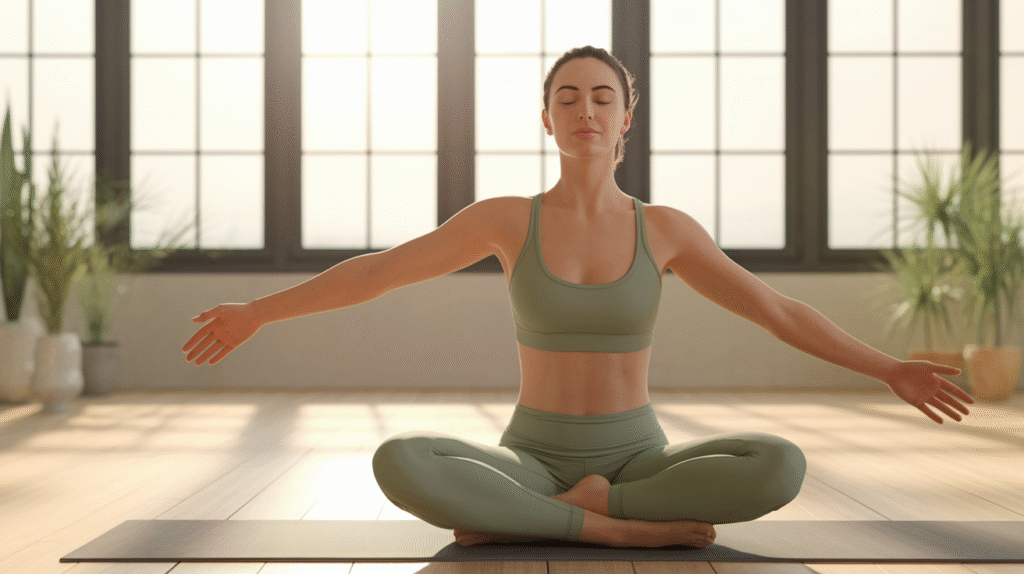
When you practice mindful movement, you’re connecting your breath with each motion. You’re noticing sensations: the stretch in your side body, the weight shifting in your feet, the release of tension in your shoulders. You’re moving slower and more intentionally than you would in a typical workout, because the point isn’t to get somewhere—it’s to be present where you are.
Traditional exercise often encourages you to push past your body’s signals, to “feel the burn” and power through. Mindful movement does the opposite. It asks you to listen carefully to those signals, to honor what your body is telling you, and to move with curiosity rather than judgment.
This approach creates a completely different experience. Instead of your mind wandering to your grocery list while you exercise, you’re fully engaged with the physical sensations of movement. That’s where the magic happens—that’s when movement becomes meditation in motion.
The Proven Benefits You’ll Experience
The research on mindful movement is compelling. Studies show that even brief daily practices lead to measurable reductions in cortisol (your primary stress hormone) and improvements in emotional regulation. Translation? You’ll feel calmer and more capable of handling whatever your day throws at you.
You’ll also develop better body awareness. Most of us have become disconnected from physical sensations—we ignore our tight shoulders until they’re screaming, or we don’t notice our shallow breathing until we’re fully stressed. Mindful movement reestablishes that vital communication between your mind and body.
The physical benefits are real too. You’ll improve flexibility, strengthen stabilizing muscles, and develop better posture—all without the intensity of traditional workouts. People often report sleeping better, experiencing less chronic pain, and feeling more energized throughout their day.
Getting Your Mindset Ready
Before we dive into the exercises, let’s address the elephant in the room: you might feel awkward at first. That’s completely normal and actually a good sign—it means you’re trying something new.
There’s no “wrong way” to practice mindful movement. If your mind wanders (and it will), that’s not failure—that’s simply what minds do. The practice is in noticing when your attention has drifted and gently bringing it back to your breath and body. That’s the work.
Set realistic expectations. You won’t feel instantly transformed after one session. But if you practice consistently—even just 5-10 minutes daily—you’ll notice changes within a week or two. Maybe you’ll catch yourself taking a conscious breath during a stressful moment, or you’ll notice tension building in your shoulders before it becomes painful.
Here’s the simple truth that makes all the difference: consistency matters more than duration. Five minutes every day beats an hour once a week. Start small, make it sustainable, and let the practice grow naturally from there.
10 Simple Mindful Movement Exercises (Part 1: Grounding & Centering)
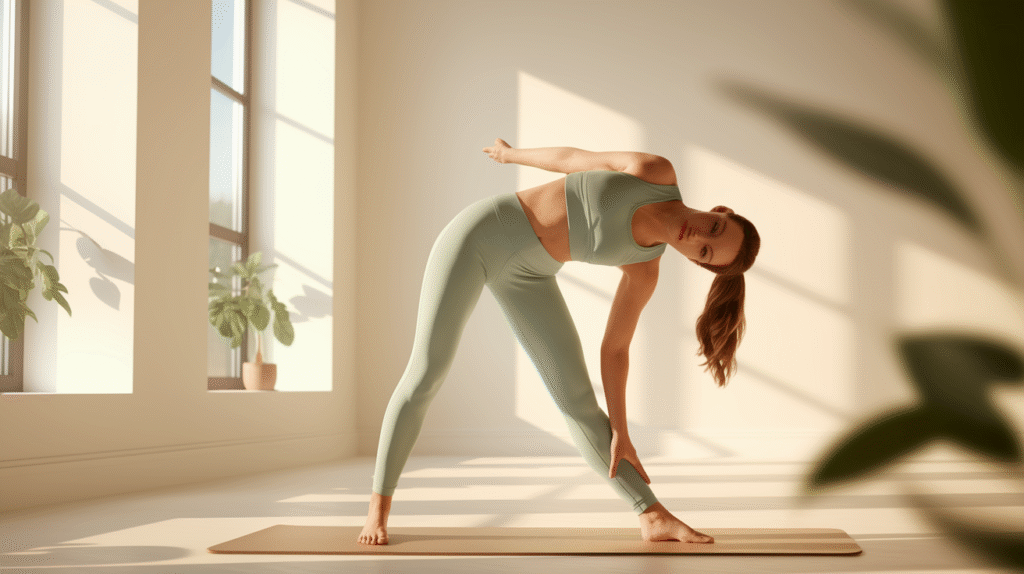
Exercise 1: Mindful Standing
Let’s start with the foundation of all mindful movement—simply standing with awareness. This might sound too easy to be effective, but I promise you’ll be surprised by what you discover.
Stand with your feet hip-width apart, arms relaxed by your sides. Close your eyes if that feels comfortable, or soften your gaze toward the floor. Now, bring your attention to your feet. Really feel them making contact with the ground. Notice the weight distribution—are you leaning more on your heels or the balls of your feet? Is one foot bearing more weight than the other?
Slowly scan your attention up your body. Notice your knees—are they locked or slightly soft? Feel your hips, your spine stacking vertebra by vertebra, your shoulders settling away from your ears. Check in with your head—is it balanced evenly over your spine, or are you jutting your chin forward?
Take five deep breaths here, simply observing. You’re not trying to fix anything or achieve perfect posture. You’re just noticing. This awareness is the cornerstone of everything that follows.
Exercise 2: Gentle Neck Rolls
Your neck holds an incredible amount of tension—especially if you spend time looking at screens (which, let’s be honest, is all of us). This simple exercise releases that tightness while teaching you to move with breath awareness.
Start in your mindful standing position. On an inhale, simply notice your breath. As you exhale, slowly drop your right ear toward your right shoulder. Don’t force it—let gravity do the work. Inhale here, feeling the stretch along the left side of your neck. On your next exhale, roll your chin down toward your chest, taking your time. Inhale in this forward position. Exhale as you continue rolling your left ear toward your left shoulder.
Continue this pattern for 3-4 complete circles in one direction, then reverse. The key is coordinating your breath with the movement and moving slowly enough to notice any areas of particular tightness or discomfort.
Common mistake to avoid: Don’t roll your head backward. Keep the movement from side to front to side, protecting your cervical spine.
Exercise 3: Shoulder Circles
Now we’re moving to those shoulders that have been creeping up toward your ears all day. This exercise is incredibly effective for releasing upper body tension.
Standing tall, let your arms hang naturally. On an inhale, draw your shoulders up toward your ears. Hold them there for a moment—notice how that feels (probably not great!). On your exhale, roll your shoulders back and down, creating a circular motion. Feel your shoulder blades slide down your back.
Repeat this 5-6 times, then reverse the direction. This time, inhale as you roll your shoulders forward and up, exhale as you draw them back and down. Pay attention to where you feel the movement most—in your upper back, your chest, your neck? Just notice without judgment.
If your shoulders feel particularly tight, move even slower. Sometimes the areas that need the most attention resist movement initially. That’s your body’s way of protecting old patterns. Breathe into those sticky spots.
Exercise 4: Arm Raises with Breath
This exercise beautifully demonstrates the connection between breath and movement. It’s also perfect for creating a sense of expansion and openness in your body.
Stand with your arms at your sides, palms facing your thighs. As you inhale, slowly raise your arms out to the sides and up overhead, turning your palms to face each other at the top. Feel your ribcage expand, your chest open, your whole body reaching upward.
At the top of your inhale, pause for just a moment. Then, as you exhale, slowly lower your arms back down to your sides, palms returning to face your thighs. The exhale should last as long as the arm movement—don’t rush it.
Repeat this 6-8 times, keeping your movements smooth and synchronized with your breath. Notice how moving slowly makes this more challenging than you’d expect. That’s because you’re truly present with the movement rather than mindlessly going through the motions.
This exercise is amazing for morning energy—it literally opens your body and deepens your breath—but it’s equally effective as an afternoon reset when you’re feeling mentally foggy.
10 Simple Mindful Movement Exercises (Part 2: Dynamic Flow)
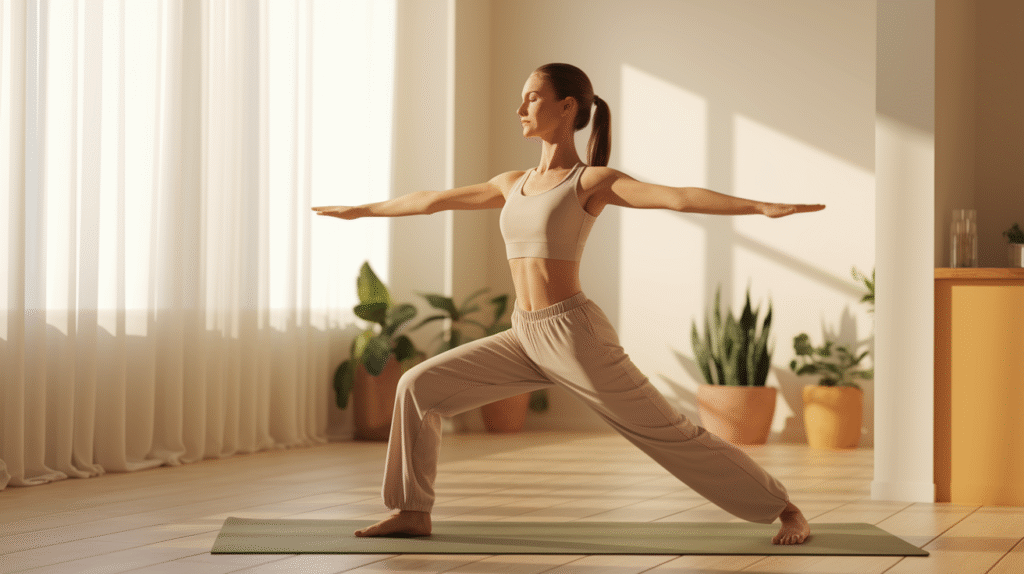
Exercise 5: Side Bends
Now we’re moving into exercises that create more dynamic stretch while maintaining that essential mind-body connection. Side bends are particularly effective for releasing tension along your entire side body—an area most of us never consciously stretch.
Start in your mindful standing position. Inhale and raise both arms overhead, interlacing your fingers and turning your palms toward the ceiling. Press your feet firmly into the ground—this creates stability for the stretch.
On your exhale, bend gently to the right, keeping both hips level and facing forward. The tendency is to let your hip jut out to the left—resist that. Instead, imagine you’re between two panes of glass, bending purely to the side. Feel the stretch along your entire left side, from your hip all the way up through your ribcage.
Inhale as you return to center. Exhale as you bend to the left. Move slowly enough that you can really feel the sensations along your side body. Are some areas tighter than others? Does the stretch feel different on one side?
Keep your head aligned with your spine—don’t let it drop forward or back. Complete 4-5 bends on each side, using your breath to deepen the stretch without forcing anything.
Exercise 6: Gentle Chair Pose
This exercise asks you to do two things at once—raise your arms and bend your knees—which makes it perfect for practicing focused attention. Can you keep your mind present in your body while executing multiple movements?
Start standing. On an inhale, raise your arms overhead (just like Exercise 4). But this time, as you exhale, bend your knees and sit back as if you’re lowering into an invisible chair. Your weight should shift into your heels, your chest stays lifted, and your arms remain reaching toward the ceiling.
Here’s what to focus on: Can you feel your thigh muscles engaging? Is your breath still flowing smoothly, or are you holding it? Are your shoulders creeping up toward your ears? Gently adjust anything that needs attention.
Hold this position for 3-5 breaths, then inhale to stand back up. Start with just one or two repetitions, and build up as the exercise becomes more familiar.
Essential alignment tips: Keep your knees behind your toes, maintain length in your spine (don’t round your back), and if full chair pose feels too intense, don’t sit back as far. Remember, this isn’t about achievement—it’s about awareness.
Exercise 7: Standing Leg Bends
Balance exercises are incredible for developing body awareness because they demand your full attention. You literally can’t think about your to-do list while balancing on one leg—your mind has to be present.
From standing, shift your weight onto your left leg. On an exhale, bend your right knee and lift your right foot off the ground, bringing your heel toward your glutes. You can hold your ankle if that helps with balance, or simply let your arms hang by your sides.
Use your breath to maintain stability. Inhale, finding your center. Exhale, settling more deeply into the standing leg. If you wobble, that’s completely fine—just notice it without judgment. Wobbling is your body figuring out how to balance. It’s part of the process.
After 3-5 breaths, lower your right foot back down. Take a breath in neutral standing, then repeat on the other side.
Quick tip: If balance feels challenging, practice near a wall or chair back that you can touch for support. There’s no prize for struggling unnecessarily. Use the support, build your stability gradually, and eventually you won’t need it.
Exercise 8: Mindful Forward Fold
We’re ending this sequence with a forward fold—a deeply releasing movement that lets gravity do most of the work. This exercise is particularly effective for releasing lower back tension and calming your nervous system.
Stand with your feet hip-width apart, knees slightly soft (never locked). On an inhale, raise your arms overhead. On your exhale, hinge forward from your hips, letting your arms and head hang heavy toward the floor. Your knees can bend as much as needed—this isn’t about touching your toes.
Let gravity pull you deeper into the fold with each exhale. Your head should be completely relaxed, neck loose. Breathe into any tight areas you notice—maybe your hamstrings, your lower back, or your hips.
Stay here for 5-8 breaths. When you’re ready to come up, bend your knees generously, place your hands on your thighs, and slowly roll up to standing, one vertebra at a time. Your head should be the last thing to arrive.
The amazing release this provides comes from the combination of gentle inversion (your head below your heart), the stretch through your entire back body, and the surrender required to let gravity do the work. This is the opposite of forcing—it’s about allowing.
Creating Your Perfect Mindful Movement Routine
Building Your Daily Practice
You’ve learned eight powerful exercises (we’ll add two more variations as you progress). Now let’s talk about how to actually make this a consistent practice in your real life—not your fantasy life where you have unlimited time and motivation.
First, choose your time. Morning practice energizes you for the day ahead and ensures you complete it before life gets hectic. Evening practice helps you transition from work mode to rest mode and can improve sleep quality. There’s no “best” time—only the time you’ll actually do it.
Start with just 5-10 minutes. I know you’ve probably read articles claiming you need 30-minute daily practices, but here’s the truth: 5 minutes you’ll actually do beats 30 minutes you’ll avoid. Set a realistic goal that feels almost too easy. You can always add more time later.
For sequencing, try this simple flow: Start with Mindful Standing (Exercise 1) to center yourself. Move through Neck Rolls and Shoulder Circles (Exercises 2-3) to release upper body tension. Add Arm Raises with Breath (Exercise 4) for expansion. Flow through Side Bends, Chair Pose, and Leg Bends (Exercises 5-7) for dynamic movement. End with Forward Fold (Exercise 8) for release and integration.
Create a dedicated space, even if it’s tiny. Clear a spot in your bedroom, living room, or even office where you can move freely. You don’t need much room—just enough to extend your arms. Having a designated space makes it easier to build the habit because your environment cues the behavior.
Making It Stick: Essential Tips for Consistency
The most effective strategy for building consistency is habit stacking—attaching your new practice to an existing habit. For example: “After I pour my morning coffee, I’ll do my mindful movement practice while it cools.” Or: “Before I start dinner prep, I’ll spend 5 minutes with these exercises.”
Use reminders without creating stress. Set a gentle phone alarm or leave your yoga mat visible as a visual cue. But if you miss the reminder, don’t spiral into guilt. Which brings me to the next point…
What to do when you miss a day: absolutely nothing. Don’t try to “make up” for it or punish yourself. Just return to your practice the next day. Consistency isn’t about perfection—it’s about returning again and again, even after interruptions.
Track your progress in a way that feels good. Some people love checking off calendar boxes. Others prefer journaling briefly about how they felt after each practice. Find what motivates you without creating pressure. The goal is to notice patterns and celebrate your commitment, not to create another source of stress.
Deepening Your Practice Over Time
As these eight exercises become familiar, you’ll naturally want to explore more. That’s wonderful—it means the practice is working. Here’s how to expand mindfully.
Add more repetitions gradually. If you started with 3-4 neck rolls, work up to 6-8. If you held chair pose for three breaths, try five. Let your body guide the progression rather than forcing arbitrary increases.
Explore additional mindful movement exercises. The two we haven’t covered yet—gentle twists and standing forward fold variations—can be added once you’re comfortable with the foundation. You might also explore cat-cow stretches, gentle hip circles, or ankle rolls. The key is maintaining that breath-movement connection and present-moment awareness.
When you’re ready, consider exploring related practices like yoga, tai chi, or qigong. These traditions have centuries of wisdom about mindful movement and can deepen your practice significantly. Many people find that starting with these simple exercises gives them the body awareness and confidence to try more structured classes.
Most importantly, keep listening to your body’s evolving needs. Some days you’ll crave more dynamic movement. Other days, simply standing and breathing will be exactly right. Your practice should serve you, not the other way around.
Troubleshooting Common Challenges
“I don’t have time.” I hear this constantly, and I get it—life is demanding. Here’s your solution: the 3-minute version. Do just three exercises: Mindful Standing (1 minute), Shoulder Circles (1 minute), and Forward Fold (1 minute). That’s it. Three minutes is enough to interrupt stress patterns and reconnect with your body. On days when you have more time, great. On packed days, three minutes still counts.
“I feel silly doing this.” This is completely normal, especially if you’re new to mindfulness practices. Our culture values constant productivity and external achievement, so spending time simply being present in your body can feel strange initially. Reframe it this way: you’re not being silly, you’re being brave enough to try something that might actually help you feel better. That’s admirable, not silly.
“I can’t focus—my mind keeps wandering.” Perfect! You’re doing it right. Seriously. The point isn’t to have a completely quiet mind (that’s nearly impossible). The point is to notice when your mind wanders and gently bring it back. That noticing and returning—that’s the practice. Every time you catch your wandering mind and redirect it to your breath or body, you’re strengthening your attention muscles.
“I have physical limitations.” These exercises can be adapted for virtually any body. If standing is difficult, do them seated in a sturdy chair. If raising your arms overhead is painful, raise them only as high as comfortable. If balance is challenging, practice near a wall for support. Mindful movement isn’t about achieving specific shapes—it’s about moving with awareness within your body’s current capabilities.
Conclusion: Your Journey Starts Now
Let’s bring this all together. Mindful movement isn’t another item on your overwhelming to-do list—it’s a gift you give yourself. A few minutes of intentional, breath-connected movement that helps you feel more grounded, less stressed, and genuinely more present in your life.
These 10 simple exercises provide everything you need to start a complete mindful movement practice today. You don’t need special equipment, previous experience, or even much space. Just your body, your breath, and a willingness to pay attention.
The proven benefits are real: reduced stress hormones, improved focus, better body awareness, enhanced emotional regulation, and increased physical flexibility. People who practice consistently report feeling more capable of handling daily challenges and more connected to their bodies than they’ve felt in years.
But here’s what matters most: you already have everything you need to begin. Not tomorrow, not after you buy the perfect yoga mat or clear your schedule—right now. This moment is exactly the right time to start.
Your Next Steps
Choose three or four exercises from the ones we’ve covered and try them today. Maybe start with Mindful Standing, Neck Rolls, Shoulder Circles, and Forward Fold. Spend just 5 minutes moving through them slowly, connecting your breath with each movement.
Set a realistic goal for this week. Perhaps: “I’ll practice for 5 minutes, three times this week.” Write it down. Tell someone about it. Make it real but achievable.
Remember this essential truth: progress over perfection. Some days your practice will feel amazing. Other days your mind will wander constantly and your body will feel stiff. Both experiences are valuable. Both are part of the journey.
Make this practice your own. Maybe you add music. Maybe you practice in complete silence. Maybe you do these exercises in your pajamas before your morning shower, or in your office during lunch break. There’s no single “right way”—only the way that works for your life.
Final Encouragement
Your body has been carrying you through life, often without much acknowledgment or appreciation. These simple movements are a way of saying thank you—of checking in and reconnecting with the physical vessel that makes everything else possible.
Start small. Stay consistent. Watch what unfolds. In a few weeks, you’ll notice yourself taking conscious breaths during stressful moments. You’ll catch tension building in your shoulders before it becomes painful. You’ll feel more at home in your body.
That transformation isn’t dramatic or flashy—it’s quiet and profound. It’s the kind of change that makes everything else in your life a little bit easier.
Your mindful movement practice is waiting for you. All you have to do is take that first intentional breath and begin.