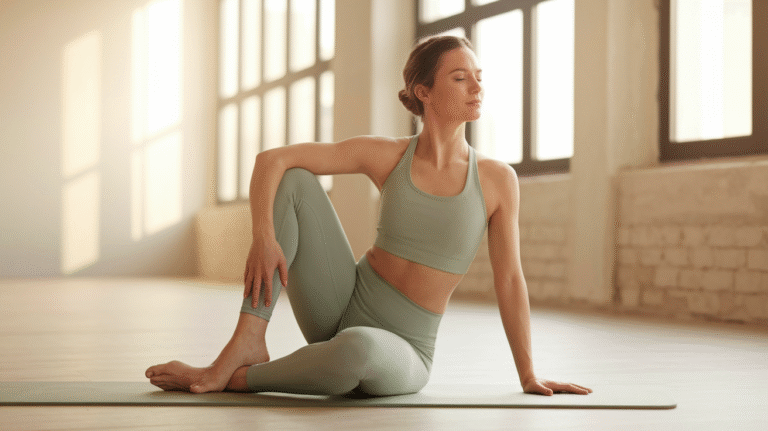
Home Butt Workout: Tone, Lift, and Shape Your Glutes with This Routine!
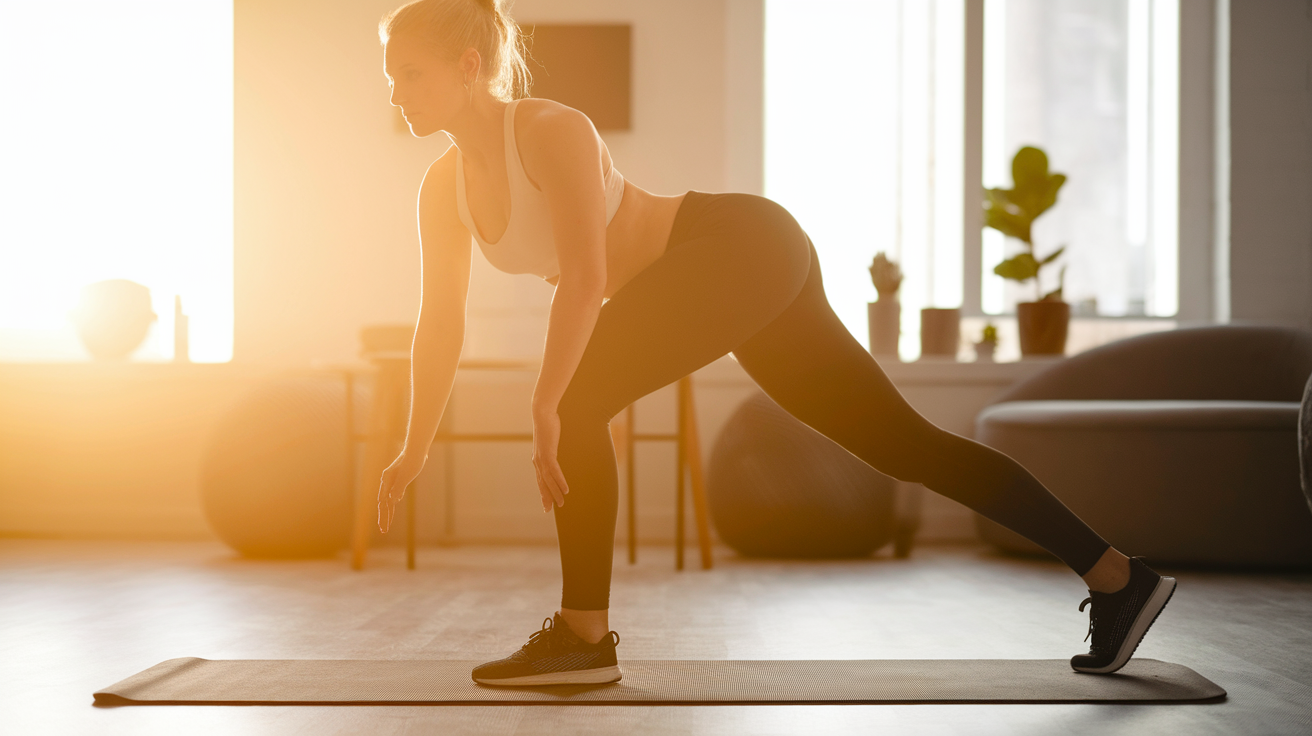
You don’t need a fancy gym membership or expensive equipment to build the strong, sculpted glutes you’ve been dreaming about. The truth is, your living room is the perfect training ground for transforming your backside—and this routine proves it.
Home glute workouts deliver real results because they focus on what matters most: proper form, consistent effort, and progressive challenge. While gym equipment adds variety, bodyweight exercises engage your glutes just as effectively when performed correctly. The key difference? You can do them anytime, anywhere, without the commute or the monthly fees eating into your budget.
This complete guide walks you through a proven four-exercise routine designed specifically for toning, lifting, and shaping your glutes. You’ll learn exactly how to perform each movement with perfect form, understand why these exercises work so well, and discover the essential strategies for maximizing your results. Whether you’re a complete beginner taking your first fitness steps or someone with a busy schedule who needs efficient workouts, this routine fits seamlessly into your life.
The best part? You need absolutely zero equipment to get started. Just clear a small space in your home, commit to showing up consistently, and prepare to feel muscles you didn’t know existed. No more excuses about not having time to get to the gym or waiting for equipment to become available. Your transformation starts right here, right now, with movements your body was designed to perform. Let’s build those glutes together.
Why Glute Training Matters (Beyond Just Aesthetics)
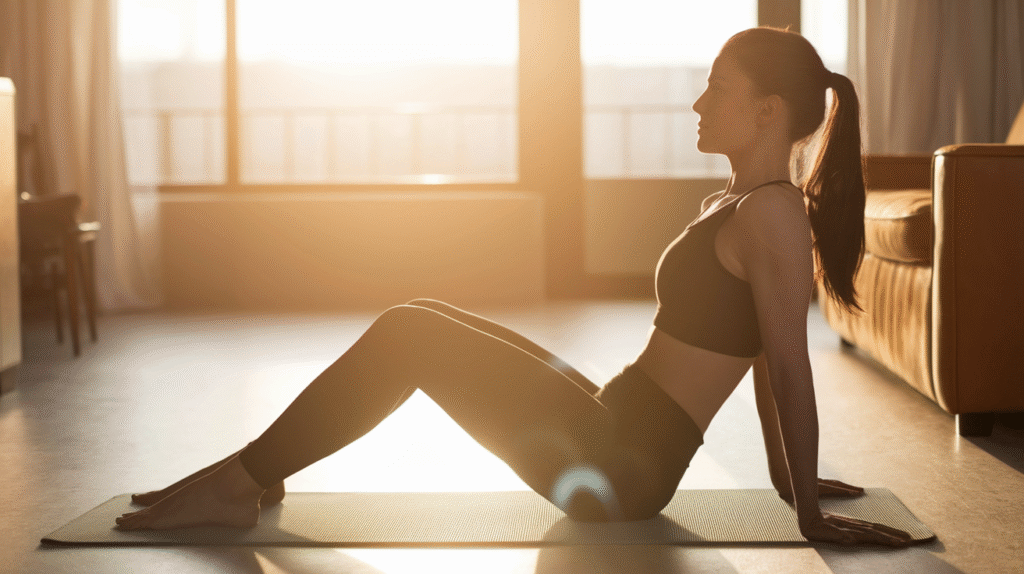
The Amazing Benefits of Strong Glutes
Sure, sculpted glutes look incredible in your favorite jeans, but the benefits extend far beyond aesthetics. Your glute muscles are the powerhouse of your lower body, and strengthening them transforms how you move through daily life.
Strong glutes dramatically improve your posture by counteracting the effects of prolonged sitting. When you spend hours at a desk, your hip flexors tighten and your glutes weaken, creating an imbalance that pulls your pelvis forward and strains your lower back. Targeted glute training reverses this pattern, stabilizing your pelvis and taking pressure off your spine. Many people report significant reductions in chronic lower back pain within just weeks of consistent glute work.
Your athletic performance gets a major boost too. Whether you’re running, cycling, hiking, or playing recreational sports, powerful glutes generate the force needed for explosive movements. They’re your body’s primary hip extensors, meaning they drive you forward with every step and help you jump higher, sprint faster, and change direction more efficiently.
Here’s something most people don’t realize: building lean muscle in your glutes elevates your metabolism. Muscle tissue burns more calories at rest than fat tissue, so as you develop stronger, more defined glutes, your body becomes more efficient at burning calories throughout the day—even when you’re not working out.
Understanding Your Glute Muscles
Your glutes aren’t just one muscle—they’re actually three distinct muscles working together to create that lifted, rounded shape you’re after.
The gluteus maximus is the largest muscle in your body and the one responsible for that classic “peach” shape. It handles hip extension (moving your leg backward) and external rotation. When you squeeze your glutes at the top of a bridge or push through your heels during squats, you’re primarily engaging this powerful muscle.
The gluteus medius sits on the outer upper portion of your butt and plays a crucial role in hip stability. It prevents your hips from dropping when you stand on one leg and helps you move your leg away from your body. Weak glute medius muscles contribute to knee pain and poor balance.
The gluteus minimus, the smallest of the three, works alongside the medius to stabilize your pelvis and assist with hip abduction. Though it’s small, it’s essential for complete glute development and injury prevention.
Effective glute training targets all three muscles through varied movement patterns. That’s why this routine includes different exercises—each one emphasizes different aspects of glute function to ensure complete development. Consistency matters more than perfection here. You’re building new neural pathways and strengthening muscle fibers, which takes time. Stick with the routine for at least four to six weeks, and you’ll start noticing real changes in how your glutes look and feel.
The Ultimate Home Glute Workout Routine
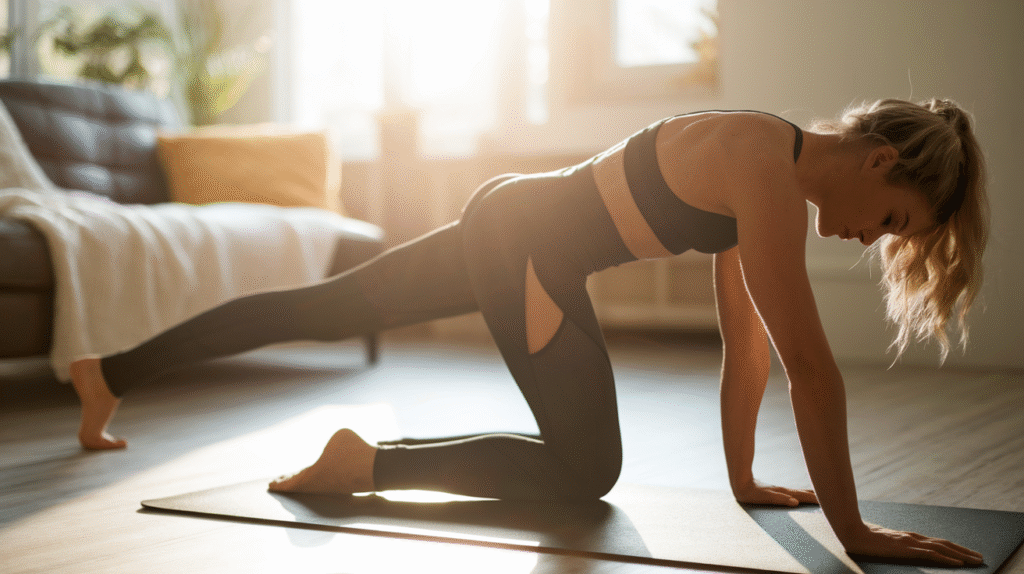
Exercise 1: Bodyweight Squats (The Foundation)
Squats are the cornerstone of any effective glute routine because they engage your entire lower body while placing significant emphasis on your glutes when performed correctly.
Start by standing with your feet slightly wider than hip-width apart, toes pointed forward or angled slightly outward (whatever feels natural for your body). Before you descend, engage your core by pulling your belly button toward your spine—this protects your lower back throughout the movement.
Initiate the squat by pushing your hips back as if you’re sitting into a chair, then bend your knees to lower yourself down. Keep your chest lifted and your weight distributed evenly across your entire foot—don’t let your heels come off the ground. Aim to lower until your thighs are at least parallel to the floor, or as deep as you can go while maintaining proper form.
The key to feeling this in your glutes is the ascent. As you push back up, drive through your heels and really focus on squeezing your glutes at the top. That squeeze activates the gluteus maximus and creates the muscle contraction necessary for growth and toning.
For beginners, start with partial squats and gradually increase your depth as your strength improves. If you’re more advanced, try pausing at the bottom for two seconds before rising, or add a pulse at the bottom for extra burn.
Complete 3 sets of 15-20 reps, resting 45-60 seconds between sets. If you can easily complete 20 reps with perfect form, it’s time to add challenge through tempo changes or single-leg variations.
Exercise 2: Glute Bridges (Lift and Tone)
Glute bridges isolate your glutes more directly than squats, making them essential for building that lifted, rounded shape. This exercise specifically targets the gluteus maximus and teaches you what proper glute engagement feels like.
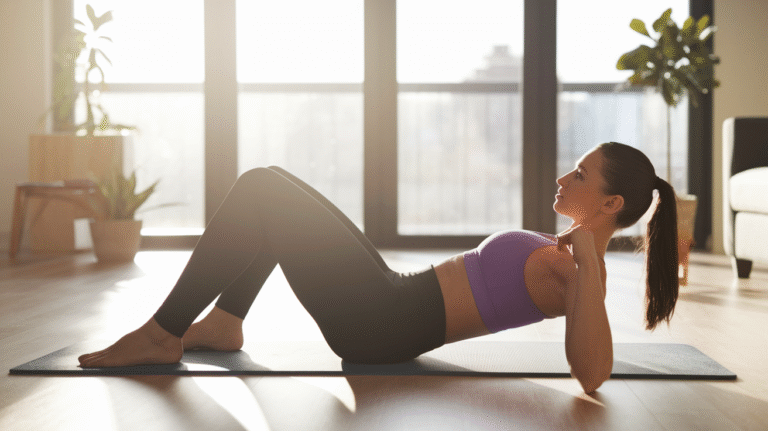
Lie on your back with your knees bent and feet flat on the floor, positioned about hip-width apart. Your feet should be close enough to your butt that you can almost touch your heels with your fingertips. Place your arms flat on the floor beside you for stability.
Press through your heels and lift your hips toward the ceiling, creating a straight line from your knees through your hips to your shoulders. Here’s the crucial part: at the top of the movement, squeeze your glutes as hard as you can for a full second. This intentional contraction is what creates results.
Avoid these common mistakes: don’t arch your lower back at the top (this shifts the work away from your glutes), and don’t push through your toes instead of your heels. If you feel this primarily in your hamstrings or lower back, adjust your foot position—moving your feet slightly closer to your butt typically helps.
Lower your hips back down with control, stopping just before your butt touches the floor, then immediately press back up. This continuous tension keeps your glutes working throughout the entire set.
For progression, try single-leg glute bridges. Extend one leg straight out and perform the bridge on the supporting leg only—this dramatically increases the challenge and helps correct any strength imbalances between sides.
Complete 3 sets of 15-20 reps, or 10-12 reps per leg for single-leg variations. Rest 45 seconds between sets.
Exercise 3: Donkey Kicks (Targeted Sculpting)
Donkey kicks target the gluteus maximus through hip extension while also engaging your core for stability. This exercise sculpts and lifts the lower portion of your glutes, creating that defined separation between your glutes and hamstrings.
Start on all fours in a tabletop position with your hands directly under your shoulders and knees under your hips. Engage your core to keep your spine neutral—don’t let your lower back sag or arch excessively.
Keeping your right knee bent at 90 degrees, lift your right leg up and back, driving your heel toward the ceiling. Think about pushing through your heel rather than pointing your toe—this keeps the emphasis on your glutes rather than your hamstrings. Your thigh should reach roughly parallel to the floor, or slightly higher if your flexibility allows.
At the top of the movement, squeeze your glute hard for one second. This mind-muscle connection is what transforms a simple movement into a glute-building exercise. Lower your knee back down with control, stopping just before it touches the floor, then immediately kick back up.
The most common mistake is swinging the leg up using momentum and arching the lower back. This not only reduces glute activation but also risks lower back strain. Keep the movement controlled and maintain a stable core throughout. If you feel your lower back working more than your glutes, reduce your range of motion and focus on the squeeze at the top.
Complete 3 sets of 15 reps per leg, resting 30-45 seconds between sets. As you get stronger, add a two-second hold at the top of each rep to increase time under tension.
Exercise 4: Fire Hydrants (Complete the Burn)
Fire hydrants are the perfect finishing move because they target the gluteus medius and minimus—the muscles responsible for that rounded, lifted appearance from the side and back. This exercise also improves hip mobility and stability.
Begin in the same tabletop position as donkey kicks, with your hands under your shoulders and knees under your hips. Keep your core engaged and your spine neutral throughout the movement.
Keeping your right knee bent at 90 degrees, lift your right leg out to the side, leading with your knee. Imagine you’re opening your hip like a clamshell. Your knee should travel out to the side and slightly back, reaching roughly hip height at the top of the movement.
The key is maintaining that 90-degree bend in your knee throughout the entire range of motion. Straightening your leg shifts the work away from your glutes and into your hip flexors. At the top, pause and squeeze the outer glute muscle for one second, then lower back down with control.
Keep your hips level—don’t let the lifting side hike up toward your ribcage. This compensatory movement means you’re not engaging your glutes properly. If you struggle with this, reduce your range of motion and focus on moving from your hip joint rather than tilting your entire pelvis.
You should feel this burning on the outer upper portion of your glute. If you feel it primarily in your hip flexor (the front of your hip), you’re likely lifting too high or rotating too far forward.
Complete 3 sets of 15 reps per leg, resting 30-45 seconds between sets. This exercise burns intensely, especially as the final movement in your routine, so embrace that burn—it’s your glutes working hard.
Quick Tips for Maximum Results
Creating Your Perfect Workout Schedule
Consistency beats intensity every single time when it comes to building stronger, more sculpted glutes. Your muscles need both stimulus and recovery to grow, so finding the right balance is essential.
For optimal glute growth, perform this workout three times per week with at least one rest day between sessions. This schedule gives your muscles 48 hours to recover and rebuild stronger. Training the same muscle group on consecutive days doesn’t allow adequate recovery time and can actually slow your progress.
A simple weekly structure looks like this: Monday, Wednesday, and Friday for your glute workouts, with Tuesday, Thursday, and the weekend for rest or other activities like walking, yoga, or upper body training. This approach keeps you active throughout the week while prioritizing glute development.
Progressive overload is how you continue seeing results after those initial weeks. Your body adapts to the stress you place on it, so you need to gradually increase the challenge. At home without weights, you can progress by adding more reps (work up to 25 per set), adding more sets (progress to 4 or 5 sets), slowing down your tempo (try 3 seconds down, 1 second up), or adding pauses and pulses at peak contraction points.
Track your workouts in a simple notebook or phone app. Write down how many reps and sets you complete each session. When you can easily complete all your sets with perfect form, it’s time to increase the difficulty. This systematic approach ensures you’re always challenging your muscles appropriately.
Nutrition Essentials for Glute Building
You can’t out-train a poor diet. Your glutes are muscles, and muscles need proper fuel to grow and recover. Protein plays the starring role in muscle development because it provides the amino acids your body uses to repair and build muscle tissue.
Aim for 0.7-1 gram of protein per pound of body weight daily. For a 150-pound person, that’s 105-150 grams of protein spread throughout the day. Easy protein sources include chicken breast, fish, eggs, Greek yogurt, cottage cheese, beans, lentils, and protein powder if needed.
Simple meal ideas that support glute building: scrambled eggs with vegetables for breakfast, grilled chicken salad for lunch, Greek yogurt with berries as a snack, and salmon with sweet potato and broccoli for dinner. You don’t need complicated meal plans—just focus on including a protein source with each meal and eating enough total calories to support muscle growth.
Hydration matters more than most people realize. Water supports every metabolic process in your body, including muscle recovery and growth. Aim for at least 8 glasses daily, and more on workout days. Dehydration reduces performance and slows recovery, making it harder to see the results you’re working toward.
Don’t forget about recovery nutrition. Eating a combination of protein and carbohydrates within a couple hours after your workout helps replenish energy stores and provides the building blocks your muscles need to repair and grow stronger.
Tracking Your Progress
The scale doesn’t tell the whole story—in fact, it often lies. As you build muscle and lose fat, your weight might stay the same or even increase slightly while your body composition dramatically improves. That’s why you need better ways to track your transformation.
Take before photos from multiple angles: front, side, and back. Wear the same fitted clothing and take photos in the same spot with similar lighting every two weeks. These visual records reveal changes that you can’t see day-to-day when you look in the mirror. The difference between week one and week eight will amaze you.
Measurements provide objective data that the scale can’t. Measure around the fullest part of your glutes (typically across your butt at hip level) and write it down. Measure every two weeks at the same time of day. Even a half-inch increase represents real progress.
Pay attention to non-scale victories: your jeans fitting differently, increased strength (completing more reps or sets), better endurance, improved posture, or reduced lower back pain. These indicators often appear before visual changes and prove that your hard work is paying off.
Celebrate small wins along the way. Completed your first full week of workouts? That’s worth celebrating. Felt your glutes burning more intensely than last week? Progress. Held a single-leg glute bridge for the first time? Victory. These small milestones add up to major transformations, and acknowledging them keeps you motivated through the inevitable plateaus.
Common Mistakes and How to Avoid Them
Form Errors That Sabotage Results
Perfect form isn’t about being a perfectionist—it’s about ensuring the right muscles do the work. Small form breakdowns shift tension away from your glutes and onto other muscles, reducing your results and increasing injury risk.
The biggest mistake is not engaging your core during exercises. Your core stabilizes your spine and pelvis, allowing your glutes to work effectively. Before every single rep, take a breath and brace your core as if someone might poke your stomach. Maintain this tension throughout the movement. When your core disengages, your lower back compensates, which is why so many people feel glute exercises in their back instead of their butt.
Rushing through reps is another result-killer. Fast, bouncy movements use momentum instead of muscle contraction. Slow down. Take 2-3 seconds to lower into each rep, pause briefly at the bottom, then take 1-2 seconds to return to the starting position, finishing with a strong squeeze. This controlled tempo keeps constant tension on your glutes and creates the metabolic stress necessary for growth.
Not feeling the burn in your glutes? Check your mind-muscle connection. Before you start each set, place your hand on your glute and do a few practice squeezes. This tactile feedback helps your brain establish a stronger connection with those muscles. During your workout, actively think about squeezing your glutes with each rep. This conscious focus dramatically increases muscle activation.
Quick fixes for common form issues: If squats hurt your knees, check that your knees track over your toes rather than caving inward, and make sure you’re sitting back into your hips first. If bridges hurt your lower back, tuck your pelvis slightly under and focus on squeezing your glutes rather than arching your spine. If donkey kicks feel awkward, reduce your range of motion and prioritize the squeeze at the top over how high you can lift your leg.
Mindset and Consistency Challenges
You’ve been working out for two weeks and haven’t seen dramatic changes yet. You’re wondering if this routine actually works. Here’s the truth: visible results take time, and expecting overnight transformations sets you up for disappointment and quitting.
Real glute development takes 4-6 weeks of consistent training before you notice visible changes, and 8-12 weeks before others start commenting. Your muscles need time to adapt, grow, and respond to the new stimulus. The people with amazing results you see online? They’ve been training consistently for months or years, not days.
Consistency beats perfection every single time. Three imperfect workouts per week deliver infinitely better results than zero perfect workouts. Missed a workout? Don’t spiral into an all-or-nothing mindset. Just do the next one. Had to modify exercises because something hurt? That’s smart training, not failure. Progress isn’t linear—some weeks you’ll feel strong, others you’ll struggle. Keep showing up anyway.
Motivation fades, but systems last. Don’t rely on feeling motivated to work out. Instead, schedule your workouts like important appointments. Lay out your workout clothes the night before. Create a simple routine: change clothes, press play on your workout playlist, and start your first exercise before your brain can talk you out of it. After a few weeks, working out becomes habit rather than a daily decision.
When progress feels slow, remember why you started. Write down your goals and place them somewhere visible. Take progress photos even when you don’t feel like you’ve changed—the camera captures what your critical eye misses. Connect with others on the same journey through online communities or workout buddies. Shared accountability makes consistency easier.
When to Level Up Your Routine
Your body adapts to challenges, which means the workout that felt impossible in week one will eventually feel manageable. This adaptation is progress, not a sign that the routine stopped working. However, continuous adaptation requires continuous challenge.
Signs you’re ready for added resistance: you can complete all sets with perfect form, you no longer feel significant muscle soreness after workouts, the exercises feel too easy, or you’ve been doing the same routine for 8-12 weeks without changes.
Affordable equipment options for progression include resistance bands (mini bands for fire hydrants and bridges, longer bands for squats), ankle weights for donkey kicks and fire hydrants, or household items like a backpack filled with books for weighted squats and bridges. You don’t need a full home gym—just one or two pieces of equipment can dramatically increase the challenge.
Keep your workouts fresh by changing variables every 4-6 weeks. Adjust your rep ranges (switch from 15-20 reps to 10-12 reps with added resistance), modify your tempo (try 5-second negatives), add isometric holds (pause for 10 seconds at the top of bridges), or incorporate new exercise variations (Bulgarian split squats, curtsy lunges, or single-leg deadlifts).
The key is progressive overload: gradually increasing the demands on your muscles over time. This doesn’t always mean adding weight. Increasing reps, sets, time under tension, or exercise difficulty all create the stimulus your glutes need to continue growing and strengthening.
Conclusion
Your Path to Stronger, Sculpted Glutes Starts Today
You now have everything you need to transform your glutes from the comfort of your home. This complete four-exercise routine—bodyweight squats, glute bridges, donkey kicks, and fire hydrants—targets all three glute muscles for comprehensive development. No gym required, no expensive equipment necessary, just your dedication and consistency.
Remember that building strong, sculpted glutes isn’t about perfection. It’s about showing up three times per week, performing each exercise with proper form, and trusting the process even when results feel slow. Your body is responding to the work you’re putting in, even before you see visible changes. Those muscle fibers are strengthening, neural pathways are forming, and transformation is happening beneath the surface.
Start with three workouts per week, allowing at least one rest day between sessions. Focus on mastering form before worrying about adding resistance or advanced variations. Track your progress through photos, measurements, and strength gains rather than obsessing over the scale. Fuel your body with adequate protein and stay hydrated to support muscle recovery and growth.
Final Motivation
Every single person with amazing glutes started exactly where you are right now—at the beginning, wondering if they could really do this. The only difference between them and you is that they started and didn’t quit. They showed up on the days they didn’t feel like it. They pushed through plateaus. They trusted the process.
Your transformation doesn’t begin when you see results in the mirror—it begins the moment you complete your first workout. That first set of squats, that first glute bridge, that first moment of feeling your muscles burn—that’s when change starts. Every rep you complete is a vote for the stronger, more confident version of yourself you’re becoming.
You have everything you need right now to begin. Your living room is your gym, your body is your equipment, and this routine is your roadmap. No more waiting for the perfect time or the perfect circumstances. The perfect time is now.
Pin this routine, clear some space in your home, and commit to your first workout today. Three times per week for the next month. That’s all you need to do to start seeing real changes. Your glutes—and your future self—will thank you for starting today rather than waiting for tomorrow. Let’s build those glutes together!