Exercises to reduce meno belly fast
You’ve been doing everything right. You’re eating clean, hitting the gym regularly, maybe even cutting calories. But that stubborn belly fat? It’s not budging. In fact, it seems to be growing—settling around your midsection like an unwelcome guest who refuses to leave.
Welcome to the reality of meno belly, the frustrating phenomenon that affects up to 70% of women during menopause. Here’s what you need to know: your body isn’t broken, and you’re not failing.
Your hormones have fundamentally changed how your body stores fat, and that means your old workout routine needs a complete overhaul.
I’m not going to promise you’ll lose 10 pounds in 10 days or that some magic exercise will melt belly fat overnight. But I will show you the proven, science-backed exercises that target hormonal belly fat effectively.
These strategies work with your changing body, not against it. You’ll build strength, boost your metabolism, and finally see that stubborn midsection start to transform.
The key word here is “fast”—but let’s be realistic. For menopausal bodies, fast means consistent results over weeks, not days. We’re talking about sustainable fat loss that actually stays off, not water weight that returns the moment you eat a normal meal. Ready to understand what your body actually needs right now? Let’s get started.
Understanding Meno Belly: Why Traditional Exercises Aren’t Enough

The Hormonal Shift That Changes Everything
Your body is experiencing the most dramatic hormonal shift since puberty, and it’s rewriting the rules for where fat gets stored. During menopause, estrogen levels can drop by up to 60%, and this decline triggers a cascade of metabolic changes that directly impact your waistline.
Here’s what’s happening: estrogen doesn’t just control your reproductive system—it’s a master regulator of fat distribution. When levels plummet, your body shifts from storing fat in your hips and thighs (the pear shape) to storing it around your abdomen (the apple shape). This isn’t just cosmetic—visceral belly fat surrounds your organs and increases health risks.
The cortisol connection makes everything worse. Stress hormones rise during menopause, partly because your body is stressed from the hormonal changes themselves. High cortisol levels signal your body to store more abdominal fat, creating a vicious cycle. Every stressful day at work, every sleepless night, every worry about your changing body adds to the problem.
But here’s the empowering truth: your body isn’t broken; it’s adapting. And once you understand these changes, you can design a workout strategy that works with your hormones, not against them. The exercises I’m about to share target these specific hormonal challenges head-on.
Why Your Old Workout Routine Stopped Working
Remember when you could skip a few meals or add an extra cardio class and watch the pounds melt off? Those days are gone, and there’s solid science explaining why. Starting around age 40, women lose approximately 5% of their muscle mass per decade—and menopause accelerates this loss dramatically.
Less muscle means a slower metabolism. Your body burns fewer calories at rest, and that morning jog that used to keep you lean? It’s not creating the same calorie deficit anymore. Research shows that metabolic rate can decrease by 200-300 calories per day during menopause. That’s like eating an extra snack every single day without changing your diet.
Insulin resistance increases during menopause, making your body less efficient at processing carbohydrates and more likely to store them as belly fat. Your cells become less responsive to insulin’s signals, so glucose stays in your bloodstream longer and eventually gets converted to fat—primarily around your midsection.
Traditional cardio doesn’t address the inflammation factor that drives hormonal belly fat. While that hour on the treadmill burns calories, it doesn’t build the muscle you desperately need or reduce the inflammatory markers that make fat loss harder. In fact, excessive steady-state cardio can actually increase cortisol levels, making meno belly worse.
Let’s talk about realistic expectations. “Fast” results for menopausal bodies means seeing noticeable changes in 4-6 weeks with consistent effort. You might lose 1-2 pounds per week initially, with measurements around your waist decreasing even when the scale doesn’t move much. This is sustainable, healthy fat loss—not the dramatic water weight drops that disappear as quickly as they came.
What Your Body Actually Needs Now
Your menopausal body requires a completely different approach: a powerful combination of resistance training, strategic cardio, and flexibility work. This isn’t about doing more exercise—it’s about doing smarter exercise that addresses your specific hormonal challenges.
Resistance training becomes non-negotiable. Building and maintaining muscle is your secret weapon against metabolic slowdown. Every pound of muscle you build burns approximately 6 calories per day at rest, while fat burns only 2 calories. Multiply that across your entire body, and you’re looking at a significant metabolic boost.
The importance of muscle-building over pure calorie burning cannot be overstated. A 30-minute strength session might burn fewer calories during the workout than a 30-minute run, but it keeps your metabolism elevated for up to 48 hours afterward. This “afterburn effect” is what actually transforms your body composition.
Why consistency beats intensity for hormonal belly fat: Your cortisol-sensitive body doesn’t respond well to extreme workouts that spike stress hormones. Instead, moderate-intensity exercise performed consistently—4-5 times per week—delivers better results than occasional intense sessions that leave you exhausted and inflamed.
Setting yourself up for sustainable success means abandoning the quick-fix mentality. The exercises I’m about to share work, but only if you commit to them for at least 6-8 weeks. Your body needs time to build muscle, adjust metabolism, and start mobilizing stubborn fat stores. This is about creating a new lifestyle, not following another temporary diet and exercise plan.
The Foundation: Powerful Core-Strengthening Exercises

Dead Bug Variations (The Meno Belly Destroyer)
The dead bug exercise might look simple, but it’s one of the most effective movements for targeting the deep core muscles that support and flatten your midsection. Unlike crunches that only work surface muscles, dead bugs engage your transverse abdominis—the deep muscle layer that acts like a natural corset around your waist.
Here’s how to perform the basic dead bug: Lie on your back with arms extended straight up toward the ceiling and knees bent at 90 degrees, shins parallel to the floor. Press your lower back firmly into the mat—this is crucial. Slowly extend your right arm overhead while straightening your left leg, hovering it a few inches above the floor. Return to start and repeat on the opposite side. That’s one rep.
Why this exercise targets a hormonal belly: Dead bugs force your core to resist movement and maintain stability, building functional strength that translates to a tighter, flatter midsection. The anti-extension pattern directly combats the lower belly pooch that’s so common during menopause.
Progression options include adding a light dumbbell in your hands, slowing down the tempo to 3-4 seconds per rep, or holding the extended position for 2-3 seconds. Start with 3 sets of 10-12 reps, performed 3 times per week. Within two weeks, you’ll notice improved core control and a tighter feeling in your midsection.
Common mistakes to avoid: Don’t let your lower back arch off the floor—that means your hip flexors are taking over and your core isn’t working properly. Don’t hold your breath; exhale as you extend your limbs and inhale as you return to start. And don’t rush through the movement—controlled, deliberate reps deliver results.
Plank Series for Deep Abdominal Engagement
Planks have earned their reputation as a core-sculpting powerhouse, but time under tension matters more than duration. A 30-second plank performed with perfect form and maximum muscle engagement beats a sloppy 2-minute plank every time.
Standard plank with proper form: Start in a forearm plank position with elbows directly under shoulders, body forming a straight line from head to heels. Engage your core by pulling your belly button toward your spine. Squeeze your glutes, press your forearms into the floor, and don’t let your hips sag or pike up. Breathe steadily—never hold your breath.
Side planks to sculpt obliques and reduce love handles: Lie on your side with your elbow under your shoulder, feet stacked. Lift your hips until your body forms a straight line. This variation targets the obliques that define your waistline and reduce the muffin-top effect. Hold for 20-30 seconds per side, working up to 45-60 seconds.
Plank shoulder taps add dynamic core stability: From a high plank position (hands instead of forearms), lift one hand to tap the opposite shoulder while keeping your hips absolutely still. This anti-rotation challenge forces your deep core muscles to work overtime, building the kind of strength that flattens your belly.
Realistic starting point: Begin with 20-30 second holds, focusing on quality over quantity. Rest 30-60 seconds between sets, and perform 3 sets of each variation. Build gradually to 60-second holds over 4-6 weeks. Your core will strengthen faster than you expect.
Modification for beginners: Knee planks are completely legitimate and effective. Drop to your knees while maintaining that straight line from head to knees. You’ll still engage your core effectively while building the strength needed for full planks.
Bird Dog Exercise for Core Stability
The bird dog is a functional exercise that builds real-world core strength—the kind that helps you lift groceries, play with grandkids, and move through daily life without back pain. It engages your entire core, not just the front abs, creating balanced strength that supports a flatter midsection.
Complete form breakdown: Start on hands and knees with hands under shoulders and knees under hips. Engage your core by drawing your belly button up toward your spine. Simultaneously extend your right arm forward and left leg back, creating a straight line from fingertips to toes. Hold for 2-3 seconds, focusing on keeping your hips level and spine neutral. Return to start and switch sides.
Breathing cues matter: Exhale as you extend your limbs, inhale as you return to start. This breathing pattern enhances core engagement and prevents you from holding your breath, which can spike blood pressure.
Why this exercise builds functional strength: Bird dogs train your core to stabilize your spine during movement—exactly what you need for daily activities. This translates to better posture, less back pain, and a naturally flatter-looking midsection as your core learns to engage properly throughout the day.
Progressive overload options: Once you can perform 10-12 smooth reps per side, add challenge by placing a light dumbbell in your extended hand or an ankle weight on your extended leg. You can also slow down the tempo to 5 seconds per rep or add small pulses at the top of the movement.
Recommended frequency: Practice bird dogs daily if possible, performing 2-3 sets of 8-10 reps per side. This exercise is gentle enough for daily practice while still delivering powerful core-strengthening benefits.
Resistance Training: The Secret Weapon to Burn Belly Fat

Why Lifting Weights Transforms Your Menopausal Body
Resistance training is the single most effective tool for combating meno belly, and the science backs this up completely. When you lift weights, you’re not just burning calories during the workout—you’re fundamentally changing your body composition and metabolic rate.
Muscle tissue burns more calories at rest than fat—about three times more. Every pound of muscle you build increases your resting metabolic rate, meaning you burn more calories while sitting at your desk, watching TV, or sleeping. For menopausal women fighting metabolic slowdown, this is game-changing.
Resistance training directly combats the muscle loss caused by declining hormones. Without intervention, you’ll lose that 5% of muscle mass per decade, and menopause accelerates this loss. But studies show that women who strength train 2-3 times per week can actually build muscle during menopause, reversing the age-related decline.
The “afterburn effect” is real and powerful. After a resistance training session, your metabolism stays elevated for 24-48 hours as your body repairs muscle tissue and replenishes energy stores. This excess post-exercise oxygen consumption (EPOC) means you’re burning extra calories long after you’ve left the gym.
Let’s debunk the myth once and for all: you won’t get bulky from lifting weights. Women don’t have enough testosterone to build large, bulky muscles without extreme effort and specific programming. What you will get is toned, defined muscles that create a lean, sculpted appearance and a metabolism that actually works in your favor.
Compound Movements That Shred Meno Belly
Squats: The Foundation Exercise
Squats are the king of lower body exercises, but they’re also a powerful core strengthener and belly fat burner. When you squat properly, your core muscles engage intensely to stabilize your spine and maintain balance throughout the movement.
Proper form starts with feet hip-width apart, toes slightly turned out. Keep your chest up and core engaged as you push your hips back and bend your knees, lowering until your thighs are parallel to the floor (or as low as comfortable). Drive through your heels to stand back up, squeezing your glutes at the top.
Variations include goblet squats (holding a dumbbell at chest height), sumo squats (wider stance targeting inner thighs), and split squats (one leg elevated behind you). Each variation challenges your core differently while building lower body strength.
Starting protocol: Perform 3 sets of 12-15 reps, 2-3 times per week. Begin with bodyweight only until your form is perfect, then add weight gradually—5-10 pounds every 2-3 weeks.
Deadlifts: The Full-Body Fat Burner
Deadlifts are a game-changer for hormonal belly fat because they engage virtually every muscle in your body, creating a massive metabolic demand. Your core works overtime to stabilize your spine, building the kind of deep strength that flattens your midsection.
Step-by-step form: Stand with feet hip-width apart, dumbbells or kettlebell in front of you. Hinge at your hips, pushing them back while keeping your back flat and chest up. Grip the weight and drive through your heels to stand up, squeezing your glutes at the top. Lower with control by pushing your hips back again.
Romanian deadlift variation for beginners: Keep a slight bend in your knees throughout the movement and focus on the hip hinge pattern. This variation is easier to learn and still delivers powerful results.
Core engagement cues: Before you lift, brace your core as if someone’s about to punch you in the stomach. Maintain this tension throughout the entire movement. This protects your back and maximizes belly fat-burning benefits.
Overhead Press: The Standing Core Challenge
Standing overhead presses force your core to stabilize your entire body while your arms work, creating a powerful combination for belly fat reduction. The standing version burns more calories and engages your core more intensely than the seated version.
How to perform: Stand with feet hip-width apart, holding dumbbells at shoulder height. Brace your core and press the weights straight overhead until your arms are fully extended. Lower with control back to shoulder height. Keep your ribs down and avoid arching your back—this is key for core engagement.
Weight selection guide: Start with 5-10 pound dumbbells and focus on perfect form. You should be able to complete 10-12 reps with the last 2-3 feeling challenging but not impossible. Increase weight by 2.5-5 pounds when you can easily complete 15 reps.
Targeted Resistance Exercises for Abdominal Sculpting
Pallof Press: The Anti-Rotation Powerhouse
The Pallof press is superior to traditional crunches because it builds anti-rotation strength—your core’s ability to resist twisting forces. This creates deep, functional core strength that translates to a flatter, more stable midsection.
Using resistance bands at home: Anchor a resistance band at chest height (doorway anchor works perfectly). Stand sideways to the anchor point, holding the band handle at your chest with both hands. Press your hands straight out in front of you, resisting the band’s pull to rotate your torso. Hold for 2-3 seconds, then return to chest. That’s one rep.
Why this exercise works: Your obliques and transverse abdominis fire intensely to keep your torso stable, building the kind of core strength that actually shows. Sets and reps: 3 sets of 10-12 per side, 2-3 times per week.
Farmer’s Carries: The Walking Fat Burner
Farmer’s carries are deceptively simple but incredibly effective for burning belly fat and building core strength. You’re simply walking while carrying heavy weights, but your core must engage intensely to keep your torso upright and stable.
How to perform: Grab heavy dumbbells, kettlebells, or even heavy household items (gallon water jugs work). Stand tall with weights at your sides, core braced. Walk forward with controlled steps, maintaining perfect posture—shoulders back, chest up, core tight. Walk 30-50 feet, rest, and repeat.
Core engagement throughout: The constant tension required to stabilize your spine while carrying heavy loads builds incredible core endurance and strength. Distance and weight recommendations: Start with 20-30 pound weights per hand and walk 30 feet. Build up to 40-50 feet over several weeks, then increase weight.
Cardio Strategies That Actually Work for Meno Belly

HIIT: High-Intensity Interval Training (Modified for Menopause)
HIIT is more effective than steady-state cardio for hormonal belly fat, but the key word here is “modified.” Traditional HIIT can spike cortisol levels too high for menopausal bodies, so we’re using a gentler approach that still delivers powerful fat-burning benefits.
The science is clear: interval training boosts metabolism more effectively than steady cardio, increases insulin sensitivity, and burns more belly fat specifically. A study in the Journal of Obesity found that HIIT reduced visceral belly fat by 17% more than steady-state cardio over 12 weeks.
Beginner-friendly HIIT protocol: Work for 20-30 seconds at moderate-high intensity, then recover for 40-60 seconds at low intensity. This ratio keeps cortisol in check while still providing metabolic benefits. Total workout time: 15-20 minutes including warm-up and cool-down.
Sample workout using bodyweight exercises you can do anywhere: – Marching in place with high knees: Lift knees to hip height, pumping arms vigorously – Modified burpees: Step back to plank position instead of jumping, step forward and stand up – Standing mountain climbers: Stand tall and drive alternating knees toward chest quickly – Squat to overhead reach: Squat down, then stand and reach arms overhead explosively
Perform each exercise for 30 seconds, rest 45 seconds, then move to the next exercise. Complete 3-4 rounds total. Frequency: 2-3 times per week on non-consecutive days. Your body needs recovery time to adapt and burn fat effectively.
Walking: The Underrated Belly Fat Burner
Don’t underestimate the power of walking for reducing meno belly. Walking keeps you in the “fat-burning zone” where your body preferentially burns fat for fuel rather than carbohydrates. For menopausal women, this zone becomes increasingly important as insulin resistance rises.
Why brisk walking is perfect for menopausal bodies: It doesn’t spike cortisol levels, it’s low-impact on aging joints, and it’s sustainable long-term. You can walk daily without overtraining, and consistency is what drives results for hormonal belly fat.
Power walking technique for maximum results: Walk with purpose—aim for 3-4 miles per hour. Pump your arms vigorously (bent at 90 degrees), engage your core by pulling your belly button toward your spine, and take quick, purposeful steps. This turns a casual stroll into a serious fat-burning workout.
Incline walking is the secret weapon that transforms walks into powerful workouts. Walking uphill or on a treadmill incline increases calorie burn by 50-70% compared to flat walking. If you’re on a treadmill, set the incline to 5-8% and walk at a brisk pace. If you’re outside, seek out hilly routes.
Daily goal: Build up to 7,000-10,000 steps per day. Start where you are—even 5,000 steps is beneficial—and add 500-1,000 steps per week. Track your steps with a smartphone or fitness tracker, and make walking a non-negotiable part of your daily routine.
Metabolic Conditioning Circuits
Metabolic conditioning circuits combine strength and cardio into efficient workouts that build muscle while burning fat. For busy women dealing with meno belly, these 15-20 minute circuits deliver maximum results in minimum time.
What metabolic conditioning means for meno belly: You’re performing resistance exercises back-to-back with minimal rest, keeping your heart rate elevated throughout. This creates a powerful metabolic stimulus that burns calories during the workout and keeps your metabolism elevated for hours afterward.
Sample 15-minute circuit requiring no equipment:
1. Bodyweight squats (45 seconds): Focus on depth and control 2. Push-ups (45 seconds): Modified on knees if needed, maintain straight body line 3. Reverse lunges (45 seconds): Alternate legs, step back and lower until front thigh is parallel 4. Plank holds (45 seconds): Maintain perfect form, breathe steadily 5. Glute bridges (45 seconds): Lie on back, drive through heels to lift hips, squeeze glutes at top
How to structure: Perform each exercise for 45 seconds, rest 15 seconds, then immediately move to the next exercise. After completing all five exercises, rest 60-90 seconds. Complete 3 full rounds.
Why these circuits build muscle while burning fat: The combination of resistance exercises performed at a cardio pace creates a unique metabolic demand. You’re building strength and endurance simultaneously while keeping your heart rate in the optimal fat-burning zone. Perform these circuits 2-3 times per week for best results.
Flexibility and Stress-Reduction Exercises
Yoga Poses That Target Belly Fat
The cortisol-belly fat connection makes stress reduction essential for losing meno belly. Yoga addresses this by lowering cortisol levels while simultaneously engaging and strengthening your core muscles. It’s a two-pronged approach that tackles hormonal belly fat from both angles.
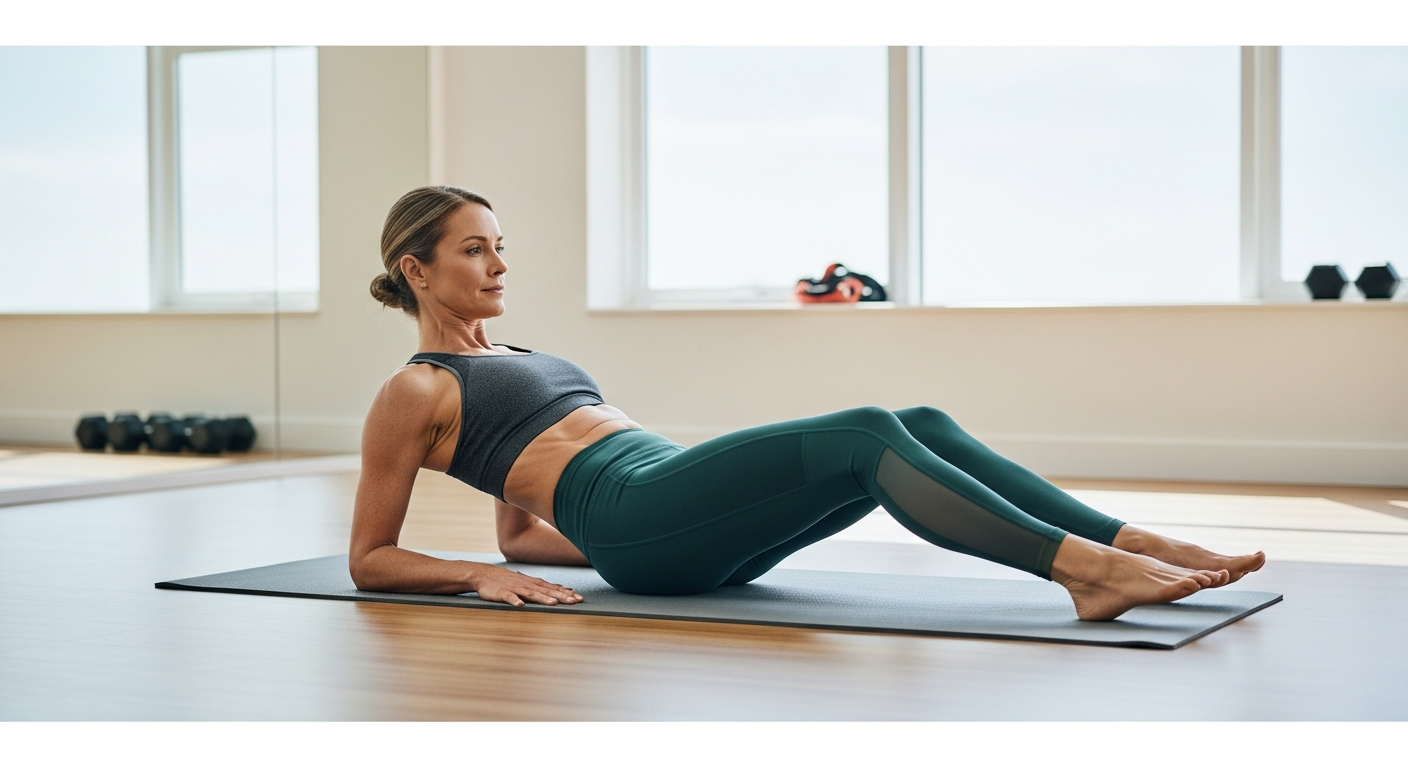
Boat Pose (Navasana) is a powerful core strengthener that targets your entire abdominal region. Sit on the floor with knees bent, feet flat. Lean back slightly and lift your feet off the floor, extending legs to form a V-shape with your body. Extend arms forward parallel to the floor. Hold for 20-30 seconds, working up to 60 seconds. Your core will burn intensely—that’s the deep muscles engaging.
Plank to Downward Dog Flow creates dynamic core engagement while building upper body strength. Start in a high plank, hold for 5 breaths, then push your hips up and back into downward dog. Hold for 5 breaths, then return to plank. This flow forces your core to stabilize through different positions, building functional strength.
Bridge Pose activates your lower belly and glutes while opening your hip flexors (which often become tight during menopause). Lie on your back with knees bent, feet flat on the floor hip-width apart. Press through your heels to lift your hips toward the ceiling, squeezing your glutes at the top. Hold for 30-60 seconds, breathing deeply.
Seated Spinal Twists improve digestion and tone obliques. Sit with legs extended, bend right knee and place right foot outside left thigh. Twist to the right, placing left elbow outside right knee. Hold for 5-10 breaths, then switch sides. The twisting motion massages internal organs and engages your obliques.
Recommended practice: 15-20 minutes, 4-5 times per week. Morning yoga sessions are particularly effective for setting a calm, low-cortisol tone for your entire day.
Pilates-Inspired Moves for a Toned Midsection
The Hundred is the classic Pilates exercise for deep abdominal engagement. Lie on your back, lift your head and shoulders off the mat, and extend legs to 45 degrees (or keep knees bent for modification). Pump arms up and down vigorously while breathing—5 short inhales through your nose, 5 short exhales through your mouth. That’s one set of 10 pumps. Build up to 100 pulses total (10 breaths).
Modifications for different fitness levels: Beginners keep knees bent at 90 degrees. Intermediate extends legs to 45 degrees. Advanced lowers legs closer to the floor while maintaining lower back contact with the mat.
Breathing pattern that enhances results: The rhythmic breathing pattern increases oxygen flow and enhances core engagement. Never hold your breath—the breathing is as important as the movement.
Roll-Ups sculpt your entire core through controlled spinal articulation. Lie flat with arms extended overhead. Slowly roll up one vertebra at a time, reaching toward your toes. Roll back down with the same control. Why slow and controlled beats fast and sloppy: The controlled movement forces your deep core muscles to work throughout the entire range of motion.
Regression for beginners: Bent-knee roll-ups reduce the difficulty while still providing excellent core work. You can also use a resistance band around your feet to assist the upward movement.
Leg Circles target your lower belly while challenging hip stability. Lie on your back with one leg extended toward the ceiling. Draw small circles with your leg (about the size of a dinner plate), keeping your hips absolutely still. This stabilization challenge forces your deep core muscles to engage intensely.
Sets and reps: Perform 2 sets of 8-10 circles in each direction per leg. Focus on keeping your lower back pressed to the mat and your hips stable—that’s where the core work happens.
The Power of Breathwork for Belly Fat
Diaphragmatic breathing reduces cortisol levels by activating your parasympathetic nervous system—your body’s “rest and digest” mode. High cortisol is a major driver of meno belly, so this simple practice delivers surprisingly powerful results.
How proper breathing engages transverse abdominis: When you breathe deeply into your belly, your diaphragm descends and your transverse abdominis (your deepest core muscle) engages to control the movement. This constant engagement throughout the day naturally tones your midsection.
5-minute daily practice that complements your workouts: Sit or lie comfortably. Place one hand on your chest, one on your belly. Inhale deeply through your nose for 4 counts, feeling your belly rise while your chest stays relatively still. Hold for 2 counts. Exhale slowly through your mouth for 6 counts, feeling your belly fall. Repeat for 5 minutes.
Belly breathing technique step-by-step: The key is making your exhale longer than your inhale—this activates the relaxation response and lowers cortisol. Practice this daily, ideally in the morning and before bed. Over time, this breathing pattern will become automatic, keeping your stress hormones in check throughout the day.
The 7-Day Meno Belly Workout Plan
You have all the exercises—now let’s put them together into a structured weekly plan that delivers results. This plan balances resistance training, cardio, flexibility, and recovery to optimize fat loss while preventing overtraining and cortisol spikes.
Monday: Full-Body Resistance Training – Warm-up: 5 minutes of brisk walking or marching in place – Squats: 3 sets of 12-15 reps – Deadlifts: 3 sets of 10-12 reps – Overhead Press: 3 sets of 10-12 reps – Dead Bugs: 3 sets of 10-12 reps – Plank: 3 sets of 30-45 seconds – Cool-down: 5 minutes of stretching
Tuesday: HIIT Cardio + Core – Warm-up: 5 minutes of easy movement – HIIT Circuit: 30 seconds work, 45 seconds rest, 4 rounds – High knees marching – Modified burpees – Standing mountain climbers – Squat to overhead reach – Core Finisher: – Bird Dogs: 2 sets of 10 reps per side – Pallof Press: 2 sets of 12 reps per side – Cool-down: 5 minutes of stretching
Wednesday: Active Recovery + Yoga – 20-30 minutes of gentle yoga focusing on: – Boat pose: 3 sets of 30 seconds – Bridge pose: 3 sets of 45 seconds – Seated spinal twists: Hold each side for 10 breaths – Plank to downward dog flow: 5 rounds – 5 minutes of diaphragmatic breathing
Thursday: Metabolic Conditioning Circuit – Warm-up: 5 minutes of dynamic movement – Circuit (45 seconds work, 15 seconds rest, 3 rounds): – Bodyweight squats – Push-ups – Reverse lunges – Plank holds – Glute bridges – Farmer’s Carries: 3 sets of 40-50 feet – Cool-down: 5 minutes of stretching
Friday: Lower Body + Core Focus – Warm-up: 5 minutes – Goblet Squats: 3 sets of 12-15 reps – Romanian Deadlifts: 3 sets of 12 reps – Side Planks: 3 sets of 30 seconds per side – Pilates Hundred: Build to 100 pulses – Leg Circles: 2 sets of 10 circles each direction per leg – Cool-down: 5 minutes of stretching
Saturday: Steady-State Cardio – 30-45 minutes of brisk walking (include hills or incline) – Focus on power walking technique – Optional: Add 10 minutes of gentle yoga or stretching afterward
Sunday: Complete Rest or Gentle Movement – Full rest day, or – 20 minutes of gentle yoga and breathwork – Focus on recovery and stress reduction
Key Guidelines for Success: – Never skip warm-ups or cool-downs—they’re essential for injury prevention – Start with lighter weights and perfect your form before progressing – If you’re exhausted or extremely sore, take an extra rest day – Aim for 7-9 hours of sleep nightly—this is when fat loss actually happens – Stay hydrated: drink half your body weight in ounces of water daily – Track your workouts and progress—what gets measured gets managed
Progression Strategy: – Weeks 1-2: Focus on learning proper form, use lighter weights – Weeks 3-4: Increase weights by 5-10%, improve plank hold times – Weeks 5-6: Add extra sets or reps, decrease rest periods slightly – Weeks 7-8: Evaluate results, adjust based on what’s working best for your body
What to Expect: – Week 1-2: You’ll feel stronger and more energized, but may not see visible changes yet – Week 3-4: Clothes start fitting better, measurements decrease even if scale doesn’t move much – Week 5-6: Visible reduction in belly fat, increased muscle definition – Week 7-8: Significant improvements in strength, endurance, and body composition
Remember: consistency beats perfection. Missing one workout won’t derail your progress, but missing consistently will. Show up, do the work, and trust the process.
—
Your Meno Belly Transformation Starts Today
You now have the complete blueprint for reducing meno belly fast—the science-backed exercises, the structured workout plan, and the realistic expectations that set you up for sustainable success. No gimmicks, no false promises, just proven strategies that work with your changing hormonal landscape.
Here’s the truth: your body is different now, but it’s not broken. The exercises in this plan target the specific metabolic and hormonal challenges of menopause. Resistance training builds the muscle that revs your metabolism. Strategic cardio burns fat without spiking cortisol. Core work strengthens and flattens your midsection from the inside out. And flexibility practices reduce the stress hormones that drive belly fat storage.
The women who get the best results are the ones who commit fully for at least 8 weeks. They don’t expect overnight miracles, but they show up consistently, follow the plan, and trust the process. They celebrate non-scale victories—jeans fitting better, increased energy, improved strength—because they understand that transformation happens gradually, then suddenly.
Start with the 7-day plan above. Follow it for one week, then repeat for at least 8 weeks. Take progress photos and measurements every two weeks. Notice how your clothes fit, how you feel, how much stronger you’re becoming. These indicators matter more than the number on the scale.
Your meno belly doesn’t have to be permanent. With the right exercises, consistent effort, and patience with your body’s timeline, you can transform your midsection and reclaim your confidence. The power is in your hands—literally. Pick up those weights, roll out that yoga mat, and take the first step today.
You’ve got this. Now go prove it to yourself.