Chair Pilates for beginners over 40: Master Seated core
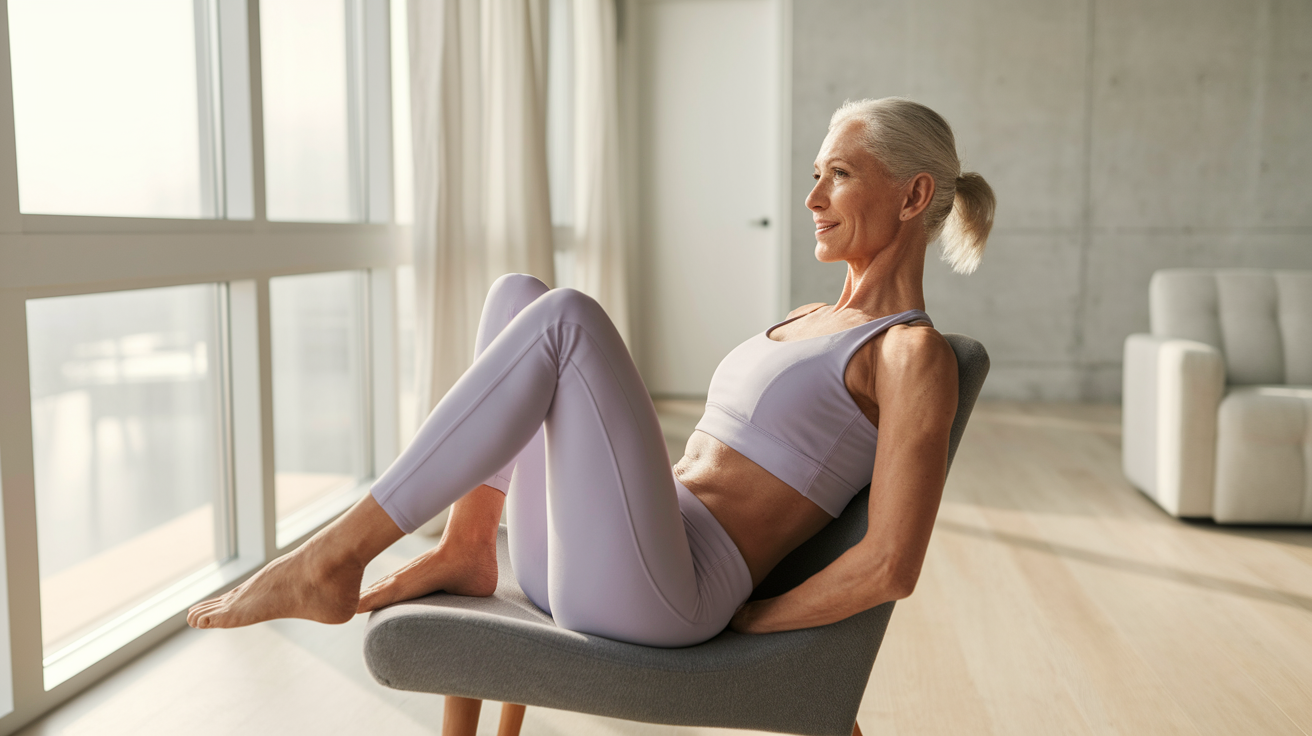
Getting down on the floor for a workout sounds simple until you’re over 40 and suddenly it’s not. The struggle to lower yourself down, the discomfort on your knees, the awkward moment when you’re trying to get back up—it’s enough to make anyone skip their workout entirely.
Here’s the truth: You don’t need to do a single floor exercise to build a strong, functional core.
Chair Pilates delivers all the core-strengthening benefits of traditional Pilates without requiring you to get down on the ground. This proven method has transformed fitness for thousands of people over 40 who want real results without the barriers that come with floor-based routines.
This complete guide walks you through everything you need to know about chair Pilates for your core. You’ll discover why seated exercises are perfect for your body after 40, learn the essential movements that target deep abdominal muscles, and get a simple weekly routine you can start today. No special equipment needed—just a sturdy chair and 15 minutes of your time.
The best part? Chair Pilates meets you exactly where you are. Whether you’re dealing with joint concerns, recovering from an injury, or simply want a more accessible way to strengthen your core, this approach works with your body instead of against it.
Why Chair Pilates is Perfect for Your Core After 40
The Essential Benefits of Seated Core Work
Chair Pilates removes every obstacle that makes traditional floor workouts challenging. You stay seated throughout your entire session, which means no painful transitions, no pressure on your knees or wrists, and no struggling to get up when you’re done. This low-impact approach protects your joints while building genuine strength where it matters most.
Research shows that seated Pilates exercises effectively engage the same deep core muscles as floor-based movements—specifically the transverse abdominis and internal obliques that stabilize your spine and support everyday movement. The difference is you’re working from a supported position that allows you to focus entirely on proper form and muscle engagement.
Your posture improves dramatically with consistent chair Pilates practice. As we age, we naturally tend toward forward head posture and rounded shoulders from years of sitting, driving, and looking at screens. Seated core exercises counteract these patterns by strengthening the muscles that hold you upright and teaching your body what proper alignment feels like.
The convenience factor matters too. You can do chair Pilates anywhere—at home in your living room, in your office during lunch break, or even in a hotel room when traveling. No yoga mat required, no clearing floor space, no excuses.
How Chair Pilates Targets Your Core Differently
Chair Pilates emphasizes controlled, precise movements that wake up muscles you might not even realize you have. Unlike crunches or sit-ups that focus on the superficial “six-pack” muscles, seated Pilates work targets the deeper stabilizing muscles that actually support your spine and improve functional strength for daily activities.
The seated position creates a unique challenge for your core. Without the support of lying on your back, your abdominal muscles must constantly engage to maintain your upright posture while performing movements. This constant engagement builds endurance alongside strength.
Breath work forms the foundation of every chair Pilates exercise. You’ll learn to coordinate your breathing with movement, which increases oxygen flow to working muscles and enhances the mind-body connection. This focused breathing also activates your deepest core muscles—the ones that traditional ab exercises often miss.
Balance and stability improve naturally through chair Pilates because many exercises challenge your body to maintain position while moving your limbs. This translates directly to better balance in everyday life, reducing fall risk and increasing confidence in your movements.
Why Traditional Floor Pilates Isn’t Always the Answer
Floor-based Pilates classes often move quickly through transitions that assume everyone can easily get down and up from the ground. For many people over 40, these transitions become the workout itself—and not in a good way. You spend more energy and mental focus on the logistics of moving positions than on the actual exercises.
Joint concerns make floor work genuinely uncomfortable for many beginners. Pressure on knees during kneeling exercises, strain on wrists during plank variations, or discomfort in the lower back during supine movements can all create barriers to consistent practice. Chair Pilates eliminates these pressure points entirely.
The intimidation factor is real. Walking into a Pilates class and seeing complex floor routines can make beginners feel like they’re starting ten steps behind everyone else. Chair modifications make Pilates approachable and achievable from day one, building confidence instead of frustration.
You get identical core-strengthening benefits from chair Pilates—the research backs this up. A study published in the Journal of Physical Therapy Science found that seated Pilates exercises produced comparable improvements in core strength and stability as traditional floor-based programs. The key difference? Participants reported higher adherence rates and greater enjoyment with the seated approach.
Getting Started: Simple Setup and Safety Tips
Choosing the Right Chair for Your Workout
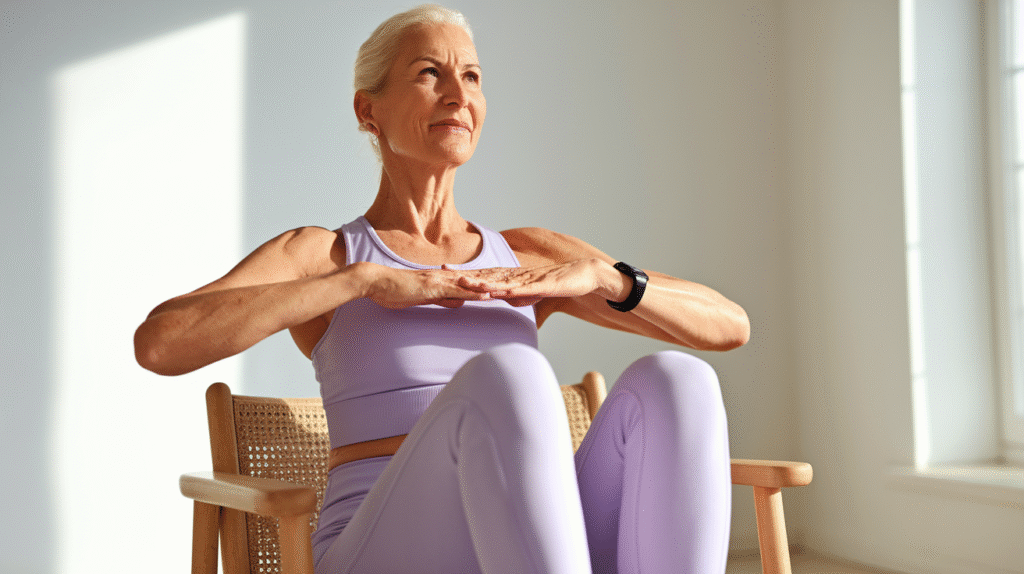
Your chair makes all the difference in your chair Pilates practice. Look for a sturdy, stable chair without arms—armrests limit your range of motion and get in the way of many exercises. The chair should feel solid and secure, never wobbly or unstable.
The ideal seat height allows your feet to rest completely flat on the floor with your knees at approximately 90-degree angles. If you’re shorter, you might need a cushion under your feet to achieve proper positioning. If you’re taller, a slightly higher chair works better than one that’s too low.
Avoid chairs with wheels, excessive cushioning, or reclining backs. You want a firm, flat seat that doesn’t sink when you sit on it. Most standard kitchen or dining room chairs work perfectly. Office chairs typically have too much cushioning and mobility for effective Pilates work.
Test your chair before starting: Sit on it and rock gently side to side. It shouldn’t tip, slide, or feel unstable in any way. Your safety depends on a solid foundation, so take this selection seriously.
Essential Posture and Positioning Basics
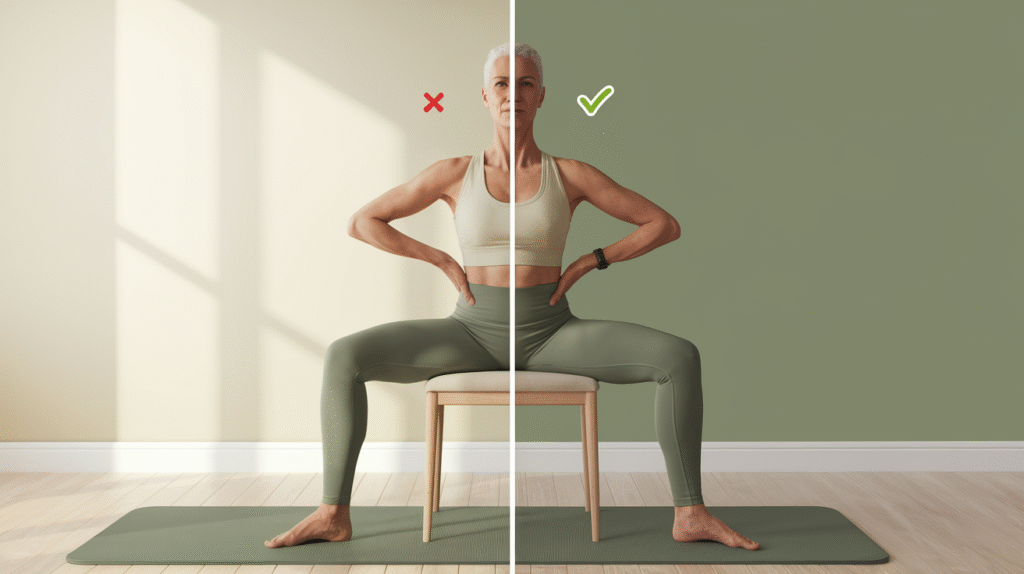
Proper positioning transforms ordinary sitting into an active, core-engaging foundation for your workout. Sit toward the front half of your chair seat—roughly the front third or half. This positioning allows your pelvis to tilt naturally and gives you room to move without the chair back getting in your way.
Place your feet hip-width apart with your entire foot—heel to toe—firmly planted on the floor. This stable base supports balance and allows you to engage your leg muscles when needed. Your knees should point forward, aligned with your hips and ankles.
Imagine a string attached to the crown of your head, gently pulling you upward toward the ceiling. This visualization helps you sit tall without straining. Your spine should feel long and lifted, not collapsed or rigid. Think “lengthening” rather than “stiffening.”
Relax your shoulders down and back, away from your ears. Many people carry tension in their shoulders, which interferes with proper breathing and core engagement. Roll your shoulders up, back, and down a few times to release tension before starting your exercises.
Engage your core gently—about 30% of your maximum contraction. You’re not trying to pull your belly button to your spine or hold your breath. Instead, think about drawing your lower abdominal muscles slightly inward and upward, creating a sense of support around your midsection.
Quick Safety Guidelines for Beginners
Start slowly and build gradually. Your first few sessions should feel almost too easy—that’s perfect. You’re teaching your body new movement patterns and building awareness of muscles you might not have consciously engaged before. Speed and intensity come later, after you’ve mastered the basics.
Never hold your breath during exercises. Breath-holding creates unnecessary tension and actually weakens your core engagement. If you find yourself holding your breath, slow down and focus on coordinating your breathing with your movement. Generally, exhale during the effort phase of each exercise and inhale during the recovery phase.
Listen to your body’s signals. Mild muscle fatigue is expected. Sharp pain, joint discomfort, or dizziness are not stop immediately if you experience any of these. The phrase “no pain, no gain” doesn’t apply to Pilates. Proper form and consistent practice create results, not pushing through pain.
Modify any movement that doesn’t feel right for your body. Every exercise in this guide can be adjusted to match your current fitness level and physical limitations. Smaller ranges of motion, fewer repetitions, or slower tempos all count as effective modifications. Progress happens through consistency, not perfection.
The Ultimate Seated Core Exercises for Beginners
Foundational Breathing and Engagement
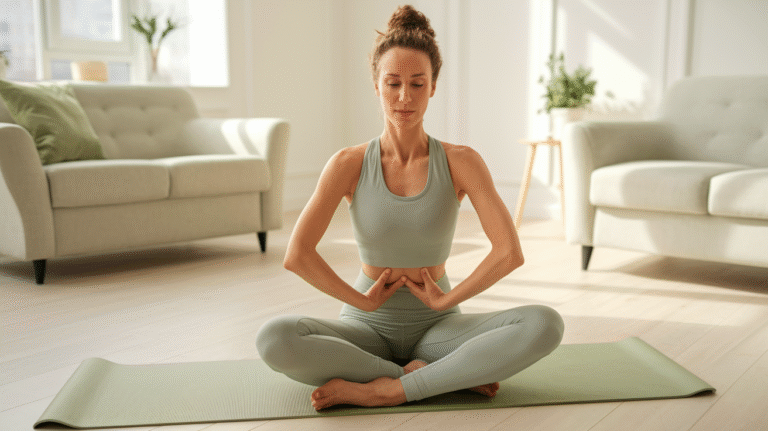
Seated Pilates Breathing forms the cornerstone of every exercise you’ll do. Sit tall in your chair with your hands resting on your ribcage. Inhale deeply through your nose, feeling your ribs expand sideways into your hands. Exhale completely through your mouth, feeling your ribs draw together and your abdominal muscles gently engage. Practice this for 2-3 minutes at the start of every session. This breathing pattern oxygenates your muscles and activates your deepest core stabilizers.
Core Connection Exercise teaches you what proper core engagement feels like. Sit tall and place one hand on your lower belly. Inhale naturally, then as you exhale, gently draw your lower abdominal muscles inward and upward—imagine you’re zipping up a tight pair of jeans.
Hold this gentle engagement for 5 seconds while breathing naturally, then release. Repeat 8-10 times. This simple exercise builds awareness and control that carries through every other movement.
Spinal Alignment Check ensures you’re starting from the optimal position. Sit tall and place one hand on your chest and one on your lower back. Rock your pelvis forward and backward gently, finding the neutral position where you feel balanced between the two extremes. This is your neutral spine—memorize how it feels. Check this position before beginning each exercise sequence.
Effective Seated Twists and Rotations
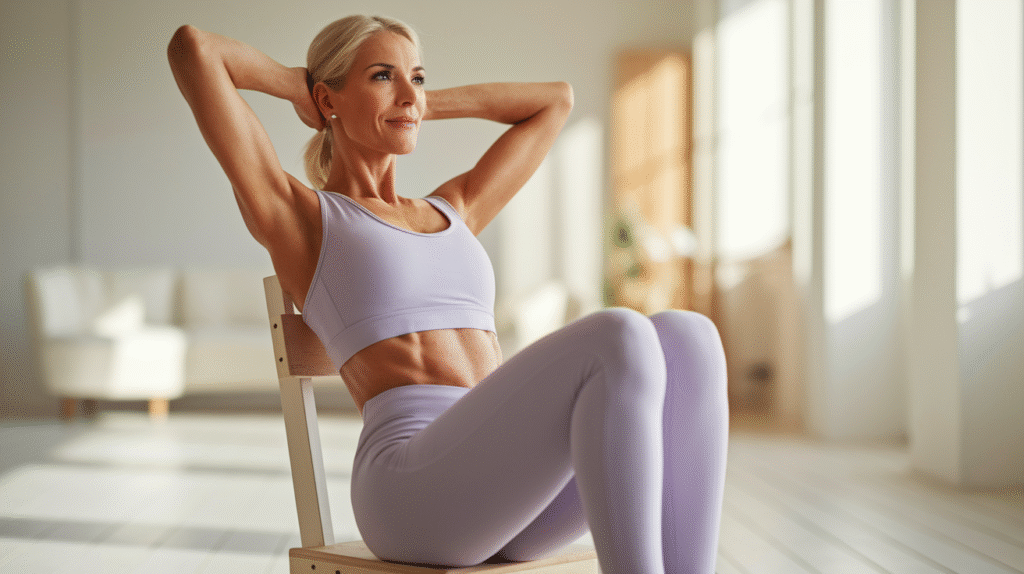
Gentle Seated Twist targets your obliques and improves spinal mobility. Sit tall with your hands behind your head, elbows wide. Inhale to prepare, then exhale as you rotate your torso to the right, keeping your hips facing forward. Your movement comes from your waist, not your arms. Inhale back to center, exhale to twist left. Complete 8-10 twists on each side, moving slowly and with control. You should feel your oblique muscles working along the sides of your waist.
Arm Reach Rotations add an upper body element that increases the core challenge. Sit tall with your arms extended forward at shoulder height. Inhale to prepare, then exhale as you rotate your torso to the right, reaching your right arm behind you while your left arm reaches across your body. Your eyes follow your back hand. Inhale back to center, exhale to rotate left. Perform 6-8 rotations on each side. This movement builds rotational strength essential for everyday activities like reaching for items or looking behind you while driving.
Windmill Arms create complete torso engagement through large, controlled movements. Sit tall with your arms extended to the sides at shoulder height. Inhale, then as you exhale, reach your right hand down toward your left foot while your left arm reaches up toward the ceiling, creating a diagonal line through your torso. Your core works to control the movement. Inhale back to center, exhale to the opposite side. Complete 6-8 windmills on each side. Move slowly—this isn’t about touching your toes, it’s about engaging your entire core through the reaching motion.
Powerful Forward and Side Bends
Seated Forward Fold combines gentle core activation with a hamstring stretch. Sit tall with your feet hip-width apart. Inhale to lengthen your spine, then exhale as you hinge forward from your hips, reaching your hands toward your feet. Keep your back straight rather than rounding your spine. You should feel your lower abdominal muscles engage to control the forward movement. Hold for 3-5 breaths, then slowly roll back up. Repeat 4-6 times. This exercise strengthens your core while improving flexibility—a perfect combination.
Side Reaches target your obliques while improving lateral flexibility. Sit tall with your right hand behind your head and your left arm reaching down toward the floor beside your chair. Inhale to prepare, then exhale as you reach your left arm further down while gently lifting your right elbow toward the ceiling, creating a side bend. Your right obliques work to control the movement. Inhale back to center. Complete 8-10 reaches on each side. Focus on lengthening through your side body rather than collapsing or crunching.
Cat-Cow Seated Variation brings spinal mobility together with core strengthening. Sit tall with your hands on your thighs. Inhale as you arch your back gently, lifting your chest and looking slightly upward (cow position). Exhale as you round your spine, drawing your belly button toward your spine and tucking your chin (cat position). Your core muscles control both movements. Flow between these positions 8-10 times, coordinating your breath with the movement. This exercise improves spinal flexibility while teaching your core to stabilize through different positions.
Dynamic Leg Lifts and Holds
Single Leg Extensions build lower abdominal strength safely and effectively. Sit tall toward the front of your chair. Engage your core, then slowly extend your right leg straight out in front of you, foot flexed. Hold for 3-5 seconds while maintaining your upright posture—your core works hard to keep you stable. Lower your foot back down with control. Alternate legs for 8-10 extensions on each side. If this feels too challenging, lift your leg just a few inches off the floor instead of extending it fully.
Marching in Place seems simple but delivers powerful core activation. Sit tall and engage your core. Lift your right knee a few inches off the chair, hold for 2 seconds, then lower it. Immediately lift your left knee. Continue alternating for 30-60 seconds, maintaining your tall posture throughout. Your core muscles work constantly to stabilize your torso while your legs move. This exercise also improves coordination and gets your heart rate up slightly.
Knee to Chest Pulls create controlled movement for complete core engagement. Sit tall with your hands behind your thighs. Engage your core and lift your right knee toward your chest, using your hands for light assistance. Hold for 2-3 seconds, feeling your lower abdominals engage. Lower your foot back down with control. Alternate legs for 8-10 pulls on each side. This movement strengthens your hip flexors and lower abs while improving hip mobility—essential for activities like climbing stairs or getting in and out of cars.
Creating Your Easy Weekly Chair Pilates Routine
The Perfect Beginner Schedule
Starting with three sessions per week gives your body the perfect balance between challenge and recovery. Schedule your chair Pilates workouts for Monday, Wednesday, and Friday, or Tuesday, Thursday, and Saturday—whichever fits your lifestyle best. The rest days between sessions allow your muscles to recover and adapt, which is when actual strength building happens.
Begin with 15-20 minute sessions for the first 2-3 weeks. This duration feels manageable and sustainable, making it easier to stick with your new routine. You’re building a habit, not training for a competition. Consistency matters infinitely more than duration when you’re starting out.
After 3-4 weeks of consistent practice, gradually increase your session length by 5-minute increments. You might move to 20-25 minute sessions, then eventually to 30 minutes. Listen to your body—some people progress faster than others, and that’s completely normal.
Plan to commit to chair Pilates for at least 4-6 weeks before evaluating your progress. This timeline allows your body to adapt to the new movements and build genuine strength. Many beginners notice improved posture within 2-3 weeks, but significant core strength develops over the longer term.
Sample 15-Minute Seated Core Sequence
This complete sequence targets your entire core while building the mind-body connection that makes Pilates so effective. Set a timer and follow this structure for a perfectly balanced workout.
Warm-up (3 minutes): Start with 2 minutes of Seated Pilates Breathing to center yourself and activate your core. Follow with 1 minute of gentle spinal movements—Cat-Cow Seated Variation performed slowly, 6-8 repetitions. This prepares your body for more challenging work ahead.
Main Workout (10 minutes): Cycle through these six exercises, performing each for about 90 seconds before moving to the next: – Core Connection Exercise: 12-15 repetitions – Gentle Seated Twist: 10 repetitions each side – Single Leg Extensions: 10 repetitions each leg – Side Reaches: 10 repetitions each side – Marching in Place: 60 seconds continuous – Knee to Chest Pulls: 10 repetitions each leg
Move smoothly from one exercise to the next with minimal rest. If you need to pause, take 10-15 seconds between exercises to reset your posture and breathing.
Cool-down (2 minutes): Finish with Seated Forward Fold, holding for 30 seconds and repeating 3 times. End with 30 seconds of deep Pilates breathing, allowing your heart rate to return to normal and your muscles to begin recovery.
This sequence flows logically from foundational exercises to more challenging movements, then back to gentle stretching. As you become familiar with the routine, you’ll move through it more smoothly and confidently.
Quick Tips for Staying Motivated
Track your progress in a simple notebook or phone app. Write down the date, which exercises you completed, and how you felt afterward. This record keeps you accountable and lets you see your improvement over time. You’ll be amazed at how quickly movements that felt challenging become easier.
Set realistic, specific goals that go beyond appearance. Instead of “get six-pack abs,” try “complete three chair Pilates sessions per week for one month” or “improve my posture enough that I notice less back pain.” These concrete, achievable goals keep you motivated through the early weeks when physical changes aren’t yet visible.
Join online communities dedicated to Pilates or fitness over 40. Seeing others on similar journeys provides inspiration, accountability, and practical tips. Many people find that sharing their progress—even with internet strangers—helps them stay consistent.
Celebrate how you feel, not just how you look. Notice when you sit taller naturally, when you climb stairs more easily, or when you get through your day with less back fatigue. These functional improvements are the real victories of chair Pilates, and they often appear before visible physical changes.
When to Progress and Add Variety
You’re ready to increase intensity when your current routine feels comfortable and you can complete all exercises with good form while maintaining steady breathing. This typically happens after 4-6 weeks of consistent practice. Signs of readiness include: finishing your workout feeling energized rather than exhausted, maintaining proper posture throughout all exercises, and feeling confident in your movement patterns.
Adding light hand weights (1-3 pounds) increases the challenge for upper body movements like Arm Reach Rotations and Windmill Arms. The added resistance makes your core work harder to stabilize your torso. Start with the lightest weights and only add them to exercises where you can maintain perfect form.
Increase your repetitions gradually—add 2-3 reps per exercise every week or two. This progressive overload principle ensures continued strength gains without overwhelming your body.
Combine chair Pilates with other gentle activities for complete fitness. Walking, swimming, or gentle yoga complement your seated core work beautifully. Chair Pilates 3 times per week plus 2-3 days of other activity creates a well-rounded routine that supports overall health.
Keep your routine fresh by occasionally changing the order of exercises, trying new variations you discover, or following online chair Pilates videos for variety. The core principles remain the same, but variety prevents boredom and challenges your muscles in new ways.
Your Path to a Stronger Core Starts Now
Chair Pilates removes every barrier between you and a strong, functional core. No floor work required, no expensive equipment needed, no intimidating gym environment—just you, a sturdy chair, and 15 minutes to invest in your strength and wellbeing.
The benefits extend far beyond a flatter stomach or better-looking abs. You’re building the deep core strength that supports every movement you make throughout your day. You’re improving posture that reduces back pain and increases confidence. You’re creating stability that helps prevent falls and injuries. You’re proving to yourself that fitness after 40 is not only possible but genuinely enjoyable.
This proven approach works because it meets you exactly where you are right now. The seated position provides support while still challenging your muscles effectively. The low-impact nature protects your joints while building genuine strength. The accessibility means you can actually stick with it long enough to see real results.
Start with just one 15-minute session this week. Choose three exercises from this guide and practice them with focus on proper form rather than speed or intensity. Notice how your body feels afterward—the sense of accomplishment, the gentle fatigue in muscles you might not have felt before, the improved posture that lasts for hours.
Trust the process. Results build gradually through consistent practice, not through heroic single efforts. Three sessions per week for one month will create noticeable changes in your core strength, posture, and confidence. Six weeks will transform how you move through your daily life. Three months will make you wonder why you didn’t start sooner.
You deserve a fitness routine that works with your body, not against it. You deserve to feel strong, capable, and confident in your movements. You deserve the proven benefits of Pilates without the barriers that make traditional floor work challenging.
Your stronger, more confident self is waiting—just a few seated sessions away. Pull up your chair and begin today.