Best Full Body Kettlebell Workout for Women at Home
 I. Introduction
You know that frustrating cycle, right? You scroll through Instagram, see another transformation story, and think “I need to do something.” You research gym memberships, calculate the commute time, factor in childcare or work schedules, and suddenly that motivation deflates like a sad balloon.
Here’s the truth: You don’t need a fancy gym membership or expensive equipment taking over your living room. You need one powerful tool that delivers serious results—a kettlebell.
This isn’t about following some trendy workout that promises overnight miracles. We’re talking about a proven, science-backed full-body routine that builds genuine strength, torches calories, and sculpts lean muscle. All from your living room, garage, or that corner of your bedroom you’ve been meaning to use.
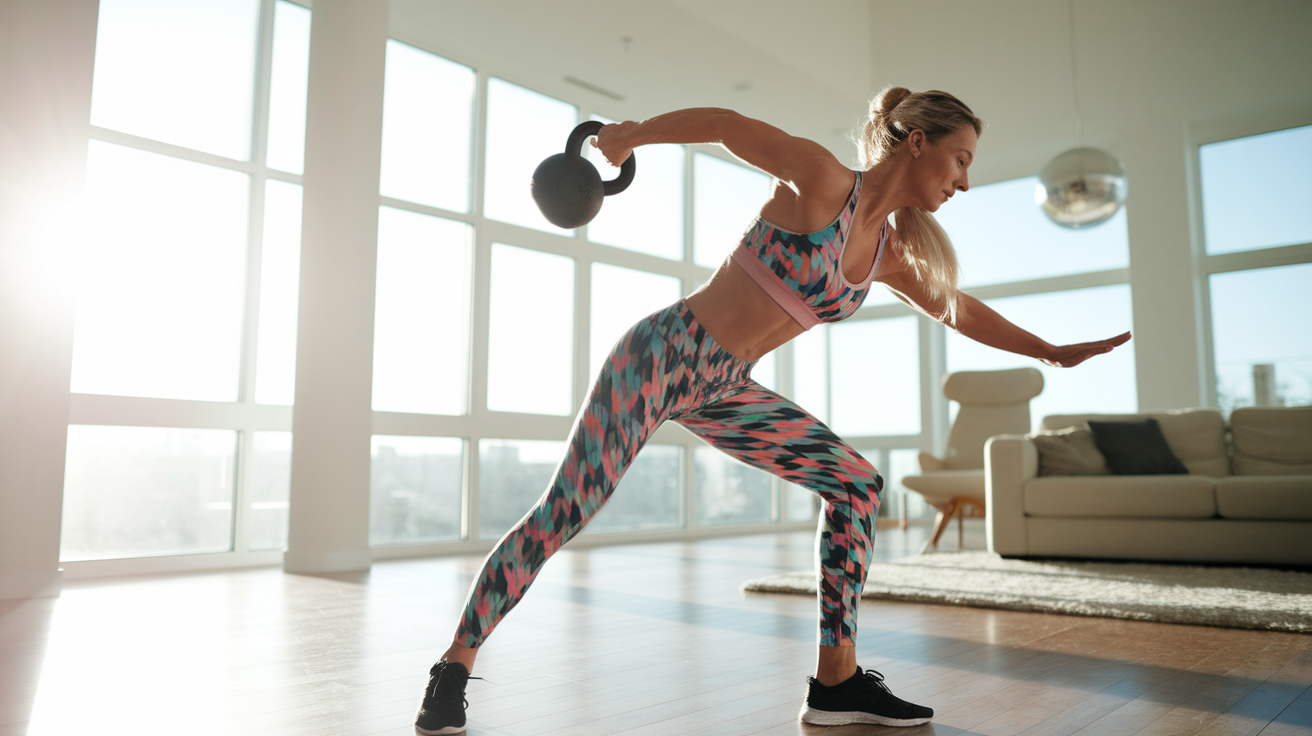
I’m going to walk you through a complete kettlebell workout designed specifically for women who want real results without the intimidation factor. This routine targets every major muscle group, burns fat efficiently, and fits into your actual life—not some fantasy schedule where you have unlimited time and energy.
The commitment? Three to four 30-minute sessions per week. That’s it. No complicated choreography to memorize, no equipment you’ll use once and donate next spring, and absolutely no need to feel intimidated. Whether you’re a complete beginner or getting back into fitness after a break, this workout meets you where you are.
Let’s transform your home into your most effective gym.
Why Kettlebells Are Perfect for Women’s Home Workouts
 II. Why Kettlebells Are Perfect for Women’s Home Workouts
The Science-Backed Benefits You Need to Know
 III. Choosing Your Kettlebell: Weight and Equipment Essentials
Kettlebells aren’t just another fitness fad that’ll disappear next year. Research from the American Council on Exercise shows kettlebell training burns approximately 20 calories per minute—that’s 400 calories in a 20-minute session. Compare that to traditional strength training at around 9 calories per minute, and you’ll understand why kettlebells deliver such efficient results.
What makes kettlebells unique is their dual-action benefit. Every swing, press, and squat combines strength training with cardiovascular conditioning. Your heart rate elevates while your muscles work against resistance, creating what exercise scientists call “metabolic conditioning.” This means you’re building muscle and improving endurance simultaneously—no need to split your workout between weights and cardio.
The functional strength you develop translates directly to everyday life. Lifting groceries, carrying kids, moving furniture, or hauling laundry baskets—these real-world movements mirror kettlebell exercises. You’re not just getting stronger in the gym; you’re making daily activities genuinely easier.
Space, Budget, and Time Advantages
 IV. The Complete Full Body Kettlebell Workout Routine
Let’s talk money. A quality kettlebell costs between $30-$80 depending on weight and brand. The average gym membership runs $50-$100 monthly. Do the math—your kettlebell pays for itself in the first month and lasts for years.
Space constraints? A single kettlebell requires about four square feet of workout space. That’s less room than your coffee table occupies. You can store it in a closet, under your bed, or leave it in the corner as surprisingly attractive decor (seriously, modern kettlebells look pretty sleek).
Time efficiency separates kettlebells from traditional workouts. You’ll complete a comprehensive full-body session in 25-30 minutes. No driving to the gym, waiting for equipment, or navigating crowded locker rooms. You can knock out a powerful workout during your lunch break, before the kids wake up, or while dinner’s in the oven.
Why Women Shouldn’t Fear “Bulking Up”
 V. Maximizing Results: Form, Progression, and Recovery
Let’s destroy this myth permanently: kettlebell training will not make you “bulky” or “too muscular.” This fear stops too many women from strength training, and it’s based on complete misinformation.
Women produce significantly less testosterone than men—about one-tenth the amount. Testosterone is the primary hormone responsible for building large muscle mass. Without pharmaceutical assistance or extremely specialized training and nutrition protocols, women simply don’t develop bulky muscles from strength training.
What kettlebells actually do is sculpt lean, defined muscle. They create that toned look you see in fitness magazines—strong shoulders, defined arms, sculpted legs, and a tight core. You’ll burn fat while building muscle, which increases your metabolism and helps you maintain results long-term.
Professional female athletes who lift heavy weights for hours daily still maintain feminine physiques. Your 30-minute kettlebell sessions three times weekly will build strength and definition, not bulk.
Choosing Your Kettlebell: Weight and Equipment Essentials
 VI. Conclusion
What Weight Should Beginners Start With?
Starting with the right weight makes the difference between effective training and frustration. Most women should begin with an 8-12 kg (18-26 lb) kettlebell. I know that might sound heavy if you’re new to strength training, but kettlebells feel different than dumbbells because of weight distribution.
Here’s a simple test: Can you press the kettlebell overhead for 8-10 controlled reps? Can you complete 15 goblet squats with good form? If you answered yes to both, you’ve found your starting weight. If the overhead press feels impossible but squats are manageable, you’re still in the right range—different exercises naturally allow different weights.
Many women underestimate their strength and start too light. An 8 kg kettlebell might feel challenging initially, but you’ll adapt within two weeks. Starting slightly heavier ensures continued progress rather than needing to replace your kettlebell after a month.
Progression happens naturally. When you can complete all prescribed reps with excellent form and the last few reps don’t feel challenging, increase your weight by 2-4 kg. Most women progress to a 12-16 kg kettlebell within 8-12 weeks of consistent training.
Quality Matters: What to Look For
Not all kettlebells are created equal. Cast iron kettlebells work perfectly for home workouts and cost less than competition-style bells. Competition kettlebells maintain the same dimensions regardless of weight, which is useful for athletes but unnecessary for home training.
Handle width matters more than most people realize. Women’s hands are generally smaller than men’s, so look for kettlebells with handles approximately 35mm in diameter. Wider handles cause grip fatigue and make certain movements awkward. Test the grip if possible—you should comfortably wrap your fingers around the handle with slight overlap.
The finish affects your training experience. Powder-coated kettlebells provide excellent grip without tearing up your hands. Avoid cheap painted kettlebells that chip and flake. E-coat finishes offer durability but can feel slippery when your hands sweat.
Budget-friendly brands like CAP Barbell, AmazonBasics, and Yes4All deliver solid quality for $30-$60. If you want to invest more, Rogue Fitness and Kettlebell Kings offer premium options around $80-$100 that’ll last decades.
Optional Accessories That Enhance Your Workout
You don’t need much beyond your kettlebell, but a few accessories improve comfort and tracking. A yoga mat or exercise mat protects your floors and cushions your joints during floor exercises. Any basic mat works—you don’t need an expensive option.
Workout gloves remain controversial. Some trainers swear by them; others insist they interfere with grip development. Try training without gloves first. If you develop painful calluses or the handle irritates your hands, invest in lightweight lifting gloves or gymnastics grips.
A timer app transforms your training efficiency. Download a free interval timer like Seconds or Tabata Timer. Set your work periods, rest intervals, and rounds, then let the app guide your workout. No more checking your watch or losing count mid-exercise.
The Complete Full Body Kettlebell Workout Routine
Warm-Up: Prime Your Body (5 Minutes)
Never skip your warm-up. Cold muscles don’t perform well and increase injury risk. This five-minute sequence prepares your joints, activates key muscle groups, and mentally transitions you into workout mode.
Kettlebell Halos: Hold your kettlebell by the horns (the sides of the handle) at chest height. Circle it around your head in a controlled motion, keeping your core tight and head still. Complete 10 slow circles in each direction. This warms up your shoulders, core, and upper back while improving mobility.
Goblet Squats (Light): Hold the kettlebell at chest height, elbows pointing down. Perform 10 bodyweight-pace squats, focusing on depth and control rather than speed. Your hips should drop below parallel if mobility allows. This activates your glutes, quads, and core.
Arm Circles and Hip Rotations: Set the kettlebell down. Make large arm circles forward and backward for 30 seconds total. Then place your hands on your hips and rotate your hips in large circles, 30 seconds total. These dynamic movements increase blood flow and joint mobility.
The Powerful 6-Exercise Circuit
Exercise 1: Kettlebell Goblet Squat
This foundational movement targets your quads, glutes, hamstrings, and core while teaching proper squat mechanics.
Hold the kettlebell by the horns at chest height, elbows tucked close to your ribs. Stand with feet slightly wider than shoulder-width, toes pointed slightly outward. Initiate the movement by pushing your hips back as if sitting into a chair. Keep your chest proud and core braced. Descend until your hips drop below knee level—your elbows should travel between your knees at the bottom. Drive through your entire foot to stand, squeezing your glutes at the top.
Perform 12-15 reps. Focus on keeping your weight balanced across your whole foot—avoid shifting to your toes. Your knees should track over your toes, not caving inward. The kettlebell acts as a counterbalance, making it easier to maintain proper form than bodyweight squats.
This exercise burns serious calories while building lower body strength. It’s the foundation of your transformation.
Exercise 2: Kettlebell Swing
The swing is the ultimate fat-burning, full-body power movement. It targets your glutes, hamstrings, core, shoulders, and cardiovascular system.
Start with the kettlebell on the floor about a foot in front of you. Hinge at your hips (push your butt back, slight knee bend), grip the handle with both hands, and tilt the kettlebell toward you. Hike the kettlebell back between your legs like a football snap, keeping your arms straight. Explosively drive your hips forward, standing tall. The kettlebell swings forward as a result of your hip power—your arms are just ropes connecting you to the weight. Let the kettlebell swing to approximately chest height, then let gravity pull it back down. As it descends, hinge at your hips again and repeat.
Perform 15-20 reps. The power comes from your hips, not your arms. Maintain a neutral spine throughout—no rounding your lower back. Your core should stay braced like you’re about to be punched in the stomach. Breathe out forcefully as you drive your hips forward.
This single exercise can burn more calories than running, making it the cornerstone of efficient fat loss.
Exercise 3: Single-Arm Kettlebell Row
Rows build a strong, sculpted back while improving posture and shoulder stability.
Place one hand on a bench, chair, or couch for support. Step the same-side foot back, opposite foot forward in a staggered stance. Hold the kettlebell in your free hand, arm hanging straight down. Pull your shoulder blade back and down, then row the kettlebell toward your hip. Your elbow should travel close to your body, not flaring out wide. Lower with control and repeat.
Perform 10-12 reps per arm. Keep your torso stable—don’t rotate or twist. Imagine pulling your elbow toward the ceiling rather than just lifting the weight. You should feel this in your mid-back and lat muscles. Switch arms and repeat.
Strong back muscles create that defined, athletic look while protecting your spine during daily activities.
Exercise 4: Kettlebell Overhead Press
This movement sculpts your shoulders and arms while building functional upper body strength.
Clean the kettlebell to the rack position: hold it at shoulder height, resting in the V created by your forearm and bicep, elbow tucked close to your ribs. Your wrist should stay straight, not bent backward. Brace your core and squeeze your glutes. Press the kettlebell straight overhead, fully extending your arm. Your bicep should finish near your ear. Lower with control back to the rack position.
Perform 10-12 reps per arm. Don’t arch your lower back as you press—keep your core tight and ribs down. The path should be straight up and down, not forward. If you can’t complete 10 reps with good form, decrease the weight. This exercise requires more shoulder stability than most movements.
Defined shoulders create that strong, confident look while improving your ability to lift objects overhead safely.
Exercise 5: Kettlebell Romanian Deadlift
The RDL builds posterior chain strength—your glutes, hamstrings, and lower back—creating a strong, sculpted backside.
Hold the kettlebell with both hands in front of your thighs, arms straight. Stand with feet hip-width apart, slight knee bend. Push your hips backward, lowering the kettlebell down your thighs while keeping it close to your body. You should feel a stretch in your hamstrings. Your back stays flat—imagine a broomstick touching your head, upper back, and tailbone throughout the movement. Once you feel a strong hamstring stretch (usually mid-shin height), drive your hips forward to return to standing.
Perform 12-15 reps. This is a hip hinge, not a squat—your knees bend slightly but don’t change position during the movement. Keep your shoulders pulled back and chest proud. The stretch in your hamstrings tells you you’re doing it correctly.
This exercise protects your lower back by teaching proper lifting mechanics while building the glutes and hamstrings that create a strong, toned lower body.
Exercise 6: Kettlebell Russian Twist
Russian twists define your obliques and build rotational core strength.
Sit on the floor holding your kettlebell at chest height. Lean back slightly, creating a V-shape with your torso and thighs. Lift your feet off the ground if you can maintain balance; otherwise, keep heels on the floor. Rotate your torso to the right, bringing the kettlebell beside your hip. Rotate to the left, bringing the kettlebell to your left hip. That’s one rep.
Perform 20 total twists (10 per side). Move with control, not momentum. Your eyes follow the kettlebell. Keep your chest lifted and core braced throughout. If holding the kettlebell makes this too challenging initially, perform the movement without weight until you build core strength.
This exercise creates those defined obliques while building the rotational strength you use constantly in daily life.
Workout Structure and Timing
Here’s how to put it all together. Complete all six exercises in circuit format—one exercise after another with minimal rest between movements. Rest 30-60 seconds between exercises, enough to catch your breath and set up for the next movement.
After finishing all six exercises, rest for 2 minutes. That’s one complete round. Repeat the circuit 3-4 times total depending on your fitness level. Beginners start with 3 rounds; progress to 4 rounds as you adapt.
Total workout time runs 25-30 minutes including warm-up. Perform this routine 3-4 times weekly with at least one rest day between sessions. Your muscles need recovery time to repair and grow stronger.
Maximizing Results: Form, Progression, and Recovery
Form First: Safety Tips Every Woman Should Know
Perfect form beats heavy weight every single time. The most common kettlebell mistake is rushing through movements to finish faster. Speed comes later—right now, focus on controlling every rep.
For swings, the biggest error is squatting instead of hinging. Your hips drive the movement, not your legs. If your quads burn more than your glutes and hamstrings, you’re squatting. Film yourself from the side and check your hip hinge.
During presses, arching your lower back compensates for weak core stability. If you feel pressure in your lower back, decrease the weight and focus on keeping your ribs down and glutes squeezed.
Goblet squats fail when your weight shifts to your toes. This usually means limited ankle mobility or weak glutes. Elevate your heels on small weight plates temporarily while working on mobility.
Consider filming your sets occasionally. Compare your form to tutorial videos from certified kettlebell instructors like StrongFirst or Onnit Academy. Small adjustments make huge differences in results and safety.
Progressive Overload: How to Keep Seeing Results
Your body adapts to stress by getting stronger. To continue seeing results, you must progressively challenge your muscles. This doesn’t mean increasing weight every week—that’s unsustainable and leads to injury.
Start by increasing reps. If you begin with 12 goblet squats, progress to 13, then 14, then 15 over several weeks. Once you hit the top of the rep range with excellent form, increase your weight by 2-4 kg and drop back to the lower rep range.
Track your workouts in a simple notebook or phone app. Write down the date, exercises, weight used, reps completed, and how you felt. This data shows your progress and prevents you from guessing whether you’re improving.
After mastering the basics (usually 8-12 weeks), explore advanced variations. Single-leg Romanian deadlifts, bottoms-up presses, and Turkish get-ups add new challenges. But don’t rush—these foundational exercises deliver results for years.
Recovery and Nutrition for Lean Muscle
Rest days aren’t optional—they’re when your body actually builds muscle. During workouts, you create tiny tears in muscle fibers. During rest, your body repairs these tears, making muscles stronger and more defined. Training every day prevents this repair process.
Take at least one full rest day between kettlebell sessions. Light activity like walking, yoga, or swimming on rest days promotes recovery without overtaxing your muscles.
Protein supports muscle recovery and growth. Women building strength need approximately 0.7-1 gram of protein per pound of body weight daily. A 150-pound woman needs 105-150 grams of protein. Sources include chicken, fish, eggs, Greek yogurt, legumes, and protein powder if needed.
Don’t fear protein—it won’t make you bulky. It helps you recover faster, maintain muscle while losing fat, and stay satisfied between meals.
Hydration affects performance more than most people realize. Dehydrated muscles fatigue faster and recover slower. Drink at least half your body weight in ounces daily—a 150-pound woman needs 75 ounces minimum.
Sleep is your secret weapon. Aim for 7-9 hours nightly. During deep sleep, your body releases growth hormone, which repairs muscle tissue and burns fat. Chronic sleep deprivation sabotages even the best workout program.
Realistic Timeline: When to Expect Visible Changes
Let’s set honest expectations. You won’t see dramatic transformation in week one. Sustainable results take time, and that’s actually good news—it means they last.
Weeks 1-2: You’ll feel stronger and more energetic. The kettlebell that felt heavy on day one feels more manageable. You’ll sleep better and notice improved mood from endorphin release. These internal changes matter even though they’re not visible yet.
Weeks 4-6: You’ll notice muscle definition, especially in your shoulders and arms. Your clothes fit differently—looser in some areas, more fitted in others. You’ll complete workouts with less rest and better form. Friends might start commenting that you look different.
Weeks 8-12: Visible body composition changes become obvious. You’ll see defined muscles in your legs, sculpted shoulders, and a tighter core. Your strength increases significantly—exercises that challenged you initially now feel moderate. This is when transformation becomes undeniable.
Most women lose 1-2 pounds weekly while gaining muscle, which means the scale might not reflect your progress. Take progress photos and measurements instead. The mirror tells the truth better than the scale.
Final Thoughts
You now have everything you need to transform your fitness without leaving home. This full-body kettlebell routine delivers proven results through efficient, science-backed movements that build strength, burn fat, and sculpt lean muscle.
The beauty of this program is its simplicity. Six exercises, 30 minutes, three times weekly. No complicated equipment, no expensive memberships, no intimidating gym environments. Just you, your kettlebell, and consistent effort.
Remember: consistency beats perfection every time. You don’t need to execute flawless workouts or follow a perfect nutrition plan. You need to show up regularly, put in honest effort, and trust the process. Some days you’ll feel strong and powerful. Other days you’ll struggle through every rep. Both days count equally toward your transformation.
Start where you are. If you can only manage two workouts this week, that’s infinitely better than zero. If you need to use a lighter weight than recommended, use it. Progress isn’t linear—it’s messy and individual and completely worth it.
Your challenge this week: Complete this workout three times. Don’t overthink it, don’t wait for the perfect moment, don’t convince yourself you’ll start Monday. Grab your kettlebell and begin today.
You’re not just building a stronger body—you’re building confidence, discipline, and proof that you can commit to yourself. Those qualities transform every area of your life, not just your fitness.
The kettlebell is sitting there waiting. Your stronger, more confident self is waiting too. Let’s make this happen.