At-Home ABS Workout for New Mothers
You’re standing in front of the mirror, three months postpartum, and your belly looks… different. Not just softer, but somehow disconnected.
You try to engage your abs like you used to, and nothing happens. You’re exhausted, your back hurts from carrying your baby, and you’re terrified that your body will never feel strong again.
I hear you. And here’s what you need to know: your postpartum body isn’t broken—it’s healing from one of the most transformative physical experiences possible.
This article delivers a proven, science-backed approach to rebuilding your core strength at home. No gym membership required. No expensive equipment.
Just 10-15 minutes when your baby naps and a commitment to doing this the right way—the safe way that honors what your body has been through.
Let’s be clear about expectations: this isn’t about “bouncing back” or getting six-pack abs in six weeks. Those promises are garbage, and they set you up for disappointment and potential injury.
This is about reconnecting with your deep core muscles, healing diastasis recti if you have it, and building functional strength that makes everything easier—from lifting your car seat to playing with your toddler years from now.
Your core went through nine months of gradual stretching and shifting. It deserves patience, not punishment. The powerful truth? When you approach postpartum abs training correctly, you’ll build a foundation stronger than before pregnancy. That’s not motivational fluff—that’s what happens when you strengthen muscles from the inside out.
Ready to feel like yourself again? Let’s start with what every new mother needs to understand before doing a single crunch.
Understanding Your Postpartum Core: What New Mothers Need to Know First
The Reality of Your Post-Baby Abs
Your abdominal muscles didn’t just get “out of shape” during pregnancy—they underwent a complete structural transformation. The linea alba (the connective tissue running down the center of your abs) stretched to accommodate your growing baby. Your rectus abdominis muscles (the “six-pack” muscles) separated to make room. Your entire core, including deep stabilizers like the transverse abdominis, learned to work differently for nine months.
Diastasis recti—the separation of your ab muscles—affects about 60% of women during pregnancy and immediately postpartum. This isn’t a defect; it’s a normal adaptation. But here’s what matters: how you exercise now determines whether that separation heals properly or gets worse.
Traditional ab exercises like crunches, sit-ups, and planks can actually increase abdominal separation if you do them too soon. When you perform these movements before your core reconnects, you create intra-abdominal pressure that pushes outward, widening the gap instead of closing it. That bulging you see when you try to sit up? That’s your internal organs pushing through weakened connective tissue—a clear sign you’re not ready for that movement yet.
The “bouncing back” myth needs to die. Celebrities with personal trainers, chefs, and nannies aren’t your measuring stick. Your timeline is yours alone, influenced by genetics, how many pregnancies you’ve had, whether you had a vaginal birth or C-section, and how your body individually heals.
When It’s Safe to Start Abs Training
The six-week postpartum checkup isn’t just a formality—it’s your green light checkpoint. Your healthcare provider needs to confirm that your uterus has returned to normal size, any tearing or incisions have healed, and you’re not experiencing complications like excessive bleeding or infection.
Vaginal birth recovery typically allows for gentle core work sooner than C-section recovery. Why? Because a C-section involves cutting through seven layers of tissue, including your abdominal muscles. That’s major surgery, and those muscles need time to heal before you load them with exercise.
Signs your body is ready for core work include: no pain during daily activities, bleeding has stopped or is very light, you can engage your pelvic floor without discomfort, and you feel generally recovered from birth. Red flags that mean “not yet” include: any pain in your abdomen or pelvic floor, bulging in your belly when you stand or move, continued heavy bleeding, or a feeling that something is “falling out” (possible pelvic organ prolapse).
Even with medical clearance, start with reconnection exercises before strengthening exercises. Think of it like this: you wouldn’t try to lift heavy weights with a disconnected muscle. Your brain and core need to reestablish their communication first.
Setting Realistic Goals and Expectations
In the first three to six months postpartum, “results” look like: being able to engage your deep core muscles on command, reduced or eliminated diastasis recti gap, less back pain, better posture while holding your baby, and more energy throughout the day. Notice what’s not on that list? Visible abs and pre-pregnancy jeans.
Core strength matters infinitely more than visible abs. A strong core protects your back, stabilizes your pelvis, supports your pelvic floor, and makes every movement more efficient. These functional benefits transform your daily life in ways that flat abs never could.
Hormones complicate your progress. Relaxin, the hormone that loosened your ligaments during pregnancy, stays elevated for months—especially if you’re breastfeeding. This means your joints remain more mobile and vulnerable to injury. Cortisol, the stress hormone, runs high when you’re sleep-deprived (and what new mother isn’t?). High cortisol makes fat loss harder and can actually break down muscle tissue.
Building sustainable habits around a newborn’s schedule requires flexibility. Your baby doesn’t care about your workout plan. Some days you’ll get your full 15 minutes. Other days, you’ll squeeze in five minutes of breathing exercises. Both count. Both matter. Consistency over perfection wins every single time.
Essential Foundation: Reconnecting with Your Core
Breath Work and Pelvic Floor Connection
Diaphragmatic breathing is the foundation of all effective postpartum core work. This isn’t just relaxation breathing—it’s a powerful tool that reactivates your deep core muscles and pelvic floor in coordination.
Here’s how to practice 360-degree breathing: Lie on your back with knees bent, feet flat. Place one hand on your chest and one on your belly. Inhale slowly through your nose for four counts, allowing your belly, ribcage, and even your lower back to expand in all directions—not just up toward the ceiling. Your chest hand should barely move. Exhale through your mouth for six counts, gently drawing your belly button toward your spine and your pelvic floor up and in. That exhale is where the magic happens.
Your pelvic floor engagement should feel like you’re stopping the flow of urine and holding back gas simultaneously, then lifting everything upward. Not clenching, not holding your breath—just a gentle lift and squeeze. Many women over-tighten their pelvic floor, which creates as many problems as a weak one. Aim for about 30-40% of your maximum effort.
Practice this breathing pattern for five minutes daily before adding any other exercises. It seems simple, almost too simple to matter. But this mind-muscle connection that pregnancy disrupted is essential for everything that follows. You’re literally teaching your brain and body to work together again.
Gentle Core Activation Exercises
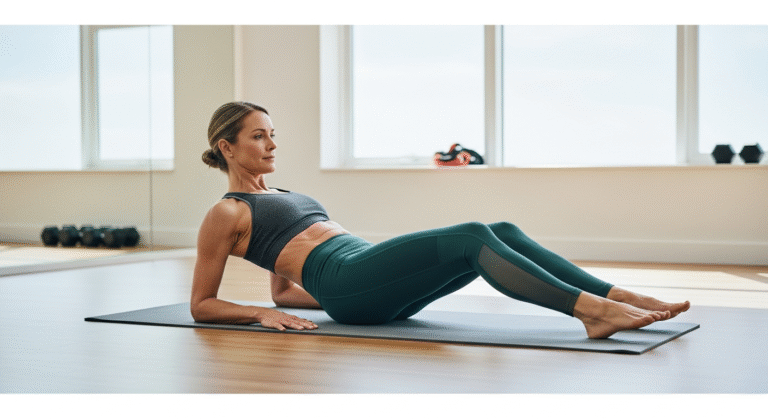
Pelvic Tilts are your first movement-based exercise. Lying on your back with knees bent, inhale to prepare. On your exhale, gently tilt your pelvis so your lower back presses into the floor. Your tailbone lifts slightly, and you should feel your low abs engage. Inhale to return to neutral. This tiny movement activates your transverse abdominis without creating the outward pressure that crunches do. Perform two sets of ten reps, focusing on the quality of the contraction, not speed.
Heel Slides build on pelvic tilts by adding leg movement while maintaining core engagement. Start in the same position. Exhale and engage your core, then slowly slide one heel away from your body, keeping your low back pressed to the floor. If your back arches, you’ve gone too far. Inhale as you slide your heel back. Alternate legs for eight to ten reps per side. This exercise challenges your core to stabilize while your limbs move—exactly what you need for real-life activities like walking.
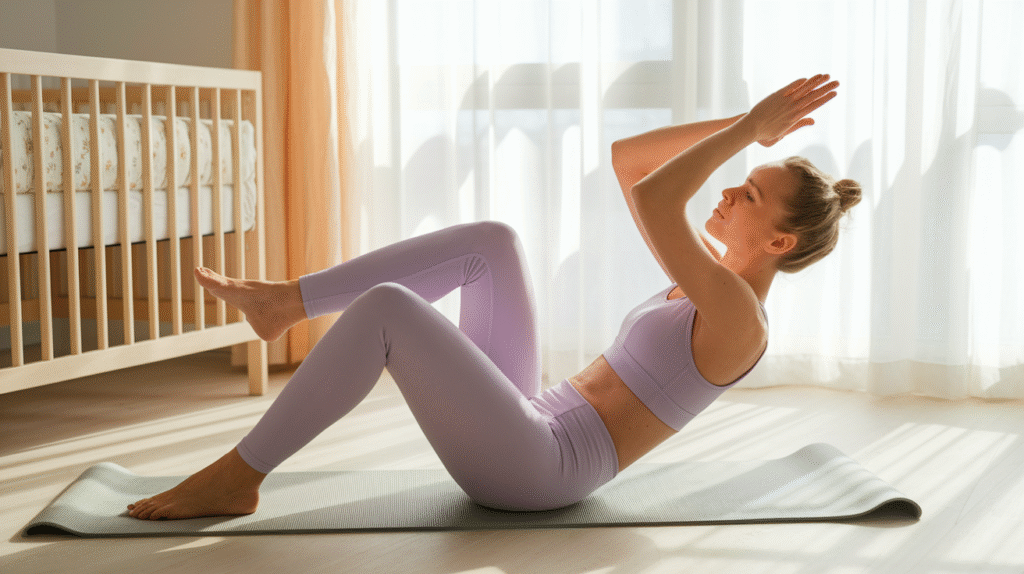
Toe Taps increase the challenge slightly. From your starting position, lift both feet so your knees are at 90 degrees (tabletop position). Maintaining that core engagement and flat back, exhale and lower one foot to tap the floor, then inhale to return. Alternate sides for eight to ten reps each. If you feel your back arching or a bulge in your belly, return to heel slides—you’re not ready for this progression yet.
Progress to the next level when you can complete all reps with perfect form, no back pain, no bulging, and no breath-holding. Rushing this foundation phase is the number one mistake new mothers make.
Checking for Diastasis Recti
You can assess yourself at home in under two minutes. Lie on your back with knees bent. Place your fingers horizontally just above your belly button, pointing down toward your toes. Gently lift your head and shoulders off the floor as if doing a tiny crunch. Feel for a gap between your ab muscles. Measure how many finger widths fit in that gap.
A separation of one to two finger widths is normal and usually closes on its own with proper exercise. Two to three finger widths indicates moderate diastasis that requires modified exercises. More than three finger widths, or a gap that’s very deep, means you should consult a pelvic floor physical therapist before progressing your workouts.
Also check the quality of the tissue. Does it feel firm when you press, or does it feel like your fingers sink into soft tissue? Firm is better. Very soft, squishy tissue indicates the connective tissue hasn’t regained tension yet.
If you have diastasis recti, avoid: crunches, sit-ups, full planks, push-ups, and any exercise that causes your belly to dome or bulge outward. Stick with the exercises in this article, which are specifically designed to close the gap by strengthening your transverse abdominis.
When to seek professional help: if your gap isn’t improving after eight weeks of consistent exercise, if you have pain, if you see significant bulging, or if you’re just not sure you’re doing things correctly. Pelvic floor physical therapists specialize in postpartum recovery and can accelerate your healing dramatically.
The Proven At-Home Abs Workout for New Mothers
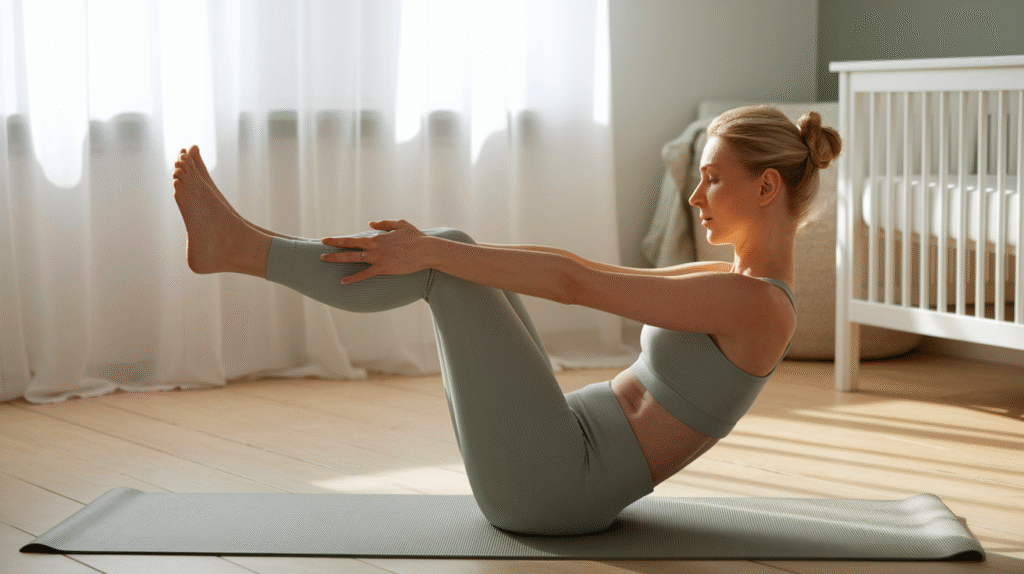
Workout Structure and Guidelines
Perform this workout three to four times per week. More isn’t better when you’re healing—your muscles need rest days to repair and strengthen. Two days of rest per week gives your connective tissue time to rebuild.
Each session takes just 10-15 minutes. That’s one nap cycle. One episode of your favorite show. The time you spend scrolling Instagram. You have the time—you just need to prioritize it, and that’s okay. You deserve these 15 minutes.
Equipment needed: a yoga mat or folded blanket for cushioning. That’s it. No dumbbells, no resistance bands, no expensive gear. Your body weight provides all the resistance you need right now.
Always warm up for two to three minutes with gentle movement: marching in place, arm circles, hip circles, or cat-cow stretches. Cold muscles are more prone to injury, and warming up signals your nervous system that it’s time to work.
The Core Sculpt Routine (Beginner Level)
Dead Bug (Modified): This exercise earned its name from the position, but don’t let that fool you—it’s incredibly effective for deep core activation. Lie on your back with arms extended toward the ceiling and knees in tabletop position. Exhale and engage your core, then slowly extend your right arm overhead while straightening your left leg, hovering it a few inches off the floor. Your lower back stays glued to the mat. Inhale to return. Alternate sides for eight to ten reps per side. Common mistake: letting your back arch. Fix: only extend your limbs as far as you can while maintaining back contact.
Bird Dog: Start on hands and knees with a neutral spine. Engage your core by drawing your belly button toward your spine. Exhale and simultaneously extend your right arm forward and left leg back, creating one long line from fingertips to toes. Hold for two seconds, focusing on stability—no wobbling or twisting. Inhale to return. Alternate sides for six to eight reps each. This exercise builds anti-rotation strength, which is crucial for preventing back pain when you’re constantly reaching for and lifting your baby.
Glute Bridges: Lie on your back with knees bent, feet hip-width apart and close to your glutes. Arms rest by your sides. Exhale, engage your pelvic floor, and press through your heels to lift your hips toward the ceiling. Squeeze your glutes at the top and hold for two seconds. Your body should form a straight line from shoulders to knees. Inhale to lower with control. Perform 12-15 reps. This exercise strengthens your entire posterior chain—glutes, hamstrings, and low back—which supports your core and improves posture.
Side-Lying Leg Lifts: Lie on your right side with your body in a straight line, head resting on your extended arm. Engage your core to prevent your torso from rolling. Exhale and lift your top leg about 12 inches, keeping your foot flexed and toes pointing forward (not toward the ceiling). Pause, then inhale to lower. Complete ten reps, then switch sides. This targets your obliques and hip stabilizers without the twisting movements that can worsen diastasis recti.
Cat-Cow Stretch: End with this gentle mobility exercise. On hands and knees, inhale and arch your back, lifting your chest and tailbone toward the ceiling (cow). Exhale and round your spine, tucking your chin and tailbone (cat). Flow slowly between these positions for eight to ten repetitions. This releases tension in your spine and reinforces the breath-to-movement connection.
Progressive Variations (When You’re Ready)
You’re ready to advance when you can complete all exercises with perfect form, no pain, no bulging, and the workout feels moderately easy. This might take four weeks or four months—honor your timeline.
Add resistance with household items: hold a water bottle during dead bugs, place a soup can on your hips during glute bridges, or wear a backpack with books during bird dogs. Start light—even one or two pounds increases the challenge significantly.
Increase time under tension by slowing down each repetition. Instead of a two-second hold at the top of a glute bridge, hold for five seconds. This builds muscular endurance and strength without adding weight.
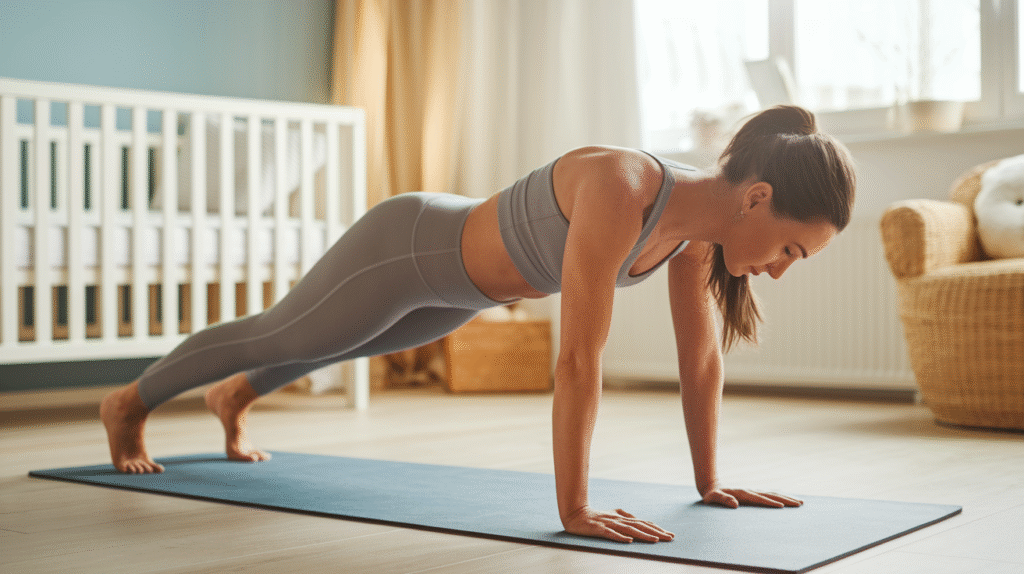
The plank progression timeline for postpartum moms looks like this: wall planks (weeks 6-8), incline planks on a couch or counter (weeks 8-12), modified planks on knees (weeks 12-16), and finally full planks (month 4+). Never rush to full planks. A wall plank done correctly builds more functional strength than a full plank done with poor form.
Cool-Down and Recovery
Spend three to five minutes stretching after every workout. Your hip flexors and lower back take tremendous strain from sitting while nursing and carrying your baby, so they need attention.
Hip flexor stretch: kneel on your right knee with your left foot forward (like a proposal position). Tuck your pelvis under and gently shift your weight forward until you feel a stretch in the front of your right hip. Hold for 30 seconds, then switch sides.
Child’s pose: sit back on your heels with knees wide and fold forward, extending your arms in front of you. This gently stretches your entire back and allows your core to fully relax. Hold for one minute, breathing deeply.
Supine spinal twist: lie on your back and bring both knees toward your chest. Let both knees fall to the right while extending your arms in a T-position. Turn your head left. Hold for 30 seconds, then switch sides. This releases tension in your spine and obliques.
Rest days are non-negotiable. Your muscles don’t get stronger during workouts—they get stronger during recovery. If you’re breastfeeding, overtraining can actually impact your milk supply by increasing stress hormones. Two to three rest days per week protects your progress and your milk production.
Making It Work: Practical Tips for Busy New Moms
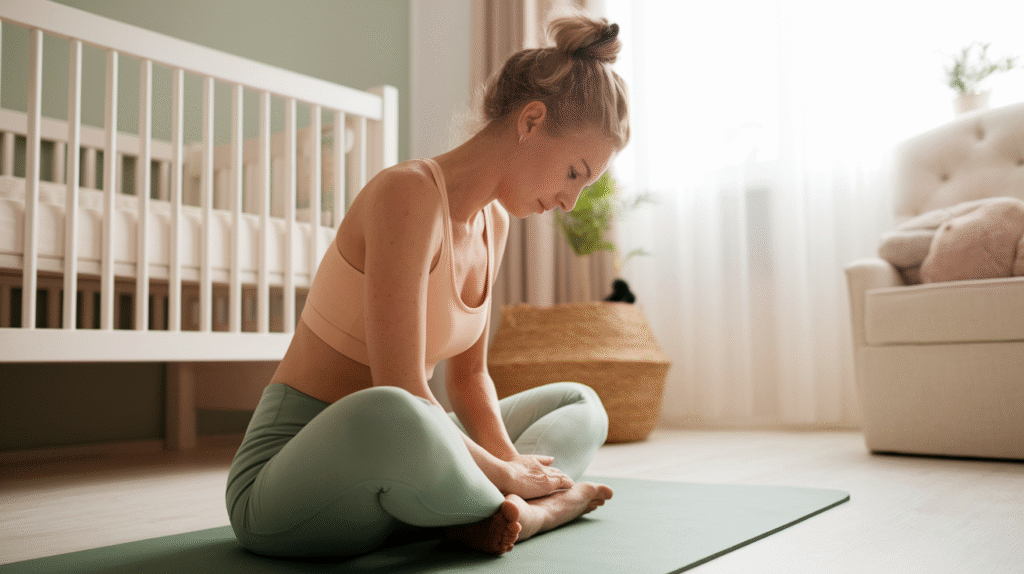
Fitting Workouts Into Your New Reality
Exercise snacking transforms your approach when 15 consecutive minutes feels impossible. Do three minutes of breathing and pelvic tilts in the morning. Five minutes of the core routine during afternoon naptime. Two minutes of stretching before bed. These mini-sessions accumulate, and research shows they’re just as effective as one longer session.
Use your baby as motivation and sometimes gentle resistance. Your little one loves watching you move. Place them on a play mat nearby during your workout. When they’re a bit older (4-6 months), hold them during glute bridges for added weight. They giggle, you get stronger—it’s a win-win.
Best times to workout: right after a feeding when your baby is content and drowsy, during tummy time (you do your exercises while they do theirs), or when your partner takes the baby for a walk. Don’t wait for the “perfect” time—it doesn’t exist. Start when you have ten minutes, even if it’s not ideal.
Let go of perfectionism. Your pre-baby self might have crushed hour-long gym sessions. Your postpartum self is crushing motherhood while finding ten minutes for core work. That’s not a downgrade—that’s impressive adaptation. Some movement beats no movement, every single time.
Nutrition and Hydration for Core Recovery
Caloric deficits aren’t recommended while breastfeeding. Your body needs approximately 500 extra calories per day to produce milk. Cutting calories too aggressively can tank your milk supply, your energy, and your ability to recover. Focus on nourishing your body, not restricting it.
Protein needs increase during postpartum recovery. Aim for 80-100 grams per day to support muscle repair and building. Practical sources: Greek yogurt (20g per cup), eggs (6g each), chicken breast (25g per 3oz), lentils (18g per cup), and protein smoothies. You don’t need to track obsessively—just include protein at each meal.
Hydration impacts everything: milk production, energy levels, muscle recovery, and even how well your connective tissue heals. Drink at least 100 ounces of water daily—more if you’re sweating during workouts or it’s hot outside. Keep a large water bottle with you while nursing; you’ll naturally drink more.
Simple meal prep ideas: hard-boil a dozen eggs on Sunday. Prep overnight oats in mason jars. Cook a big batch of chicken and quinoa. Cut up vegetables for easy snacking. You don’t have time for complicated recipes, and you don’t need them. Simple, nutritious food fuels your recovery just fine.
Tracking Progress Without the Scale
The scale is a terrible measure of postpartum progress. Your weight fluctuates based on water retention, hormones, milk production, and inflammation. It doesn’t tell you that your diastasis recti closed by half an inch or that you can now engage your deep core muscles.
Take measurements and progress photos if they motivate you (not if they stress you out). Measure around your natural waist, across your belly button, and around your hips. Take photos in the same lighting, same outfit, same time of day every two weeks. Visual progress sneaks up on you.
Functional wins matter more than any number. Can you lift your baby’s car seat without back pain? That’s progress. Can you play on the floor with your baby and stand up easily? Progress. Do you have more energy at 3 PM? That’s your stronger core supporting better posture and breathing. Progress.
Celebrate small victories: completing a workout when you felt exhausted, choosing to stretch instead of scrolling, feeling your abs engage during a daily activity. These moments compound into transformation.
Getting Support and Staying Accountable
Online communities for postpartum fitness provide encouragement and reality checks. Look for groups led by certified pre/postnatal fitness specialists, not just general mom groups. The right community celebrates your three-minute workout as much as someone else’s thirty-minute session.
Partner involvement makes everything easier. Ask specifically: “I need you to watch the baby for 15 minutes at 10 AM on Tuesday, Thursday, and Saturday so I can do my core workout.” Specific requests get better results than “I need more help.”
Apps and timers keep workouts simple. Set a timer for each exercise so you’re not counting reps and watching the clock. Use a simple workout tracking app to log your sessions—seeing your consistency streak builds motivation.
When to invest in postpartum fitness specialist guidance: if you’re not seeing improvement after 8-12 weeks of consistent exercise, if you have pain, if your diastasis recti isn’t closing, or if you feel lost and overwhelmed. A few sessions with a certified pre/postnatal fitness specialist or pelvic floor physical therapist can accelerate your progress by months.
Rebuild Your Core, Reclaim Your Strength
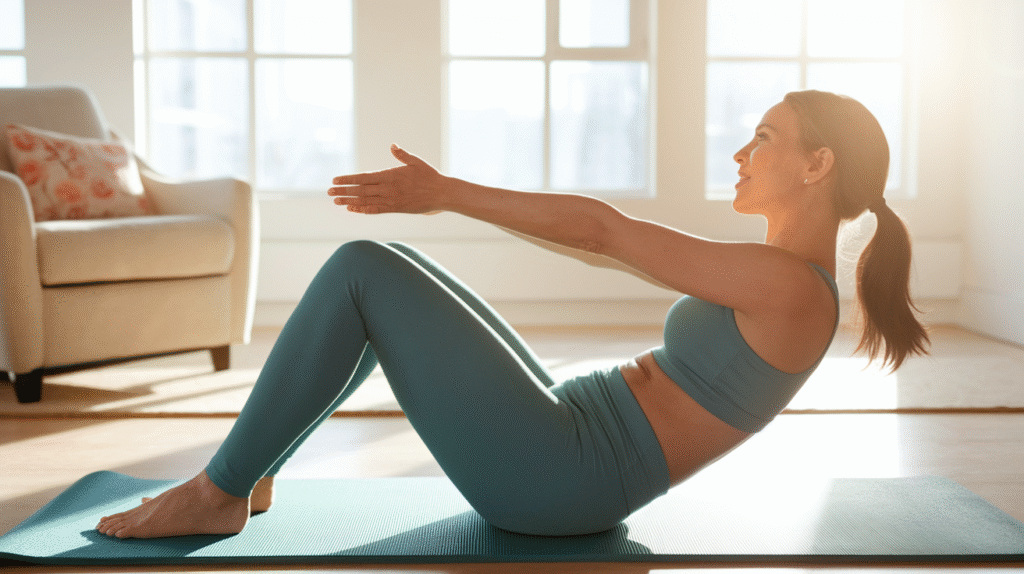
Your postpartum abs journey is about healing first, strengthening second, and aesthetics third. That order matters. Rush the healing phase, and you’ll spend years compensating with a weak, disconnected core. Honor the healing phase, and you’ll build strength that serves you for decades.
The truth about transforming your core: consistency over intensity wins every single time. Three 10-minute workouts per week, done correctly for three months, delivers better results than sporadic hour-long sessions. Your body responds to regular, appropriate stimulus—not heroic efforts followed by weeks of nothing.
You’re not just doing ab exercises—you’re rebuilding from the inside out. That requires more courage than any pre-pregnancy workout ever did. You’re showing up for yourself while caring for a tiny human who needs you constantly. You’re choosing strength when you feel weak. You’re investing in your long-term health when immediate results aren’t visible.
Your body deserves patience, not punishment. This effective approach honors both your need for results and your body’s need for proper recovery. You grew a human. Your abs separated to make room for life. They can heal, they can strengthen, and they can become more functional than before—but only if you give them the time and appropriate exercises they need.
Start with just breath work today. Five minutes of 360-degree breathing while your baby naps. Tomorrow, add pelvic tilts. Next week, try the full beginner routine. Small steps accumulate into powerful transformation.
Every new mother’s timeline is different, and yours is perfect for you. Not faster, not slower—just yours. The mother who starts at six weeks postpartum and the mother who starts at six months postpartum can both build incredible core strength. The only timeline that matters is the one where you start and stay consistent.
Your action step: Commit to one 10-minute session this week. Put it in your calendar. Tell your partner. Set up your space. Then do it, notice how powerful you feel, and do it again in two days. That’s how transformation begins—not with motivation, but with decision and repetition.
You’ve got this, mama. Your core is ready to reconnect, rebuild, and become stronger than ever. Start today.