Tone your arms in 4 weeks without weights
One morning, I caught my reflection as I reached for a coffee mug and thought, “When did my arms start looking like this?” I was a busy professional juggling deadlines, and the gym membership I’d paid for sat unused while my upper arms told the story of too many desk hours and not enough movement. The frustration wasn’t just about appearance—I felt weaker opening jars, carrying groceries, even holding my yoga poses.
Here’s what changed everything: I didn’t need expensive equipment or a gym membership to sculpt strong, defined arms. Just my body weight, 15 minutes a day, and the commitment to show up consistently.
If you’re a busy professional, a parent squeezing workouts between responsibilities, or someone intimidated by gym culture, this is your proven roadmap. Over the next four weeks, you’ll follow a science-backed bodyweight plan that delivers visible results you can do anywhere—your living room, office, hotel room, or backyard.
What to expect: progressive exercises that build real strength, realistic timelines (because overnight transformations are fiction), and a sustainable approach that fits into your actual life. No hype. No impossible promises. Just effective movements that work when you work them.
The best part? You’ll start feeling stronger within days, even though visible definition takes longer. That’s the honest truth about arm transformation, and we’re going to walk through every step together.
Why Bodyweight Training Is the Secret to Sculpted Arms

The Science Behind Bodyweight Arm Exercises
Your muscles don’t actually know the difference between a dumbbell and your own body weight—they only understand tension and resistance. When you perform a push-up, you’re pressing approximately 64% of your body weight away from the ground. That’s significant load on your chest, shoulders, and triceps.
The principle at work is called progressive overload, and it’s the cornerstone of muscle development. Research consistently shows that muscles adapt and grow stronger when exposed to gradually increasing demands. Without weights, you create this progression through tempo manipulation (slowing down movements), increasing reps, decreasing rest periods, or advancing to more challenging variations.
Time under tension matters more than you think. A standard push-up might take 2-3 seconds, but when you control the lowering phase for 3-4 seconds, you’ve nearly doubled the muscle engagement. This eccentric loading—the lengthening phase of movement—causes more muscle fiber recruitment and metabolic stress, both triggers for the toned appearance you’re after.
Benefits Beyond the Gym
The “no equipment means no excuses” reality transformed my consistency. I traveled frequently for work, and bodyweight training meant my hotel room became my gym. No searching for fitness centers, no packing resistance bands, no workout disruption.
You’re also building functional strength—the kind that helps you push a heavy door open, lift your suitcase into an overhead bin, or play with your kids without fatigue. Unlike isolation machines that lock you into fixed movement patterns, bodyweight exercises engage stabilizer muscles and improve coordination.
The financial benefit is undeniable. The average gym membership costs $58 monthly, totaling nearly $700 annually. This program costs exactly zero dollars while delivering powerful results. You’re not sacrificing quality for savings—you’re accessing the same resistance training principles that build muscle, just using your body as the tool.
Realistic Expectations for Your 4-Week Journey
Let’s talk honest timelines, because unrealistic expectations kill more fitness journeys than anything else.
Week 1: You’re building neural pathways and muscle memory. Your brain is learning movement patterns, and you might feel awkward or uncoordinated. That’s completely normal. You won’t see visible changes yet, but you’re laying essential foundation. You will feel accomplished after each workout.
Week 2: Endurance improves noticeably. Movements that felt impossible in week one become manageable. You might complete 2-3 more reps than your first session. Initial muscle firmness begins—you’ll feel it more than see it. Your arms will feel slightly fuller from increased blood flow and glycogen storage.
Week 3: This is where visible definition starts emerging, especially if you’re managing nutrition (more on that later). The back of your arms shows more shape. Shoulders begin looking more defined. You’ll notice strength gains—maybe you progress from knee push-ups to standard push-ups, or add 5 more reps to your tricep dips.
Week 4: Noticeable transformation becomes apparent in photos and how your clothes fit. Sleeves feel different. You can see muscle separation when you flex. Friends might comment. More importantly, you feel genuinely stronger and more capable in daily activities.
This progression assumes consistency—missing multiple workouts will delay results. That’s not judgment; it’s physiology.
Understanding Your Arm Anatomy (Keep It Simple)

The Three Muscle Groups That Transform Your Arms
Your arms aren’t one muscle—they’re a complex system, but we only need to understand three key players.
Biceps sit on the front of your upper arm and create that coveted peak when you flex. They’re responsible for pulling movements and elbow flexion. While they get lots of attention, they’re actually the smaller contributor to overall arm size.
Triceps run along the back of your upper arm and are your secret weapon for transformation. Here’s what most people miss: triceps comprise roughly 60% of your upper arm mass. If you want bigger, more defined arms, triceps development is non-negotiable. They’re responsible for pushing movements and arm extension.
Shoulders (specifically the deltoids) cap your arm and create that athletic, sculpted silhouette. Well-developed shoulders make your waist appear smaller and give your entire upper body a balanced, strong appearance. They’re involved in nearly every arm movement, providing stability and power.
Why Triceps Are Your Secret Weapon
When people complain about “arm flab” or lack of definition, they’re usually referring to the tricep area. This isn’t about spot-reducing fat—that’s physiologically impossible—but about building muscle in the area that creates the most visual impact.
Most traditional workouts emphasize biceps because they’re visible and flexing them feels satisfying. But triceps are often neglected, creating imbalanced development. When I finally started prioritizing tricep work through variations like diamond push-ups and tricep dips, my arms transformed faster than months of bicep-focused training had achieved.
The triceps have three heads (hence “tri”), and bodyweight exercises like push-ups and dips engage all three simultaneously, creating comprehensive development without needing different angles or equipment.
The Truth About “Toning” vs. Building Muscle
Let’s debunk the biggest myth: “toning” isn’t a separate biological process from building muscle. What people call “toned” is actually muscle definition that becomes visible when you increase muscle mass and reduce the fat layer covering it.
You will not get bulky from bodyweight exercises. This fear, especially common among women, is based on misunderstanding hormones and training volume. Building significant muscle mass requires testosterone levels, caloric surplus, and training volume that far exceeds what this program provides. What you will get is defined, strong arms with visible shape and improved firmness.
The “toned” look comes from two factors: increased muscle mass (even small increases create shape) and reduced body fat percentage (which reveals the muscle underneath). This program addresses the first factor directly. The nutrition section addresses the second.
Women especially benefit from arm strengthening beyond aesthetics. Resistance training increases bone density (reducing osteoporosis risk), improves metabolic rate, enhances insulin sensitivity, and builds functional strength for daily life. The aesthetic benefits are just a bonus to these powerful health outcomes.
The Complete 4-Week Bodyweight Arm Transformation Plan

Week 1: Foundation Building (3 Days Per Week)
Your first week establishes movement patterns and baseline strength. Don’t rush this phase—perfect form now prevents injury and accelerates progress later.
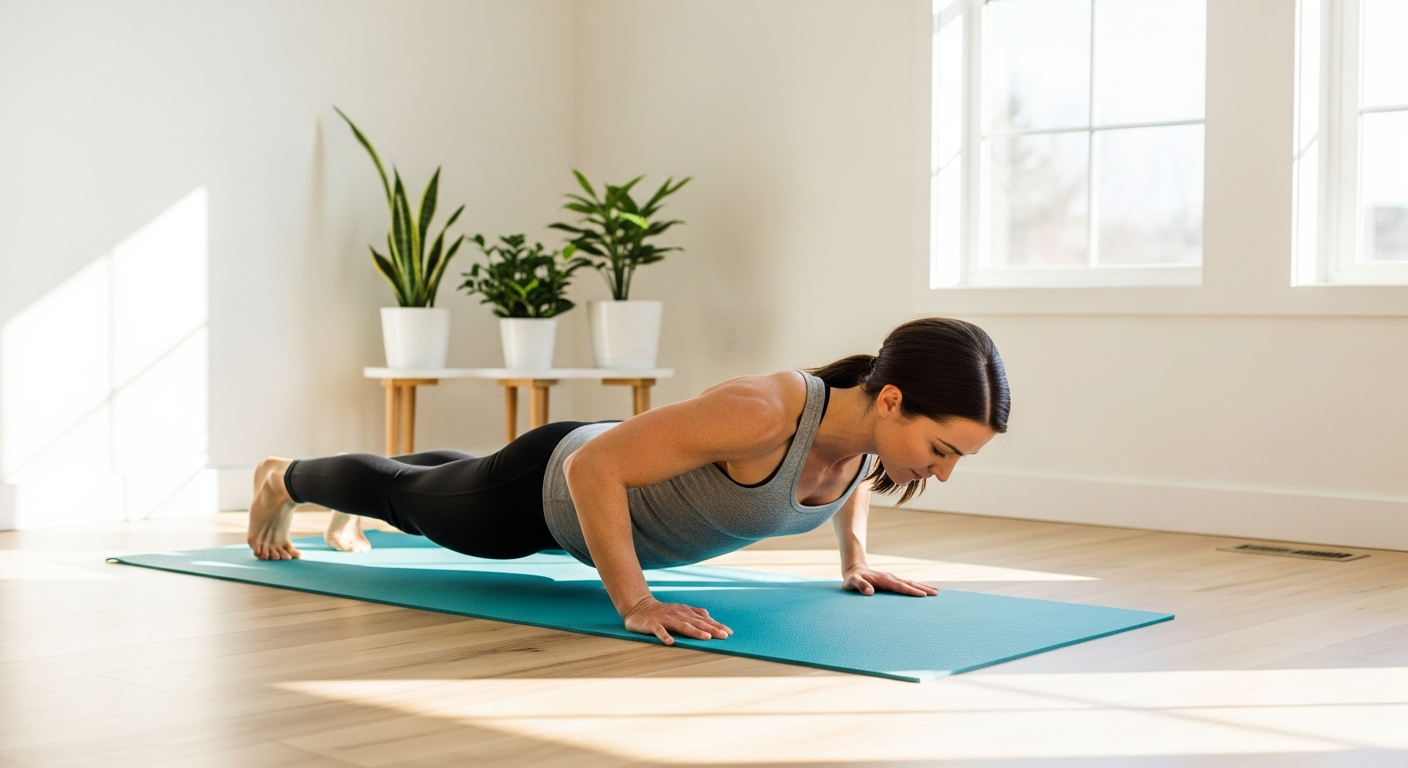
Exercise 1: Standard Push-Ups (or modified knee push-ups) – 3 sets of 8-12 reps – Rest 60-90 seconds between sets
Proper form breakdown: Hands slightly wider than shoulder-width, fingers pointing forward. Create a straight line from head to heels—no sagging hips or raised buttocks. Lower until chest nearly touches ground, elbows at 45-degree angle to body. Push through palms to return to start.
Common mistake: Flaring elbows out to 90 degrees. This stresses shoulder joints and reduces tricep engagement. Keep elbows at 45 degrees maximum.
Modification: Perform from knees, maintaining the same straight line from head to knees. Don’t let this feel “easier”—make each rep challenging by controlling tempo.
Exercise 2: Tricep Dips (using chair or bench) – 3 sets of 10-15 reps – Rest 60 seconds between sets
Setup: Sit on chair edge, hands gripping beside hips, fingers forward. Walk feet out, supporting weight on arms. Lower body by bending elbows to 90 degrees, keeping back close to chair. Press back up.
Beginner modification: Keep feet closer to body, knees bent. This reduces resistance. As you strengthen, extend legs farther.
Exercise 3: Plank Shoulder Taps – 3 sets of 20 taps (10 each side) – Rest 45 seconds between sets
Start in high plank position. Maintaining stable hips (minimal rotation), lift right hand to tap left shoulder. Return to plank. Alternate sides. This builds shoulder stability while engaging core—the foundation for all arm exercises.
Exercise 4: Arm Circles – 2 sets of 30 seconds each direction – No rest between directions
Stand with arms extended to sides at shoulder height. Make small circles forward for 30 seconds, then reverse direction. This burnout finisher increases blood flow and builds shoulder endurance. Your arms should feel fatigued by the end.
Week 2: Intensity Increase (4 Days Per Week)
Add one workout day and increase reps by 2-3 per exercise. Your body has adapted to week one’s stimulus—now we challenge it further.
Continue all Week 1 exercises with increased volume, plus:
New Addition: Diamond Push-Ups – 2 sets of 6-10 reps – Rest 90 seconds between sets
Place hands together under chest, forming a diamond shape with thumbs and index fingers. This narrow hand position shifts emphasis heavily to triceps. These are significantly harder than standard push-ups—starting with 6 quality reps beats 15 sloppy ones.
New Addition: Pike Push-Ups – 3 sets of 8-12 reps – Rest 60 seconds between sets
Start in downward dog position—hips high, forming an inverted V. Bend elbows, lowering head toward ground between hands. Press back up. This targets shoulders more directly than standard push-ups, building that sculpted cap.
Week 3: Progressive Challenge (4 Days Per Week)
Introduce tempo training—the game-changer for muscle development without adding weight. Slow down the lowering phase to 3-4 seconds on every exercise. This increases time under tension dramatically.
New Addition: Decline Push-Ups – 3 sets of 8-10 reps – Rest 90 seconds between sets
Elevate feet on chair or couch (12-18 inches high). Perform push-ups in this declined position. You’re now pressing closer to 75% of your body weight, significantly increasing resistance. This targets upper chest and shoulders more intensely.
New Addition: Tricep Push-Ups – 3 sets of 10-12 reps – Rest 60 seconds between sets
Similar to diamond push-ups but hands are shoulder-width apart, elbows stay tight to ribs throughout movement. Lower slowly, keeping elbows pointing backward, not out. This variation allows slightly higher reps than diamond push-ups while maintaining intense tricep focus.
Increase plank shoulder taps to 30 taps (15 per side) with slower, more controlled movement.
Week 4: Maximum Results Push (5 Days Per Week)
Final week combines everything into circuit format—performing exercises back-to-back with minimal rest. This increases metabolic demand and muscular endurance while maximizing results.
Complete Circuit Format: – Standard Push-Ups: 12-15 reps – Tricep Dips: 15-20 reps – Diamond Push-Ups: 8-12 reps – Pike Push-Ups: 10-15 reps – Plank Shoulder Taps: 30 taps – Arm Circles: 30 seconds each direction
Perform exercises consecutively with no rest between exercises. Rest 60-90 seconds after completing the full circuit. Complete 3-4 rounds total.
Track your progress: How many reps can you complete in week 4 versus week 1? Most people see 30-50% improvement in rep capacity—that’s measurable strength gain.
Sample Weekly Schedule
Monday: Upper body focus—complete full circuit Tuesday: Rest or 20-minute walk (active recovery) Wednesday: Arm-intensive day—all exercises, traditional sets Thursday: Yoga, stretching, or complete rest Friday: Full arm circuit (aim for 4 rounds) Saturday: Bonus session—pick your three favorite exercises Sunday: Complete rest
Rest days aren’t optional—they’re when adaptation happens. Your muscles don’t grow during workouts; they grow during recovery.
Proven Techniques to Maximize Your Arm-Toning Results

Perfect Your Form for Effective Muscle Activation
I spent my first month doing push-ups wrong—hands too wide, elbows flaring, hips sagging. I was working hard but getting minimal results because poor form distributes tension across joints instead of concentrating it in muscles.
Push-up alignment checklist: Hands directly under shoulders (or slightly wider). Shoulders, hips, and heels form a straight line. Core engaged—imagine someone might punch your stomach and you’re bracing. Neck neutral—look at ground slightly ahead, not straight down. Lower until chest is 1-2 inches from floor.
Engage your core during every exercise, even tricep dips and arm circles. This isn’t just about preventing lower back strain—core engagement creates full-body tension that increases force production. You’ll actually complete more reps with better core activation.
Breathing techniques matter more than most realize. Exhale during the exertion phase (pushing up), inhale during the lowering phase. Holding your breath creates internal pressure that can spike blood pressure and reduce performance. Rhythmic breathing delivers oxygen to working muscles.
Video yourself or use a mirror initially. What feels like proper form often isn’t—external feedback corrects this disconnect quickly.
Progressive Overload Without Weights
Here’s the common mistake that stalls progress: doing the same workout week after week. Your body adapts to repeated stimulus by becoming more efficient, which means less muscle growth.
Progressive overload strategies without adding weight:
Increase reps gradually: Add 1-2 reps per set each week. If you completed 10 push-ups in week one, aim for 12 in week two, 14 in week three.
Slow down tempo: A 3-second lowering phase nearly doubles time under tension compared to a 1-second drop. This creates more muscle damage (the good kind that triggers growth) and metabolic stress.
Add isometric holds: Pause at the bottom of a push-up for 2-3 seconds before pressing up. Or hold at the top of a tricep dip for 2 seconds. These static holds increase intensity without changing the exercise.
Decrease rest time: If you rested 90 seconds between sets in week one, reduce to 75 seconds in week two, then 60 seconds. Shorter rest increases metabolic demand and muscular endurance.
Try more challenging variations: Progress from knee push-ups to standard push-ups to decline push-ups. Each variation increases resistance.
The Power of Consistency Over Intensity
The biggest predictor of your results isn’t the perfect workout—it’s showing up consistently. I’ve seen people transform their arms with imperfect programs done consistently, while others with “optimal” routines failed because they missed half their sessions.
Research on habit formation shows it takes 66 days on average to establish a new behavior. You’re building a habit, not just completing a program. Missing one workout derails momentum more than you’d think—it makes the next skip easier.
Fifteen focused minutes beats sixty distracted minutes every time. Quality over quantity. If you’re truly present, controlling tempo, feeling muscles work, and maintaining form, 15 minutes creates significant stimulus.
Schedule workouts like important appointments. Put them in your calendar. Set phone reminders. Lay out workout clothes the night before. These simple systems remove decision-making friction that kills consistency.
Track completion for motivation. Put a checkmark on your calendar for every completed workout. Watching that chain of checkmarks grow creates powerful momentum—you won’t want to break the streak.
Nutrition Strategies to Burn Fat and Reveal Toned Arms

You Can’t Out-Exercise a Bad Diet (But Keep It Simple)
This is the truth that transformed my results: I was doing everything right in workouts but eating in ways that prevented visible definition. You can build muscle with bodyweight exercises—that’s proven—but if that muscle sits under a layer of fat, you won’t see the toned appearance you’re working toward.
Caloric deficit basics without obsessive counting: You need to consume slightly fewer calories than you burn to reduce body fat. For most people, this means reducing portion sizes by about 20% or eliminating one snack daily. You don’t need to count every calorie—just create awareness.
Focus on whole foods over processed options. Whole foods (vegetables, fruits, lean proteins, whole grains) are more satiating per calorie than processed foods (chips, cookies, fast food). You’ll naturally eat less while feeling more satisfied.
Protein importance for muscle recovery and definition: Aim for 0.7-1 gram of protein per pound of body weight. For a 150-pound person, that’s 105-150 grams daily. Protein preserves muscle mass during fat loss and provides the building blocks for the muscle development you’re creating through workouts.
Foods That Support Your Transformation
Lean proteins: Chicken breast, turkey, fish (especially salmon for omega-3s), tofu, tempeh, Greek yogurt, cottage cheese, eggs. Include protein at every meal.
Complex carbs: Sweet potatoes, quinoa, brown rice, oats, whole grain bread. These provide sustained energy for workouts and daily life without blood sugar spikes.
Healthy fats: Avocado, nuts (almonds, walnuts), seeds (chia, flax), olive oil, fatty fish. Fats support hormone production (including hormones that build muscle) and increase satiety.
Hydration target: Half your body weight in ounces daily. A 160-pound person needs 80 ounces (10 cups) of water. Proper hydration improves performance, reduces fatigue, and supports metabolic processes.
Pre and Post-Workout Nutrition Tips
Pre-workout (30-60 minutes before): Light protein and carb combination. Examples: Greek yogurt with berries, apple with almond butter, small protein smoothie. This provides energy without causing digestive discomfort.
Post-workout (within 2 hours): Protein and carbs to support recovery. Examples: Grilled chicken with sweet potato, protein shake with banana, salmon with quinoa and vegetables.
Sample meal prep for busy schedules: Sunday evening, grill 3-4 chicken breasts, roast a large batch of vegetables, cook quinoa or rice. Portion into containers for grab-and-go meals throughout the week. This consistency supports consistent results.
Troubleshooting Common Challenges and Plateaus
“I’m Not Seeing Results After 2 Weeks”
Two weeks feels like forever when you’re working hard, but physiologically, it’s just the beginning.