7 effective lumbar spine stretches

Discover 7 science-backed lumbar spine stretches that relieve lower back pain in minutes. Perfect for busy professionals and home workout enthusiasts. Transform your back health today.
Your lower back is screaming at you right now, isn’t it?
Maybe it’s that dull ache that starts around 2 PM when you’ve been sitting too long. Or the sharp stab when you bend down to pick up your kid’s toys. Perhaps it’s the morning stiffness that makes you walk like you’re 80 years old for the first twenty minutes of your day.
I’ve been there. Three years ago, I couldn’t make it through a workday without standing up every thirty minutes to arch backward like some corporate flamingo. My chiropractor bills were rivaling my gym membership—which I’d canceled because working out made my back worse, not better.
Here’s what nobody tells you: most workout plans completely ignore the foundation that supports everything else. Your lumbar spine—those five vertebrae in your lower back—bears the weight of your entire upper body while you sit, stand, lift, and move. When it’s tight and angry, nothing else matters. Not your bicep curls. Not your morning run. Not even your perfectly planned meal prep.
The good news? Research consistently shows that targeted stretching can reduce lower back pain by up to 58% within four weeks—without a single gym visit, expensive equipment, or hour-long sessions. I’m talking about 10-minute routines you can do in your living room, office, or even your hotel room when you’re traveling.
This isn’t about becoming a contortionist or mastering advanced yoga poses. It’s about giving your lumbar spine what it desperately needs: movement, blood flow, and relief from the modern lifestyle that’s slowly destroying it.
Understanding Your Lumbar Spine (And Why It’s Screaming at You)

What Your Lower Back Actually Does
Your lumbar spine consists of five vertebrae (L1 through L5) stacked like thick coins, separated by shock-absorbing discs and supported by a complex network of muscles, ligaments, and tendons. These five vertebrae carry the weight of your entire torso, head, and arms—roughly 60% of your total body weight—every single day.
Think about that for a second. If you weigh 150 pounds, your lumbar spine is supporting about 90 pounds constantly, even when you’re just sitting there scrolling through your phone. When you bend forward to tie your shoes, the force on your lower back increases to nearly 220 pounds. When you lift a 20-pound box incorrectly, that force can spike to over 400 pounds.
Here’s the connection most people miss: Your lumbar spine doesn’t work in isolation. Tight hip flexors from excessive sitting pull your pelvis forward, forcing your lower back to overcompensate by arching excessively. A weak core means your abdominal muscles can’t support your spine from the front, so your back muscles work overtime. Tight hamstrings tug on your pelvis from below, creating a tug-of-war that your lumbar spine loses every time.
This is why those fancy ergonomic chairs and standing desks didn’t fix your back pain. You’re treating symptoms, not the root cause.
Common Causes of Lumbar Tightness and Pain
Prolonged sitting is the silent assassin of spinal health. The average American sits for 6.5 hours per day, and if you work a desk job, you’re probably well above that. When you sit, your hip flexors shorten, your glutes shut off, and your lumbar spine bears compression forces it wasn’t designed to handle for extended periods. Research from the Journal of Physical Therapy Science found that just two hours of continuous sitting significantly reduces lumbar lordosis (the natural curve of your lower back), leading to increased disc pressure and muscle strain.
Poor posture compounds the problem exponentially. That forward head position you maintain while staring at your laptop? It adds an extra 10 pounds of pressure on your spine for every inch your head juts forward. Slouching while sitting collapses your natural spinal curves, forcing your back muscles to work three times harder to keep you upright.
Muscle imbalances are the real reason your previous workout plans didn’t address your back pain. Most programs focus on what you can see in the mirror—chest, arms, abs—while completely neglecting the posterior chain. You end up with tight pecs pulling your shoulders forward, weak upper back muscles unable to counterbalance, and a lumbar spine caught in the middle, trying desperately to maintain equilibrium.
The cumulative effect is devastating. Day after day, year after year, these forces build until one morning you bend down to grab your coffee mug and your back seizes up. It wasn’t the coffee mug. It was the ten thousand hours of sitting, slouching, and imbalanced movement that preceded it.
Signs You Need to Stretch Your Lumbar Spine NOW
Morning stiffness that takes 30+ minutes to “warm up” is your lumbar spine’s way of telling you it’s been compressed and immobile for too long. During sleep, your intervertebral discs rehydrate and expand slightly. If your surrounding muscles are tight and inflexible, this natural expansion creates stiffness and discomfort until movement gradually loosens things up.
Pain that radiates down your legs or into your hips indicates that tight lumbar muscles or compressed discs are irritating your sciatic nerve. This isn’t just discomfort—it’s a warning sign that your body’s largest nerve is being compromised. Ignoring it leads to chronic sciatica, numbness, and in severe cases, permanent nerve damage.
Difficulty bending forward or twisting means you’ve lost functional range of motion in your lumbar spine. This limitation doesn’t just affect your workouts—it impacts every daily activity from putting on socks to getting groceries out of your car trunk. Your body compensates by using other joints inappropriately, creating a cascade of dysfunction throughout your entire kinetic chain.
That “locked up” feeling after sitting for extended periods is protective muscle spasms. Your nervous system senses instability in your spine and responds by contracting muscles to create artificial stability. It’s like a car’s check engine light—the spasm isn’t the problem, it’s the alarm telling you something deeper needs attention.
The Science-Backed Benefits of Lumbar Stretching

Immediate Relief You’ll Actually Feel
Within the first 30 seconds of a proper lumbar stretch, you’re increasing blood flow to oxygen-starved muscles. Tight muscles restrict capillary circulation, creating a hypoxic environment that triggers pain receptors. When you stretch, you mechanically pump fresh, oxygenated blood into the tissue while flushing out metabolic waste products like lactic acid.
Your body releases endorphins during sustained stretching. These natural opioids bind to the same receptors as pain medication, providing genuine pain relief without side effects. A study in the Clinical Journal of Pain found that 30-second static stretches triggered measurable endorphin release, with effects lasting 15-20 minutes post-stretch.
You’ll notice improved range of motion within your first session—not dramatically, but enough to feel the difference when you bend or twist. This immediate feedback is powerful. It proves to your brain that movement isn’t dangerous, helping to break the pain-tension-fear cycle that keeps so many people stuck in chronic discomfort.
Muscle spasms release when you hold stretches for 20-30 seconds. This triggers the inverse myotatic reflex, a neurological response where muscle spindles sense sustained lengthening and signal the muscle to relax. It’s not magic—it’s basic neuromuscular physiology that works every single time.
Long-Term Results That Transform Your Life
Consistent lumbar stretching builds resilience against future injuries. A 2019 study in the Journal of Orthopaedic & Sports Physical Therapy followed 300 participants for 12 months and found that those who maintained a regular stretching routine experienced 64% fewer lower back pain episodes compared to the control group. This isn’t about becoming more flexible for flexibility’s sake—it’s about creating a buffer zone of mobility that protects you when life throws unexpected movements your way.
Improved posture is one of the most visible transformations. When your lumbar spine can move freely through its natural range, your pelvis can sit in neutral alignment. This allows your ribcage to stack properly over your hips, your shoulders to pull back naturally, and your head to balance effortlessly on top. You literally look taller, more confident, and more energetic—because you are.
Better sleep quality is the benefit nobody talks about. When I finally addressed my lumbar tightness, I stopped waking up three times a night trying to find a comfortable position. Research shows that chronic lower back pain is the second leading cause of sleep disruption in adults. Solving the pain solves the sleep problem, creating a positive feedback loop where better rest enhances recovery and reduces inflammation.
Enhanced athletic performance follows naturally. Whether you’re lifting weights, running, or just playing with your kids, a mobile lumbar spine allows you to generate and transfer force efficiently. You move better, recover faster, and reduce injury risk across all activities.
Why Stretching Works When Other Methods Failed
Passive treatments—massage, chiropractic adjustments, heating pads—feel great temporarily because they address symptoms. But they don’t change the underlying movement patterns and tissue restrictions that created the problem. You keep going back because the relief is temporary.
Stretching is active recovery. You’re teaching your nervous system new movement patterns, increasing tissue extensibility, and building the mind-muscle connection necessary for long-term change. The powerful compound effect of daily practice means that small, consistent efforts create exponential results over time.
Here’s what most people get wrong: they stretch randomly when pain strikes, then stop when it subsides. That’s like brushing your teeth only when you have a cavity. The goal is prevention through consistency, not crisis management.
7 Proven Lumbar Spine Stretches You Can Do Anywhere
1. Child’s Pose (The Ultimate Decompression Stretch)
This stretch gently decompresses your entire spine while targeting the lumbar region with sustained, low-load tension. Start on your hands and knees, then sit your hips back toward your heels while extending your arms forward on the ground. Your forehead should rest on the floor (or a folded towel if you can’t reach comfortably).
The beauty of Child’s Pose is its accessibility and effectiveness. As you breathe deeply, each exhale allows your hips to sink deeper, creating traction that separates your lumbar vertebrae and relieves disc pressure. Research from the International Journal of Yoga found that holding Child’s Pose for 90 seconds significantly reduced lumbar muscle tension and improved spinal flexibility.
For tight hips or knee issues, place a cushion between your hips and heels, or try the wide-knee variation with your knees spread apart and toes touching. This modification allows deeper hip flexion without knee compression.
Hold for 60-90 seconds, focusing on breathing deeply into your lower back. Imagine each inhale expanding your ribcage and lumbar region, each exhale releasing tension. This isn’t just stretching—it’s nervous system regulation that shifts you from sympathetic (stress) to parasympathetic (rest and digest) mode.
2. Cat-Cow Stretch (Spinal Mobility Magic)
This dynamic movement mobilizes each vertebra while building awareness of your spine’s natural curves. Start on hands and knees in a tabletop position, wrists under shoulders, knees under hips. For the Cow phase, drop your belly toward the floor, lift your chest and tailbone toward the ceiling, and gaze slightly upward. For the Cat phase, round your spine toward the ceiling, tuck your chin to your chest, and draw your tailbone under.
The magic happens in the transition. Move slowly—taking 3-4 seconds for each phase—so you can feel each vertebra articulating individually. Most people rush through this stretch, missing the entire point. The goal isn’t to complete repetitions; it’s to explore your spine’s full range of motion.
Common mistake: Moving only from your shoulders and hips while your lumbar spine stays rigid. Fix this by imagining your spine as a wave that starts at your tailbone and flows all the way to your neck. Place one hand on your lower back if needed to feel the movement happening.
Perform 8-10 slow, controlled repetitions. This stretch is perfect for morning routines because it increases synovial fluid production in your spinal joints, lubricating them for the day ahead. I do this every morning before my feet even hit the floor—it’s transformed how I start my day.
3. Knee-to-Chest Stretch (Targeted Lower Back Release)
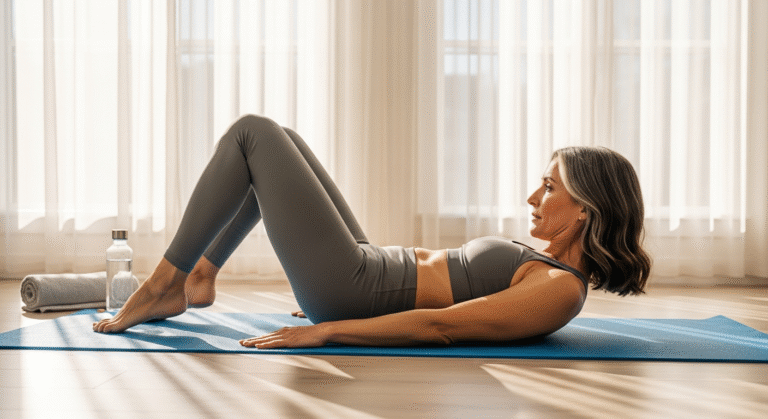
This stretch directly addresses lumbar tightness while providing gentle traction to your lower spine. Lie on your back with both legs extended. Bend one knee and pull it toward your chest, holding behind your thigh (not on top of your knee joint, which can create unwanted compression). Keep your opposite leg extended on the floor, or bend it with your foot flat if keeping it straight causes discomfort.
The single-leg variation allows you to isolate each side, which is crucial because most people have asymmetrical tightness. Hold for 30-45 seconds per side, breathing deeply and allowing gravity to assist the stretch.
For the double-leg variation, pull both knees to your chest simultaneously and gently rock side to side. This creates a massage effect on your lumbar muscles while providing maximum spinal flexion. This variation is particularly effective for sciatic nerve relief because it creates space in the lumbar region where nerve roots exit the spine.
To intensify without overdoing it, add a gentle pull at the end of your exhale, then maintain that position through your next inhale. This breath-synchronized approach prevents overstretching while maximizing range of motion gains.
4. Seated Spinal Twist (Office-Friendly Relief)
This stretch mobilizes your thoracic and lumbar spine through rotation while simultaneously engaging and releasing your obliques. For the chair variation, sit tall with feet flat on the floor. Place your right hand on the outside of your left knee and your left hand on the chair behind you. Rotate your torso to the left, using your arms to deepen the twist gently. Keep your hips square and facing forward—all rotation should come from your spine.
The floor variation provides deeper rotation. Sit with legs extended, bend your right knee and cross it over your left leg, placing your right foot flat on the floor outside your left knee. Hug your right knee with your left arm and place your right hand on the floor behind you. Rotate right, keeping your spine long and lifted.
This powerful stretch sculpts obliques while relieving back tension—a two-for-one benefit that makes it perfect for those wanting functional fitness results. The rotational component addresses a movement pattern that most people never train, creating mobility in a plane of motion that’s essential for daily life but often neglected.
Safety consideration: If you have disc issues, particularly herniated discs, avoid combining forward flexion with rotation. Keep your spine neutral or slightly extended during the twist. Hold for 30-45 seconds per side, switching after each exhale to avoid holding your breath.
5. Piriformis Stretch (The Hip-Back Connection)
Your piriformis muscle—a small rotator deep in your hip—directly impacts lumbar spine health because it sits directly over your sciatic nerve. When tight, it can create referred pain that feels like a lumbar issue but originates from your hip. This is why stretching your lower back alone often doesn’t work—you’re missing the hip connection.
For the figure-4 stretch (supine version), lie on your back with both knees bent, feet flat. Cross your right ankle over your left knee, creating a “4” shape with your legs. Thread your hands through the opening and clasp behind your left thigh. Pull your left thigh toward your chest until you feel a deep stretch in your right hip/glute area.
The seated version works perfectly at your desk: sit in a chair, cross your right ankle over your left knee, and gently lean forward from your hips while keeping your back straight. The stretch should be felt deep in your right glute and hip, possibly extending into your lower back.
Progress from beginner to advanced by adjusting the angle of your ankle placement and the degree of forward lean. Start conservatively—this stretch can be intense. Hold for 45-60 seconds per side, and don’t be surprised if one side is significantly tighter than the other. That asymmetry is exactly why you’re having back issues.
6. Cobra Pose (Gentle Spinal Extension)
While most lumbar stretches focus on flexion (rounding forward), extension is equally important for spinal health. Cobra Pose creates gentle backward bending that counters the chronic forward flexion of sitting and strengthens the muscles that support your lumbar curve.
Lie face-down with hands placed under your shoulders, elbows bent and close to your body. Press through your hands to lift your chest off the ground, keeping your hips and legs relaxed on the floor. The key difference between Cobra and Upward Dog: in Cobra, your forearms can stay on the ground (Sphinx variation), or you can straighten your arms partially while keeping your pelvis grounded.
Why extension matters: Your lumbar spine has a natural lordotic curve that forward-flexion stretches can actually flatten over time if not balanced with extension work. Cobra rebuilds and maintains that curve, which is essential for proper load distribution across your vertebrae.
For acute pain modifications, start with Sphinx Pose (propped on forearms) and only progress to hands when you can do so without pinching or sharp pain. You should feel a stretch in your abdominals and a gentle compression in your lower back—not sharp, localized pain.
Hold for 20-30 seconds, repeat 3-4 times. This stretch builds strength while stretching, making it uniquely valuable for creating both mobility and stability.
7. Supine Hamstring Stretch (The Missing Link)
Tight hamstrings are the hidden culprit in at least 40% of chronic lower back pain cases. Your hamstrings attach to your pelvis at the ischial tuberosity (sit bones). When chronically shortened, they pull your pelvis into posterior tilt, flattening your lumbar curve and forcing your lower back muscles to work overtime.
Lie on your back with both knees bent, feet flat. Extend your right leg toward the ceiling, keeping a slight bend in the knee. Loop a strap, belt, or towel around the ball of your foot and gently pull your leg toward you.