
30-Day stability and mobility challenge
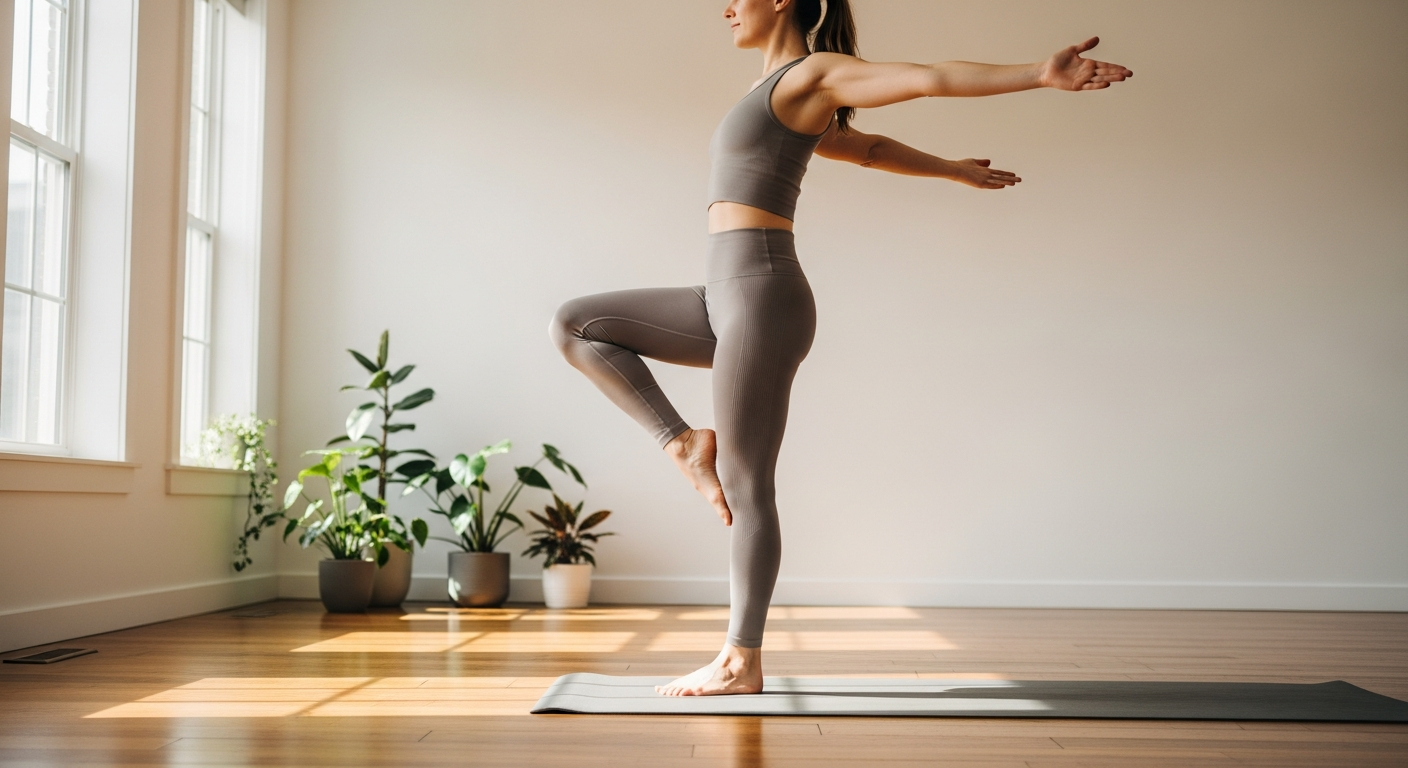
I was 34 when I bent down to pick up a dropped pen and felt my lower back seize up like a rusted hinge. Not from deadlifting. Not from running.
From picking up a pen. That’s when I realized I’d spent years building strength on a foundation that could no longer support basic human movement.
Here’s the uncomfortable truth most fitness content won’t tell you: your $60/month gym membership and that intense HIIT program aren’t going to fix the fact that you can’t rotate your thoracic spine or stabilize through a single-leg movement pattern.
Research from the Journal of Strength and Conditioning Research shows that mobility restrictions reduce force production by up to 30%—meaning you’re leaving a third of your potential strength on the table before you even start lifting.
Most people attack fitness backward. They jump into complex workout programs while their hips are locked up from sitting eight hours a day, their shoulders are rounded forward from desk work, and their core can’t stabilize a sneeze without compensation. It’s like building a house on quicksand and wondering why the walls keep cracking.
This 30-day challenge strips fitness down to its actual foundation. Just three minutes daily. No equipment. No gym commute. No intimidating environment. Just you, your body, and the movement patterns humans were designed to perform before we spent our lives folded into chairs.
By day 30, you won’t just move better—you’ll have eliminated the hidden dysfunction that causes chronic pain, sabotages your workouts, and makes you feel decades older than your age. This isn’t about touching your toes for Instagram. It’s about rebuilding your body’s operating system.
What Stability and Mobility Actually Mean (And Why You Need Both)

Let me clear up the confusion that trips up 90% of people starting their fitness journey.
Mobility: Your Body’s Freedom of Movement
Mobility is your joints’ ability to move through their full, natural range of motion with control. Not flexibility—that’s passive. Mobility is active, functional range that you can access and use in real life. When you can’t reach overhead to put luggage in the bin without arching your back, that’s a mobility restriction. When you squat down and your heels lift off the ground, that’s limited ankle mobility forcing compensation patterns up the chain.
The real-world impact? Every mobility restriction creates a compensation. Your body is brilliant at finding workarounds, but those workarounds create stress on joints and tissues that weren’t designed to handle it. That’s why your knee hurts even though the problem is actually your immobile hips. That’s why your lower back aches when the real culprit is your locked-up thoracic spine.
For busy professionals especially, mobility restrictions show up in the mundane moments that shouldn’t be difficult: getting out of your car without feeling stiff, playing with your kids without your back complaining, or simply feeling comfortable in your own body.
Stability: The Unsung Hero of Effective Movement
Stability is your body’s ability to maintain control through movement—to resist unwanted motion while creating intended motion. Think of it as the brakes and steering system while mobility is the engine. You can have all the range of motion in the world, but without stability, that range becomes a liability.
Here’s what most people miss: stability prevents injury more effectively than any other training modality. A study in the American Journal of Sports Medicine found that athletes with poor core stability were 2.8 times more likely to suffer lower extremity injuries. Not flexibility. Not strength. Stability.
When you can’t stabilize your spine during movement, your body compensates by tensing up muscles that should be relaxed, limiting the mobility you’re trying to improve. It’s a vicious cycle. You need mobility to move well, but you need stability to access that mobility safely. They’re not separate qualities—they’re two sides of the same functional coin.
The Science-Backed Benefits You’ll Experience
Within 30 days of consistent stability and mobility work, research shows measurable improvements in pain levels, movement quality, and performance. A meta-analysis in the Journal of Orthopaedic & Sports Physical Therapy demonstrated that mobility interventions reduced chronic lower back pain by an average of 40% in just four weeks.
But the benefits extend far beyond pain reduction. Improved hip mobility alone increases squat depth by an average of 15-20%, meaning every lower body exercise becomes more effective. Enhanced shoulder mobility allows proper overhead positioning, reducing shoulder impingement risk by up to 60%. Better spinal stability improves force transfer, making you stronger in every compound lift without adding a single pound to the bar.
For desk workers, the posture improvements are transformative. When your thoracic spine can extend properly and your hips can flex without compensation, you’re no longer fighting your body’s dysfunction just to sit upright. The chronic tension headaches, the tight traps, the perpetual feeling of being “wound up”—those diminish as your body remembers how to organize itself efficiently around gravity.
Who This 30-Day Challenge Is Perfect For

The Busy Professional
You’re not looking for another hour-long commitment. You need effective, not time-consuming. Three minutes fits before your morning coffee, during your lunch break, or right before bed. There’s no commute to a gym, no changing clothes, no setup time. Just hit the floor and move.
The beauty of this challenge for desk workers specifically: it directly counters the adaptive shortening and dysfunction caused by prolonged sitting. Your hip flexors shorten, your glutes forget how to fire, your thoracic spine loses extension. This challenge systematically addresses each compensation pattern your workday creates.
I’ve coached executives who swore they didn’t have time for fitness. They found three minutes. Everyone finds three minutes when the alternative is continuing to feel like their body is betraying them.
The Frustrated Beginner
If you’re intimidated by gyms or confused about where to start, this is your entry point. Not because it’s easy—it’s not. But because it’s foundational. You’re not trying to learn complex exercise technique while your body lacks basic movement competency. You’re building the base that makes everything else possible.
This challenge builds confidence through competence. Every day, you’ll notice small improvements—a little more range, a little less discomfort, movements that feel smoother. That progress is addictive in the healthiest way. It proves to you that your body responds to consistent effort, which is the belief system every successful fitness journey is built on.
Most beginners fail because they start with programs that demand movement quality their bodies can’t deliver. They get frustrated, injured, or both. This challenge ensures you’re ready for whatever comes next.
The Experienced Athlete
You’ve been training for years, but you’ve hit plateaus you can’t explain. Your squat hasn’t progressed in months. Your shoulder feels “off” during pressing movements. You’re strong, but you don’t feel athletic anymore.
Mobility and stability work is the missing piece. Research from the National Strength and Conditioning Association shows that addressing mobility restrictions can improve force production by 15-30% in trained athletes—no additional strength required. You’re not weak. You’re restricted.
I’ve watched powerlifters add 40 pounds to their squat in eight weeks just by unlocking hip and ankle mobility. I’ve seen CrossFit athletes eliminate chronic shoulder pain by building proper scapular stability. The strength was always there. The foundation to express it wasn’t.
Your Complete 30-Day Stability and Mobility Challenge Roadmap

Week 1: Foundation Phase—Hip Mobility & Core Stability
Days 1-3 focus on hip mobility because your hips are the center of human movement. Most people have hips that move like rusty door hinges—flexion and extension only, with minimal rotation or lateral movement. Start with 90/90 stretches (40 seconds per side), sitting with one leg internally rotated and one externally rotated. You’ll feel this in places you didn’t know could feel things. Add hip circles—standing on one leg, moving the elevated knee in full circles, 20 each direction. Finish with the world’s greatest stretch, which sounds hyperbolic until you do it.
Days 4-5 introduce core stability fundamentals. Dead bugs teach your core to resist extension while moving your limbs—lie on your back, press your lower back flat, extend opposite arm and leg while keeping your spine stable. Most people fail this immediately by arching their back. That’s the point. You’re teaching your core to maintain position under movement stress. Bird dogs follow the same principle in a quadruped position. Plank variations (standard, side, Copenhagen if you’re feeling ambitious) build the endurance component of stability.
Days 6-7 combine what you’ve learned. Hip CARs (Controlled Articular Rotations) with breathing—you’re moving your hip through its full range while maintaining spinal stability and proper breathing mechanics. This is where mobility and stability start to integrate. Hold positions that challenge both qualities simultaneously.
What to expect this week: You’ll feel stiff, possibly frustrated, and you’ll discover tight spots you didn’t know existed. Your hip flexors will complain. Your core will fatigue faster than you expect from “just” stability work. These are features, not bugs. You’re waking up dormant movement patterns.
Week 2: Building Blocks—Shoulder Mobility & Lower Body Stability
Days 8-10 shift focus to your shoulders and thoracic spine. Wall slides teach proper scapular mechanics—stand against a wall, slide your arms overhead while keeping your ribs down and shoulder blades connected. Most people lose position immediately because their lats are tight and their thoracic spine won’t extend. Thread the needle (quadruped position, reaching one arm under your body and rotating) addresses thoracic rotation, which is crucial for shoulder health. Large arm circles, focusing on smooth, controlled movement through the entire range.
Days 11-12 build single-leg stability. Stand on one leg—sounds simple until you try to hold it for 40 seconds with your eyes closed. Progress to single-leg deadlift patterns (no weight, just the movement), which require hip stability, ankle stability, and core control simultaneously. Add glute activation work—clamshells, fire hydrants, glute bridges. Your glutes are probably asleep from sitting. Time to wake them up.
Days 13-14 develop upper body stability. Quadruped holds with limb lifts teach your core to resist rotation. Scapular push-ups (protraction and retraction without bending elbows) build the stability foundation your shoulders need. Hollow body holds connect everything—your entire anterior chain working to maintain a stable position.
Progress markers: You should notice increased shoulder range this week. Reaching overhead feels easier. Your balance is improving—you’re not wobbling as much during single-leg work. The movements are starting to feel less foreign.
Week 3: Integration Phase—Full Body Movement Patterns
Days 15-17 introduce rotation, the most neglected movement plane. Seated spinal twists with proper mechanics—rotate from your thoracic spine, not your lumbar spine. Standing wood chop patterns without weight, teaching your body to create and control rotational force. Hip rotations in various positions—standing, half-kneeling, seated—exploring your hips’ ability to rotate internally and externally.
Days 18-19 challenge dynamic stability. Controlled lunges aren’t about leg strength—they’re about maintaining spinal stability and pelvic control while moving through space. Lateral movements (side lunges, lateral bounds if you’re ready) challenge stability in the frontal plane, which most people completely ignore. Crawling patterns—yes, crawling—integrate everything you’ve built. Cross-body coordination, core stability, shoulder stability, hip mobility all working together.
Days 20-21 introduce flow sequences. You’re combining movements you’ve mastered into smooth transitions. Hip mobility flows that move from one position to another without stopping. Upper body flows that integrate shoulder mobility with thoracic rotation. This is where the magic happens—when individual pieces become integrated movement.
The transformation point: This is usually when people report that movement feels natural again. You’re not thinking through every position. Your body is remembering how it’s supposed to move.
Week 4: Mastery & Results—Advanced Patterns & Assessment
Days 22-24 push into advanced mobility territory. Deep squat holds—sitting in the bottom of a squat for time, working on ankle dorsiflexion, hip mobility, and thoracic extension simultaneously. Advanced hip openers like pigeon pose variations and frog stretches. Full-range movements that test your mobility under control—think controlled articular rotations for every major joint.
Days 25-27 challenge stability with advanced variations. Eyes-closed balance work removes visual input, forcing your proprioceptive system to work harder. Unstable surface work (if you have a couch cushion or folded towel) increases the stability demand. Complex holds that combine multiple stability challenges—single-leg deadlift hold with rotation, for example.
Days 28-30 are assessment and celebration. Re-test the positions you struggled with on day one. Take videos or photos—the visual proof is powerful. Most people see dramatic improvements in squat depth, overhead reach, and rotation that they didn’t notice gradually accumulating. Create your maintenance plan based on what you’ve learned about your body.
Measuring results: Can you sit in a deep squat comfortably? Can you reach overhead without your ribs flaring? Can you rotate your thoracic spine without your hips moving? Can you balance on one leg with your eyes closed for 30+ seconds? These are the real markers of functional improvement.
The Proven Daily Routine Structure (Just 3 Minutes!)

The Perfect Timing Formula
Morning practice, before your brain fully wakes up and starts negotiating, works best for most people. Your body is naturally stiffer in the morning (your intervertebral discs are more hydrated, making your spine less mobile), which makes it the perfect time to work on mobility. You’re also establishing the habit before the day’s chaos can derail it.
Evening practice works if you’re naturally a night person or if morning schedules are impossible. The advantage: your body is warmer and more pliable. The disadvantage: decision fatigue makes it easier to skip.
The 40-seconds-on, 20-seconds-off method comes from Tabata protocol research, though we’re applying it differently. Forty seconds is long enough to explore a movement pattern and find depth, but short enough that you won’t lose focus. Twenty seconds of rest allows partial recovery while keeping your nervous system engaged. Set a timer (I use the Seconds Pro app, but your phone’s default timer works fine).
Why consistency beats intensity every single time: Your nervous system adapts to frequent, repeated stimulus. Doing three minutes daily creates more neural adaptation than doing 30 minutes once per week. The research on motor learning is unambiguous—frequency matters more than duration for building new movement patterns.
How to Perform Each Movement Safely
The golden rule that will keep you safe: stretch into discomfort, never into pain. Discomfort is your body saying “this is new and challenging.” Pain is your body saying “you’re creating damage.” Learn the difference. Discomfort is a 4-6 out of 10. Pain is 7+. If you’re grimacing, you’ve gone too far.
Breathing techniques that actually enhance results: Exhale into stretches. Your nervous system relaxes on the exhale, allowing greater range. For stability work, breathe behind your brace—create intra-abdominal pressure, then breathe shallowly into your upper chest while maintaining that pressure. Never hold your breath through an entire movement.
Modifications for different fitness levels matter. Beginners: reduce range of motion, use support (hold onto something for balance), and take extra rest if needed. Intermediate: perform movements as prescribed, focus on quality over depth. Advanced: add complexity (eyes closed, unstable surface), increase hold times, reduce rest periods.
When to push and when to back off: Push when you feel capable but challenged. Back off if you’re exhausted, sick, or experiencing actual pain (not discomfort). Some days will feel amazing. Some days will feel like you’ve regressed. That’s normal. The trend over 30 days matters, not individual sessions.
Tracking Your Progress Without Obsessing
Simple daily check-ins take 30 seconds. After your three minutes, ask yourself three questions: How did today’s movements feel compared to yesterday? (Better, same, worse.) Where did I notice the most restriction? What felt surprisingly good? Write one-sentence answers in your phone’s notes app.
Weekly photo comparisons reveal changes you won’t notice day-to-day. Take photos in key positions: deep squat (front and side view), overhead reach (side view), spinal rotation (top-down view). Compare week 1 to week 2, week 2 to week 3, etc. The visual evidence is undeniable and motivating.
Movement tests that reveal real results: Test your squat depth against a wall (how close can you stand to a wall and still squat without falling backward?). Test your shoulder flexion (can you reach overhead with your biceps by your ears and your ribs down?). Test your hip rotation (in 90/90 position, can both knees touch the ground?). Re-test these every 7-10 days.
Common Mistakes That Sabotage Your Results (And How to Avoid Them)

Skipping Days Because “It’s Just 3 Minutes”
This is the number one killer of 30-day challenges. Because it’s “only” three minutes, it feels insignificant enough to skip. Then you skip two days. Then four. Then you’ve quit without officially quitting.
The compound effect of daily practice is everything. Your nervous system needs frequent, repeated exposure to build new motor patterns. Missing even two days per week reduces your results by approximately 50%. Not 28% (two out of seven days). Fifty percent. Because the consistency is what drives neural adaptation.
Strategies that actually work: Habit stack—attach your three minutes to an existing habit. “After I pour my coffee, I do my mobility work.” “Before I shower, I do my mobility work.” Set a phone reminder for the same time daily. Tell someone you’re doing this challenge and text them after each session. The accountability of “I did it today” to another human is surprisingly powerful.
Pushing Too Hard, Too Fast
The ego trap in mobility work catches everyone. You see someone on Instagram in a full split or a perfect deep squat, and you try to force your body into that position on day three. This is how you create actual injury and develop an aversion to the work.
Gentle progression builds powerful, lasting results because you’re working with your nervous system, not against it. Your nervous system protects you from ranges it perceives as dangerous. When you force into a position, you trigger protective tension—the opposite of what you want.