8 Lazy in-Bed Workouts to Tone Your Body
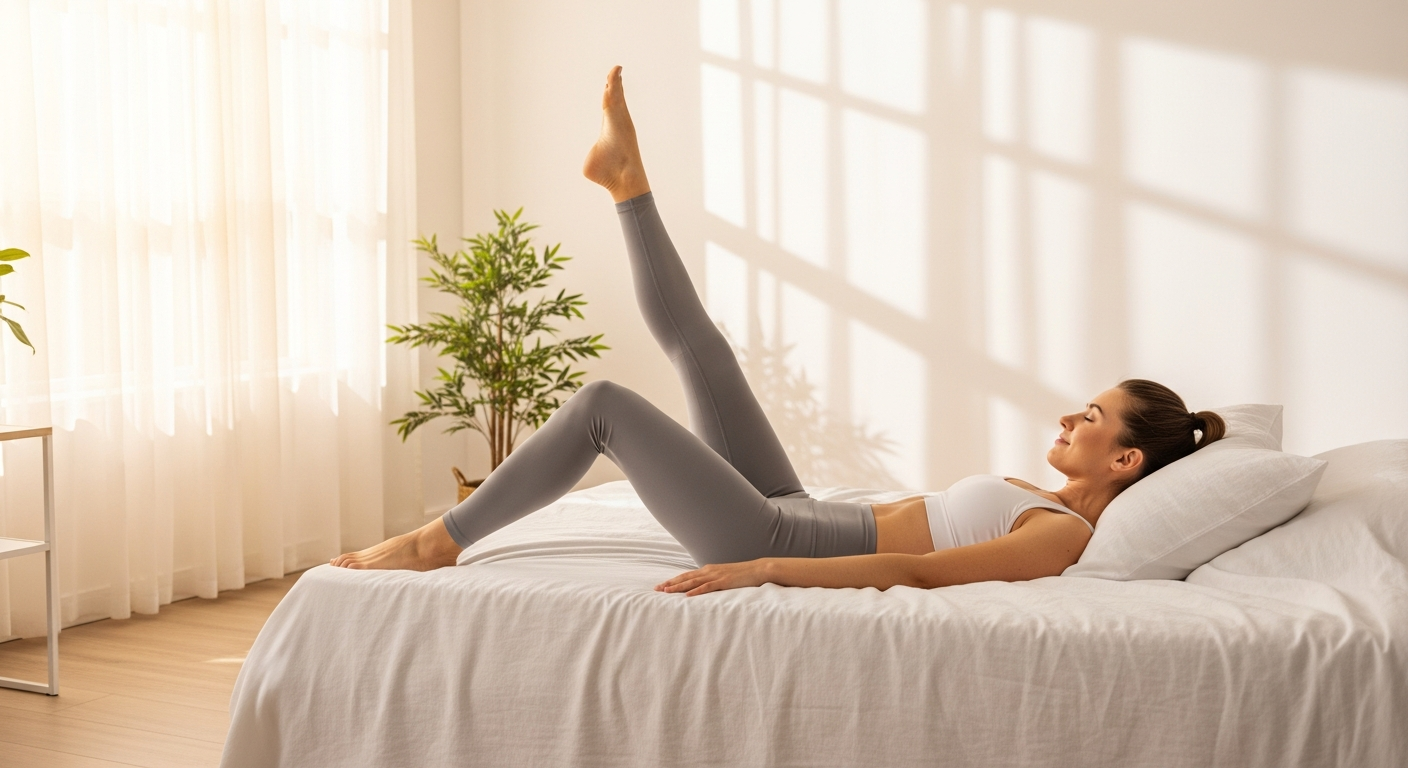
Your Bed Is Your New Gym (And That’s Perfectly Okay)
What if I told you that your bed—yes, that cozy sanctuary you never want to leave—could become your personal gym? No expensive equipment, no intimidating gym bros, no 5 AM wake-up calls.
I used to be the person who set three alarms for morning workouts, hit snooze on all of them, then spent the entire day drowning in guilt. The cycle was exhausting: promise myself I’d work out tomorrow, feel like a failure when I didn’t, repeat. Sound familiar?
Here’s what changed everything for me: I stopped fighting my natural rhythms and started meeting myself exactly where I was—literally, in bed.
That first morning, instead of scrolling Instagram for 20 minutes, I did three simple exercises without even fully sitting up. Nothing dramatic happened.
I didn’t suddenly love mornings. But I did something, and that something was enough to break the cycle of all-or-nothing thinking that had kept me stuck.
The fitness industry has sold us a lie: that effective workouts require suffering, special equipment, and superhuman motivation. Research consistently shows that adherence—not intensity—is the strongest predictor of long-term fitness success. Translation? The workout you’ll actually do beats the “perfect” workout you’ll avoid.
This article is for the busy professional who works 50-hour weeks, the new parent operating on four hours of sleep, the fitness beginner who feels overwhelmed by where to start, and anyone who’s ever thought, “I’m too tired to work out.”
You’re about to learn eight powerful exercises that deliver real results from the comfort of your bed. No gym membership required. No motivation speeches needed. Just effective, proven movements that work with your life, not against it.
Small, consistent efforts compound into real transformation. Let’s get started.
Why In-Bed Workouts Actually Work (Science-Backed Benefits)

The Power of Consistency Over Intensity
Here’s the truth most fitness influencers won’t tell you: doing 10 minutes of exercise in bed three times per week will produce better results than planning an intense gym session you never actually do. A 2019 study published in the British Journal of Sports Medicine found that people who performed low-intensity, frequent movement had better long-term adherence rates—78% versus 43%—compared to those attempting high-intensity programs.
The barrier to entry matters more than we acknowledge. When your workout requires changing clothes, driving somewhere, and carving out 90 minutes, you’ve created multiple decision points where you can quit. When your workout happens in bed before you check your phone, there’s literally one decision: do it or don’t.
This isn’t about being lazy—it’s about being strategic. Something is always better than nothing, and those “somethings” compound over weeks and months into visible, measurable changes in muscle tone, energy levels, and functional strength.
Your Body Doesn’t Know the Difference
Your muscles don’t have eyes. They can’t see whether you’re in a $200/month boutique gym or lying on your mattress. Muscle engagement is muscle engagement, period.
The principle of progressive overload—gradually increasing the demand on your musculoskeletal system—applies anywhere. When you perform a glute bridge on your bed, you’re activating the same muscle fibers you would on a yoga mat or gym floor. The soft surface actually creates an additional stability challenge, engaging smaller stabilizer muscles that might not activate on firm ground.
A 2020 systematic review in Sports Medicine found that bodyweight exercises performed consistently produced comparable muscle tone and strength gains to weighted exercises for beginners and intermediate exercisers. The key word? Consistently. The location matters far less than the repetition.
Mental Health Benefits of “Lazy” Movement
Let’s address the elephant in the room: exercise anxiety is real, and it keeps more people inactive than we talk about. The gym can feel intimidating. Home workout videos can feel overwhelming. The perfectionism trap—”if I can’t do it right, I won’t do it at all”—paralyzes thousands of people every single day.
Starting with in-bed workouts removes the psychological barriers. There’s no performance pressure, no comparison to others, no feeling like you’re doing it “wrong.” This matters because building sustainable habits requires reducing friction and increasing psychological safety.
Research in behavioral psychology shows that tiny habits—actions so small they feel almost ridiculous—create momentum that leads to bigger changes. That five-minute bed workout becomes the gateway to longer sessions, then to additional movement throughout your day. You’re not being lazy; you’re being smart about behavior change.
Preparing for Your Lazy Workout Success

What You’ll Need (Spoiler: Not Much!)
The beauty of in-bed workouts is the minimal equipment requirement. You need:
Your bed (a firmer mattress works better than ultra-plush for stability, but any bed works). Comfortable clothing you can move in—pajamas are perfectly fine. Optional: a pillow for extra support under your head or between your knees. Water bottle within arm’s reach because you’ll need it.
That’s it. No yoga mat, no resistance bands, no special shoes. This removes every excuse between you and movement.
Best Times to Do In-Bed Workouts
Morning energizer before phone scrolling: This is my personal favorite. Before you reach for your phone, do 5-10 minutes of movement. You’ll start your day with a small win and a hit of endorphins that coffee can’t match.
Evening wind-down routine: Gentle movement before bed can actually improve sleep quality by releasing physical tension. Skip the intense exercises and focus on controlled, stretching-based movements.
Midday energy boost on work-from-home days: That 2 PM slump? Instead of reaching for another coffee, try a quick circuit. You’ll increase blood flow and oxygen to your brain without the caffeine crash.
Weekend lazy mornings: Those days when you want to stay in bed but also want to feel productive? Perfect. Do your workout, then enjoy your coffee guilt-free.
Setting Realistic Expectations
Let’s be brutally honest: you won’t get shredded overnight, and that’s completely okay. Visible muscle tone typically takes 6-8 weeks of consistent training to appear. Strength gains happen faster—you’ll notice you can do more reps or hold positions longer within 2-3 weeks.
Focus on how you feel, not just how you look. Better energy, improved mood, less afternoon fatigue, easier time climbing stairs—these are your real progress markers.
Track your progress through consistency (how many days per week you actually do it), strength improvements (can you do more reps than last week?), and energy levels. Progress photos are optional but can be motivating when you take them monthly, not daily.
The 8 Proven Lazy in-Bed Workouts to Transform Your Body

1. Bed Bicycle Crunches (Sculpt Your Core)
Target areas: Rectus abdominis (six-pack muscles), obliques, hip flexors
Lie on your back with hands gently behind your head (not pulling on your neck). Lift your shoulder blades slightly off the mattress and bring your knees to a 90-degree angle. Extend your right leg straight while bringing your right elbow toward your left knee. Switch sides in a pedaling motion, keeping your core constantly engaged.
Reps/Duration: Start with 15-20 reps (one rep = both sides) or 30 seconds
Why it works: This movement engages your entire core through rotation and anti-rotation, building functional strength that translates to better posture and reduced lower back pain. The soft mattress surface forces your core to work harder for stability than it would on a firm floor.
Lazy tip: Keep your head resting on your pillow if full elevation bothers your neck. The core engagement still happens even with modified head position.
Common mistake: Pulling on your neck with your hands. Your hands are just there for light support—the work happens in your abs, not your arms.
2. Pillow Leg Lifts (Tone Lower Abs & Thighs)
Target areas: Lower abdominals, hip flexors, inner thighs
Lie flat on your back and place a pillow between your ankles. Squeeze the pillow to engage your inner thighs, then slowly lift both legs toward the ceiling until they’re perpendicular to your body (or as close as your flexibility allows). Lower them back down with control, stopping just before your feet touch the bed.
Reps/Duration: 12-15 reps
Why it works: This targets the often-stubborn lower abdominal region by creating tension through the entire range of motion. The pillow adds an inner-thigh engagement that standard leg lifts miss, giving you more muscle activation in one movement.
Modification: If straight legs are too challenging, bend your knees at 90 degrees and perform the same lifting motion. You’ll still get significant core engagement.
Pro tip: Press your lower back into the mattress throughout the movement. If your back arches, you’re going too low—stop your descent higher.
3. Bed Bridge Pulses (Build Your Glutes & Burn Calories)
Target areas: Glutes, hamstrings, lower back, core
Lie on your back with knees bent and feet flat on the bed, hip-width apart. Press through your heels to lift your hips until your body forms a straight line from shoulders to knees. From this top position, pulse your hips up and down in small movements (about 2-3 inches of range).
Reps/Duration: 20 pulses, then hold the top position for 10 seconds
Why it works: Your glutes are the largest muscle group in your body, meaning activating them burns maximum calories while building shape. The pulse variation keeps constant tension on the muscles, which research shows increases muscle fiber recruitment compared to standard reps with rest at the bottom.
Form cue: Squeeze your glutes hard at the top of each pulse. You should feel this in your butt, not your lower back. If you feel back strain, check that your feet aren’t too far from your body.
Advanced variation: Perform single-leg bridges by extending one leg straight while pulsing on the other leg. Switch sides for balanced development.
4. Lazy Plank (Strengthen Your Entire Core)
Target areas: Entire core, shoulders, back, even your legs
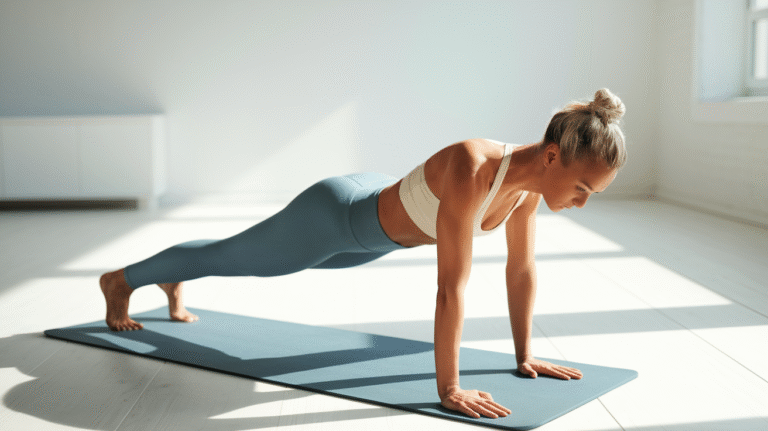
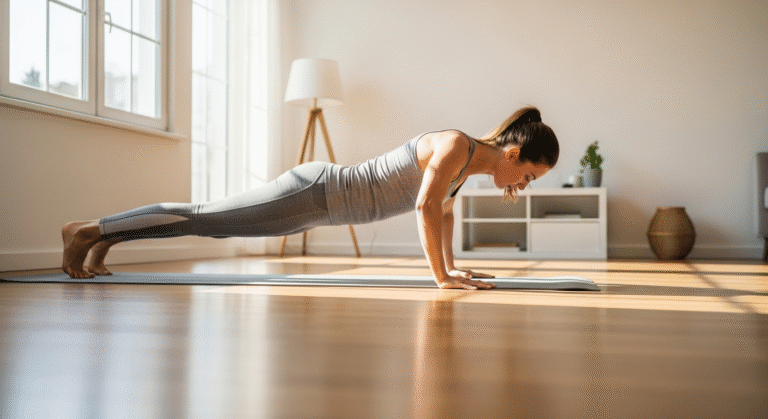
Position yourself on your forearms and toes (or knees for the modified version) with your body in a straight line. The soft mattress creates an unstable surface that forces your core to work harder than it would on the floor.
Reps/Duration: Hold for 20-30 seconds to start, building up to 60 seconds over several weeks
Why it works: Planks build isometric strength—the ability to maintain tension without movement. This translates directly to better posture, reduced back pain, and a stronger foundation for all other exercises. A 2014 study in the Journal of Strength and Conditioning Research found that plank exercises activated deep core muscles more effectively than traditional crunches.
Beginner option: Drop to your knees instead of staying on your toes. You’ll still get 60-70% of the core engagement without the overwhelming difficulty.
Breathing tip: Don’t hold your breath. Breathe normally throughout the hold—this actually increases core activation as your diaphragm and abs work together.
When to stop: If your hips start sagging or your shoulders creep toward your ears, end the set. Poor form means you’re no longer getting the benefit.
5. Side-Lying Leg Circles (Sculpt Outer Thighs & Hips)
Target areas: Hip abductors (outer thighs), obliques, glute medius
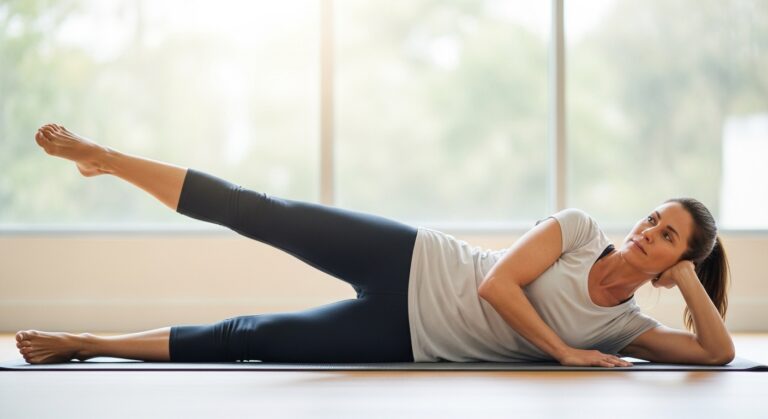
Lie on your side with your bottom arm extended under your head (or use a pillow for comfort). Stack your hips and shoulders. Lift your top leg to hip height, then draw 10 circles forward, then 10 circles backward. The circles should be about the size of a dinner plate.
Reps/Duration: 10 circles each direction per leg
Why it works: This movement targets the often-neglected outer hip muscles that are crucial for hip stability and that coveted outer thigh definition. Most people have weak hip abductors from excessive sitting, which contributes to knee pain and poor movement patterns.
Form cue: Keep your hips stacked—don’t let them roll backward. The movement should be controlled and deliberate, not momentum-driven.
Feel it working: You should feel a burn in the outer hip and thigh. If you feel it in your lower back, you’re lifting too high or moving too fast.
6. Seated Twists (Tone Your Waistline)
Target areas: Obliques, upper abs, spinal rotators
Sit up in bed with your legs extended or bent (whatever’s comfortable). Lean back slightly—about 45 degrees—and lift your feet a few inches off the bed. Clasp your hands together and twist your torso to the right, bringing your hands toward the bed beside your hip. Return to center, then twist left.
Reps/Duration: 15-20 twists per side (30-40 total rotations)
Why it works: Rotational movements are essential for functional fitness but often missing from typical workout routines. This exercise strengthens the obliques while improving spinal mobility—both crucial for daily activities like reaching, turning, and bending.
Add challenge: Hold a pillow in your hands for added resistance. The extra weight forces your core to work harder to control the rotation.
Tempo tip: Slow and controlled beats fast and sloppy every time. Take 2 seconds to rotate, pause, then 2 seconds to return to center.
7. Bed Donkey Kicks (Lift & Tone Your Booty)
Target areas: Glutes, hamstrings, lower back
Get on your hands and knees with your hands directly under your shoulders and knees under your hips. Keeping your right knee bent at 90 degrees, lift your right leg until your thigh is parallel to the bed (or as high as you can go without arching your back). Lower back down with control without letting your knee touch the bed.
Reps/Duration: 15 kicks per leg
Why it works: This isolation exercise targets the gluteus maximus specifically, building the rounded, lifted appearance most people want. The bent-knee position keeps tension on the glute throughout the movement rather than shifting to the hamstring.
Feel the burn: At the top of each kick, pulse 2-3 times before lowering. This keeps the muscle under constant tension, increasing the effectiveness.
Common mistake: Arching your lower back to get your leg higher. This takes the work out of your glutes and puts strain on your spine. Only lift as high as you can while maintaining a neutral spine.
8. Dead Bug (Build Core Stability)
Target areas: Deep core muscles (transverse abdominis), coordination, full-body control
Lie on your back with arms extended straight toward the ceiling and knees bent at 90 degrees (shins parallel to the bed). Slowly lower your right arm overhead while simultaneously extending your left leg straight, hovering just above the bed. Return to start, then switch sides.
Reps/Duration: 10-12 reps per side
Why it works: This exercise strengthens the deep core muscles responsible for spinal stability and injury prevention. Physical therapists consistently recommend dead bugs because they teach your core to resist unwanted movement—exactly what it needs to do during daily activities and other exercises.
Perfect for: Anyone with back issues or beginners who find crunches uncomfortable. The dead bug keeps your spine in a safe, neutral position throughout.
Progression check: Can you keep your lower back pressed into the mattress throughout the entire movement? That’s the goal. If your back arches when you extend your leg, don’t extend as far.
Breathing pattern: Exhale as you extend, inhale as you return to center. This breathing pattern naturally engages your deep core muscles.
Creating Your Lazy Workout Routine (That Actually Sticks)

The 5-Minute Morning Routine
Perfect for people who genuinely have no time or are just starting to build a habit. Pick three exercises from the list above and perform each for one minute with brief rest between.
Sample routine: – Bed Bicycle Crunches: 1 minute – Rest: 15 seconds – Bed Bridge Pulses: 1 minute – Rest: 15 seconds – Dead Bug: 1 minute
Total time commitment: 5 minutes and 30 seconds. This is your pre-coffee energizer that sets a positive tone for your entire day. Do this three times per week, and you’ll notice improved energy and core strength within two weeks.
The 10-Minute Full-Body Session
When you have a bit more time and want comprehensive results, circuit all eight exercises together. Perform each exercise for 45 seconds, rest for 15 seconds, then move to the next.
Complete circuit: 1. Bed Bicycle Crunches (45 sec) 2. Rest (15 sec) 3. Pillow Leg Lifts (45 sec) 4. Rest (15 sec) 5. Bed Bridge Pulses (45 sec) 6. Rest (15 sec) 7. Lazy Plank (45 sec) 8. Rest (15 sec) 9. Side-Lying Leg Circles – Right (45 sec) 10. Rest (15 sec) 11. Side-Lying Leg Circles – Left (45 sec) 12. Rest (15 sec) 13. Seated Twists (45 sec) 14. Rest (15 sec) 15. Bed Donkey Kicks – Right (45 sec) 16. Rest (15 sec) 17. Bed Donkey Kicks – Left (45 sec) 18. Rest (15 sec) 19. Dead Bug (45 sec)
Perform this routine 2-3 times per week for visible toning results. Space your workout days (Monday/Wednesday/Friday or Tuesday/Thursday/Saturday) to allow for recovery.
The Progressive Approach (Beginner to Advanced)
Week 1-2: Foundation Phase Focus on mastering form with lower reps. Do 8-10 reps of each exercise (or 15-20 seconds for holds), performing the 5-minute routine 3 times per week. Your only goal is consistency and proper form. Take videos of yourself if helpful.
Week 3-4: Building Phase Increase to the full prescribed reps and durations. Move to 4 times per week if possible. You should start feeling noticeably stronger—exercises that felt challenging in week 1 now feel manageable.
Week 5+: Challenge Phase Add the advanced variations mentioned in each exercise. Increase to the 10-minute full-body circuit. Consider doing the routine 4-5 times per week or adding a second daily session (morning and evening).
How to know when to level up: If you can complete all prescribed reps with good form and could do 2-3 more reps, it’s time to progress. If you’re struggling to finish or your form breaks down, stay at your current level.
Maximizing Results from Your Bed Workouts

The Nutrition Connection (No Crazy Diets Required)
Here’s the uncomfortable truth: you cannot out-exercise a consistently poor diet.