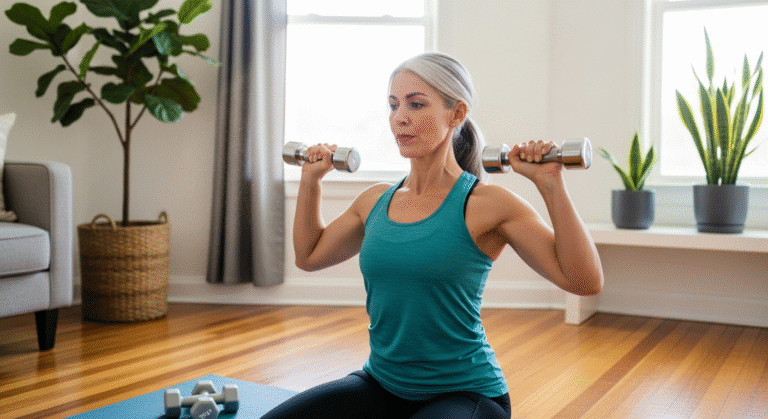
15 Minute Arm Workout for Women Over 40
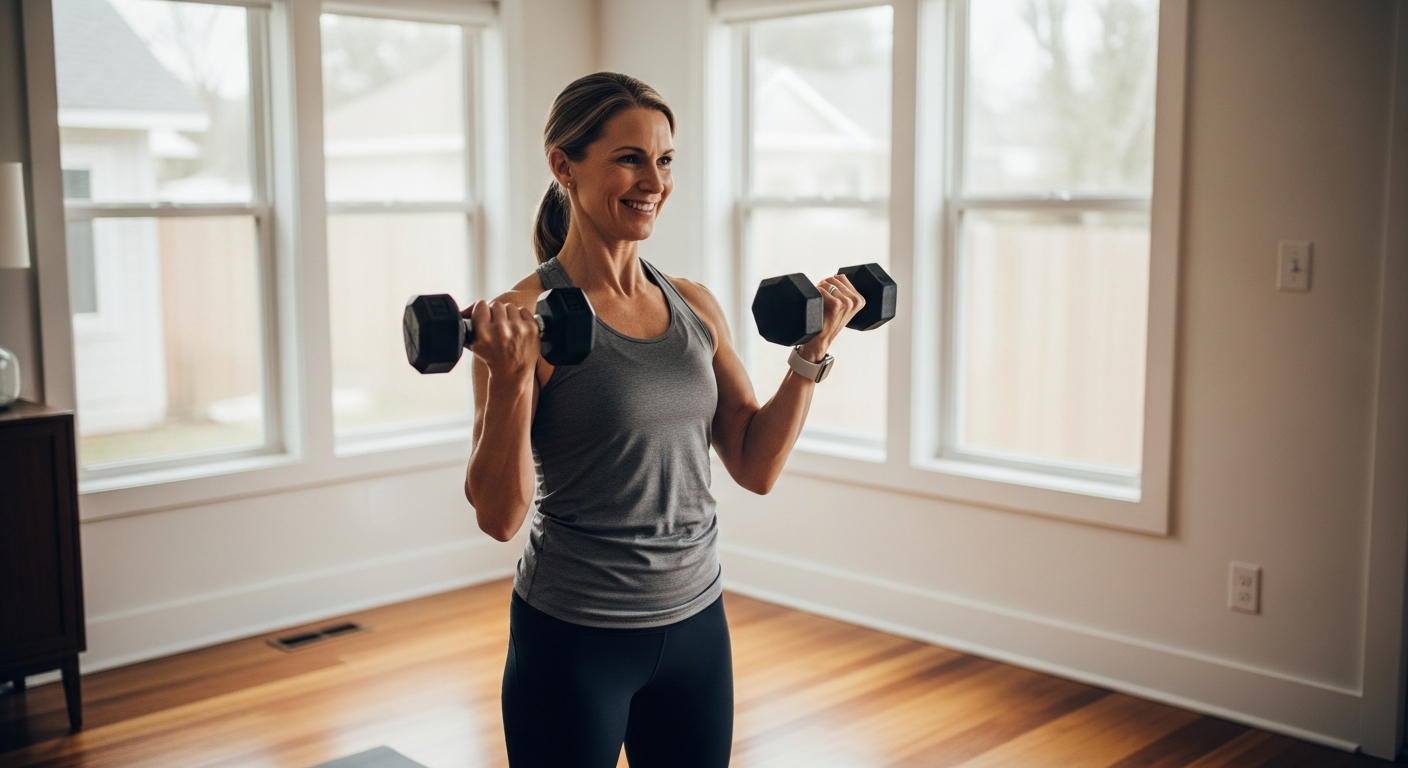
Let’s talk about something that frustrates so many of us: looking in the mirror and noticing our arms don’t look quite like they used to.
Maybe you’ve caught yourself avoiding sleeveless tops or feeling self-conscious when you wave goodbye. Those “bat wings” and loss of definition? They’re not your fault, and they’re definitely not permanent.
I get it. You’re busy juggling work, family, maybe grandkids. The thought of spending hours at a gym surrounded by 20-somethings lifting massive weights sounds exhausting and intimidating. Here’s the truth: you don’t need any of that.
What if I told you that just 15 minutes—less time than it takes to scroll through social media—could transform your arms? No gym membership required. No fancy equipment. Just you, a pair of dumbbells, and a commitment to yourself.
This workout is specifically designed for women over 40 because our bodies work differently now. Hormonal changes, natural muscle loss, and metabolic shifts mean we can’t train like we did in our twenties. And that’s okay! This routine works *with* your body’s changes, not against them.
You’ll discover five proven exercises that target every angle of your arms—biceps, triceps, and shoulders. These movements build functional strength for real life: carrying groceries, lifting grandchildren, moving furniture, living confidently. The best part? You’ll see visible results without sacrificing hours you don’t have.
Ready to reclaim your arm confidence? Let’s transform those arms together.
Why Women Over 40 Need a Different Approach to Arm Training
The Science Behind Changing Arms After 40
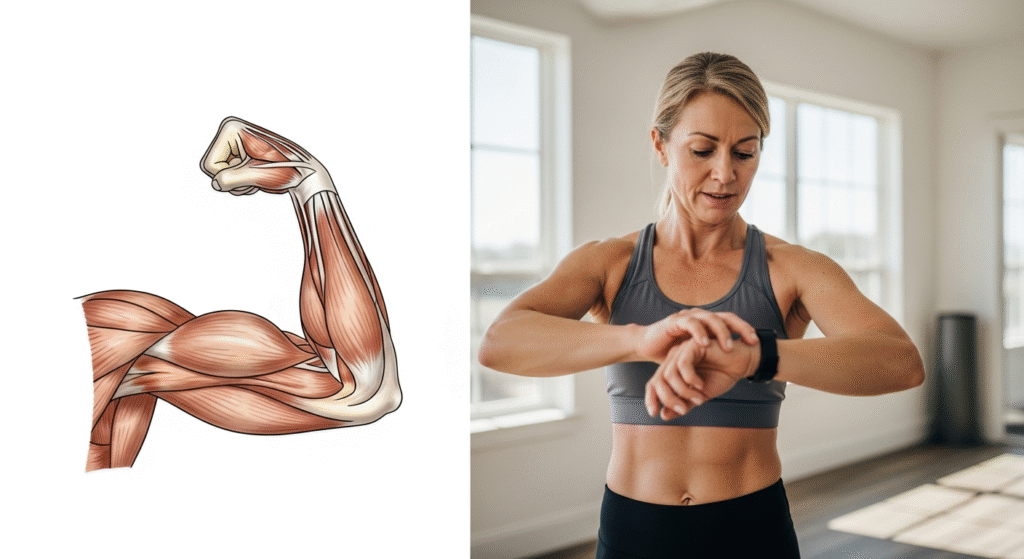
Here’s what’s really happening in your body: starting in our 30s, we lose 3-5% of muscle mass per decade. This process, called sarcopenia, accelerates after 40. Your arms aren’t getting weaker because you’re doing something wrong—it’s biology.
Add hormonal shifts into the mix, and things get more complicated. Declining estrogen affects where your body stores fat and how efficiently you build muscle. Your metabolism slows down, making it harder to maintain lean muscle mass. Meanwhile, collagen production decreases, affecting skin elasticity.
But here’s the powerful truth: strength training reverses these changes. Research shows women over 40 who incorporate resistance exercises can build muscle just as effectively as younger women—we just need the right approach.
The Benefits That Go Beyond Appearance
Yes, toned arms look incredible in that sleeveless dress. But the real transformation happens in your daily life. Imagine carrying all the grocery bags in one trip without strain. Lifting your grandchild effortlessly. Opening stubborn jars without help. That’s functional strength.
Strong arms improve your posture, pulling your shoulders back and making you stand taller. They stabilize your shoulder joints, reducing injury risk. Every rep you do builds lean muscle that burns calories even while you’re resting—boosting your metabolism naturally.
The confidence boost? That’s the secret weapon. When you feel strong, you carry yourself differently. You stop hiding in cardigans. You raise your hand in meetings. You live bigger.
Why 15 Minutes Changes Everything
Forget what you’ve heard about needing hour-long workouts. For sustainable results, consistency beats intensity every single time. Fifteen minutes is short enough that you’ll actually do it, but long enough to deliver real results.
This timeframe prevents burnout. You won’t dread your workout or find excuses to skip it. It fits into the busiest schedule—before work, during lunch, while dinner’s in the oven. No gym commute. No waiting for equipment. Just quick, effective training that builds the habit without overwhelming your life.
What You’ll Need: Simple Equipment, Maximum Results
Your Essential Equipment Guide
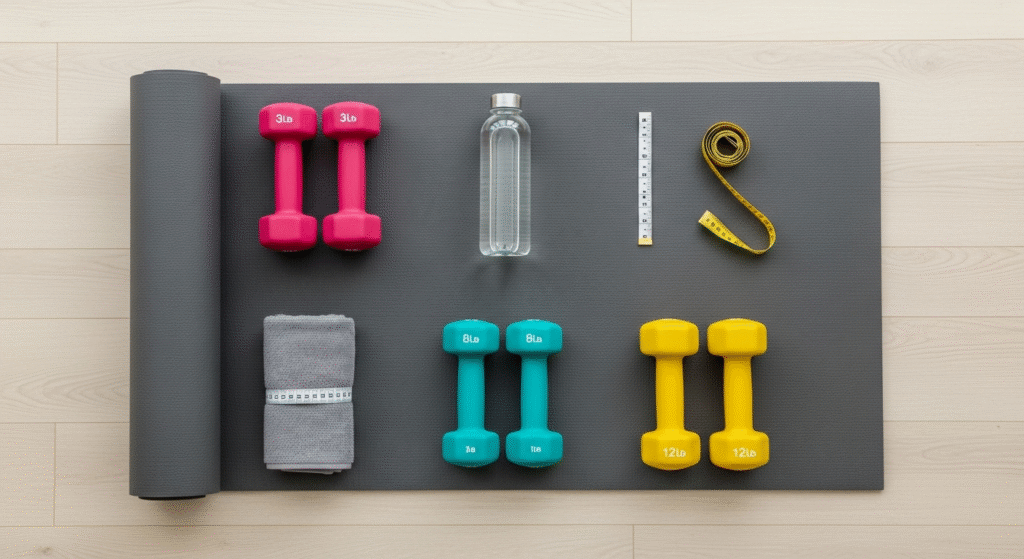
Let’s keep this simple. You need dumbbells—that’s it. But choosing the right weight matters.
Beginners: Start with 3-5 pound dumbbells. If you’re new to strength training or haven’t worked out in years, lighter weights let you master form without risking injury. You’ll still feel the burn—trust me.
Intermediate: If you’ve been active or did some strength training before, grab 8-10 pound weights. This range challenges your muscles while maintaining control through each movement.
Advanced: Already strength training regularly? Go for 12-15 pounds. You should struggle on the last few reps of each set, but never sacrifice form for heavier weight.
Here’s the reality check: if you can breeze through all 50 seconds without feeling challenged, your weights are too light. If you can’t complete the movement with proper form, they’re too heavy. Find your sweet spot.
Budget-Friendly Alternatives That Actually Work
Don’t have dumbbells? No problem. Fill two water bottles with sand or water (adjust fullness for desired weight). Grab two cans of soup or vegetables from your pantry. Use resistance bands with handles. I’ve seen incredible transformations from women who started with household items.
The equipment doesn’t make the workout—your effort does.
Creating Your Perfect Workout Space
You need exactly 6 feet by 6 feet of clear space. That’s it. Your living room, bedroom, garage, or backyard works perfectly. Make sure you have stable flooring—carpet, hardwood, or a yoga mat all work.
Keep a sturdy chair or bench nearby for exercises that need support. Proper lighting helps you check your form. A mirror is optional but helpful for monitoring your posture.
Safety first: remove any obstacles you might trip over, especially during the stepping movements. Keep water nearby—hydration matters more after 40.
The Complete 15-Minute Arm Sculpting Routine
Your Workout Structure
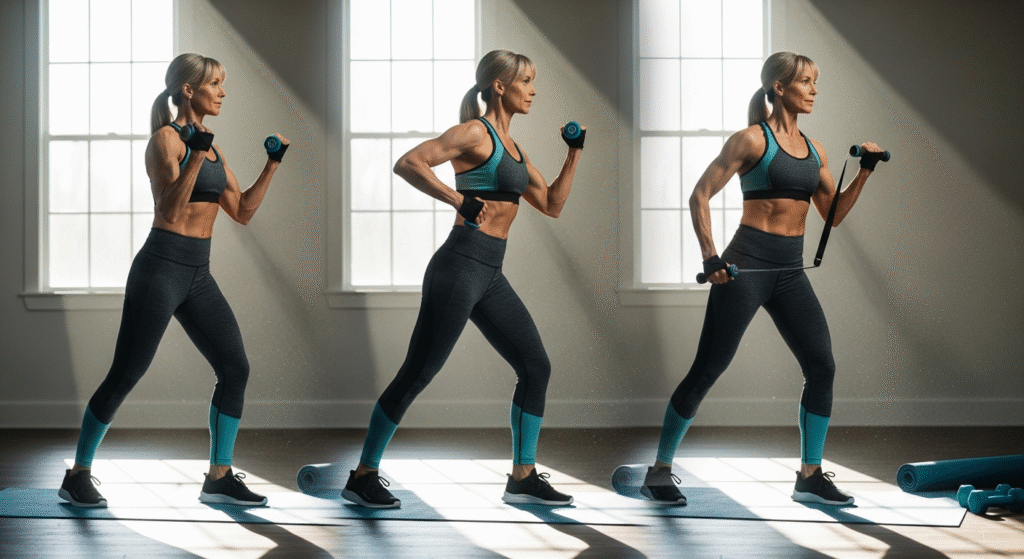
This circuit format maximizes efficiency. You’ll perform each exercise for 50 seconds, rest for 10 seconds, then move immediately to the next exercise. Complete all five exercises, then repeat the entire circuit two more times for three total rounds.
Before you start, spend two minutes warming up. Cold muscles after 40 are injury waiting to happen. Do arm circles forward and backward (20 each direction), shoulder rolls (10 forward, 10 back), and light torso twists (20 total). Get your blood flowing and joints lubricated.
After your workout, take two minutes to cool down and stretch. Your muscles will thank you tomorrow.
Exercise 1: Cross Bicep Curls
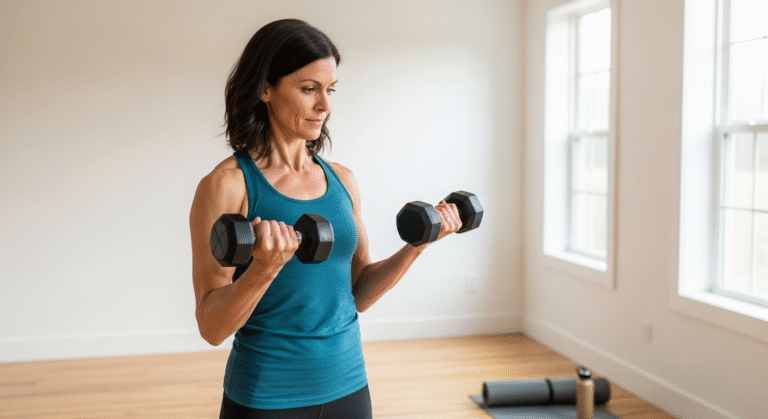
Stand with feet hip-width apart, holding one dumbbell in each hand at your sides. Here’s what makes this effective: instead of curling straight up, you’ll curl across your body. Bring your right hand up toward your left shoulder, then lower with control. Alternate sides.
Keep your elbows tucked close to your ribs—don’t let them flare out. Your core should be engaged, shoulders pulled back and down. Move with control, not momentum. Squeeze at the top of each curl for maximum muscle engagement.
This variation hits your biceps from a different angle than traditional curls, sculpting definition in that coveted front-of-arm area. The cross-body motion also engages your core for bonus toning.
Common mistake: Swinging the weights up using momentum. Slow down and feel your biceps doing the work.
Exercise 2: Tricep Kickbacks with Hold
This exercise targets those “bat wings” directly. Hinge forward at your hips (protect your lower back by keeping it neutral), holding dumbbells with elbows bent at 90 degrees. Extend both arms straight back, squeezing your triceps. Here’s the game-changer: hold that extended position for three seconds before lowering.
That hold? It creates maximum burn and builds serious strength. Your triceps will shake—that’s normal and means it’s working.
Keep your upper arms stationary throughout the movement. Only your forearms should move. Breathe out as you extend, breathe in as you lower. If your lower back hurts, you’re hinging too far forward.
Modification: Place one hand on a chair for support and work one arm at a time.
Exercise 3: Upright Row & Clean
This compound movement is a powerhouse. Start with dumbbells hanging in front of your thighs. Pull them straight up toward your chin, keeping them close to your body (that’s the row). Lower back down, then immediately “clean” them up to shoulder height by flipping your wrists and catching the weights at your shoulders.
This two-in-one exercise builds shoulder strength and definition while burning more calories than isolation exercises. Your shoulders, upper back, and arms all work together.
Keep the weights close to your body during the row—don’t let them drift forward. Your elbows should drive the movement, rising higher than your wrists. During the clean, use a slight knee bend to generate power.
Safety tip: If you have shoulder issues, skip the row and just do the clean portion.
Exercise 4: Back to Front & Front Drive
Hold dumbbells at shoulder height. Press them straight back behind you, then bring them forward to starting position. Immediately press them straight out in front of you at shoulder height, then return to start. That’s one rep.
This movement sculpts your shoulders from every angle while challenging your stability. The constant tension keeps your muscles engaged throughout the entire 50 seconds.
Keep your core tight to prevent arching your back. Your shoulders should stay down, not hunched up by your ears. Move with control—this isn’t a race.
Why it works: By hitting your shoulders from multiple angles without rest, you create the metabolic demand that shreds fat while building lean muscle.
Exercise 5: Stepping Shoulder Press
This full-body finisher combines arm work with cardio. Hold dumbbells at shoulder height. Step your right foot forward into a lunge while pressing the weights overhead. Step back to starting position and lower the weights. Repeat on the left side.
The stepping component adds functional fitness—you’re training movements you use in real life. The balance requirement engages your core. The shoulder press builds those sculpted shoulders you want.
Press straight up, not forward. Keep your front knee behind your toes during the lunge. Engage your core to protect your lower back. The movement should feel coordinated, not chaotic.
Cardiovascular bonus: This exercise elevates your heart rate, adding a fat-burning component to your strength workout.
Maximizing Your Results: The Details That Matter
Progressive Overload: Your Transformation Secret
Your body adapts quickly. After two to three weeks, those same weights will feel easier. That’s your cue to progress. Increase your dumbbell weight by 2-3 pounds, add an extra round to your circuit, or slow down your tempo (try 3 seconds up, 3 seconds down).
Track your workouts in a simple notebook or phone app. Write down the weights you used and how you felt. When you can complete all three rounds with perfect form and don’t feel challenged, it’s time to level up.
Celebrate every milestone. The first time you increase your weight? That’s a victory. Completing your third workout of the week? Success. Building muscle after 40 requires patience, but every small win compounds into major transformation.
Nutrition That Amplifies Your Results
You can’t out-train a poor diet. Women over 40 need 0.8-1 gram of protein per pound of body weight to build and maintain muscle. That’s roughly 120-150 grams for a 150-pound woman.
Eat protein within two hours after your workout—your muscles are hungry and ready to repair. Greek yogurt, eggs, chicken, fish, protein shakes, or beans all work perfectly.
Hydration matters more than you think. Dehydrated muscles don’t recover well and look flat. Aim for half your body weight in ounces daily (a 150-pound woman needs 75 ounces).
You don’t need restrictive diets or expensive supplements. Just real food, adequate protein, and consistency.
Recovery: Where the Magic Happens
Here’s what most women get wrong: your muscles don’t grow during workouts—they grow during recovery. You need 2-3 rest days per week minimum. On those days, your body repairs the micro-tears in your muscle fibers, building them back stronger and more defined.
Sleep is non-negotiable. Aim for 7-9 hours nightly. Growth hormone, which helps build muscle, releases during deep sleep. Skimp on sleep, and you sabotage your results.
Active recovery accelerates your progress. Go for walks, do gentle yoga, or swim on rest days. Light movement increases blood flow to your muscles without stressing them.
Soreness is normal for the first week or two. If you can barely move your arms, you went too heavy. If something feels sharp or painful (not just uncomfortable), stop and consult a healthcare provider.
Your 4-Week Transformation Plan and Beyond
Week 1-2: Building Your Foundation
Your first two weeks focus entirely on mastering form. Use lighter weights than you think you need. Film yourself or use a mirror to check your posture. It should feel challenging but doable.
You might feel sore—that’s normal. You might feel frustrated learning new movements—that’s also normal. Stick with it. By the end of week two, these exercises will feel natural.
Aim for three sessions per week with at least one rest day between workouts. Monday, Wednesday, Friday works perfectly. Or Tuesday, Thursday, Saturday. Find your rhythm.
Week 3-4: Increasing Intensity
Now you increase the challenge. Add 2-3 pounds to your dumbbells or slow your tempo. You should struggle on the last 10 seconds of each exercise.
This is when you start seeing results. Your arms will feel firmer. You’ll notice definition starting to emerge. Your clothes might fit differently around your shoulders. Take progress photos—the changes are happening even when you can’t see them daily.
Document your journey. Measure your biceps and triceps at the start and end of the month. Take photos from multiple angles. These objective markers keep you motivated when the scale doesn’t move (muscle weighs more than fat, remember?).
Beyond Week 4: Sustaining Your Sculpted Arms
After four weeks, you’ve built a habit. Now you maintain and progress. Continue this workout 3-4 times weekly. Every 4-6 weeks, change something—different exercises, heavier weights, or additional rounds.
Integrate this routine into a balanced fitness plan. Add lower body workouts twice weekly. Include cardio you enjoy—walking, cycling, dancing. Strong arms are incredible, but total-body fitness keeps you healthy and functional.
The long-term secret? Consistency over perfection. You’ll miss workouts sometimes—that’s life. What matters is getting back to it. Three workouts weekly for a year beats seven workouts weekly for a month.
Your toned arms after 40 aren’t about perfection. They’re about strength, confidence, and showing yourself what you’re capable of achieving. Keep going. The best is yet to come.
—
Your 15 minutes start now. You have everything you need: the workout, the knowledge, and the power to transform your arms. Commit to three sessions this week. Just three. That’s 45 minutes total—less time than a single movie.
Age isn’t a barrier—it’s simply a different starting point. Your arms can be strong, sculpted, and confident at 40, 50, 60, and beyond. The only question is: are you ready to prove it to yourself?
Grab those dumbbells. Clear your space. Transform your arms and your confidence, 15 minutes at a time.