Biceps and triceps workout for women Over 40
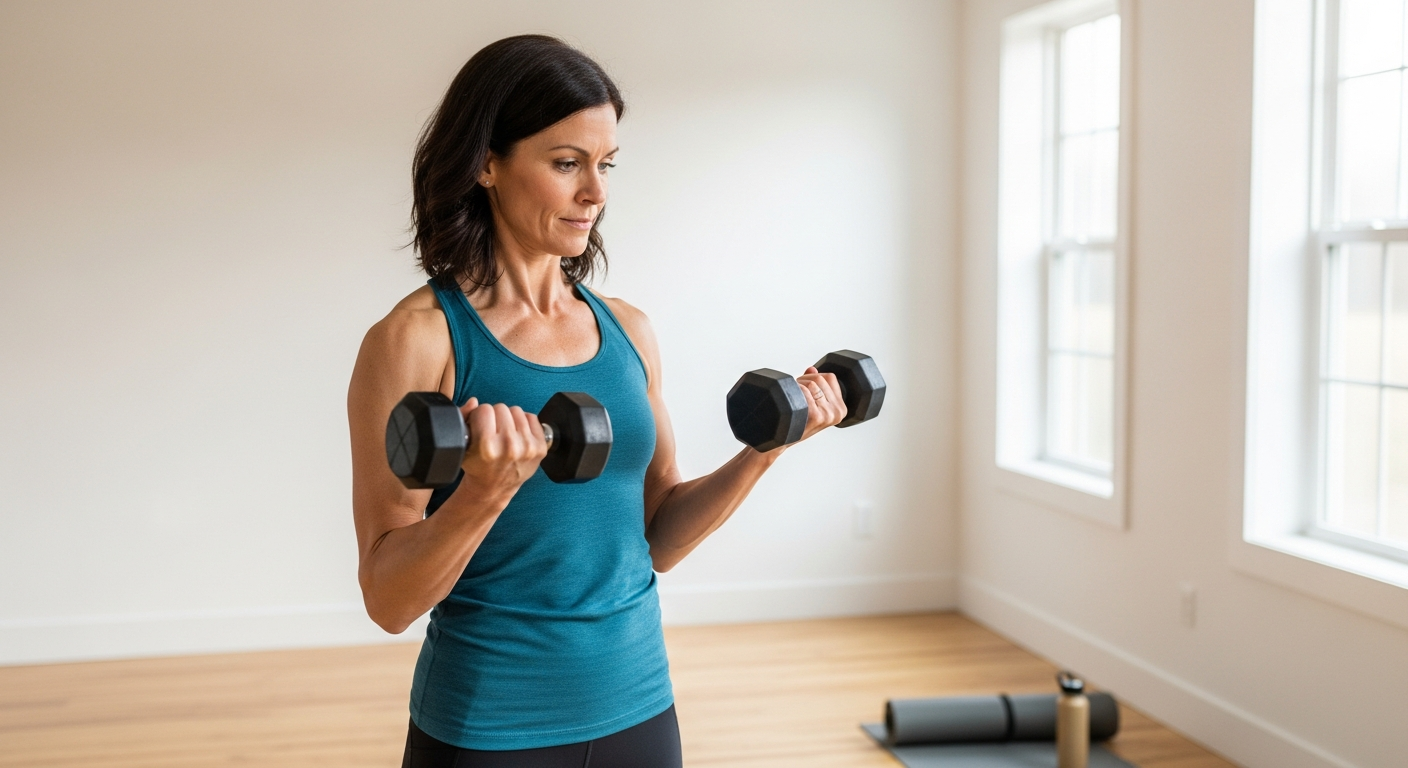
Let me be direct: turning 40 doesn’t mean you have to accept arm jiggle or lose definition. I’ve watched countless women transform their arms in their 40s, 50s, and beyond—and the science backs up what I’ve seen firsthand.
Here’s what’s really happening after 40. Your estrogen levels drop, which directly impacts muscle maintenance. Testosterone (yes, women need it too) declines by about 50% between your 20s and 40s. This hormonal shift triggers sarcopenia—age-related muscle loss that steals about 3-5% of your muscle mass per decade after 30. Your arms? They’re often the first place you notice it.
But here’s the empowering truth: resistance training reverses this process. A study in the Journal of Applied Physiology found that women over 40 who performed consistent strength training built muscle at nearly the same rate as younger women. Your body is absolutely capable of building strong, sculpted arms right now.
This workout plan addresses the specific challenges you face—joint sensitivity, recovery time, and hormonal changes—while delivering visible results in 6-8 weeks. You’ll train smart, not just hard, using exercises that build strength without unnecessary stress on your body.
And let’s tackle the elephant in the room: you will NOT bulk up. Women lack the testosterone levels needed for massive muscle growth. What you will get? Defined, toned arms that look amazing in sleeveless tops and feel powerful in everyday life. You’ll carry groceries without struggle, lift your grandchildren with ease, and feel genuinely confident in your physical strength.
This isn’t about chasing some unrealistic ideal. It’s about reclaiming the strength and definition that naturally decline with age—and proving that your 40s can be your strongest decade yet.
Why Your Arms Change After 40 (And Why You Should Care)

The Hormone Shift That Affects Muscle Tone
The changes you’re seeing in your arms aren’t in your head—they’re in your hormones. After 40, your body experiences a metabolic shift that directly impacts muscle tissue, especially in areas like your arms where muscle loss becomes visibly apparent.
Estrogen, which helps maintain muscle mass and supports protein synthesis, begins its steady decline in your late 30s and drops significantly during perimenopause and menopause. Lower estrogen means your body struggles to maintain existing muscle and build new tissue. Meanwhile, your testosterone levels—critical for muscle development even in women—decrease by roughly 1-2% annually after your mid-30s.
This hormonal double-whammy accelerates sarcopenia. Without intervention, you lose 3-8% of muscle mass per decade after 30, with that rate increasing after 60. Your arms, with their smaller muscle groups, show this loss quickly. That “soft” appearance or lack of definition? It’s not fat gain—it’s muscle loss.
The metabolism connection makes this even more critical. Muscle tissue burns approximately 6 calories per pound daily at rest, while fat burns only 2. Less arm muscle means fewer calories burned, which contributes to that frustrating metabolic slowdown everyone talks about after 40.
The Functional Strength Factor
Strong arms aren’t just about aesthetics—they’re about maintaining independence and quality of life. After 40, functional strength becomes a health priority, not a vanity project.
Consider your daily activities: lifting a 30-pound toddler, carrying two grocery bags up stairs, opening a stubborn jar, pushing a heavy door, or moving furniture. These tasks require genuine upper body strength. Research from the American Journal of Medicine shows that women with greater upper body strength maintain independence longer and have lower rates of age-related disability.
Resistance training also builds bone density in your arms, wrists, and shoulders—critical for preventing osteoporosis and fractures. A study published in the Journal of Bone and Mineral Research found that women who performed upper body resistance training twice weekly increased their bone mineral density by 1-3% annually, while sedentary women lost bone density at the same rate.
Your joints benefit too. Strong biceps and triceps stabilize your elbow joints and support your shoulders, reducing injury risk during everyday movements. This matters more as ligaments and tendons naturally lose elasticity with age.
Beyond Aesthetics: The Confidence Boost
There’s something profoundly empowering about physical strength. When you can see muscle definition in your arms and feel genuine power in your movements, it changes how you carry yourself in the world.
I’ve watched women in their 40s and 50s completely transform their self-image through arm training. They stop avoiding sleeveless dresses. They feel capable and strong rather than fragile and aging. This psychological shift extends beyond the gym—it affects how you approach challenges in every area of life.
The myth that women over 40 can’t build sculpted arms? Completely false. Your muscles respond to resistance training at any age. While the process might take slightly longer than in your 20s, the results are absolutely achievable. Women in their 40s, 50s, and 60s regularly build impressive arm definition with consistent training.
This isn’t about turning back time—it’s about being your strongest, most capable self at the age you are right now.
Understanding Your Biceps and Triceps: Arm Anatomy Made Simple

What Your Biceps Actually Do
Your biceps brachii—that muscle on the front of your upper arm—consists of two heads (hence “bi-ceps”) that work together to create the classic arm flex everyone recognizes. When you bend your elbow to bring your hand toward your shoulder, you’re using your biceps.
These muscles handle pulling movements: carrying bags, lifting objects toward you, pulling open doors, or doing a chin-up. Your biceps also help rotate your forearm, which is why exercises like hammer curls feel different than standard curls—they target different functions of the muscle.
Here’s what most women don’t realize: biceps alone won’t give you the toned arms you want. They’re the “show” muscles that look impressive when flexed, but they make up only about one-third of your upper arm mass. If you only train biceps, you’re neglecting two-thirds of the equation.
The Triceps: Your Secret Weapon for Toned Arms
The triceps brachii runs along the back of your upper arm and consists of three heads (the “tri” in triceps). This muscle group makes up approximately 60-65% of your upper arm mass, which means it’s your primary weapon against arm jiggle and the key to that sleek, defined look you’re after.
Your triceps straighten your arm—the opposite motion of your biceps. Every pushing movement uses your triceps: pushing a door open, doing a push-up, pressing overhead, or even pushing yourself up from a chair. These muscles provide the functional strength you use constantly throughout the day.
The back of your upper arm—where most women notice that frustrating “wave” when they move their arm—is your triceps. If this area lacks definition, it’s not because you need to lose fat (though that might be a factor); it’s primarily because you need to build muscle in your triceps. Strong, developed triceps create that taut, toned appearance that looks amazing in sleeveless tops.
The Balance Approach for Best Results
Training both muscle groups equally creates balanced strength, prevents injury, and delivers the best aesthetic results. When you develop your biceps but neglect your triceps (or vice versa), you create muscle imbalances that can lead to elbow pain and poor posture.
The compound movement advantage matters especially for busy women over 40. Exercises that work multiple muscle groups simultaneously—like close-grip push-ups that engage both triceps and chest—deliver more results in less time. You’ll build functional strength that translates to real-world activities while maximizing workout efficiency.
Your arms work as an integrated system. When you perform a push-up, your triceps push while your biceps stabilize. When you pull open a heavy door, your biceps pull while your triceps control the movement. Training both muscle groups creates this functional synergy that makes everyday activities easier and reduces injury risk.
The Proven 8-Exercise Arm Workout for Women Over 40
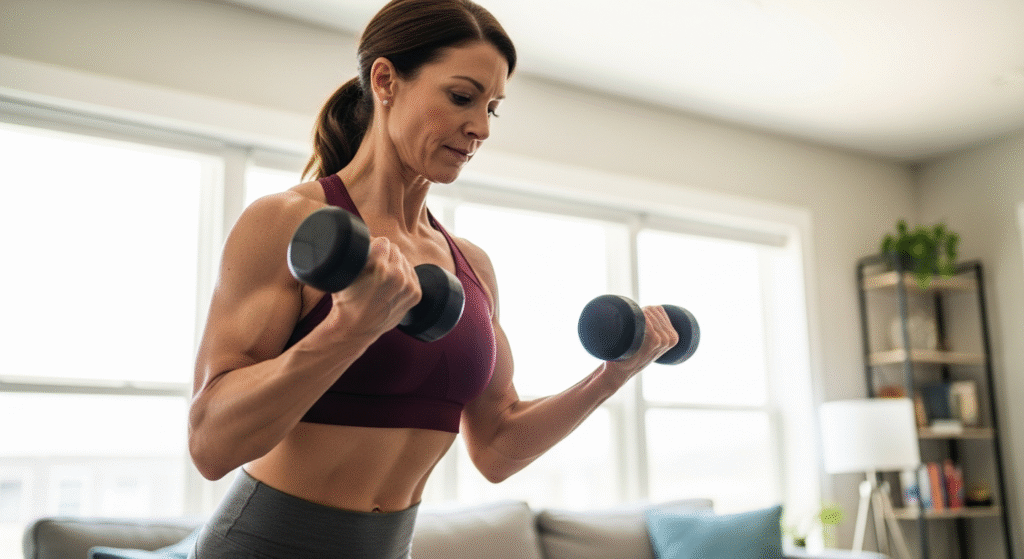
Biceps Exercises That Sculpt and Strengthen
Exercise 1: Standing Dumbbell Bicep Curls
This classic exercise delivers results for a reason—it directly targets both heads of your biceps through a full range of motion.
Stand with feet hip-width apart, holding a dumbbell in each hand with palms facing forward. Keep your elbows close to your sides—this is crucial. Curl the weights toward your shoulders, squeezing your biceps at the top. Lower with control for 2-3 seconds. Don’t swing the weights or arch your back; if you need momentum, your weights are too heavy.
Common mistake: letting your elbows drift forward, which reduces bicep engagement and can strain your shoulders. Keep those elbows locked at your sides throughout the movement.
Modification for beginners: Start with 5-pound dumbbells or even soup cans. For advanced: try single-arm curls to increase focus and address strength imbalances.
Sets/reps: 3 sets of 12-15 reps
Exercise 2: Hammer Curls
This variation targets the brachialis muscle underneath your biceps and the brachioradialis in your forearm, creating fuller-looking arms from multiple angles.
Hold dumbbells with palms facing each other (like you’re holding hammers). Curl the weights toward your shoulders while maintaining that neutral grip throughout. This hand position reduces stress on your wrists and elbows—perfect for women over 40 who might experience joint sensitivity.
The different grip angle recruits different muscle fibers than standard curls, which means more complete arm development. You’ll also build serious grip strength, which translates to better performance in all pulling exercises.
Sets/reps: 3 sets of 12-15 reps
Exercise 3: Resistance Band Bicep Curls
Resistance bands provide constant tension throughout the movement and are incredibly joint-friendly—ideal if you’re dealing with any elbow or wrist discomfort.
Stand on the center of a resistance band, holding one end in each hand. Perform curls exactly like dumbbell curls, focusing on the squeeze at the top. The band’s resistance increases as you curl up, which means maximum muscle engagement at the peak contraction.
Bands are also perfect for travel. Throw one in your suitcase and maintain your routine anywhere. Consistency matters more than equipment, and bands eliminate the “I don’t have access to a gym” excuse.
Sets/reps: 3 sets of 15-20 reps
Exercise 4: Concentration Curls
This isolation exercise maximizes bicep engagement by eliminating momentum and forcing you to focus entirely on the working muscle.
Sit on a bench or chair with legs spread. Hold a dumbbell in your right hand, rest your elbow against your inner right thigh. Curl the weight toward your shoulder, really squeezing at the top. Lower with control.
The seated position and elbow support prevent cheating, which means every rep counts. This mind-muscle connection—actively thinking about your biceps contracting—has been shown to increase muscle activation by up to 12% compared to just going through the motions.
Sets/reps: 3 sets of 10-12 reps per arm
Triceps Exercises That Burn and Tone
Exercise 5: Tricep Dips (Chair or Bench)
This bodyweight exercise effectively targets all three tricep heads while building functional pushing strength.
Sit on the edge of a sturdy chair or bench, hands gripping the edge beside your hips. Slide your bottom off the edge, supporting your weight with your arms. Bend your elbows to lower your body, keeping elbows pointing straight back (not flaring out to the sides). Push back up to start.
Proper form protects your shoulders: keep your shoulders down and back, not hunched up by your ears. Lower only as far as comfortable—you don’t need to go below 90 degrees at the elbow.
Modification for beginners: Keep knees bent with feet flat on the floor. For advanced: straighten your legs or elevate your feet on another chair.
Sets/reps: 3 sets of 10-15 reps
Exercise 6: Overhead Tricep Extensions
This exercise targets the long head of your triceps—the part most responsible for that toned look you’re after.
Stand or sit holding one dumbbell with both hands. Raise it overhead, then bend your elbows to lower the weight behind your head. Keep your elbows pointing forward and close to your ears. Press the weight back up by straightening your arms.
Shoulder and elbow protection is critical here: start with light weight (8-10 pounds max) and focus on controlled movement. If you feel any shoulder discomfort, reduce the weight or skip this exercise. Never sacrifice joint health for one exercise.
The standing version engages your core for stability. The seated version provides more back support if needed.
Sets/reps: 3 sets of 12-15 reps
Exercise 7: Tricep Kickbacks
This exercise directly targets that “problem area” on the back of your upper arm where many women notice the most jiggle.
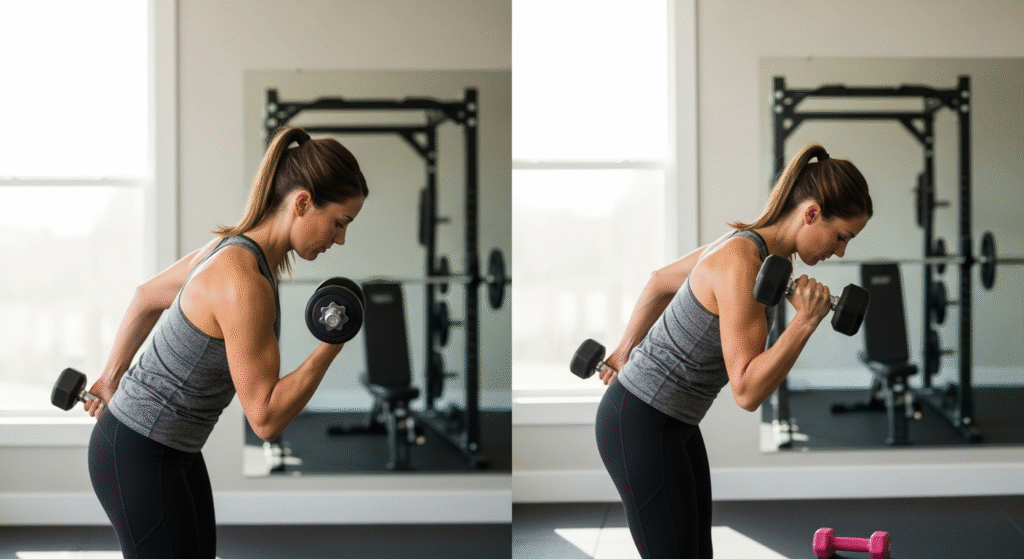
Hinge forward at your hips with a flat back, knees slightly bent. Hold a dumbbell in your right hand, bring your elbow up so your upper arm is parallel to the floor. This is your starting position. Straighten your arm behind you, squeezing your tricep hard at full extension. Bend your elbow to return to start.
The key is keeping your upper arm stationary—only your forearm moves. Engage your core to maintain that flat back position. Use lighter weights here (5-8 pounds) and focus on perfect form and that squeeze at the top. This isn’t about ego; it’s about targeting the exact muscle fibers you want to develop.
Sets/reps: 3 sets of 12-15 reps per arm
Exercise 8: Close-Grip Push-Ups
This compound movement works your triceps intensely while also engaging your chest and shoulders—maximum results in minimum time.
Start in a plank position with hands directly under your shoulders (closer than standard push-ups). Lower your body while keeping elbows close to your sides—they should brush your ribs as you descend. Push back up, focusing on your triceps doing the work.
This hand position shifts emphasis from chest to triceps. The closer your hands, the more tricep activation you get.
Modifications: Perform against a wall (easiest), on an incline like a countertop (moderate), on your knees (still challenging), or full plank position (advanced). There’s no shame in modifications—they allow you to maintain proper form while building strength.
Sets/reps: 3 sets of 8-12 reps
Your Complete Weekly Arm Training Schedule (Time-Efficient and Effective)
How Often Should You Train Arms After 40?
Recovery becomes more important as you age. Your muscles need time to repair and rebuild between workouts—this is when actual muscle growth happens. Training the same muscle group daily doesn’t give you better results; it leads to overtraining, fatigue, and potential injury.
For women over 40, training arms 2-3 times per week delivers optimal results. This frequency provides enough stimulus for muscle growth while allowing 48-72 hours of recovery between sessions. Research published in Sports Medicine found that training muscle groups 2-3 times weekly produces better strength and size gains than once-weekly training.
You can integrate arm training into full-body workouts or dedicate specific sessions to arms. Both approaches work—choose based on your schedule and preferences. The best workout plan is the one you’ll actually follow consistently.
Sample Weekly Schedule Options
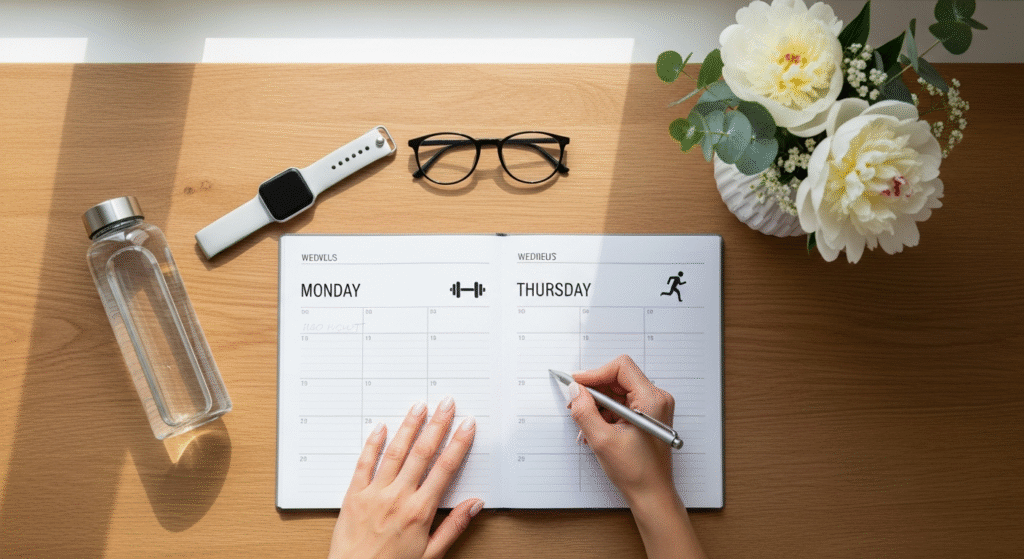
Option 1: Busy Professional Schedule (20 minutes, 2x per week)
Perfect if you’re juggling work, family, and limited time. Two focused sessions per week deliver significant results without overwhelming your schedule.
– Monday: Complete all 8 exercises (4 biceps + 4 triceps), 3 sets each – Thursday: Repeat the full routine – Weekend: Rest or light activity (walking, yoga, stretching)
This schedule provides maximum efficiency. You’re hitting your arms with comprehensive training twice weekly, allowing three full rest days between sessions. Most women see visible definition within 6-8 weeks following this schedule consistently.
Option 2: Home Workout Enthusiast (15 minutes, 3x per week)
If you enjoy more frequent, shorter workouts, this split approach keeps things interesting while allowing adequate recovery.
– Monday: Biceps focus (all 4 biceps exercises + 1 triceps exercise for balance) – Wednesday: Triceps focus (all 4 triceps exercises + 1 biceps exercise) – Friday: Balanced arm workout (alternate between biceps and triceps exercises)
This approach works well if you’re also training other body parts on these days. You can do legs on Monday, back on Wednesday, and shoulders on Friday, adding the arm work at the end of each session.
Option 3: Beginner-Friendly Approach
If you’re new to strength training or returning after a long break, start gradually to build confidence and prevent soreness that might derail your motivation.
– Week 1-2: Choose 1 biceps and 1 triceps exercise, perform 2 sets of 10 reps, twice weekly – Week 3-4: Add a second exercise for each muscle group, increase to 2-3 sets – Week 5-6: Add third exercises, work up to 3 sets of 12 reps – Week 7-8: Complete full routine with all 8 exercises
This progressive approach builds strength gradually while teaching proper form. You’re less likely to experience extreme soreness or injury, which means better adherence long-term.
Warm-Up and Cool-Down Essentials
Never skip your warm-up. Cold muscles are injury-prone muscles, and this matters more after 40 when your tissues are naturally less elastic.
5-Minute Arm-Specific Warm-Up: – Arm circles (forward and backward): 30 seconds each direction – Shoulder rolls: 20 reps – Light resistance band pulls: 15 reps – Wrist circles: 10 each direction – Air punches: 30 seconds
This increases blood flow to your arm muscles, warms up your joints, and prepares your nervous system for the work ahead.
Post-Workout Stretches (hold each 30 seconds): – Overhead triceps stretch: Reach one arm overhead, bend elbow, use opposite hand to gently pull elbow – Biceps wall stretch: Extend arm straight against a wall behind you, rotate body away – Cross-body shoulder stretch: Pull one arm across your chest – Prayer stretch: Press palms together in front of chest, lower hands to stretch forearms
These stretches improve flexibility, reduce soreness, and speed recovery. They’re not optional—they’re essential for maintaining joint health and preventing stiffness.
Nutrition and Recovery Strategies for Building Toned Arms After 40
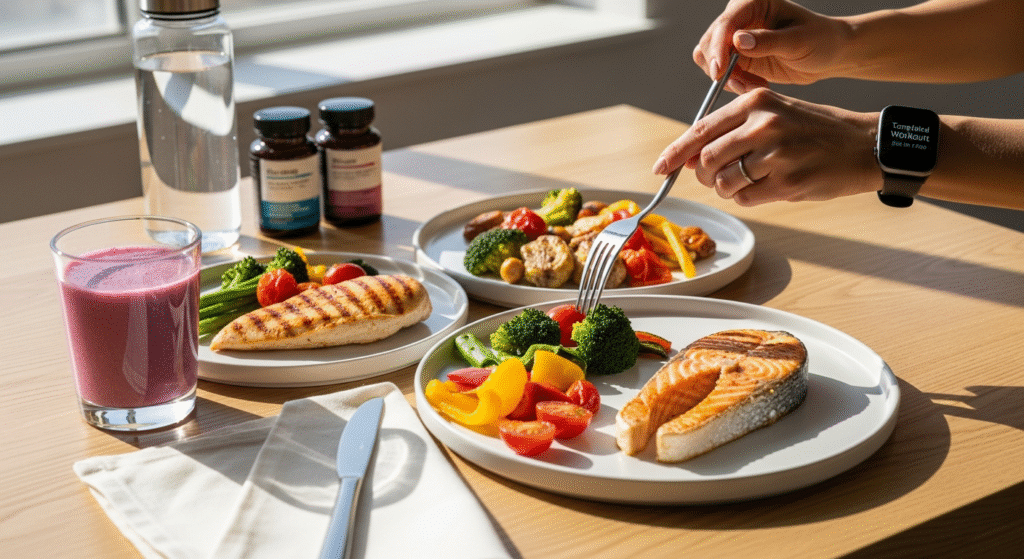
Protein: Your Muscle-Building Foundation
You cannot build muscle without adequate protein. This macronutrient provides the amino acids your body needs to repair and build muscle tissue after your workouts. After 40, your body becomes less efficient at processing protein, which means you actually need more than younger women—not less.
Aim for 0.8-1 gram of protein per pound of body weight daily. For a 150-pound woman, that’s 120-150 grams of protein spread throughout the day. Research in the Journal of Nutrition found that women over 40 who consumed this amount while strength training gained significantly more muscle than those eating lower protein amounts.
Best protein sources: chicken breast (31g per 4 oz), Greek yogurt (20g per cup), eggs (6g per egg), salmon (25g per 4 oz), cottage cheese (14g per half cup), lean beef (26g per 4 oz), protein powder (20-25g per scoop), lentils (18g per cup).
Timing matters for optimal results. Consume 20-30 grams of protein within 2 hours after your workout. This post-workout window is when your muscles are most receptive to nutrients. A protein shake with banana, Greek yogurt with berries, or chicken with sweet potato all work perfectly.
The Hydration and Sleep Connection
Dehydration sabotages your results in ways you might not realize. Water makes up 75% of muscle tissue. When you’re dehydrated, your muscles can’t contract as effectively, your strength decreases, and your recovery slows dramatically.
Drink at least 8-10 glasses of water daily, more on workout days. A good rule: drink half your body weight in ounces. If you weigh 150 pounds, aim for 75 ounces of water daily. Your urine should be pale yellow—if it’s dark, you’re dehydrated.
Sleep is when muscle growth actually happens. During deep sleep, your body releases growth hormone, which repairs and builds muscle tissue. Women over 40 who sleep 7-9 hours nightly build muscle more effectively than those sleeping less than 6 hours.
Practical sleep tips: establish a consistent bedtime, keep your bedroom cool (65-68°F), avoid screens for an hour before bed, and consider magnesium supplementation (300-400mg) to improve sleep quality and muscle recovery.
Managing Inflammation and Supporting Joint Health
After 40, managing inflammation becomes crucial for recovery and joint health. Chronic inflammation slows muscle recovery and can cause joint pain that interferes with training consistency.
Anti-inflammatory foods that support recovery: fatty fish (salmon, mackerel, sardines), berries (especially blueberries and cherries), leafy greens, olive oil, turmeric, ginger, green tea, and walnuts. Build meals around these foods to naturally reduce inflammation.
Supplements worth considering (always consult your doctor first): – Omega-3 fatty acids (EPA/DHA): 2000-3000mg daily reduces inflammation and supports joint health – Collagen peptides: 10-15g daily supports tendon and ligament health, may reduce joint pain – Vitamin D: 2000-4000 IU daily supports muscle function and bone health; most women over 40 are deficient
Listen to your body. There’s a difference between muscle soreness (normal after workouts) and joint pain (a warning sign). Soreness feels like a dull ache in the muscle belly and improves with movement. Joint pain feels sharp, localized to the joint, and worsens with movement. If you experience joint pain, reduce weight, modify exercises, or take an extra rest day.
Common Mistakes Women Over 40 Make (And How to Avoid Them)
Using Weights That Are Too Light
This is the number one mistake I see. Women grab 3-pound dumbbells and wonder why they’re not seeing results after months of training. Here’s the truth: “toning” requires building muscle, and building muscle requires progressive overload—gradually increasing the challenge you place on your muscles.
If you can easily complete 15 reps and could keep going, your weight is too light. The last 2-3 reps of each set should feel challenging. You should think, “I’m not sure I can do another rep” by rep 12-13. That’s the sweet spot where muscle growth happens.
How to know when to increase weight: When you can complete all your sets with perfect form and the last reps don’t feel challenging, increase by 2-5 pounds. This might mean you need multiple sets of dumbbells or adjustable weights.
The bulking myth needs to die. You will NOT accidentally get bulky arms. Building significant muscle mass requires years of dedicated training, extremely high protein intake, and often genetic predisposition. What you will get from lifting challenging weights is defined, toned arms that look sleek and strong. The women you see with “bulky” arms either train specifically for that look or use performance-enhancing substances. It won’t happen by accident.
Neglecting Form for Repetitions
Quality beats quantity every single time, especially after 40 when injury risk increases. One perfectly executed rep builds more muscle and carries less injury risk than ten sloppy reps.
Poor form leads to injury and wasted effort. When you swing weights using momentum, arch your back, or let your elbows drift, you’re reducing muscle engagement and increasing stress on your joints. That bicep curl performed with a swinging motion? You’re using your back and shoulders, not your biceps.
Focus on controlled movements: 1-2 seconds lifting, brief pause and squeeze at peak contraction, 2-3 seconds lowering. This time under tension builds muscle effectively while protecting your joints.
If maintaining form requires dropping to lighter weights, do it. Your ego might take a hit, but your results won’t. Perfect form with 8-pound dumbbells delivers better results than sloppy form with 15-pound dumbbells.
—
Your arms at 40, 50, or beyond can be strong, defined, and powerful. This workout gives you the proven framework—now it’s time to take action.
Start with just two exercises this week. Pick one biceps and one triceps movement, perform 2 sets of 10 reps, and experience how capable your body is. You don’t need to be perfect; you just need to begin.
Your strongest arms aren’t behind you—they’re ahead of you. And they’re worth the effort.
Ready to transform your arms? Save this workout, grab your dumbbells, and let’s build the strong, sculpted arms you deserve. Your future self will thank you.