7 Safe Pelvic Floor Workouts for Pregnant Women Over 40
You’re over 40, expecting a baby, and your body feels completely different from what you remember—or imagined. The stakes feel higher, the concerns more real, and finding safe, effective prenatal exercises feels overwhelming.
Here’s what nobody tells you: pregnancy after 40 brings unique challenges, especially for your pelvic floor. Maybe you’re carrying your first baby and worried about starting from scratch.
Or perhaps this isn’t your first rodeo, and you’re noticing your body doesn’t bounce back like it used to. Either way, you’re dealing with natural changes in muscle elasticity, hormonal shifts, and legitimate concerns about delivery and recovery.
But here’s the powerful truth—your pelvic floor can absolutely be strengthened at any age. In fact, targeted exercises during pregnancy can transform your entire experience.
We’re talking better bladder control (yes, even when you sneeze), easier delivery, faster postpartum recovery, and long-term health benefits that extend far beyond these nine months.
The workouts I’m sharing aren’t intimidating gym routines or complicated physical therapy sessions. These are proven, science-backed exercises you can start today, right from your living room—no special equipment. No judgment. Just effective movements designed specifically for your pregnant body over 40.
Your pelvic floor deserves this attention now more than ever. These muscles support your growing baby, control your bladder and bowels, stabilize your core, and play a crucial role in delivery.
Strengthening them isn’t just about preventing embarrassing leaks—it’s about empowering yourself for the journey ahead and protecting your body for decades to come.
Ready to build a stronger foundation? Let’s get started with exercises that actually work.
Why Your Pelvic Floor Deserves Special Attention After 40
The Reality of Pregnancy Over 40
Your body at 40-plus isn’t worse than it was at 25—it’s just different. And understanding these differences helps you work *with* your body instead of against it.
Natural changes in muscle elasticity and connective tissue happen as we age. Collagen production slows down, tissues become less flexible, and muscles don’t respond quite as quickly to training. Add pregnancy hormones like relaxin into the mix, and you’ve got a perfect storm affecting your pelvic floor integrity.
If you’ve had previous pregnancies, your pelvic floor has already been stretched and stressed. Each pregnancy leaves its mark, and the time between pregnancies matters. Your muscles may have compensated in ways that created imbalances, even if you didn’t notice symptoms before.
But here’s the good news that changes everything: your pelvic floor can be strengthened at any age. Research shows that women who engage in targeted pelvic floor training during pregnancy—regardless of age—experience significant improvements in muscle function. Your muscles still respond to proper exercise. They still adapt. They still grow stronger.
The key is working smarter, not harder.
What Happens When You Ignore Pelvic Floor Health
Let’s talk about the elephant in the room—or rather, the leak when you laugh.
Common complications from weak pelvic floor muscles include stress incontinence (leaking with coughs, sneezes, or exercise), pelvic organ prolapse (when organs drop from their normal position), chronic lower back pain, and painful intercourse. These aren’t just pregnancy problems—they’re quality-of-life issues that can persist for years if left unaddressed.
During delivery, a weak or poorly coordinated pelvic floor increases your risk of severe tearing. Recovery takes longer. Postpartum complications become more likely. And the long-term consequences extend far beyond those early months with your baby.
Here’s what really matters: prevention is easier than treatment. Strengthening your pelvic floor during pregnancy takes 15 minutes a day. Treating prolapse or chronic incontinence later? That’s months of physical therapy, possible surgery, and lifestyle limitations you don’t want to face.
The Proven Benefits of Prenatal Pelvic Floor Training
When you commit to pelvic floor exercises during pregnancy, you’re investing in multiple powerful benefits.
Better bladder and bowel control during and after pregnancy tops the list. We’re talking about maintaining dignity and comfort throughout your pregnancy and beyond. No more panic-searching for bathrooms or wearing pads “just in case.”
Research shows that women who practice pelvic floor exercises during pregnancy have reduced risk of perineal tearing during delivery. Your muscles learn to relax and coordinate properly, which helps during the pushing phase. This means faster healing, less pain, and quicker return to normal activities.
Improved core stability translates to reduced back pain—a game-changer when you’re carrying extra weight in front. Your pelvic floor works with your deep abdominal muscles to support your spine and pelvis.
And let’s not forget enhanced intimate health post-delivery. Strong, well-coordinated pelvic floor muscles contribute to better sensation and function, helping you reclaim this part of your life when you’re ready.
These benefits aren’t hypothetical. They’re documented, proven results from consistent practice.
Understanding Your Pelvic Floor: A Simple Guide
What Exactly Is Your Pelvic Floor?
Think of your pelvic floor as a hammock of muscles stretched between your pubic bone in front and your tailbone in back. This muscular hammock supports your bladder, uterus, and bowels. It has openings for your urethra, vagina, and rectum—and it controls all three.
These muscles work 24/7, even when you’re not thinking about them. They contract to prevent leakage, relax to allow urination and bowel movements, and coordinate with your core muscles to stabilize your spine. During pregnancy, they support the increasing weight of your baby, placenta, and amniotic fluid.
When you’re pregnant, especially over 40, these muscles face extraordinary demands. Hormones soften them. Weight stretches them. Your growing uterus constantly puts pressure on them. Without targeted exercise, they can weaken, leading to the complications we discussed earlier.
Understanding this anatomy isn’t just academic—it helps you connect with these muscles during exercise. You can’t strengthen what you can’t feel or visualize.
Signs Your Pelvic Floor Needs Attention
Your body sends clear signals when your pelvic floor needs help. Leaking when coughing, sneezing, laughing, or jumping is the most obvious sign. Even small amounts count—this isn’t normal, and it’s not something you just have to accept.
Heaviness or pressure in your pelvic area, especially by the end of the day, indicates your pelvic floor is struggling to support everything. You might feel like something is “falling out” or notice a bulge in your vaginal area.
Lower back pain that won’t quit, despite rest and stretching, often connects to pelvic floor dysfunction. These muscles are part of your core system, and when they’re not working properly, your back compensates.
Difficulty controlling your bladder or bowels—even subtle changes like urgency or frequency—deserves attention.
Here’s what you need to hear: these symptoms are common, but they’re not shameful, and they’re absolutely fixable. Most women experience at least one of these signs during pregnancy. Acknowledging them is the first step toward addressing them.
The Connection Between Breathing and Pelvic Floor
This connection is the foundation of everything that follows, so pay close attention.
Your pelvic floor doesn’t work in isolation. It’s part of your body’s pressure management system, working in coordination with your diaphragm (breathing muscle), deep abdominal muscles, and back muscles. When you inhale, your diaphragm descends, and your pelvic floor gently relaxes and descends slightly too. When you exhale, both rise back up.
This coordinated movement is crucial for proper pelvic floor function. Many women hold their breath during exercise or daily activities, creating downward pressure that stresses the pelvic floor. Others breathe shallowly into their chest, never engaging the full system.
Proper breathing activates your pelvic floor muscles naturally and efficiently. It also prevents you from bearing down incorrectly during exercises. Every exercise I’m about to share includes specific breathing cues because breath work is the foundation of effective pelvic floor training.
Master your breath, and you’ve mastered half the battle.
7 Effective Prenatal Pelvic Floor Exercises You Can Start Today
Exercise 1: Diaphragmatic Breathing with Pelvic Floor Awareness
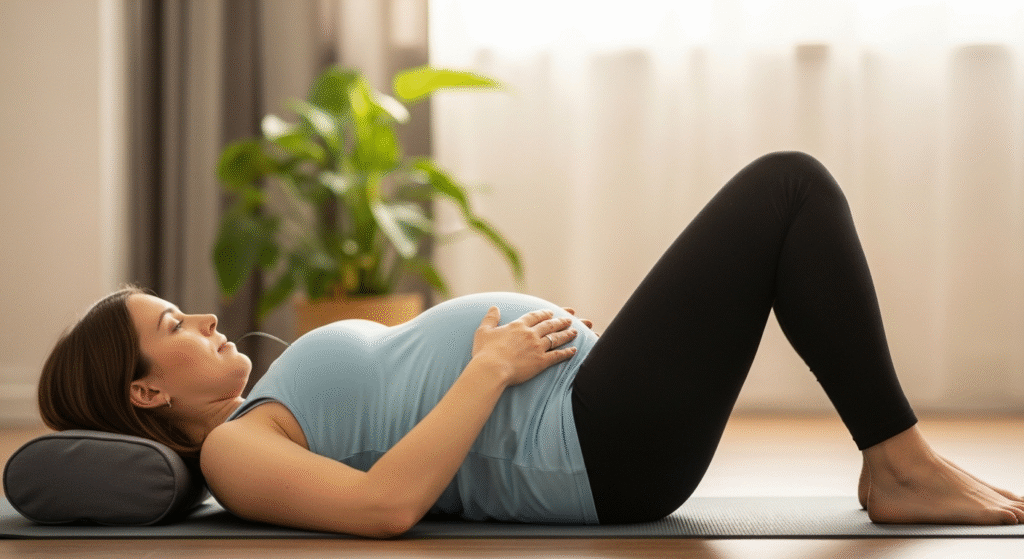
This is your foundation exercise—simple but powerful.
How to do it: Sit comfortably in a chair or lie on your left side with a pillow between your knees. Place one hand on your chest and one on your belly. Inhale slowly through your nose for 4 counts, feeling your belly expand while your chest stays relatively still.
As you inhale, allow your pelvic floor to relax and gently descend. Exhale slowly through your mouth for 6 counts, feeling your belly soften and your pelvic floor naturally lift.
What you should feel: A gentle expansion in your lower ribs and belly on the inhale, and a subtle lifting sensation in your pelvic floor on the exhale. You shouldn’t feel straining or tension in your neck or shoulders.
Reps and duration: Start with 5-10 breaths, 2-3 times daily. This can be your morning wake-up routine and your evening wind-down.
Trimester modifications: First trimester—any position works. Second and third trimesters—avoid lying flat on your back; use side-lying or seated positions.
Common mistakes: Breathing into your chest instead of your belly, holding your breath between inhale and exhale, forcing the movement instead of allowing it to happen naturally.
Exercise 2: Modified Kegels (The Right Way)
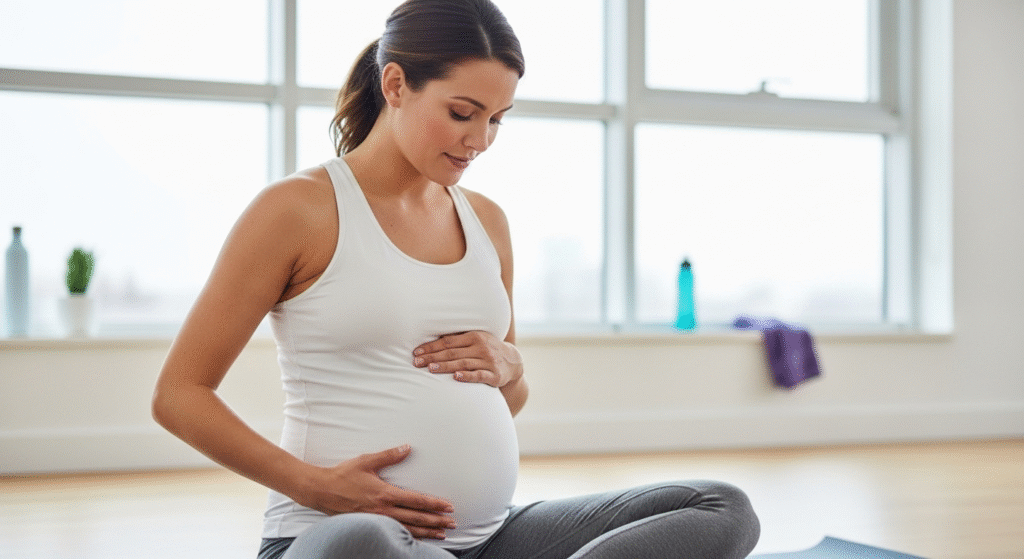
Traditional kegels get a bad rap because most people do them incorrectly. Let’s fix that.
Proper technique: Start from the breathing position above. After an inhale and exhale, take another gentle inhale. On your next exhale, imagine stopping the flow of urine and lifting a blueberry with your vagina—this creates the right engagement. Lift gently (not a hard squeeze), hold for 3-5 seconds while breathing normally, then release completely for 5-10 seconds.
Finding the right muscles: You should feel a lifting and tightening sensation deep inside your pelvis, not in your buttocks, thighs, or belly. If you’re holding your breath, clenching your jaw, or tensing your shoulders, you’re working too hard.
Sets and reps: Build up to 10 reps, 3 times daily. Quality beats quantity—5 perfect kegels are better than 20 sloppy ones.
Important note: If your pelvic floor is already tight or tense (signs include pain with intercourse, difficulty starting urination, or chronic pelvic pain), you might need to focus on relaxation exercises instead. Consult a pelvic floor physical therapist if you’re unsure.
Exercise 3: Pelvic Tilts
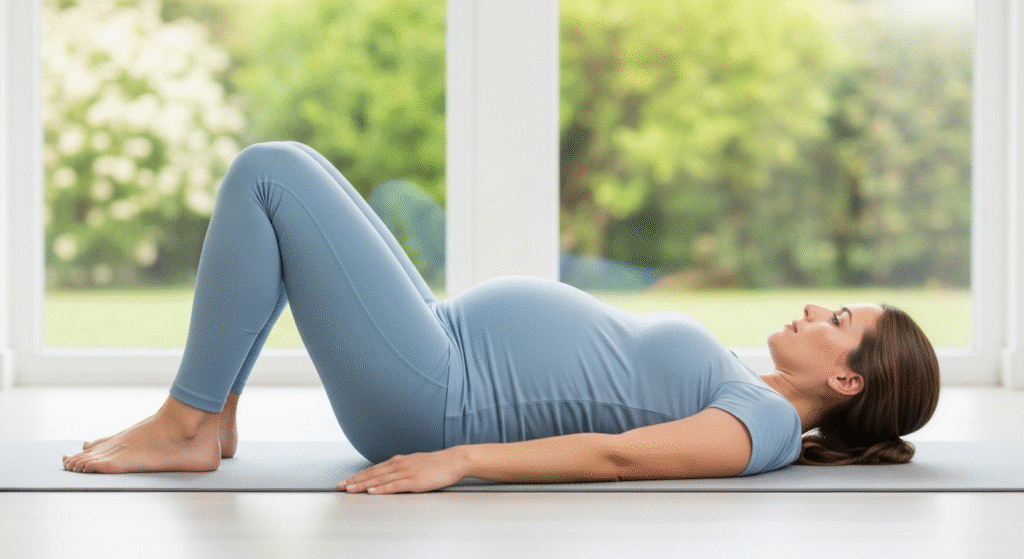
This exercise strengthens your pelvic floor while relieving lower back pain—a win-win for pregnant bodies.
Benefits: Pelvic tilts engage your deep core muscles and pelvic floor together, teaching them to work as a coordinated team. They also mobilize your lower back and pelvis, which often get stiff during pregnancy.
Standing variation: Stand with your back against a wall, feet hip-width apart and about 6 inches from the wall. Inhale to prepare. Exhale and gently tilt your pelvis, pressing your lower back toward the wall while your pelvic floor lifts. Inhale to release back to neutral.
Lying variation (first and early second trimester only): Lie on your back with knees bent and feet flat. Same breathing pattern—exhale to tilt pelvis and press lower back to floor, inhale to release.
Reps: 10-15 reps, once or twice daily.
Trimester modifications: After 20 weeks, stick with the standing version to avoid lying flat on your back. You can also do these on hands and knees.
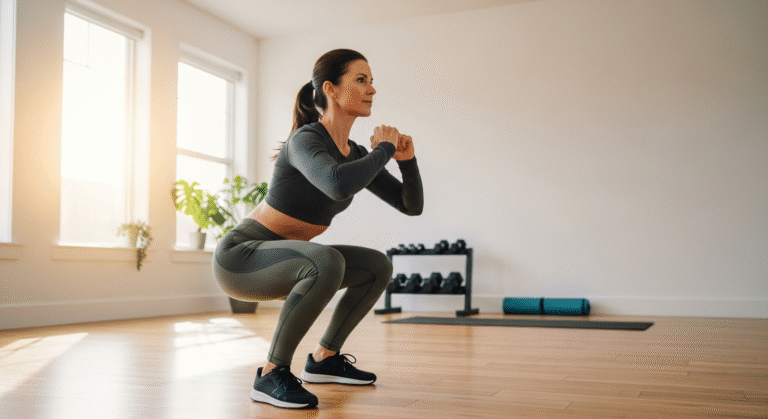
Exercise 4: Supported Squats
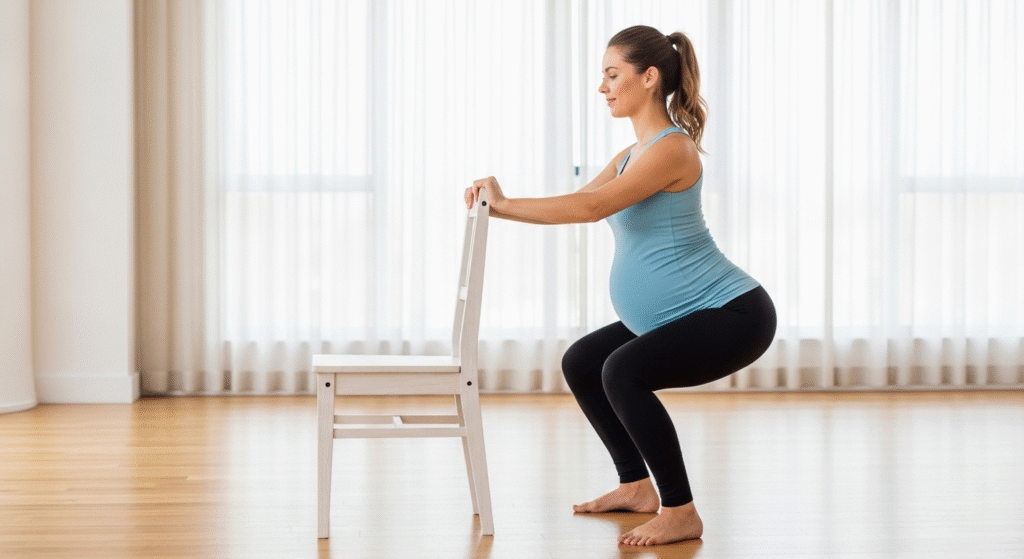
Squats are a game-changer for building functional pelvic floor strength and preparing your body for delivery.
Why they work: Squats strengthen your glutes, legs, and pelvic floor simultaneously. They also practice the pelvic floor’s ability to lengthen and relax—crucial for delivery.
Proper form: Stand facing a sturdy chair or wall for support, feet slightly wider than hip-width, toes turned out about 30 degrees. Inhale as you lower into a squat, allowing your pelvic floor to relax and lengthen. Keep your weight in your heels, chest lifted, and knees tracking over your toes. Exhale as you press through your heels to stand, feeling your pelvic floor lift naturally.
Support options: Hold onto a chair back, place a yoga block or pillow under your heels for ankle support, or lean against a wall.
Breathing pattern: This is crucial—inhale down (pelvic floor relaxes), exhale up (pelvic floor lifts). Never hold your breath.
Reps: 8-12 reps, 2-3 sets. Rest between sets.
When to modify: If you experience pelvic pressure, pain, or heaviness, reduce your range of motion. You don’t need to squat deeply—even small movements build strength.
Exercise 5: Cat-Cow Stretch
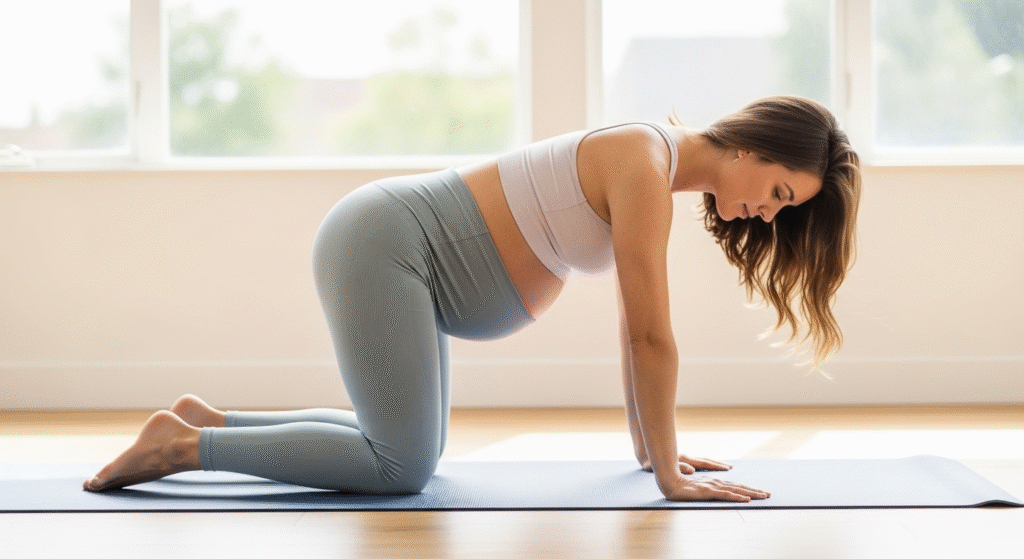
This yoga-inspired movement combines gentle spinal mobility with pelvic floor activation and provides sweet relief for pregnancy-related back pain.
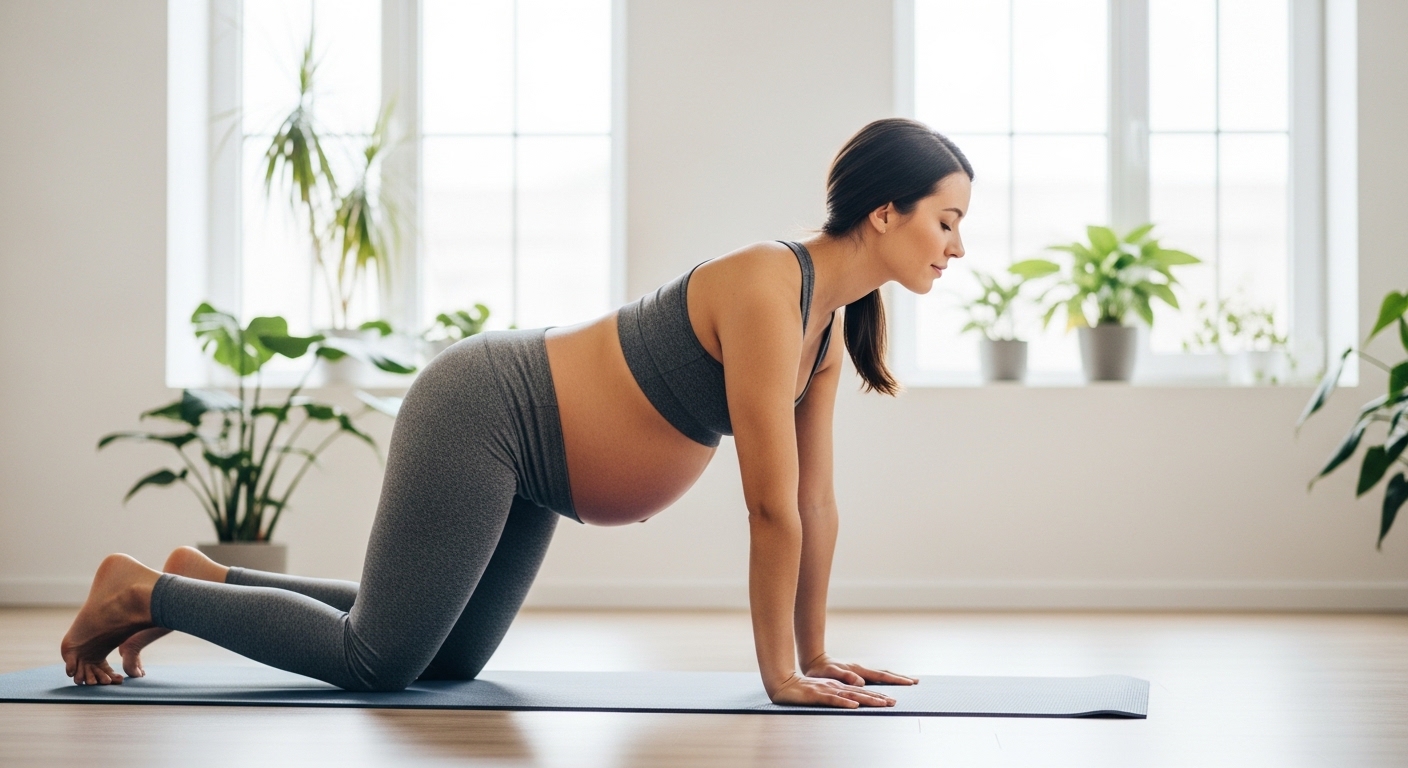
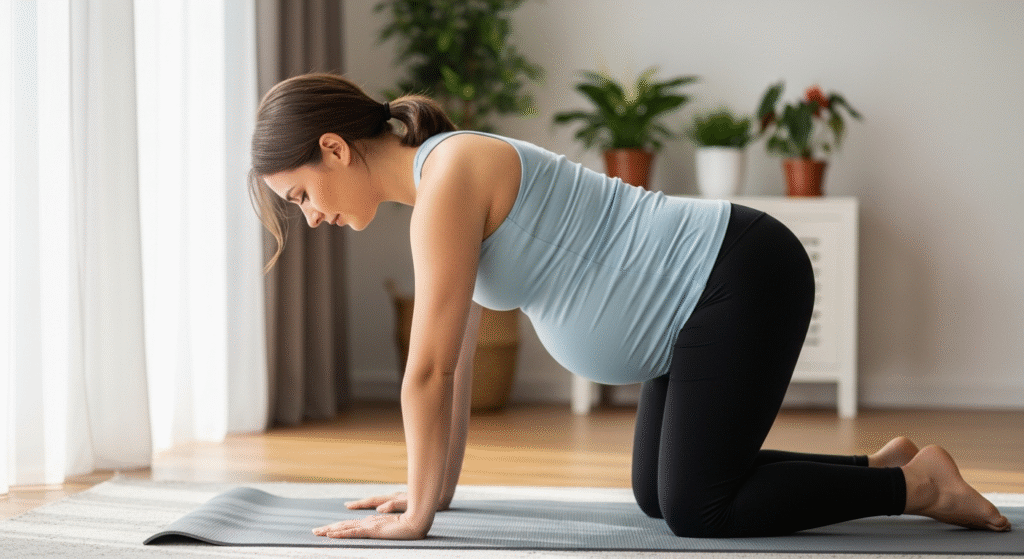
How to do it: Start on hands and knees with wrists under shoulders and knees under hips. For cow pose, inhale as you let your belly drop toward the floor, lifting your chest and tailbone toward the ceiling. Your pelvic floor gently relaxes. For cat pose, exhale as you round your spine, tucking your tailbone and drawing your belly toward your spine. Your pelvic floor lifts.
Coordinating movement with breath: The breath leads the movement. Inhale initiates cow, exhale initiates cat. Move slowly and smoothly, syncing your pelvic floor with the movement.
What to feel: A gentle wave of movement through your spine, a release of tension in your back, and a subtle engagement of your pelvic floor on the cat portion.
Reps: 8-10 slow repetitions, focusing on the quality of movement and breath coordination.
Trimester modifications: This exercise works well throughout pregnancy. In the third trimester, you might need to widen your knees for belly clearance.
Exercise 6: Side-Lying Leg Lifts
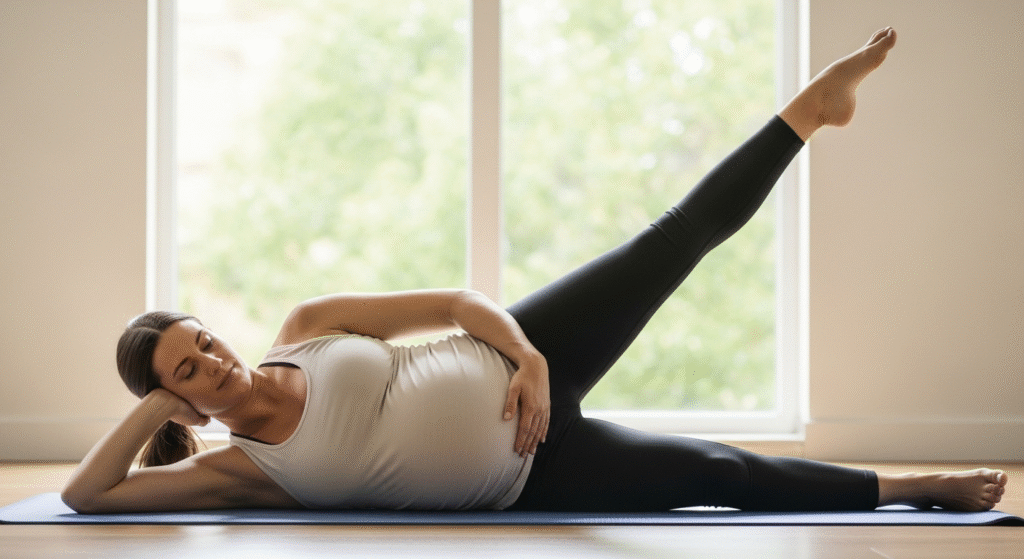
This exercise strengthens the lateral aspects of your pelvic floor and hip stabilizers—often-neglected muscles that play a crucial role in pelvic stability.
Proper setup: Lie on your left side with your head supported by your arm or a pillow. Stack your hips and shoulders vertically. Bend your bottom leg for stability and extend your top leg straight.
The movement: Inhale to prepare. Exhale as you lift your top leg to hip height (no higher), feeling your pelvic floor engage. Inhale as you lower with control. The movement is small and controlled—you’re not trying to kick the ceiling.
Pelvic floor connection: Focus on maintaining a gentle pelvic floor lift throughout the movement, not letting it bulge or bear down.
Reps: 8-10 reps per side, 2 sets.
Trimester modifications: First trimester—any side works. Second and third trimesters—lying on your left side is generally more comfortable and better for circulation.
Exercise 7: Supported Bridge Pose
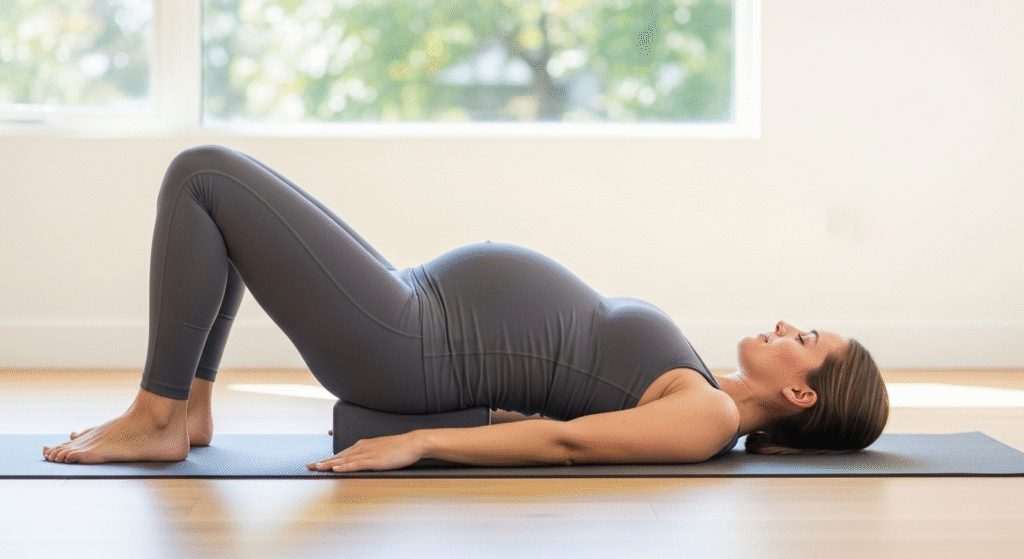
This exercise builds glute and pelvic floor strength simultaneously while being completely safe for pregnant bodies when done correctly.
Safe technique: Lie on your back (first trimester or early second only) or use an incline with pillows supporting your upper back. Bend your knees and place feet flat, hip-width apart. Inhale to prepare. Exhale as you press through your heels, lifting your hips toward the ceiling while your pelvic floor lifts. Your body forms a straight line from shoulders to knees. Hold for 3-5 seconds, breathing normally. Inhale as you lower with control.
When to stop: After 20 weeks, avoid lying flat on your back. You can continue this exercise on an incline (upper back elevated on pillows or a wedge) or switch to standing exercises instead.
Breathing cues: Never hold your breath at the top. Exhale to lift, breathe normally at the top, inhale to lower. This prevents bearing down on your pelvic floor.
Reps: 8-10 reps, holding for 3-5 seconds each. Focus on the quality of the lift and the pelvic floor engagement.
Creating Your Weekly Workout Routine and Avoiding Common Mistakes
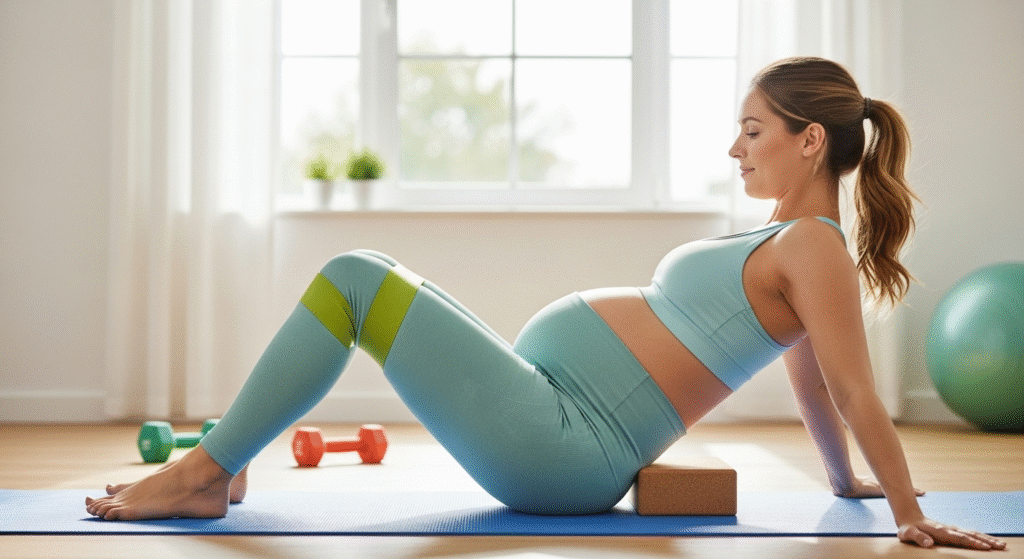
The 15-Minute Daily Practice
Consistency beats intensity every single time with pelvic floor training. Here’s how to structure your practice for maximum results without overwhelming your schedule.
Sample morning routine (7-8 minutes): Start your day with diaphragmatic breathing (2 minutes), followed by pelvic tilts (10 reps), cat-cow stretches (8 reps), and modified kegels (10 reps). This gentle wake-up routine activates your pelvic floor and prepares your body for the day ahead.
Evening wind-down routine (7-8 minutes): Focus on relaxation and release with diaphragmatic breathing (3 minutes), supported squats (10 reps), side-lying leg lifts (8 per side), and more breathing to release tension.
Why consistency matters: Your pelvic floor muscles respond to regular, repeated stimulation. Doing 15 minutes daily delivers far better results than doing an hour once a week. These muscles need consistent reminders to stay strong and coordinated.
Realistic expectations: During the first week, you’re learning the exercises and building mind-muscle connection. By week 2-3, you’ll start feeling stronger and more aware of your pelvic floor. By week 4-6, most women notice functional improvements—less leaking, less pressure, better control. Keep going—results compound over time.
Common Mistakes That Sabotage Your Results
Mistake #1: Holding Your Breath
This is the number one error I see, and it completely undermines your efforts. When you hold your breath during exercise, you create downward pressure on your pelvic floor—exactly what you’re trying to avoid. This is called the Valsalva maneuver, and while it’s useful for lifting heavy objects, it’s terrible for pelvic floor health during pregnancy.
The fix: Practice breathing patterns separately from the exercises first. Once you’ve mastered diaphragmatic breathing, add it to each movement. If you catch yourself holding your breath, pause, reset, and try again. It takes practice, but it’s worth it.
Mistake #2: Doing Too Many Kegels
More isn’t always better. Some women develop overly tight pelvic floor muscles from excessive kegel exercises. A tight pelvic floor is just as problematic as a weak one—it can cause pain, difficulty with intercourse, and ironically, leaking and prolapse.
Signs of tension: Pain during intercourse, difficulty starting urination, feeling like you can’t fully empty your bladder or bowels, chronic pelvic pain or pressure.
The solution: Balance strengthening exercises with relaxation. For every kegel contraction, make sure you’re fully releasing. Consider adding more breathing and stretching exercises to your routine. If you suspect your pelvic floor is too tight, consult a pelvic floor physical therapist before continuing kegel exercises.
Mistake #3: Expecting Overnight Transformation
Your pelvic floor took time to weaken, and it will take time to strengthen. This isn’t a quick fix—it’s a sustainable practice.
Realistic timeline: Most women notice initial improvements in awareness and control within 2-3 weeks. Functional improvements (reduced leaking, better stability) typically appear around 4-6 weeks of consistent practice. Significant strength gains take 8-12 weeks.
Celebrate small victories: Notice when you can hold a kegel longer, when you feel more connected to your pelvic floor, when you make it through a sneeze without leaking. These small wins add up to major transformation.
Tracking progress: Keep a simple journal noting your exercises and any symptoms. This helps you see patterns and progress that might otherwise go unnoticed. But don’t obsess—check in weekly, not daily.
When to Seek Professional Help
Sometimes, you need more than exercises you can do at home. A pelvic floor physical therapist specializes in exactly what you’re dealing with and can provide personalized assessment and treatment.
Benefits of seeing a pelvic floor PT: They can perform an internal exam to assess your actual muscle strength, coordination, and any areas of tension or weakness. They’ll create a customized exercise program based on your specific needs. They can use techniques like biofeedback to help you better understand what your muscles are doing.
What to expect: Your first appointment typically includes a health history discussion, external assessment of your posture and movement patterns, and possibly an internal vaginal exam (always optional and with your consent). The therapist will explain their findings and create a treatment plan. Follow-up sessions might include manual therapy, exercise instruction, and progress monitoring.
Red flags requiring immediate attention: Severe pelvic pain, visible bulging from your vagina, complete loss of bladder or bowel control, or bleeding associated with exercise. These symptoms need prompt medical evaluation.
Building your support team: Your pelvic floor PT works alongside your obstetrician or midwife. Many insurance plans cover pelvic floor physical therapy during pregnancy. Don’t hesitate to ask for a referral—this is specialized care that can make a tremendous difference in your pregnancy and postpartum experience.
To Conclude: Your Pelvic Floor, Your Power
You’ve just learned seven proven exercises that can transform your pregnancy experience and set you up for a stronger postpartum recovery. These aren’t complicated gym routines or time-consuming programs—they’re efficient, effective movements designed specifically for your pregnant body over 40.
Your pelvic floor deserves this attention. These muscles support your baby, control essential functions, and play a crucial role in delivery and recovery. Strengthening them isn’t vanity—it’s investing in your health, your comfort, and your quality of life for decades to come.
Start with just one exercise today. Master the diaphragmatic breathing. Feel the connection between your breath and your pelvic floor. Build from there, adding exercises as you gain confidence and strength. Fifteen minutes a day is all you need.
Remember: consistency beats intensity. Your pelvic floor responds to regular practice, not occasional heroic efforts. Show up for yourself daily, even when it feels like nothing is happening. Trust the process. Your body is capable of incredible strength and adaptation at any age.
Ready to take action? Choose your favorite exercise from this list and do it right now—yes, right now. Three repetitions. That’s your starting point. Tomorrow, do it again. By next week, you’ll have built a habit. By next month, you’ll feel the difference.
Your pregnancy over 40 can be powerful, comfortable, and strong. Your pelvic floor is the foundation. Let’s build it together.