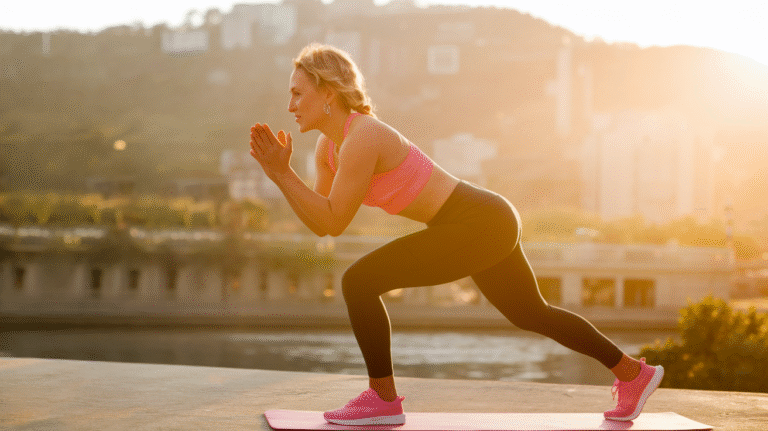
5 Inner Thigh Exercises for Women Over 40: Tone and Tighten
You’ve been squatting, lunging, and sweating through countless leg days, yet that inner thigh area remains stubbornly soft. Sound familiar?
Here’s what nobody tells you: those traditional exercises aren’t designed to target your adductors—the muscle group responsible for that toned, sculpted inner thigh appearance you’re after.
And after 40, when hormonal changes shift how your body stores fat and maintains muscle, you need a different approach entirely.
This isn’t about chasing unrealistic beauty standards or fitting into a certain size. The exercises I’m sharing today deliver real, functional benefits that transform how you move through daily life.
We’re talking improved balance when you’re rushing up stairs, reduced knee pain during your morning walks, and the confidence that comes from feeling strong in your own body.
The best part? You don’t need a gym membership, fancy equipment, or hours of free time. These five proven exercises work with your schedule, not against it.
You can do them during your morning coffee, while watching your favorite show, or in those precious 10 minutes before the rest of your household wakes up.
Let’s build strength where it matters most—starting right now.
Why Inner Thighs Need Special Attention After 40
The Muscle Connection That Weakens With Age
Your inner thighs house the adductor muscle group—five muscles that pull your legs together and stabilize your hips. After years of sitting at desks, doing quad-dominant workouts, or running on autopilot during cardio sessions, these muscles become disconnected. They’re not injured—they’ve simply forgotten how to fire properly.
Add hormonal changes to the equation, and you’ve got a perfect storm. As estrogen levels decline after 40, your body naturally redistributes fat, often depositing more around the inner thighs and hips.
Simultaneously, you lose muscle mass at a rate of 3-8% per decade if you’re not actively working against it. This combination creates that soft, undefined appearance many women struggle with.
Here’s the critical insight: traditional squats and lunges primarily target your quads and glutes. They’re fantastic exercises, but they don’t generate the specific tension your adductors need to tone and tighten. You’re working hard without addressing the actual problem area.
Think of it like trying to sculpt your biceps by only doing push-ups. Sure, there’s some arm involvement, but you’re missing the targeted work that delivers visible results.
The Real Benefits Beyond Appearance
Before we dive into the exercises, let’s talk about what strong inner thighs actually do for you—because this goes far beyond aesthetics.
Your adductors are stability powerhouses. Every time you step sideways, change direction quickly, or catch yourself from tripping, these muscles activate to keep you upright and balanced. For women over 40, this becomes increasingly important as balance naturally declines with age.
Strong inner thighs also protect your knees and hips. When your adductors are weak, other muscles compensate, creating imbalances that lead to pain and injury.
I’ve worked with countless women who eliminated chronic knee discomfort simply by strengthening their inner thighs—no physical therapy or medication required.
If you’re active in sports or fitness classes, powerful adductors enhance your performance dramatically. They improve your lateral movement in tennis, boost your power in cycling, and increase your stability in yoga poses. You’ll move with more confidence and control in everything you do.
What Makes These Exercises Different
The exercises you’re about to learn use isolated movements that generate consistent tension at clean angles. Instead of going heavy or moving fast, you’ll focus on controlled movements that create a deep burn in exactly the right spot.
This approach works because it establishes a mind-muscle connection—your brain relearns how to activate these dormant muscles.
When you slow down and focus on feeling the squeeze in your inner thighs, you’re not just building strength. You’re rewiring the neural pathways that control these muscles.
Research backs this up. Studies show that slower, controlled movements with focused attention activate more muscle fibers than fast, heavy reps. You’re working smarter, not just harder.
The science-backed truth? Controlled movements deliver more powerful results than intense cardio for sculpting specific areas. You don’t need to jump around or work yourself into exhaustion. You need precision, consistency, and proper form.
Exercise 1: Sumo Walks With Pause
How to Perform This Movement Correctly
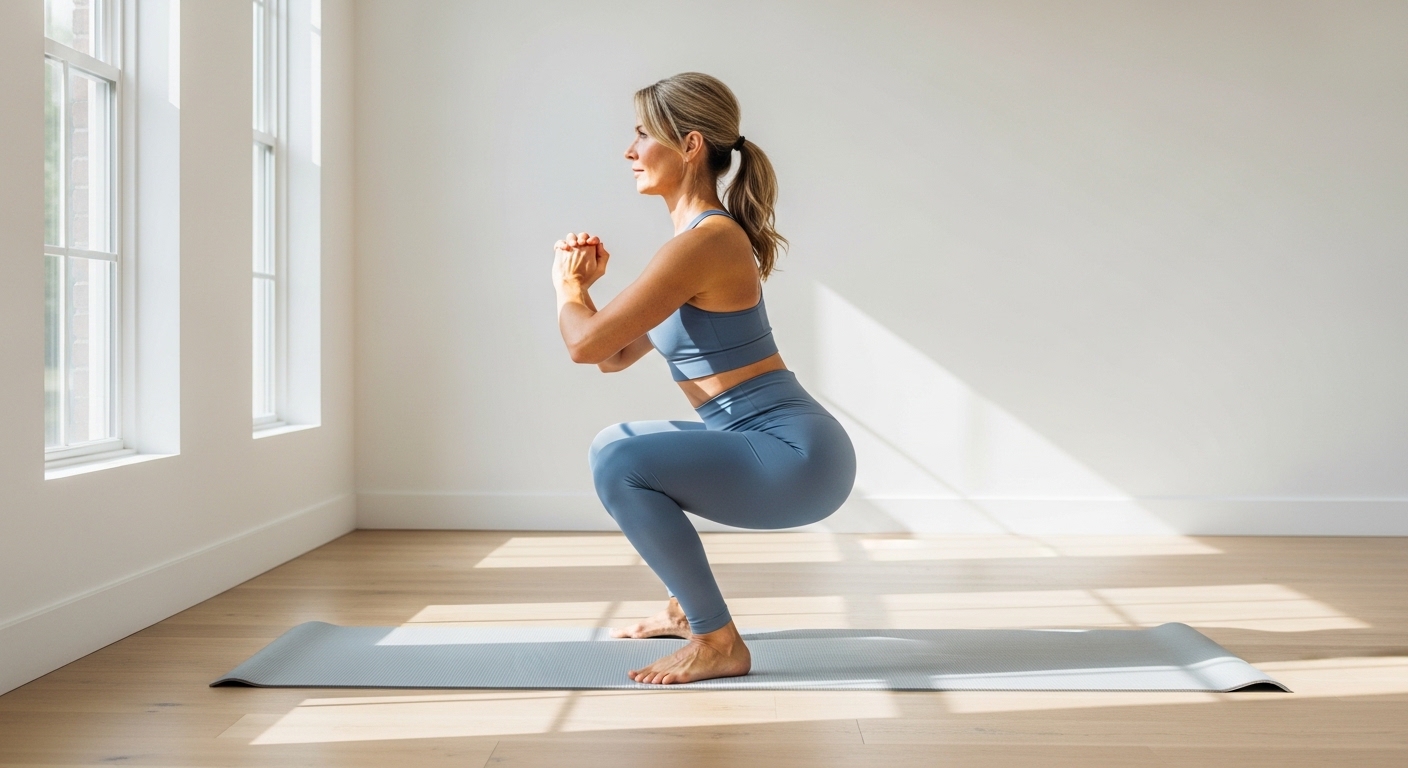
Start by standing with your feet wider than hip-width apart, toes pointed slightly outward at about 45 degrees. Lower yourself into a sumo squat position—your thighs should be roughly parallel to the floor, knees tracking over your toes, not caving inward.
Here’s where the magic happens: Take a step to your right, maintaining that low squat position. Your inner thighs should feel immediate tension as they work to control the movement. Pause for three full seconds, really squeezing your inner thighs. Then step to the left and pause again.
Focus on these form cues: Keep your chest lifted and core engaged throughout the movement. Your knees should never collapse inward—push them out actively. Maintain the same squat depth as you walk; don’t bob up and down.
Common mistakes destroy the effectiveness of this exercise. Don’t stand up between steps—that releases all the tension you’re trying to build.
Don’t rush through the pauses—those three seconds of squeeze are where the transformation happens. And don’t let your knees cave inward, which shifts the work away from your adductors.
For breathing, exhale as you step and squeeze, inhale as you prepare for the next step. This pattern helps you maintain core stability while maximizing muscle activation.
Why This Exercise Works
Sumo walks with pause target your adductors and glutes simultaneously, creating a compound effect that sculpts your entire lower body. The wide stance forces your inner thighs to work harder than they would in a traditional squat.
The pause is your secret weapon. When you hold that squeeze for three seconds, you create time under tension—the proven factor that builds muscle and burns fat. Your muscles don’t get a break to rest, so they have to work continuously throughout the set.
This exercise is perfect for beginners because it requires zero equipment and allows you to control the intensity completely. If you need to make it easier, don’t squat quite as low. If you want more challenge, add resistance bands around your thighs or hold light dumbbells.
Modifications and Progressions
Starting your fitness journey? Begin with a shallower squat—maybe just a quarter of the way down. Focus on mastering the stepping pattern and feeling your inner thighs engage. As you build strength over 2-3 weeks, gradually lower your squat depth.
Once you’ve mastered the basic movement, add a resistance band just above your knees. This creates additional tension that forces your adductors to work even harder. Start with a light band and progress to heavier resistance as you get stronger.
For women over 40, I recommend 3 sets of 10-12 steps in each direction. Rest for 45-60 seconds between sets. Perform this exercise 3-4 times per week, allowing at least one rest day between sessions for recovery.
As you progress, try holding light dumbbells at your shoulders or chest. This adds an upper body component while challenging your core stability. Just remember: perfect form matters more than added weight.
Exercise 2: Side-Lying Leg Lifts With Controlled Tempo
Proper Setup and Execution
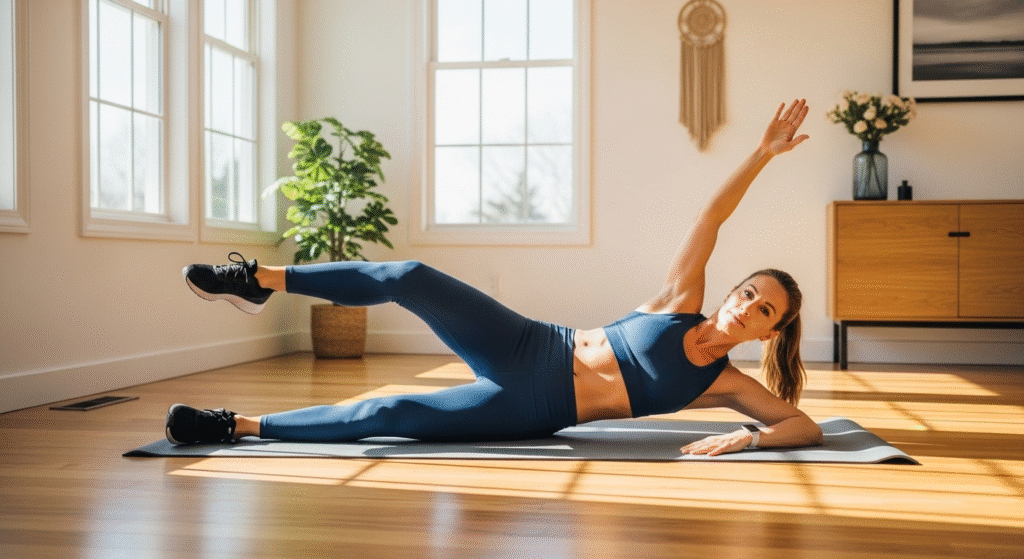
Lie on your right side on a yoga mat or comfortable surface. Stack your hips directly on top of each other—this alignment is crucial for isolating your inner thighs. Bend your top (left) leg and place that foot flat on the floor in front of your bottom leg.
Your bottom (right) leg stays straight, with your foot flexed (toes pointing toward your shin). Rest your head on your extended right arm or prop it up with your hand for comfort.
Now for the controlled tempo technique: Lift your bottom leg off the floor slowly, counting to three as you raise it. Hold at the top for two seconds, really squeezing your inner thigh. Lower for three seconds, stopping just before your leg touches the floor. That’s one rep.
Maintain perfect alignment throughout every rep. Your hips should stay stacked—don’t roll forward or backward. Keep your bottom leg straight but not locked. Your foot stays flexed to maximize inner thigh activation.
The burn you’ll feel is intense, and that’s exactly what you want. This controlled tempo forces your adductors to work continuously without any momentum to help them. You’re building strength and tone with pure muscle power.
The Science Behind the Slow Burn
Slower reps tone more effectively than fast movements because they eliminate momentum. When you lift quickly, physics does half the work. When you move slowly and deliberately, your muscles handle 100% of the load.
This exercise activates dormant muscle fibers that faster movements miss. Your adductors contain both fast-twitch and slow-twitch muscle fibers. The controlled tempo with extended time under tension recruits more of these fibers, creating more comprehensive muscle development.
Let’s talk about sensation versus pain—knowing the difference keeps you safe and effective. You should feel a deep burn in your inner thigh, possibly some shaking as muscles fatigue. This is good. What you shouldn’t feel: sharp pain in your hip, lower back discomfort, or knee pain. If you experience any of those, stop and check your form.
Research shows that eccentric contractions (the lowering phase) build muscle particularly effectively. That three-second lowering phase is actually more important than the lifting phase for sculpting and toning.
Making It Work in Your Busy Schedule
This move works perfectly during morning coffee or TV time. Seriously—you can do a complete set during a commercial break or while scrolling through your phone. No special time block required.
Here’s how to fit it into a 10-minute home workout routine: Pair it with sumo walks for a powerful inner thigh circuit. Do one set of sumo walks, immediately followed by side-lying leg lifts on each side. Rest for one minute, then repeat for 3 total rounds. That’s an efficient, effective workout in under 10 minutes.
Track your progress without intimidating measurements or scale watching. Instead, notice how many reps you can complete with good form. When you started, maybe you could only do 8 reps before your form broke down. Three weeks later, you’re hitting 15 reps easily. That’s progress you can feel and measure.
You can also track how the exercises feel in your daily life. Do you feel more stable walking on uneven surfaces? Can you get up from the floor more easily? These functional improvements matter more than any number on a scale.
Exercises 3, 4, and 5: Your Complete Inner Thigh Transformation Circuit
Exercise 3: Pilates Scissors
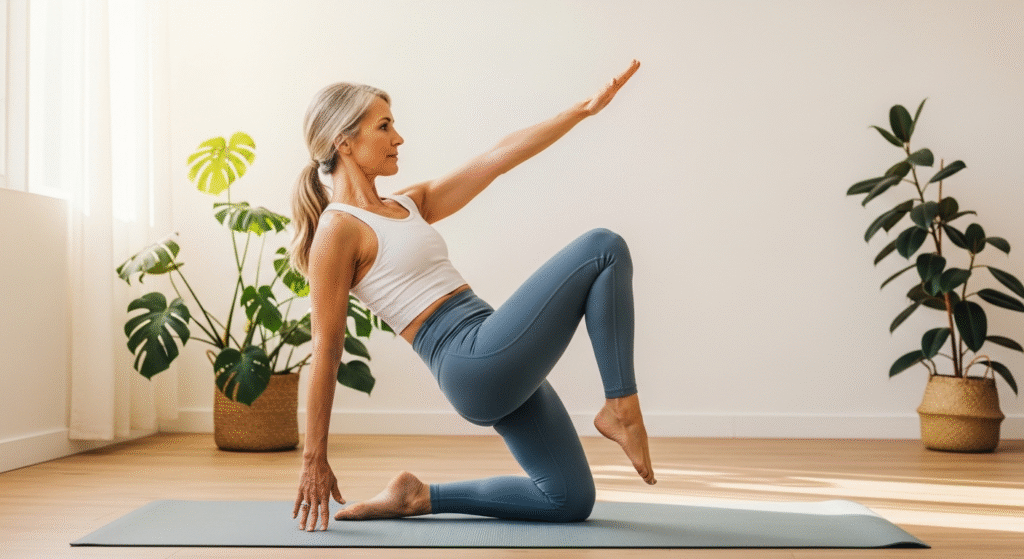
Lie on your back with your legs extended toward the ceiling, perpendicular to the floor. Lift your head and shoulders off the mat, engaging your core. Lower your right leg toward the floor at about a 45-degree angle while keeping your left leg vertical.
Here’s the inner thigh component: As you switch legs, really squeeze your inner thighs together at the center point where your legs pass each other. This squeeze is what transforms regular scissors into an inner thigh sculptor.
Perform the movement with control—no swinging or using momentum. As your right leg lifts back up and your left leg lowers, pulse your legs together twice at the center, squeezing your inner thighs hard. That’s one rep.
This movement builds stability while sculpting because it challenges your core and hip flexors simultaneously with your adductors. You’re not just working one muscle group in isolation—you’re building functional strength that translates to better posture and movement patterns.
Perfect pairing: Do Pilates scissors immediately after side-lying leg lifts. Your inner thighs are already fatigued, so the scissors will create an intense burn that signals serious muscle building.
Aim for 12-15 reps (each leg lowering counts as one rep). If you feel strain in your lower back, bend your knees slightly or place your hands under your hips for support.
Exercise 4: Sumo Squat Pulses
Stand with feet wider than shoulder-width, toes pointed out at 45 degrees. Lower into your deepest comfortable sumo squat—thighs parallel to the floor if possible, but don’t force it.
Now for the pulsing technique that delivers powerful results: Instead of standing up, pulse up and down just 2-3 inches, staying in that tension zone. These small movements keep constant tension on your inner thighs and glutes without any relief.
Why staying in the tension zone matters more than depth: When you pulse at the bottom of your squat, your muscles never get to rest. This continuous tension creates metabolic stress—one of the three key mechanisms for building muscle. You’re essentially doing 20-30 mini-reps instead of 10 full reps, multiplying the effectiveness.
Pulse for 30 seconds, rest for 15 seconds, then repeat. Work up to 3 sets of 45-second pulses as you build endurance.
Modifications for different fitness levels: Beginners can pulse from a quarter-squat position, gradually going deeper as strength improves. Advanced exercisers can hold dumbbells at chest height or wear a weighted vest for additional resistance.
The burn you’ll feel is intense—embrace it. That burning sensation is lactic acid buildup, a sign that you’re working at the right intensity to transform your inner thighs.
Exercise 5: Standing Inner Thigh Lifts
Stand tall with your feet hip-width apart, hands on your hips or holding a chair for balance. Shift your weight onto your left leg, keeping a soft bend in that knee.
Flex your right foot and sweep your right leg across your body, moving from right to left in front of your standing leg. Lift as high as you comfortably can while keeping your hips square—don’t rotate your torso to cheat the movement.
Lower with control, stopping just before your foot touches the floor. That’s one rep. The key is keeping tension on your inner thigh throughout the entire set by never fully resting your foot down.
How to perform this anywhere—no mat required: This is your secret weapon for sneaking in inner thigh work throughout your day. Do a set while brushing your teeth, waiting for your coffee to brew, or during a work break. You can literally do this exercise anywhere.
Balance benefits for women over 40: This exercise doubles as balance training, which becomes increasingly important for fall prevention as we age. You’re building stability and coordination while sculpting your inner thighs.
The finishing move that completes your routine: After you’ve done the first four exercises, standing inner thigh lifts provide a final burn that ensures you’ve worked your adductors from every angle. Your inner thighs will be completely fatigued—in the best possible way.
Perform 15-20 reps on each leg. If balance is challenging, hold onto a chair or wall. As you improve, try doing the exercise without support, which increases the balance challenge and core engagement.
Putting It All Together: Your Inner Thigh Transformation Plan
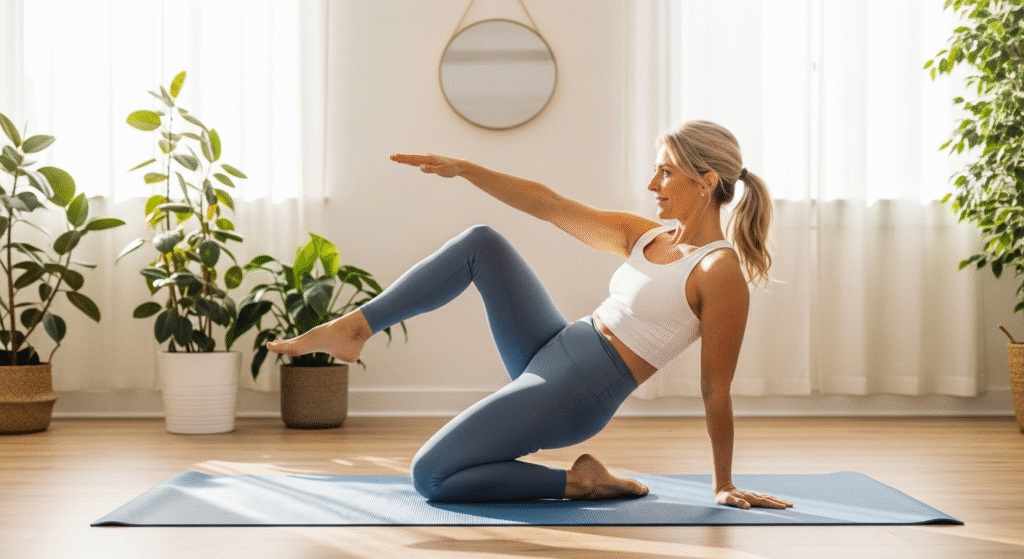
You’ve got five proven exercises that target your inner thighs from every angle. Now let’s talk about how to actually use them to transform your legs.
The Complete Circuit Workout
When you have 20-25 minutes for a full workout, perform all five exercises in circuit format:
1. Sumo Walks With Pause: 3 sets of 10 steps each direction 2. Side-Lying Leg Lifts: 3 sets of 12-15 reps per side 3. Pilates Scissors: 3 sets of 12-15 reps 4. Sumo Squat Pulses: 3 sets of 30-45 seconds 5. Standing Inner Thigh Lifts: 3 sets of 15-20 reps per leg
Rest 30-45 seconds between exercises, 60-90 seconds between complete circuits. This format keeps your heart rate elevated while ensuring each muscle group gets adequate recovery.
The Quick 10-Minute Option
Short on time? Pick any three exercises and do 2-3 sets of each. My favorite quick combinations:
Morning Energizer: Sumo walks, side-lying leg lifts, standing inner thigh lifts Evening Burn: Sumo squat pulses, Pilates scissors, side-lying leg lifts Balanced Approach: Sumo walks, Pilates scissors, sumo squat pulses
Progressive Overload Strategy
Your body adapts quickly, so you need to progressively challenge your muscles. Here’s how to advance over 8-12 weeks:
Weeks 1-2: Master form, establish baseline reps Weeks 3-4: Increase reps by 2-3 per set Weeks 5-6: Add resistance bands to sumo walks and squats Weeks 7-8: Increase tempo holds (5-second squeezes instead of 3) Weeks 9-12: Add light weights, increase sets, or decrease rest periods
Recovery and Frequency
Your muscles grow during recovery, not during workouts. For women over 40, adequate recovery becomes even more critical as our bodies need more time to repair and rebuild.
Perform these exercises 3-4 times per week with at least one rest day between sessions. On rest days, light activities like walking, swimming, or gentle yoga support recovery without overtaxing your muscles.
Listen to your body. Some muscle soreness 24-48 hours after your workout is normal and expected. Sharp pain, joint discomfort, or soreness that doesn’t improve after 3-4 days signals you need more recovery time.
Nutrition for Inner Thigh Transformation
Exercise builds the muscle, but nutrition reveals the results. You can’t out-exercise a poor diet, especially after 40 when metabolism naturally slows.
Focus on adequate protein—aim for 0.8-1 gram per pound of body weight daily. Protein provides the building blocks your muscles need to repair and grow stronger. Include lean meats, fish, eggs, Greek yogurt, legumes, and protein powder if needed.
Stay hydrated. Muscle tissue is about 75% water, and dehydration impairs muscle function and recovery. Aim for half your body weight in ounces daily (150-pound woman = 75 ounces water).
Don’t slash calories drastically. Severe calorie restriction signals your body to hold onto fat and break down muscle—exactly the opposite of what you want. A moderate deficit of 300-500 calories below maintenance supports fat loss while preserving muscle.
Conclusion
Your inner thighs don’t need another generic leg workout—they need these five targeted exercises that actually work the muscles you’re trying to tone.
Start with just 2-3 exercises if all five feel overwhelming. There’s no rule that says you have to do everything perfectly from day one. Pick the exercises that feel most comfortable and effective for your body, master those, then add more as you build confidence and strength.
Commit to 3-4 sessions per week, not perfection. You don’t need to work out every single day or spend hours in the gym. Consistency beats intensity every time. Three focused 15-minute sessions will transform your inner thighs more effectively than sporadic hour-long workouts.
Focus on form over speed—quality reps shred better than sloppy ones. Slow down, feel the squeeze, and make every rep count. That mind-muscle connection you’re building is the foundation for long-term results.
The women I’ve worked with who get the best results share one trait: they show up consistently, even when motivation fades. They trust the process, focus on progress over perfection, and celebrate small wins along the way.
Your inner thigh transformation starts with your next workout. Not next Monday, not after the holidays, not when life gets less busy. Right now. Pick two exercises, set a timer for 10 minutes, and prove to yourself that you can do this.
Your stronger, more sculpted legs are waiting. Let’s build them together.
Ready to start? Drop a comment below telling me which exercise you’re trying first, and check back in two weeks to share your progress. I read every comment and love celebrating wins with you!