5 Minute Arm Toning For Women 30+ (No equipment)
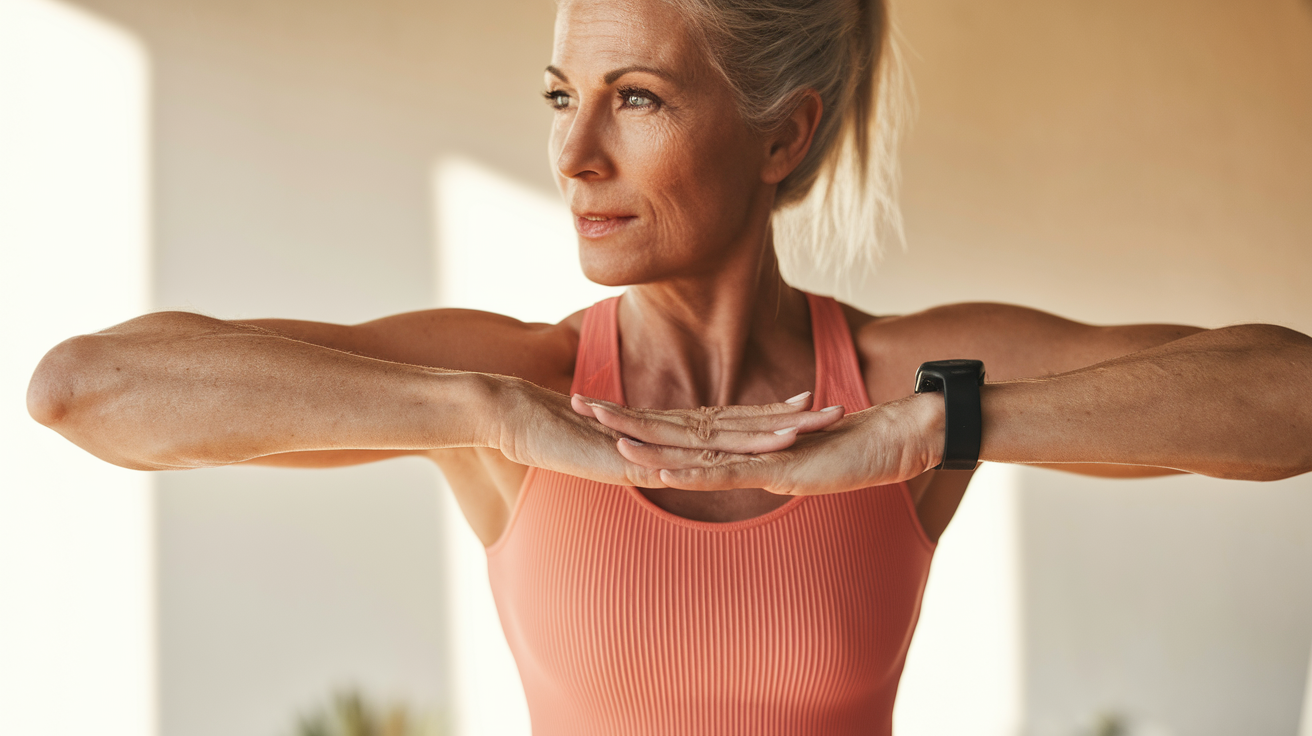
Let’s talk about something nobody prepared us for: the way our arms change after 30.
You’re not imagining it. That stubborn softness under your arms, the way your favorite sleeveless tops fit differently, the loss of definition you once took for granted—it’s all real. And it’s not your fault.
After 30, your metabolism naturally slows by about 5% per decade. Hormonal shifts affect how your body stores fat and builds muscle.
Collagen production decreases, impacting skin elasticity. Add in the demands of career, family, and life in general, and suddenly maintaining toned arms feels like an uphill battle you didn’t sign up for.
Here’s the empowering truth: you don’t need hours at the gym, expensive equipment, or a complete lifestyle overhaul to see real results. Just five minutes daily can make a genuine difference in how your arms look and feel.
This isn’t about perfection or fitting into someone else’s ideal. This is about feeling strong when you lift groceries, confident when you wave to a friend, and comfortable in the clothes you love. It’s about reclaiming a part of your body that might feel like it’s working against you.
What makes this routine different? It’s built specifically for women over 30, acknowledging the real changes happening in your body. These exercises work with your natural physiology, not against it.
No weights, no gym membership, no complicated moves you’ll never remember. Just five proven exercises that target every major muscle in your arms—biceps, triceps, shoulders, and even your upper back.
You can do this routine anywhere: in your bedroom before your shower, during your lunch break, while watching your favorite show, or in a hotel room while traveling. The flexibility means you’ll actually stick with it, and consistency is where the magic happens.
In the next few minutes, you’ll discover why traditional arm workouts often fail women over 30, learn the complete five-minute routine with proper form cues, and get practical strategies to maximize your results without adding more time to your already packed schedule. Your stronger, more confident self is waiting—and she’s just five minutes away.
Why Traditional Arm Workouts Don’t Work for Women 30+

The Metabolism Shift Nobody Warned You About
Remember when you could do a few push-ups and see definition within days? Those weren’t the “good old days”—that was your 20s metabolism working overtime.
After 30, everything changes. Your body produces less growth hormone, which directly impacts muscle development and fat burning. Estrogen levels start their gradual decline, affecting where your body stores fat (hello, upper arms and midsection). Your muscle mass naturally decreases by 3-5% per decade without intervention, a process called sarcopenia.
This isn’t doom and gloom—it’s biology. And understanding it changes everything about how you approach arm toning.
The exercises that worked in your 20s relied on a metabolic engine that simply runs differently now. Those high-rep, low-intensity moves? They’re not enough anymore. Your body needs targeted, efficient movements that trigger muscle engagement quickly. You need exercises that work smarter, not longer.
The simple truth about age-appropriate fitness is this: quality beats quantity every single time. Five minutes of the right exercises, done consistently, delivers better results than sporadic hour-long sessions that leave you exhausted and unmotivated.
The Equipment Excuse (And Why You Don’t Need It)
You’ve probably scrolled past countless fitness influencers with their color-coordinated dumbbells and resistance bands, thinking you need to invest in equipment before you can start. Wrong.
Bodyweight exercises are actually more effective for toning, especially for women over 30. Here’s why: they engage multiple muscle groups simultaneously, improve functional strength (the kind you use in daily life), and reduce injury risk because you’re working within your body’s natural range of motion.
When you use your own body as resistance, you develop better body awareness and control. You learn to engage muscles properly, which translates to better form and faster results. Plus, there’s no learning curve with complicated equipment—you already know how your body moves.
The amazing benefits go beyond just convenience. Bodyweight training improves balance, enhances core stability, and creates lean, defined muscles rather than bulk. For women over 30 dealing with joint sensitivity or previous injuries, bodyweight exercises offer a safer entry point that you can progress at your own pace.
And let’s be honest: eliminating equipment eliminates excuses. No gym is closed. No weights are at the cleaner. No resistance bands snapped. You have everything you need, right now, exactly where you are.
The 5-Minute Sweet Spot
Longer isn’t always better—especially for busy women juggling multiple responsibilities.
Research shows that short, consistent workouts often outperform occasional marathon sessions. Your body responds to regular stimulus. Doing five minutes daily creates a habit your muscles adapt to, triggering consistent improvement. Working out for an hour once a week? Your body doesn’t get the regular signal it needs to change.
The science is clear: consistency beats intensity for sustainable results. When you commit to just five minutes, you’re far more likely to follow through. You don’t need to shower afterward. You don’t need to change into special clothes. You don’t need to block out a chunk of time you don’t have.
Five minutes fits into real life. Do it right after you wake up, before your brain can talk you out of it. Squeeze it in during your lunch break for an energy boost. Make it your evening wind-down routine. The flexibility means you’ll actually do it—and that’s what creates results.
Plus, short workouts prevent the burnout that comes with overly ambitious fitness plans. You’re building a sustainable practice, not sprinting toward exhaustion.
The Complete 5-Minute Arm Toning Routine
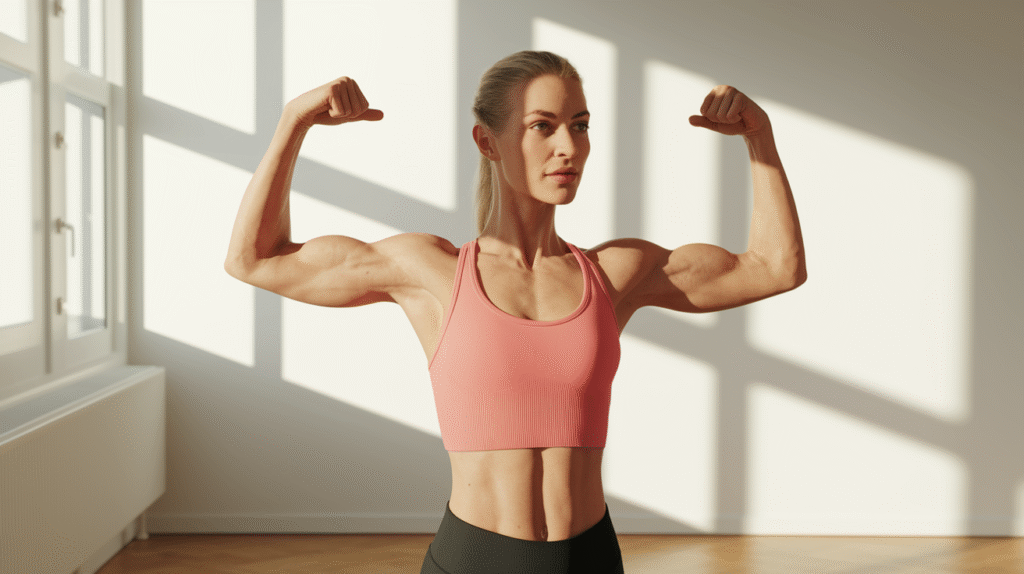
Exercise 1: Arm Circles (60 seconds)
Start standing with your feet hip-width apart, core engaged, and arms extended straight out to your sides at shoulder height. This is your power position.
Forward circles (30 seconds): Begin making small circles forward, about the size of a dinner plate. Keep your arms perfectly straight—no bending at the elbows. Your shoulders should stay down and back, not hunched toward your ears. Focus on controlled movements, not speed. You should feel your shoulders and upper arms working within 15 seconds.
Reverse circles (30 seconds): Without dropping your arms, immediately switch to backward circles. Maintain the same size and control. This direction targets different shoulder muscles and helps create balanced strength.
What you should feel: a burning sensation in your shoulders and triceps. That burn means your muscles are working. If you feel nothing, make your circles slightly larger or extend your arms a bit more.
Common mistakes to avoid: dropping your arms when they get tired (push through!), making circles too large (controlled beats wild), and holding your breath (breathe steadily throughout).
Pro tip: To increase intensity without weights, slow down your circles or make them slightly larger. You can also hold light water bottles if you want to progress beyond bodyweight.
Exercise 2: Tricep Dips Using a Chair (60 seconds)
Find a sturdy chair, coffee table, or low bench. Sit on the edge, place your hands next to your hips with fingers pointing forward, and slide your bottom off the edge while keeping your feet flat on the floor.
Perfect form breakdown: Your hands should be shoulder-width apart, elbows pointing straight back (not out to the sides). Lower your body by bending your elbows to about 90 degrees, keeping your back close to the chair. Press through your palms to straighten your arms and return to start. That’s one rep. Aim for 10-15 reps in your 60 seconds.
Modifications for beginners: Keep your knees bent and feet closer to the chair for more support. This reduces the amount of body weight you’re lifting.
For wrist sensitivity: Turn your hands slightly outward or place them on a padded surface. If it still bothers you, skip this exercise and hold a plank position instead.
The essential cue: Think about pulling your shoulder blades down and together as you press up. This engages your triceps properly and protects your shoulders. You should feel this primarily in the back of your upper arms—that’s your triceps working.
Exercise 3: Push-Up Variations (60 seconds)
Push-ups are the ultimate arm-toning exercise, but proper form matters more than how many you can do.
Wall push-ups (beginners): Stand arm’s length from a wall, place your palms flat against it at shoulder height, and perform push-ups against the wall. Focus on keeping your body in a straight line and lowering your chest toward the wall with control.
Knee push-ups (intermediate): Start in a plank position, then lower your knees to the floor. Cross your ankles if it helps. Lower your chest toward the floor, keeping your elbows at about 45 degrees from your body, then press back up. Your core should stay tight—no sagging hips.
Full push-ups (advanced): Traditional plank position with straight legs. Lower your entire body as one unit, maintaining a straight line from head to heels.
Why proper form beats high reps: One perfect push-up with controlled movement and full range of motion works your muscles more effectively than ten sloppy ones. Quality creates results. If you can only do three perfect push-ups in 60 seconds, that’s exactly what you should do. Progress will come.
Exercise 4: Plank to Down Dog (60 seconds)
This dynamic movement targets your shoulders, triceps, and upper back while adding a gentle stretch.
Start in a plank position on your hands, wrists under shoulders, body in a straight line. Press your hips up and back, straightening your legs and arms to form an inverted V shape (downward-facing dog). Hold for a breath, then return to plank. That’s one rep.
Breathing technique: Exhale as you press into down dog, inhale as you return to plank. This rhythm helps you maintain the movement and builds endurance.
Quick adjustments for different fitness levels: Beginners can do this from their knees instead of toes. Advanced exercisers can slow down the transition, holding each position for three seconds.
You should feel your shoulders working throughout, with a nice stretch in your hamstrings during the down dog position. This combination of strength and mobility makes it perfect for women over 30 who need both muscle tone and flexibility.
Exercise 5: Pulse Holds (60 seconds)
The final burn that brings everything together.
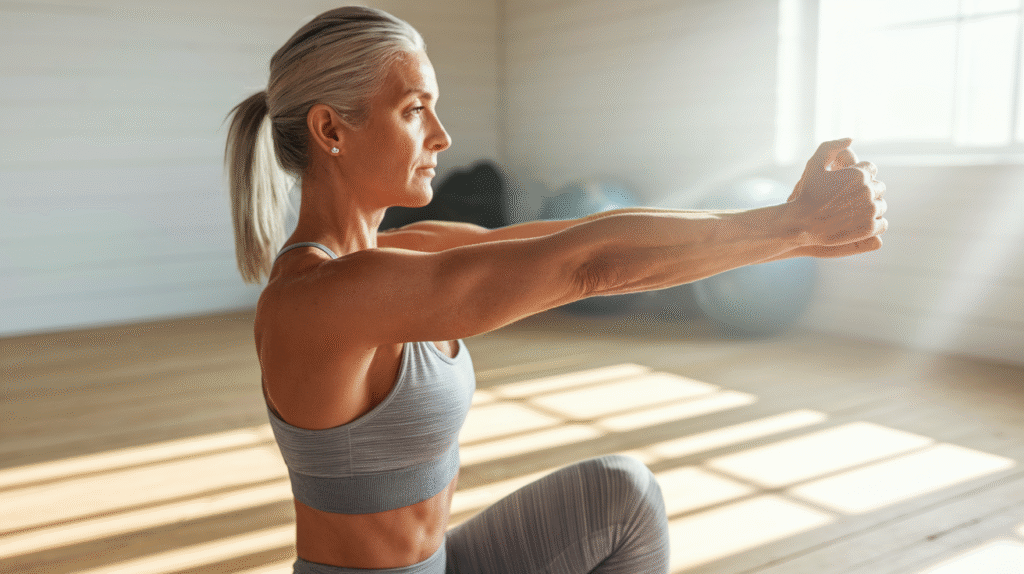
Stand with feet hip-width apart. Extend both arms straight out in front of you at shoulder height, palms facing down. Hold this position while making tiny pulsing movements—up and down about an inch. Keep your arms perfectly straight and maintain shoulder height.
Why the burn means it’s working: Around 30 seconds, your shoulders will start screaming. This is muscular fatigue—exactly what triggers muscle toning. Your muscles are working hard to maintain the position, building endurance and definition.
Mental strategies for the final 30 seconds: Count down from 30. Break it into three 10-second intervals. Focus on your breathing. Remind yourself it’s only 30 more seconds—you can do anything for 30 seconds. This mental toughness builds with practice and carries over into other areas of your life.
If you absolutely must drop your arms, lower them for five seconds, then raise them again and continue. But push yourself to hold the full 60 seconds whenever possible.
Maximizing Your Results: Simple Strategies That Make a Difference
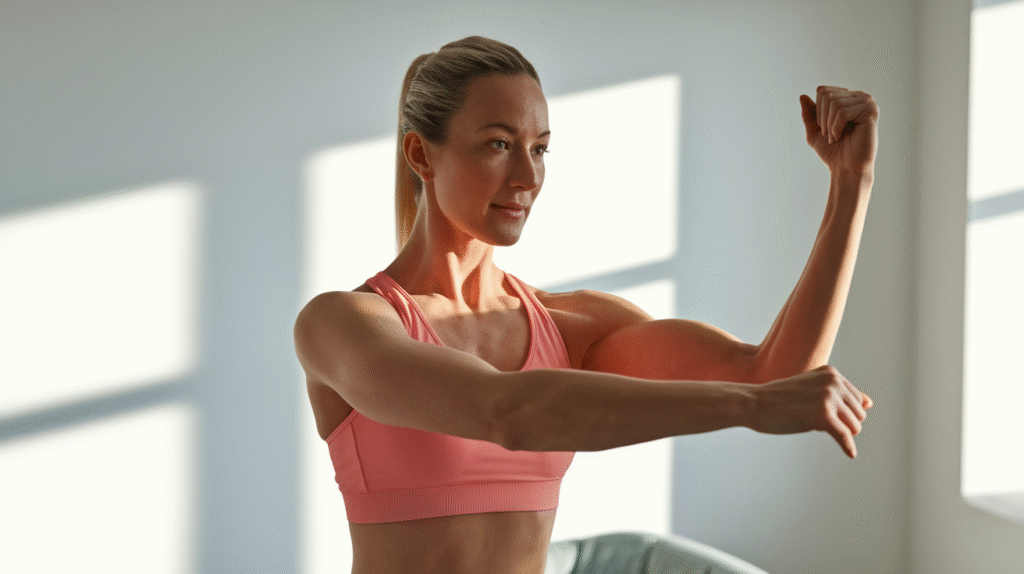
Consistency Over Intensity
Showing up daily matters more than perfect execution. This is the ultimate truth about fitness after 30.
Your body adapts to regular patterns. When you do this routine every single day (or at least five days per week), your muscles receive consistent signals to strengthen and tone. Miss several days, and you lose momentum—not just physically, but mentally too.
The habit-stacking technique: Attach your five-minute routine to something you already do daily. After your morning coffee? Before your shower? Right after brushing your teeth at night? When you link new habits to established ones, you’re far more likely to stick with them.
I know a woman who does her arm routine every morning while her coffee brews. Five minutes later, her workout is done and her coffee is ready. Another completes it every evening during the commercial breaks of her favorite show. Find your anchor, and your new habit will stick.
Tracking progress without obsessing: Don’t overthink this. Put a simple checkmark on your calendar each day you complete the routine. Seeing those checkmarks accumulate creates motivation. After two weeks of consistent marks, you won’t want to break your streak.
Skip the daily photos and measurements. Instead, notice how your arms feel when you’re carrying groceries or how your favorite shirt fits. These real-world changes matter more than any number.
Nutrition Tips for Toned Arms
You can’t out-exercise a poor diet, but you also don’t need to follow a restrictive eating plan.
The protein principle: Women over 30 need about 0.8-1 gram of protein per pound of body weight daily to support muscle maintenance and development. That’s roughly 25-30 grams per meal. Think: a palm-sized portion of chicken, fish, tofu, or Greek yogurt with each meal.
Protein helps repair and build the muscle fibers you’re working during your five-minute routine. Without adequate protein, you’re making the effort but not giving your body the building blocks it needs.
Hydration’s amazing effect: Water affects muscle definition more than most people realize. Proper hydration helps flush excess sodium, reduces water retention, and makes muscles appear more defined. Aim for half your body weight in ounces daily. If you weigh 150 pounds, that’s 75 ounces of water.
Simple swaps that support arm toning: Replace sugary drinks with water or herbal tea. Choose whole foods over processed options when possible. Add an extra serving of vegetables to lunch and dinner. These aren’t restrictions—they’re additions that fuel your results.
No restrictive dieting required. Just make slightly better choices consistently, and your body will respond.
Progressive Overload Without Equipment
As you get stronger (and you will), you need to challenge your muscles more to continue seeing results.
Making bodyweight exercises harder: Slow down your movements. Instead of regular-speed push-ups, take three seconds to lower down and three seconds to press up. This time under tension dramatically increases difficulty without changing the exercise.
Add holds at the most challenging point. Pause at the bottom of your tricep dips for two seconds before pressing up. Hold your arm circles at the front or back of the circle for a few seconds.
Increase your range of motion. Lower deeper into push-ups. Make your arm circles larger. These subtle changes create significant differences in muscle engagement.
When to increase reps versus slowing down: If you can complete the full 60 seconds of an exercise without significant fatigue, either slow down your tempo or add more reps. Both approaches work—choose based on what feels right for your body that day.
Rest and Recovery Essentials
More isn’t always better. Your muscles actually grow and tone during rest, not during the workout itself.
Why rest days help you tone faster: When you exercise, you create tiny tears in your muscle fibers. During rest, your body repairs these tears, making the muscles stronger and more defined. Without adequate rest, you’re just creating more tears without allowing repair time.
Take at least one full rest day per week. Two is even better if you’re just starting out. Your body will thank you with better results.
Quick stretches to prevent soreness: After your five-minute routine, spend 30 seconds stretching each arm across your body, and 30 seconds stretching each arm overhead. These simple stretches improve flexibility and reduce next-day soreness.
Signs you’re overdoing it: Sharp pain (different from muscle fatigue), persistent soreness lasting more than 48 hours, decreased performance, or feeling exhausted rather than energized. If you experience any of these, take an extra rest day. Progress requires patience.
Troubleshooting Common Challenges and FAQs
“I’m Not Seeing Results Yet”
Let’s set realistic expectations: visible changes typically appear after 3-4 weeks of consistent practice. Noticeable definition usually takes 6-8 weeks. Significant transformation? That’s a 12-week journey.
This timeline isn’t meant to discourage you—it’s meant to prepare you for the real process of changing your body. Anyone promising faster results is selling you something that doesn’t exist.
Non-scale victories to celebrate: Before you see visible changes, you’ll feel them. Your arms will feel stronger during daily activities. You’ll notice improved posture. Your clothes might fit differently around your shoulders. You’ll complete the routine more easily than when you started. These changes matter just as much as visible definition.
The proven patience principle: Every single woman who has toned arms after 30 got there the same way—consistent effort over time. There are no shortcuts, but there’s also no mystery. Show up, do the work, and trust the process. Your body is responding even when you can’t see it yet.
“My Arms Get Too Sore”
Muscle soreness is normal, especially in the first two weeks. But there’s a difference between productive soreness and pain.
Good soreness: A dull ache in your muscles, especially 24-48 hours after exercise. It feels tight but improves with movement. This is called delayed onset muscle soreness (DOMS), and it’s a sign your muscles are adapting.
Bad pain: Sharp, stabbing sensations. Pain in your joints rather than muscles. Pain that worsens with movement or doesn’t improve after a few days. If you experience this, stop and consult a healthcare provider.
Effective recovery techniques: Light movement helps more than complete rest. Take a gentle walk, do some stretching, or simply move your arms through their full range of motion several times throughout the day. Apply ice if there’s significant inflammation. Take a warm bath with Epsom salts to ease muscle tension.
Modifications to keep moving: If you’re very sore, reduce your workout to three exercises instead of five, or do each exercise for 30 seconds instead of 60. Some movement is better than none, and it actually helps your muscles recover faster.
“I Don’t Have 5 Minutes Every Day”
I hear you, but let’s be honest: you have five minutes. You might not have a convenient five-minute block, but you have the time.
Creative ways to fit this in: Do it while waiting for your coffee to brew. Complete it during TV commercials. Wake up five minutes earlier. Do it while your kids are brushing their teeth. Fit it in during your lunch break. Complete it right before bed.
The routine requires no setup, no equipment, and no special location. You can literally do it anywhere, in any clothes, at any time. The barrier isn’t time—it’s prioritization.
The 3-day minimum: If daily truly isn’t possible, commit to three days per week minimum. You’ll still see results, just at a slower pace. Three consistent days beats seven inconsistent ones every single time.
How to restart after missing days: Life happens. You’ll miss days. When you do, simply start again the next day without guilt or self-criticism. One missed day doesn’t erase your previous progress. Just pick up where you left off and keep going.
“Will This Make My Arms Bulky?”
This is one of the most common concerns, and I’m going to give you the straight truth: no, this routine will not make your arms bulky.
Women over 30 have significantly less testosterone than men, which is the primary hormone responsible for building large muscles. Creating bulky arms requires heavy weights, specific training protocols, surplus calories, and often years of dedicated effort. It doesn’t happen accidentally from five minutes of bodyweight exercises.
What actually creates that sleek, defined look: Moderate resistance training (exactly what you’re doing) combined with a reasonable diet creates lean, toned muscles. You’re building strength and definition, not size.
The “bulk” some women fear is often a combination of muscle underneath a layer of fat. As you build muscle and gradually reduce body fat through consistent exercise and reasonable nutrition, you’ll see definition—not bulk.
Why toning and strengthening go hand-in-hand: You can’t tone without strengthening. “Toning” is simply building muscle while reducing the fat covering it. This routine does exactly that, creating the lean, defined arms you’re after.
Final Thoughts
Your Simple Path Forward
You now have everything you need: five proven exercises that take just five minutes, strategies to maximize your results, and solutions to common challenges. The path forward is simple—not always easy, but definitely simple.
The essential elements: Arm circles, tricep dips, push-ups, plank to down dog, and pulse holds. Five exercises, one minute each, targeting every major muscle in your arms. Do this routine consistently, and your arms will respond.
No more scrolling past fitness content thinking “someday.” No more avoiding sleeveless tops or feeling self-conscious when you wave. No more believing you need more time, better equipment, or different circumstances.
Start today, not tomorrow. Tomorrow becomes next week, which becomes next month, which becomes “I’ll start after the holidays.” The perfect time doesn’t exist. The only time that matters is right now.
This quick practice creates ripple effects beyond your arms. You’ll feel more energized throughout the day. You’ll build confidence that carries into other areas of your life. You’ll prove to yourself that you can commit to something and follow through. These benefits extend far beyond physical appearance.
Your 7-Day Quick Start Challenge
Here’s your invitation: commit to just seven days. One week. Anyone can do anything for a week.
Mark your calendar right now with seven consecutive days. Each day you complete the routine, put a big checkmark on that date. Don’t break the chain.
After seven days, you’ll notice a difference. Not necessarily in the mirror yet, but in how your arms feel. In your confidence. In the satisfaction of keeping a promise to yourself. That feeling will motivate you to continue.
Simple tracking method: Use your phone’s calendar, a paper calendar on your fridge, or a notebook by your bed. The method doesn’t matter—just make your commitment visible. When you see those checkmarks accumulating, you’ll want to keep going.
Final Encouragement
You don’t need more time. You don’t need expensive equipment. You don’t need perfect conditions or a complete lifestyle overhaul. You need five minutes and the decision to show up for yourself.
Your stronger, more confident self is waiting—and she’s just five minutes away. She’s the version of you who feels comfortable in sleeveless tops, who lifts heavy grocery bags without thinking twice, who looks in the mirror and sees strength reflected back.
The amazing transformation happens when you show up consistently, even when you don’t feel like it. Especially when you don’t feel like it. That’s where real change lives—in the gap between wanting to skip it and doing it anyway.
Your arms are ready to change. The question is: are you ready to give them five minutes? Start today. Your future self will thank you.