7 minute ab routine for women over 40

Let’s talk about what nobody wants to admit: those ab workouts you crushed in your twenties? They’re not cutting it anymore. You’re doing crunches until you’re blue in the face, but that stubborn belly fat isn’t budging. Sound familiar?
Here’s the truth: traditional ab workouts fail women over 40 because they ignore the massive hormonal shifts happening in your body. After 40, estrogen levels drop, metabolism slows down, and your body starts losing muscle at an alarming rate—up to 8% per decade after 40. That’s not a character flaw. That’s biology.
But here’s the good news: science shows that 7 minutes of targeted core work is the sweet spot for busy women who want real results. Not 60 minutes. Not complicated equipment. Just 7 strategic minutes that work WITH your body’s changes, not against them.
This routine is different because it’s designed specifically for women’s bodies after 40. Every exercise addresses the unique challenges you’re facing—from hormonal belly fat to decreased bone density to the reality that you probably don’t have an hour to spend on the floor doing endless sit-ups.
The promise? Proven exercises that strengthen your core, protect your back, boost your metabolism, and actually fit into your real life. Whether you’re dealing with perimenopause symptoms, recovering from having kids, or just want to feel strong and confident again, this routine delivers.
Why Your Core Matters More After 40 (And It’s Not Just About Looks)
The Functional Benefits You Can’t Ignore
Let’s get real: you’re not chasing a six-pack for Instagram. You want to tie your shoes without groaning, play with your grandkids without throwing out your back, and feel capable in your own body.
A strong core is your body’s natural back brace. If you’re spending hours hunched over a desk (who isn’t?), weak core muscles force your spine to compensate, leading to chronic pain and poor posture. Research shows that targeted core exercises reduce lower back pain by up to 60% in just 8 weeks.
But here’s what really matters: balance and stability. After 40, your risk of falls increases significantly, and falls are the leading cause of injury-related deaths in women over 65. A powerful core keeps you steady on your feet, whether you’re hiking, carrying groceries, or navigating icy sidewalks.
And here’s something most people don’t know: core strength directly impacts hormone regulation during perimenopause and menopause. When your core muscles are engaged, they support better circulation and lymphatic drainage, which helps your body process hormonal fluctuations more efficiently.
What Changes After 40 (The Real Talk)
Sarcopenia—the fancy term for age-related muscle loss—accelerates dramatically after 40. You’re losing muscle mass that previously helped you burn calories at rest. That’s why the same diet that kept you slim at 30 leaves you frustrated at 45.
Hormonal shifts redirect where your body stores fat. Declining estrogen means more belly fat, particularly visceral fat around your organs. This isn’t just cosmetic—visceral fat increases inflammation and disease risk.
The exercises that worked in your twenties won’t deliver the same results now because your body’s recovery capacity has changed. You need smarter, more efficient movements that build strength without beating up your joints.
The Mental and Emotional Wins
Building core strength after 40 isn’t about fitting into your high school jeans. It’s about reclaiming confidence in your body’s capabilities.
When you complete a challenging plank or nail a set of dead bugs, you’re proving to yourself that you’re still strong, still capable, still powerful. That mental shift affects every area of your life—how you show up at work, how you set boundaries, how you approach challenges.
Plus, focused core work reduces cortisol levels and provides genuine stress relief. Seven minutes of concentrated movement gives your mind a break from the endless to-do list and reconnects you with your physical strength.
Most importantly, this routine is sustainable. It’s not a 90-day boot camp that leaves you exhausted and injured. It’s a realistic habit that fits into your actual life, whether you do it before your morning coffee or during your lunch break.
The Complete 7-Minute Ab Routine Breakdown
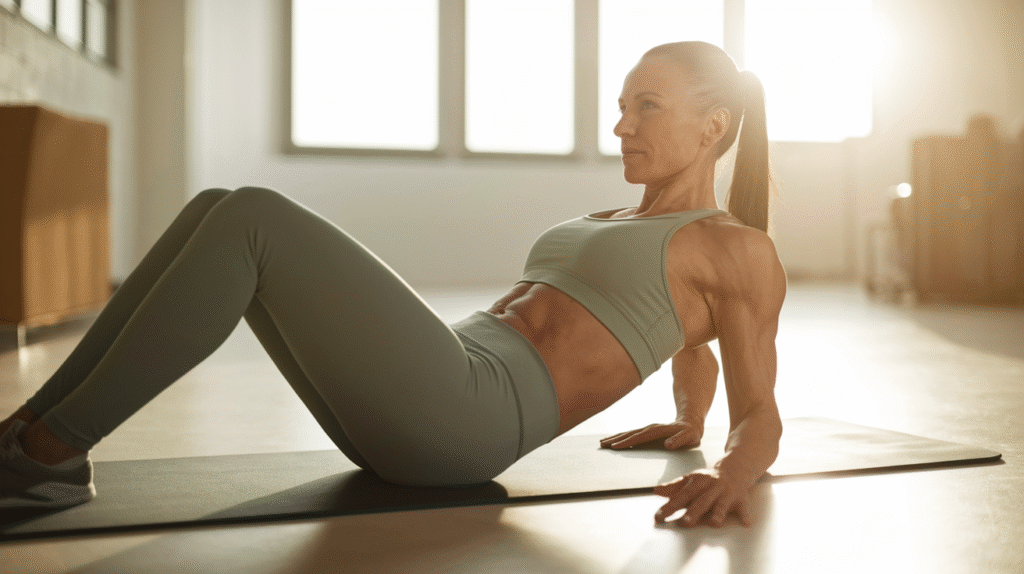
Exercise 1: Pelvic Tilts with Core Activation (60 seconds)
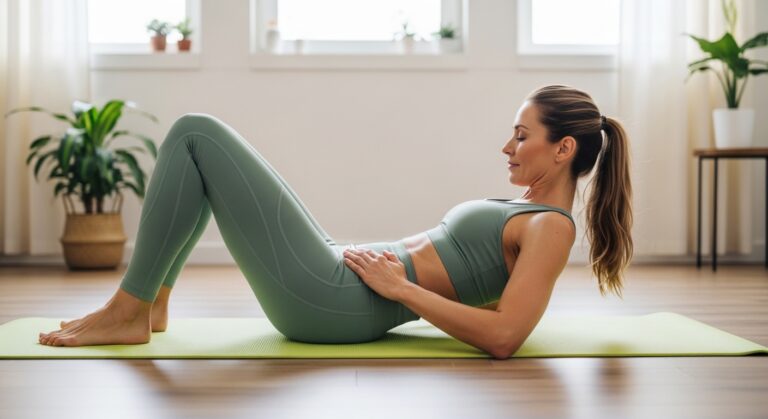
Start by lying on your back with knees bent and feet flat on the floor, hip-width apart. Place your hands on your hip bones to feel the movement.
Engage your abdominal muscles and slowly press your lower back into the floor, tilting your pelvis upward. Your tailbone will lift slightly off the ground. Hold for 2-3 seconds, then return to neutral. Repeat for the full 60 seconds.
This gentle warm-up is essential for protecting your lower back and waking up your deep core muscles. Many women skip this step and jump straight into crunches, which can strain an unprepared spine.
Common mistake to avoid: Don’t push so hard that you’re arching your back or holding your breath. This should feel like a gentle rocking motion, not a dramatic lift.
Exercise 2: Modified Planks for Core Stability (60 seconds)
Choose your level: – Knee plank: Start on your hands and knees, hands under shoulders. Engage your core and hold. – Elevated plank: Place your hands on a sturdy chair or counter, body in a straight line from head to heels. – Full plank: On your forearms or hands, body straight, engaging everything from shoulders to ankles.
The key is maintaining a neutral spine—no sagging hips or lifted butt. Think about pulling your belly button toward your spine and squeezing your glutes.
This move sculpts without strain when you maintain proper form. You’re engaging your entire core, not just your abs—including your back muscles, obliques, and deep stabilizers.
Breathing technique: Inhale through your nose for 4 counts, exhale through your mouth for 4 counts. Never hold your breath.
Exercise 3: Standing Oblique Crunches (60 seconds)
Stand with feet hip-width apart, hands behind your head, elbows wide. Lift your right knee toward your right elbow, crunching your obliques on the right side. Return to standing. Alternate sides for 60 seconds.
This move is perfect for beginners and anyone with neck sensitivity because you’re not lying on the floor straining your neck. It tones your waistline while being completely joint-friendly.
Focus on the contraction in your side muscles, not how high you can lift your knee. Quality over quantity wins here.
Pro tip: Exhale forcefully as you crunch, really squeezing your obliques at the top of the movement.
Exercise 4: Dead Bug Exercise (60 seconds)
Lie on your back, arms extended straight up toward the ceiling, knees bent at 90 degrees with shins parallel to the floor. Slowly lower your right arm overhead while straightening your left leg, hovering it just above the floor. Return to start and switch sides.
Yes, this looks awkward. Yes, it delivers powerful results. Dead bugs improve coordination between your upper and lower body while strengthening your deep core stabilizers.
Coordination tip for beginners: Start with just the arms or just the legs until you master the movement pattern. Then combine them.
As you build strength, slow down the tempo. The slower you move, the harder your core works to stabilize.
Exercise 5: Seated Russian Twists (60 seconds)
Sit on the floor, knees bent, feet flat. Lean back slightly (about 45 degrees), keeping your back straight. Clasp your hands together at your chest. Rotate your torso to the right, bringing your hands beside your right hip. Return to center and rotate left.
Modification options: – Beginner: Keep feet on the floor – Intermediate: Lift feet slightly off the floor – Advanced: Hold a water bottle or light weight
The right way to rotate is from your core, not your arms. Your hands are just along for the ride. Keep your chest lifted and avoid rounding your spine.
This burns calories while building rotational strength—essential for everyday movements like reaching for something in the back seat or looking over your shoulder.
Exercise 6: Leg Raises or Knee Tucks (60 seconds)
Lie on your back, hands under your glutes for support, legs extended. Slowly raise your legs to about 45 degrees, then lower them back down without touching the floor. If this is too challenging, bend your knees and pull them toward your chest (knee tucks) instead.
This targets your lower abs—that stubborn area where belly fat loves to hang out.
Wall-supported variation: Lie perpendicular to a wall with your butt against it and legs up the wall. Lower one leg at a time toward the floor, keeping the other leg vertical.
Progression pathway: Start with knee tucks, progress to single leg raises, then double leg raises as you build confidence and strength.
Exercise 7: Cooldown with Cat-Cow Stretches (60 seconds)
Come to hands and knees, wrists under shoulders, knees under hips. Inhale and arch your back, lifting your chest and tailbone (cow). Exhale and round your spine, tucking your chin and tailbone (cat). Flow between these positions for 60 seconds.
Stretching matters for recovery after 40 because your muscles need more time to repair and your joints need extra care. This move supports spinal health and releases tension in your back and abs.
You’re also setting yourself up for success in your next workout by maintaining flexibility and reducing soreness.
Maximizing Your Results: The Do’s and Don’ts

Nutrition Strategies That Support Your Goals
Here’s the uncomfortable truth: abs are made in the kitchen. But that doesn’t mean deprivation diets or cutting out entire food groups.
After 40, your protein needs increase dramatically. You need 1.2-1.6 grams of protein per kilogram of body weight to maintain muscle mass. That’s roughly 90-120 grams daily for a 150-pound woman. Protein at every meal helps repair muscle tissue and keeps you full longer.
Focus on reducing inflammation, which contributes to belly bloat and makes it harder to see your hard work. Cut back on processed foods, added sugars, and excessive alcohol. Increase anti-inflammatory foods like fatty fish, leafy greens, berries, and nuts.
Simple nutrition wins: – Start each meal with protein – Eat vegetables at lunch and dinner – Drink half your body weight in ounces of water daily – Limit added sugar to less than 25 grams per day
When and How Often to Do This Routine
Consistency beats perfection every single time. The best time to do this routine is whenever you’ll actually do it.
Morning people: knock it out before your coffee brews. Afternoon people: use it as a midday energy boost. Evening people: decompress with core work before dinner.
Integration ideas: – While watching the morning news – During your lunch break at work – Before jumping in the shower – While dinner is cooking
Aim for 4-5 times per week. Your muscles need rest days to repair and grow stronger. Doing this routine daily won’t get you faster results—it’ll just wear you out.
Progressive overload: After 4 weeks, increase difficulty by slowing down your tempo, adding a light weight to Russian twists, or holding planks 10 seconds longer.
Common Mistakes That Sabotage Your Progress
Holding your breath: When you hold your breath, you spike your blood pressure and prevent oxygen from reaching your muscles. Breathe continuously through every exercise.
Expecting six-pack abs in two weeks: Visible abs require both muscle development and fat loss. Most women see improved core strength in 2-3 weeks, visible changes in 6-8 weeks, and significant transformation in 3-4 months. That’s normal and healthy.
Neglecting the rest of your body: You can’t spot-reduce belly fat. Full-body strength training builds lean muscle everywhere, which increases your metabolism and helps reveal your core work.
Doing too much too soon: Starting with perfect form for 7 minutes beats doing 20 minutes of sloppy exercises that risk injury. Master the basics before advancing.
Beyond the 7 Minutes: Building a Sustainable Core-Strong Lifestyle

Complementary Exercises for Total Body Transformation
Cardio matters for revealing your hard work. You can have the strongest core in the world, but if it’s hidden under a layer of fat, you won’t see it.
The best low-impact options for women over 40 protect your joints while burning calories: – Walking: 30-45 minutes daily at a brisk pace burns fat without beating up your knees – Swimming: full-body workout that’s easy on joints and builds endurance – Cycling: whether outdoors or on a stationary bike, it’s effective and sustainable
Strength training basics shred fat and build lean muscle. Two to three full-body strength sessions per week transform your metabolism. Focus on compound movements like squats, lunges, rows, and presses that work multiple muscle groups simultaneously.
Lifestyle Factors That Make or Break Your Results
Sleep and cortisol have a hidden connection to belly fat. When you’re sleep-deprived, your body produces excess cortisol, which signals your body to store fat around your midsection. Aim for 7-9 hours of quality sleep nightly.
Stress management techniques that actually work: – 10-minute morning meditation or deep breathing – Evening walks without your phone – Saying no to commitments that drain you – Regular connection with supportive friends
Hydration affects core definition more than you’d think. Dehydration causes bloating and water retention, which obscures muscle definition. Proper hydration also improves workout performance and recovery.
Staying Motivated When Progress Feels Slow
Track non-scale victories because the scale lies. Pay attention to: – Increased energy throughout the day – Ability to hold plank longer each week – How your jeans fit in the waist – Reduced back pain – Improved posture – Better balance and stability
Build a support system through a workout buddy, online community, or accountability partner. Share your journey on social media or in a private group. When you commit publicly, you’re more likely to follow through.
Adjust your expectations: “success” after 40 looks different than it did at 25. You’re not competing with your younger self or with filtered Instagram photos. You’re building sustainable strength and health that will serve you for decades.
Your Next 30 Days Start Now
This 7-minute routine works because it’s built on proven exercise science and designed specifically for women’s bodies after 40. Each exercise addresses the unique challenges you face—from hormonal changes to time constraints to the reality that your body needs smarter, not harder, workouts.
Consistency over intensity delivers lasting results. You don’t need to work out for hours or push yourself to exhaustion. You need strategic, focused movement that strengthens your core without destroying your joints or dominating your schedule.
Remember: starting is the hardest part. You’ve already taken the first step by reading this article and learning exactly what to do. Now you just need to show up.
Your 30-Day Challenge:
Commit to this routine 4-5 times per week for the next 30 days. Set a recurring alarm on your phone. Put it in your calendar like any other important appointment. Because investing 7 minutes in your strength and health IS important.
Track your progress with photos (same time of day, same lighting), measurements (waist, hips), or a simple journal noting how you feel after each workout. The data will motivate you when you need it most.
Share your journey. Post about it on social media, tell your friends, or join an online community of women over 40 who are prioritizing their health. When you inspire others, you strengthen your own commitment.
You’re not too old, too out of shape, or too busy to build a strong core. You just need the right approach and 7 minutes a day. This is it. Your stronger, more confident self is waiting on the other side of consistency.
Start today. Your future self will thank you.