Quick Toned Arms Routine For Women 40+

Let’s talk about something you’ve probably noticed: those arms that used to tone up easily now seem to have a mind of their own. Maybe you’ve caught your reflection and wondered when things shifted, or you’ve avoided sleeveless tops that once made you feel confident.
Here’s the truth—your body is changing, and that’s completely normal. After 40, hormonal shifts and natural muscle loss make arm toning more challenging. But here’s the exciting part: with the right approach, you can build strong, sculpted arms in just 15-20 minutes, three to four times per week.
This isn’t about grueling gym sessions or complicated equipment. This proven routine fits into your busy life and delivers real results. You’ll learn exactly which exercises work best for women over 40, how to protect your joints while building strength, and why your arms are capable of incredible transformation at any age.
The best part? You can start today, right in your living room, with minimal equipment. Let’s build those toned, strong arms you deserve.
Why Arm Toning Changes After 40 (And Why That’s Okay!)
Understanding What’s Happening to Your Body
Your body isn’t betraying you—it’s simply following a natural biological process. Starting in your 30s, you begin losing muscle mass at a rate of 3-5% per decade. This process, called sarcopenia, accelerates after 40, making it easier to lose muscle tone and harder to build it back.
Hormonal changes play a massive role here. As estrogen levels decline during perimenopause and menopause, your body distributes fat differently. Areas that stayed lean before—like your arms—may now store more fat. Meanwhile, your metabolism slows by approximately 2% per decade, meaning your body burns fewer calories at rest.
The combination of muscle loss, hormonal shifts, and metabolic changes creates the perfect storm for arm changes. But understanding this process is empowering because it means you’re not doing anything wrong—you just need a different approach.
The Essential Benefits of Arm Strength Training After 40
Building toned arms after 40 isn’t just about aesthetics—it’s about investing in your long-term health. Resistance training increases bone density, which is critical since women lose bone mass rapidly after menopause. Strong arms mean reduced osteoporosis risk and better protection against fractures.
Muscle tissue burns more calories than fat, even when you’re resting. By building lean muscle in your arms, you’re boosting your metabolism and improving your body’s ability to manage weight. Every pound of muscle burns approximately 6 calories per day at rest, compared to just 2 calories per pound of fat.
The functional benefits are equally impressive. Strong arms make everyday activities easier—carrying groceries, lifting luggage, playing with grandchildren, or pushing yourself up from the floor. You’re building independence and quality of life for decades to come.
Why Traditional Arm Workouts Need Adjustments
The arm workouts that worked in your 20s and 30s need modifications now. Joint health becomes paramount—your shoulders, elbows, and wrists require more attention and care. High-impact, fast-paced movements can lead to injury, while controlled, deliberate exercises build strength safely.
Recovery time naturally increases after 40. Your muscles need 48-72 hours between workouts to repair and grow stronger. This isn’t a weakness—it’s biology. Working with your body’s natural rhythms, not against them, produces better results.
The focus shifts from extreme intensity to sustainable consistency. Quick, moderate workouts performed regularly outperform sporadic intense sessions. This routine embraces that principle, giving you effective exercises that protect your joints while building impressive strength.
The Ultimate 15-Minute Toned Arms Routine
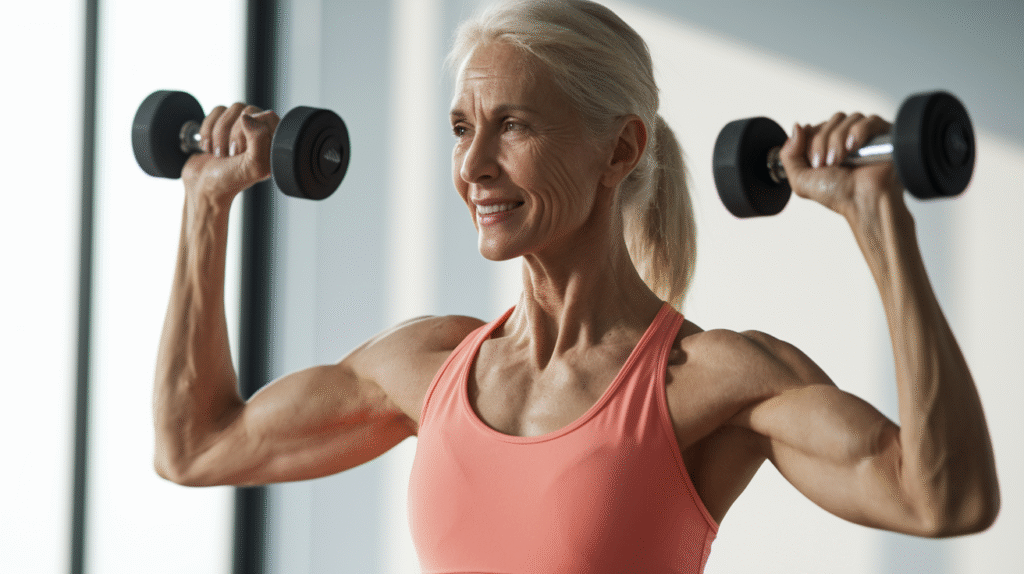
Warm-Up: The Perfect Start (3 minutes)
Never skip this step—your warm-up prevents injury and prepares your muscles for work. Start with arm circles, extending your arms straight out to the sides at shoulder height. Make small circles forward for 30 seconds, gradually increasing the size. Reverse direction for another 30 seconds.
Next, perform shoulder rolls. Lift your shoulders toward your ears, roll them back and down in a smooth circular motion. Complete 10 rolls backward, then 10 forward. This lubricates your shoulder joints and releases tension.
Finish with light cardio—march in place for one minute, lifting your knees and swinging your arms naturally. This increases blood flow to your muscles and raises your core temperature, preparing your body for the work ahead.
The Complete Exercise Sequence
Exercise 1: Overhead Shoulder Press (3 sets of 12 reps)
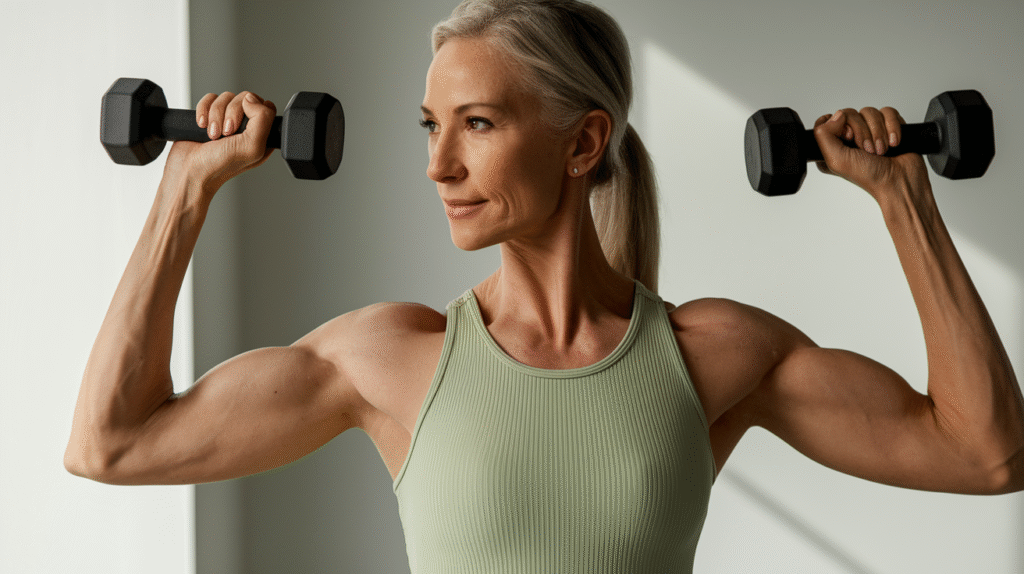
Stand with feet hip-width apart, holding dumbbells at shoulder height with palms facing forward. Your elbows should form 90-degree angles. Press the weights straight overhead until your arms are fully extended but not locked. Lower back to starting position with control.
Start with 5-pound weights if you’re new to strength training, or 8-10 pounds if you have experience. The last two reps should feel challenging but not impossible. If you can’t complete 12 reps with proper form, reduce the weight.
Common mistakes to avoid: Don’t arch your back as you press up—engage your core to keep your spine neutral. Don’t let the weights drift forward; keep them aligned over your shoulders. Breathe out as you press up, breathe in as you lower down.
For modifications, perform this exercise seated in a sturdy chair with back support. This helps maintain proper posture and reduces stress on your lower back. As you get stronger, progress by increasing weight in 2-pound increments or adding an extra set.
This exercise is essential because it targets all three deltoid muscles in your shoulders, creating that sculpted, defined look. Strong shoulders also improve posture and make other arm exercises more effective.
Exercise 2: Bicep Curls (3 sets of 15 reps)
Stand tall with dumbbells at your sides, palms facing forward. Keep your elbows close to your ribs—they shouldn’t move forward or backward during the exercise. Curl the weights up toward your shoulders, squeezing your biceps at the top. Lower with control, fully extending your arms at the bottom.
Use 5-8 pound weights for this exercise. Bicep curls require less weight than compound movements because you’re isolating one muscle group. Focus on form over weight—you’ll get better results from perfect technique with lighter weights than sloppy form with heavy ones.
Step-by-step for maximum effectiveness: Start with arms fully extended, weights at thigh level. Curl up for a count of two, pause and squeeze at the top for one count, then lower for a count of three. This tempo maximizes muscle engagement and builds strength efficiently.
Engage your core throughout the movement to prevent swaying or using momentum. Your body should remain still—only your forearms move. If you find yourself rocking back and forth, reduce the weight and focus on stability.
Alternative option: Use a resistance band instead of dumbbells. Stand on the center of the band and hold the handles, performing the same curling motion. Bands provide variable resistance that’s gentler on joints while still building strength effectively.
Exercise 3: Tricep Dips (3 sets of 10 reps)
Sit on the edge of a sturdy chair or bench with your hands gripping the edge beside your hips, fingers pointing forward. Walk your feet forward and slide your bottom off the seat, supporting your weight with your arms. Lower yourself by bending your elbows to about 90 degrees, keeping them pointing straight back (not flaring out to the sides). Press back up to starting position.
This bodyweight exercise effectively targets the backs of your arms—the area many women want to tone most. Triceps make up two-thirds of your arm muscle, so strengthening them creates significant visible changes.
For beginners or those with shoulder concerns, keep your feet closer to the chair and your knees bent at 90 degrees. This reduces the amount of bodyweight you’re lifting. As you build strength, extend your legs further to increase difficulty.
Protect your shoulders by keeping your shoulder blades pulled down and back throughout the movement. Don’t let your shoulders hunch up toward your ears. If you feel shoulder pain, reduce your range of motion or stick with bent-knee modifications until you build more strength.
Exercise 4: Push-Ups (3 sets of 8-12 reps)
Push-ups are the ultimate compound arm exercise, working your chest, shoulders, triceps, and core simultaneously. Start with the modification that matches your current fitness level—there’s no shame in beginning with wall push-ups or incline push-ups.
For wall push-ups, stand arm’s length from a wall, place your palms flat against it at shoulder height, and perform push-ups against the wall. This is perfect for building initial strength and learning proper form.
Incline push-ups use a sturdy bench, countertop, or stairs. Place your hands on the elevated surface and perform push-ups with your body at an angle. The higher the surface, the easier the exercise.
Knee push-ups are performed in a traditional push-up position but with your knees on the ground. Keep your body in a straight line from knees to head—don’t let your hips sag or pike up.
Building up to full push-ups happens gradually. Start where you are, perform your chosen modification consistently, and progress when you can complete three sets of 12 reps with good form. You might spend weeks at each level, and that’s perfectly fine—you’re building real strength.
Cool-Down and Stretching (2 minutes)
Stretching after your workout prevents soreness and maintains flexibility. For triceps, reach one arm overhead, bend the elbow, and let your hand drop behind your head. Use your other hand to gently press the elbow deeper. Hold for 30 seconds, then switch arms.
For shoulders, bring one arm across your body at chest height. Use your other arm to gently pull it closer. You should feel the stretch in the back of your shoulder. Hold 30 seconds per side.
Finish with wrist and forearm stretches. Extend one arm forward with palm up, then use your other hand to gently pull your fingers back toward your body. Hold 20 seconds, then switch to palm down and pull fingers back. Repeat on both sides.
Simple Nutrition Tips to Support Your Toned Arms Journey
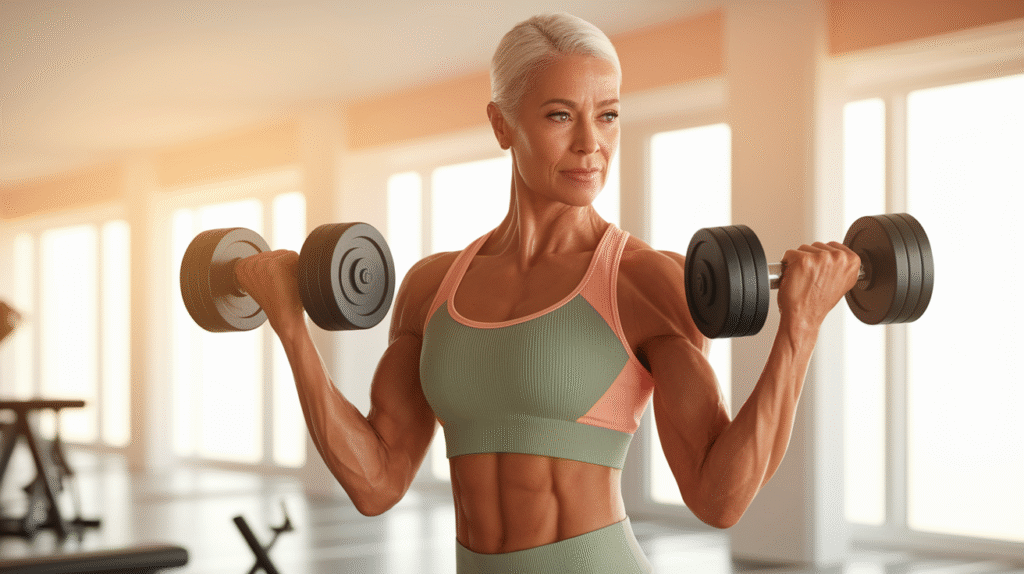
Protein: Your Secret Weapon for Muscle Building
Women over 40 need more protein than younger women—approximately 25-30 grams per meal—to maintain and build muscle mass. Your body becomes less efficient at protein synthesis after 40, so you need higher intake to achieve the same muscle-building results.
Easy protein sources fit naturally into your daily routine. Greek yogurt delivers 15-20 grams per cup. A palm-sized portion of chicken breast provides about 25 grams. Two eggs offer 12 grams. Black beans give you 15 grams per cup.
Quick protein-rich snack ideas for busy days: hard-boiled eggs, string cheese with almonds, protein smoothies with Greek yogurt and berries, cottage cheese with cucumber slices, or turkey roll-ups with vegetables. Keep these options ready so you’re never caught without adequate protein.
Distribute protein throughout the day rather than loading up at dinner. Your muscles can only utilize about 25-30 grams at once, so spreading intake across three meals plus one or two snacks optimizes muscle building and recovery.
Hydration and Its Amazing Impact on Muscle Tone
Water affects how your muscles look and perform. Dehydrated muscles appear flat and less defined, while properly hydrated muscles look fuller and more toned. Water also transports nutrients to muscle cells and removes waste products from exercise.
Aim for half your body weight in ounces daily. If you weigh 150 pounds, drink 75 ounces of water. This simple formula ensures adequate hydration for your activity level and body size.
After 40, consider adding electrolytes to your water, especially on workout days. Age reduces your body’s ability to regulate electrolyte balance, and proper electrolyte levels improve hydration, reduce cramping, and enhance recovery. Add a pinch of sea salt to your water, or use sugar-free electrolyte packets.
Foods That Fight Inflammation and Support Recovery
Anti-inflammatory foods speed recovery and reduce joint discomfort. Berries contain powerful antioxidants that combat exercise-induced inflammation. Fatty fish like salmon provides omega-3s that reduce muscle soreness. Leafy greens deliver vitamins and minerals essential for muscle repair. Nuts and seeds offer healthy fats and protein.
Foods to limit include excess sugar, which promotes inflammation and interferes with muscle recovery. Processed foods contain additives that stress your system. Alcohol disrupts sleep quality and protein synthesis, both critical for building toned arms.
Practical meal planning makes healthy eating sustainable. Prep protein sources on Sunday—grill chicken breasts, hard-boil eggs, or cook a batch of quinoa. Wash and chop vegetables so they’re grab-and-go ready. Having healthy options immediately available means you’ll actually eat them.
Proven Strategies to Stay Consistent and See Results
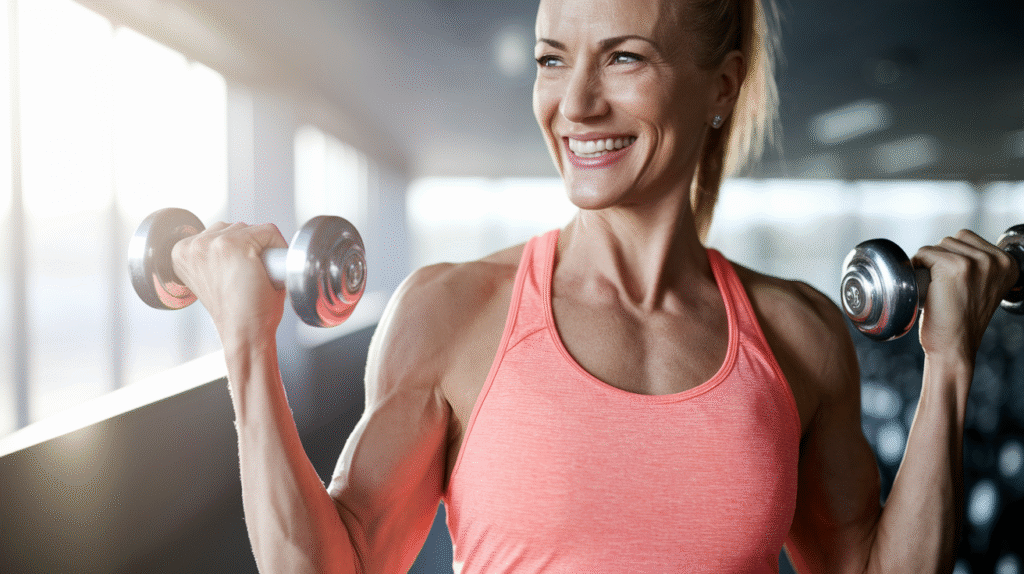
Creating Your Perfect Weekly Schedule
Perform this arm routine three to four times per week for optimal results. Monday, Wednesday, Friday works perfectly, or try Tuesday, Thursday, Saturday. The key is allowing 48 hours between sessions for complete muscle recovery.
Rest days aren’t lazy days—they’re when your muscles actually rebuild stronger. During workouts, you create tiny tears in muscle fibers. During rest, your body repairs these tears, building the muscle back slightly stronger and more toned. Skip rest days, and you sabotage your results.
Pair arm workouts with complementary activities. On rest days, go for walks, practice yoga, or do lower body exercises. This balanced approach builds overall fitness while giving your arms adequate recovery time.
Tracking Progress Without Obsessing
Take progress photos every two to four weeks in the same location, lighting, and clothing. Stand relaxed for one photo, then flex your arms for another. These visual records show changes you might miss in the mirror.
Measure arm circumference at the midpoint between shoulder and elbow. Write down the measurement and date. Every four weeks, measure again. You might see circumference increase initially as you build muscle, then decrease as fat reduces—both indicate progress.
Celebrate non-scale victories like lifting heavier weights, completing more reps, or noticing daily activities feel easier. These markers prove your routine is working even before visual changes appear.
Overcoming Common Obstacles After 40
Joint pain or arthritis requires modifications, not quitting. Reduce weight and increase reps, use resistance bands instead of dumbbells, or perform exercises in a pool where buoyancy reduces joint stress. Movement actually helps arthritis by lubricating joints and building supportive muscle.
Busy schedules accommodate quick 10-minute sessions. Do two exercises instead of four, or split the routine—upper arms Monday and Wednesday, lower arms Tuesday and Thursday. Something always beats nothing.
Stay motivated during the realistic 6-8 week timeline for visible results. Muscle building takes time, especially after 40. Trust the process, stay consistent, and results will come. Take measurements and photos to document changes you might not see in the mirror.
The Power of Community and Accountability
Find a workout buddy who shares your goals. You’re less likely to skip workouts when someone counts on you. Video call a friend and exercise together, or text each other completion photos.
Join online fitness groups specifically for women over 40. These communities understand your unique challenges and celebrate your victories. Search Facebook for “women over 40 fitness” or similar terms.
Follow inspiring women over 40 on social media who share their fitness journeys. Seeing real women achieving real results provides powerful motivation and proves transformation is possible at any age.
Reward yourself for consistency milestones—after four consecutive weeks, buy new workout clothes. After eight weeks, treat yourself to a massage. After twelve weeks, book that photo session or buy that sleeveless dress. You’re earning these rewards through dedication and hard work.
Your Transformation Starts Right Now

You’ve learned the complete system for building toned, strong arms after 40. This quick, effective routine takes just 15-20 minutes, three to four times weekly. No expensive gym membership, no complicated equipment, no hours of your day—just proven exercises that deliver real results.
The key takeaway bears repeating: consistency beats intensity every single time. Small, regular efforts create amazing transformations. You don’t need to be perfect—you just need to show up consistently and trust the process.
Your body is capable of incredible strength at any age. The hormonal changes and muscle loss after 40 are real, but they’re not insurmountable. With the right approach—targeted exercises, proper nutrition, adequate recovery, and consistent effort—you can build arms that are stronger and more toned than ever.
Essential Next Steps
Start with lighter weights and perfect your form first. Proper technique prevents injury and maximizes results. Watch yourself in a mirror or record videos to check your form against the descriptions above.
Schedule your first three workouts in your calendar this week. Treat these appointments as non-negotiable commitments to yourself. Block the time, set reminders, and protect this investment in your health.
Take a “before” photo today. You’ll want this visual record when you see your transformation in eight weeks. Wear fitted clothing and capture front, side, and back views with arms relaxed and flexed.
Download or print this routine to keep it handy. Refer to it during workouts until the exercises become second nature. Having the instructions readily available ensures you maintain proper form and complete all sets.
Final Encouragement
You’re not just building toned arms—you’re investing in your health, confidence, and longevity. Every rep strengthens your bones, every workout boosts your metabolism, every session proves you’re capable of more than you imagined.
Join thousands of women over 40 who are stronger than ever. They started exactly where you are now, wondering if transformation was possible. They showed up consistently, trusted the process, and achieved results that changed their lives.
Every rep counts. Every workout matters. Your future self—the one with strong, toned arms who feels confident in sleeveless tops—is thanking you for starting today. Pick up those weights, perform that first set, and begin your transformation right now. You’ve got this.