11 Somatic Movement Exercises to Calm Your Nervous System
Your body has been keeping score. Every stressful meeting, every anxious moment, every time you pushed through when you really needed rest—it’s all stored in your muscles, your tissues, your nervous system.
You might not remember last Tuesday’s deadline panic, but your shoulders do. Your jaw remembers. Your hips are holding onto things you can’t even name.
This is where somatic movement changes everything.
Unlike regular exercise that focuses on burning calories or building strength, somatic exercises work with your nervous system to release stored tension and trauma. These gentle, intentional movements help your body finally let go of what it’s been carrying—sometimes for years.
Here’s what makes this approach different: You’re not pushing through pain or forcing your body into positions. Instead, you’re listening, noticing, and allowing your nervous system to return to a state of calm naturally. It’s the difference between telling your body to relax and actually giving it the tools to do so.
In this guide, you’ll discover 11 proven somatic exercises that calm your nervous system fast. These techniques work whether you’re dealing with daily stress, chronic tension, or lingering effects of past trauma. The best part? You don’t need special equipment, a gym membership, or any previous experience. You need a few minutes and a willingness to reconnect with your body.
If you’ve tried meditation, deep breathing, or other stress-relief methods without lasting results, somatic movement might be the missing piece. These exercises address stress where it actually lives—in your body—and they work remarkably well for beginners.
Understanding Somatic Movement and Your Nervous System

What Makes Somatic Exercises Different
Traditional exercise asks: “How does my body look from the outside?” Somatic movement asks: “How does my body feel from the inside?”
This internal focus changes everything. When you do a somatic exercise, you’re not worried about perfect form or hitting a certain number of reps. Instead, you’re paying attention to sensations—the subtle release in your hip, the softening in your jaw, the way your breath deepens naturally as tension melts away.
The science backs this up: Research in somatic experiencing shows that your body literally stores stress and trauma in your tissues. Your nervous system gets stuck in protective patterns, keeping you in a state of fight-or-flight even when the actual danger has passed. This is why you can logically know you’re safe but still feel anxious, tense, or on edge.
Somatic exercises work directly with your autonomic nervous system—the part that controls your stress response. Through gentle, mindful movement, you signal to your body that it’s safe to relax. Your parasympathetic nervous system (the “rest and digest” system) kicks in, and your body can finally complete the stress cycle it’s been stuck in.
This mind-body connection isn’t just theoretical. When you practice somatic movement regularly, you’re literally rewiring your nervous system’s response to stress. You’re teaching your body a new pattern—one of safety, release, and regulation instead of constant vigilance.
Signs Your Nervous System Needs Calming
Your body has been sending signals, even if you haven’t been listening. A dysregulated nervous system shows up in surprisingly physical ways.
Common physical symptoms include: chronic muscle tension (especially in your neck, shoulders, and jaw), persistent fatigue that sleep doesn’t fix, digestive issues that doctors can’t fully explain, trouble falling or staying asleep, frequent headaches, and a feeling of being “wired but tired.”
Emotionally, you might notice: constant low-level anxiety, difficulty concentrating or making decisions, feeling overwhelmed by small tasks, irritability or emotional outbursts that seem disproportionate, and a sense of disconnection from your body or emotions.
Here’s what’s frustrating: traditional stress relief methods often don’t work because they’re addressing the symptoms in your mind while the root problem lives in your body. You can think positive thoughts all day, but if your nervous system is stuck in survival mode, your body will override your mind every time.
The Amazing Benefits of Regular Somatic Practice
When you commit to regular somatic movement—even just five minutes daily—the changes are profound.
Your stress response transforms: Studies show that somatic practices significantly reduce cortisol levels (your primary stress hormone). Your body learns to return to baseline faster after stressful events instead of staying activated for hours or days.
Your emotional regulation improves: You’ll notice you can handle challenging situations with more calm and clarity. That’s because you’re no longer operating from a chronically stressed nervous system that sees everything as a threat.
Physical symptoms ease: Better sleep comes naturally when your nervous system isn’t stuck in hypervigilance. Digestive issues often improve because your body can finally focus on “rest and digest” functions. Chronic tension patterns begin to release, reducing pain and increasing mobility.
You develop genuine body awareness: Perhaps most valuable, you reconnect with your body’s signals. You learn to notice tension before it becomes pain, stress before it becomes overwhelm. This awareness becomes your early warning system and your most powerful tool for self-care.
Quick Somatic Exercises for Immediate Relief (Exercises 1-4)
Exercise 1: The Butterfly Hug
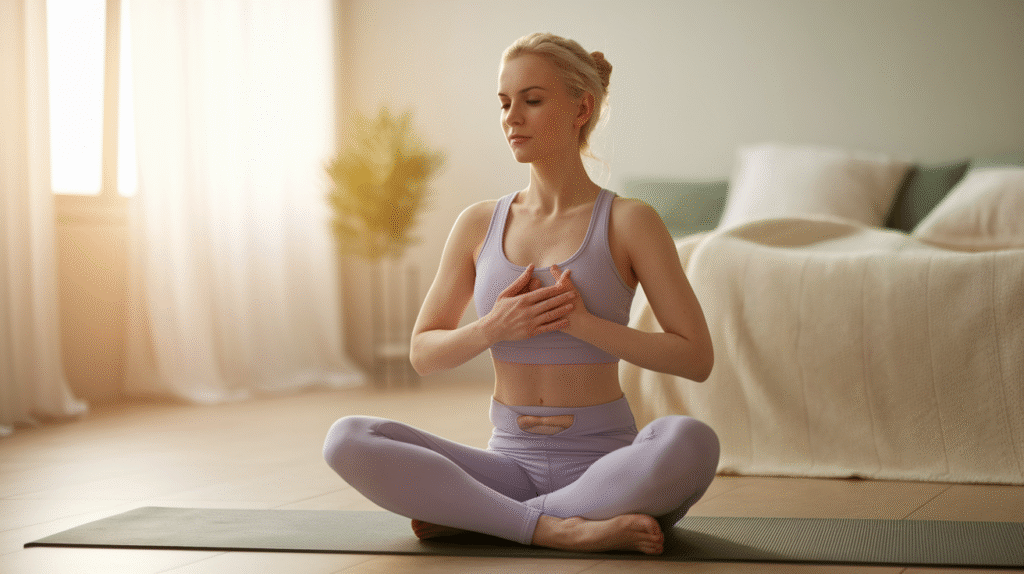
When anxiety hits and you need relief right now, the butterfly hug delivers. This simple self-soothing technique activates your parasympathetic nervous system in under two minutes.
Here’s how to do it: Cross your arms over your chest, placing each hand on the opposite shoulder or upper arm. Your arms form an X across your chest, resembling butterfly wings. Hook your thumbs together at your sternum if that feels comfortable.
Now, begin alternating gentle taps—right hand, then left hand, then right again. Create a slow, rhythmic pattern. Tap 8-10 times on each side, breathing slowly and deeply as you go. Close your eyes if you feel safe doing so.
Why this works: The bilateral stimulation (alternating left-right tapping) helps process stress and regulate your nervous system. This technique is used in EMDR therapy and trauma treatment because it genuinely calms your stress response.
When to use it: Perfect for moments of acute anxiety, before a stressful event, when you’re feeling overwhelmed, or anytime you need quick grounding. You can do this anywhere—at your desk, in your car, even in a bathroom stall if you need a moment.
Exercise 2: Gentle Somatic Shaking
Animals instinctively shake after stressful events. A gazelle that escapes a predator will literally shake off the stress before returning to grazing. Humans have this same built-in release mechanism—we’ve just been socialized to suppress it.
How to practice somatic shaking: Stand with your feet hip-width apart, knees slightly soft. Start by gently bouncing—just small movements that create a light shake through your body. Let this movement gradually spread upward through your legs, hips, torso, shoulders, and arms.
There’s no right way to do this. Let your body move however feels natural. You might shake more vigorously or stay subtle. You might notice your arms want to flop, your head wants to gently wobble, or your whole body wants to shimmy. Follow what feels good.
Continue for 2-5 minutes, then gradually slow down and stand still. Notice how you feel. Many people report feeling lighter, more energized, and calmer all at once.
Important modifications: If standing feels uncomfortable, you can do a seated version, gently bouncing and shaking from a chair. If full-body shaking feels like too much, start with just shaking out your hands and arms.
Exercise 3: Grounding Through Your Feet
Anxiety often pulls you out of your body and into your racing thoughts. This standing exercise brings you back down, literally grounding you through connection with the earth beneath you.
Complete instructions: Stand barefoot if possible (or in socks). Close your eyes or soften your gaze downward. Begin by noticing the contact between your feet and the floor. Really feel it—the temperature, the texture, the solid support.
Slowly shift your weight forward onto the balls of your feet, then rock back onto your heels. Move side to side, feeling how your weight transfers. Make these movements small and exploratory, not big or dramatic.
Now, imagine roots growing down from the soles of your feet, anchoring you to the earth. With each exhale, let tension drain down through these roots. Spend 2-3 minutes just standing, breathing, and feeling your connection to the ground.
Why this interrupts the stress cycle: When you’re anxious, your awareness floats up into your head—racing thoughts, worries, what-ifs. Grounding through your feet literally brings your consciousness back down into your body and the present moment. You can’t be fully anxious and fully grounded at the same time.
Exercise 4: Humming and Vagal Toning
Your vagus nerve is the superhighway of your parasympathetic nervous system. When you stimulate it, you directly activate your body’s relaxation response. Humming is one of the most effective and accessible ways to do this.
The simple technique: Sit or stand comfortably. Take a deep breath in through your nose, then exhale while humming—any pitch that feels natural. Feel the vibration in your chest, throat, and face.
Continue for 5-10 breaths, experimenting with different pitches. Lower pitches often feel more grounding, while higher pitches can be energizing. Notice which resonates with you today.
Why humming is so powerful: The vibration directly stimulates your vagus nerve, which runs through your throat and chest. This sends an immediate signal to your nervous system: “We’re safe. We can relax.” Research confirms that vagal toning through humming, singing, or chanting significantly reduces stress markers.
Variations to try: Hum your favorite song. Try “om” or other sustained sounds. Hum while placing your hand on your chest to feel the vibration. Do this in your car, in the shower, or anytime you need quick calm.
Essential Lying Down Somatic Movements (Exercises 5-8)
Exercise 5: Pelvic Tilts and Releases
Your pelvis holds incredible tension—physical and emotional. This gentle movement releases lower back tightness while addressing stored stress in your hips and core.
Step-by-step instructions: Lie on your back with your knees bent, feet flat on the floor hip-width apart. Rest your arms by your sides, palms down.
Inhale and let your lower back arch slightly, tilting your pelvis so your tailbone presses toward the floor. Exhale and gently tilt your pelvis the opposite direction, pressing your lower back toward the floor and tucking your tailbone slightly.
Move slowly, following your breath. This isn’t about range of motion—it’s about the quality of attention you bring to the movement. Continue for 2-3 minutes, then rest completely still and notice sensations.
What you might feel: Don’t be surprised if emotions surface during this exercise. Your hips and pelvis store tremendous stress and trauma. If you feel like crying, laughing, or experiencing other emotions, that’s your nervous system releasing. This is healthy and normal. Breathe through it and be gentle with yourself.
The key difference from regular exercise: In a fitness class, you might do pelvic tilts to strengthen your core. In somatic practice, you’re not trying to strengthen anything—you’re exploring sensation and allowing release.
Exercise 6: Somatic Cat-Cow (Lying Version)
You might know cat-cow from yoga, but this lying-down version focuses entirely on internal sensation rather than achieving a specific shape with your spine.
How to practice: Stay on your back with knees bent. Place your hands on your belly. As you inhale, allow your belly to expand and your lower back to arch slightly away from the floor (like cow pose).
As you exhale, gently draw your belly in and press your lower back toward the floor (like cat pose). Move with your breath, creating a gentle wave through your spine.
The crucial difference: In yoga, you might be thinking about your alignment or how you look. In somatic practice, you’re feeling the movement from inside your body. Notice how your spine articulates. Feel the massage-like effect on your nervous system as your spine gently flexes and extends.
Continue for 3-5 minutes. This exercise is perfect before bed—it signals to your nervous system that it’s safe to rest.
Exercise 7: Knee Drops for Hip Release
Your hips are emotional storage units. This simple exercise safely releases hip tension where we commonly hold stress, anxiety, and unprocessed experiences.
Complete guide: Lie on your back, knees bent, feet slightly wider than hip-width apart. Let your knees rest together in the center.
Slowly let both knees drop to the right, only going as far as feels comfortable. Pause here for several breaths. Notice any sensations—pulling, releasing, warmth, tingling. Then slowly bring your knees back to center.
Repeat on the left side. Continue alternating for 5-10 rounds, moving slowly and breathing deeply throughout.
Breathing cues: Exhale as your knees drop to the side (releasing). Inhale as you return to center (gathering energy). Let your breath lead the movement.
Modifications for tight hips: If your hips are very tight, place a pillow or folded blanket under your knees when they’re dropped to the side. This provides support and allows you to relax more fully into the stretch. Remember: you’re not trying to touch your knees to the floor. You’re exploring sensation and allowing release.
Exercise 8: Body Scan with Micro-Movements
This practice combines mindfulness with gentle movement for deep relaxation. It’s remarkably effective in just 5-10 minutes.
How to practice: Lie comfortably on your back. Close your eyes. Begin by bringing your attention to your feet. Without moving them yet, just notice how they feel.
Now, make the tiniest movement possible—maybe wiggling your toes slightly or flexing your feet just a millimeter. Notice what changes with that micro-movement. Does tension release? Does sensation shift?
Move up your body slowly: ankles, calves, knees, thighs, hips, belly, chest, hands, arms, shoulders, neck, face. At each area, first notice sensation, then make a tiny exploratory movement, then notice what changes.
Why micro-movements matter: Big movements can activate your nervous system. Tiny movements allow you to stay relaxed while still releasing unconscious holding patterns. You’re teaching your body that it doesn’t need to grip and tense—it can soften and let go.
The proven results: Research on somatic body scans shows significant reductions in anxiety, improved sleep quality, and better overall nervous system regulation. This practice literally rewires your brain’s relationship with your body.
Complete Upper Body Somatic Releases (Exercises 9-11)

Exercise 9: Shoulder Rolls with Awareness
You’ve done shoulder rolls before, but probably not like this. The somatic version transforms a simple movement into a powerful release.
The somatic difference: Most people rush through shoulder rolls, barely paying attention. In somatic practice, you slow way down and notice everything.
How to practice: Sit or stand comfortably. Bring your awareness to your shoulders. Notice how they feel right now—tense, heavy, tired, tight?
Slowly begin to roll your right shoulder back—and I mean slowly. Take 5-10 seconds for one complete circle. Notice every sensation: where you feel tightness, where movement feels smooth, where you might hear clicking or popping.
Complete 3-5 slow circles on the right, then switch to the left. Finally, do both shoulders together, maintaining that slow, attentive quality.
Releasing the weight you’ve been carrying: Your shoulders literally carry the weight of your stress. “Shouldering” responsibility, carrying burdens—these aren’t just metaphors. As you roll your shoulders with awareness, imagine releasing everything you’ve been carrying that isn’t yours to hold.
Perfect for: Desk workers, caregivers, parents, anyone who carries tension in their upper body. Practice this several times throughout your day, especially after stressful moments.
Exercise 10: Gentle Neck Releases
Your neck holds enormous tension, often contributing to headaches, jaw pain, and general stress. These safe, effective movements provide quick relief.
The key to safety: Never force your neck or move quickly. These are gentle, exploratory movements, not stretches you’re trying to deepen.
Step-by-step practice: Sit comfortably with your spine relatively upright but not rigid. First, simply turn your head slowly to look over your right shoulder. Don’t push—just go to where movement feels easy. Pause and breathe for 3-5 breaths. Return to center, then repeat on the left.
Next, tilt your right ear toward your right shoulder (lateral flexion). Again, only go as far as feels comfortable. Breathe here for 3-5 breaths, then return to center and repeat on the left.
Finally, slowly lower your chin toward your chest, feeling a gentle stretch along the back of your neck. Breathe deeply for 5 breaths.
Common mistakes to avoid: Don’t circle your head in full rotations—this can create more tension. Don’t push into pain. Don’t hold your breath. These mistakes activate your stress response instead of calming it.
Quick relief anywhere: You can do these neck releases at your desk, in your car (when parked!), or anytime you notice neck tension building.
Exercise 11: Jaw Release and Face Softening
Your jaw might be the most tension-filled part of your entire body. If you clench your teeth, grind at night, or have TMJ issues, this exercise is essential.
Why your jaw holds so much tension: Your jaw is directly connected to your stress response. When you’re anxious or stressed, your body instinctively clenches your jaw as part of the fight-or-flight response. Over time, this becomes an unconscious pattern.
The simple technique: Sit comfortably. Place your fingertips gently on your jaw joints (right in front of your ears). Let your jaw hang open slightly—not wide, just enough that your teeth aren’t touching.
Begin making small, gentle circles with your jaw. Move slowly and notice any clicking, popping, or tight spots. Continue for 1-2 minutes.
Next, massage your jaw muscles with your fingertips, working from your jaw joint down toward your chin. Use gentle pressure and breathe deeply.
Finally, practice the “lion’s breath”: inhale through your nose, then exhale forcefully through your mouth while sticking out your tongue and opening your eyes wide. This releases facial tension beautifully. Repeat 3 times.
Face softening: After releasing your jaw, scan your entire face. Soften your forehead, relax your eyes, let your cheeks be heavy. Notice how facial tension is connected to overall nervous system activation.
Creating Your Personal Somatic Practice
You don’t need to do all 11 exercises every day. That’s not how somatic practice works.
How to choose which exercises to do: Start by noticing where you hold tension. Neck and shoulders tight? Focus on exercises 9-11. Feeling anxious and disconnected? Try exercises 1-4. Lower back and hip tension? Work with exercises 5-7.
Building a simple daily routine: Even five minutes creates lasting change. Try this beginner routine: One quick exercise in the morning (like grounding through your feet), one mid-day reset (like the butterfly hug or humming), and one before bed (like the lying cat-cow or body scan).
The essential skill of listening: The most important part of somatic practice isn’t the specific movements—it’s developing the ability to listen to your body. Notice what you need today. Some days you’ll crave gentle movement. Other days you’ll need stillness. Both are valid. Your body knows what it needs when you learn to listen.
Your Path to a Calmer Nervous System Starts Now

Your nervous system has been running on overdrive, keeping you in survival mode even when you’re safe. These 11 somatic exercises give you the tools to finally change that pattern.
Here’s what you’ve learned: Somatic movement works differently than regular exercise because it addresses stress where it actually lives—in your body’s tissues and nervous system. Through gentle, mindful movement, you can release stored tension and trauma that talk therapy and traditional stress relief methods can’t touch.
You now have exercises for immediate relief (the butterfly hug, somatic shaking, grounding, and humming), lying-down practices for deeper release (pelvic tilts, somatic cat-cow, knee drops, and body scans), and upper body releases for the tension you carry daily (shoulder rolls, neck releases, and jaw work).
The truth is, you don’t need to do all 11 exercises. Start with 2-3 that resonate with you. Maybe the butterfly hug feels immediately soothing, or perhaps the jaw release addresses tension you’ve been carrying for years. Trust what calls to you.
Consistency matters more than intensity. Five minutes of daily somatic practice creates more lasting change than an occasional hour-long session. Your nervous system learns through repetition. Each time you practice, you’re reinforcing a new pattern—one of safety, release, and regulation.
Quick Action Steps
Choose one exercise to try right now. Seriously, right now. Put down your phone or step away from your computer and spend two minutes with one technique. The butterfly hug or humming work perfectly for a quick first experience.
Set a reminder to practice daily for the next week. Put it in your phone. Make it non-negotiable. Morning, lunch break, or before bed—pick a time that works for you and commit to just five minutes.
Notice the changes. Keep a simple journal or mental note of what shifts. You might sleep better, feel less reactive to stress, notice your shoulders aren’t up by your ears anymore, or simply feel more at home in your body. These changes often happen gradually, so tracking helps you see your progress.
Final Encouragement
Your body has been holding onto stress, tension, and unprocessed experiences—possibly for years. That tightness in your shoulders, the anxiety you can’t think away, the exhaustion that sleep doesn’t fix—these are all signs of a nervous system that needs support.
Now you have the tools to provide that support. These proven somatic techniques work when you give them time and consistent practice. They’re not a quick fix, but they are a real solution.
Be patient and gentle with yourself as you reconnect with your body. You might feel emotional during these exercises—that’s your nervous system releasing what it’s been holding. You might feel awkward or disconnected at first—that’s normal when you’re learning a new way of relating to your body.
The most important thing? You’ve taken the first step. You’re here, reading this, learning about somatic movement. That awareness alone is powerful. Your body has been waiting for you to listen, and now you’re ready to hear what it’s been trying to tell you.
Your calmer, more regulated nervous system is possible. It starts with one exercise, one breath, one moment of reconnection at a time.