9 Easy At-Home Strength Workouts for Women Over 50

Let me tell you something that might surprise you: your fifties are the perfect time to become the strongest version of yourself. Not the youngest, not the thinnest—the strongest. And you can do it right from your living room.
Here’s the reality nobody talks about enough: after age 50, women lose 3-8% of their muscle mass every decade. This natural process, called sarcopenia, affects everything from how easily you carry groceries to whether you can get up from the floor while playing with your grandchildren. But here’s the amazing news—strength training reverses this process completely.
You don’t need a gym membership, expensive equipment, or hours of free time. You don’t need to feel intimidated by complicated machines or crowded fitness classes. What you need is simple: a few basic tools, 20-30 minutes a few times per week, and the knowledge that every single rep you do is an investment in your independence, health, and quality of life.
While cardio has its place, strength training delivers benefits that walking and swimming simply can’t match. We’re talking about stronger bones, better balance, improved metabolism, and the confidence that comes from knowing your body can handle whatever life throws at you.
This guide will walk you through everything you need to know: the science behind why strength training matters more now than ever, the minimal equipment you’ll need, seven proven exercises that work your entire body, and a simple weekly schedule that fits into your real life. Whether you’re completely new to exercise or returning after years away, this is your starting point for building lasting strength.
Why Strength Training Is Essential for Women Over 50
The Science Behind Strength After 50
Your body changes after 50, but these changes aren’t a life sentence—they’re a call to action. Research shows that adults lose approximately 3-8% of their muscle mass per decade after age 30, and this loss accelerates after 50. By age 70, you could lose up to 40% of your muscle mass if you do nothing to prevent it.
This muscle loss directly impacts your bone density. Women face a heightened risk of osteoporosis after menopause due to declining estrogen levels. Strength training creates the mechanical stress that tells your bones to stay strong and dense. Studies prove that resistance training can increase bone mineral density by 1-3% annually—a significant defense against fractures and breaks.
Your metabolism slows down as you lose muscle because muscle tissue burns more calories than fat tissue, even at rest. By building and maintaining muscle through strength training, you’re essentially revving up your metabolic engine. This makes maintaining a healthy weight significantly easier and gives you more energy throughout the day.
Beyond Physical Strength: The Complete Benefits
Balance and coordination naturally decline with age, making falls one of the leading causes of injury in women over 50. Strength training improves your proprioception—your body’s awareness of where it is in space—and builds the leg and core strength needed to catch yourself if you stumble. This isn’t just about avoiding injury; it’s about maintaining your independence and confidence in everyday activities.
If you deal with arthritis or joint pain, you might think strength training would make it worse. The opposite is true. Strengthening the muscles around your joints provides better support and stability, reducing pain and stiffness. The key is starting with appropriate weights and proper form—which we’ll cover in detail.
The mental health benefits deserve equal attention. Strength training releases endorphins, reduces anxiety and depression, and builds genuine confidence. There’s something powerful about knowing you’re getting stronger each week. You’ll stand taller, feel more capable, and approach challenges—physical and otherwise—with a different mindset.
Breaking the Myths
“I’m too old to start” is the most common excuse I hear, and it’s completely false. Research consistently shows that adults in their 70s, 80s, and even 90s can build significant muscle mass and strength through resistance training. Your starting point doesn’t matter; what matters is that you start.
The fear of “getting bulky” stops many women from picking up weights. Let me be clear: women lack the testosterone levels required to build large, bulky muscles without extreme effort and specific training. What you will build is lean, toned muscle that makes you look fit and feel strong. You’ll likely lose inches even as you gain strength.
Safety concerns are valid, but proper strength training is actually one of the safest forms of exercise for women over 50. Unlike high-impact activities that stress your joints, controlled resistance exercises with appropriate weights protect your joints while building strength. The key is learning proper form and progressing gradually—exactly what this guide provides.
Getting Started: Essential Equipment and Safety Tips
The Perfect At-Home Setup (Minimal Investment Required)
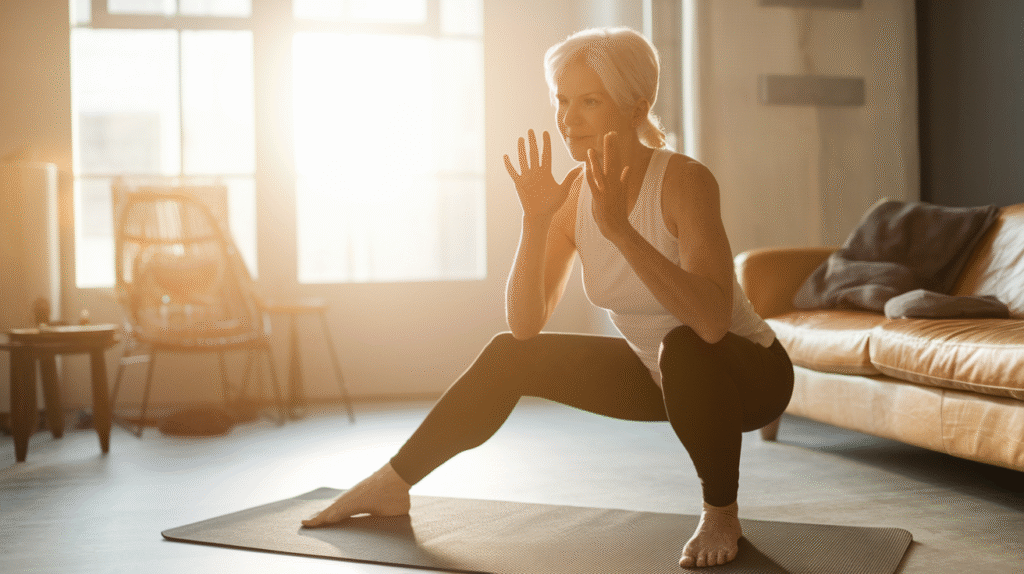
You can build impressive strength with minimal equipment. Start with a pair of light dumbbells—5 to 10 pounds is perfect for most beginners. Don’t worry about starting “too light.” You can always add weight as you get stronger, but starting too heavy increases injury risk and discourages consistency.
Resistance bands are your secret weapon for versatile, joint-friendly exercises. They’re inexpensive, portable, and provide variable resistance that’s easier on your joints than weights. Get a set with different resistance levels so you can adjust the challenge for different exercises. They’re especially effective for upper body work and rehabilitation exercises.
A sturdy chair is essential for balance support and certain exercises. Choose one without wheels that won’t slide across your floor. You’ll use it for modified exercises, balance work, and seated movements. This simple tool makes many exercises accessible while you build confidence and strength.
A yoga mat provides cushioning for floor exercises and prevents slipping during standing movements. While optional, it makes your workout more comfortable and defines your workout space. If you don’t have one, a towel on carpet works fine when you’re starting out.
The total investment? Under $50 for everything you need to transform your strength and health. Compare that to a gym membership, and you’ll see why at-home training is so appealing.
Safety First: Proven Guidelines for Success
Never skip your warm-up. Spend 5-10 minutes doing gentle movement before you touch a weight. March in place, do arm circles, gentle twists, and leg swings. This increases blood flow to your muscles, lubricates your joints, and prepares your body for the work ahead. A proper warm-up dramatically reduces injury risk.
Breathing technique matters more than you might think. The general rule: exhale during the exertion phase (the hard part) and inhale during the easier phase. For example, exhale as you push up from a squat, inhale as you lower down. Never hold your breath during exercises, as this can spike your blood pressure.
Consult your doctor before starting any new exercise program, especially if you have existing health conditions, take medications, or haven’t exercised regularly. This isn’t just a legal disclaimer—it’s genuine advice. Your doctor can provide specific guidance based on your health history and may suggest modifications for certain conditions.
Learn to distinguish between good discomfort and bad pain. Muscle fatigue and mild burning during exercise are normal. Sharp pain, joint pain, or discomfort that worsens during an exercise means stop immediately. Your body communicates clearly when something’s wrong—listen to it.
Setting Realistic Goals and Expectations
Start with two to three sessions per week, with at least one rest day between workouts. Each session should last 20-30 minutes initially. This frequency gives your muscles time to recover and grow stronger while building a sustainable habit. More isn’t always better, especially when you’re starting out.
Progressive overload is the proven principle behind getting stronger. This means gradually increasing the challenge over time by adding weight, increasing repetitions, or slowing down your movements. Don’t rush this process. Adding just one or two reps per week or increasing weight by 2-5 pounds every few weeks delivers consistent, safe progress.
Track your workouts in a simple notebook or phone app. Write down which exercises you did, how many reps, and what weight you used. This creates accountability and lets you see your progress clearly. You’ll be amazed looking back at where you started after just a few months.
The Complete 7-Move At-Home Strength Workout
Upper Body Exercises
Wall or Incline Push-Ups
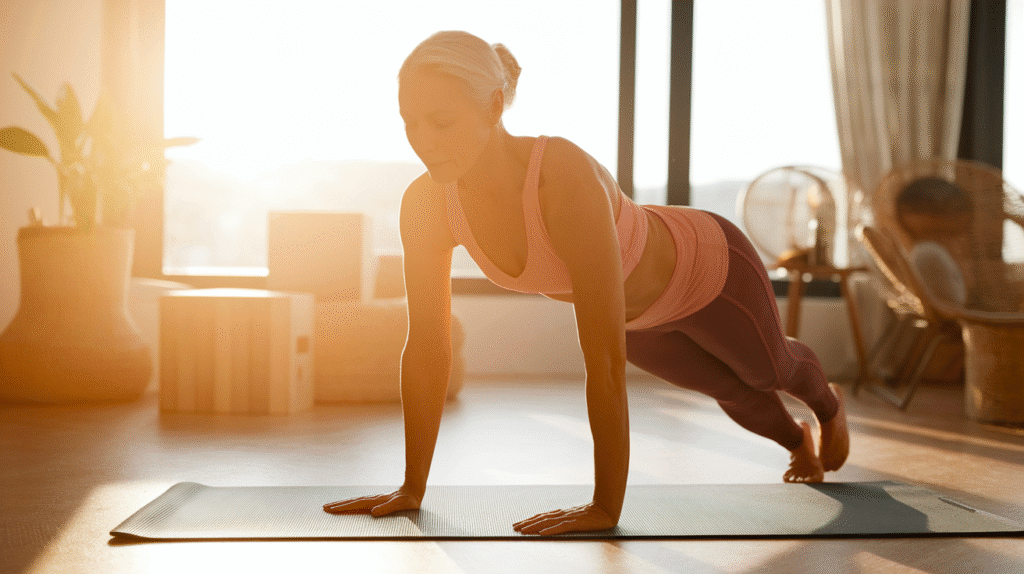
Push-ups are one of the most effective upper body exercises, building strength in your chest, shoulders, arms, and core. If traditional floor push-ups feel too challenging right now, wall or incline push-ups provide the perfect starting point.
For wall push-ups, stand arm’s length from a wall. Place your palms flat against the wall at shoulder height and width. Keep your body straight from head to heels as you bend your elbows, bringing your chest toward the wall. Push back to the starting position. The farther your feet are from the wall, the more challenging it becomes.
Incline push-ups use a sturdy counter, table, or chair. Place your hands on the elevated surface, walk your feet back until your body forms a straight line, and perform push-ups from this angle. This variation is more challenging than wall push-ups but easier than floor push-ups.
Focus on keeping your core tight and your body in a straight line throughout the movement. Don’t let your hips sag or pike up. Start with 8-10 repetitions for 2 sets, gradually building to 3 sets of 12-15 reps. As you get stronger, lower the angle of your incline until you can perform full push-ups from the floor.
Dumbbell Shoulder Press
This exercise strengthens your shoulders, upper back, and arms—essential for lifting objects overhead and maintaining good posture. Sit in a sturdy chair with your back supported or stand with feet hip-width apart.
Hold a dumbbell in each hand at shoulder height, palms facing forward, elbows bent at 90 degrees. Press both dumbbells straight up overhead until your arms are fully extended but not locked. Lower them back to shoulder height with control.
Keep your core engaged and avoid arching your back as you press up. If you feel strain in your lower back, you’re either using too much weight or need to focus more on engaging your core. Start with 5-pound dumbbells for 2 sets of 10 repetitions, building to 3 sets of 12-15 reps over time.
Bent-Over Dumbbell Rows
Rows strengthen your upper back, shoulders, and arms while improving posture—crucial for counteracting the forward hunch many women develop from daily activities.
Stand with feet hip-width apart, holding a dumbbell in each hand. Hinge forward at your hips, keeping your back straight and core engaged, until your torso is at about a 45-degree angle. Let your arms hang straight down, palms facing each other.
Pull both dumbbells up toward your ribcage, squeezing your shoulder blades together at the top. Lower the weights back down with control. Keep your neck neutral—don’t crane it up. Start with 5-8 pound dumbbells for 2 sets of 10 reps, progressing to 3 sets of 12-15 reps.
Lower Body Exercises
Chair Squats
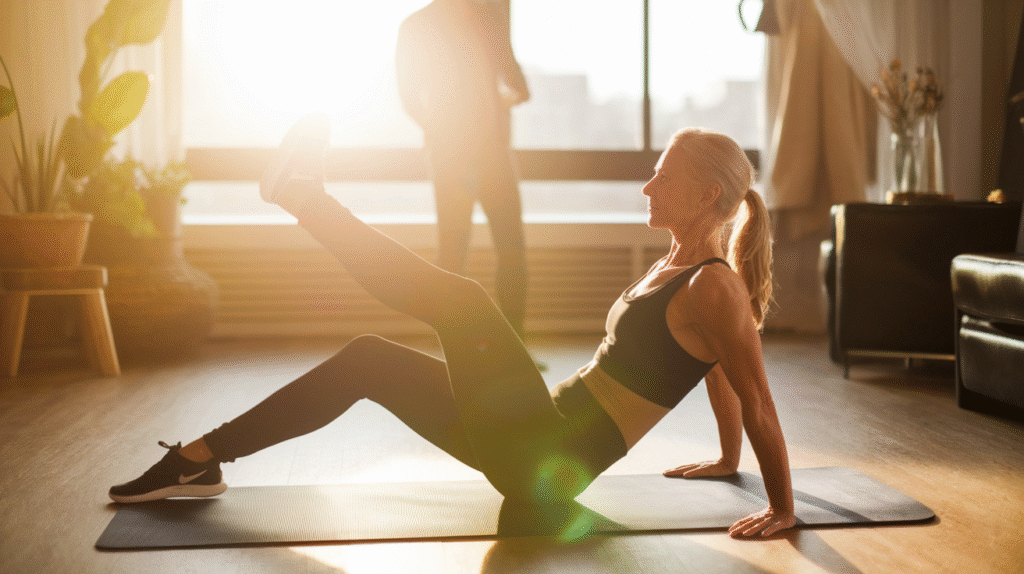
Squats are the ultimate functional exercise, strengthening the exact muscles you use to stand up from a chair, get in and out of a car, or pick something up from the floor. This movement builds strength in your quads, glutes, and core.
Stand in front of a sturdy chair with feet hip-width apart, toes pointing slightly outward. Keep your chest up and core engaged as you push your hips back and bend your knees, lowering yourself until you lightly touch the chair seat. Don’t actually sit down—just tap the chair and immediately push through your heels to stand back up.
Keep your knees tracking over your toes, not caving inward. Your weight should be in your heels, not your toes. Start with 2 sets of 10 reps, building to 3 sets of 15 reps. As you get stronger, lower the chair height or eliminate it entirely, performing air squats.
Standing Leg Lifts
This exercise improves balance while building strength in your hips, thighs, and glutes. Balance work is critical for fall prevention and maintaining independence.
Stand behind a chair, holding the back lightly for balance. Shift your weight to your left leg. Keeping your right leg straight, lift it out to the side as high as comfortable—typically 6-12 inches. Lower it back down with control. Complete all reps on one side before switching.
Keep your torso upright and avoid leaning to the side. Your supporting leg should have a slight bend in the knee. Start with 2 sets of 10 reps per leg, building to 3 sets of 15 reps. As your balance improves, try using just one finger on the chair for support.
Reverse Lunges
Lunges build single-leg strength and balance while targeting your glutes, quads, and hamstrings. Reverse lunges are easier on the knees than forward lunges, making them ideal for women over 50.
Stand with feet hip-width apart, hands on hips or holding the back of a chair for balance. Step your right foot backward, lowering your back knee toward the floor until both knees form 90-degree angles. Push through your left heel to return to standing. Alternate legs.
Keep your front knee directly over your ankle, not pushing past your toes. Your torso should remain upright throughout the movement. Start with 2 sets of 8 reps per leg, building to 3 sets of 12 reps. Add light dumbbells when you’re ready for more challenge.
Core and Balance Exercises
Modified Plank
Planks build core strength that supports your back, improves posture, and makes every other exercise more effective. A strong core is essential for all daily activities.
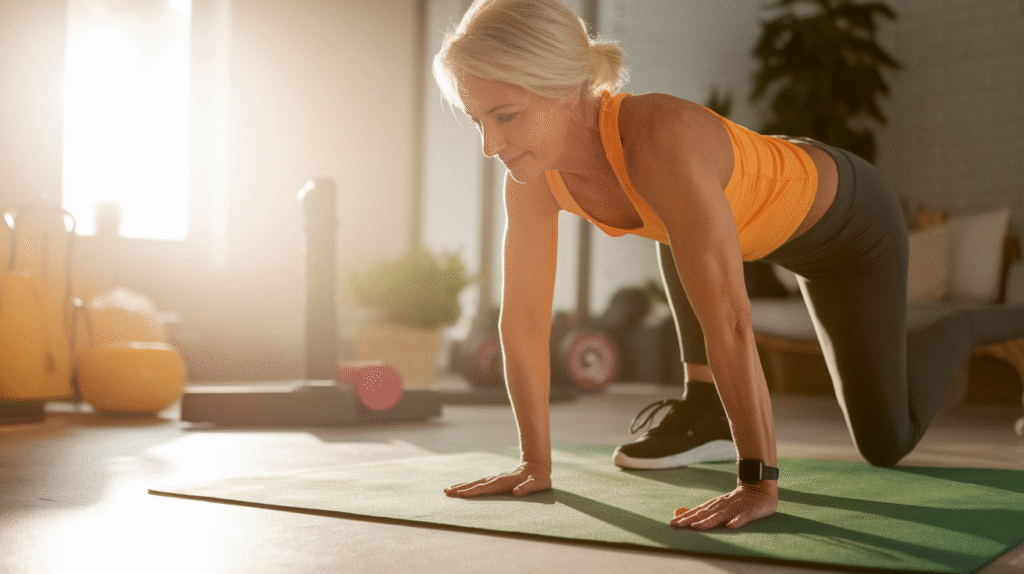
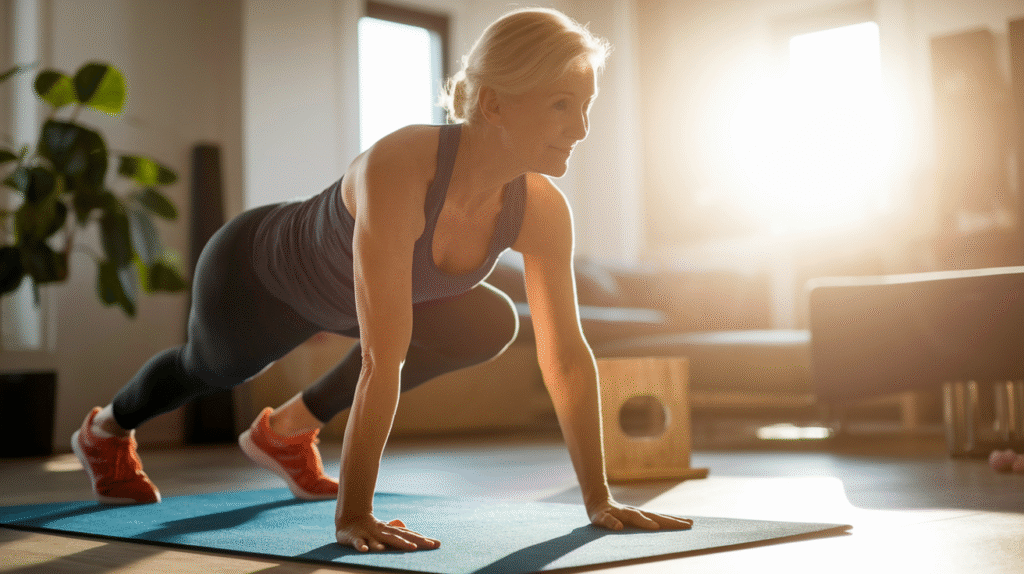
Start on your hands and knees. Walk your hands forward until your body forms a straight line from your head to your knees. Keep your core tight, pulling your belly button toward your spine. Hold this position, breathing normally.
Don’t let your hips sag or pike up. Keep your neck neutral by looking at the floor about a foot in front of your hands. Start by holding for 15-20 seconds for 2 sets, gradually building to 45-60 seconds for 3 sets. As you get stronger, try a full plank from your toes.
Bird Dog
This exercise combines balance, coordination, and core strength while working your back and glutes. It’s deceptively simple but incredibly effective.
Start on your hands and knees with your wrists under your shoulders and knees under your hips. Keeping your core engaged and back flat, simultaneously extend your right arm forward and left leg backward until both are parallel to the floor. Hold for 2-3 seconds, then return to start. Alternate sides.
Focus on keeping your hips level—don’t let them rotate or tilt. Move slowly and with control. Start with 2 sets of 8 reps per side, building to 3 sets of 12 reps.
Glute Bridges
This exercise strengthens your glutes, hamstrings, and lower back—the posterior chain muscles crucial for good posture, back health, and powerful movement.
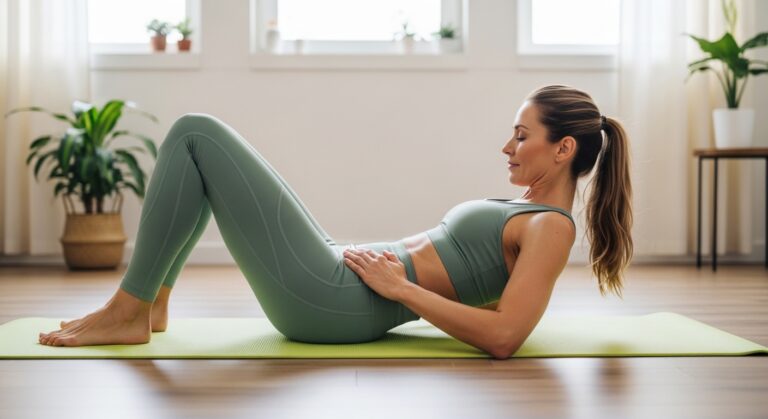
Lie on your back with knees bent, feet flat on the floor hip-width apart, arms by your sides. Press through your heels to lift your hips toward the ceiling until your body forms a straight line from shoulders to knees. Squeeze your glutes at the top, hold for 2 seconds, then lower back down.
Keep your core engaged and avoid arching your lower back excessively. Start with 2 sets of 12 reps, building to 3 sets of 15-20 reps. For added challenge, hold the top position longer or try single-leg bridges.
Creating Your Weekly Workout Schedule and Staying Motivated
The Quick and Easy Weekly Plan
A simple, sustainable schedule beats an ambitious plan you can’t maintain. Start with three non-consecutive days per week—Monday, Wednesday, and Friday work well for most people. Each session takes just 20-30 minutes once you know the exercises.
Structure each workout as follows: 5-10 minute warm-up, perform all seven exercises in order (2-3 sets each), and finish with 5 minutes of gentle stretching. Complete one exercise fully before moving to the next. This circuit-style approach keeps your heart rate elevated while giving each muscle group adequate rest.
Rest days are when your muscles actually grow stronger. During workouts, you create tiny tears in muscle fibers. During rest, your body repairs these tears, building them back stronger. Skipping rest days sabotages your progress and increases injury risk. On rest days, gentle activities like walking or stretching are fine, but avoid intense exercise.
As you build confidence and strength over 4-6 weeks, you can add a fourth workout day if desired. But three days per week delivers impressive results when you’re consistent.
Progression Strategies That Work
After 2-3 weeks of consistent training, you’ll notice exercises feeling easier. This is your signal to increase the challenge. Add 1-2 reps to each set or increase your weight by 2-5 pounds. Never increase both simultaneously—change one variable at a time.
Time under tension is an advanced technique that increases difficulty without adding weight. Slow down your movements, taking 3-4 seconds to lower the weight and 2 seconds to lift it. This creates more muscle fiber recruitment and accelerates strength gains.
Prevent boredom and plateaus by occasionally substituting similar exercises. Swap regular squats for sumo squats, or try different row variations. Your muscles adapt to repeated movements, so variety keeps them challenged and growing.
Staying Consistent: Proven Motivation Tips
Connect your workouts to a deeper purpose than appearance. Maybe it’s keeping up with grandchildren, maintaining independence, traveling without limitations, or simply feeling strong and capable. Write down your “why” and review it when motivation wanes.
Track progress beyond the scale. Take photos monthly, note when exercises feel easier, pay attention to improved energy levels, and notice how your clothes fit. Strength gains often happen before visible changes, so celebrate lifting heavier weights or completing more reps.
Accountability transforms good intentions into consistent action. Tell a friend about your goals, work out with a buddy (even virtually), post your workouts on social media, or join an online community of women over 50 focusing on strength. When you commit publicly, you’re more likely to follow through.
Celebrate every victory, no matter how small. Completed all three workouts this week? Celebrate. Increased your weights? Celebrate. Did your first full push-up? Definitely celebrate. These small wins accumulate into major transformations.
Common Obstacles and Simple Solutions
Muscle soreness is normal when you start strength training. This delayed onset muscle soreness (DOMS) typically peaks 24-48 hours after exercise and gradually decreases. Gentle movement, stretching, and staying hydrated help. If soreness persists beyond 72 hours or is severe, you may have overdone it—reduce intensity next session.
Missing a workout isn’t failure; it’s life. Don’t let one missed session derail your entire routine. Simply pick up where you left off with your next scheduled workout. Consistency over time matters far more than perfection.
Travel and busy periods require flexibility, not abandonment. Most exercises in this program require minimal or no equipment. Do bodyweight versions in your hotel room or even modified versions in 10 minutes if that’s all you have. Some movement always beats no movement.
Conclusion
Key Takeaways
Strength training after 50 isn’t a luxury or optional activity—it’s essential for maintaining the quality of life you deserve. The science is clear: you will lose muscle mass, bone density, and functional strength if you don’t actively work to preserve them. But the opposite is equally true: consistent strength training reverses these losses and makes you stronger, more capable, and more confident.
You don’t need expensive equipment, a gym membership, or hours of free time. The seven exercises in this guide provide a complete, balanced workout that targets every major muscle group. Performed consistently 2-3 times per week for just 20-30 minutes, these movements will transform your strength and how you move through the world.
Consistency trumps perfection every single time. You don’t need to execute every workout flawlessly or never miss a session. You simply need to show up regularly, put in honest effort, and trust the process. Results compound over weeks and months, not days.
Empowering Final Thoughts
Your age isn’t a limitation—it’s simply your starting point. Every woman who’s strong at 55, 65, or 75 made a choice to prioritize her strength. She didn’t wait for the perfect time, the perfect program, or the perfect motivation. She started where she was with what she had.
Every single repetition you complete makes you stronger. Not just physically, but mentally. Each workout proves to yourself that you’re capable, committed, and worth the investment. This confidence radiates into every area of your life, changing how you approach challenges and opportunities.
The best time to start building strength was 20 years ago. The second best time is right now, today, this moment. You’re not too old, too out of shape, or too late. You’re exactly where you need to be to begin.
Call to Action
Stop reading and start moving. Choose one exercise from this guide—just one—and do it right now. Do 10 wall push-ups or 10 chair squats. Feel your muscles working. Feel your strength.
Commit to your first week using the simple schedule provided. Put it in your calendar like any other important appointment. Monday, Wednesday, Friday—20 minutes each. That’s one hour total to invest in your strength, health, and independence.
Remember this truth: strong women over 50 don’t happen by accident. They happen by choice. They happen because someone decided that their strength mattered, that their health was worth protecting, and that their future was worth investing in.
That someone is you. Your journey to becoming stronger starts today. Not tomorrow, not next Monday, not when conditions are perfect. Today.
Pick up those weights. Step up to that wall. Get down on that mat. Your stronger, more confident, more capable self is waiting on the other side of consistent action. She’s been waiting for you to begin.
Now begin.