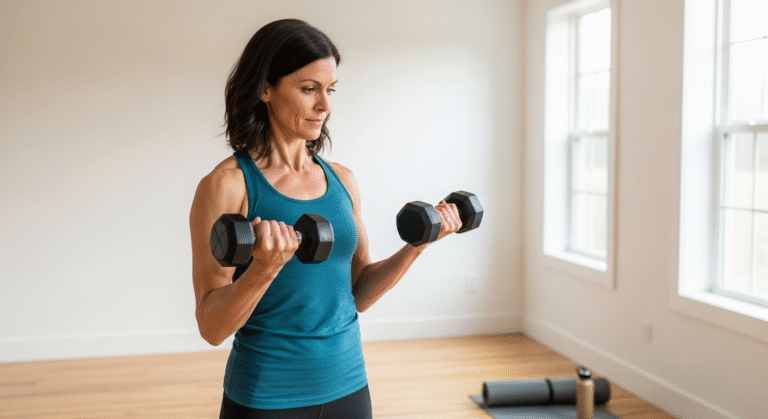
5 Powerful Christmas Workout Motivation Tips

The Christmas season is here, and with it comes a familiar challenge: maintaining your fitness routine while navigating office parties, family gatherings, cookie exchanges, and completely disrupted schedules.
You know the drill—your alarm goes off for that morning workout, but you stayed up late wrapping presents. Your gym bag sits by the door, but you’ve got three holiday events this week alone.
Here’s the reality check you need: maintaining your workout momentum during the holidays is significantly easier than starting over in January. Think about it.
When January 1st rolls around, you’ll either be continuing a habit you maintained through December, or you’ll be fighting to rebuild momentum you lost weeks ago. Which sounds more appealing?
This guide will help you achieve something powerful: staying consistent with your fitness without sacrificing the joy, connection, and celebration that make this season special. You don’t need to choose between your goals and your life. You can have both.
The empowering truth? You don’t need a gym membership or hours of free time to transform your fitness during the festive season.
What you need is a realistic plan, proven strategies, and the mindset shift that makes consistency possible even when life gets chaotic. Let’s build that foundation together.
Why Christmas Is Actually the Perfect Time to Build Your Fitness Foundation
The Hidden Advantages of Holiday Workouts

Most people view Christmas as a fitness obstacle course. I’m going to challenge that thinking entirely. For many professionals, the holiday season brings reduced work stress and more flexible schedules.
Sure, you’ve got parties and shopping, but you’re not stuck in back-to-back meetings or dealing with year-end deadlines the same way you were in November.
This creates opportunities. That mid-morning gap when you’d normally be in a conference call? That’s your workout window. The flexible Friday when your office closes early? Perfect time for a 20-minute strength session.
There’s also built-in accountability when you involve family members in home workout sessions. Are your kids home from school? Turn your living room into a fun movement space.
Is your partner off work? That’s your new workout buddy. These connections make exercise feel less like a chore and more like quality time.
But here’s the most powerful advantage: the psychological win of proving to yourself that you can stay consistent during the “hardest” time of year.
When you maintain your fitness through Christmas, you build unshakeable confidence. You demonstrate to yourself that your commitment isn’t conditional on perfect circumstances.
Breaking the All-or-Nothing Mindset

Let’s address the thinking that derails most people: “If I can’t do my full 60-minute workout, I might as well skip it.” This all-or-nothing approach is the enemy of consistency.
The science-backed truth? Fifteen-minute effective workouts beat skipping exercise entirely. Research shows that short, consistent training sessions maintain muscle mass, support metabolism, and deliver cardiovascular benefits.
Your body doesn’t know you “only” worked out for 15 minutes. It just knows you moved, challenged your muscles, and elevated your heart rate.
During December, those brief sessions become your secret weapon. They keep your metabolism active, help you burn through holiday stress, and maintain the neural pathways that make exercise feel natural. When January arrives, you’re not starting from zero—you’re building on a foundation of consistent action.
Small, consistent actions during December create proven results by mid-January. While others are struggling through week two of their New Year’s resolution, you’ll already be seeing changes because you’ve been showing up for six weeks. That’s the power of refusing to quit during the busy season.
Setting Yourself Apart from the January Crowd

Walk into any gym on January 2nd, and you’ll see the crowd. Packed classes, equipment waiting lists, and overwhelmed beginners trying to figure out where to start.
Now imagine walking in with six weeks of momentum already built. That’s the psychological advantage of being “ahead” when others are just starting.
You’re already sculpting results while others are still planning. Your muscles remember the work you put in during December. Your cardiovascular system is primed. Your habit loops are established. You’re not fighting inertia—you’re maintaining momentum.
Real talk: Starting in December gives you a 6-week head start on your goals. If your target is to lose 15 pounds by spring, maintaining consistency through the holidays means you’re already one-third of the way there by New Year’s Day. If you’re building strength, those December workouts preserve your progress instead of letting it slip backwards.
This isn’t about being perfect. It’s about being persistent. And that persistence during the “impossible” season sets you apart from everyone who decided to wait until conditions were ideal.
5 Powerful Strategies to Stay Motivated Through the Festivities
Strategy 1: Reframe Your Fitness Goals for the Season

The fastest way to fail during Christmas? Trying to maintain the same intense shred mode you had in October. That’s not realistic, and it sets you up for frustration.
Instead, shift from “shred mode” to “maintain and sustain mode.” Your goal isn’t to achieve your best body by December 25th.
Your goal is to stay consistent, maintain your strength and conditioning, and arrive in January with your foundation intact. This mindset shift removes pressure while keeping you accountable.
Set realistic, achievable benchmarks that don’t intimidate or overwhelm. Instead of “lose 10 pounds in December,” try “complete three 20-minute workouts per week.”
Instead of “hit a new PR on my deadlift,” aim for “maintain my current strength levels.” These goals are within your control regardless of how chaotic your schedule becomes.
I recommend the 80/20 approach: 80% consistency, 20% holiday flexibility. If you normally work out five days per week, aim for three or four during December.
If you usually train for an hour, scale back to 30 minutes. You’re not lowering your standards—you’re being strategic about sustainability.
Strategy 2: Schedule Workouts Like Holiday Commitments

You wouldn’t skip Christmas dinner because you “didn’t feel like it.” You wouldn’t miss your child’s holiday concert because you were tired. Apply that same non-negotiable energy to your workout time.
Treat your 20-minute workout as non-negotiable as your holiday commitments. Put it in your calendar. Set an alarm. Create the same level of commitment you give to everything else that matters.
The proven “morning momentum” method works brilliantly during the holidays: exercise before the day gets chaotic. When you knock out your workout before breakfast, nothing can derail it. No last-minute shopping emergencies, no unexpected guests, no evening exhaustion. It’s done, and you’ve already won the day.
Create a visual calendar that tracks your consistency. This doesn’t need to be complicated—a simple wall calendar with X’s marking your workout days works perfectly. The visual reminder of your streak becomes its own motivation. You don’t want to break that chain of X’s, so you show up even when you’re not feeling it.
Strategy 3: Transform Your Environment for Success

Your environment shapes your behavior more than your willpower does. Move the path of least resistance.
Set up a simple home workout space. You don’t need a full gym—just clear a 6×6 foot area in your living room, bedroom, or garage. Keep a yoga mat rolled in the corner. Store resistance bands in a visible basket. The less friction between you and exercise, the more likely you’ll do it.
Use the 5-minute rule: Keep workout clothes visible and accessible. Lay them out the night before. Keep sneakers by the door. When your gear is staring at you, it’s harder to ignore. When it’s buried in a drawer, it’s easy to forget.
Build a motivating playlist that energizes your festive fitness routine. Music is a proven performance enhancer. Create a 20-minute playlist of songs that pump you up. When those first beats drop, your brain associates it with movement, making it easier to transition into workout mode.
Strategy 4: Find Your Accountability Partner
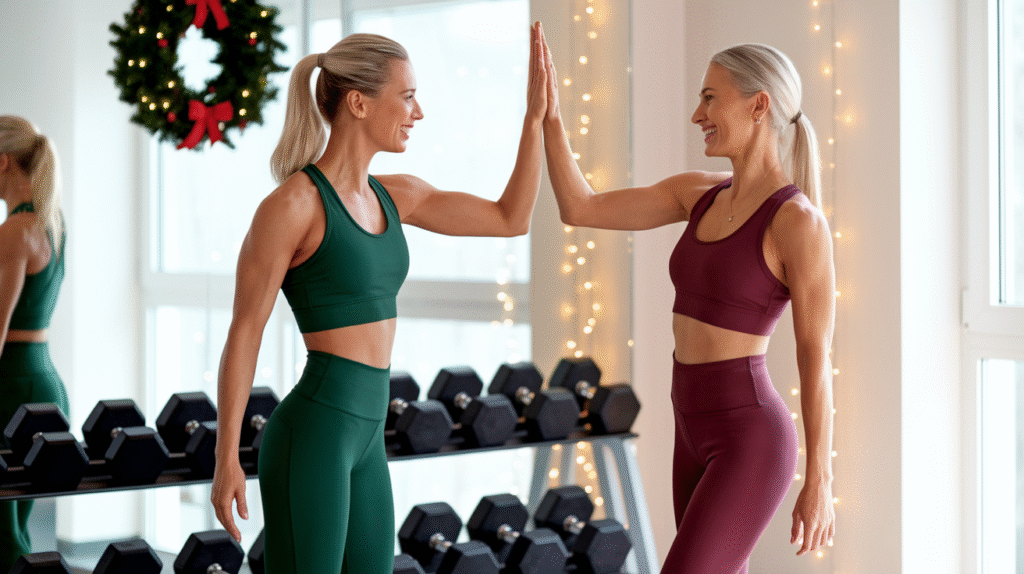
Humans are social creatures. We perform better when someone else is counting on us.
Recruit family members for quick workout sessions. This is especially powerful for stay-at-home parents managing kids during school breaks. Turn exercise into family time. Do jumping jacks with your children.
Challenge your teenager to a plank hold contest. Make it fun, and suddenly you’re not sacrificing family time for fitness—you’re combining them.
Use social media or apps to track progress without feeling intimidated. You don’t need to post gym selfies if that’s not your style. A simple check-in with a friend or a private accountability group works just as well. The key is having someone who notices when you show up and when you don’t.
The buddy system delivers powerful results. Partner with one person—a friend, spouse, or coworker—who’s also committed to staying active during the holidays.
Text each other after workouts. Share struggles and wins. When you’re tempted to skip, knowing someone else is counting on you provides the extra push you need.
Strategy 5: Celebrate Non-Scale Victories

The scale is a terrible measure of progress during the holidays. Water retention from salty foods, hormonal fluctuations, and normal weight variations will mess with that number daily. Stop giving it so much power.
Track energy levels, mood improvements, and stress reduction instead. Notice how much better you handle holiday chaos when you’ve moved your body. Pay attention to the quality of your sleep. Recognize that your jeans still fit comfortably despite the cookie exchange.
Recognize that showing up IS the victory during busy seasons. You don’t need to set a PR or have the perfect workout. You just need to honor your commitment to yourself. That builds character and resilience that extends far beyond fitness.
Consistent movement helps you burn through holiday stress more effectively than any other method. Exercise is proven to reduce cortisol, improve mood, and increase mental clarity. When you’re feeling overwhelmed by gift lists and dinner preparations, a 15-minute workout resets your nervous system better than scrolling social media or pouring another glass of wine.
Quick, Effective Christmas Workout Plans You Can Do Anywhere
The 15-Minute Living Room Tone & Burn
This no-equipment bodyweight circuit targets full-body muscle building and is perfect for busy professionals squeezing in exercise between commitments.
The Circuit (perform each exercise for 45 seconds, rest 15 seconds between moves, complete 3 rounds):
- Squats (builds lower body strength and burns significant calories)
- Push-ups (modifiable on knees for beginners, on toes for advanced)
- Alternating reverse lunges (sculpts legs while improving balance)
- Plank hold (strengthens your entire core)
- Mountain climbers (cardio burst that elevates heart rate)
Modifications for beginners: Reduce work time to 30 seconds, increase rest to 30 seconds, and complete just 2 rounds. For advanced fitness enthusiasts: Add jump squats, explosive push-ups, and extend the plank hold to 60 seconds.
This workout delivers results because it combines strength training with cardiovascular conditioning. You’re building muscle and burning calories simultaneously, which is exactly what you need when time is limited.
The Family-Friendly Holiday Movement Session
Turn fitness into quality time with fun, engaging exercises that work for all ages and fitness levels.
The Family Flow (10 minutes):
- Dance party warm-up (2 minutes of freestyle movement to holiday music)
- Animal walks across the room (bear crawls, crab walks, frog jumps)
- Partner high-five planks (facing each other in plank, alternating high-fives)
- Freeze dance intervals (dance during music, hold a squat when music stops)
- Team relay races (running in place, jumping jacks, or hopping on one foot)
This approach makes fitness feel less intimidating for those just starting their journey. Kids don’t realize they’re exercising—they think they’re playing. Adults get a genuine workout while creating memories. Everyone wins.
The Christmas Morning Energy Booster
Start your holiday with a gentle yet powerful 10-minute routine that combines movement with mindfulness.
The Morning Flow:
- Deep breathing (1 minute, focusing on full inhales and exhales)
- Gentle stretching sequence (cat-cow, child’s pose, downward dog)
- Bodyweight squats (2 sets of 10, focusing on form)
- Standing side bends and twists (opening up your spine)
- Gratitude meditation (1 minute, reflecting on what you’re thankful for)
This proven approach prevents the “I’ll start tomorrow” trap. By moving first thing, you’ve already accomplished something meaningful before the chaos begins. The combination of physical movement and mental centering sets a positive tone for your entire day.
The Post-Feast Recovery Workout
After a big holiday meal, your body benefits from easy digestive-supporting movements that maintain consistency without overwhelming your system.
The Gentle Reset (15 minutes):
- Slow walking (5 minutes, indoors or outdoors)
- Gentle yoga poses (child’s pose, supine twist, legs up the wall)
- Easy stretching (focusing on hips, hamstrings, and lower back)
- Diaphragmatic breathing exercises (supporting digestion)
The science behind this: Moving after eating actually helps with weight management by supporting healthy blood sugar levels and improving digestion. This isn’t about “burning off” your meal—it’s about helping your body process food more efficiently while maintaining your exercise habit.
Overcoming the Top 5 Christmas Fitness Obstacles
Obstacle 1: “I Have No Time Between All These Events”
The truth about time? You have it. You just need to reframe it. You’re not looking for 60-minute blocks—you’re looking for 10-minute gaps.
Micro-workout strategies fit into the smallest windows. Ten minutes before your shower. Fifteen minutes while coffee brews. Twenty minutes while dinner is in the oven. These fragments add up to meaningful movement.
You can burn calories and maintain muscle with minimal time investment. Three 10-minute sessions throughout the day provide similar benefits to one 30-minute workout. Your body doesn’t care how you accumulate the movement—it just responds to the stimulus.
Challenge yourself: Track your screen time for one day. Most people discover they have 30-60 minutes of scrolling or TV watching they could redirect. You have the time. It’s about prioritizing what matters.
Obstacle 2: “I Feel Guilty Working Out Instead of Spending Time with Family”
Reframe fitness as self-care that makes you a better partner, parent, and person. When you’re stressed, exhausted, and depleted, you show up as a lesser version of yourself. When you’ve moved your body and managed your stress, you’re more patient, present, and positive.
Involve loved ones to transform workouts into bonding time. Your family benefits when you include them. Kids learn that fitness is a normal part of life. Partners connect through shared activity. You’re modeling healthy habits while staying consistent.
Set boundaries that empower rather than isolate you. Communicate your needs: “I’m going to take 20 minutes for a quick workout, then I’ll be fully present for our movie night.” Most people respect clear boundaries when you explain why they matter.
Obstacle 3: “I Don’t Want to Miss Out on Holiday Foods”
The realistic approach: Enjoy treats AND maintain your fitness. These aren’t mutually exclusive. Exercise during the holidays isn’t about “earning” food or “burning off” cookies. It’s about maintaining your health, energy, and mental well-being.
Consistent movement helps your body handle indulgences more effectively. When you exercise regularly, your body manages blood sugar better, your metabolism stays active, and you build muscle that burns calories even at rest. This creates a buffer that makes occasional treats less impactful.
The goal isn’t perfection. It’s balance. Enjoy your grandmother’s famous pie. Savor the holiday cocktails. And also move your body regularly. Both can coexist in a healthy, sustainable lifestyle.
Obstacle 4: “My Routine Is Completely Disrupted”
Create a flexible “minimum viable workout” that adapts to any schedule. Define your absolute minimum: “Even on my craziest days, I’ll do 10 minutes of movement.” This prevents all-or-nothing thinking.
The proven power of habit stacking: Attach workouts to existing holiday routines. After you pour your morning coffee, do 5 minutes of stretching. Before you sit down for dinner, do 20 squats. While cookies bake, do a plank hold. Stack new habits onto established ones.
Disruption can actually help you build a more resilient fitness practice. When you learn to exercise in imperfect conditions, you develop adaptability. You prove that your commitment isn’t dependent on ideal circumstances. This makes you unstoppable long-term.
Obstacle 5: “I’m Traveling and Don’t Have Access to Equipment”
Hotel room and guest bedroom workout ideas deliver results without any gear. Bodyweight exercises work anywhere. Push-ups, squats, lunges, planks, burpees, and mountain climbers require nothing but floor space.
Use household items to add resistance and build strength. Water bottles become dumbbells. A sturdy chair enables tricep dips and step-ups. A towel creates resistance for rowing motions. Your suitcase becomes a weight for squats and deadlifts.
The beginner-friendly approach: Focus on consistency over intensity when traveling. Your goal is simply to move daily. A 10-minute hotel room workout maintains your habit and keeps your momentum alive. That’s a win.
Your Christmas Fitness Action Plan
Let’s recap the most powerful strategies that will carry you through this season: Schedule your workouts like non-negotiable appointments. Set realistic goals that prioritize consistency over perfection. Use quick, effective workouts that fit your available time. Maintain a flexible mindset that adapts to circumstances without abandoning your commitment.
The proven truth: Consistency beats intensity, especially during the holidays. You don’t need to train like an athlete in December. You just need to show up regularly. Those small, consistent actions compound into significant results.
Here’s your challenge: Commit to just 15 minutes, 4 times per week through January 1st. That’s one hour total per week. You can find four 15-minute windows in 168 hours. This commitment is achievable, sustainable, and powerful.
The Bigger Picture
Maintaining fitness during Christmas builds mental resilience beyond physical results. You’re training your discipline, proving your commitment, and developing the identity of someone who follows through even when it’s hard. These qualities transform every area of your life.
You’re not just sculpting your body—you’re proving to yourself that you can stay committed when it’s hardest. That self-trust becomes the foundation for achieving any goal. When you demonstrate to yourself that you keep promises even during chaos, you become unstoppable.
The empowering reality: By reading this guide and taking action, you’re already ahead of where you were yesterday. You’ve invested time in your growth. You’ve armed yourself with strategies. You’ve made the decision that this December will be different.
Your Next Steps
Choose ONE strategy from this guide to implement tomorrow. Don’t try to overhaul everything at once. Pick the approach that resonates most—maybe it’s scheduling workouts in your calendar, or creating a simple home workout space, or recruiting an accountability partner. Start there.
Set up your home workout space tonight, even if it’s just clearing a 6×6 foot area and laying out your workout clothes. Remove friction. Make movement easy.
Remember: The goal isn’t perfection—it’s progress, consistency, and showing up for yourself when it matters most. You don’t need to have the perfect workout every time. You just need to honor your commitment more often than you break it.
This Christmas season, you’re not choosing between your fitness and your life. You’re integrating both. You’re proving that you can maintain what matters while fully experiencing the joy, connection, and celebration that make this time special.
You’ve got this. Now go move your body.