11 Best Somatic Exercises for Beginners

Have you ever noticed your shoulders creeping up to your ears during a stressful day, or felt your jaw clenching without realizing it?
Maybe you’ve experienced that tight knot in your stomach before an important meeting, or the way your chest constricts when anxiety hits.
These aren’t just random physical reactions—they’re your body speaking a language you might not have learned to understand yet.
Our bodies are remarkable record-keepers. Every stressful commute, every difficult conversation, every moment of anxiety or fear gets stored somewhere in our muscles, tissues, and nervous system.
While our minds might move on from these experiences, our bodies often hold onto them, creating patterns of chronic tension, pain, and dysregulation that we accept as normal.
This disconnect between mind and body has become so common in modern life that we’ve forgotten what it feels like to truly inhabit our physical selves.
This is where somatic exercises come in—not as another fitness trend or workout routine, but as a gentle, accessible way to help your body release what it’s been holding onto.
Unlike traditional exercise that focuses on burning calories or building strength, somatic exercises are about tuning inward, listening to your body’s signals, and allowing your nervous system to complete the stress cycles it’s been stuck in.
In this comprehensive guide, you’ll discover 11 accessible somatic exercises specifically designed for complete beginners. No prior experience needed. No special equipment required.
No complicated movements to master. Just simple, mindful practices that you can start today, right where you are. Whether you’re dealing with chronic tension, anxiety, stress, or simply want to feel more at home in your body, these exercises offer a pathway to relief that works with your body’s natural healing abilities rather than against them.
The beauty of somatic practice is that it meets you exactly where you are. You don’t need to be flexible, fit, or coordinated. You don’t need to “get it right.”
In fact, the entire focus shifts from external performance to internal sensation—from how you look to how you feel. This fundamental shift makes somatic exercises uniquely accessible to people of all ages, fitness levels, and physical abilities.
Understanding Somatic Movement
The Mind-Body Connection Explained
Somatic exercises are gentle, mindful movements focused on internal bodily awareness and sensations rather than external appearance or performance.
The word “somatic” comes from the Greek word “soma,” meaning “the body as experienced from within.” This distinction is crucial: while traditional exercise asks “how many reps?” or “how does this look?”, somatic practice asks “what do I feel?” and “what is my body telling me?”
The core principle underlying all somatic work is beautifully simple yet profound: every human experience gets stored in the body. Not just through emotions and thoughts, but through physical sensations, muscle tension patterns, and nervous system states.
When you experience stress, your body responds with a cascade of physiological changes—increased heart rate, muscle tension, shallow breathing.
In an ideal world, once the stressor passes, your body would naturally complete this stress cycle and return to baseline calm.
But in our modern lives, we rarely get that completion. Instead, we suppress, push through, or move on to the next stressor, leaving our bodies stuck in various stages of the stress response.
This is fundamentally different from traditional exercise. When you go to the gym, you focus on external metrics: how much weight you’re lifting, how many miles you’re running, whether your form matches the instructor’s.
Somatic exercises flip this entirely inward. You might make the same physical movement, but your attention stays with the internal experience—the quality of sensation, the subtle shifts in tension, the way your breath moves through your body.
How Somatic Exercises Work
At the heart of somatic practice is nervous system regulation. Your autonomic nervous system has two primary branches: the sympathetic (fight-or-flight) and parasympathetic (rest-and-digest).
Modern life keeps most of us tilted heavily toward sympathetic activation—constantly alert, ready to respond, never fully relaxed.
Somatic exercises specifically activate the parasympathetic response, signaling to your nervous system that it’s safe to let go, rest, and heal.
The trauma and tension release mechanism is equally important. When we experience overwhelming stress or trauma, our bodies engage protective responses—fleeing, bracing, stiffening, or collapsing.
We’re evolutionarily wired to respond this way automatically and unconsciously. The problem arises when these protective patterns get stuck.
Your body might still be bracing against a threat that ended years ago, creating chronic tension patterns that manifest as neck pain, headaches, digestive issues, or anxiety.
Here’s where somatic exercises draw wisdom from nature: watch how animals naturally shake off stress. A gazelle that escapes a predator will literally shake and tremble, completing the stress cycle and allowing its nervous system to settle.
Humans have this same capacity, but we’ve learned to suppress it. Somatic exercises give you permission and tools to complete these natural cycles safely.
Key Principles for Beginners
As you begin your somatic practice, keep these foundational principles in mind:
Slow, deliberate movements: Speed contradicts everything somatic work is about. When you move slowly, you can actually feel what’s happening in your body.
You notice the quality of sensation, the places of resistance, the moments of release. Rushing through movements keeps you in your head; slowing down brings you into your body.
Non-judgmental awareness: This might be the most challenging principle for beginners. We’re conditioned to evaluate and critique our bodies constantly.
Somatic practice asks you to simply notice without judgment. Not “this tension is bad” but “I notice tension here.” Not “I’m doing this wrong” but “this is what I’m experiencing right now.”
Breath coordination: Your breath is the bridge between your conscious and unconscious nervous system. It’s both automatic and controllable, making it the perfect tool for regulation.
In somatic exercises, you’ll learn to coordinate breath with movement and use breathing patterns to signal safety to your nervous system.
Focus on sensation, not perfection: There’s no perfect way to do somatic exercises. Two people doing the same exercise might have completely different experiences, and that’s exactly right.
Your only job is to notice what you feel—tingling, warmth, tension, ease, emotion, or nothing at all. All experiences are valid.
Safety and comfort first: If something hurts (not just uncomfortable, but actually painful), stop. If an exercise triggers overwhelming emotions, slow down or choose something gentler. Your body has been through enough. This practice is about creating safety, not pushing through.
Why Somatic Exercises Work
Physical Benefits
The physical benefits of regular somatic practice extend far beyond simple relaxation:
Release chronic muscle tension and pain: Many people carry tension patterns for years—tight shoulders, clenched jaw, lower back pain—without realizing these are protective holding patterns.
Somatic exercises help your nervous system recognize these patterns and release them, often providing relief where stretching and massage have failed.
Improve flexibility and mobility: Unlike forcing your body into positions, somatic movement re-educates your nervous system about what’s safe and possible.
When your nervous system stops sending constant tension signals, your natural range of motion often returns without forcing.
Reduce inflammation from stress: Chronic stress creates chronic inflammation, which contributes to everything from pain to disease. By regulating your nervous system, somatic exercises address inflammation at its source.
Re-educate your nervous system: Perhaps the most powerful physical benefit is neuroplasticity—your nervous system’s ability to create new patterns. Somatic exercises teach your body that it doesn’t need to maintain those protective tension patterns anymore.
Mental and Emotional Benefits
The mental and emotional benefits often surprise people who approach somatic work expecting only physical results:
Regulate anxiety and stress responses: When you learn to recognize and shift your nervous system state through somatic practice, you gain real-time tools for managing anxiety. Instead of being at the mercy of your stress response, you can actively participate in regulating it.
Process stored trauma safely: Trauma isn’t just a memory—it’s a physiological state that gets stuck in your body. Somatic exercises provide a gentle pathway for releasing these stuck states without having to verbally process or relive traumatic experiences.
Restore sense of safety and grounding: Many people live in a constant state of low-level threat activation. Somatic practice helps your nervous system remember what safety feels like, creating a physiological foundation for emotional well-being.
Enhance emotional awareness and regulation: As you develop sensitivity to physical sensations, you also become more aware of emotions as they arise in your body. This early awareness gives you more choice in how you respond.
Improve sleep quality: A regulated nervous system sleeps better. When you practice somatic exercises, especially in the evening, you signal to your body that it’s safe to move into deep rest states.
Long-Term Wellness Impact
The true power of somatic practice reveals itself over time. With regular practice, you’ll notice cumulative effects: faster stress recovery, earlier awareness of tension patterns, and a growing sense of being at home in your body.
These exercises become preventive medicine, helping you avoid stress-related conditions before they develop. Perhaps most importantly, you develop enhanced body awareness that carries into daily life, giving you better tools for managing whatever challenges arise.
Before You Begin

Creating Your Practice Space
Your environment matters when you’re learning to tune into subtle internal sensations. Choose a quiet, distraction-free space where you won’t be interrupted.
This might be a corner of your bedroom, a spot in your living room, or even your office with the door closed. You’ll need a comfortable surface—a yoga mat is ideal, but carpet, a folded blanket, or even your bed works perfectly well.
Some exercises benefit from having a mirror available, not for checking your form, but for grounding practices that involve visual feedback.
Most importantly, ensure you have privacy for emotional release. Somatic work can bring up unexpected emotions, and you need to feel safe enough to let whatever arises move through you.
Essential Guidelines
Before diving into the exercises, understand these foundational guidelines:
Pace: Move slowly—this cannot be emphasized enough. Speed contradicts somatic principles entirely. When you slow down, you can actually feel what’s happening in your body, notice the quality of sensations, and allow your nervous system time to register and respond to the movements.
Breathing: Coordinate breath with movement whenever possible, and use conscious breathing as a relaxation tool. Your breath should be natural and easy, never forced or strained. In somatic work, the breath often leads the movement rather than the other way around.
Awareness: Notice sensations without judgment. This means observing what you feel—tingling, warmth, tension, ease, emotion—without labeling it as good or bad, right or wrong. You’re developing a curious, friendly relationship with your body’s signals.
Safety: Stop if you experience pain. Discomfort is okay—that slight sense of resistance or the emotional vulnerability of opening to sensation. But sharp pain, shooting sensations, or overwhelming distress means you need to slow down, modify, or choose a different exercise.
Duration: Start with just 5-10 minutes and build gradually. Somatic work can be surprisingly intense, even though the movements look gentle. Your nervous system needs time to adapt to this new way of moving and feeling.
When to Seek Professional Guidance
While these exercises are safe for most people to practice independently, certain situations call for professional support.
If you’re working through specific trauma or dealing with severe anxiety or PTSD, a trained Somatic Experiencing practitioner can provide crucial guidance.
Similarly, chronic pain without clear cause, exercises that repeatedly trigger overwhelming emotions, or a desire for deeper trauma processing all suggest working with a qualified professional.
It’s important to note that Somatic Experiencing therapy—the formal therapeutic approach—must be guided by a trained therapist.
The exercises in this article are for general wellness and stress management, not trauma therapy. If you’re dealing with significant trauma, these exercises can complement professional treatment but shouldn’t replace it.
Your Complete Beginner’s Routine

1. Body Scan Meditation
Difficulty: Easiest
Time: 5-10 minutes
Best for: Building body awareness, bedtime relaxation
Body scan meditation is the foundation of somatic awareness. It teaches you to systematically notice sensations throughout your body without trying to change anything. This practice of pure observation is deceptively powerful—simply paying attention begins to shift stuck patterns.
Step-by-step instructions:
- Lie down on your back with legs extended or knees bent, arms resting comfortably at your sides. You can also sit in a comfortable chair if lying down isn’t accessible.
- Close your eyes or soften your gaze toward the floor. If closing your eyes feels unsafe or uncomfortable, keeping them open is perfectly fine.
- Bring your attention to your toes. Don’t try to feel anything specific—just notice whatever sensations are present. You might feel tingling, warmth, coolness, pressure, or nothing at all. All of these are valid experiences.
- Slowly move your awareness up through each body part: feet, ankles, lower legs, knees, thighs, hips, lower back, abdomen, chest, fingers, hands, arms, shoulders, neck, jaw, face, and crown of head. Spend 20-30 seconds with each area.
- As you scan, observe without trying to change anything. If you notice tension, just note it. If you notice ease, note that too. Your only job is to be a curious observer.
- When you reach the top of your head, take three deep breaths, feeling your entire body with each breath. Then slowly open your eyes and notice how you feel.
Beginner tips: Many people feel nothing at first, and that’s completely normal. Sensation awareness is a skill that develops with practice.
Start with eyes open if closing them triggers anxiety. Using guided recordings initially can help you stay focused and learn the pattern.
Common sensations: You might experience tingling, warmth, heaviness, lightness, pulsing, or areas of numbness. Some people feel energy moving or emotions arising. Others feel very little initially. All experiences are part of the process.
2. Progressive Muscle Relaxation (PMR)
Difficulty: Easy
Time: 10-15 minutes
Best for: Releasing physical tension, pre-sleep routine
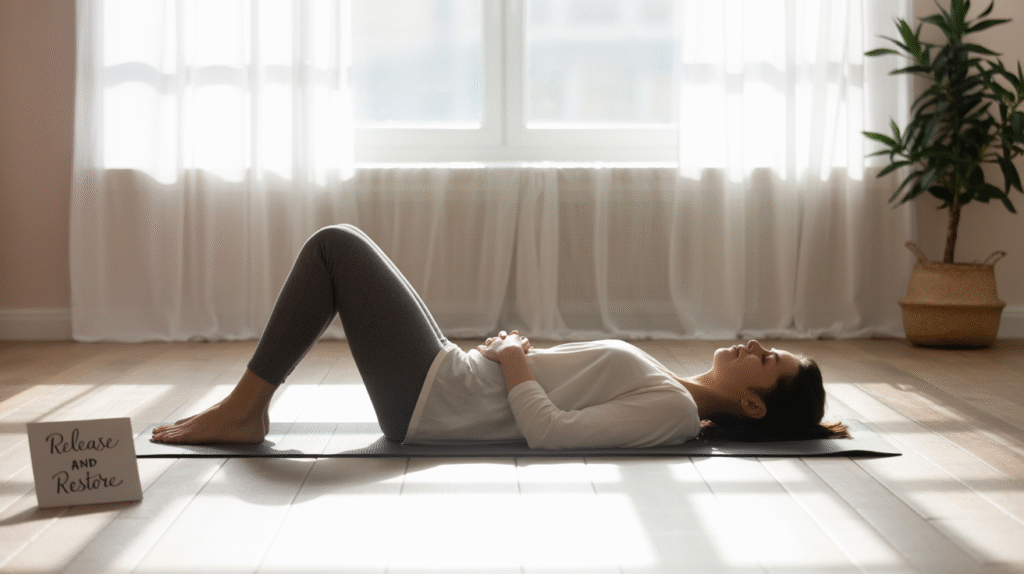
Progressive muscle relaxation teaches your body to recognize the difference between tension and release. By deliberately creating tension and then letting it go, you train your nervous system to identify and release chronic holding patterns.
Step-by-step instructions:
- Start lying down or seated comfortably with good support. Close your eyes if comfortable.
- Begin with your feet. Curl your toes tightly, tensing all the muscles in your feet. Hold this tension for exactly 5 seconds, breathing normally.
- Release suddenly and completely, like cutting a string. Notice the wave of relaxation, the contrast between the tension you just created and the release you’re experiencing now. Rest for 10-15 seconds, observing the sensations.
- Move systematically through your body: calves (point toes toward shins), thighs (squeeze legs together), glutes (squeeze tightly), abdomen (draw navel toward spine), chest (take deep breath and hold), hands (make fists), arms (bend arms and flex biceps), shoulders (raise toward ears), neck (gently press head back into surface), face (scrunch everything toward nose).
- For each muscle group, hold the tension for exactly 5 seconds, then release completely. Rest 10-15 seconds between each area, noticing the quality of relaxation.
- After completing all muscle groups, take three deep breaths and scan your entire body, noticing the overall sense of relaxation.
Beginner tips: Don’t tense so hard that it causes pain—about 70% of your maximum tension is perfect. The magic is in the contrast between tension and release, not in how hard you can squeeze. If you have injuries in certain areas, skip those muscle groups or use very gentle tension.
Why it works: Most of us carry chronic tension without realizing it. Our “relaxed” state is actually partially tensed. By deliberately creating tension and then releasing it, you teach your nervous system what true relaxation feels like, making it easier to access that state in daily life.
3. Grounding Exercise (Barefoot Connection)
Difficulty: Easiest
Time: 5-10 minutes
Best for: Anxiety relief, feeling disconnected or “spacey”
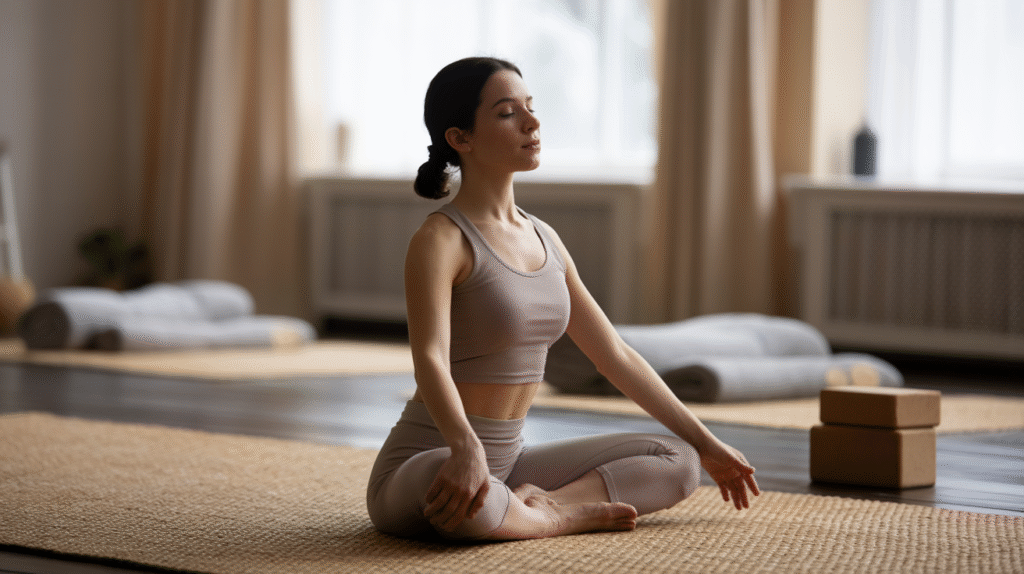
Grounding exercises reconnect you to the present moment through physical sensation. When anxiety pulls you into future worries or trauma pulls you into the past, grounding brings you back to here and now.
Step-by-step instructions:
- Stand barefoot on grass, sand, carpet, or floor. Remove your shoes and socks to maximize sensory input.
- Position your feet slightly wider than hip-width apart for stability. Let your knees be soft, not locked.
- Close your eyes or lower your gaze to the floor. Begin to notice the complete surface of your feet against the ground. What’s the temperature? What’s the texture? Where do you feel the most pressure?
- Spend a full minute just noticing these sensations. Notice the ball of your foot, your heel, the outside edge, the inside arch, your toes.
- Gently shift your weight from side to side, front to back. Move slowly, noticing how the sensations change as weight shifts.
- Press down through all four corners of your feet—big toe mound, little toe mound, inside heel, outside heel. Imagine you’re creating a stable foundation.
- Visualize roots growing from the soles of your feet deep into the earth. With each exhale, imagine these roots growing deeper, anchoring you more firmly.
Beginner tips: If standing is difficult, you can do this seated, pressing your feet firmly into the floor. The key is the attention you bring to the sensations, not the specific position. This exercise is particularly powerful outdoors on natural surfaces like grass or sand.
When to use: Practice grounding during anxiety or panic, after overwhelming experiences, when you feel “spacey” or dissociated, or as a way to start your day with presence and stability.
4. Somatic Breathing (Wave Breath)

Difficulty: Easy
Time: 3-5 minutes
Best for: Immediate stress relief, nervous system reset
Wave breath coordinates gentle spinal movement with breathing, creating a wave-like motion that activates the parasympathetic nervous system and releases spinal tension.
Step-by-step instructions:
- Sit comfortably on the floor or in a chair with your spine relatively straight but not rigid. Rest your hands on your thighs or knees.
- Take a moment to notice your natural breath without changing it.
- On your next inhale, gently arch your back, lifting your chest and heart forward and up. Your gaze lifts slightly. The movement should be subtle, like a gentle wave moving through your spine.
- On the exhale, round your spine, drawing your navel toward your spine and tucking your chin slightly. Again, keep the movement subtle and flowing.
- Create a smooth, continuous wave-like motion through your spine, with your breath leading the movement. Don’t force the movement to fit the breath or vice versa—let them flow together naturally.
- Move slowly, taking 10-15 seconds for one complete breath cycle (inhale and exhale). This is much slower than your normal breathing, which is intentional.
- Repeat for 10-15 cycles, then return to stillness and notice how you feel.
Beginner tips: Keep movements subtle—this isn’t about achieving a big stretch. Focus on the breath leading the movement rather than forcing your spine into positions. If sitting on the floor is uncomfortable, this works beautifully in a chair.
Variation: You can also practice wave breath lying down with knees bent. On the inhale, your lower back gently arches away from the floor. On the exhale, your lower back presses into the floor.
5. Gentle Swaying

Difficulty: Easiest
Time: 3-5 minutes
Best for: Self-soothing, emotional regulation, releasing stuck energy
Gentle swaying mimics the natural self-comforting movements we used as children. This rhythmic movement is deeply regulating to the nervous system and helps release stuck energy.
Step-by-step instructions:
- Stand with feet hip-width apart, knees soft and slightly bent. Let your arms hang loosely at your sides.
- Begin gently rocking from side to side, shifting your weight from foot to foot. Start with very small movements, just a few inches.
- Let your arms hang loosely, swaying naturally with the movement of your body. Don’t control them—let them be moved by the rocking motion.
- Keep the movement small and rhythmic, finding a pace that feels soothing. Some people prefer slower swaying, others slightly faster. There’s no right answer.
- Close your eyes if it feels safe and comfortable. This helps you focus on the internal sensations rather than how you look.
- Notice any emotions or sensations that arise. You might feel silly at first, then peaceful. You might feel sadness or joy. Whatever arises is welcome.
- Continue for 3-5 minutes, then slowly come to stillness. Stand quietly for a moment and notice the effects.
Beginner tips: This exercise often feels awkward or silly at first—that’s completely normal. The self-consciousness usually passes after a minute or two. If standing isn’t comfortable, you can practice seated swaying in a chair. Some people find it helpful to play gentle music.
Why it works: Swaying activates the vestibular system (your inner ear balance system), which has direct connections to the parts of your brain that regulate emotion and stress. This is why rocking is naturally calming—it’s not just psychological, it’s neurological.
6. Therapeutic Shaking

Difficulty: Easy-Moderate
Time: 2-5 minutes
Best for: Releasing acute stress, post-anxiety episode, stored tension
Therapeutic shaking mimics the natural stress-release behavior seen in animals. This exercise helps your body complete the stress cycles that get interrupted in daily life.
Step-by-step instructions:
- Stand with feet hip-width apart and knees slightly bent. This bent-knee position is important—it allows the shake to move through your body more freely.
- Begin bouncing gently on your feet, letting your knees bend and straighten in a small, rhythmic movement.
- Allow this bounce to create a shake that moves through your legs, up into your torso, and through your arms. Don’t choreograph or control it—let it be natural and messy.
- You can shake your hands, let your head move gently, allow your whole body to participate. There’s no right way to look—this is about release, not performance.
- Start with just 30 seconds if this feels vulnerable or intense. You can gradually build to 2-5 minutes as you become comfortable with the practice.
- When you’re ready to stop, slow down gradually rather than stopping abruptly. Come to stillness and stand quietly for a moment, noticing how you feel.
- Take several deep breaths and observe any shifts in your body or emotional state.
Beginner tips: This exercise can feel very vulnerable, especially if you’re self-conscious. Practice alone initially, or start by just shaking your hands or legs while seated. It’s normal for emotions to arise during shaking—this is actually the release working. If it becomes overwhelming, slow down or stop, but know that some emotional release is therapeutic.
Important note: Shaking may bring up stored emotions, memories, or sensations. This is normal and part of the healing process. If you have significant trauma, you might want to try this exercise first with a somatic practitioner present.
7. Somatic Stretching (Mindful Cat-Cow)
Difficulty: Easy
Time: 5-7 minutes
Best for: Back pain, improving spinal mobility, morning routine
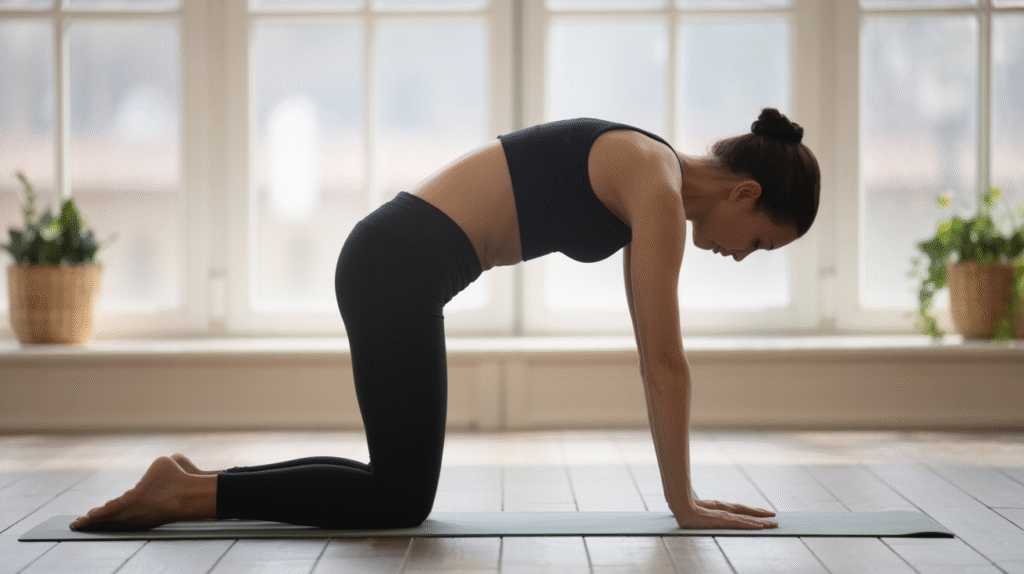
Somatic stretching takes familiar movements like cat-cow and adds the crucial element of internal awareness. This isn’t about achieving a perfect pose—it’s about feeling each vertebra move and releasing held tension in the spine.
Step-by-step instructions:
- Start on your hands and knees in tabletop position. Hands directly under shoulders, knees under hips. Spread your fingers wide for stability.
- Begin in neutral spine, noticing how your back feels right now. Take a full breath here.
- On your next inhale, slowly drop your belly toward the floor, lift your chest and tailbone toward the ceiling, and let your gaze lift gently (cow pose). Take 5-7 seconds for this transition—much slower than typical yoga.
- Hold this position for three deep breaths, noticing sensations in your spine, belly, chest, and throat.
- On an exhale, slowly round your spine, tucking your tailbone, drawing your navel toward your spine, and dropping your head (cat pose). Again, take 5-7 seconds for this transition.
- Hold cat pose for three deep breaths, noticing the stretch along your back, the engagement in your abdomen, the position of your head and neck.
- As you move between positions, try to feel each vertebra moving. Imagine your spine is a chain, and you’re moving one link at a time.
- Repeat this cycle 5-10 times, always moving slowly and keeping your attention on internal sensation rather than external form.
Beginner tips: Unlike yoga, where you might be corrected on form, somatic cat-cow asks you to focus entirely on how it feels, not how it looks. If your wrists hurt, try it on your forearms instead. If being on the floor is difficult, you can do a seated version in a chair.
Somatic difference: In traditional yoga, you might hold cat-cow for one breath cycle each and move quickly through multiple repetitions.
In somatic practice, you slow way down, hold each position for multiple breaths, and keep your attention on the internal landscape of sensation. This shift from external form to internal awareness is what makes it somatic.
8. Bilateral Stimulation (Butterfly Hug)

Difficulty: Easiest
Time: 2-3 minutes
Best for: Acute anxiety, panic, emotional overwhelm
The butterfly hug uses bilateral stimulation—alternating left-right stimulation—to reset the nervous system. This technique is similar to what’s used in EMDR therapy and can be remarkably effective for acute anxiety.
Step-by-step instructions:
- Cross your arms over your chest, placing your right hand on your left shoulder and your left hand on your right shoulder. This creates an “X” across your chest.
- Alternately tap your left shoulder, then your right shoulder, in a slow, rhythmic pattern. The taps should be gentle but firm enough to feel.
- Tap at a pace that feels soothing—roughly one tap per second, like a slow heartbeat. Imagine butterfly wings gently opening and closing.
- Continue this alternating pattern for 1-2 minutes, breathing naturally.
- Pause, rest your hands over your heart, and take three deep breaths.
- Notice any shifts in your anxiety level, body sensations, or emotional state.
- You can repeat for another cycle if needed.
Beginner tips: If crossing your arms is uncomfortable, you can alternately tap your knees, thighs, or march in place with alternating feet. The key is the bilateral (left-right) alternating stimulation, not the specific position.
Science: Bilateral stimulation engages both hemispheres of your brain, which helps process emotional experiences and calm the nervous system. This technique is used in EMDR (Eye Movement Desensitization and Reprocessing) therapy for trauma processing, but the butterfly hug version can be used for general anxiety management.
9. Somatic Yoga (Child’s Pose with Awareness)
Difficulty: Easy
Time: 5-10 minutes
Best for: Anxiety, feeling overwhelmed, need for safety
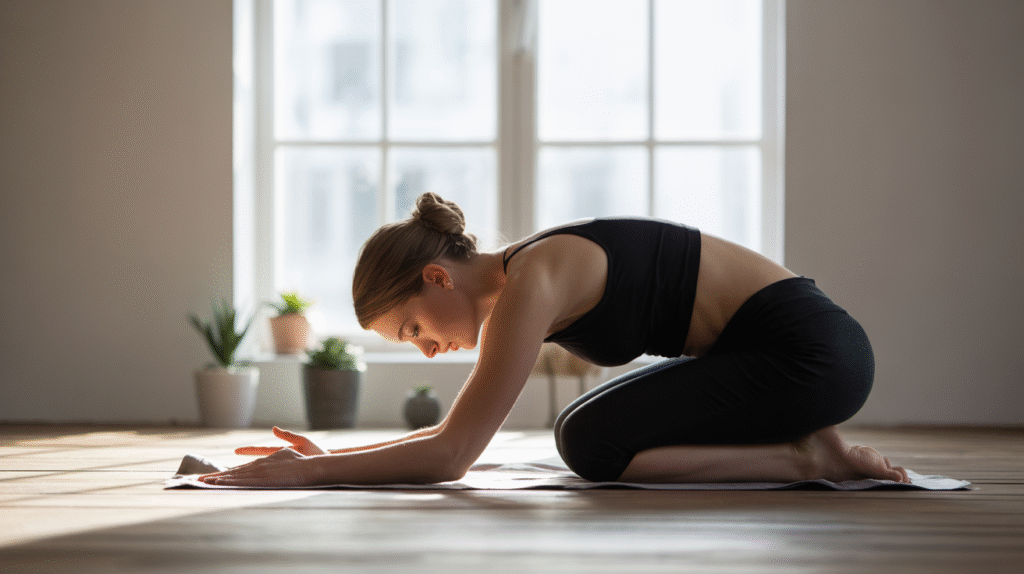
Child’s pose creates a physical sense of protection and safety while gently releasing tension in the back, shoulders, and hips. The somatic version adds conscious awareness of the safety and support you’re feeling.
Step-by-step instructions:
- Kneel on the floor with your big toes touching and knees separated about hip-width (or wider if more comfortable).
- Sit back on your heels. If this is uncomfortable, place a folded blanket or pillow between your hips and heels.
- Fold forward, bringing your forehead toward the ground. Use a pillow, block, or folded blanket under your forehead if it doesn’t comfortably reach the floor.
- Extend your arms forward, palms down, or rest them alongside your body with palms up—whichever feels more restful.
- Close your eyes and focus on your breath expanding into your back body. Feel your back rise with each inhale, soften with each exhale.
- Notice the sensation of the ground supporting your forehead. Feel the weight of your body being held by the earth beneath you.
- Scan through your body, noticing any areas of tension in your back, shoulders, hips, or neck. You don’t need to change anything—just notice.
- Stay for 3-5 minutes, breathing deeply and allowing gravity to do the work of releasing tension.
- To come out, walk your hands back toward your body and slowly roll up to sitting, taking your time.
Beginner tips: This should feel restful, not straining. Use as many props as you need to make it comfortable—pillows under your forehead, between your hips and heels, under your chest. If kneeling isn’t possible, you can create a similar effect by folding forward over a pile of pillows while seated in a chair.
Somatic element: The key difference between regular child’s pose and somatic child’s pose is the emphasis on noticing feelings of safety and support. This isn’t just a stretch—it’s a practice of allowing yourself to be held and supported.
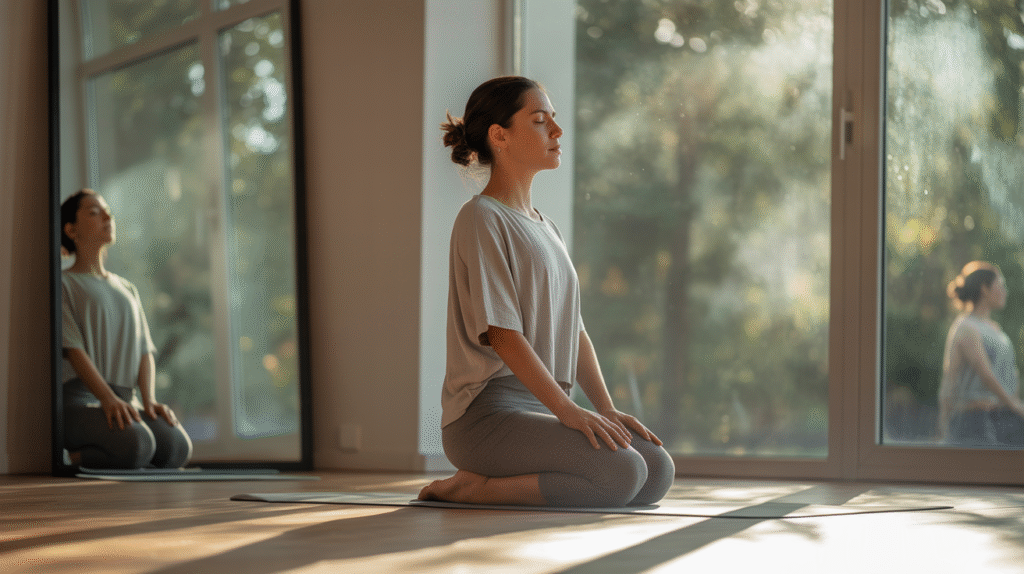
10. Mirror Grounding Practice
Difficulty: Moderate
Time: 5-10 minutes
Best for: Dissociation, building self-connection, body image work
Mirror grounding combines visual feedback with physical sensation to create a powerful grounding experience. This practice can feel vulnerable but is particularly effective for people who struggle with dissociation or feeling disconnected from their bodies.
Step-by-step instructions:
- Stand in front of a mirror, barefoot if possible, with feet hip-width apart.
- Take a moment to simply look at yourself. Not critically, not judgmentally—just looking. Make eye contact with your own reflection.
- Place your hands on your body—perhaps one on your belly and one on your chest, or both on your shoulders. Experiment with what feels grounding and comforting.
- Press your feet firmly into the ground, feeling all four corners of each foot making contact.
- While maintaining eye contact with yourself in the mirror, speak grounding statements aloud: “I am here.” “I am safe.” “This is my body.” “I am present in this moment.”
- Notice your reflection as you breathe deeply. Watch your chest or belly rise and fall. See the movement of your body.
- Observe without judgment. If critical thoughts arise, acknowledge them and return to simple observation.
- Continue for 5-10 minutes, maintaining the connection between seeing yourself, feeling your hands on your body, and feeling your feet on the ground.
Beginner tips: This exercise can feel extremely vulnerable, especially if you have a difficult relationship with your body or struggle with body image. Start with just 1-2 minutes. You can be fully clothed or practice during your morning or evening routine. The vulnerability is part of the healing—you’re practicing being present with yourself.
When to use: This is particularly helpful after dissociative episodes when you feel disconnected from your body or reality. It’s also valuable as a morning practice to start your day grounded in your physical presence, or as part of body image healing work.
11. Soothing Breath with Touch

Difficulty: Easy
Time: 3-5 minutes
Best for: Self-compassion, emotional regulation, bedtime
This exercise combines breathwork with nurturing touch, creating a dual calming effect. The physical touch releases oxytocin (the bonding hormone), while the breath pattern activates the parasympathetic nervous system.
Step-by-step instructions:
- Sit comfortably or lie down on your back. Close your eyes if comfortable.
- Place one hand on your heart center (middle of your chest) and one hand on your belly, just below your navel.
- Take a moment to simply feel the warmth and weight of your hands. This is your own caring touch.
- Begin breathing deeply, feeling your hands rise and fall with your breath. Notice the movement under your palms.
- Inhale slowly through your nose for a count of 4, feeling your belly expand into your hand.
- Hold your breath gently for a count of 4.
- Exhale slowly through your nose or mouth for a count of 6-8. This longer exhale is key—it activates the calming branch of your nervous system.
- As you breathe, notice the warmth building under your hands, the gentle pressure, the rhythm of rise and fall.
- Repeat this cycle 10-15 times, or for 3-5 minutes.
- When you finish, rest for a moment with your hands still in place, noticing how you feel.
Beginner tips: The touch should feel comforting, like a friend’s reassuring hand. Adjust the pressure to what feels supportive—some people prefer light touch, others prefer firmer pressure. If placing your hands on your body doesn’t feel comfortable, you can rest them on your thighs or hold your own hand instead.
Variation: Experiment with hand placement. Some people find one hand on the heart and one on the forehead soothing. Others prefer both hands on the belly. There’s no wrong placement—use what feels most comforting to you.
Creating Your Somatic Practice Routine
Sample Routines for Different Needs
The beauty of having multiple somatic exercises in your toolkit is that you can combine them to address specific needs. Here are some sample routines to get you started:
Morning Grounding Routine (10 minutes)
- Grounding Exercise (3 minutes): Start your day connected to your body and the present moment
- Wave Breathing (3 minutes): Wake up your spine and energize your nervous system
- Somatic Cat-Cow (4 minutes): Release overnight tension and prepare your body for the day
Anxiety Relief Routine (8 minutes)
- Butterfly Hug (2 minutes): Immediate nervous system reset
- Grounding Exercise (3 minutes): Anchor yourself in the present
- Soothing Breath with Touch (3 minutes): Activate your calming response
Evening Wind-Down Routine (15 minutes)
- Body Scan (7 minutes): Transition from doing to being
- Progressive Muscle Relaxation (5 minutes): Release the day’s accumulated tension
- Child’s Pose (3 minutes): End in a position of rest and safety
Quick Reset (5 minutes) When you only have a few minutes but need immediate relief:
- Therapeutic Shaking (2 minutes): Release acute stress
- Wave Breathing (3 minutes): Regulate your nervous system
Progression Tips for Beginners
Building a sustainable somatic practice is about consistency and gradual expansion, not perfection. Here’s a realistic progression path:
Week 1-2: Choose 2-3 exercises that resonate with you. Practice them daily, even if just for 5 minutes. Focus on learning the movements and beginning to notice sensations. Don’t worry about doing them “right”—just do them.
Week 3-4: Add 1-2 new exercises to your repertoire. Start noticing which exercises help with which situations. Maybe you discover that grounding works best for anxiety, while shaking helps after stressful meetings.
Month 2+: Begin creating personalized combinations based on what you’ve learned about your body’s needs. You now have enough experience to intuitively choose what will help in different moments.
Listen to your body: Some days you’ll need gentle, quiet practices like body scanning. Other days you’ll need more active release through shaking or swaying. Your needs change day to day, and your practice should reflect that.
Common Challenges and Solutions
Challenge: “I don’t feel anything”
This is the most common challenge for beginners, and it’s completely normal. Years of disconnection from your body means sensation awareness is a skill that needs to be rebuilt.
Solution: This is actually not a problem—it’s just where you’re starting. Sensation awareness develops with consistent practice. Try committing to body scan meditation daily for two weeks. Even if you don’t feel much, you’re building the neural pathways for body awareness.
Challenge: “I feel emotional during exercises”
Many people are surprised when tears, sadness, anger, or even joy arise during somatic practice. This can feel confusing or concerning.
Solution: This is actually the release working. Emotions that have been stored in your body are finally finding a way out. This is therapeutic, not problematic. Allow the tears or feelings to move through you while continuing to breathe. If it becomes overwhelming, you can slow down, open your eyes, or choose a gentler exercise. But some emotional release is a sign of healing.
Challenge: “I don’t have time”
Modern life is busy, and adding one more thing can feel impossible.
Solution: Even 3 minutes makes a difference. Somatic exercises work cumulatively—brief, consistent practice is more effective than occasional long sessions. Try attaching your practice to existing habits: wave breathing while your morning coffee brews, body scan before sleep, grounding while brushing your teeth.
Challenge: “I feel silly or self-conscious”
Especially with exercises like swaying or shaking, many people feel awkward or self-conscious.
Solution: Privacy helps—practice when you’re alone, at least initially. Remember, this is for your nervous system, not for performance or anyone else’s approval. The self-consciousness usually passes after the first minute or two as you drop into the internal experience. Starting with eyes-closed exercises can also help you focus inward rather than worrying about how you look.
Tips for Deeper Practice
Enhancing Mind-Body Connection
To deepen your somatic practice beyond just doing the exercises:
Journal after practice: Keep a simple notebook where you jot down what you noticed—physical sensations, emotions, insights, or even just “felt calm” or “didn’t notice much.” Over time, patterns emerge that help you understand your body’s language.
Track patterns: Which exercises help most with specific issues? You might discover that shaking is your go-to for acute anxiety, while body scanning helps with insomnia. This personalized knowledge makes your practice more effective.
Be curious, not critical: Approach sensations with genuine interest rather than judgment. Instead of “I shouldn’t be so tense,” try “Interesting, there’s tension in my shoulders today. I wonder what that’s about?”
Consistency over intensity: Daily 5-minute practice beats weekly 30-minute sessions. Your nervous system responds to regular, repeated signals that it’s safe to release and relax.
Combining with Other Practices
Somatic exercises complement and enhance other wellness practices:
Meditation: Many people find sitting meditation challenging because of body discomfort or restlessness. Somatic exercises prepare your body for meditation, releasing physical tension so you can sit more comfortably.
Therapy: Talk therapy addresses the cognitive and emotional aspects of healing, while somatic work addresses the physiological. Many therapists now incorporate somatic techniques, and doing your own somatic practice between sessions can deepen therapeutic work.
Traditional exercise: Use somatic exercises as a warm-up or cool-down for your regular workouts. A few minutes of body scanning or wave breathing before exercise helps you move with more awareness and reduces injury risk.
Yoga: If you already practice yoga, bring somatic awareness to your existing practice. Slow down, focus on internal sensation rather than achieving poses, and notice how this shift changes your experience.
Signs Your Practice Is Working
How do you know if somatic exercises are helping? Look for these signs:
- Increased awareness of tension before it becomes severe: You notice your shoulders rising or jaw clenching earlier, when it’s easier to release.
- Ability to self-regulate emotions more quickly: You move through emotional states faster, with less getting stuck in anxiety or overwhelm.
- Improved sleep quality: You fall asleep more easily and sleep more deeply.
- Reduced chronic pain or tension: That persistent neck pain or low back tension begins to ease.
- Feeling more “in your body” and present: You feel less spacey, more grounded, more here.
- Better stress recovery time: You bounce back from stressful events more quickly.
These changes often happen gradually, so you might not notice them day-to-day. But if you compare how you feel after a month of practice to how you felt before starting, the shifts can be significant.
Working with Somatic Practitioners
When Self-Practice Isn’t Enough
While the exercises in this article are safe and effective for general wellness, certain situations call for professional guidance:
Complex trauma or PTSD: If you’re dealing with significant trauma, a trained Somatic Experiencing practitioner can guide you through release work safely, helping you avoid becoming overwhelmed or retraumatized.
Severe dissociation: If you frequently feel disconnected from your body or reality, professional guidance helps you build body awareness gradually and safely.
Chronic pain without clear cause: Sometimes chronic pain is the body’s way of protecting you from feeling difficult emotions or memories. A somatic therapist can help you explore this safely.
Exercises trigger overwhelming emotions repeatedly: If you consistently become overwhelmed during self-practice, a professional can help you develop resources and titrate the work appropriately.
Want deeper trauma processing: Self-practice is excellent for maintenance and general wellness, but deeper trauma work benefits from professional support.
Types of Professionals
Somatic Experiencing (SE) Practitioners: Trained specifically in Peter Levine’s Somatic Experiencing methodology for trauma resolution. This is the gold standard for trauma-focused somatic work.
Somatic therapists: Licensed therapists (psychologists, counselors, social workers) who integrate body-based approaches with traditional talk therapy.
Body-based coaches: For non-trauma wellness applications, coaches trained in somatic practices can provide guidance and support.
Finding qualified practitioners: Look for practitioners certified through recognized training programs. The Somatic Experiencing Trauma Institute maintains a directory of certified practitioners. Always verify credentials and ensure the practitioner has appropriate licensure for their scope of practice.
What to Expect
Working with a somatic practitioner is different from traditional talk therapy. Sessions typically include:
- Safe, gradual approach: Somatic work follows your nervous system’s pace, never forcing or pushing.
- Guided awareness exercises: The practitioner helps you notice subtle sensations and supports you through release.
- Trauma processing at your pace: You’re always in control, and work proceeds as slowly as needed for safety
- Integration of insights: Connecting physical sensations to emotions, memories, and patterns.
Your Journey to Body Wisdom Starts Now
We’ve covered a lot of ground together—from understanding what somatic exercises are and why they work, to learning 11 specific practices you can use starting today. Let’s bring it all together.
Somatic exercises offer something profoundly simple yet revolutionary: a way to reconnect your mind and body through gentle, internal awareness.
In a world that constantly pulls you into your head—into worries about the future, ruminations about the past, endless to-do lists and obligations—these practices bring you home to your body, to this moment, to the wisdom that lives in your physical self.
The 11 exercises you’ve learned span the full range of somatic work. You have grounding practices for anxiety, release techniques for acute stress, awareness exercises for building body connection, and soothing practices for emotional regulation.
Some are active, some are still. Some take 2 minutes, others 10. This variety ensures you have the right tool for whatever your nervous system needs in any given moment.
Remember, you don’t need special equipment, a gym membership, or any particular level of fitness. You don’t need to get it “right” or achieve any external standard.
Somatic practice is radically inclusive—it meets you exactly where you are, in whatever body you inhabit, with whatever history you carry. Your only requirements are curiosity, gentleness with yourself, and a willingness to feel.
The benefits we’ve explored—stress relief, anxiety reduction, pain release, trauma processing, improved sleep, emotional regulation—aren’t just theoretical.
They’re real changes that happen when you give your nervous system what it’s been asking for: permission to complete stress cycles, release protective patterns, and return to a state of safety and ease.
But perhaps the most profound benefit isn’t any specific symptom relief. It’s the gradual restoration of trust between you and your body.
For many of us, our bodies have felt like sources of pain, anxiety, or betrayal. Somatic practice helps you rediscover your body as a source of wisdom, resilience, and healing. Small, daily practices create this profound shift over time.
Your Next Steps
You don’t need to master all 11 exercises immediately. In fact, trying to do too much too soon contradicts the gentle, gradual nature of somatic work. Instead:
Today: Choose one exercise from this list. If you’re not sure where to start, try the body scan or grounding exercise—they’re the gentlest entry points. Set aside just 5 minutes, find a quiet space, and practice. Notice what you feel, without judgment or expectation.
This week: Practice your chosen exercise for 5 minutes each day, at the same time if possible. Morning or evening works well for most people. Notice how the practice shifts or deepens over repeated days.
This month: Explore all 11 exercises, giving each one at least two or three tries. Some exercises will resonate immediately; others might feel awkward or uncomfortable at first. That’s normal. Notice which ones you’re drawn back to, which ones help with specific situations.
Ongoing: Build your personalized routine based on what you’ve learned about your body’s needs and preferences. You might have a morning routine, an anxiety-relief sequence, and an evening wind-down practice. Let your practice evolve as you evolve.
A Final Word
Be patient with yourself. If you’ve spent years or decades disconnected from your body, it takes time to rebuild that relationship. Some days you’ll feel profound shifts. Other days you’ll feel nothing at all. Both experiences are part of the process.
Your body has been waiting for you to listen. It’s been sending signals—tension, pain, anxiety, exhaustion—trying to get your attention. These somatic exercises are how you finally answer. You’re saying, “I’m here. I’m listening. I’m ready to feel.”
This is brave work. In a culture that teaches us to push through, ignore discomfort, and stay in our heads, choosing to slow down and feel takes courage. But it’s also the most natural thing in the world—animals do it instinctively, and so can you.
You deserve to feel safe, grounded, and at home in your body. You deserve to have tools that actually help when stress and anxiety arise. You deserve to release the tension and trauma your body has been carrying. These 11 somatic exercises are your pathway there.
Ready to start your somatic journey? Choose one exercise from this list and try it right now—your nervous system will thank you.
Bookmark this page and return whenever you need to reconnect with your body’s wisdom. Your healing begins with a single breath, a single moment of awareness, a single choice to feel. Start now.