8 Kettlebell Toning Beginner Exercises Transform Your Body:

Starting a fitness journey feels overwhelming, doesn’t it? You scroll through social media seeing perfectly sculpted bodies performing complex gym routines, and suddenly that voice in your head whispers, “Maybe I’m not ready for this.”
The crowded gyms, the expensive memberships, the equipment that looks like medieval torture devices—it all adds up to one massive intimidation factor that keeps you stuck on the couch.
Here’s the truth: You don’t need any of that.
Welcome to the world of kettlebell training, where one simple piece of equipment transforms your living room into a results-driven fitness studio.
Kettlebells are the ultimate home workout solution—affordable (one kettlebell costs less than two months of gym membership), space-saving (fits in your closet), and incredibly effective at delivering the toned physique you’re after.
By the end of this guide, you’ll have a proven roadmap to tone your entire body with beginner-friendly kettlebell exercises that actually work. No guesswork, no intimidation, just straightforward movements that build confidence while they build muscle.
What makes kettlebells uniquely powerful? They deliver a three-in-one punch: cardio conditioning that torches calories, strength training that builds lean muscle, and dynamic movements that improve flexibility.
While traditional workouts isolate these elements, kettlebell training combines them into efficient sessions that fit your busy schedule. This isn’t about spending hours at the gym—it’s about spending 20-30 minutes at home and seeing real results.
Why Kettlebells Are Perfect for Beginners Seeking Toning Results

Understanding What “Toning” Really Means

Let’s clear up the biggest myth in fitness: “toning” isn’t some magical process that happens separately from strength training. The science is straightforward—toning equals building lean muscle while reducing body fat. That sculpted, defined look you want? It comes from having muscle underneath and less fat covering it up.
Kettlebells deliver both simultaneously through dynamic movements that elevate your heart rate while challenging your muscles. When you swing a kettlebell, you’re not just moving weight around—you’re creating metabolic demand that forces your body to burn fat for fuel while the resistance builds lean muscle tissue.
This dual action explains why kettlebell enthusiasts see results faster than people doing traditional cardio or isolated strength exercises alone.
Let’s set realistic expectations right now: visible results take consistency, not perfection. You won’t wake up tomorrow with defined abs after one workout.
But commit to three 20-minute sessions per week for four weeks, and you’ll absolutely notice changes—in how your clothes fit, in your energy levels, and in your strength. The scale might not drop dramatically (muscle weighs more than fat), but your body composition will transform.
The Beginner-Friendly Advantages of Kettlebell Training

One piece of equipment works your entire body. Think about that cost-effectiveness for a moment. Instead of buying multiple dumbbells, resistance bands, and machines, you invest in a single kettlebell that targets every major muscle group. Your legs, core, back, shoulders, and arms all get worked in movements that feel natural rather than forced.
The compact nature makes kettlebells perfect for home workouts. You don’t need a dedicated home gym or even a spare room. A 6×6 foot space in your living room, bedroom, or garage is plenty. No more gym intimidation, no more waiting for equipment, no more excuses about not having time to drive across town.
The movements feel intuitive even for complete beginners. Unlike complicated machines that require instruction manuals, kettlebell exercises mimic natural human movements—squatting, bending, lifting, pressing. Your body already knows these patterns; you’re just adding resistance to make them more effective.
Here’s the efficiency factor that busy people love: studies show kettlebell workouts torch 400+ calories in just 20 minutes. That’s more than most traditional cardio sessions deliver in twice the time. The dynamic nature keeps your heart rate elevated while building strength, creating what researchers call “afterburn effect”—your metabolism stays elevated for hours after you finish exercising.
What You Need to Get Started

Choosing your first kettlebell doesn’t require complicated calculations. For women beginning their fitness journey, start with 8-12 pounds. Men should begin with 15-20 pounds. Yes, this might feel light at first—that’s intentional. You’re learning proper form, and lighter weight allows you to focus on movement patterns without risking injury.
Your space requirements are minimal—just 6×6 feet of clear area. Make sure you can extend your arms in all directions without hitting furniture or walls. That’s it.
Optional additions enhance comfort but aren’t required: a yoga mat protects your floors and provides cushioning, while workout shoes with flat soles (not running shoes with cushioned heels) give you stable footing during exercises. Some beginners also appreciate workout gloves to prevent blisters, though your hands will naturally develop calluses that protect you over time.
Essential Kettlebell Safety and Form Fundamentals

Master the Kettlebell Grip and Posture First

Before you swing, press, or squat with a kettlebell, you need to understand proper hand positioning. Grip the handle firmly but not with white-knuckle tension—think “firm handshake” rather than “death grip.” The kettlebell should rest in the base of your palm where your fingers meet your hand, not up in your fingers where it creates leverage that strains your wrists.
Your posture sets the foundation for every exercise. Stand with feet hip-width apart, shoulders pulled back and down (not hunched forward), chest proud like you’re showing off a t-shirt logo. Engage your core by pulling your belly button toward your spine—not sucking in, but activating those deep stabilizer muscles. Maintain a neutral spine, meaning your lower back has its natural curve without excessive arching or rounding.
The hip hinge pattern forms the foundation of most kettlebell movements, so we’ll spend time mastering it. Stand with feet hip-width apart, knees slightly bent. Push your hips backward like you’re closing a car door with your butt, keeping your back straight and chest up. Your torso should hinge forward at the hips, not round at the spine. This movement pattern protects your lower back while engaging your powerful glute and hamstring muscles.
Beginner Safety Guidelines That Protect Your Results
Start light and focus on form over weight—this is ego-free training. I know you want to challenge yourself, but lifting too heavy too soon leads to injury, not results. Master the movement with lighter weight first. When you can complete all prescribed reps with perfect form and the last few reps still feel manageable, then consider increasing weight.
Never skip your warm-up. Spend five minutes doing dynamic stretches—arm circles, leg swings, bodyweight squats, hip circles. This increases blood flow to your muscles, improves range of motion, and dramatically reduces injury risk. Cold muscles tear; warm muscles perform.
How do you know if you’re using too much weight? Watch for these warning signs: your form breaks down (back rounds, shoulders hunch, knees cave inward), you hold your breath during movements, or you feel sharp pain rather than muscle fatigue. Any of these signals means drop down in weight immediately.
Create safe space around you. Kettlebells swing in arcs, and you need clearance in all directions. Remove coffee tables, push furniture back, and make sure pets and children are in another room. Check that your flooring is stable—thick carpet can throw off your balance, while slippery tile needs a yoga mat for traction.
Common Beginner Mistakes to Avoid
Rushing through reps sabotages your results. This isn’t a race. Controlled movements with proper form build muscle and burn fat; sloppy speed just increases injury risk. Count “one-one-thousand, two-one-thousand” for each rep to maintain deliberate pacing.
Holding your breath might seem natural when exerting effort, but it spikes blood pressure and reduces performance. The proper breathing pattern: exhale during the exertion phase (when you’re pushing, pulling, or lifting), inhale during the easier phase. For example, exhale as you press the kettlebell overhead, inhale as you lower it back down.
Gripping too tightly leads to forearm fatigue that forces you to stop before your target muscles are properly worked. Maintain that “firm handshake” grip—secure but not strangling the handle.
The 8 Most Effective Kettlebell Toning Exercises for Beginners
Lower Body Sculpting Exercises
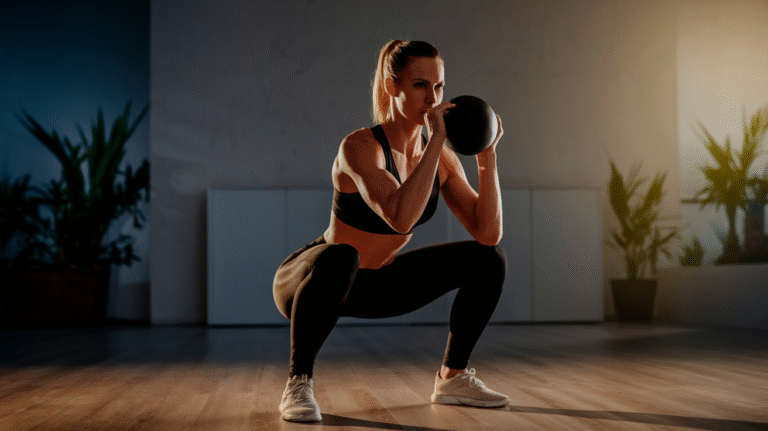
Goblet Squats: Building Powerful Legs and Glutes
Hold the kettlebell by the horns (the sides of the handle) at chest height, elbows pointing down. Stand with feet slightly wider than shoulder-width, toes pointing slightly outward. Engage your core and keep your chest proud.
Push your hips back and bend your knees, lowering your body as if sitting in a chair. Your elbows should track inside your knees at the bottom position. Descend until your thighs are parallel to the ground (or as low as your mobility allows), then drive through your heels to stand back up, squeezing your glutes at the top.
Target muscles: quadriceps, glutes, core stabilizers, and upper back (from holding the weight).
Beginner modification: Place a sturdy box or bench behind you and tap your butt to it at the bottom of each rep. This gives you a depth target and builds confidence in the movement pattern.
Reps/sets recommendation: 3 sets of 10-12 reps, resting 60 seconds between sets.
Deadlifts: Sculpting Your Posterior Chain
Place the kettlebell on the ground between your feet. Stand with feet hip-width apart, toes pointing forward. Hinge at your hips (remember that car door movement), keeping your back straight and chest up, and grip the kettlebell handle with both hands.
Engage your core, press your feet into the ground, and drive your hips forward to stand up, keeping the kettlebell close to your body. At the top, squeeze your glutes hard. Reverse the movement by pushing your hips back and lowering the kettlebell to the ground with control.
Target muscles: hamstrings, glutes, lower back, and core—your entire posterior chain.
Why this builds a powerful foundation: The deadlift teaches the hip hinge pattern that appears in most kettlebell exercises, making it essential to master early.
Reps/sets recommendation: 3 sets of 8-10 reps, resting 90 seconds between sets.
Upper Body and Core Toning Exercises
Halos: Shoulder Mobility and Tone
Hold the kettlebell upside down by the horns at chest height. Stand with feet hip-width apart, core engaged. Circle the kettlebell around your head in a smooth, controlled motion—up and around to the right, behind your head, around to the left, and back to the starting position. Keep your core tight and don’t let your lower back arch.
Complete half your reps going one direction, then reverse and go the opposite direction. Move slowly and deliberately—this isn’t about speed.
Target muscles: shoulders (all three heads), arms, and core stabilizers that prevent your torso from rotating.
Common errors: Moving too fast, allowing your lower back to arch, or holding the kettlebell too far from your head. Keep it close, move smoothly, and maintain tension throughout.
Reps/sets recommendation: 3 sets of 8 reps each direction (16 total per set), resting 45 seconds between sets.
Single-Arm Rows: Building a Sculpted, Strong Back
Place your left hand and left knee on a bench or sturdy chair for support, keeping your back flat and parallel to the ground. Your right foot stays on the floor. Hold the kettlebell in your right hand, arm extended toward the floor.
Pull the kettlebell up toward your hip, driving your elbow back and keeping it close to your body. Squeeze your shoulder blade toward your spine at the top. Lower with control. Complete all reps on one side before switching.
Target muscles: latissimus dorsi (lats), rhomboids, rear deltoids, and biceps. This exercise builds that coveted V-taper and improves posture.
Reps/sets recommendation: 3 sets of 10 reps per arm, resting 60 seconds between sets.
Full-Body Toning Powerhouses
Kettlebell Swings: The Ultimate Fat-Burning Movement
This is the most effective fat-burning, muscle-building kettlebell movement you’ll learn. Master this, and you’ve unlocked the secret to rapid body transformation.
Stand with feet slightly wider than shoulder-width, kettlebell on the ground about 12 inches in front of you. Hinge at your hips, grip the kettlebell with both hands, and hike it back between your legs like a football snap. Keep your arms straight and back flat.
Explosively drive your hips forward, standing up tall and squeezing your glutes hard. This hip drive—not your arms—propels the kettlebell forward and up to chest height. Let the kettlebell float momentarily at the top, then let gravity pull it back down as you hinge at the hips again, guiding it back between your legs for the next rep.
Your arms stay relatively straight throughout—they’re just ropes connecting you to the weight. All power comes from your hip drive. Breathe out forcefully with each hip snap forward, inhale as the kettlebell descends.
Target muscles: entire posterior chain (glutes, hamstrings, lower back), shoulders, core, and cardiovascular system.
Why swings deliver disproportionate results: They combine strength training with high-intensity cardio, creating massive metabolic demand that burns fat while building lean muscle. Research shows swings can elevate heart rate to 85-90% of maximum—that’s serious calorie-burning territory.
Reps/sets recommendation: 3 sets of 15-20 reps, resting 90 seconds between sets.
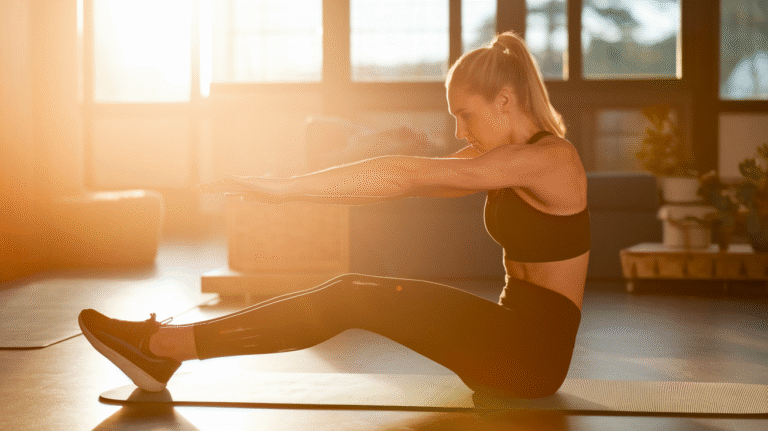
Russian Twists: Core Definition and Oblique Sculpting
Sit on the ground holding the kettlebell by the horns at chest height. Lean back slightly (about 45 degrees), keeping your back straight, and lift your feet off the ground with knees bent (or keep heels on the ground for an easier modification).
Rotate your torso to the right, bringing the kettlebell toward the ground beside your hip. Return to center, then rotate left. That’s one rep. Move with control, engaging your obliques to create the rotation rather than just swinging your arms.
Target muscles: obliques (side abs), rectus abdominis (front abs), and hip flexors.
Modification options: Keep your heels on the ground for more stability, or elevate your feet higher for increased difficulty.
Reps/sets recommendation: 3 sets of 20 total reps (10 per side), resting 45 seconds between sets.
Bonus Exercises for Balanced Development
Overhead Press: Building Shoulder Strength and Tone
Hold the kettlebell in your right hand at shoulder height, the bell resting on the back of your forearm (this is called the “rack position”). Stand with feet hip-width apart, core engaged, knees slightly bent.
Press the kettlebell straight up overhead, rotating your arm slightly so your palm faces forward at the top. Keep your core tight to prevent your lower back from arching. Lower with control back to the rack position.
Target muscles: shoulders (especially front and middle deltoids), triceps, and core stabilizers.
Reps/sets recommendation: 3 sets of 8-10 reps per arm, resting 60 seconds between sets.
Goblet Lunges: Lower Body Sculpting with Balance Challenge
Hold the kettlebell by the horns at chest height. Stand tall, then step forward with your right foot into a lunge position. Both knees should bend to approximately 90 degrees, with your back knee hovering just above the ground.
Push through your front heel to return to standing, then repeat on the left side. That’s one rep. Keep your torso upright and core engaged throughout.
Target muscles: quadriceps, glutes, hamstrings, calves, and core (for balance).
Reps/sets recommendation: 3 sets of 8-10 reps per leg (16-20 total), resting 60 seconds between sets.
Your 4-Week Beginner Kettlebell Toning Program
Week 1-2: Foundation Phase (Building Confidence)
These first two weeks focus on mastering form with lighter weight. You’re building neuromuscular connections—teaching your body these new movement patterns—and developing the confidence to push harder in later weeks.
Workout structure: 3 days per week (Monday, Wednesday, Friday works well), 20-25 minutes per session.
Sample Week 1-2 Workout:
- Warm-up: 5 minutes of dynamic stretches (arm circles, leg swings, bodyweight squats)
- Goblet Squats: 3 sets of 10 reps
- Deadlifts: 3 sets of 8 reps
- Single-Arm Rows: 3 sets of 10 reps per arm
- Halos: 3 sets of 8 reps each direction
- Russian Twists: 3 sets of 20 total reps
- Cool-down: 5 minutes of static stretching
Rest 60-90 seconds between sets. Focus on perfect form rather than speed. If you feel your form breaking down, rest longer or reduce the weight.
Rest days matter: Your muscles don’t grow during workouts—they grow during recovery. Those off days are when your body repairs muscle tissue, making it stronger and more toned. Take rest days seriously: sleep well, eat protein-rich foods, and stay hydrated.
Week 3-4: Progressive Intensity Phase (Seeing Results)
Now you’re ready to increase volume and intensity. Your body has adapted to the basic movements, and it’s time to challenge it further to continue seeing results.
Increasing volume options:
- Add more reps (12-15 instead of 8-10)
- Add a 4th workout day
- Reduce rest periods between sets (45-60 seconds instead of 60-90)
- Increase weight by 2-4 pounds if your form stays perfect
Sample Week 3-4 Circuit Workout:
Complete all exercises back-to-back with minimal rest, then rest 2 minutes before repeating the circuit. Complete 3-4 total rounds.
Circuit:
- Kettlebell Swings: 20 reps
- Goblet Squats: 12 reps
- Overhead Press: 10 reps per arm
- Russian Twists: 20 total reps
- Single-Arm Rows: 12 reps per arm
- Goblet Lunges: 10 reps per leg
This circuit-style training elevates your heart rate for enhanced calorie burn while building strength. You’ll finish in 25-30 minutes and feel absolutely accomplished.
Tracking progress beyond the scale: The scale doesn’t tell the whole story. Take these measurements on Day 1 and every two weeks:
- Chest, waist, hips, thighs (in inches)
- Progress photos (front, side, back) in the same lighting and clothing
- Strength gains (how much weight you can use with perfect form)
- Energy levels and how your clothes fit
Many people see inches disappear while the scale stays the same—that’s because muscle is denser than fat. You’re getting leaner and stronger even if your weight doesn’t drop dramatically.
Recovery and Nutrition Tips That Amplify Your Toning Results
Post-workout nutrition basics: Within 30-60 minutes after exercising, eat a combination of protein and carbohydrates. This timing helps your muscles recover and grow. Examples: Greek yogurt with berries, protein shake with a banana, chicken and sweet potato, or eggs with whole grain toast.
Hydration guidelines: Drink at least half your body weight in ounces of water daily. If you weigh 150 pounds, that’s 75 ounces minimum. During workout days, add another 16-20 ounces. Proper hydration improves performance, reduces fatigue, and helps your body flush out metabolic waste products.
Sleep’s critical role: This is non-negotiable—aim for 7-9 hours per night. During deep sleep, your body releases growth hormone that repairs and builds muscle tissue. Chronic sleep deprivation sabotages your toning efforts by elevating cortisol (a stress hormone that promotes fat storage) and reducing recovery capacity.
Active recovery ideas for rest days: Complete rest doesn’t mean lying on the couch all day. Light movement enhances recovery by increasing blood flow to sore muscles. Try 20-30 minutes of walking, gentle yoga, swimming, or stretching. These activities help without creating additional stress on your system.
Your Transformation Starts Today
You now have everything you need to transform your body with kettlebell training. One simple piece of equipment, a 6×6 foot space, and 20-30 minutes three times per week—that’s the formula that delivers proven results.
The eight exercises in this guide target every major muscle group, combining strength building with fat-burning cardio efficiency. The 4-week progressive program takes you from complete beginner to confident kettlebell user, with clear guidelines for sets, reps, and rest periods. You’re not guessing anymore—you have a roadmap.
Here’s what matters most: consistency beats perfection every single time. You don’t need to execute flawless workouts or never miss a session. You just need to show up more often than you skip, focus on form over ego, and trust the process. Even 20 minutes three times per week delivers proven results when you maintain consistency over weeks and months.
The transformation you’re seeking isn’t about finding motivation—it’s about building systems and habits that work regardless of how motivated you feel. Some days you’ll be excited to train; other days you’ll have to push through. Both count equally. The version of you four weeks from now, eight weeks from now, six months from now will be grateful you started today rather than waiting for the “perfect” moment that never comes.
Address that final mindset piece: be patient and compassionate with yourself. You’re learning new skills, building new habits, and literally rebuilding your body at the cellular level. This takes time. Celebrate small victories—the first time you complete all sets without stopping, the moment you notice your jeans fitting differently, the day you realize you carried groceries upstairs without getting winded. These “small” wins are actually massive indicators of progress.
Your action step: Choose one exercise from this guide and practice it today. Not tomorrow, not Monday, not when you “feel ready”—today. Set a timer for 10 minutes, grab that kettlebell (or even practice the movement patterns without weight), and complete 3 sets of your chosen exercise. That’s it. One exercise, 10 minutes, and you’ve officially started your transformation.
Your stronger, more toned, more confident future self is already thanking you for taking this first step. Now go make it happen.