7 Transverse Abdominis Exercises to Do in Bed

What if the most powerful core exercise you could do every day required no gym, no equipment, no getting on the floor and no leaving your bed?
Most women over 40 have tried crunches. They have tried planks. They have tried sit ups. And they have wondered why their core still feels weak, their lower back still aches and their waist still does not look or feel the way they want it to.
Here is what nobody tells you. The muscle responsible for all of those things — a flat tummy, a supported lower back, a strong pelvic floor and a stable spine — is not your six pack. It is your transverse abdominis. And it is almost certainly not being trained by anything in your current routine.
There is actually a group of hidden core muscles called the corset muscles, or deep transverse abdominis, that truly sculpt tighten and tone the waistline. These muscles fly under the radar but are essential to train especially after the age of 40.
The extraordinary thing about transverse abdominis exercises is that the most effective ones do not require you to be upright, on the floor or even dressed. They can be done lying exactly where you are right now — in bed, before you get up — in under fifteen minutes.
This guide covers the seven best transverse abdominis exercises to do in bed before getting up, why they matter so much for women over 40, and exactly how to do each one correctly to get real results starting from tomorrow morning.
Why the Transverse Abdominis Matters So Much After 40

Before we get into the seven exercises it helps to understand exactly what the transverse abdominis is and why it becomes so much more important after the age of 40.
The transverse abdominis is the deepest of the core muscles situated close to the spine and internal organs lying beneath the obliques and rectus abdominis. Its structure has led many to call it the body’s corset as it wraps around the core like a corset.
The deep core muscles act as the spine’s safety belt. These intrinsic core stabilisers support and stabilise the spine and also work with the glutes and hip flexors to stabilise the pelvis.
Starting from around our mid-40s we lose muscle mass at about 1% a year. Deep stabilising muscles often lose the most — not muscles that burn during crunches but the ones constantly working in the background to keep our spines in the right position every time we move.
Strengthening the transverse abdominis is not about doing harder ab exercises — it is about restoring the brain to muscle connection so this deep core muscle can activate automatically. Over time stress sitting pregnancy injury and repetitive movement patterns can dull this connection. When that happens stronger muscles such as the hip flexors lower back or outer abdominals tend to take over even during exercises that are meant to target the core.
This is exactly why crunches and sit ups do not solve the problem. Traditional ab training focuses on the rectus abdominis the outermost layer. You can do hundreds of crunches every week and leave your transverse abdominis completely untrained — which is precisely what most women over 40 are doing without realising it.
The bed is actually the perfect place to start training this muscle. The mattress provides a stable supported surface that takes pressure off the spine and allows the transverse abdominis to activate without the compensating muscles jumping in to take over. Morning is the perfect time because you are activating the muscle before the patterns of daily movement — sitting, standing, lifting — have had the chance to switch it off.
Before You Begin: How to Find and Activate Your Transverse Abdominis

Every exercise in this guide depends on one foundational skill — knowing how to find and activate your transverse abdominis correctly. Spend two minutes on this before you begin any of the seven exercises and every move will be dramatically more effective.
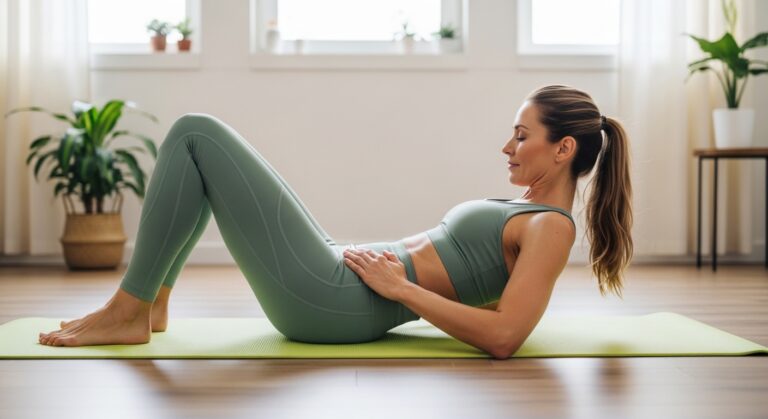
To begin, lie on the floor — or in this case your bed — with your knees bent and feet flat. Take two fingers and place them on the top of your hip bones. Take a deep breath in and slowly exhale out of your mouth. As you exhale draw in your lower abs and engage your pelvic floor muscles. You should notice your transverse abdominis contracting under your fingers.
Take a deep breath in allowing your abdomen to drop toward the ground. On the exhale draw your abs up and inward as if you are zipping up a zipper. Hold for 5 seconds.
Pulling your navel toward your spine is not the same thing as sucking in your gut. When you suck in your gut you hold your breath and tuck your hips. You do not want to do that. A great cue is saying ssssss as you exhale. Core stability takes time and consistency. It is not a form of traditional training — be patient.
Once you can feel that deep internal zipping sensation you are ready to begin. Every exercise below should be performed with this same gentle activation — never gripping, never holding your breath, always breathing normally once activated.
Exercise 1: Transverse Abdominis Activation Breathing

This is where every transverse abdominis routine must begin — and for many women over 40 this single exercise alone delivers noticeable results within two weeks of daily practice.
How to do it: Lie on your back with knees bent and feet flat on the mattress. Place both hands on your lower abdomen just below your navel. Breathe in slowly through your nose allowing your belly to rise gently into your hands. As you exhale through your mouth draw your lower abdomen gently inward and upward — that zipping sensation — while keeping your upper body completely relaxed. Hold the gentle contraction for five seconds while continuing to breathe. Release completely on the next inhale. Repeat 8 to 10 times.
Why it works: Breathing exercises such as diaphragmatic breathing are extremely beneficial for the transverse abdominis. An excellent way of strengthening the TVA is through deep breathing techniques. International Citizens Insurance
What to feel: A gentle deep internal tightening beneath your hands — not a sucking in of the stomach but a subtle lifting and drawing inward of the deepest layer. If you feel your ribs gripping or your breath stopping you are working too hard. Reduce the effort to about 30 percent and try again.
Reps: 8 to 10 breath cycles Hold: 5 seconds per exhale
Exercise 2: Heel Slides

Heel slides are one of the most effective and most gentle transverse abdominis exercises available for women over 40 — and the mattress surface makes them even more accessible than the traditional floor version.
How to do it: Lie on your back with both knees bent and feet flat on the mattress. Activate your transverse abdominis with the zipping sensation from Exercise 1 and maintain this gentle activation throughout. On your next exhale slowly slide one heel along the mattress extending your leg as far as you can without your lower back lifting away from the surface. Pause for a moment at full extension then slowly draw the heel back in on the next exhale. Repeat on the other side. Keep your pelvis completely still throughout — no rocking, no tilting.
Why it works: Lie flat on your back with feet on the ground and place one heel on a slider disc. Breathe in. On the exhale pull your navel inward to activate your TA. Hold this activation as you press through the heel to lengthen your leg. Slowly draw the leg back in. Sixty and Me The mattress acts as a natural slider surface making this exercise immediately accessible without any equipment.
What to feel: Deep internal stability in the lower abdomen as the leg extends. If your lower back arches away from the mattress your transverse abdominis has switched off — shorten the range of movement and rebuild the connection before extending further.
Reps: 8 per side Sets: 2
Exercise 3: Dead Bug
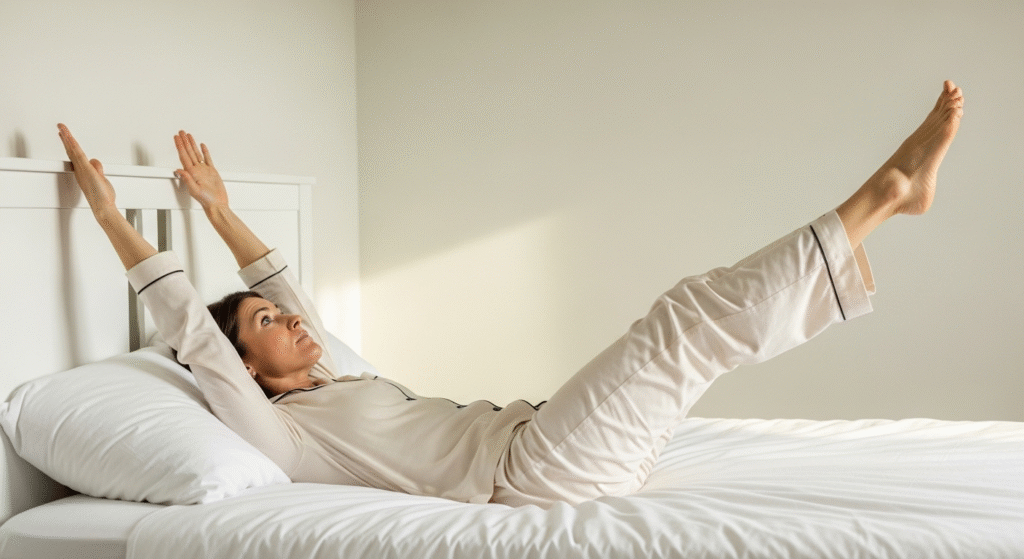
The dead bug is arguably the single most effective transverse abdominis exercise for women over 40 because it trains the deep core in exactly the way it functions in real life — stabilising the spine while the limbs move independently.
How to do it: Lie on your back and raise both arms straight up toward the ceiling. Lift both knees to a 90 degree angle so your knees are directly above your hips and your shins are parallel to the mattress. This is your starting position. Activate your transverse abdominis. On your exhale slowly lower your right arm toward the headboard while simultaneously extending your left leg toward the foot of the bed. Move both limbs as low as you can without your lower back lifting away from the mattress. Slowly return to the starting position and repeat on the opposite side.
Why it works: Begin lying on your back with legs bent. Lift your legs and arms off the ground keeping your knees bent. Keep your spine neutral core braced. Lower one arm to the ground and lower your opposite leg at the same time. Maintain your lower back on the floor and keep abdominals drawn down towards your spine. American Express
This tests the ability to maintain a neutral spine while the limbs create a destabilising load — exactly what happens in real life every time you reach forward carry something or lift your leg to climb a step. If the deep core is not switched on the lower back arches away from the floor to compensate. Time Out
What to feel: Solid stable stillness in your lower back and pelvis throughout the entire movement. The limbs should move slowly and with complete control — this is not about range of movement, it is about maintaining spinal stability.
Reps: 6 to 8 per side Sets: 2
Exercise 4: Supine Abdominal Bracing

This exercise looks deceptively simple but is one of the most targeted transverse abdominis activation exercises available — and lying in bed first thing in the morning is the ideal time to do it.
How to do it: Lie on your back with knees bent and feet flat on the mattress. Place your fingertips just inside your hip bones on your lower abdomen. Gently press your lower back toward the mattress so there is no gap between your spine and the surface. Now activate your transverse abdominis with the zipping sensation — drawing the deep lower abdomen inward and upward without holding your breath. Hold this gentle contraction for 5 seconds while breathing normally. Release and repeat.
Why it works: Lay on your back with knees bent and feet flat on the floor. Place your fingers on the muscles just below your belly button then contract those muscles by pulling them down and away from your fingers. Keep your upper abdominal muscles back muscles and hip muscles relaxed. Hold this position for 5 seconds making sure you continue to breathe.
Exhale and gently zip up the low belly at 30 to 40 percent effort. Do 5 to 8 reps of 3 to 5 second holds keeping breathing. A common mistake is breath-holding or smashing ribs down.
What to feel: A subtle but clear deep engagement beneath your fingertips — the muscle drawing inward rather than pushing outward. If you feel your stomach pushing out against your fingers you are using the wrong muscle. Reduce the effort significantly and try the zipping cue again.
Reps: 8 to 10 Hold: 5 seconds each Sets: 2
Exercise 5: Single Leg Abdominal Press

The single leg abdominal press is a Mayo Clinic recommended core exercise that translates perfectly to the bed environment and specifically targets the transverse abdominis through gentle resistance.
How to do it: Lie on your back with knees bent and feet flat on the mattress. Keep your back in a neutral position — not arched and not pressed hard into the mattress. Activate your transverse abdominis. Raise your right leg off the mattress so your knee and hip are both at 90 degree angles. Place your right hand on top of your right knee with your arm straight. Push your hand against your knee while simultaneously using your deep abdominal muscles to push your knee toward your hand. You are creating resistance against yourself — neither the hand nor the knee actually moves. Hold for three slow breaths. Lower and repeat on the left side.
Why it works: The single leg abdominal press is a popular core strength exercise. Lie on your back with your knees bent. Keep your back in a neutral position not arched and not pressed into the floor. Avoid tilting your hips. Tighten the abdominal muscles. Raise your right leg off the floor so that your knee and hip are bent at 90 degree angles. Rest your right hand on top of your right knee. Push your hand against your knee while using the abdominal muscles to push your knee toward your hand. Keep your arm straight. Hold for three deep breaths. Wendy Perrin
What to feel: A clear and satisfying deep core engagement that is stronger and more specific than the previous exercises. The isometric resistance helps the brain locate the transverse abdominis more precisely — many women feel this as a warm steady engagement deep in the lower abdomen.
Reps: 8 per side Hold: 3 breaths each Sets: 2
Exercise 6: Knee Fall Outs
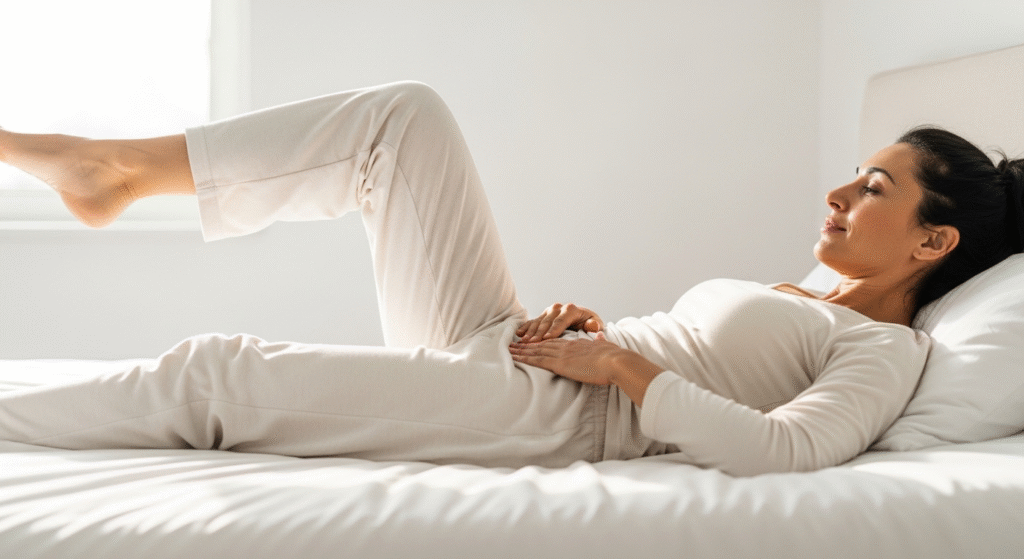
Knee fall outs train the transverse abdominis alongside the pelvic floor and deep hip stabilisers — making this one of the most comprehensive deep core exercises available for women over 40, particularly those experiencing perimenopause symptoms or pelvic floor changes.
How to do it: Lie on your back with both knees bent and feet flat on the mattress hip width apart. Gently press your lower back toward the mattress. Place your hands on your hip bones to monitor for any movement in the pelvis. Activate your transverse abdominis. Let one knee slowly fall outward to the side as far as it can go without your pelvis tilting or lifting. The foot stays flat on the mattress — only the knee moves. Hold that position for 20 to 25 seconds with the pelvis completely still. Slowly return the knee to centre and repeat on the other side.
Why it works: This tests the pelvic floor and the deep hip stabilisers alongside the core. The pelvic floor is part of the core system and it is one of the most neglected parts of it. When the pelvis rotates or tilts during the test the core is not holding position which means there will be problems during any rotation based movement in real life from getting out of a car to stepping off a kerb.
The transversus abdominis works in harmony with the pelvic floor muscles. Together they create a strong foundation for the pelvic organs. A well functioning TVA can help prevent issues like incontinence and pelvic organ prolapse particularly in women.
What to feel: Deep steady stability in the lower abdomen and pelvis throughout the entire movement. If your pelvis rocks or tilts as the knee falls outward your transverse abdominis and pelvic floor are not yet communicating effectively — reduce the range of movement and rebuild the connection gradually.
Reps: 5 per side Hold: 20 to 25 seconds each Sets: 2
Exercise 7: Modified Dead Bug Leg Tap

This final exercise takes everything you have built across the previous six moves and challenges your transverse abdominis to maintain activation under a greater destabilising load — making it the perfect progression exercise to end this morning routine.
How to do it: Lie on your back and lift both knees to a 90 degree angle with knees above hips and shins parallel to the mattress. Press your lower back gently toward the mattress. Activate your transverse abdominis and hold. Breathe normally. Slowly lower one foot toward the mattress to gently tap the surface then raise it back to the starting position before lowering the other foot. Move slowly and deliberately — the challenge is maintaining a completely flat lower back and still pelvis as each foot lowers. If your lower back lifts away from the mattress at any point your transverse abdominis has switched off.
Why it works: Raise both arms straight up above the chest pointing at the ceiling. Lift both knees up to a 90 degree angle with knees above hips and shins parallel to the floor. Hold this position and breathe normally. Keep the lower back in contact with the floor throughout. Aim for 30 seconds with the back staying completely flat. That tells you the deep stabilisers are doing their job without needing external bracing.
Bend your legs at a 90 degree angle and slowly bring one leg down. Ensure not to over-arch your lower back when you lower your leg. Switch sides. Breathe deeply into your belly.
What to feel: Clear deep core engagement that holds steady as each leg lowers. This should feel significantly more challenging than the earlier exercises — if it does not you are compensating with your hip flexors rather than your transverse abdominis. Slow the movement down further and refocus on the zipping activation before each tap.
Reps: 6 to 10 per side Sets: 2
Your Complete 10 Minute Morning Routine
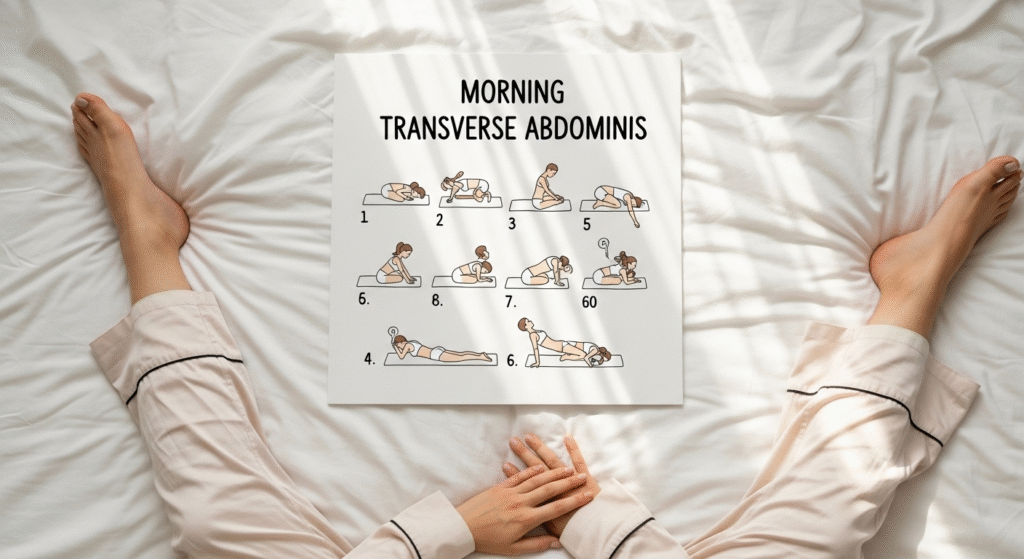
Here is how to put all seven exercises together into a complete morning transverse abdominis routine before you get out of bed:
| Exercise | Reps | Sets | Rest |
|---|---|---|---|
| 1. TA Activation Breathing | 8 to 10 breaths | 1 | 30 seconds |
| 2. Heel Slides | 8 per side | 2 | 30 seconds |
| 3. Dead Bug | 6 to 8 per side | 2 | 30 seconds |
| 4. Supine Abdominal Bracing | 8 to 10 holds | 2 | 30 seconds |
| 5. Single Leg Abdominal Press | 8 per side | 2 | 30 seconds |
| 6. Knee Fall Outs | 5 per side | 2 | 30 seconds |
| 7. Modified Dead Bug Leg Tap | 6 to 10 per side | 2 | 30 seconds |
Total time: 10 to 15 minutes depending on rest periods. No equipment. No floor work. No leaving your bed.
What to Expect and When to Expect It
Having a strong core makes performing daily activities and exercises safer and easier. A strong transverse abdominis provides dynamic stabilisation, meaning stabilisation during movement of the lumbar spine.
Most women over 40 notice the following changes in this order:
In the first one to two weeks, you will notice improved awareness of your deep core during daily activities — sitting, standing and lifting will feel more supported and connected.
By weeks three to four, lower back discomfort typically begins to reduce as the transverse abdominis takes over the stabilising work that has been defaulting to the back muscles.
By weeks six to eight, waist definition begins to improve as the transverse abdominis functions more effectively as its natural internal corset — drawing the deep abdomen inward even during regular daily movement.
A strong and responsive TVA provides the stability and power transfer necessary for activities such as lifting weights, running, and jumping. While not its primary function, training the TVA can lead to a flatter abdominal appearance by improving the support of abdominal organs.
Final Thoughts
The transverse abdominis is the most important and most neglected muscle in the female body over 40, and now you have seven exercises to train it before your feet even touch the floor each morning.
We do not need external waist trainers to reduce our waist; we literally have a built-in corset. The key is learning how to activate it correctly, consistently and at the right intensity — which is exactly what this morning routine delivers.
Start tomorrow. Set your alarm ten minutes earlier. Do all seven exercises in the order listed. And save this post so you can come back to it every morning until the routine becomes as automatic as brushing your teeth.
Your deep core will thank you within a week.