7 Functional Fitness Routines for Women Over 40 (No Gym Needed)
Remember when you could bounce back from anything—a late night, an intense workout, even a week of indulgence? If you’re over 40, you’ve probably noticed your body doesn’t quite work the same way anymore. But here’s the truth that fitness magazines won’t tell you: you’re not broken, you just need a different approach.
Maybe you’ve tried those intense workout programs designed for 25-year-olds and ended up sore for days (or worse, injured). Perhaps you’re tired of scrolling through fitness content that shows you what to do but never explains *why* it matters for YOUR changing body. Or maybe you’re simply done with the gym intimidation factor and ready to transform your fitness journey on your own terms.
The secret isn’t working harder—it’s working smarter with functional fitness. These aren’t just exercises; they’re movements that mirror real life, helping you lift groceries without straining your back, play with your kids or grandkids without getting winded, and maintain the independence and strength that makes life enjoyable at any age.
In this guide, you’ll discover seven proven functional fitness routines specifically designed for women over 40. No expensive equipment, no gym membership, no intimidating environments—just effective, science-backed movements you can do in your living room. Each routine targets the specific needs of your changing body while building real-world strength that makes everyday life easier.
Let’s dive into what makes functional fitness the perfect solution for busy women who want results without the gym drama.
Why Functional Fitness Is a Game-Changer for Women Over 40
Your Body’s Changing Needs After 40
Your body after 40 operates under different rules. Hormone shifts during perimenopause and menopause directly impact your muscle mass, bone density, and metabolism. You’re not imagining it—your body genuinely responds differently to exercise than it did a decade ago.
Traditional high-impact workouts that once delivered results now stress aging joints and increase injury risk. That’s not weakness; that’s biology. Your body needs movements that address the natural decline in balance, flexibility, and muscle strength while respecting the changes happening at a cellular level.
The focus shifts from chasing aesthetics to maintaining independence and quality of life. Functional fitness honors this transition by building the strength you need for real-world activities—not just looking good in a mirror.
The Proven Benefits of Functional Training
Functional training builds strength for the activities that actually matter: carrying laundry baskets up stairs, lifting heavy grocery bags, playing on the floor with grandchildren, and maintaining your independence as you age. Research shows that functional fitness improves balance and coordination, reducing fall risk by up to 23% in women over 40—a statistic that becomes increasingly important with each passing year.
These movements enhance joint stability and mobility without the high-impact stress that damages cartilage and inflames tissues. You’ll burn calories efficiently while protecting precious muscle mass, which becomes crucial as your metabolism naturally slows.
The beauty of functional fitness? It adapts to YOUR current fitness level. Whether you’re a complete beginner or returning after years away from exercise, these routines scale to challenge you appropriately without overwhelming your system.
Why You Don’t Need a Gym to Get Powerful Results
Your body weight provides natural resistance that’s perfectly calibrated to your strength level. Minimal equipment—resistance bands, water bottles, or household items—creates effective challenges without requiring a single dumbbell.
Home workouts eliminate the time barriers that sabotage consistency. No commute, no waiting for equipment, no comparing yourself to the 25-year-old doing burpees next to you. This privacy allows you to focus on proper form and listen to your body’s signals without distraction.
Here’s what the fitness industry won’t tell you: consistency beats intensity every single time. Regular 20-30 minute sessions in your living room outperform sporadic gym visits. You’re building a sustainable practice, not chasing short-term transformations that disappear the moment life gets busy.
Routine #1: The Morning Mobility Flow (15 Minutes)
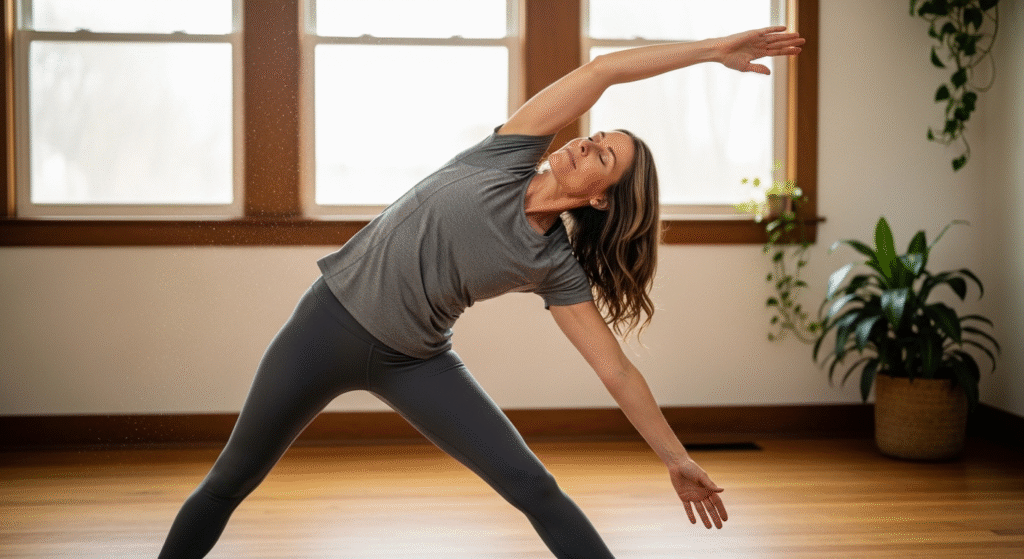
Why Mobility Matters More Than Ever
Morning stiffness isn’t just annoying—it’s your body signaling decreased synovial fluid production, the natural lubricant that keeps joints moving smoothly. This mobility flow addresses that stiffness directly, improving your range of motion and preventing injuries during daily activities.
Mobility work activates dormant muscles and “wakes up” your nervous system for better movement patterns throughout your entire day. You’re not just stretching; you’re teaching your body to move efficiently again. Plus, starting your morning with intentional movement sets a positive, empowering tone that influences every decision you make.
The Movement Sequence
Cat-Cow Stretches (2 minutes)
Start on hands and knees with your spine in a neutral position. Inhale deeply as you drop your belly, lift your chest, and raise your tailbone toward the ceiling—this is cow pose. Exhale completely as you round your spine, tucking your chin and tailbone under—that’s cat pose.
This dynamic movement lubricates your entire spine, improves posture, and relieves the back tension that accumulates from sitting, sleeping, and daily stress. Complete 10-12 slow, controlled repetitions, focusing on the quality of each movement rather than speed.
World’s Greatest Stretch (3 minutes)
Step your right foot forward into a low lunge position. Drop your left hand to the ground beside your front foot, then rotate your right arm toward the ceiling, opening your chest. Hold for 3-5 deep breaths, feeling the stretch through your hip flexors, hamstrings, and thoracic spine.
This single movement opens tight hips, improves thoracic mobility (crucial for shoulder health), and stretches hip flexors that shorten from sitting. Perform 4-5 repetitions per side, moving slowly and breathing deeply.
Standing Hip Circles (2 minutes)
Balance on your left leg and lift your right knee to hip height. Circle your knee outward in a smooth arc, then reverse direction and circle inward. This movement lubricates your hip joint, improves single-leg balance, and activates your glutes—the powerhouse muscles that support everything from walking to climbing stairs.
Complete 8-10 circles in each direction on both legs. If balance is challenging, hold a wall or countertop for support.
Arm Circles with Shoulder Rolls (3 minutes)
Extend your arms out to the sides and create large, controlled circles moving forward. After 10 repetitions, reverse direction. Add shoulder rolls by lifting your shoulders up toward your ears, pulling them back, and dropping them down.
These movements increase shoulder mobility, reduce upper body tension from computer work and stress, and improve your ability to reach overhead—essential for daily tasks like putting away dishes or grabbing items from high shelves.
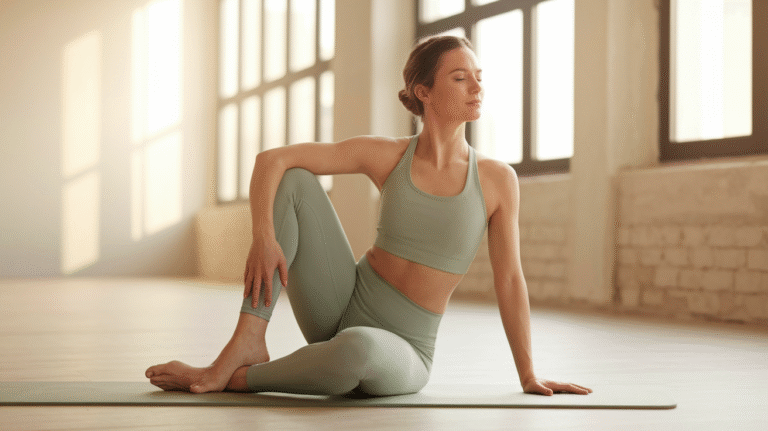
Spinal Twists (3 minutes)
Sit or stand tall with your hips facing forward. Rotate your torso to the left, using your core muscles to control the movement. Return to center, then rotate right. Keep the movement smooth and controlled, never forcing the rotation.
Spinal twists improve rotational mobility, aid digestion, and release lower back tension. Complete 8-10 twists per side, breathing naturally throughout.
Standing Quad Stretch (2 minutes)
Stand tall and bend your right knee, bringing your right foot toward your glutes. Hold your ankle with your right hand, keeping your knee pointing down toward the floor. Feel the stretch through the front of your thigh and hip.
This stretch releases tight hip flexors and quadriceps while challenging your balance. Hold for 30 seconds per leg, using a wall for support if needed.
Pro Tip: Perform this mobility flow before breakfast to jumpstart your metabolism and reduce stiffness that would otherwise plague you all day.
Routine #2: The Lower Body Strength Builder (25 Minutes)
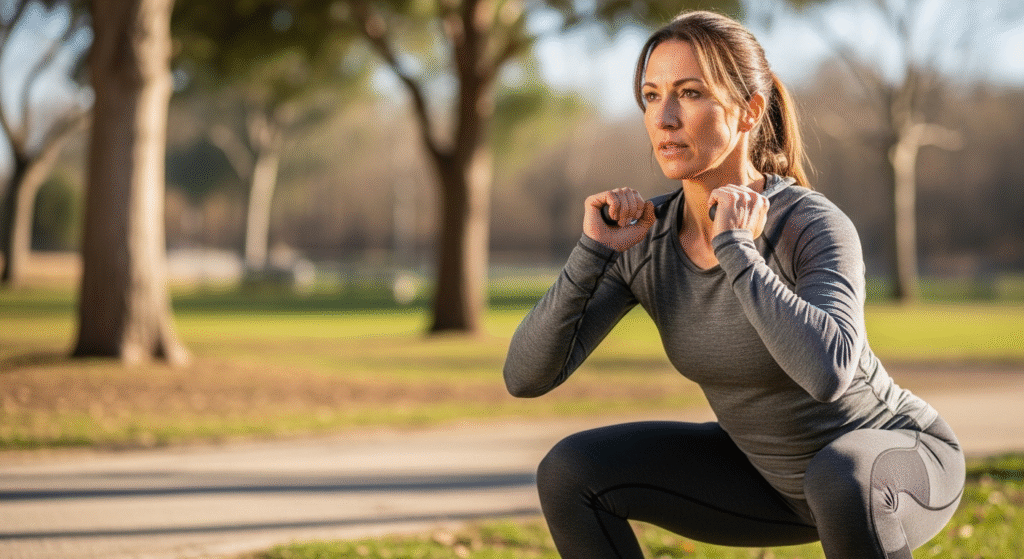
Why Lower Body Strength Protects Your Independence
Your leg strength directly correlates with your longevity and quality of life after 40. This isn’t motivational fluff—it’s documented science. Strong legs prevent sarcopenia (age-related muscle loss) that accelerates dramatically after age 40.
The equation is simple: strong legs equal better balance, fewer falls, and maintained bone density. Your lower body contains the largest muscle groups in your body, which means these exercises burn more calories and support healthy weight management even as your metabolism slows.
The Workout Breakdown
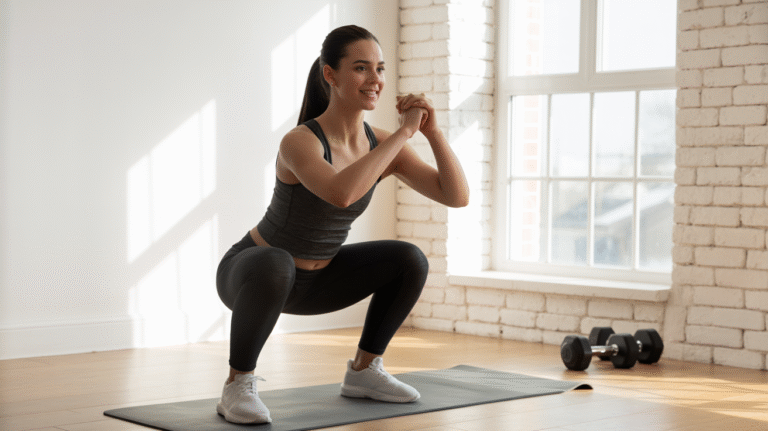
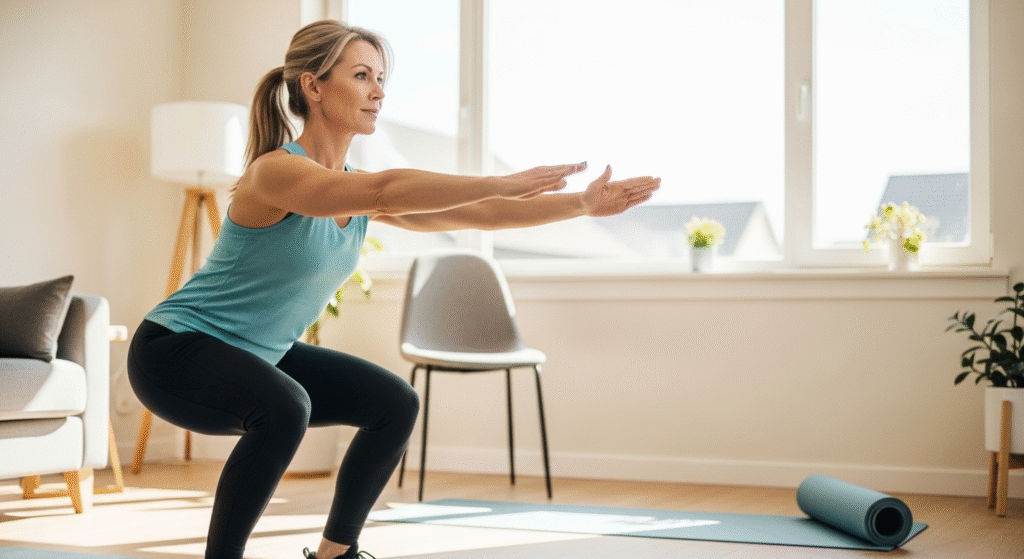
Bodyweight Squats (5 minutes)
Stand with feet hip-width apart and toes slightly turned out. Lower your hips back and down as if sitting into a chair, keeping your chest lifted and knees tracking over your toes. Push through your heels to return to standing.
Squats build quad, glute, and core strength while mirroring the sitting and standing movements you perform dozens of times daily. Complete 3 sets of 12-15 reps. If you need support, hold the back of a sturdy chair. If depth is challenging, reduce how low you squat—partial range of motion with good form beats full range with poor alignment.
Glute Bridges (5 minutes)
Lie on your back with knees bent and feet flat on the floor, hip-width apart. Press through your heels to lift your hips until your body forms a straight line from shoulders to knees. Squeeze your glutes hard at the top, then lower with control.
This movement strengthens your glutes and hamstrings, supports your lower back, and improves posture by counteracting the hip flexor tightness from sitting. Perform 3 sets of 15-20 reps. For an advanced challenge, try the single-leg variation by extending one leg toward the ceiling.
Reverse Lunges (7 minutes)
Step your right foot backward and lower down until both knees form 90-degree angles. Your front knee should stay directly over your ankle. Push through your left heel to return to standing, bringing your feet together.
Reverse lunges build single-leg strength, improve balance, and are easier on your knees than forward lunges. Complete 3 sets of 10 reps per leg. Hold a countertop for balance support if needed—there’s no shame in modifying for safety.
Lateral Leg Raises (4 minutes)
Stand tall with feet together. Keeping your toe pointing forward, lift your right leg out to the side as high as comfortable. Lower with control and repeat.
This movement strengthens your hip abductors, improves lateral stability (reducing fall risk), and tones outer thighs. Perform 2 sets of 12-15 reps per leg. Progress by adding a resistance band around your thighs just above your knees.
Calf Raises (4 minutes)
Stand with feet hip-width apart. Rise onto your toes as high as possible, then lower slowly until you feel a stretch in your calves.
Strong calves and ankles support every step you take. Complete 3 sets of 15-20 reps. For a greater challenge, try single-leg calf raises or hold light weights.
Cool Down: Walk in place for 2 minutes, then gently stretch your hamstrings and calves, holding each stretch for 30 seconds.
Weekly Schedule: Perform this routine 2-3 times per week with at least one rest day between sessions. Your muscles need recovery time to rebuild stronger.
Routine #3: The Core Stability Power Session (20 Minutes)
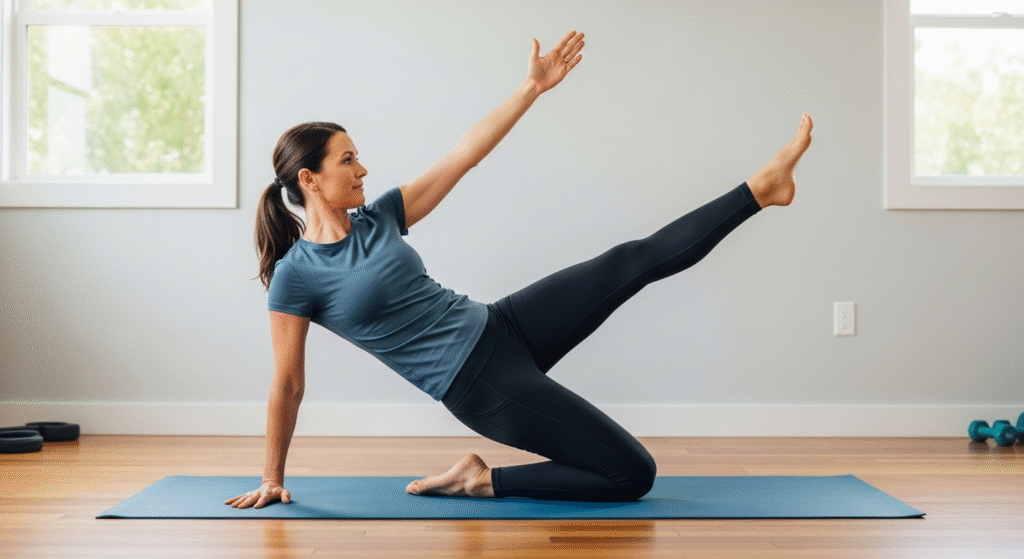
The Truth About Core Strength After 40
Core weakness contributes directly to back pain, poor posture, and reduced balance—three issues that plague women over 40. Traditional crunches strain your neck and don’t address the functional core needs that matter for daily life.
Your core isn’t just your abs; it’s the entire muscular system that stabilizes your spine and pelvis. A strong core protects your back when you bend, twist, and lift. It improves your balance and prevents the forward-leaning posture that ages your appearance and compresses your organs.
The Core Workout
Plank Hold (4 minutes)
Start on your forearms and toes with your body forming a straight line from head to heels. Engage your abs by pulling your belly button toward your spine. Don’t let your hips sag or pike upward.
Planks build total core endurance and teach your body to maintain spinal stability under load. Hold for 20-30 seconds, rest for 30 seconds, and repeat 4-6 times. Modify by dropping to your knees while maintaining that straight line from head to knees.
Bird Dog (5 minutes)
Start on hands and knees. Extend your right arm forward and left leg back simultaneously, creating a straight line from fingertips to toes. Hold for 3-5 seconds, return to start, then switch sides.
This movement challenges balance, builds core stability, and strengthens your back extensors. Complete 3 sets of 8-10 reps per side, moving slowly and maintaining balance.
Dead Bug (4 minutes)
Lie on your back with arms extended toward the ceiling and knees bent at 90 degrees. Slowly lower your right arm overhead while straightening your left leg, hovering it above the floor. Return to start and switch sides.
Dead bugs teach core control while protecting your lower back. Perform 3 sets of 10 reps per side, pressing your lower back into the floor throughout.
Side Plank (4 minutes)
Lie on your right side, propped on your right forearm with feet stacked. Lift your hips until your body forms a straight line. Hold, then switch sides.
Side planks strengthen obliques and lateral core stabilizers crucial for rotational movements. Hold for 15-20 seconds per side, repeating 3-4 times. Modify by bending your bottom knee for support.
Pelvic Tilts (3 minutes)
Lie on your back with knees bent. Gently tilt your pelvis to flatten your lower back against the floor, then release. This subtle movement builds deep core awareness and strengthens pelvic floor muscles.
Complete 2 sets of 15 reps, focusing on the mind-muscle connection rather than speed.
This core session builds the foundation for every other movement you make. Perform it 2-3 times weekly, and you’ll notice improvements in posture, balance, and back comfort within weeks.
Routine #4: The Upper Body Sculptor (20 Minutes)
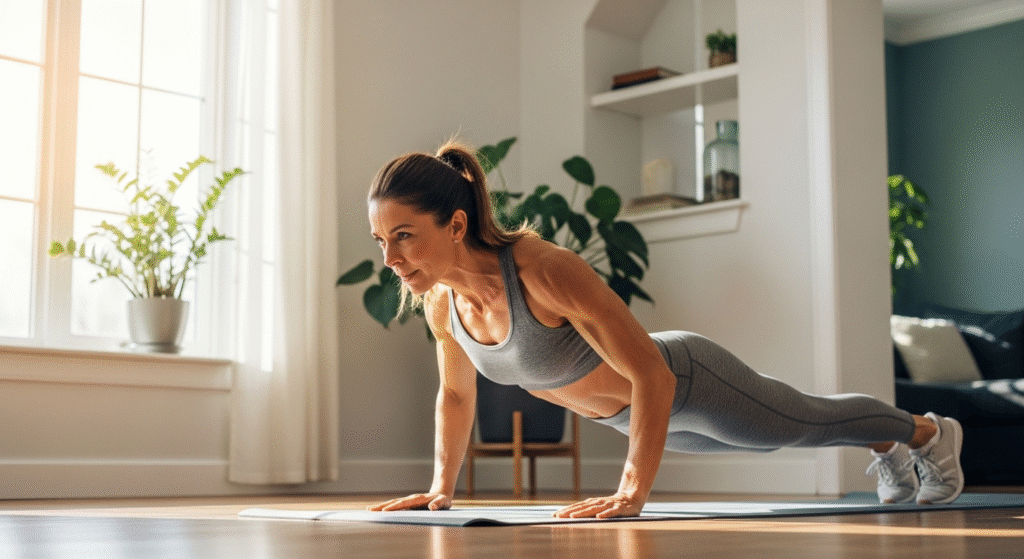
Why Upper Body Strength Matters
Upper body strength isn’t about vanity—it’s about maintaining independence. Can you lift your luggage into an overhead compartment? Carry a bag of dog food from the car? Push open a heavy door? These everyday tasks require upper body strength that diminishes rapidly without targeted training.
After 40, women lose upper body muscle mass faster than lower body, making intentional upper body work essential. Strong arms, shoulders, and back also improve posture, reducing the rounded-shoulder look that adds years to your appearance.
Push-Ups (Modified) (5 minutes)
Start on your knees with hands slightly wider than shoulder-width. Lower your chest toward the floor, keeping your body straight from head to knees. Push back up with control.
Modified push-ups build chest, shoulder, and tricep strength. Complete 3 sets of 8-12 reps. As you get stronger, progress toward full push-ups from your toes.
Tricep Dips (4 minutes)
Sit on a sturdy chair with hands gripping the seat beside your hips. Slide forward off the chair, supporting your weight with your arms. Bend your elbows to lower down, then press back up.
This movement sculpts the back of your arms while building functional pushing strength. Perform 3 sets of 10-12 reps, keeping movements controlled.
Resistance Band Rows (5 minutes)
Wrap a resistance band around a sturdy post at chest height. Hold both ends and step back until there’s tension. Pull the band toward your chest, squeezing your shoulder blades together.
Rows strengthen your back muscles, improving posture and counteracting the forward pull from computer work and daily activities. Complete 3 sets of 12-15 reps.
Shoulder Press with Water Bottles (3 minutes)
Hold filled water bottles at shoulder height. Press them overhead until arms are straight, then lower with control.
This movement builds shoulder strength for overhead reaching. Perform 3 sets of 10-12 reps, adjusting bottle size based on your strength level.
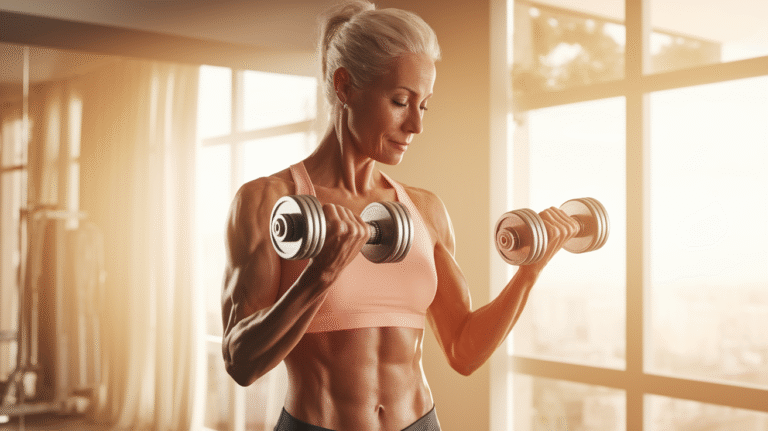
Bicep Curls (3 minutes)
Hold water bottles with arms extended. Curl them toward your shoulders, keeping elbows close to your body. Lower slowly.
Complete 3 sets of 12-15 reps. Strong biceps help with carrying, lifting, and pulling movements throughout your day.
Perform this upper body routine twice weekly, allowing at least two days between sessions for muscle recovery.
Routine #5: The Balance and Coordination Challenge (15 Minutes)
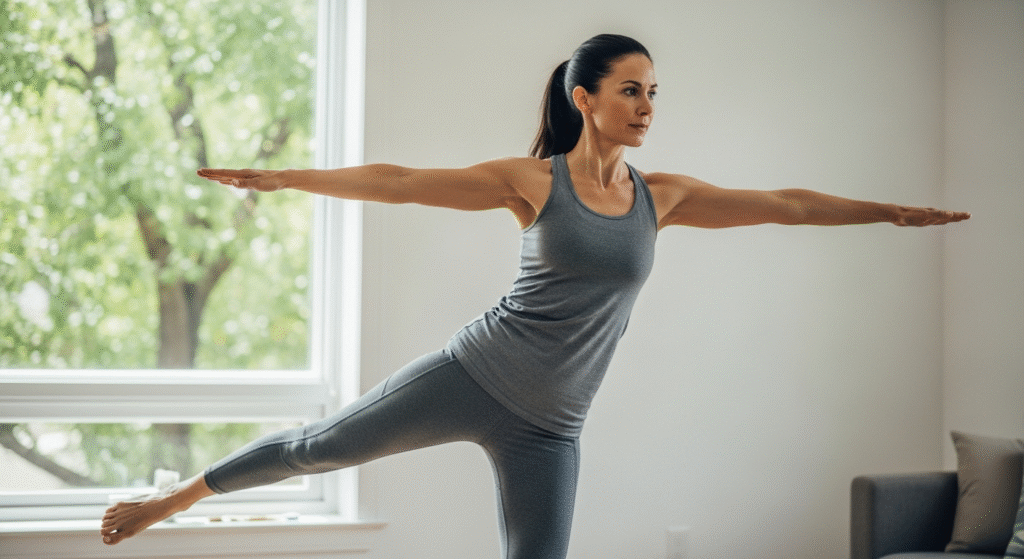
Why Balance Training Becomes Critical
Balance deteriorates naturally with age, but you can slow or reverse this decline through targeted training. Better balance means fewer falls, greater confidence in movement, and maintained independence. It also strengthens the small stabilizer muscles that protect your joints.
Single-Leg Stance (3 minutes)
Stand on your right leg for 30 seconds, then switch. Progress by closing your eyes or standing on an unstable surface like a folded towel.
This simple exercise dramatically improves balance and ankle stability. Complete 4-6 rounds per leg.
Heel-to-Toe Walk (3 minutes)
Walk in a straight line, placing your heel directly in front of your toes with each step, as if walking a tightrope.
This movement challenges your balance while improving coordination. Walk for 20 steps, turn around, and return. Repeat 3-4 times.
Standing Marches (3 minutes)
Stand tall and march in place, lifting your knees to hip height. Focus on controlled, balanced movements.
Marching builds hip strength while challenging balance with each step. Perform for 1 minute, rest 30 seconds, repeat 3 times.
Clock Reaches (3 minutes)
Stand on your left leg. Reach your right leg toward 12 o’clock, tap the ground, return to center. Reach toward 3 o’clock, tap, return. Continue around the clock.
This exercise challenges balance in multiple directions, improving stability for real-world movements. Complete one full clock per leg, repeat twice.
Single-Leg Deadlift (3 minutes)
Stand on your right leg, hinge at the hip to lower your torso while extending your left leg behind you. Return to standing.
This movement builds balance, strengthens glutes and hamstrings, and improves hip stability. Perform 2 sets of 8-10 reps per leg.
Practice balance training 3-4 times weekly. These exercises take minimal time but deliver maximum impact for fall prevention and confident movement.
Final Words: Your Path to Sustainable Strength
You now have seven proven functional fitness routines designed specifically for your body’s needs after 40. These aren’t trendy workouts that disappear in six months—they’re foundational movement patterns that build real-world strength, protect your independence, and make everyday life easier.
Start with the Morning Mobility Flow to establish a daily practice. Add the Lower Body Strength Builder and Core Stability Power Session twice weekly. Gradually incorporate the Upper Body Sculptor and Balance Challenge as your fitness improves. You don’t need to do everything at once. Consistency with two routines beats sporadic attempts at all seven.
Your body isn’t broken—it’s evolved. These routines honor that evolution while building the strength, mobility, and confidence you deserve. No gym required, no intimidation factor, just you and your commitment to feeling powerful in your own body.
Ready to transform your fitness journey? Choose one routine and commit to it for the next seven days. Your future self—the one who lifts grandchildren without hesitation, carries groceries with ease, and moves through life with confidence—will thank you for starting today.
The best time to begin was ten years ago. The second best time is right now. Let’s build your strength together.