7 Best Morning Joint-friendly Workouts For Women 40+

Let’s talk about something you’ve probably noticed: your body doesn’t bounce back quite like it used to. That morning stiffness takes longer to shake off.
The way your knees protest when you jump into a high-intensity workout. The subtle ache in your hips after yesterday’s exercise class.
Here’s what I want you to know: this isn’t weakness, and it definitely isn’t failure. It’s your body going through natural changes—hormonal shifts, decreased cartilage production, and reduced synovial fluid (that’s the lubricant in your joints). The solution isn’t to stop moving or push through pain. It’s to move smarter.
Morning workouts are particularly powerful for joint health. When you wake up, your joints are stiff because they’ve been stationary all night.
Gentle, purposeful movement literally “wakes them up” by increasing circulation and lubricating the joint spaces. You’re essentially telling your body, “We’re ready to move comfortably today.”
What makes a workout truly joint-friendly? It’s all about controlled movements, proper form, and building strength without unnecessary impact.
These aren’t watered-down exercises—they’re strategic movements that protect your joints while making you genuinely stronger and more flexible.
In this guide, you’ll discover seven proven exercises that work with your body’s natural changes, not against them. You’ll learn exactly how to perform each movement, why it’s effective, and how to modify it for your fitness level.
By the end, you’ll have a complete morning routine that takes just 10-20 minutes and helps you feel energized, capable, and pain-free throughout your day.
Ready to transform your mornings? Let’s dive in.
Understanding Joint Health After 40: Why Your Morning Routine Matters
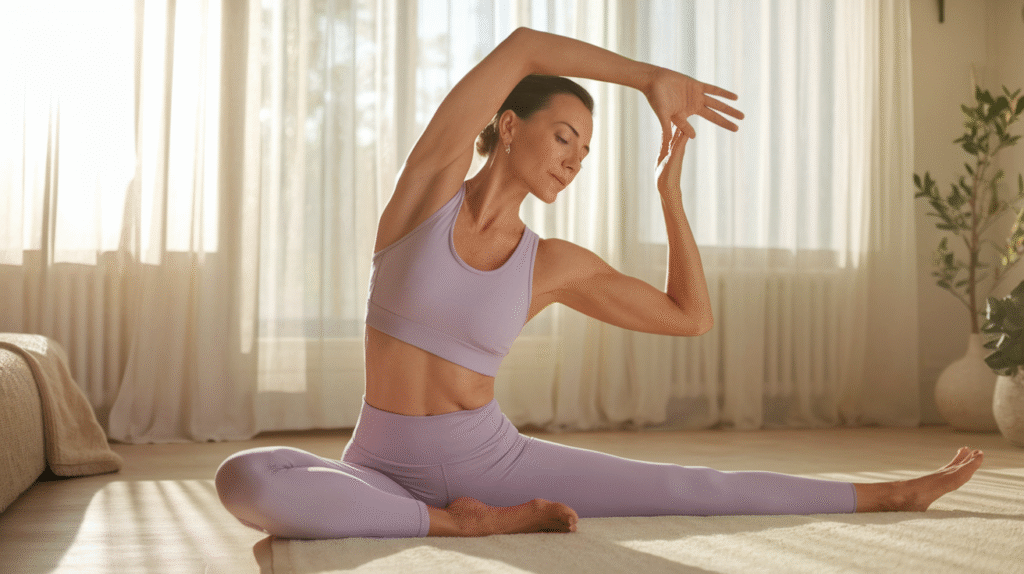
The Science Behind Joint-Friendly Movement
After 40, your body experiences real physiological changes that affect how your joints function. Estrogen levels fluctuate and decline, which directly impacts collagen production—the protein that keeps cartilage healthy and resilient. Meanwhile, the synovial fluid that cushions your joints decreases in both quantity and quality.
This isn’t something to fear, but it does explain why that morning stiffness feels more pronounced now. Your joints have been immobile for 6-8 hours, and that fluid needs movement to circulate properly. Think of it like motor oil in a car—it works best when it’s warm and flowing.
Here’s the fascinating part: gentle morning movement actually stimulates your body to produce more synovial fluid. You’re literally lubricating your joints from the inside out.
Low-impact exercises create the perfect environment for this process without causing the micro-tears and inflammation that high-impact movements can trigger.
The difference between joint-friendly and joint-stressing exercises comes down to force and control. Jumping, sudden directional changes, and repetitive pounding send shock waves through your joints. Controlled, deliberate movements strengthen the muscles around your joints, providing better support and stability.
Benefits of Morning Joint-Friendly Workouts
Moving first thing in the morning does something remarkable for your body. When you exercise, blood flow increases to your joints, delivering oxygen and nutrients while flushing out inflammatory compounds that accumulated overnight. This is why you feel less stiff after moving—you’ve literally cleaned house at the cellular level.
Enhanced flexibility and range of motion aren’t just nice bonuses; they’re essential for daily activities. That improved hip mobility makes getting in and out of the car easier.
Better shoulder flexibility means you can reach overhead cabinets without strain. These small improvements compound into a significantly better quality of life.
Building sustainable strength is where joint-friendly workouts truly shine. You’re not creating wear and tear—you’re developing the muscular support system that takes pressure off your joints. Stronger glutes protect your knees. A stronger core supports your back. This is strength that serves you for decades, not just weeks.
What Makes a Workout “Joint-Friendly”
Joint-friendly exercises share specific characteristics. They involve controlled movements where you’re in charge of the speed and range of motion. Proper form matters more than repetitions or weight. Gradual progression means you’re building capacity over time, not forcing your body to adapt overnight.
The balance between challenging muscles and protecting joints is crucial. You should feel your muscles working—that slight burn, that sense of effort. But you shouldn’t feel sharp pain, grinding, or instability in your joints. That’s your body’s clear signal to modify or stop.
Consistency beats intensity every single time for women over 40. A moderate workout you do five times a week will transform your body far more effectively than an intense workout you can only manage once a week (and then need three days to recover from). Your joints thrive on regular, predictable movement patterns that build resilience gradually.
The 7 Best Joint-Friendly Morning Workouts
1. Gentle Glute Bridges: Your Ultimate Lower Body Strengthener
Glute bridges are absolute gold for women over 40. They strengthen your glutes (the largest muscle group in your body), hamstrings, and core while keeping your back completely supported against the floor. Your knees stay in a stable position with no impact or grinding.
How to do it: Lie on your back with knees bent and feet flat on the floor, hip-width apart. Your feet should be close enough that you can almost touch your heels with your fingertips. Press through your heels and lift your hips toward the ceiling, creating a straight line from knees to shoulders. Squeeze your glutes at the top, hold for two seconds, then lower with control. Perform 3 sets of 12-15 reps.
Joint-friendly modifications: If the standard bridge feels too easy, try single-leg variations (keep one foot elevated while bridging with the other). For more challenge, add a pause at the top for 5-10 seconds, or place a resistance band just above your knees and press outward as you lift. If you’re just starting, even 5-8 reps with perfect form is enough.
The beauty of glute bridges is that stronger glutes directly protect your knees and lower back. When your glutes are weak, other joints compensate—and that’s when pain develops. This exercise fixes that problem at the source.
2. Wall or Incline Push-Ups: Easy Upper Body Strength Without Joint Strain
Traditional floor push-ups can be brutal on wrists and shoulders, especially if you’re rebuilding strength. Wall or incline push-ups give you all the benefits—chest, shoulder, and tricep strength—while eliminating joint stress.
How to do it: Stand facing a wall (or use a kitchen counter or sturdy table for more challenge). Place your hands on the surface slightly wider than shoulder-width. Walk your feet back until your body forms a straight line. Bend your elbows and lower your chest toward the wall, keeping your core engaged. Push back to starting position. The more horizontal your body, the harder the exercise.
Progression tips: Start with wall push-ups for a week or two. When you can complete 15 reps easily, move to a counter height. Progress to a sturdy chair, then a low step, and eventually the floor—but only if your wrists and shoulders feel completely comfortable. There’s no rush. A perfect wall push-up builds more strength than a sloppy floor push-up.
This exercise is particularly effective for improving posture. Strong chest and shoulder muscles counteract the forward slouch that comes from sitting and using devices. You’ll stand taller and feel more confident.
3. Chair Squats: The Perfect Lower Body Movement
Chair squats are brilliant because they have a built-in safety mechanism: the chair. You can’t go too low, you have a target to aim for, and you can use it for balance if needed. This makes them perfect for building leg strength and mobility with complete confidence.
How to do it: Stand in front of a sturdy chair with feet hip-width apart. Slowly lower yourself as if sitting down, keeping your weight in your heels and your chest lifted. Lightly touch the chair with your glutes (don’t fully sit), then press through your heels to stand back up. Keep your knees tracking over your toes—not caving inward. Perform 3 sets of 10-12 reps.
Simple variations: For easier modification, actually sit down fully and then stand up. For more challenge, pause for 3-5 seconds just above the chair before standing (hello, quad burn!). You can also slow down the lowering phase to a 4-second count, which dramatically increases muscle engagement.
Proper positioning protects your knees. Keep your chest up and imagine sitting back into the chair rather than dropping straight down. This ensures your knees stay behind your toes and your glutes do the work instead of your knee joints taking the load.
4. Seated or Standing Leg Raises: Effective Hip and Core Strengthening
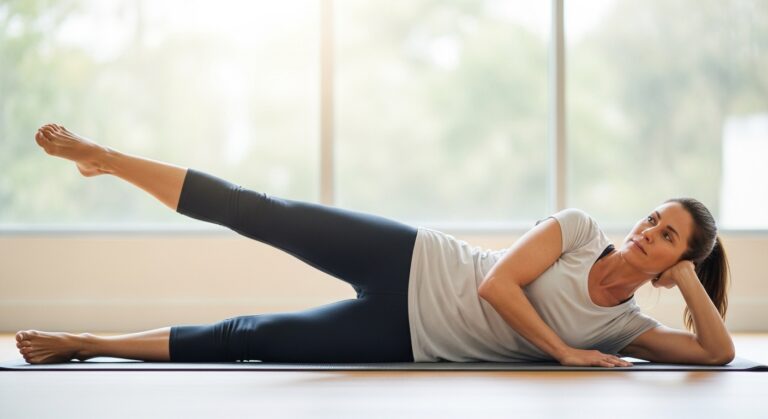
Leg raises target hip flexors, quadriceps, and core muscles without any impact. They’re particularly valuable for improving balance and preventing falls—a crucial consideration as we age.
How to do it: Sit in a sturdy chair with your back supported and feet flat on the floor. Slowly lift one leg straight out in front of you until it’s parallel to the floor (or as high as comfortable). Hold for 2-3 seconds, then lower with control. Alternate legs. For standing variation, hold the back of a chair for balance, stand tall, and lift one leg straight out to the front, side, or back. Perform 2-3 sets of 10-12 reps per leg.
Modifications: Add a resistance band around your ankles for extra challenge. For side leg raises, focus on lifting from the hip rather than leaning your torso. The movement should be controlled and deliberate—no swinging or momentum.
These movements strengthen the muscles that stabilize your hips and pelvis. When these muscles are strong, you’re less likely to experience hip pain, and your knees and lower back benefit from better alignment.
5. Cat-Cow Stretches: Essential Spinal Mobility and Back Relief
If you do only one exercise from this list, make it cat-cow. This gentle yoga movement mobilizes every segment of your spine, relieves morning stiffness, and improves posture. It takes just two minutes and feels absolutely amazing.
How to do it: Start on your hands and knees with hands under shoulders and knees under hips. For the “cow” position, drop your belly toward the floor, lift your chest and tailbone, and look slightly upward. For the “cat” position, round your spine toward the ceiling, tuck your tailbone, and drop your head. Flow between these positions slowly, coordinating with your breath—inhale for cow, exhale for cat. Perform 8-10 complete cycles.
Quick benefits: This movement lubricates the joints between your vertebrae, stretches the muscles along your spine, and gently compresses and releases the spinal discs. It’s like a massage for your back from the inside out. Many women report that this single exercise eliminates the back stiffness they used to experience all morning.
The breath coordination is key. Deep breathing while moving increases oxygen flow and helps your nervous system relax. You’re not just stretching your spine—you’re calming your entire system and setting a positive tone for the day.
6. Resistance Band Rows: Amazing Posture and Back Strength Builder
Resistance band rows strengthen your upper back, shoulders, and arms while being completely adaptable to your strength level. Unlike weights that create jerky movements, resistance bands provide smooth, consistent tension that’s easy on joints.
How to do it: Sit on the floor with legs extended (or bent if that’s more comfortable). Loop a resistance band around your feet, holding one end in each hand. Sit tall with shoulders back. Pull the band toward your torso, squeezing your shoulder blades together. Keep your elbows close to your body. Hold for one second, then slowly release. Perform 3 sets of 12-15 reps.
Joint protection: The beauty of resistance bands is progressive tension—they’re easier at the start of the movement when your joints are most vulnerable, and harder at the end when your muscles are fully engaged. Choose a band that allows you to complete all reps with good form. If you’re struggling past rep 8, use a lighter band.
This exercise directly counteracts the rounded shoulders and forward head posture that comes from modern life. Stronger upper back muscles pull your shoulders back naturally, reducing neck and shoulder pain while making you look taller and more confident.
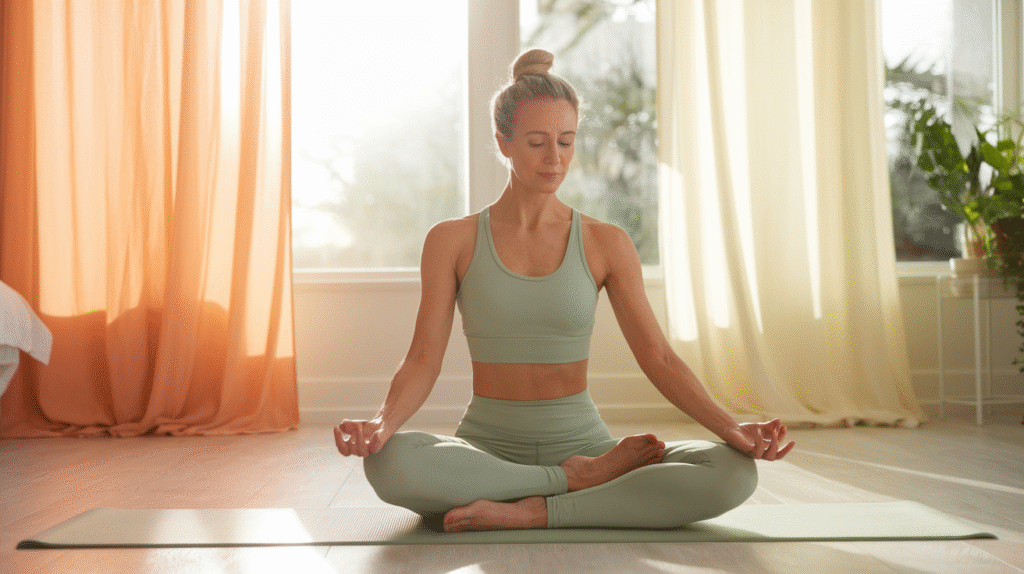
7. Gentle Yoga Flow Sequence: Complete Full-Body Joint Mobility
A simple yoga flow combines flexibility, strength, and mindfulness in one powerful routine. This isn’t about pretzel poses or advanced balance—it’s about moving your body through its full range of motion while building functional strength.
How to do it: Start in child’s pose (sitting back on your heels with arms extended forward) for 30 seconds. Move to downward-facing dog (hands and feet on the floor, hips lifted—modify by bending your knees generously). Hold for 30 seconds. Step one foot forward into a modified warrior pose (front knee bent, back leg straight, arms reaching forward). Hold 20 seconds per side. Return to child’s pose. This complete sequence takes about 5 minutes.
Daily benefits: This flow mobilizes your hips, shoulders, spine, and ankles—essentially every major joint in your body. The weight-bearing positions (like downward dog) build bone density, which is crucial for preventing osteoporosis. The holds build strength. The stretches improve flexibility. It’s a complete package.
The mindfulness component matters too. Focusing on your breath and body awareness reduces stress hormones that contribute to inflammation. You’re not just exercising your body—you’re nurturing your entire system.
Creating Your Perfect Morning Joint-Friendly Routine
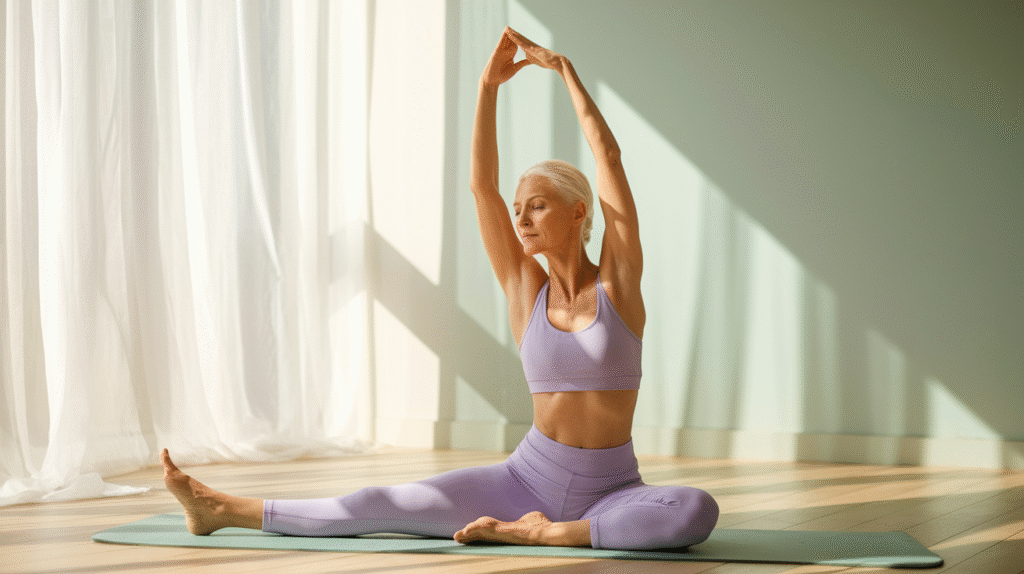
How to Structure Your Morning Workout
You don’t need to do all seven exercises every morning. In fact, choosing 3-4 exercises and performing them consistently will deliver better results than trying to do everything and burning out after a week.
Sample beginner routine (10 minutes): – Cat-cow stretches: 2 minutes – Glute bridges: 2 sets of 10 reps – Wall push-ups: 2 sets of 8 reps – Seated leg raises: 1 set of 10 reps per leg
Sample intermediate routine (15 minutes): – Gentle yoga flow: 5 minutes – Chair squats: 3 sets of 12 reps – Resistance band rows: 3 sets of 12 reps – Glute bridges with pause: 2 sets of 10 reps
Sample advanced routine (20 minutes): – Cat-cow stretches: 2 minutes – Glute bridges (single-leg variation): 3 sets of 10 reps per leg – Incline push-ups: 3 sets of 12 reps – Chair squats with pause: 3 sets of 12 reps – Standing leg raises (all directions): 2 sets of 10 reps per leg – Resistance band rows: 3 sets of 15 reps
Warming up matters even more after 40. Before starting your routine, spend 2-3 minutes doing gentle movements: arm circles, ankle rotations, gentle twists, and light marching in place. This increases blood flow and prepares your joints for exercise.
Tips for Staying Consistent and Safe
Start with just three minutes if that’s all you can manage. Seriously. Three minutes of movement beats zero minutes every single time. You can build from there once the habit is established.
Listen to your body—really listen. Good muscle engagement feels like effort, warmth, and maybe a slight burn. Joint pain feels sharp, grinding, or unstable. If you feel the latter, stop immediately and modify the exercise. There’s no prize for pushing through pain.
Building the habit: Set out your workout clothes the night before. Put your yoga mat where you’ll see it first thing. Start your coffee maker, then do your exercises while it brews. Stack your new habit onto an existing morning routine to make it automatic.
Track your progress in a simple notebook. Write down which exercises you did and how you felt. After two weeks, you’ll see patterns and improvements that keep you motivated.
Equipment You’ll Need (Minimal and Budget-Friendly)
You can start with literally nothing and still benefit from most of these exercises. But a few simple items enhance your routine significantly:
Essential items: – Yoga mat or thick towel ($15-30) – Resistance band set with different tensions ($10-20) – Sturdy chair (you already have this)
Nice-to-have additions: – Foam roller for post-workout muscle release ($15-25) – Small pillow for knee support during floor exercises ($5-10) – Resistance loop bands for glute work ($8-15)
Total investment: $25-50 for everything you need. No gym membership required. No expensive equipment. Just simple, effective tools that last for years.
Common Mistakes to Avoid and Pro Tips for Success
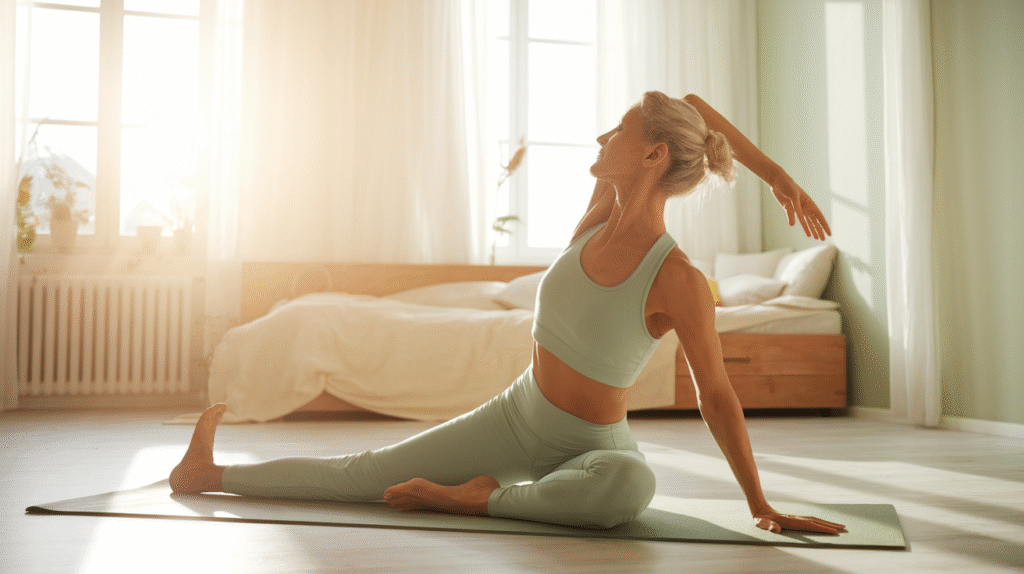
Joint-Friendly Workout Mistakes Women Over 40 Make
The biggest mistake? Pushing through pain because you think you should be able to do more. Your body isn’t being weak or lazy—it’s giving you valuable information. Pain is a stop signal, not a challenge to overcome.
Skipping warm-ups is another common error. You might have gotten away with this at 25, but at 40+, cold muscles and stiff joints need gentle preparation. Those two minutes of warm-up prevent hours of discomfort later.
Stop comparing yourself to your younger self or to other people. Your fitness journey is uniquely yours. The woman next to you might have different joint health, different hormones, different movement history. Focus on your progress, not someone else’s performance.
Proven Strategies for Maximum Results
Proper breathing transforms every exercise. Exhale during the effort (pushing up, lifting, pulling). Inhale during the easier phase (lowering, releasing). This oxygenates your muscles and helps you maintain good form.
Progress safely by adding reps before adding resistance. Master the movement pattern with your body weight or light resistance. When you can complete all sets with perfect form and still feel energized, then increase difficulty.
Rest and recovery matter immensely. Your joints need time to adapt and strengthen. Aim for 4-5 workout days per week, with at least two rest days. On rest days, gentle walking or stretching is perfect—just not structured exercise.
Signs Your Routine Is Working
In the first week, you might feel more tired as your body adapts. That’s normal. But you should also notice that morning stiffness decreases and you feel more energized by mid-morning.
After one month, expect real changes: movements that felt difficult become easier, you stand taller naturally, and you feel genuinely stronger in daily activities. That grocery bag feels lighter. Getting up from the floor is smoother.
After three months, people will notice. Your posture improves visibly. You move with more confidence. Joint pain that used to be constant becomes occasional or disappears entirely.
When to consult a healthcare provider: If you experience persistent joint pain that doesn’t improve with rest, significant swelling, or sharp pain during specific movements, get it checked. A physical therapist can provide personalized modifications and ensure you’re moving in ways that support your specific body.
Conclusion
Key Takeaways
These seven joint-friendly exercises—glute bridges, wall push-ups, chair squats, leg raises, cat-cow stretches, resistance band rows, and gentle yoga flow—offer an effective, safe path to staying strong and mobile after 40. They work with your body’s natural changes instead of fighting against them.
The amazing truth is that you don’t need to jump, run, or push yourself to exhaustion to feel energized and capable. Controlled, deliberate movements build the kind of strength that actually serves your life. This is strength that helps you play with grandchildren, travel comfortably, and live independently for decades to come.
Starting tomorrow morning, pick just 2-3 exercises from this list. Set your alarm 15 minutes earlier. Commit to showing up for yourself with 10 minutes of movement. That’s it. That’s the whole plan.
Your Action Plan
Bookmark this guide so you can reference the exercise instructions easily. Better yet, write down your chosen exercises on a notecard and keep it by your bed.
Set your alarm 15 minutes earlier tomorrow. Lay out comfortable clothes tonight. When you wake up, don’t negotiate with yourself—just start moving. Do your warm-up, perform your chosen exercises, and notice how you feel.
Remember this fundamental truth: consistency and proper form beat intensity every single time for lasting joint health. You’re not training for a competition. You’re building a body that feels good and serves you well.
Final Encouragement
Your body at 40, 50, 60, and beyond is capable of incredible things when you treat it with respect and intelligence. These simple morning movements are your investment in feeling vibrant, strong, and pain-free for decades to come.
You deserve to wake up feeling capable instead of stiff. You deserve to move through your day with energy instead of discomfort. You deserve to feel at home in your body, confident in its strength and resilience.
Here’s to mornings that start with movement, not stiffness. Here’s to building strength that lasts. Here’s to feeling 10 years younger by simply moving smarter. You’ve absolutely got this.
Now set that alarm, choose your exercises, and show up for yourself tomorrow morning. Your future self will thank you.