5 Strength Training Tips for Women in Perimenopause
If you’re in your 40s and suddenly feeling like your body has turned against you—weight creeping on despite eating the same, energy levels tanking, and your favorite jeans refusing to cooperate—you’re not alone. Welcome to perimenopause, where the rules of fitness suddenly change.
But here’s the good news: strength training becomes your secret weapon during this transition. Not the endless cardio you’ve been doing for years, but actual muscle-building work that addresses what’s happening in your body right now.
These five proven tips will help you build strength, boost your metabolism, and feel like yourself again during this challenging phase.
Why Strength Training Matters More Than Ever During Perimenopause
Understanding What’s Happening to Your Body
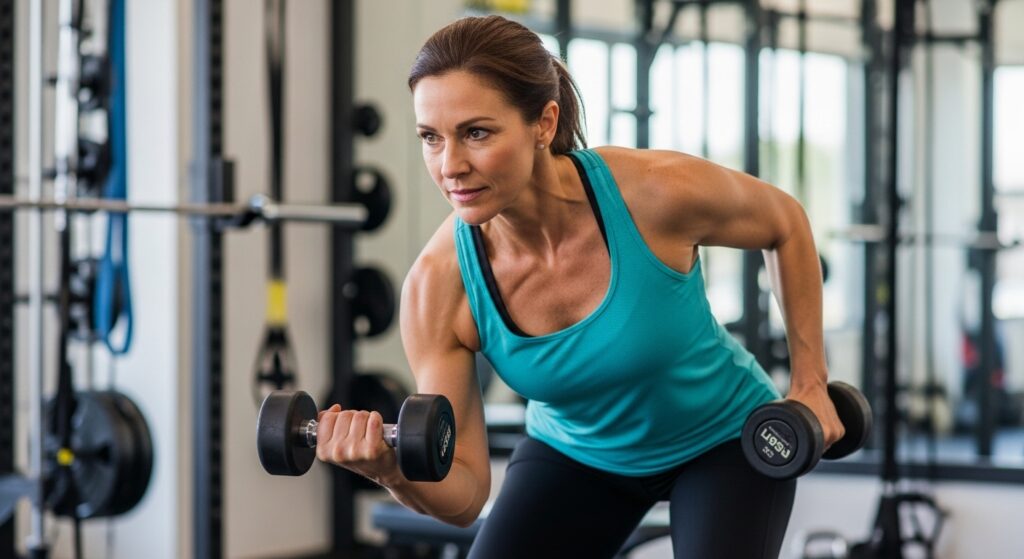
Your body is going through a massive hormonal shift during perimenopause, and it’s not subtle. Estrogen levels start fluctuating wildly before eventually declining, and this hormone plays a much bigger role in your fitness than you might realize.
Estrogen helps maintain muscle mass, supports bone density, and keeps your metabolism humming along. When it starts dropping, you naturally lose muscle mass—about 3-5% per decade after age 30, and that accelerates during perimenopause.
This muscle loss directly impacts your metabolism. Muscle tissue burns more calories at rest than fat tissue, so as you lose muscle, your body needs fewer calories to function.
That’s why you can eat exactly what you ate at 35 and suddenly gain weight at 45. The metabolic slowdown is real, and it’s directly connected to declining muscle mass and hormonal changes.
Beyond metabolism, declining estrogen significantly affects bone density. Women can lose up to 20% of their bone density in the five to seven years following menopause. This makes strength training essential—not just for looking fit, but for maintaining the structural integrity of your skeleton.
The Amazing Benefits You’ll Experience
Strength training addresses perimenopause symptoms in ways that surprised researchers. Women who engage in regular resistance training report fewer hot flashes, better sleep quality, and improved mood stability.
The mechanism? Building muscle helps regulate insulin sensitivity and supports more stable blood sugar levels, which directly impacts hormone balance.
The metabolism boost is substantial and measurable. Adding just three pounds of muscle increases your resting metabolic rate by approximately 7%, meaning you burn more calories doing absolutely nothing. Over time, this makes weight management significantly easier without restrictive dieting.
Your energy levels improve dramatically because strength training enhances mitochondrial function—the powerhouses of your cells.
Better mitochondrial function means more efficient energy production, which translates to feeling less exhausted by 3 PM. Plus, the mood benefits are backed by solid research: resistance training reduces anxiety and depression symptoms by boosting endorphins and improving self-efficacy.
Why Traditional Cardio Isn’t Enough Anymore
If you’ve been a dedicated runner or spin class enthusiast for years, this might be hard to hear: endurance cardio alone won’t address the metabolic and muscle changes of perimenopause. Long-duration cardio burns calories during the activity but doesn’t build the muscle mass you’re losing.
Cardio has its place for cardiovascular health, but during perimenopause, you need to shift your primary focus to strength training. The metabolic slowdown you’re experiencing requires muscle building to counteract it. While a 45-minute run might burn 400 calories, building muscle increases your daily caloric burn permanently.
Think of it this way: cardio is like earning interest on your existing savings, while strength training is like increasing your salary. Both matter, but one creates long-term change. Building and maintaining muscle becomes the foundation for metabolic health, bone density, functional fitness, and symptom management during this transition.
Tip #1 – Start with Compound Movements for Maximum Results
What Makes Compound Exercises Perfect for Perimenopause
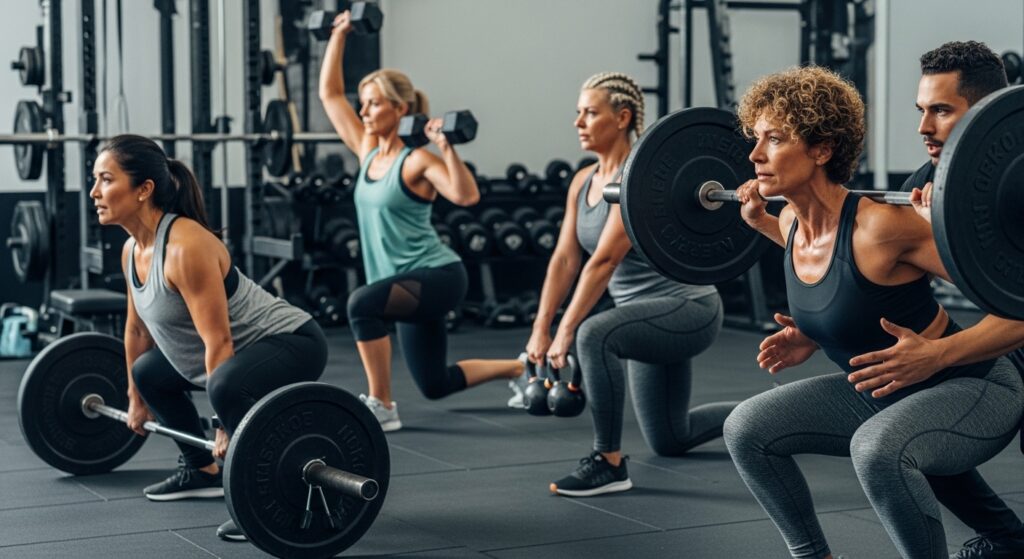
Compound movements work multiple muscle groups simultaneously, making them incredibly efficient for women juggling careers, families, and the challenges of perimenopause. Instead of isolating one small muscle with bicep curls, compound exercises like squats engage your legs, core, and stabilizing muscles all at once.
This efficiency matters because you don’t need to spend hours in the gym to see results. A 30-minute session focusing on compound movements delivers more metabolic benefit than an hour of isolation exercises. These movements also mimic real-life activities—picking up groceries, climbing stairs, getting up from the floor—making you functionally stronger for daily life.
The hormonal response to compound movements is significant. These exercises trigger greater growth hormone and testosterone release (yes, women need testosterone too!) compared to isolation exercises. During perimenopause, when these anabolic hormones are declining, maximizing their natural release through exercise becomes essential.
The Essential Compound Exercises to Master
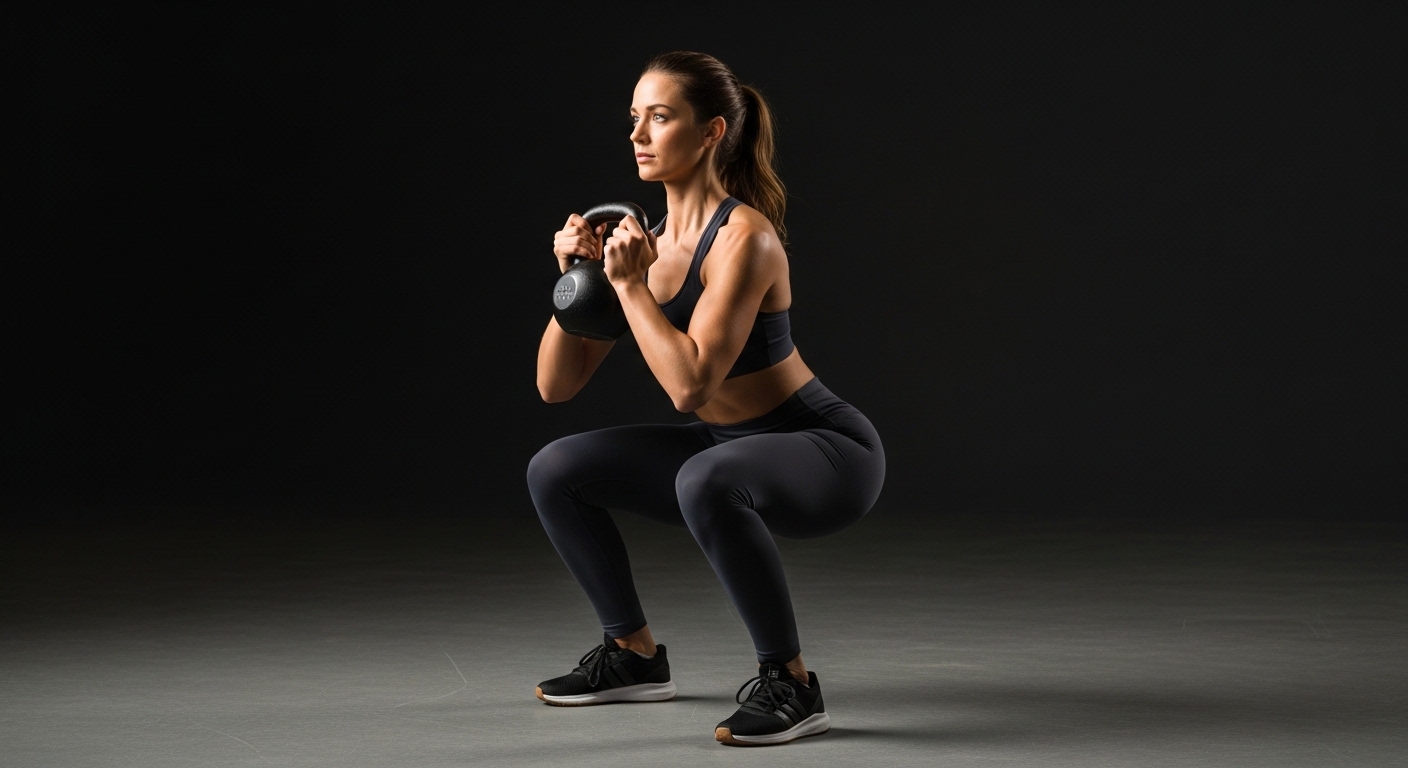
Squats are the foundation of lower body strength. They work your quadriceps, hamstrings, glutes, and core simultaneously. Start with bodyweight squats, focusing on sitting back like you’re lowering into a chair, keeping your chest up and knees tracking over your toes. As you build confidence, add dumbbells at your sides or a goblet squat holding one weight at chest level.
Deadlifts sound intimidating but they’re incredibly functional. This movement teaches you to lift heavy objects safely from the ground—something you do constantly in real life. Begin with a simplified Romanian deadlift: hold dumbbells in front of your thighs, hinge at your hips while keeping your back straight, lower the weights to mid-shin, then stand back up by squeezing your glutes. This works your entire posterior chain—back, glutes, and hamstrings.
Lunges build single-leg strength, balance, and stability. The reverse lunge (stepping backward rather than forward) is gentler on your knees while still delivering excellent results. These movements address the balance changes that can occur during perimenopause while building functional leg strength.
Push-ups are the perfect upper body compound movement. They work your chest, shoulders, triceps, and core. Start on an elevated surface like a countertop or bench if floor push-ups feel too challenging. The key is maintaining a straight line from head to heels and gradually working toward more challenging variations.
Simple Ways to Get Started Safely
Begin every compound movement with bodyweight only. Master the movement pattern before adding any resistance. This approach prevents injury and builds the neuromuscular connections that make these exercises effective.
Proper form beats heavy weight every single time. For squats, your knees should track over your toes without caving inward, and your weight should stay in your heels. For deadlifts, your back stays neutral—no rounding. For lunges, your front knee stays behind your toes. For push-ups, your body moves as one unit.
Add weight only when you can complete 10-12 repetitions with perfect form and feel like you could do 2-3 more. Start with light dumbbells—even 5-8 pounds—and increase gradually. Your goal isn’t to lift the heaviest weight tomorrow; it’s to build sustainable strength that supports you through perimenopause and beyond.
Tip #2 – Lift Heavy (Whatever Heavy Means to You)
Rethinking What “Heavy” Really Means
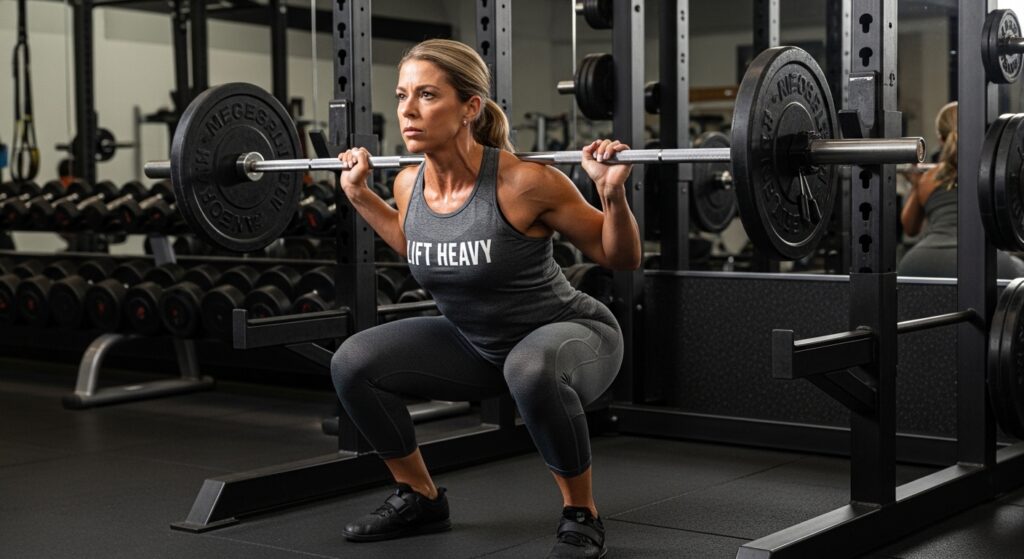
“Heavy” is completely personal and changes based on your starting point, the exercise, and how you feel that day. Heavy means challenging your muscles enough that the last 2-3 repetitions feel difficult to complete with good form. It doesn’t mean struggling through every rep or risking injury.
Many women have been conditioned to grab the lightest weights on the rack, worried about “getting bulky.” Let’s destroy that myth right now: women don’t have the testosterone levels to build massive muscles accidentally. What you will build is lean, metabolically active muscle tissue that makes you stronger, boosts your metabolism, and improves your body composition.
Light weights with high repetitions (15-20 reps) have their place, but they won’t deliver the strength and metabolic benefits you need during perimenopause. To build muscle and bone density, you need to challenge your muscles with sufficient resistance—typically in the 8-12 repetition range where the last few reps feel genuinely challenging.
How to Find Your Perfect Starting Weight
Use this simple test: choose a weight and perform the exercise. If you can easily complete 15 repetitions without feeling challenged, the weight is too light. If you can’t complete 8 repetitions with proper form, it’s too heavy. Your sweet spot is a weight that allows 8-12 repetitions where the last 2-3 feel difficult but doable with good form.
Progressive overload is the principle that drives strength gains. This means gradually increasing the challenge over time by adding weight, increasing repetitions, or decreasing rest periods. You don’t need to add weight every single workout—progress happens over weeks and months, not days.
Listen to your body’s signals carefully during perimenopause. Some days your energy is fantastic and you’ll surprise yourself with your strength. Other days, hormonal fluctuations might make the same weight feel much heavier. That’s completely normal. Adjust accordingly rather than pushing through when your body is asking for gentler work.
Building Strength Gradually and Safely
Aim to increase weight by the smallest increment available—usually 2.5 to 5 pounds—once you can complete 12 repetitions with perfect form for all your sets. This gradual progression prevents injury and builds sustainable strength.
Resistance bands offer an excellent alternative to weights, especially for home workouts or when traveling. They provide variable resistance (harder at the peak of the movement) and come in different resistance levels. You can progress by using thicker bands or doubling them up for more challenge.
Track your workouts in a simple notebook or phone app. Write down the exercises, weights used, and how you felt. This tracking serves two purposes: it ensures you’re progressively challenging yourself, and it provides motivation when you look back and see how much stronger you’ve become. Progress during perimenopause might feel slower than in your 30s, but it’s absolutely happening.
Tip #3 – Aim for 2-4 Strength Sessions Per Week
Creating Your Ultimate Weekly Workout Schedule
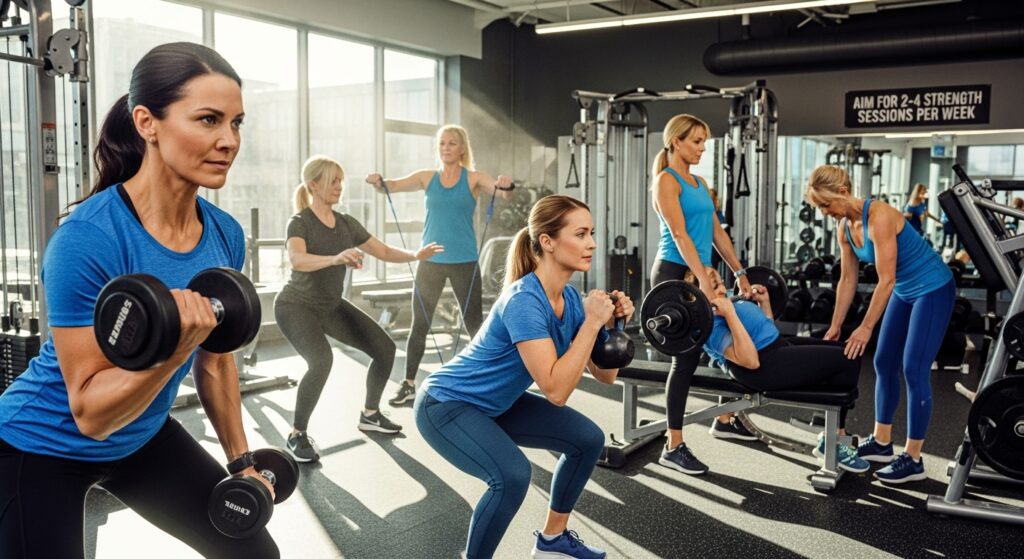
Consistency delivers results, not intensity. Four shorter workouts per week will always outperform one grueling session. Your muscles need regular stimulation to maintain and build strength, especially during perimenopause when your body is naturally inclined to lose muscle mass.
Start with 2-3 sessions per week if you’re new to strength training. Space them out—Monday, Wednesday, Friday works perfectly. This spacing allows 48 hours of recovery between sessions, which your muscles need to repair and grow stronger. As you build consistency and recovery capacity, you can add a fourth session.
Each session needs only 20-30 minutes of actual strength work. You’re not training for a bodybuilding competition; you’re building functional strength and maintaining metabolic health. A focused 30-minute session where you complete 4-5 compound exercises with proper rest between sets delivers excellent results.
Quick and Effective Session Structure
Begin every session with a 5-minute dynamic warm-up. This isn’t static stretching—it’s movement that increases blood flow and prepares your muscles for work. Arm circles, leg swings, bodyweight squats, and walking lunges work perfectly. This warm-up reduces injury risk and improves your performance during the workout.
Your main strength work should focus on 4-5 compound exercises. A simple effective structure: one lower body push (squats), one lower body pull (deadlifts), one upper body push (push-ups or chest press), one upper body pull (rows), and one core exercise. Complete 3 sets of 8-12 repetitions for each exercise, resting 60-90 seconds between sets.
Finish with a 5-minute cool-down including static stretches for the muscles you worked and some deep breathing. This cool-down helps your nervous system transition from the stress of exercise back to rest and recovery mode. Focus on deep belly breathing—inhale for 4 counts, exhale for 6 counts—to activate your parasympathetic nervous system.
Making It Work with Your Busy Life
Home workouts eliminate the time barrier of getting to a gym. With just two sets of dumbbells (one lighter, one heavier) and your bodyweight, you can complete highly effective strength sessions in your living room. No commute, no waiting for equipment, no excuses.
Stack your workouts with existing habits. Strength train right after dropping kids at school, during your lunch break, or before dinner prep. Treat these sessions as non-negotiable appointments with yourself—they’re medicine for managing perimenopause symptoms.
Adapt around your energy fluctuations and symptoms. If you’re exhausted or dealing with particularly heavy bleeding, modify your workout rather than skipping it entirely. Reduce the weight, decrease the sets, or choose easier variations of exercises. Movement almost always improves how you feel, even when starting feels hard. The key is showing up consistently, even when the workout looks different than planned.
Tip #4 – Add Balance and Flexibility Work for Complete Results
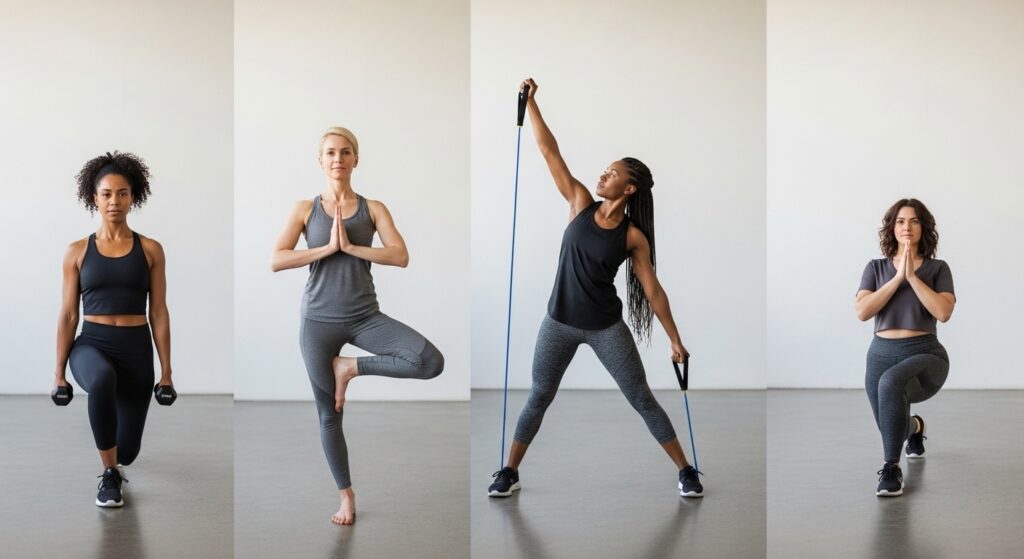
Why Balance Training Becomes Essential Now
Perimenopause affects your proprioception—your body’s awareness of where it is in space. Combined with potential changes in inner ear function and muscle mass loss, your balance can decline during this transition. This isn’t something to ignore; falls become more dangerous as bone density decreases.
Balance training builds the small stabilizing muscles that keep you upright and coordinated. These muscles often get neglected in traditional strength training but they’re essential for functional fitness. Better balance means confidence in daily activities—walking on uneven surfaces, reaching for items on high shelves, or playing with grandchildren.
The functional fitness component matters tremendously. You’re not just training for how you look; you’re training for how you live. Balance work ensures you maintain independence and capability in all your daily activities, now and in the decades ahead.
Simple Balance Exercises to Incorporate
Single-leg stands are deceptively simple but incredibly effective. Stand near a wall for safety, lift one foot off the ground, and hold for 30-60 seconds. To progress, close your eyes or stand on an unstable surface like a folded towel. Perform these while brushing your teeth or waiting for coffee to brew—they require no special time commitment.
The reverse lunge to knee lift combines strength with balance beautifully. Step back into a reverse lunge, then as you stand up, lift that back knee up in front of you and hold for 2-3 seconds before stepping back into the next lunge. This movement pattern improves single-leg stability while building lower body strength.
Incorporate stability challenges into your existing strength exercises. Try squats with your feet closer together, perform shoulder presses while standing on one leg, or do deadlifts with a brief single-leg balance at the top. These variations force your stabilizing muscles to work harder without adding extra exercises to your routine.
Flexibility and Mobility for Joint Health
Flexibility work becomes increasingly important during perimenopause as declining estrogen affects connective tissue elasticity. Tight muscles and stiff joints aren’t just uncomfortable—they increase injury risk and limit your strength training effectiveness.
Add stretching between your strength sets rather than saving it all for the end. While you’re resting between squat sets, stretch your hip flexors. Between upper body exercises, stretch your chest and shoulders. This approach makes efficient use of your rest periods and keeps your muscles from tightening up during the workout.
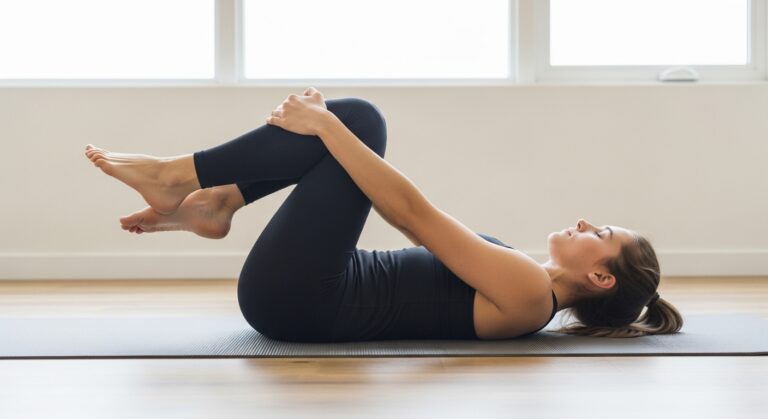
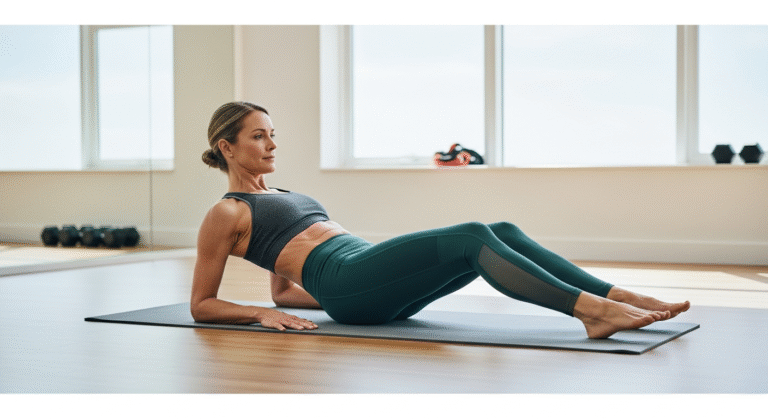
Consider adding one weekly session of restorative movement like gentle yoga or dedicated stretching. These practices complement your strength training by improving mobility, reducing stress, and supporting recovery. The breath work component of yoga particularly benefits perimenopausal women by activating the parasympathetic nervous system and reducing cortisol levels.
Tip #5 – Focus on Recovery and Listen to Your Body
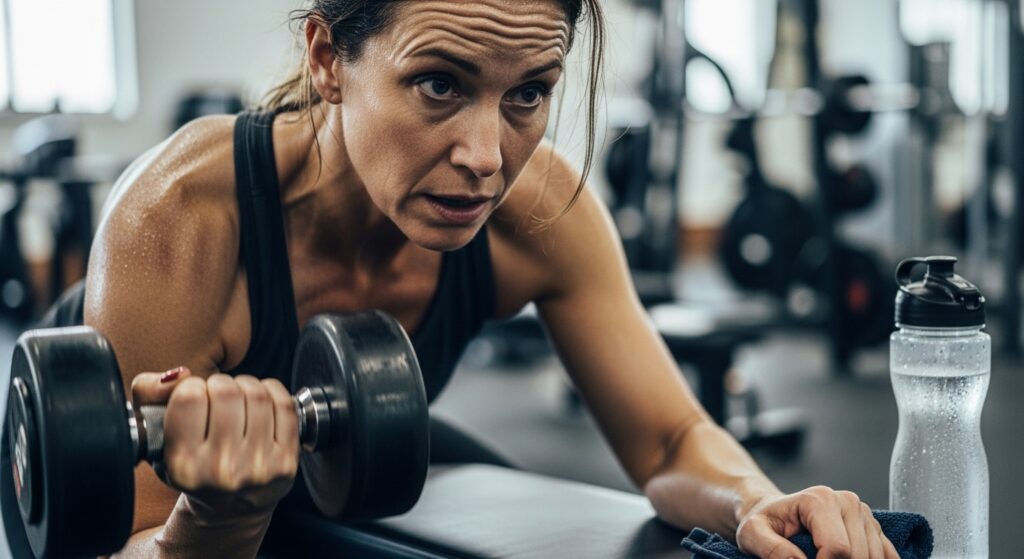
Understanding Recovery During Hormonal Changes
Recovery isn’t optional during perimenopause—it’s when your body actually builds strength. During your workout, you’re breaking down muscle tissue. During recovery, your body repairs that tissue stronger than before. Perimenopause can extend the recovery time you need, so rest days become even more important than in your 30s.
Hormonal fluctuations affect recovery capacity day to day. During the luteal phase of your cycle (if you’re still cycling), you might need extra recovery time. Sleep disruptions from night sweats or insomnia further impact your body’s ability to recover. This isn’t weakness—it’s physiology.
Signs you need an extra recovery day include persistent muscle soreness lasting more than 48 hours, feeling exhausted rather than energized after workouts, decreased performance (weights that felt manageable suddenly feel heavy), irritability, or trouble sleeping. Your body is asking for rest—listen to it.
Effective Recovery Strategies That Actually Work
Protein intake matters tremendously for muscle repair and building, especially during perimenopause when your body becomes less efficient at utilizing protein. Aim for 25-30 grams of protein within a couple hours after your strength session. This could be a protein shake, Greek yogurt with nuts, or eggs with whole grain toast. Throughout the day, target 0.7-1 gram of protein per pound of body weight.
Sleep optimization directly impacts your hormone balance and recovery capacity. Prioritize 7-9 hours of quality sleep by maintaining a consistent sleep schedule, keeping your bedroom cool (helps with night sweats), limiting screen time before bed, and considering magnesium supplementation if your doctor approves. Sleep is when growth hormone peaks—this hormone is essential for muscle repair and recovery.
Active recovery days involve gentle movement rather than complete rest. A 20-minute walk, easy swimming, gentle yoga, or stretching all count as active recovery. These activities increase blood flow to your muscles, which speeds recovery, without creating additional stress that requires more recovery time.
Adapting Your Routine to Your Symptoms
Energy fluctuations during perimenopause are real and unpredictable. Some days you’ll feel strong and capable; other days, getting through a basic workout feels monumental. Build flexibility into your program by having a “Plan B” workout—a simplified version you can complete on challenging days.
On days when symptoms are particularly difficult—severe fatigue, heavy bleeding, intense brain fog—modify rather than skip. Reduce your weights by 20-30%, cut your sets from 3 to 2, or focus on mobility and stretching instead of strength. Moving your body almost always improves symptoms, even when starting feels impossible.
Celebrate progress over perfection. Perimenopause is not the time for all-or-nothing thinking. You’re building sustainable habits that support you through this transition and beyond. Some weeks you’ll complete all four planned workouts; other weeks you’ll manage two. Both scenarios represent success because you’re consistently showing up for yourself despite the challenges your body is navigating.
Getting Started: Your Easy Action Plan
You now have the knowledge—here’s your simple roadmap to actually implement it. Start with Week 1 by choosing 4-5 compound exercises from the list: one squat variation, one deadlift or hinge movement, one upper-body push, one upper-body pull, and one core exercise. Begin with bodyweight only or very light weights (5-8 pounds) to master the movement patterns.
Schedule 2-3 sessions this week, spacing them 48 hours apart. Each session follows the same structure: a 5-minute dynamic warm-up, 20-25 minutes of strength work (3 sets of 10 repetitions per exercise), and a 5-minute cool-down with stretching. Write down what you did and how you felt—this tracking becomes incredibly motivating as weeks progress.
By Week 3-4, you should feel comfortable with the movement patterns. This is when you start adding progressive challenge. If bodyweight squats feel easy, add dumbbells. If 5-pound weights feel light, move to 8 or 10 pounds. The goal is keeping that 8-12 repetition range where the last few reps feel challenging but achievable with good form.
For equipment, you truly need minimal investment. Two sets of dumbbells—one lighter pair (5-10 pounds) and one heavier pair (12-20 pounds)—cover most exercises as you’re starting. Add resistance bands for variety and portability. A yoga mat makes floor exercises more comfortable. That’s it. You can build significant strength with this simple setup in your living room.
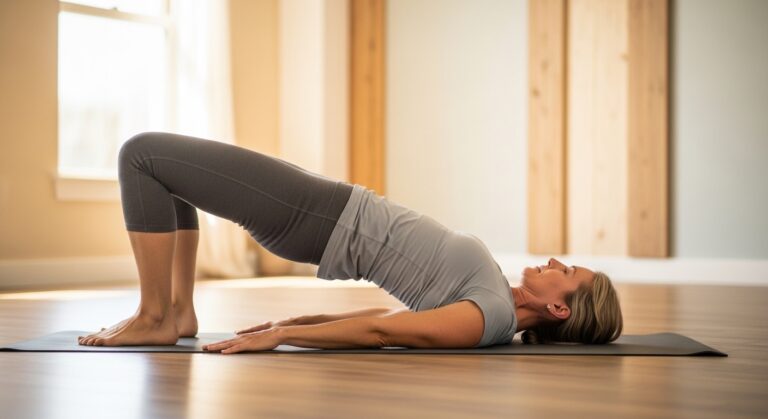
If equipment isn’t available right now, bodyweight variations work beautifully. Squats, lunges, push-ups (on an elevated surface if needed), planks, and glute bridges require zero equipment and deliver real results. The most important factor isn’t what equipment you have—it’s that you start and stay consistent.
Track how you feel, not just what you lift. Yes, record your weights and repetitions, but also note your energy levels, sleep quality, mood, and symptom changes. Many women notice improved sleep and better mood before they see physical changes. These non-scale victories matter tremendously and keep you motivated during the weeks when progress feels slow.
Strong Truly Matters More Than Skinny
Perimenopause changes the fitness game, but you’re not playing defense—you’re taking control. Strength training addresses the root causes of the symptoms you’re experiencing: declining muscle mass, slowing metabolism, decreasing bone density, and hormonal fluctuations. This isn’t about fitting into smaller jeans (though that might happen); it’s about building a body that feels strong, capable, and energized.
Compound exercises deliver maximum results in minimal time, perfect for your busy life. Lifting heavy (at your personal level) builds the muscle mass you’re naturally losing. Consistency with 2-4 weekly sessions beats occasional intense workouts every time. Balance and flexibility work complement your strength gains and protect you from injury. Recovery and adaptation aren’t luxuries—they’re essential components of your success.
Start this week. Not next Monday, not after the holidays, not when life calms down. Choose your 4-5 exercises, schedule your first 30-minute session, and show up for yourself. Your body is navigating massive changes during perimenopause—give it the support it needs through strength training. You deserve to feel strong, energized, and confident in your body during this transition and for all the decades ahead.
The women who thrive during perimenopause aren’t the ones who restrict and cardio themselves into exhaustion. They’re the ones who build strength, honor their bodies’ changing needs, and embrace the power of muscle. Join them. Your future self will thank you for starting today.