5 Spine Strengthening Exercises For Women Over 40
If your back has been talking to you more than usual lately — a dull ache after sitting too long, stiffness when you first get out of bed, or that all-too-familiar tension between your shoulder blades — you are not imagining it.
After 40, the spine begins to face a set of challenges it did not have to deal with in your twenties or thirties. And the good news? You do not need a gym membership, a physical therapist on speed dial, or hours of free time to fight back.
This guide walks you through five of the most effective spine strengthening exercises you can do right at home, specifically tailored for people over 40.
These movements are grounded in physical therapy principles, require no special equipment, and can be done in under 30 minutes. Whether you are completely new to exercise or returning after a long break, these five exercises will help you build a stronger, more resilient spine — starting today.
Why Spine Health Becomes Critical After 40
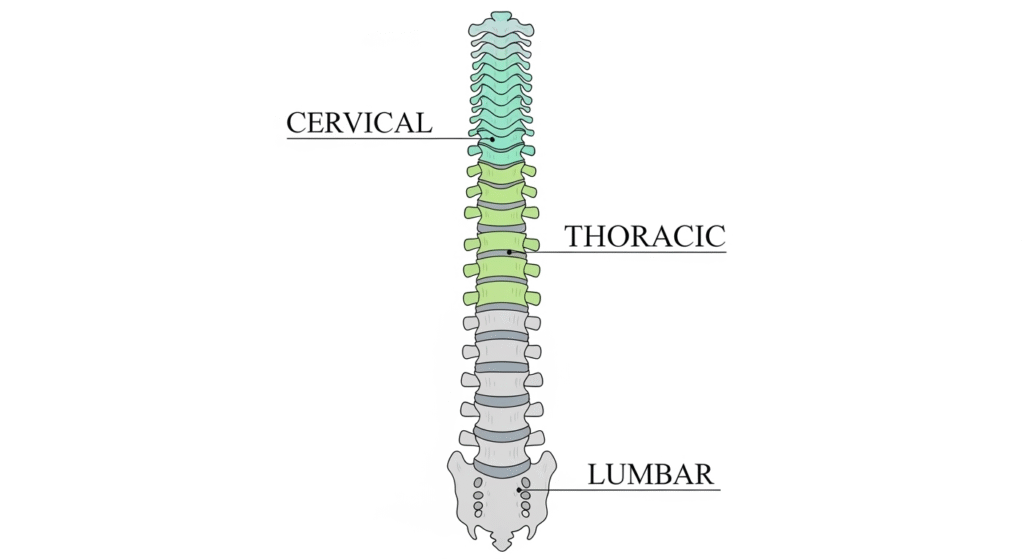
Your spine is not just a structural column that holds you upright. It is a complex, living system of 24 vertebrae, cushioning discs, ligaments, nerves, and muscles that work together constantly, every single time you move.
After 40, a combination of hormonal changes, reduced collagen production, years of sitting, and natural disc degeneration begins to affect how the spine functions.
The intervertebral discs — the shock absorbers between your vertebrae — lose hydration and height as you age. This process, known as disc desiccation, can lead to reduced flexibility, increased pressure on surrounding nerves, and pain.
Meanwhile, the supporting muscles of the spine, particularly the deep core stabilisers and the erector spinae, weaken from inactivity, creating a cycle where poor support leads to more strain on the disc and joints.
For women specifically, the hormonal shifts of perimenopause and menopause accelerate bone density loss, particularly in the lumbar spine.
This increases the risk of vertebral compression fractures and spinal osteoarthritis. The answer to all of this is not rest — it is targeted, consistent movement.
💡 Pro Tip: Strengthening the muscles around your spine reduces pressure on the discs and joints by up to 30% according to spinal rehabilitation research. Even two sessions per week makes a meaningful difference.
What to Know Before You Start
Before diving into the exercises, a few important guidelines will help you get the most out of this routine while keeping yourself safe.
Always move within a pain-free range. Mild muscle fatigue or a gentle stretch sensation is normal and expected. Sharp, shooting, or radiating pain is not. If you feel any pain that travels down your leg, into your arms, or feels electric in nature, stop immediately and consult a healthcare provider.
Breathe intentionally throughout every exercise. Holding your breath increases intra-abdominal pressure and can strain the spine. Exhale during the effort phase of each movement and inhale during the recovery phase.
Focus on quality over quantity. Five perfect repetitions with full muscle engagement will always outperform fifteen sloppy ones. Your goal is not exhaustion — it is neuromuscular connection, meaning you want your brain and your spinal muscles to develop a stronger communication pathway over time.
The 5 Best Spine Strengthening Exercises After 40
1. Bird Dog — The Foundation of Spinal Stability
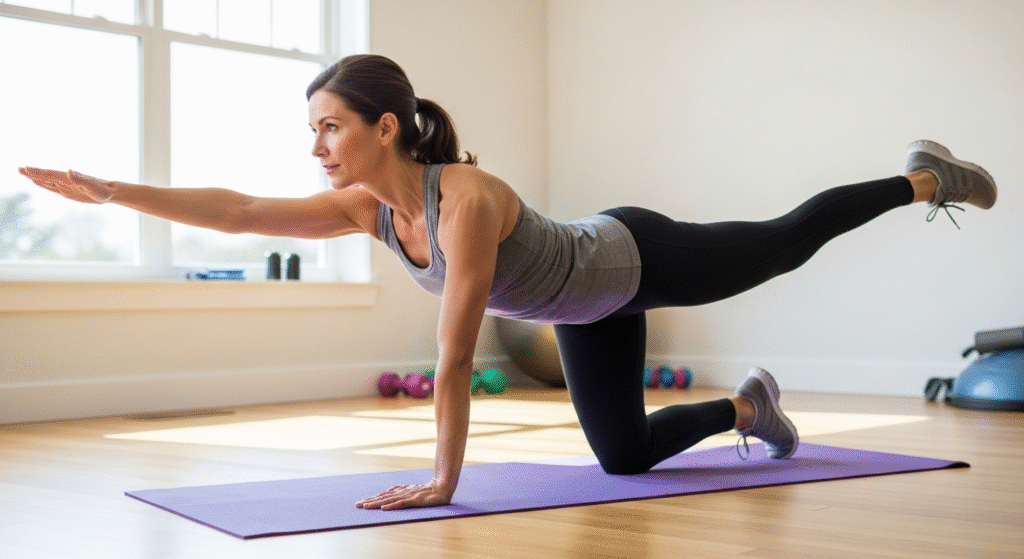
The Bird Dog is widely considered one of the most evidence-backed exercises for spinal rehabilitation and strengthening.
It targets the deep stabilising muscles of the lumbar spine, trains the core to resist rotation, and strengthens the glutes and shoulder stabilisers simultaneously — all without placing any load on the spine itself.
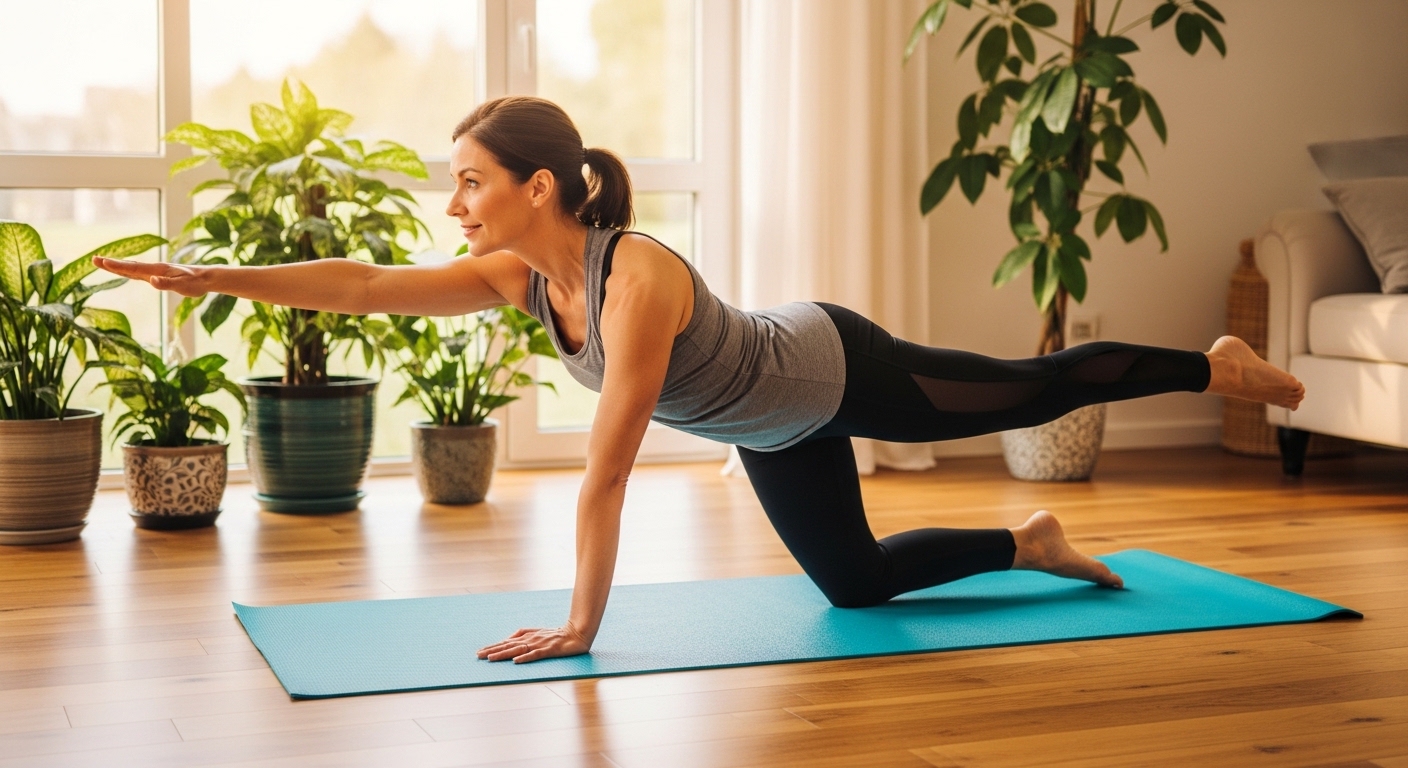
How to do it: Begin on all fours in a tabletop position with your wrists directly under your shoulders and your knees under your hips.
Engage your deep core by drawing your navel gently toward your spine. Slowly extend your right arm forward and your left leg back simultaneously, keeping both limbs parallel to the floor. Hold for three to five seconds, then return to the starting position with control. Repeat on the opposite side.
Sets and reps: Perform 3 sets of 8 to 10 repetitions per side. Rest for 30 to 45 seconds between sets.
Why it works after 40: This exercise trains what physical therapists call anti-rotation stability — your spine’s ability to stay neutral and strong while your limbs are moving.
This is exactly the type of stability that diminishes with age and that makes everyday tasks like lifting, carrying, and bending safer.
💡 Pro Tip: If you feel your lower back arching excessively when you extend your leg, reduce the range of motion. Even a 45-degree leg extension with full core engagement is far more effective than a full extension with a collapsing spine.
2. Glute Bridge — Protecting the Lumbar Spine from Below
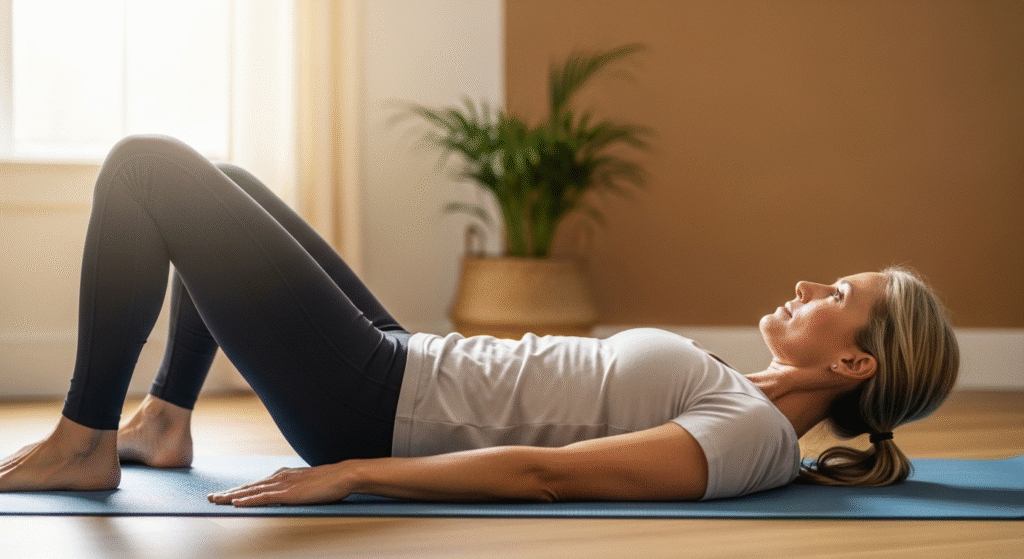
The lumbar spine is intimately connected to the hips and pelvis. When your glutes are weak, your lower back compensates by taking on load it was never designed to handle.
The glute bridge directly addresses this imbalance, strengthening the gluteus maximus and medius while simultaneously teaching the spine to maintain a neutral position under load.
How to do it: Lie on your back with your knees bent and your feet flat on the floor, hip-width apart. Place your arms by your sides with your palms facing down. Engage your core, press through your heels, and lift your hips off the floor until your body forms a straight diagonal line from your shoulders to your knees. Squeeze your glutes hard at the top, hold for two to three seconds, then lower with control.
Sets and reps: Perform 3 sets of 12 to 15 repetitions. Progress to a single-leg variation once the bilateral version feels easy.
Why it works after 40: The posterior chain — glutes, hamstrings, and lower back — tends to weaken significantly with a sedentary lifestyle. Reactivating the glutes takes pressure off the lumbar discs and reduces the risk of lower back strain during activities of daily life.
3. Superman — Building the Erector Spinae
The erector spinae is a group of muscles that runs the entire length of the spine, from the base of the skull to the sacrum. These muscles are responsible for extending the spine, maintaining upright posture, and providing dynamic stability during movement. After 40, these muscles are often chronically lengthened and weakened from years of sitting, making targeted strengthening essential.
How to do it: Lie face down on a mat with your arms extended overhead and your legs straight. Engage your core and simultaneously lift your arms, chest, and legs off the floor, contracting the muscles along your entire spine. Hold for three to five seconds at the top, then lower slowly. Avoid hyperextending your neck — keep your gaze toward the floor throughout the movement.
Sets and reps: Perform 3 sets of 10 repetitions. If the full Superman is too challenging initially, begin with alternating arm and leg lifts.
Why it works after 40: This is one of the few exercises that directly strengthens the posterior spinal musculature through its full range of motion. Stronger erector spinae muscles mean better posture, less disc compression, and a reduced risk of vertebral fractures.
4. Cat-Cow — Spinal Mobility and Fluid Movement

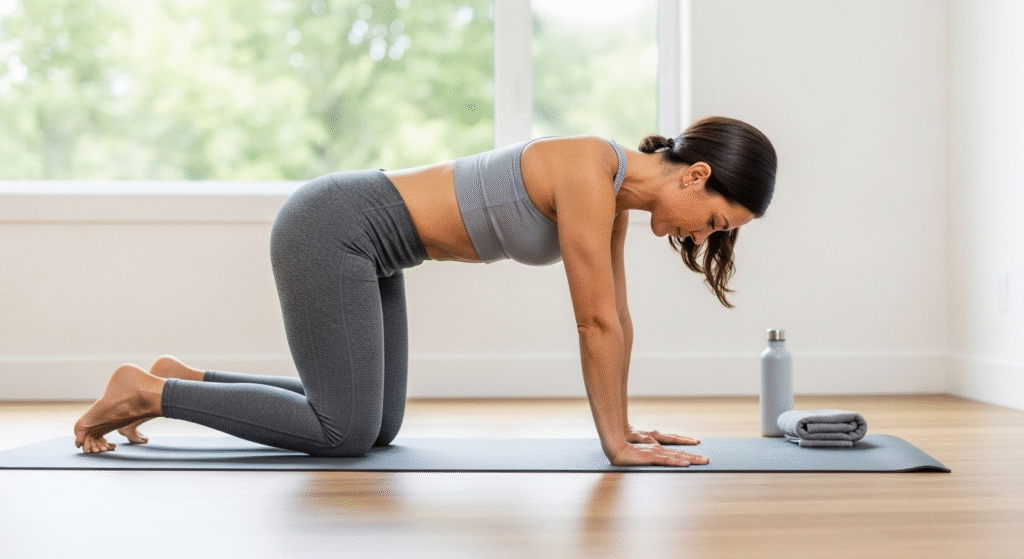
While the other exercises in this list focus on building strength, Cat-Cow addresses an equally important aspect of spinal health: mobility.
A spine that is strong but stiff is still a vulnerable spine. Cat-Cow promotes healthy movement through all segments of the thoracic and lumbar spine, encourages intervertebral disc hydration, and activates the deep core stabilisers in a gentle, pain-free way.
How to do it: Begin on all fours in a tabletop position. On an inhale, drop your belly toward the floor, lift your chest and tailbone upward, and allow your spine to arch gently — this is Cow.
On an exhale, round your spine toward the ceiling, tuck your chin and your tailbone, and draw your navel inward — this is Cat. Flow between the two positions slowly and rhythmically, pairing every movement with your breath.
Sets and reps: Perform 10 to 15 full breath cycles. Use this exercise as a warm-up before the others or as a cool-down at the end of your session.
💡 Pro Tip: Performing Cat-Cow first thing in the morning before getting out of bed is one of the most effective ways to safely reintroduce movement to your spine after the overnight rehydration process. It takes less than two minutes and significantly reduces morning stiffness.
5. Dead Bug — Deep Core Activation for Spinal Protection
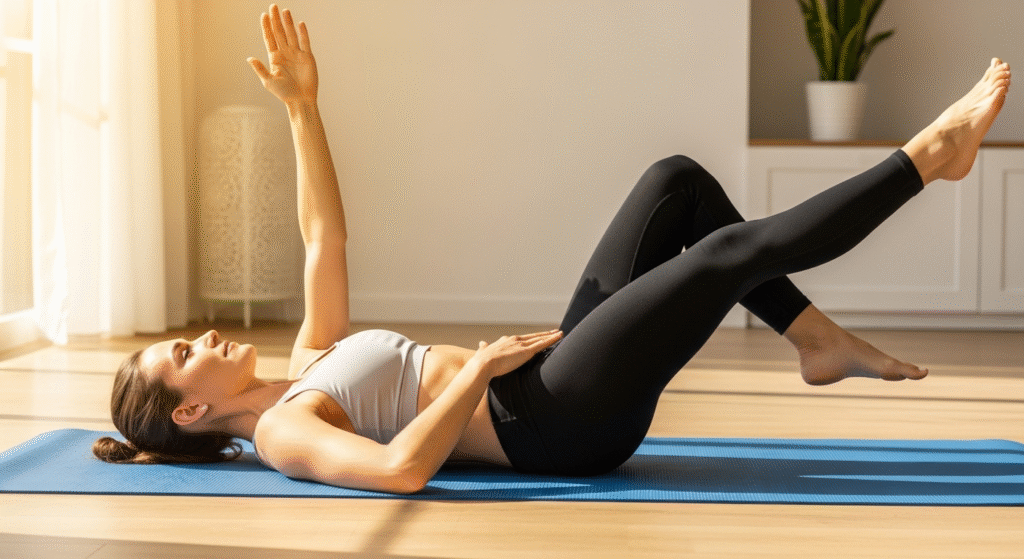
The Dead Bug exercise might look simple from the outside, but it is one of the most sophisticated spine-strengthening exercises available.
It specifically targets the transversus abdominis — the deepest layer of abdominal muscle that wraps around the spine like a natural corset — as well as the multifidus, the small but critical muscles that directly attach to the vertebrae and provide segment-by-segment spinal stability.
How to do it: Lie on your back with your arms extended toward the ceiling and your knees bent at 90 degrees, shins parallel to the floor.
Engage your deep core by pressing your lower back firmly into the mat. Slowly lower your right arm overhead toward the floor while simultaneously extending your left leg, keeping both limbs just above the floor without touching. Return to the starting position with control, then repeat on the opposite side.
Sets and reps: Perform 3 sets of 8 repetitions per side. The key is maintaining full contact between your lower back and the mat throughout the entire movement. If your back arches at all, reduce the range of motion.
Why it works after 40: The deep core muscles are the first line of defence for the spine during every movement you make.
Most people over 40 have significant weakness in these muscles from years of relying on more superficial muscles and external support. The Dead Bug rebuilds this foundational layer of protection.
How to Structure Your Weekly Routine
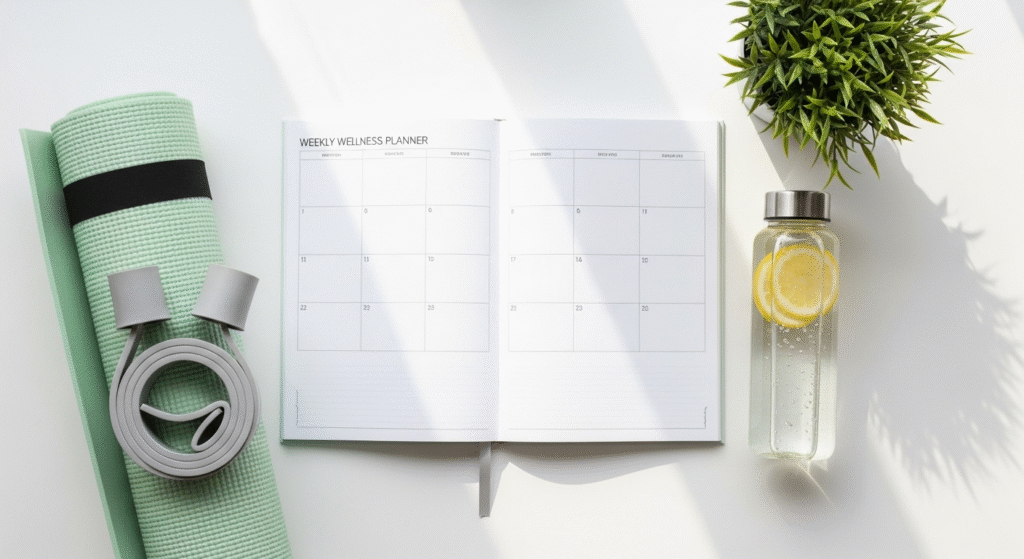
For best results, perform these five exercises as a complete circuit two to three times per week with at least one rest day between sessions.
Begin each session with Cat-Cow as a warm-up, then move through Bird Dog, Glute Bridge, Superman, and finish with the Dead Bug. The entire routine should take between 25 and 35 minutes depending on your rest periods.
Consistency over intensity is the golden rule for spinal rehabilitation and strengthening. You will see more benefit from three gentle, focused sessions per week for eight weeks than from five aggressive sessions that lead to soreness and breaks in your routine.
Signs Your Spine Strengthening Routine Is Working
After two to four weeks of consistent practice, most people notice several positive changes. Morning stiffness begins to reduce and you find it easier to get out of bed. Posture improves naturally throughout the day with less conscious effort.
The background ache of the lower back reduces in frequency and intensity. Daily tasks like lifting bags, bending to pick things up, and sitting for long periods feel less taxing.
These changes are not simply subjective. As the stabilising muscles of your spine grow stronger, they reduce the compressive load on your intervertebral discs and facet joints, meaning less inflammation, less pain signalling, and greater mobility.
Final Thoughts
Your spine does not have to deteriorate simply because you are getting older. These five spine strengthening exercises represent some of the most researched, most effective movements for building a resilient back at home without any equipment.
Start where you are, progress at your own pace, and remember that every single session — even a short one — is an investment in your long-term mobility and quality of life.
Bookmark this page, save it to your wellness board, and share it with someone who could benefit from a stronger spine. Your back will thank you for it.
ater bottle, resistance band, and green plant on a white surface, top-down view, clean aesthetic, soft natural light