5 Daily Movement Habits for Women Over 40

Remember when you could skip workouts for weeks, then jump back in with an intense boot camp class and feel amazing? Or when cutting calories for a few days would instantly show results on the scale?
Yeah, those days are gone.
If you’re over 40, you’ve probably noticed your body doesn’t respond the way it used to. That frustration is real, and you’re not imagining it. Hormonal shifts, metabolic changes, and longer recovery times aren’t just inconveniences—they’re biological realities that require a completely different approach to fitness.
Here’s the good news: What works now is actually *easier* than what you were doing before.
The punishing hour-long workouts? You don’t need them. The restrictive diets? Not necessary. The expensive gym membership you feel guilty about not using? Cancel it.
What you need instead are five simple movement habits that take less than 30 minutes combined and deliver powerful, lasting results. These aren’t trendy exercises or complicated routines. They’re science-backed strategies specifically designed for women experiencing the metabolic and hormonal changes that come with this decade of life.
When you prioritize sustainable movement over punishing workouts, something remarkable happens. Your energy returns. Your clothes fit better. Your joints feel younger. And most importantly, you build a relationship with movement that actually fits your real life—not some fitness influencer’s fantasy schedule.
Let’s dive into exactly what works now and why.
The Truth About Exercise After 40: What Actually Works Now

Why Your Old Workout Routine Stopped Working
Your body isn’t broken—it’s just changed. Starting in your mid-30s, you begin losing muscle mass at a rate of 3-8% per decade. This process, called sarcopenia, accelerates after 40 and directly impacts your metabolism. Less muscle means fewer calories burned at rest, which explains why the same eating habits that maintained your weight at 30 now lead to gradual weight gain.
Hormonal shifts compound this challenge. Declining estrogen affects how your body stores fat (hello, belly fat that won’t budge), regulates energy, and recovers from exercise. Your cortisol response changes too, meaning that high-intensity workouts you once thrived on might now leave you exhausted and inflamed rather than energized.
Your joints need more recovery time. Connective tissue becomes less elastic. Your body requires 48-72 hours to fully recover from intense exercise, compared to the 24-48 hours you needed in your 20s and 30s.
This isn’t failure—it’s biology. And once you understand it, you can work *with* your body instead of against it.
The Science-Backed Shift: From Intensity to Consistency
Research reveals something counterintuitive: For women over 40, daily moderate movement beats sporadic intense workouts. A study in the Journal of Applied Physiology found that consistent, moderate activity preserves muscle mass and metabolic function more effectively than occasional high-intensity training.
Why? Your body responds better to steady signals than dramatic stress. Daily movement tells your metabolism to stay active, your muscles to maintain strength, and your joints to stay mobile. Sporadic intense workouts, on the other hand, can spike cortisol, increase inflammation, and require recovery time that disrupts consistency.
The 10% progression rule becomes crucial now. Increase intensity, duration, or resistance by no more than 10% every two weeks. This allows your connective tissue, bones, and muscles to adapt safely without injury. Pushing harder, faster might have worked at 25. At 45, it leads to setbacks that derail your progress for weeks.
Joint health demands attention. Low-impact doesn’t mean low-effectiveness. Walking, bodyweight exercises, and controlled movements build strength while protecting your joints for decades of activity ahead.
What “Movement Habits” Really Means (And Why It’s Better Than “Workouts”)
Stop thinking “workout” and start thinking “movement habits.” This isn’t semantic gymnastics—it’s a fundamental mindset shift that determines your success.
Workouts require gym time, workout clothes, and mental energy to “get motivated.” Movement habits integrate seamlessly into your existing life. They’re the 10-minute morning routine before your shower, the 5-minute strength sequence while your coffee brews, the evening stretches while watching TV.
Small, consistent habits sculpt lasting change. You’re not trying to transform your body in 30 days. You’re building a lifestyle that maintains your strength, energy, and confidence for the next 30 years. That requires habits, not heroic efforts.
This directly addresses the “no time for the gym” reality. You don’t need gym time. You need strategic moments throughout your day where movement happens naturally. When exercise becomes integrated rather than isolated, it actually gets done.
Movement Habit #1: The Morning Mobility Ritual (10 Minutes to Unlock Your Day)

Why Mobility Matters More Than Ever After 40
Your fascia—the connective tissue surrounding your muscles—becomes less hydrated and more restricted with age. This creates the stiffness you feel when you first wake up or after sitting for extended periods. Morning mobility work rehydrates this tissue and restores your range of motion before stiffness sets in for the day.
Joint health becomes non-negotiable. Cartilage doesn’t regenerate like other tissues, so protecting what you have through proper movement is critical. Mobility exercises lubricate your joints with synovial fluid, reducing friction and preventing degenerative changes.
Morning movement also activates your metabolism. Even gentle movement increases circulation, raises your core temperature, and signals your body to start burning fuel. Research shows that people who move within 30 minutes of waking have more stable energy levels throughout the day.
Posture improvement starts here. Hours of sitting create forward head position, rounded shoulders, and tight hips. A morning mobility sequence counteracts these patterns before they compound throughout your day, reducing back pain and improving how you look and feel.
Your 10-Minute Morning Mobility Sequence
Start with cat-cow stretches for spine health. On hands and knees, alternate between arching your back (cow) and rounding it (cat). Move slowly, syncing with your breath. Do 5 complete cycles, taking about 30 seconds total. This mobilizes every segment of your spine and activates your core.
Move to hip circles and figure-8s. Standing with hands on hips, make large circles with your hips—10 in each direction. Then trace figure-8 patterns for another minute. This lubricates your hip joints and activates the glutes, which often “turn off” from excessive sitting.
Shoulder rolls and arm circles address upper body stiffness. Roll your shoulders backward 10 times, then forward 10 times. Follow with arm circles—small to large, forward and backward. Spend a full minute here. Your shoulders carry tension from stress and computer work; this releases it.
Gentle twists activate your core and improve spinal rotation. Standing with feet hip-width apart, rotate your torso side to side, letting your arms swing naturally. Move for one minute, gradually increasing your range of motion as you warm up.
The world’s greatest stretch lives up to its name. Step forward into a lunge, place both hands on the ground, rotate your torso toward your front leg, then reach that arm toward the ceiling. Hold for 5 seconds, repeat on the other side. Do 6 total repetitions over 2 minutes. This single move opens your hips, thoracic spine, and shoulders simultaneously.
Ankle and wrist circles might seem minor, but these joints need attention too. Spend 30 seconds on each, making slow, controlled circles in both directions.
Finish with deep breathing and overhead reaches. Stand tall, inhale as you reach overhead, exhale as you lower your arms. Do this for 2 minutes, focusing on expanding your ribcage fully. This completes your nervous system activation and sets a calm, energized tone for your day.
Modifications: If getting on the floor is challenging, do cat-cow against a wall or countertop. If balance is an issue during hip circles, hold onto a chair. Start with 5 minutes if 10 feels overwhelming—consistency beats duration.
How to Make It Stick: Implementation Tips
Do this sequence *before* your coffee or breakfast. Habit stacking—attaching a new habit to an existing one—dramatically increases adherence. Your morning coffee is automatic; make mobility just as automatic by doing it first.
Keep your yoga mat rolled out in your bedroom or bathroom. Visual reminders eliminate the friction of “setting up.” When the mat is already there, you just step onto it.
If 10 minutes feels overwhelming initially, start with just 5. The goal is consistency, not perfection. Five minutes every single day beats 10 minutes three times a week.
Use a simple YouTube video or app like “Morning Yoga” or “Daily Mobility” for guidance. Following along removes the mental load of remembering the sequence until it becomes automatic.
Movement Habit #2: The Strength-Building Micro-Workout (5 Minutes, 3x Daily)

Why Traditional Strength Training Fails Busy Women Over 40
Gym intimidation is real. The weights section dominated by younger men, the complicated machines, the unspoken rules—it all creates barriers that prevent you from doing what your body desperately needs: strength training.
Time constraints compound the problem. Finding a 60-minute block for the gym, plus travel time, plus shower time, adds up to 90+ minutes you simply don’t have most days.
Yet muscle preservation becomes *critical* after 40. Every pound of muscle you maintain burns 6-10 calories per day at rest. Lose 10 pounds of muscle over a decade (the average without strength training), and your metabolism drops by 60-100 calories daily. That’s 6-10 pounds of fat gain per year from metabolic slowdown alone.
Strength training also maintains bone density, improves insulin sensitivity, supports joint health, and preserves your functional independence as you age. You can’t afford to skip it—but you also can’t fit traditional gym sessions into your life.
The Power of Micro-Workouts: Small Efforts, Big Results
Research on “exercise snacking”—brief bouts of activity throughout the day—reveals remarkable benefits. A study in the American Journal of Physiology found that three 5-minute strength sessions spread across the day produced similar muscle protein synthesis to one 15-minute session, with better adherence rates.
Your muscles don’t know if you trained them for 5 minutes or 50. They only know they experienced resistance and need to adapt by getting stronger. Five minutes three times daily provides that signal consistently without the recovery demands of longer sessions.
Progressive overload works in bite-sized doses. Adding one rep this week, holding positions 5 seconds longer next week, or using a resistance band the following week creates steady strength gains without overwhelming your schedule or your joints.
The metabolic benefits extend beyond the exercises themselves. Each 5-minute session elevates your metabolism for 1-2 hours afterward, meaning you’re burning extra calories for 6+ hours daily from just 15 minutes of total exercise.
Three 5-Minute Strength Sequences You Can Do Anywhere
Morning Sequence (Lower Body Focus):
Your legs contain your largest muscle groups, making them metabolically powerful to train. Do this sequence right after your mobility routine.
– Bodyweight squats (15 reps): Feet shoulder-width apart, sit back like you’re sitting in a chair, keep your chest up. If full squats hurt your knees, do partial squats or hold onto a countertop for support.
– Alternating lunges (10 each leg): Step forward, lower your back knee toward the ground, push back to standing. Keep your front knee behind your toes. Hold onto a wall for balance if needed.
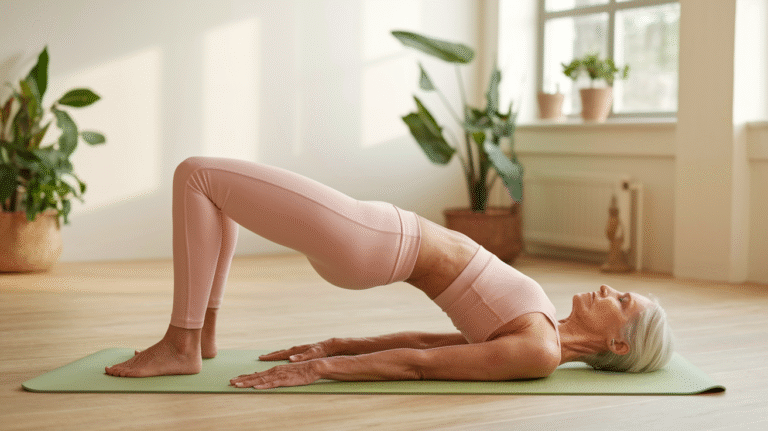
– Glute bridges (20 reps): Lie on your back, feet flat, lift your hips toward the ceiling, squeeze your glutes at the top. This strengthens your posterior chain and counteracts sitting.
– Wall sit (30-60 seconds): Back against a wall, slide down until thighs are parallel to the ground. This builds endurance in your quads and teaches proper squat positioning.
Midday Sequence (Upper Body & Core):
Perfect for a work break, this sequence fights the effects of sitting and desk work.
– Counter or wall push-ups (10-15 reps): Hands on a counter or wall, body in a straight line, lower your chest toward the surface. The higher your hands, the easier the exercise. Progress by gradually lowering the surface height.
– Tricep dips using a chair (10 reps): Sit on the edge of a sturdy chair, hands gripping the edge, slide forward and lower your body by bending your elbows. This tones the back of your arms.
– Plank hold (30-60 seconds): On forearms and toes (or knees), body in a straight line, engage your core. This builds deep core strength that protects your back.
– Standing or kneeling shoulder taps (20 total): In plank position (on hands), lift one hand to tap opposite shoulder, alternating sides. This builds core stability and shoulder strength.
Evening Sequence (Full Body):
End your day with a sequence that incorporates everything.
– Step-ups on stairs (10 each leg): Step up onto a stair, drive through your heel, step down with control. This builds functional leg strength you use daily.
– Standing rows with resistance band or water bottles (15 reps): Hold band or bottles, pull elbows back, squeeze shoulder blades together. This counters forward shoulder position from sitting.
– Bicycle crunches (20 total): Lying on your back, bring opposite elbow to opposite knee in a cycling motion. This works your entire core, especially obliques.
– Standing side leg raises (15 each side): Lift one leg out to the side, keeping your body upright. This strengthens hip abductors, which stabilize your pelvis and protect your knees.
Progression tips: Start with the suggested reps. When they feel easy, add 2-3 reps per week. Once you reach 20-25 reps, add resistance (bands, water bottles, light dumbbells) and drop back to 10-12 reps. This creates continuous progression without plateaus.
Movement Habit #3: The Non-Negotiable Daily Walk (20-30 Minutes of Fat-Burning Magic)

Walking: The Most Underrated Workout for Women Over 40
Walking gets dismissed as “not a real workout,” but research proves otherwise. A study in the Journal of the American Medical Association found that walking 30 minutes daily reduced cardiovascular disease risk by 30-40% in women over 40—comparable to more intense exercise with far less injury risk.
The low-impact nature protects your joints while still providing significant benefits. Unlike running, which creates impact forces 3-4 times your body weight, walking keeps stress manageable while building bone density in your hips and legs.
Cortisol regulation makes walking uniquely valuable for women over 40. High-intensity exercise can spike cortisol, which promotes belly fat storage when chronically elevated. Walking lowers cortisol, helping you manage stress and its metabolic consequences.
Fat loss happens in the “fat-burning zone”—moderate intensity where your body preferentially uses fat for fuel. Walking at a brisk pace puts you right in this zone for the entire duration, making it incredibly efficient for body composition changes.
Bone density benefits surprise most women. Weight-bearing exercise like walking signals your bones to maintain density, reducing osteoporosis risk. You’re literally investing in your ability to stay active and independent for decades.
How to Make Your Walk More Effective (Without Running)
Incorporate intervals to boost calorie burn without impact. Walk at a brisk pace for 2 minutes (you should be slightly breathless but able to talk), then moderate pace for 1 minute (comfortable conversation). Repeat this pattern throughout your walk. This increases your average intensity and provides cardiovascular benefits beyond steady-state walking.
Add inclines or hills for serious glute activation and calorie burn. Walking uphill can burn 50-70% more calories than flat walking and specifically targets your glutes and hamstrings. Find a hilly route or use a treadmill incline if you’re indoors.
Practice proper posture to engage your core and prevent back pain. Shoulders back and down, chest lifted, core gently engaged, eyes forward (not down at your feet). Imagine a string pulling the crown of your head toward the sky. This turns walking into a full-body exercise.
Use arm swings for upper body engagement. Bend your elbows at 90 degrees and swing your arms naturally in opposition to your legs. This increases calorie burn by 5-10% and helps with balance and rhythm.
Consider weighted vests or ankle weights for progression, but with caution. Start with no more than 5-10% of your body weight and only after you’ve built a solid walking base for several months. Too much weight too soon can stress your joints and alter your gait pattern negatively.
Fitting It In: Creative Solutions for Busy Schedules
Break it into two 15-minute walks if finding 30 consecutive minutes is impossible. A morning walk and evening walk provide the same benefits and might actually fit better into your schedule. The metabolic boost happens with each session, so you’re getting double the post-exercise calorie burn.
Walk during lunch breaks or phone calls. That work call doesn’t require you to sit at your desk. Walk around your neighborhood or office building while talking. You’ll think more clearly and get your movement in simultaneously.
Park farther away and walk to destinations. Those extra 5-10 minutes each way add up. Park at the far end of the lot, get off the bus one stop early, or walk to nearby errands instead of driving.
Walk while kids are at practice or activities. Instead of sitting in your car or on the sidelines, use that time for your walk. You’re already there; you might as well move.
Use walking as a transition between work and home life. A 15-minute walk after work clears your head, reduces work stress, and helps you show up more present for your family. It’s a mental health practice as much as physical exercise.
Movement Habit #4: The Posture Reset (2 Minutes Every Hour You Sit)
The Hidden Damage of Sitting (And Why It Ages You Faster)
Prolonged sitting shuts down your metabolism. Research shows that after just 30 minutes of sitting, your metabolic rate drops significantly, fat-burning enzymes decrease by 90%, and your body’s ability to process blood sugar declines. You’re literally aging faster at a cellular level when you sit for extended periods.
Posture deterioration happens predictably with sitting. Forward head position (your head juts forward from your shoulders), rounded shoulders, and tight hip flexors create a visual appearance of aging beyond your years. You look older, feel stiffer, and move less confidently.
Back pain becomes chronic when these postural patterns persist. Your spine wasn’t designed for 8+ hours of sitting daily. The resulting muscle imbalances, disc compression, and nerve irritation create pain that limits your activity and quality of life.
Confidence takes a hit too. Studies show that upright posture correlates with higher self-esteem and more positive mood. Slouched posture does the opposite, creating a feedback loop where poor posture makes you feel worse, which makes you care less about your posture.
Your 2-Minute Hourly Reset Routine
Set a timer for every hour. When it goes off, stand up and do this quick sequence:
Stand and reach overhead (10 reaches): Interlace your fingers, flip your palms toward the ceiling, and reach up as high as you can. Feel the stretch through your sides and back. This reverses the compression from sitting.
Neck rolls and shoulder shrugs (30 seconds each): Slowly roll your head in half-circles (ear to shoulder to chest to other shoulder), then do full shoulder shrugs, bringing your shoulders up to your ears and then pressing them down and back. This releases neck and shoulder tension.
Standing hip flexor stretch (30 seconds each side): Step one foot back into a lunge position, tuck your pelvis slightly, and lean forward until you feel a stretch in the front of your back hip. This counteracts the hip tightness from sitting.
Desk push-ups or wall push-ups (10 reps): Hands on your desk or a wall, step back, and do 10 push-ups. This activates your upper body and core after sitting has turned them off.
Bodyweight squats (10 reps): Feet shoulder-width apart, sit back and stand up 10 times. This activates your glutes and legs, which essentially “fall asleep” when you sit.
Deep breathing with chest expansion (30 seconds): Stand tall, interlace your fingers behind your back, lift your chest, and take 3-4 deep breaths, expanding your ribcage fully. This opens your chest and improves your breathing pattern.
Setting Up Your Environment for Success
Use phone alarms or computer reminders. Set a recurring alarm for every hour. Apps like “Time Out” or “Stretchly” can automatically remind you to take breaks.
Drink water regularly to force standing and bathroom breaks. Aim for 8-10 ounces per hour. The hydration benefits your health, and the bathroom trips get you moving.
Create a standing desk setup or alternate between sitting and standing. Even 2-3 hours of standing throughout your day significantly reduces the metabolic damage of sitting.
Keep a resistance band at your desk for quick exercises. You can do rows, chest presses, and shoulder work right at your desk during these hourly breaks.
Movement Habit #5: The Evening Wind-Down Stretch (10 Minutes for Recovery & Sleep)
Why Recovery Becomes Non-Negotiable After 40
Your recovery time increases with age—that’s just biology. The inflammation response that repairs muscle tissue takes longer to complete. Your nervous system needs more time to downregulate from the day’s stress. Ignoring this reality leads to chronic fatigue, poor sleep, and injury.
Stretching directly improves sleep quality. Research in the Journal of Physiological Anthropology found that gentle stretching before bed increased parasympathetic nervous system activity (your “rest and digest” mode) and improved both sleep onset and sleep depth.
Cortisol management happens during evening recovery. High cortisol at night disrupts sleep and promotes belly fat storage. Gentle stretching, especially when combined with deep breathing, lowers cortisol and prepares your body for restorative sleep.
This routine also sets up tomorrow’s success. Better sleep means better energy, better food choices, better workouts, and better mood. Your evening routine is actually your morning routine in disguise.
Your 10-Minute Evening Stretch Sequence
Child’s pose (2 minutes): Kneel on the floor, sit back on your heels, and fold forward with arms extended. Rest your forehead on the ground or a pillow. Breathe deeply, feeling your back expand with each inhale. This decompresses your spine and activates your relaxation response.
Seated forward fold (2 minutes): Sit with legs extended, hinge forward from your hips (not your back), and reach toward your feet. Don’t force it—just feel a gentle stretch in your hamstrings and lower back. This releases tension from your entire posterior chain.
Figure-4 stretch (1 minute each side): Lying on your back, cross one ankle over the opposite knee, then pull that knee toward your chest. You should feel a deep stretch in your hip and glute. This releases the tightness that accumulates from sitting and walking.
Supine twist (1 minute each side): On your back, drop both knees to one side while keeping your shoulders on the ground. Turn your head to the opposite side. This gentle twist releases spinal tension and aids digestion.
Legs up the wall (2 minutes): Scoot your hips close to a wall and extend your legs up the wall, forming an L-shape with your body. This reverses blood flow, reduces leg swelling, and deeply relaxes your nervous system. It’s the perfect way to end your day.
Breathing cues: Throughout each stretch, breathe slowly and deeply. Inhale for 4 counts, exhale for 6 counts. This breathing pattern activates your parasympathetic nervous system and deepens the relaxation effect.
Creating Your Bedtime Movement Ritual
Do this sequence 30-60 minutes before bed, not right before. This gives your body time to fully relax after the stretching.
Dim lights and eliminate screens during your stretching. Bright light and blue light from screens interfere with melatonin production. Create a calm environment that supports sleep.
Use this time for gratitude or meditation. While holding stretches, mentally review three things you’re grateful for from the day. This combines physical and mental recovery.
Track how it improves your sleep quality and morning energy. Keep a simple log for two weeks noting your sleep quality and morning energy levels. You’ll see the correlation between evening stretching and better sleep, which reinforces the habit.
Your Complete Movement Blueprint: Start Tomorrow
You now have five powerful habits that take less than 30 minutes combined and transform how you look, feel, and move. But knowing what to do and actually doing it are two different things.
Start with just two habits this week: the morning mobility ritual and the daily walk. Master these before adding more. Consistency with two habits beats sporadic attempts at all five.
Week two, add the evening wind-down stretch. Now you’re bookending your day with movement that energizes your morning and improves your sleep.
Week three, incorporate one 5-minute strength sequence—just one. Do it at the same time each day until it becomes automatic.
Week four, add the second strength sequence, and start setting hourly reminders for your posture resets.
By week five, all five habits are integrated into your life, and you’re moving your body in powerful ways throughout the day without a single gym visit.
This isn’t about perfection. Some days you’ll miss a habit. That’s fine. The goal is progress, not perfection. Even three out of five habits daily creates transformation over time.
Your body at 40, 50, and beyond can be strong, energetic, and confident. It just requires a different approach than what worked at 25. These five habits *are* that approach.
Start tomorrow. Your future self will thank you.