5 Best Kettlebell Exercises That Grow Your Glutes Fast
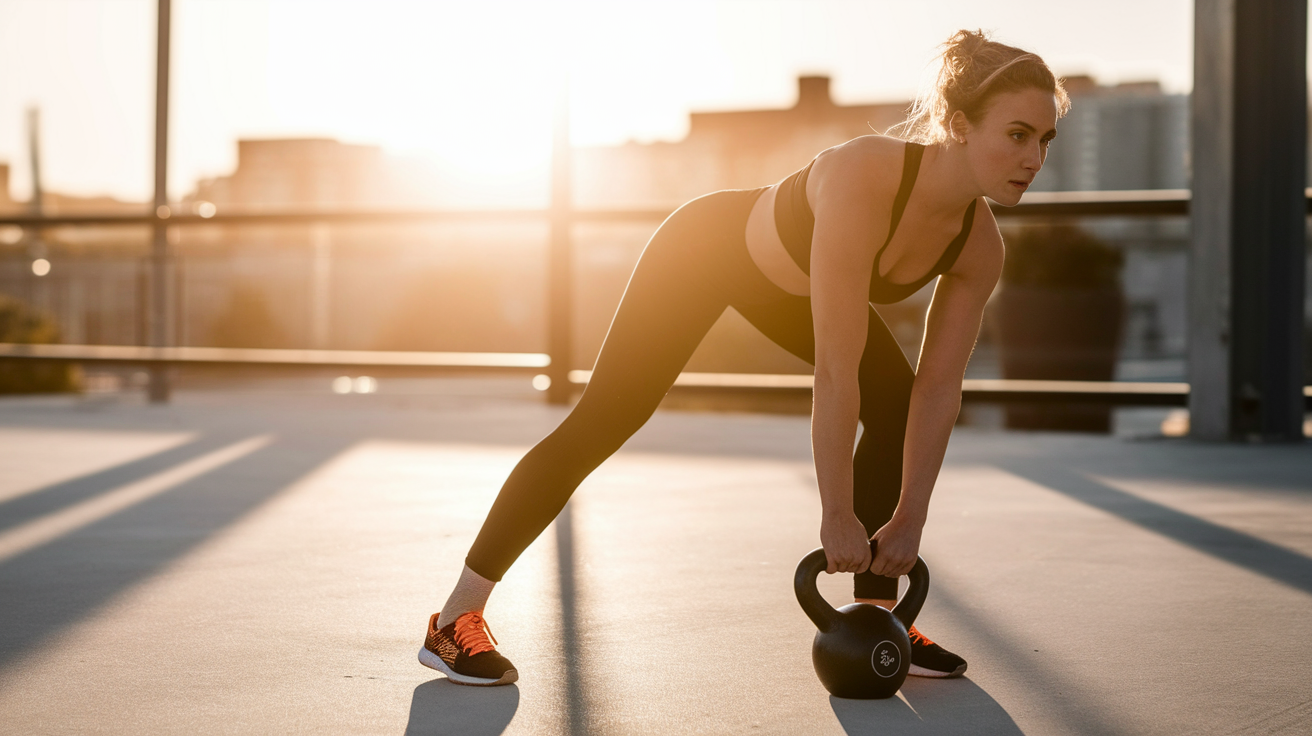
You’ve been doing squats forever, but your glutes still aren’t where you want them to be. I get it—building a strong, sculpted booty takes more than just showing up to the gym. The real game-changer? Kettlebells.
These cast-iron powerhouses deliver results that traditional exercises simply can’t match. The unique weight distribution creates explosive movements that activate your fast-twitch muscle fibers—the ones with the biggest growth potential.
Unlike dumbbells or machines, kettlebells force your glutes to work through dynamic ranges of motion that build both strength and shape.
Here’s what makes this approach so effective: kettlebell exercises combine ballistic movements with controlled tension, hitting all three glute muscles in ways that static exercises miss. You’re not just lifting weight—you’re creating power, stability, and functional strength that translates to real-world movement.
The best part? You can do these exercises anywhere. No gym membership required, no bulky equipment taking up your living room. Just one kettlebell and 20-30 minutes, three times per week.
You’ll start noticing changes in your glute strength within two weeks, and visible shape improvements by week four when you stay consistent.
This guide breaks down the five most effective kettlebell exercises for fast glute growth, complete with proper form cues, rep ranges backed by research, and a proven workout plan you can start today. Whether you’re working out at home or in the gym, these movements will transform your training and deliver the results you’ve been chasing.
Why Kettlebells Are Perfect for Building Your Glutes
The Science Behind Kettlebell Training
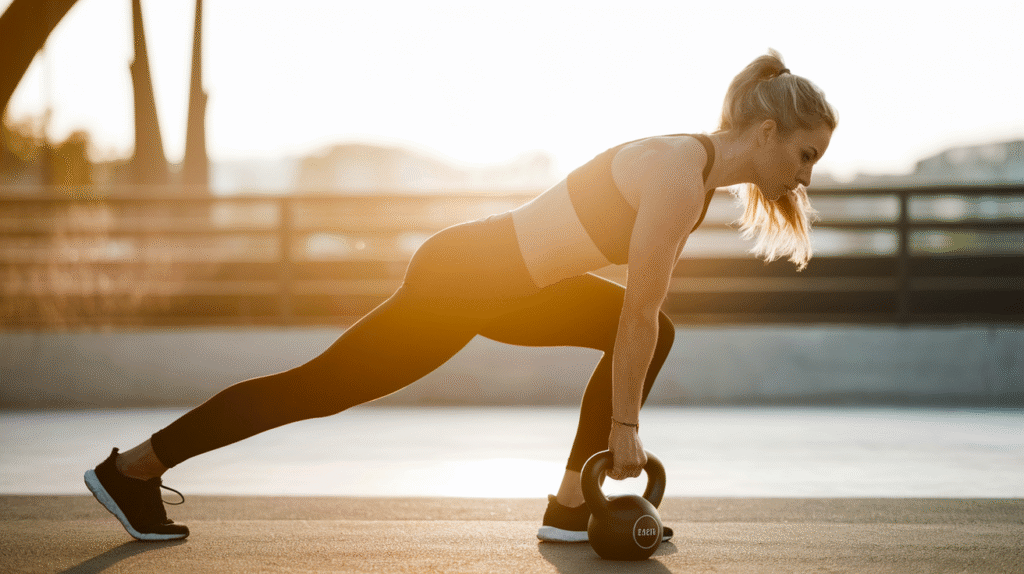
Kettlebells work differently than other equipment because of where the weight sits. The center of mass hangs below the handle, creating an offset load that your glutes must constantly stabilize. This unique design activates your fast-twitch muscle fibers—the ones responsible for explosive power and maximum growth potential.
When you perform ballistic movements like swings, your glutes fire rapidly to generate force through your hips. Research shows these explosive contractions create more muscle engagement than slow, controlled movements alone. You’re essentially teaching your glutes to produce power while building size.
The dynamic hip hinge motion—the foundation of most kettlebell exercises—targets your entire glute complex. Your gluteus maximus extends your hip, your gluteus medius stabilizes your pelvis, and your gluteus minimus controls rotation. Every swing, squat, and deadlift variation hits all three muscles simultaneously, creating complete development rather than isolated growth.
Key Benefits Over Other Equipment
Kettlebells deliver advantages that dumbbells, barbells, and machines can’t replicate. First, they’re incredibly versatile. You can perform explosive swings, controlled squats, unilateral deadlifts, and isolation exercises with the same tool. This variety keeps your muscles challenged and prevents adaptation plateaus.
The compact design makes home training realistic. One or two kettlebells take up minimal space but provide everything you need for complete glute development. No squat rack, no bench, no problem.
Kettlebells also build functional strength. The offset load challenges your core and stabilizer muscles with every rep, creating strength that carries over to daily activities. You’re not just building a better-looking booty—you’re developing power for running, jumping, lifting, and moving through life.
Time efficiency matters too. Kettlebell exercises are compound movements that work multiple muscle groups simultaneously. A 25-minute kettlebell workout delivers more glute activation than an hour of isolated machine exercises. You get better results in less time.
Understanding Your Glute Anatomy
Your glutes consist of three distinct muscles, and understanding each one helps you train smarter. The gluteus maximus is the largest muscle in your body. It extends your hip, propels you forward when running, and creates the rounded shape everyone wants. Exercises like swings and bridges target this muscle directly.
The gluteus medius sits on the outer side of your hip. It stabilizes your pelvis during single-leg movements and prevents your knee from caving inward during squats. Weak glute medius muscles lead to knee pain and poor form. Sumo squats and single-leg deadlifts strengthen this often-neglected muscle.
The gluteus minimus lies beneath the medius and assists with hip stabilization and internal rotation. While it’s the smallest of the three, it plays a crucial role in balanced development and injury prevention.
Complete glute development requires exercises that target all three muscles from multiple angles. The five exercises in this guide accomplish exactly that, ensuring you build strength, shape, and stability throughout your entire glute complex.
The 5 Best Kettlebell Exercises for Fast Glute Growth
Exercise #1: Kettlebell Swings (Two-Handed)
Why it works: Kettlebell swings are the ultimate glute builder because they train explosive hip extension—the primary function of your gluteus maximus.
The ballistic nature of swings activates fast-twitch muscle fibers that have the greatest growth potential. You’re generating power through your hips, not your arms, which forces your glutes to do the heavy lifting.
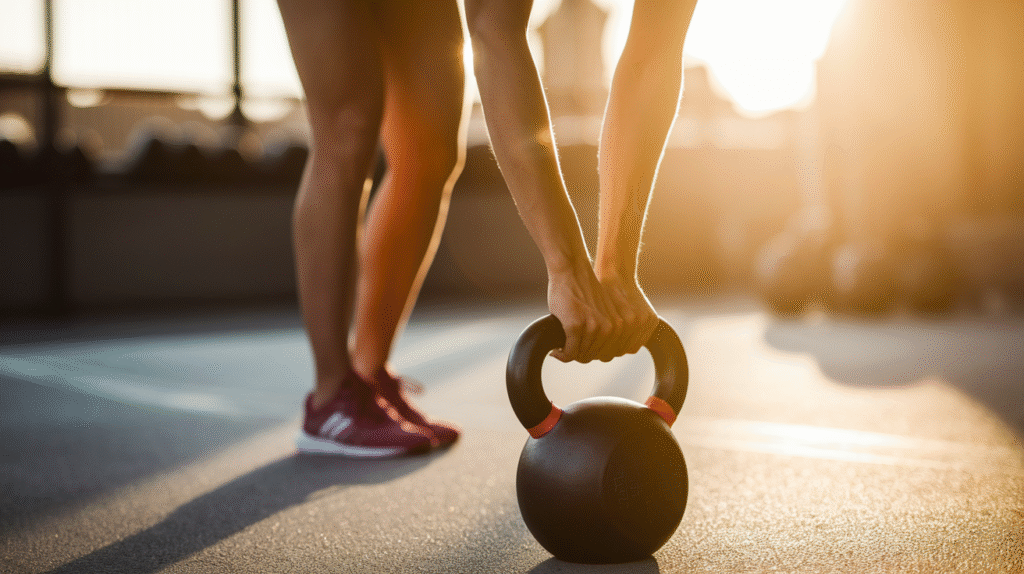
How to perform: Stand with feet shoulder-width apart, kettlebell on the floor about a foot in front of you. Hinge at your hips (not your waist), grab the kettlebell with both hands, and hike it back between your legs.
Drive your hips forward explosively, squeezing your glutes hard at the top. The kettlebell should float to chest height—you’re not lifting it with your arms. Let it swing back down, hinge at the hips again, and repeat the movement.
Pro tips: The most common mistake is squatting instead of hinging. Your knees should bend slightly, but the power comes from your hips shooting forward. Keep your core tight and your back flat throughout the movement. At the top of each swing, stand completely upright with your glutes fully contracted—don’t lean back. Your arms are just ropes connecting you to the kettlebell; your glutes generate all the force.
Reps and sets: Perform 3 sets of 15-20 swings with 60-90 seconds rest between sets. Start with a weight that allows you to maintain perfect form throughout all reps. Most beginners start with 8-12kg (18-26lbs), while intermediate lifters use 12-20kg (26-44lbs).
Exercise #2: Kettlebell Goblet Squat
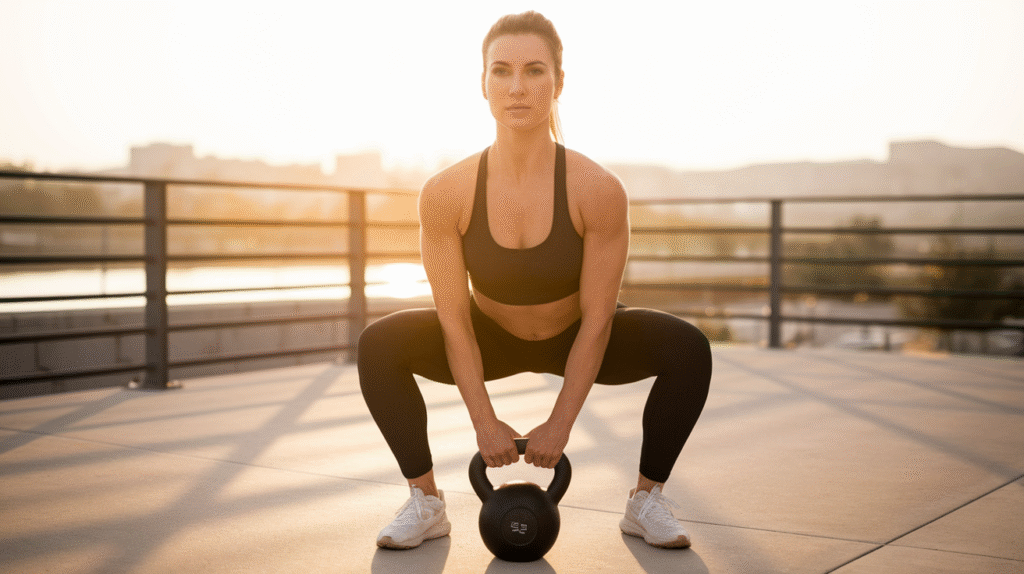
Why it works: Goblet squats place the weight in front of your body, which shifts your center of gravity and allows you to squat deeper without losing balance. Deep squats maximize gluteus maximus activation. The front-loaded position also keeps your torso upright, reducing lower back stress while increasing glute engagement. You can’t cheat this movement with momentum.
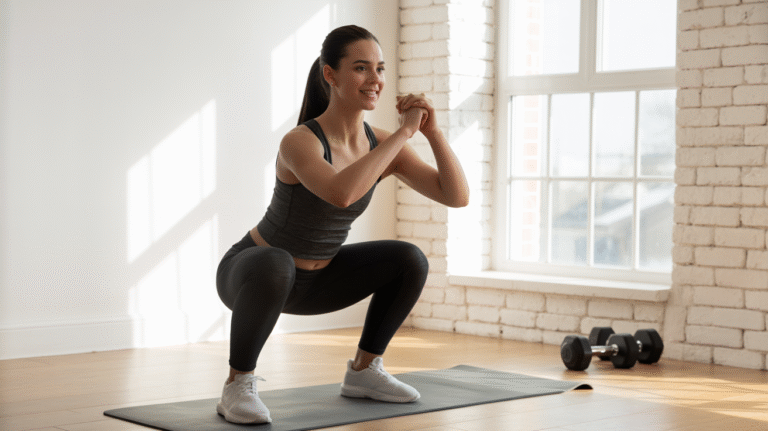
How to perform: Hold the kettlebell by the horns (the sides of the handle) at chest height, elbows pointing down. Stand with feet slightly wider than shoulder-width, toes turned out 15-30 degrees. Lower yourself by pushing your hips back and bending your knees, keeping your chest up and elbows inside your knees. Descend until your hip crease drops below your knee (or as low as your mobility allows). Drive through your heels to stand, squeezing your glutes at the top.
Pro tips: Achieving proper depth is essential for maximum glute activation. If you can’t squat deep without your heels lifting, work on ankle mobility and start with a lighter weight. Push your knees outward as you descend—they should track over your toes. The kettlebell should feel like it’s pulling you into a better squat position. Pause for one second at the bottom of each rep to eliminate momentum and increase time under tension.
Reps and sets: Complete 4 sets of 10-12 reps with 90 seconds rest between sets. This rep range balances strength development with muscle growth. Use a weight that makes the last two reps challenging but doesn’t compromise your form.
Exercise #3: Single-Leg Kettlebell Deadlift (RDL)
Why it works: Unilateral training corrects strength imbalances between your left and right glute. Most people have one side that’s stronger, which limits overall development. Single-leg deadlifts force each glute to work independently, doubling the muscle engagement compared to bilateral exercises. The balance challenge also activates your gluteus medius and minimus, creating complete development.
How to perform: Hold a kettlebell in your right hand, standing on your left leg. Slightly bend your left knee and hinge forward at the hip, extending your right leg behind you for balance. Lower the kettlebell toward the floor while keeping your back flat and your hips square to the ground. You should feel a stretch in your left hamstring and glute. Drive through your left heel to return to standing, squeezing your left glute hard at the top.
Pro tips: Balance is the biggest challenge here. Focus on a spot on the floor about six feet in front of you to maintain stability. Keep your hips level—don’t let the non-working side rotate upward. Your back leg should extend straight behind you, creating a straight line from your heel through your torso. Start with a light weight or no weight at all until you master the balance component. You can hold onto a wall or chair with your free hand initially.
Reps and sets: Perform 3 sets of 8-10 reps per leg with 60 seconds rest between sets. Always complete all reps on one leg before switching to the other. This exercise is about quality over quantity—perfect form beats heavy weight every time.
Exercise #4: Kettlebell Sumo Squat
Why it works: The wide stance of sumo squats shifts emphasis to your inner thighs and gluteus medius—the side glute muscle that creates hip width and prevents knee injuries. Most people neglect this muscle with traditional squats. Sumo squats also allow you to achieve greater depth more easily, increasing gluteus maximus activation. You’re hitting muscles that regular squats miss.
How to perform: Stand with feet wider than shoulder-width, toes pointed out 30-45 degrees. Hold the kettlebell by the handle with both hands, arms straight down. Push your hips back and bend your knees, lowering straight down while keeping your torso upright. Your knees should track over your toes. Descend until your thighs are parallel to the floor or lower. Drive through your heels to stand, squeezing your glutes and inner thighs at the top.
Pro tips: Toe angle matters significantly in sumo squats. Experiment with different angles to find what feels most natural for your hip structure. Your knees must track over your toes throughout the movement—if they cave inward, you’re either going too heavy or need to strengthen your glute medius. Keep your chest proud and your core braced. Think about pulling yourself down into the squat rather than just dropping.
Reps and sets: Complete 3 sets of 12-15 reps with 60-90 seconds rest. The higher rep range works well for sumo squats because the movement pattern allows for sustained tension without excessive lower back fatigue.
Exercise #5: Kettlebell Glute Bridge
Why it works: Glute bridges provide pure glute isolation with minimal lower back involvement. Unlike squats and deadlifts where multiple muscles contribute, bridges force your glutes to do almost all the work. The horizontal loading pattern (weight pressing down while you push up) creates constant tension throughout the entire range of motion. You’ll feel the burn immediately.
How to perform: Lie on your back with knees bent, feet flat on the floor hip-width apart. Place the kettlebell on your hips, holding it steady with both hands. Drive through your heels to lift your hips toward the ceiling, squeezing your glutes as hard as possible at the top. Your body should form a straight line from your knees through your shoulders. Hold the top position for two seconds, then lower with control. Don’t let your hips touch the floor between reps—maintain constant tension.
Pro tips: Many people feel this exercise in their hamstrings instead of their glutes. To fix this, bring your feet closer to your butt and focus on pushing through your heels, not your toes. At the top of each rep, posteriorly tilt your pelvis (flatten your lower back) and squeeze your glutes like you’re trying to crack a walnut between your cheeks. Don’t hyperextend your back by lifting too high. Progressive overload is easy with bridges—just add more weight as you get stronger.
Reps and sets: Perform 3 sets of 15-20 reps with 60 seconds rest. The higher rep range works perfectly for this isolation exercise. Focus on the mind-muscle connection—really feel your glutes working with each rep.
Your Complete Kettlebell Glute Workout Plan
Beginner-Friendly Routine (Weeks 1-4)
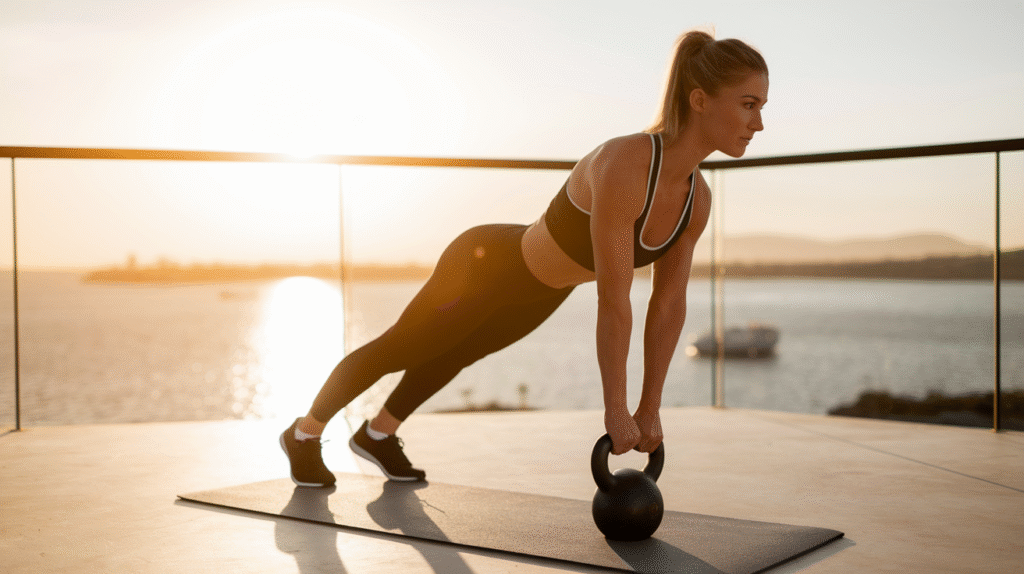
This simple 25-minute workout combines all five exercises into one effective session that delivers results. Perform this routine 2-3 times per week with at least one rest day between sessions. Your muscles grow during recovery, not during training, so don’t skip rest days.
The Workout:
- Warm-up: 5 minutes of bodyweight glute bridges, hip circles, and leg swings
- Kettlebell Swings: 3 sets of 15 reps
- Goblet Squats: 3 sets of 10 reps
- Single-Leg RDL: 3 sets of 8 reps per leg
- Sumo Squats: 3 sets of 12 reps
- Glute Bridges: 3 sets of 15 reps
- Cool-down: 5 minutes of stretching
Rest 60-90 seconds between sets. For beginners, start with an 8-12kg (18-26lb) kettlebell. If you can complete all sets with perfect form and feel like you could do 3-4 more reps, the weight is appropriate. If your form breaks down before reaching the target reps, go lighter.
Train on Monday, Wednesday, and Friday, or Tuesday, Thursday, and Saturday. This frequency allows adequate recovery while providing enough stimulus for growth. You should feel some muscle soreness after your first few workouts—that’s normal. If you’re extremely sore, take an extra rest day before your next session.
Progressive Overload Strategy
Your muscles adapt to training stress, so you must continuously challenge them to keep growing. Progressive overload means gradually increasing the demands you place on your glutes. Here’s how to implement it safely and effectively.
Week 1-2: Focus entirely on mastering form. Use the same weight for all workouts. Record yourself performing each exercise to check your technique. This foundation phase prevents injuries and ensures you’re actually targeting your glutes.
Week 3-4: Increase your reps by 2-3 per set if you can maintain perfect form. For example, if you started with 15 swings, progress to 17-18 swings per set.
Week 5-6: Increase your kettlebell weight by 2-4kg (4-8lbs). Drop back to your original rep ranges and rebuild from there.
Week 7-8: Add an extra set to each exercise (going from 3 sets to 4 sets). This increases total volume and creates new growth stimulus.
Additional progression methods include decreasing rest periods (from 90 seconds to 60 seconds), adding pause reps (holding the contracted position for 3-5 seconds), or incorporating tempo variations (lowering slowly for 3-4 seconds). You can also increase training frequency from 2 to 3 sessions per week once you’re recovering well.
Quick Tips for Maximum Results
Warm-up properly: Never skip your warm-up. Spend 5-7 minutes activating your glutes with bodyweight exercises like glute bridges, fire hydrants, and clamshells. This pre-activation ensures your glutes fire correctly during your workout rather than letting your quads and lower back take over.
Post-workout stretching: After training, stretch your hip flexors, hamstrings, and glutes for 5-10 minutes. Tight hip flexors inhibit glute activation, limiting your results. Hold each stretch for 30-60 seconds, breathing deeply to release tension.
Combine intelligently: You can perform upper body training on the same days as this glute workout, but avoid doing additional lower body exercises. Your glutes need recovery to grow. If you want to add cardio, keep it low-impact (walking, cycling, swimming) and do it on rest days or after your kettlebell session.
Nutrition basics: Your glutes are muscles, and muscles need protein to grow. Aim for 0.8-1 gram of protein per pound of bodyweight daily. Eat in a slight caloric surplus (200-300 calories above maintenance) if your goal is maximum growth. Stay hydrated—dehydration impairs muscle recovery and performance.
Track your progress: Take measurements of your glutes every two weeks and record the weights you’re using for each exercise. Progress photos from the same angle and lighting reveal changes you might miss in the mirror. Strength gains are also progress—if you’re lifting heavier weights with good form, your glutes are growing.
Common Mistakes to Avoid (And How to Fix Them)
Form Errors That Limit Your Gains
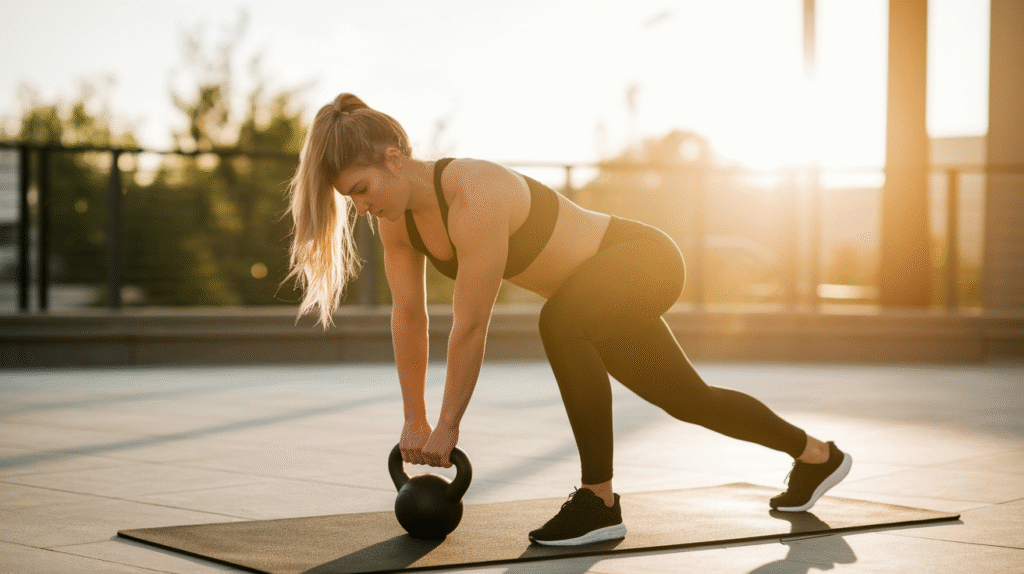
Using momentum instead of muscle control: This is especially common with kettlebell swings. People turn them into arm exercises, yanking the weight up rather than driving through their hips. Fix it by practicing the hip hinge pattern without weight first. Stand facing a wall about six inches away and practice pushing your hips back without your nose touching the wall. Once you master this, your swings will improve dramatically.
Not achieving full hip extension: Many people stop short at the top of swings, squats, and bridges, leaving gains on the table. Full hip extension with a hard glute squeeze is where growth happens. Fix it by thinking “stand tall and squeeze” at the top of every rep. Set up your phone to record your sets from the side—you’ll immediately see if you’re cutting your range of motion short.
Letting knees cave inward: Knee valgus (knees caving in) during squats and lunges indicates weak glute medius muscles and increases injury risk. Fix it by placing a resistance band around your knees during warm-ups and actively pushing your knees outward. This teaches your brain the correct movement pattern. During working sets, think “spread the floor apart” with your feet.
Rounding your back: A rounded spine during swings and deadlifts shifts stress from your glutes to your lower back, risking injury. Fix it by bracing your core like you’re about to be punched in the stomach. Keep your chest proud and your shoulder blades pulled back. If you can’t maintain a flat back with your current weight, go lighter immediately.
Training Mistakes That Slow Progress
Not allowing enough recovery: Your glutes are large muscle groups that need 48-72 hours to recover fully. Training them daily prevents growth and leads to burnout. Stick to 2-3 sessions per week with rest days in between. If you’re constantly sore or your performance is declining, you need more recovery.
Starting with inappropriate weights: Too heavy, and your form breaks down. Too light, and you don’t create enough stimulus for growth. The right weight allows you to complete all prescribed reps with perfect form while making the last 2-3 reps challenging. Your ego wants you to grab the heaviest kettlebell in the gym—don’t listen to it.
Skipping the mind-muscle connection: Going through the motions without focusing on your glutes means other muscles compensate. Before each set, touch your glutes with your hand and think about contracting them. During each rep, visualize your glutes doing the work. This conscious focus increases muscle activation by up to 25% according to research.
Inconsistent training: Working out intensely for two weeks, then taking a week off, then starting over produces minimal results. Your body needs consistent stimulus to adapt and grow. Schedule your workouts like important appointments you can’t miss. Even if you can only do 15 minutes on a busy day, that’s better than skipping entirely.
Setting Realistic Expectations
Let’s talk honestly about timelines. You won’t have a completely transformed booty in two weeks. Building muscle takes time, and anyone promising overnight results is lying to you.
Here’s what realistic progress looks like: In weeks 1-2, you’ll notice increased glute activation and improved mind-muscle connection. You’ll feel your glutes working during exercises and daily activities. Weeks 3-4 bring strength gains—you’ll lift heavier weights or complete more reps. Around week 4-6, you’ll see initial shape changes in progress photos, though they might not be obvious in the mirror yet.
By weeks 8-12, visible changes become clear. Your glutes will look rounder and feel firmer. Your clothes will fit differently. People might start commenting on your progress. After 12+ weeks of consistent training, you’ll have significant development that’s obvious to everyone, including yourself.
Consistency matters infinitely more than intensity. Three moderate workouts per week for three months beats seven intense workouts for two weeks followed by burnout. Show up regularly, follow progressive overload principles, and trust the process.
Track more than just appearance. Measure your strength gains—are you swinging a heavier kettlebell? Completing more reps? That’s progress. Take measurements around your glutes every two weeks. Sometimes the tape measure shows changes before the mirror does. Notice functional improvements too—climbing stairs feels easier, your running stride feels more powerful, your posture improves.
Your Path to Amazing Glutes Starts Now
You now have everything you need to build strong, sculpted glutes with just a kettlebell and these five proven exercises. The science is clear: kettlebell training activates your fast-twitch muscle fibers, targets all three glute muscles, and delivers results faster than traditional methods when you stay consistent.
These exercises work because they combine explosive power movements with controlled strength training. Kettlebell swings build explosive hip power. Goblet squats and sumo squats develop your gluteus maximus and medius through deep ranges of motion. Single-leg deadlifts correct imbalances while challenging your stability. Glute bridges provide pure isolation that creates serious muscle activation.
The simple truth is this: consistency plus proper form equals results you’ll love. You don’t need fancy equipment, expensive gym memberships, or complicated routines. You need one kettlebell, 25 minutes, and the commitment to show up 2-3 times per week.
Start with the beginner-friendly routine outlined in this guide. Focus on mastering your form during weeks 1-2 before worrying about weight or reps. Film yourself performing each exercise to check your technique. When you can complete all sets with perfect form, implement progressive overload by adding reps, sets, or weight.
Remember that building muscle requires more than just training. Fuel your body with adequate protein, stay hydrated, and prioritize recovery. Your glutes grow during rest days, not during workouts. Sleep 7-9 hours per night, manage your stress, and be patient with the process.
Avoid the common mistakes that derail most people: using momentum instead of muscle control, skipping full range of motion, training without adequate recovery, and expecting overnight transformations. Focus on what you can control—showing up consistently, following the program, and gradually increasing your training demands.
Your action plan is straightforward: grab a kettlebell, start with 2 sessions this week, and commit to the process for at least 8-12 weeks. Take before photos and measurements today so you can track your progress accurately. Mark your training days on your calendar and treat them as non-negotiable appointments with yourself.
The glutes you want are absolutely achievable. Thousands of people have transformed their lower body with these exact exercises. The only question is whether you’ll be one of them. Your journey to stronger, more sculpted glutes starts with your first workout. Stop waiting for the perfect time, the perfect equipment, or the perfect circumstances. Everything you need is in this guide.
Pick up that kettlebell and swing your way to the results you deserve. Your future self will thank you for starting today.