4 Best Kettlebell Legs & Glutes Workout Guide
You’re tired of waiting for the squat rack. You’re done with overpriced gym memberships that eat into your budget while you barely find time to use them. And honestly? You’re frustrated with complicated workout programs that require a dozen different machines just to train your legs effectively.
Here’s the truth: You don’t need any of that to build strong, sculpted legs and glutes that turn heads.
One simple tool changes everything—the kettlebell. This cast-iron powerhouse delivers proven results without the gym drama, equipment confusion, or time-consuming routines. Whether you’re working out in your living room during your lunch break or squeezing in a session while your kids nap, kettlebells meet you where you are.
In this guide, you’ll discover the most effective kettlebell exercises that specifically target your legs and glutes. We’re talking compound movements that work multiple muscle groups simultaneously, torch calories, and build the functional strength you actually use in real life. You’ll get complete workout plans for every fitness level, from absolute beginner to advanced athlete ready to break through plateaus.
Let’s set realistic expectations right now: You won’t wake up tomorrow with completely different legs. What you will get is a science-backed approach that delivers visible results when you show up consistently. No gimmicks. No false promises. Just proven exercises and strategies that work when you put in the effort.
The best part? You can start today with just one kettlebell and 20-30 minutes of focused work. Your transformation begins the moment you decide you’re worth the investment.
Why Kettlebells Are Perfect for Legs & Glutes Training

The Science Behind Kettlebell Effectiveness

Kettlebells aren’t just another fitness trend—they’re biomechanical powerhouses backed by solid research. The offset center of gravity creates unique challenges that traditional dumbbells and barbells simply can’t replicate.
When you hold a kettlebell, your body constantly works to stabilize the shifting weight. This activates smaller stabilizer muscles throughout your legs, glutes, and core that often get neglected with machine-based training. The result? More complete muscle development and significantly higher calorie burn during and after your workout.
Kettlebell exercises are compound movements by nature. A single goblet squat doesn’t just work your quads—it simultaneously engages your glutes, hamstrings, core, and even your upper back. You’re training movement patterns, not isolated muscles. This approach mirrors how your body actually functions in daily life, building strength that translates beyond the gym.
Research shows that kettlebell training uniquely combines strength and cardiovascular conditioning. Your heart rate stays elevated throughout the workout while your muscles handle serious resistance. You’re essentially getting two workouts in one, which explains why 20 minutes with a kettlebell can feel more effective than an hour on various gym machines.
Perfect for Your Lifestyle (No Matter How Busy)

Space is the enemy of home workouts—until you discover kettlebells. You need roughly the same floor space as a yoga mat. No squat rack taking over your spare bedroom. No bench press setup dominating your garage. One kettlebell stored in a corner, and you’re ready to train whenever life allows.
Time efficiency becomes your competitive advantage. Those 20-30 minute sessions deliver powerful results because every movement counts. You’re not walking between machines, adjusting seats, or waiting for equipment. You pick up your kettlebell and work. The intensity makes up for the brevity, and your busy schedule suddenly has room for consistent training.
This versatility eliminates excuses. Traveling for work? Pack a light kettlebell or find one at your hotel gym. Kids home sick? Train in your living room while they rest. Weather terrible? No problem—you’re already inside. The kettlebell adapts to your life instead of forcing your life to adapt to a gym schedule.
Results You Can Expect

Let’s talk about what actually happens when you commit to kettlebell training for your legs and glutes. Within the first month, you’ll notice improved muscle tone and definition. Your jeans fit differently. Your glutes sit higher. Your quads show more shape. These aren’t dramatic transformations yet, but they’re real, visible changes.
Functional strength improves faster than you expect. Climbing stairs becomes easier. Picking up heavy objects feels natural. Playing with your kids doesn’t leave you sore for days. This practical strength matters more than numbers on a weight plate.
The metabolic benefits extend well beyond your workout. Kettlebell training, especially with lower body exercises, creates an “afterburn effect” where your body continues burning extra calories for hours post-workout. You’re building muscle that increases your resting metabolic rate, meaning you burn more calories even while sitting at your desk.
Consistency over 8-12 weeks produces transformation-level results. We’re talking sculpted glutes, defined hamstrings, and powerful quads that look as strong as they are. But here’s the key: you must show up. The kettlebell delivers results, but only when you consistently do the work.
Essential Kettlebell Exercises to Build Powerful Legs & Glutes

Kettlebell Goblet Squats

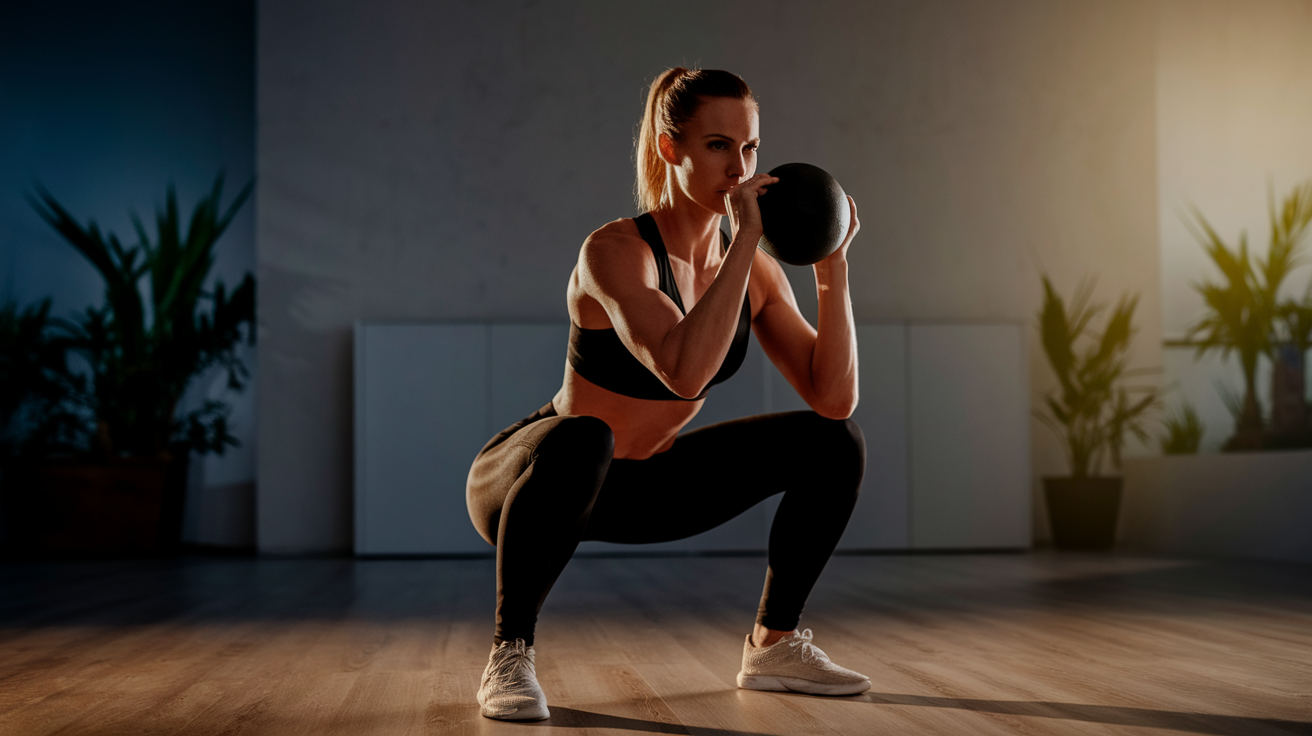
The goblet squat is your foundation movement—master this, and everything else becomes easier. Hold the kettlebell at chest height with both hands cupping the bell (not the handle). Your elbows point down, and the weight stays close to your body throughout the entire movement.
Start with feet slightly wider than hip-width, toes pointed slightly outward. Initiate the descent by pushing your hips back and bending your knees simultaneously. Keep your chest proud and your core braced tight. Descend until your elbows touch the inside of your knees—this depth ensures full glute and quad activation.
The most common mistake? Letting your knees cave inward. Fight this by actively pushing your knees outward throughout the movement, keeping them aligned with your toes. Another error: rounding your upper back. The weight pulls you forward, so consciously maintain that proud chest position.
Beginners start with a lighter weight (8-12 kg) and focus on perfect form for 3 sets of 10 reps. Intermediate lifters increase weight (16-20 kg) and add tempo variations—try a 3-second descent for intensity. Advanced athletes can perform goblet squats with a pause at the bottom (24+ kg), holding for 2-3 seconds before exploding upward.
Kettlebell Deadlifts (Romanian & Sumo)
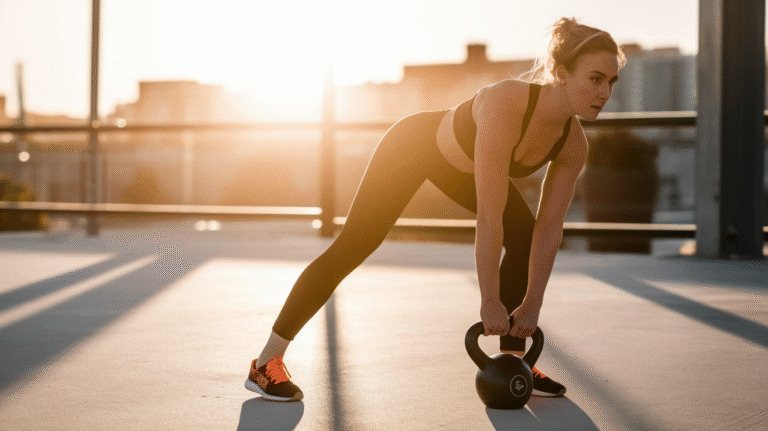
Romanian deadlifts with a kettlebell specifically target your hamstrings and glutes while teaching the crucial hip hinge pattern. Hold the kettlebell with both hands in front of your thighs. Maintain a slight knee bend throughout—this isn’t a stiff-legged deadlift.
Push your hips back as if closing a car door with your butt. The kettlebell travels straight down, staying close to your legs. You should feel a deep stretch in your hamstrings. Once you reach the bottom of your range (kettlebell roughly at mid-shin), drive your hips forward powerfully to return to standing.
Sumo deadlifts shift emphasis to your inner thighs and glutes. Take a wide stance with toes pointed outward at 45 degrees. Place the kettlebell on the ground between your feet. Squat down to grab the handle, keeping your chest up and back flat. Drive through your heels, engaging your glutes to pull the weight up as you stand tall.
Weight selection matters for safety and results. If you can’t maintain a flat back throughout the movement, the weight is too heavy. Start conservative—12-16 kg for beginners, 20-24 kg for intermediate lifters. Your lower back should feel worked but never strained or painful.
Kettlebell Lunges & Bulgarian Split Squats
Unilateral training (working one leg at a time) fixes strength imbalances and develops balanced, proportional legs. Forward lunges with a kettlebell in the goblet position challenge your balance while sculpting your quads and glutes.
Step forward with one leg, lowering your back knee toward the ground. Your front shin should stay relatively vertical—if your knee shoots forward past your toes, take a longer stride. Push through your front heel to return to standing. The kettlebell’s weight makes this significantly harder than bodyweight lunges, forcing greater muscle activation.
Bulgarian split squats take intensity to another level. Elevate your rear foot on a bench or chair (12-18 inches high). Hold the kettlebell in goblet position or let it hang at your side. Lower your back knee toward the ground while keeping your torso upright. This exercise absolutely torches your glutes and quads.
Balance challenges are normal—you’re building stabilizer strength. Start near a wall for support if needed. As you improve, the wobbling decreases and the muscle burn increases. That’s progress.
Progressive variations keep results coming. Begin with bodyweight to learn the pattern, add a light kettlebell (8-12 kg), increase weight over time, then try holding a kettlebell in each hand for advanced difficulty.
Kettlebell Swings
Kettlebell swings are the ultimate exercise to shred fat while building explosive power in your posterior chain (glutes, hamstrings, lower back). This movement looks simple but requires precise technique for maximum effectiveness and safety.
The swing is a hip hinge, not a squat. Stand with feet hip-width apart, kettlebell on the ground slightly in front of you. Hinge at your hips to grab the handle with both hands. Hike the kettlebell back between your legs like you’re snapping a football, keeping your back flat and core tight.
Explosively drive your hips forward, squeezing your glutes hard. This hip thrust propels the kettlebell forward and up—your arms are just ropes connecting your body to the weight. The kettlebell should float to roughly chest height (no higher). Let gravity bring it back down, hinging at your hips to absorb the momentum, then immediately drive your hips forward again for the next rep.
You’re doing it correctly when: you feel it primarily in your glutes and hamstrings (not your lower back or shoulders), you hear a “whoosh” sound as the kettlebell cuts through the air, and you can maintain the rhythm for 30+ seconds without breaking form.
Start with 15-20 reps for 3-4 sets, resting 60 seconds between sets. As conditioning improves, increase to 30-40 rep sets or extend the work period to 45-60 seconds. Swings build incredible endurance alongside strength.
Kettlebell Step-Ups & Single-Leg Deadlifts
Step-ups with a kettlebell sculpt your glutes while improving functional strength for stairs and hills. Find a box or bench that puts your thigh parallel to the ground when your foot is on top (usually 16-20 inches). Hold the kettlebell in goblet position or at your sides.
Place one foot completely on the box—your entire foot, not just your toes. Drive through that heel to step up, bringing your other foot to meet it. Step back down with control. The key: don’t push off with your bottom foot. Make the elevated leg do all the work.
Single-leg deadlifts challenge your balance while targeting your hamstrings and glutes with surgical precision. Hold the kettlebell in your right hand. Stand on your left leg with a slight knee bend. Hinge at your hip, extending your right leg behind you as you lower the kettlebell toward the ground. Your body forms a “T” shape at the bottom.
These exercises expose weaknesses. Your dominant leg is probably stronger—that’s normal. Perform the same reps on both sides, and over time, the weaker side catches up. This balanced development prevents injury and creates symmetrical, aesthetic legs.
Modifications make these accessible. Can’t balance during single-leg deadlifts? Lightly touch your back toe to the ground for stability. Step-ups too high? Use a lower platform and progress gradually. Meet yourself where you are, then improve consistently.
Your Complete Kettlebell Legs & Glutes Workout Plan
Beginner-Friendly Routine (Weeks 1-4)
Your first month focuses on building perfect form and establishing consistency. Train 2-3 times per week with at least one rest day between sessions. Your body needs recovery time to adapt and grow stronger.
Workout Structure:
- Goblet Squats: 3 sets of 10 reps
- Romanian Deadlifts: 3 sets of 8 reps
- Forward Lunges: 2 sets of 8 reps per leg
- Kettlebell Swings: 3 sets of 15 reps
- Rest: 60-90 seconds between sets
Start with a weight that feels challenging but allows perfect form. For most beginners, that’s 8-12 kg for women, 12-16 kg for men. If you can’t complete all reps with good form, the weight is too heavy. Pride doesn’t build muscle—consistency does.
Progression happens every week. Week 1: focus entirely on form, even if it feels easy. Week 2: if form stays solid, add 1-2 reps per set. Week 3: add another set to each exercise. Week 4: consider increasing weight by 2-4 kg if you’ve mastered the movements.
Track everything. Write down the weight used, reps completed, and how you felt. This data guides your progression decisions and keeps you accountable.
Intermediate Intensity Plan (Weeks 5-8)
You’ve built a foundation—now we increase complexity and volume. Continue training 3 times per week, but the workouts get more challenging.
Workout Structure:
- Goblet Squats: 4 sets of 12 reps (add 3-second pause at bottom on last set)
- Sumo Deadlifts: 4 sets of 10 reps
- Bulgarian Split Squats: 3 sets of 10 reps per leg
- Kettlebell Swings: 4 sets of 30 reps
- Step-Ups: 3 sets of 12 reps per leg
Tempo changes intensify exercises without adding weight. Try a 3-second descent on squats, or hold the bottom position for 2 seconds before driving up. This “time under tension” creates serious muscle growth stimulus.
Your weight should increase by 4-8 kg from beginner levels (16-20 kg for women, 20-24 kg for men). Some exercises might require different weights—that’s fine. Use heavier weight for deadlifts and swings, lighter for Bulgarian split squats.
Recovery becomes crucial at this intensity. You’re creating more muscle damage (the good kind that leads to growth), so your body needs adequate rest. Sleep 7-8 hours nightly. Eat enough protein. Take your rest days seriously—muscle grows during recovery, not during workouts.
Advanced Transformation Protocol
This level demands commitment and proper recovery. You’re pushing boundaries, so listen to your body and adjust when needed.
Workout Structure (3-4 times per week):
- Goblet Squats (tempo: 3-1-3): 4 sets of 10 reps
- Single-Leg Deadlifts: 4 sets of 8 reps per leg
- Bulgarian Split Squats: 4 sets of 12 reps per leg
- Kettlebell Swings (EMOM style): 10 minutes, 20 reps per minute
- Combination: Swing into Goblet Squat: 3 sets of 10 combos
High-intensity techniques break plateaus. EMOM (every minute on the minute) swings mean you perform 20 swings at the start of each minute, resting for whatever time remains. This interval approach torches fat while building endurance.
Combination exercises link movements together. Perform a swing, catch the kettlebell in goblet position at the top, immediately drop into a squat, then stand and swing again. One rep = swing + squat. These complexes elevate your heart rate and maximize efficiency.
Progressive overload at this level means increasing density (more work in less time), adding weight (24-32 kg becomes standard), or incorporating more challenging variations. You might hold two kettlebells, extend pause times, or add explosive jumps to movements.
Maximizing Your Results: Form, Recovery & Nutrition
Perfect Your Form for Safety & Effectiveness
Form isn’t just about injury prevention—it’s the difference between mediocre results and transformation. Every rep performed with sloppy technique is a wasted opportunity.
The most critical form points: keep your spine neutral (no excessive rounding or arching), brace your core before every rep (imagine someone’s about to punch your stomach), and breathe properly (inhale during the easier portion, exhale during exertion).
Self-assess your technique by recording videos of your workouts. Watch them with a critical eye. Does your back round during deadlifts? Do your knees cave during squats? Seeing yourself reveals issues you can’t feel in the moment.
When should you decrease weight? Always choose lighter weight over compromised form. If your back rounds, knees cave, or you can’t complete the full range of motion, drop down. Building proper movement patterns with lighter weight creates a foundation for handling heavier loads safely later.
Consider occasional form checks with a qualified trainer, even if you primarily train at home. One session every few months can catch developing bad habits before they become ingrained.
Recovery Strategies That Accelerate Progress
Rest days aren’t optional—they’re when your body actually builds the muscle you’re working for. Training breaks down muscle tissue. Recovery rebuilds it stronger. Skip recovery, and you’re just breaking down without building up.
Active recovery beats complete inactivity. On rest days, go for a walk, do gentle yoga, or perform light mobility work. Movement increases blood flow to sore muscles, accelerating repair without adding training stress.
Simple mobility work makes a massive difference. Spend 10 minutes after workouts or on rest days performing hip circles, leg swings, deep bodyweight squats, and hamstring stretches. This reduces soreness, improves your range of motion, and enhances performance in your next workout.
Sleep is non-negotiable for results. During deep sleep, your body releases growth hormone and repairs muscle tissue. Aim for 7-8 hours nightly. If you’re training hard but sleeping poorly, you’re sabotaging your own progress.
Stress management impacts your physical results more than most people realize. Chronic stress elevates cortisol, which hinders muscle growth and promotes fat storage—especially around your midsection. Find stress-reduction practices that work for you: meditation, nature walks, reading, whatever helps you decompress.
Nutrition Basics to Support Your Goals
You can’t out-train a terrible diet, but you also don’t need a restrictive meal plan to see results. Simple, sustainable nutrition habits support your kettlebell training without making your life miserable.
Protein requirements for muscle building: aim for 0.7-1 gram per pound of body weight daily. If you weigh 150 pounds, that’s 105-150 grams of protein. This supports muscle repair and growth. Good sources include chicken, fish, eggs, Greek yogurt, legumes, and protein powder if needed.
Fuel your workouts properly. Eat a small meal with carbs and protein 1-2 hours before training (like oatmeal with protein powder or a banana with peanut butter). This provides energy for intense work. Post-workout, consume protein within 2 hours to support recovery.
The realistic eating approach: focus on whole foods most of the time (lean proteins, vegetables, fruits, whole grains, healthy fats), but don’t eliminate foods you love. An 80/20 approach works—nutritious choices 80% of the time, flexibility 20% of the time. This sustainability prevents the binge-restrict cycle that derails progress.
No extreme diets required. You don’t need keto, intermittent fasting, or juice cleanses to build great legs and glutes. Consistent, moderate nutrition paired with consistent training delivers results. The best diet is the one you can maintain long-term while enjoying your life.
Conclusion
Kettlebell training transforms your legs and glutes through proven, science-backed movements that work. You’ve learned the essential exercises, received complete workout plans for every level, and discovered the recovery and nutrition strategies that accelerate results.
The powerful truth: effective workouts don’t require expensive gym memberships, complicated equipment, or hours of your time. One kettlebell, 20-30 minutes, and consistent effort build the strong, sculpted lower body you want. This simplicity removes barriers and eliminates excuses.
Results come from action, not perfection. You’ll miss workouts sometimes. You’ll have off days where the weight feels heavier than usual. You’ll face setbacks. None of that matters if you keep showing up. Consistency over time beats intensity in isolated bursts every single time.
Your next steps are clear: Choose your starting point based on your current fitness level. Get one kettlebell in the appropriate weight range (start lighter than you think you need). Schedule your first workout for this week—not “someday,” but a specific day and time. Then show up and do the work.
You have everything you need to transform your lower body on your terms, in your space, on your schedule. The kettlebell doesn’t care about your past fitness failures or current limitations. It simply responds to consistent effort with undeniable results.
Your transformation starts now. Pick up that kettlebell and prove to yourself what you’re capable of building.